
A complete issue · 32 pages · 1903
Life — July 2, 1903
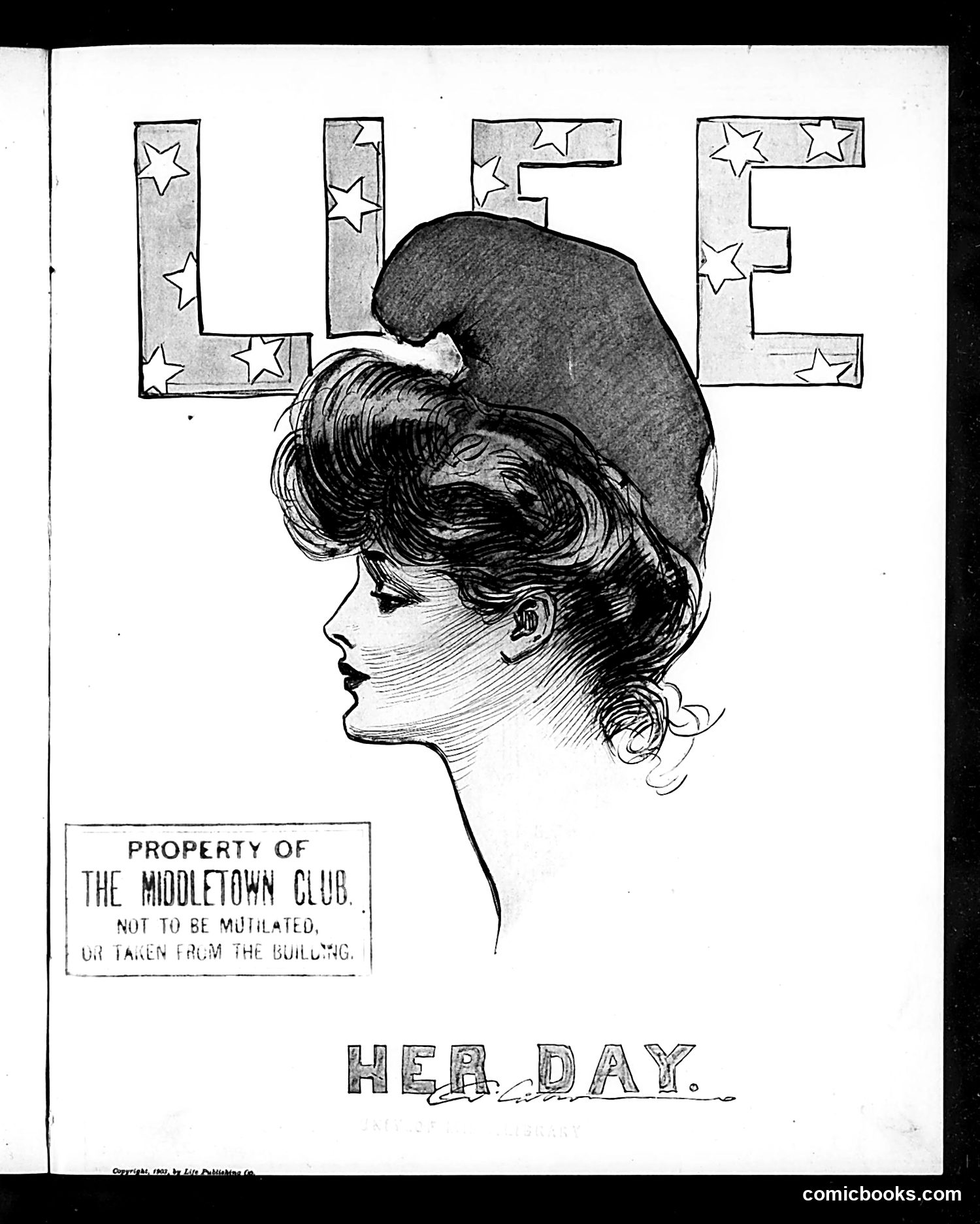
This appears to be a cover or advertisement for "Life" magazine, featuring a stylized profile of a woman wearing a tall, elaborate hat decorated with stars. The hat design cleverly incorporates the word "LIFE" into its letter forms, with stars scattered throughout—likely referencing American patriotism or national themes. The stamp indicates this belonged to "The Middletown Club" and was not to be removed from the building, suggesting this was a library or club copy. The caption reads "HER DAY," though the specific satirical point remains unclear without additional context. It may reference women's roles, fashion trends, or social commentary typical of early 20th-century Life magazine's humor, but the exact reference cannot be definitively identified from the image alone.
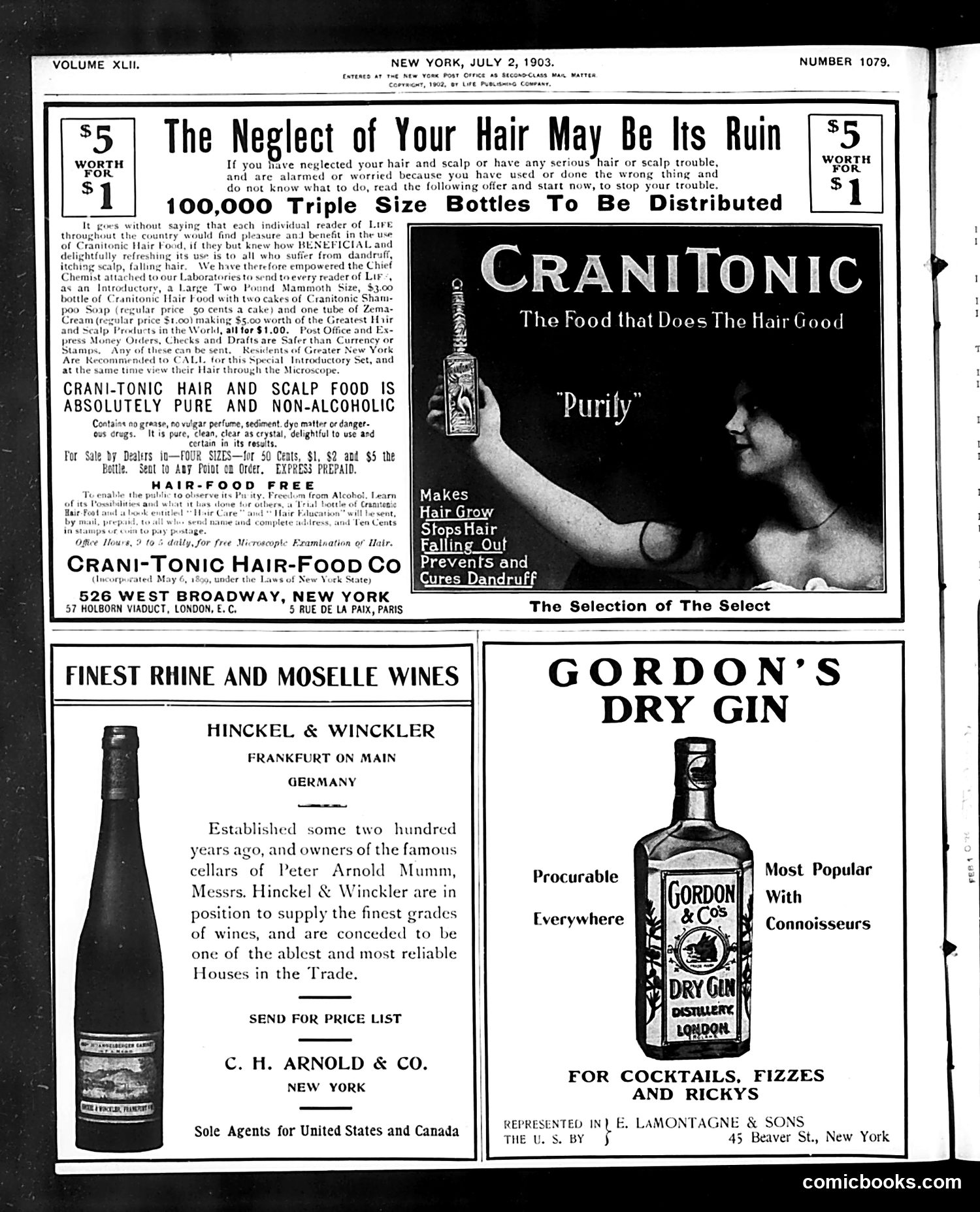
This page contains primarily **advertisements rather than satirical content**. The main advertiser is Crani-Tonic Hair Food, which promises to make hair grow, stop hair loss, and cure dandruff. The ad claims the product is "pure and non-alcoholic" and offers 100,000 "triple size bottles" for distribution. The other advertisements promote Hinckkel & Winckler wines (German Rhine and Moselle) and Gordon's Dry Gin. There is **no political cartoon or satirical commentary** on this particular page. It represents typical early 1900s magazine advertising, with health/beauty and alcohol products prominently featured—products that would face regulatory scrutiny within the following decades.
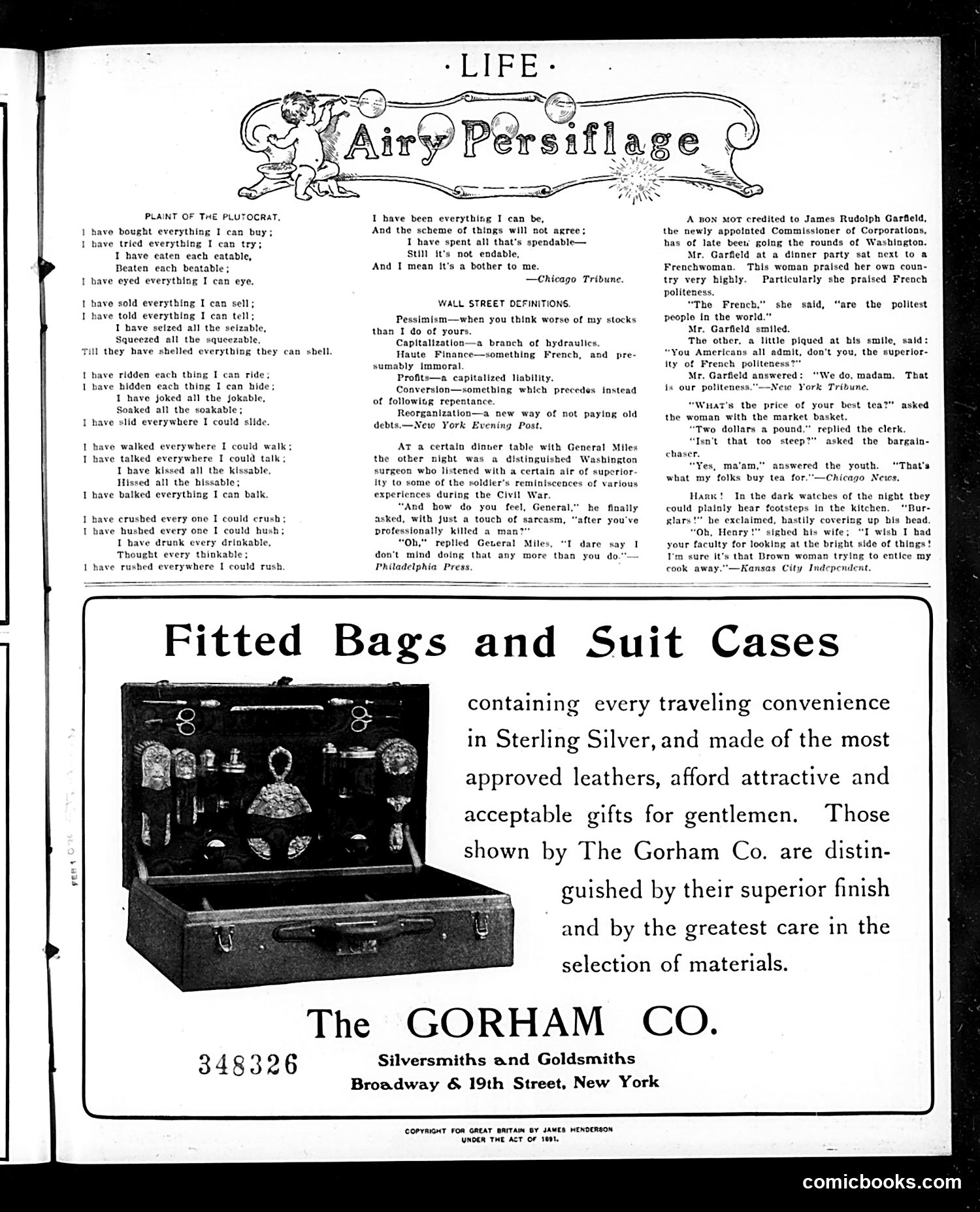
This page consists primarily of **advertising** for The Gorham Company's luxury fitted bags and suit cases, rather than political satire. The upper portion contains **"Airy Persiflage"** — a humor column mixing brief jokes and quotes. Notable content includes: - A **Wall Street Definitions** section satirizing financial terminology (pessimism, capitalism, insider trading concepts) - A **James Rudolph Garfield anecdote** (likely the Progressive-era politician/Secretary of the Interior) mocking Washington society and French politeness - Various brief jokes about tea prices, Civil War generals, and household matters The humor is **lighthearted and domestic** rather than targeting specific political figures or events. The column represents Life's characteristic gentle satire of everyday American life, financial pretension, and social conventions of the early 20th century.
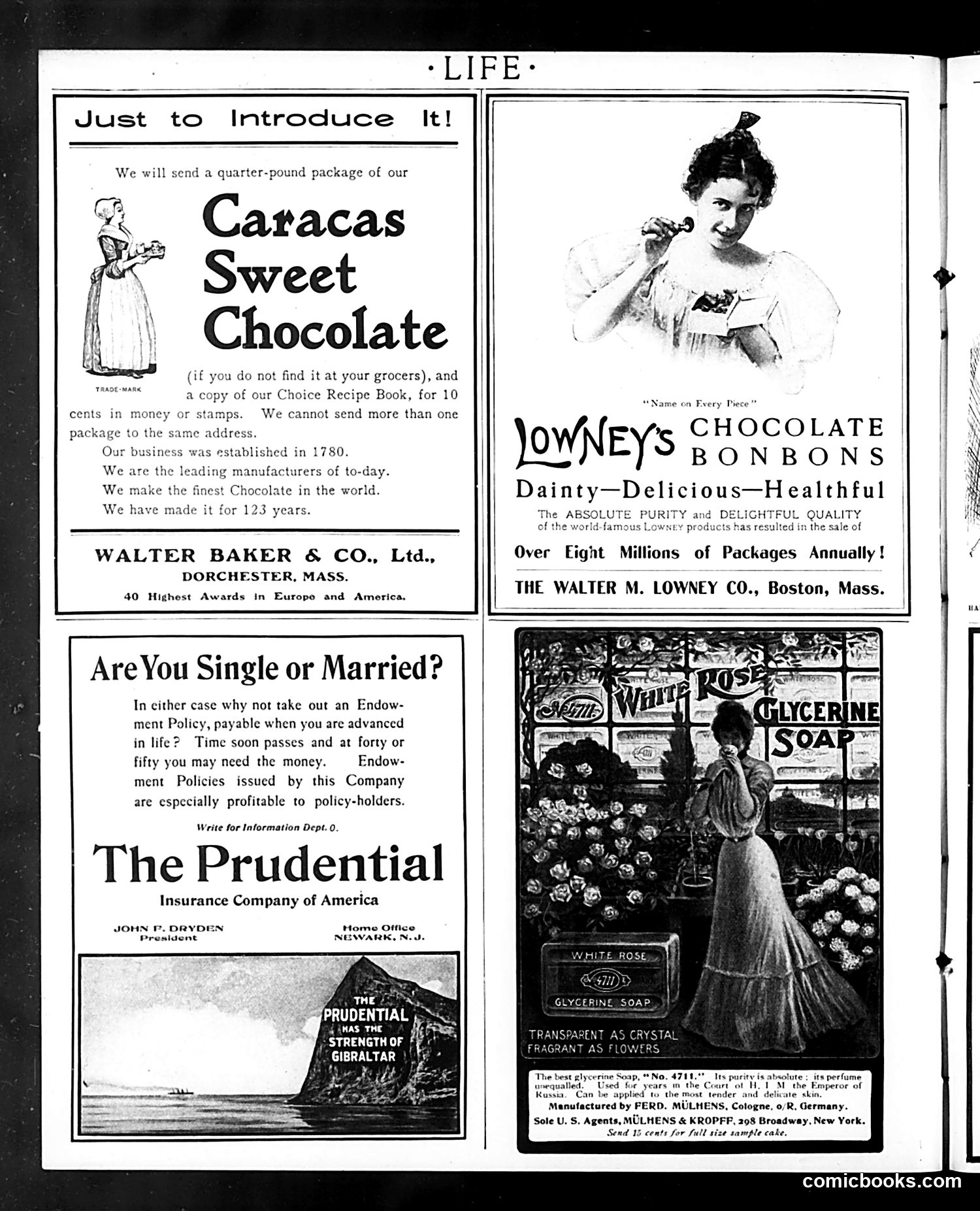
This page is **primarily advertising**, not satirical content. It contains four commercial advertisements from the early 20th century: 1. **Walter Baker & Co.** promotes Caracas Sweet Chocolate, emphasizing their 123-year history and quality. 2. **Lowney's Chocolate Bonbons** features a woman in period dress, marketing their product as "Dainty—Delicious—Healthful" with claims of selling over eight million packages annually. 3. **The Prudential Insurance Company** uses a Gibraltar rock image as a metaphor for strength and stability, appealing to both single and married readers about endowment policies. 4. **White Rose Glycerine Soap** shows a store display scene, emphasizing purity and fragrance. The advertisements reflect early 1900s consumer culture and marketing strategies targeting middle-class Americans.
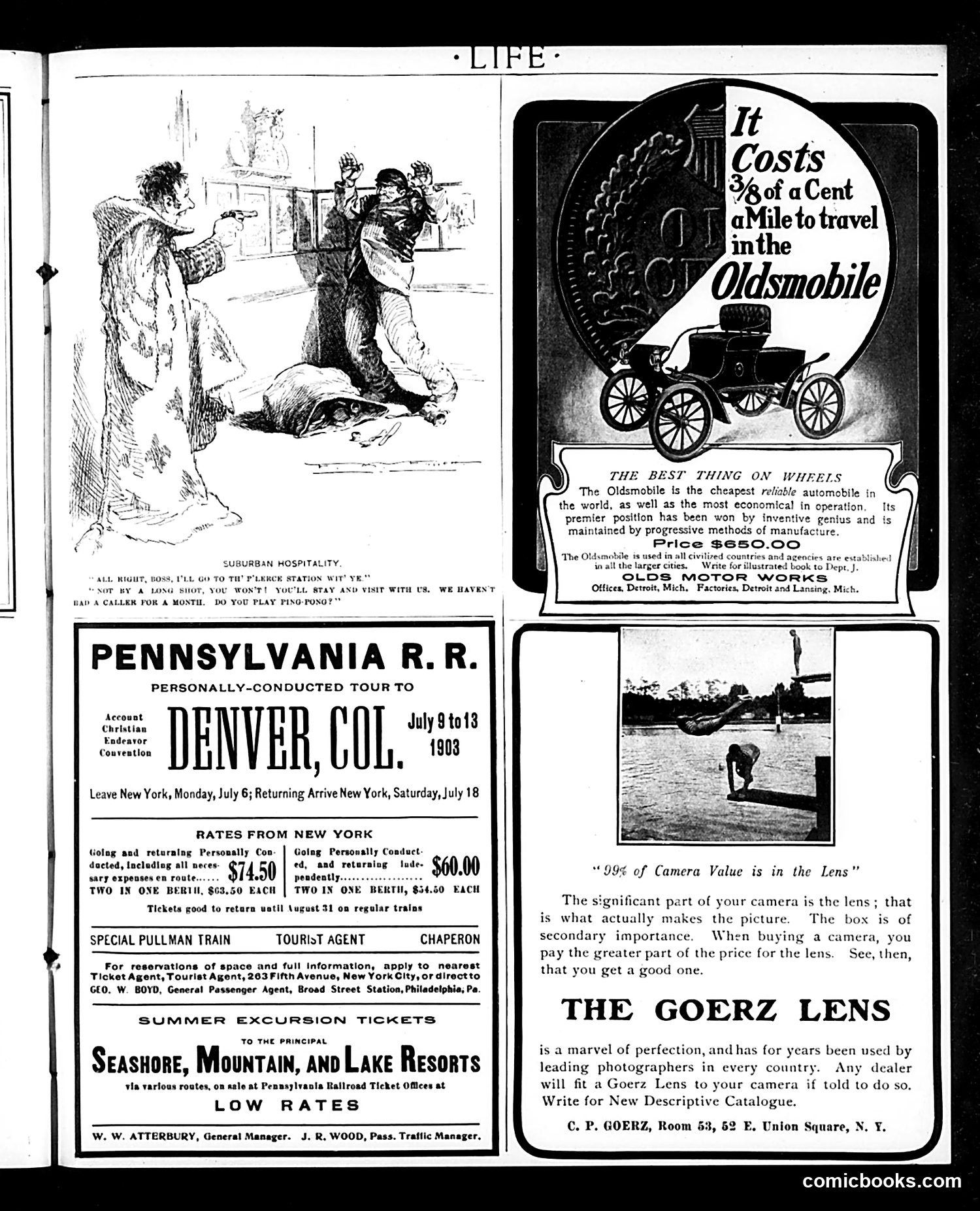
This page is primarily **advertisements** rather than satirical content. The main cartoon titled "Suburban Hospitality" (upper left) depicts a social scene with figures in period dress, though its specific satirical meaning is unclear from the image alone. The advertisements include: - **Oldsmobile**: Emphasizes affordability (⅜ cent per mile) and reliability - **Pennsylvania R.R.**: Promotes a Denver excursion tour for July 1903 - **Goerz Lens**: Camera equipment advertisement highlighting lens quality The page reflects early 1900s commercial culture: automobile marketing emphasizing economy, railroad tourism, and photography equipment. These ads suggest Life's audience was middle-to-upper-class Americans with disposable income for travel and technology.
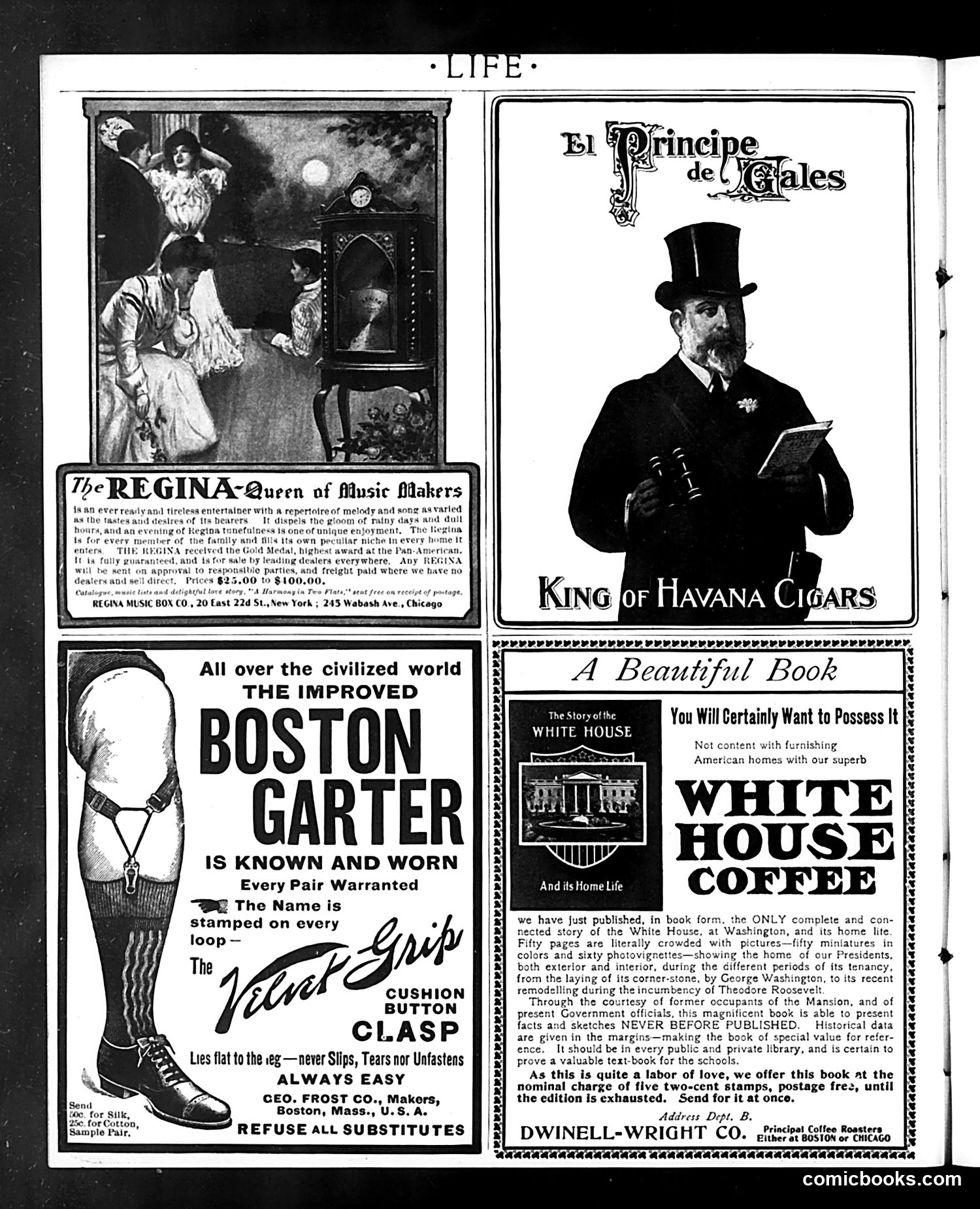
This page is primarily **advertising**, not political satire. It contains four product advertisements from the early 20th century: 1. **The Regina Music Box** - marketed as timeless home entertainment 2. **El Príncipe de Gales Cigars** - "King of Havana Cigars" (featuring a gentleman in formal dress) 3. **Boston Garter** - hosiery for men, emphasizing durability and comfort 4. **White House Coffee** - promoting a book about the actual White House's "home life" The page reflects the era's consumer culture and advertising aesthetics. The only potentially satirical element is the Regina ad's claim that the music box dispels "gloom of rainy days" — typical period marketing hyperbole. Otherwise, this represents straightforward commercial promotion in *Life* magazine, which relied heavily on advertising revenue alongside its editorial content.
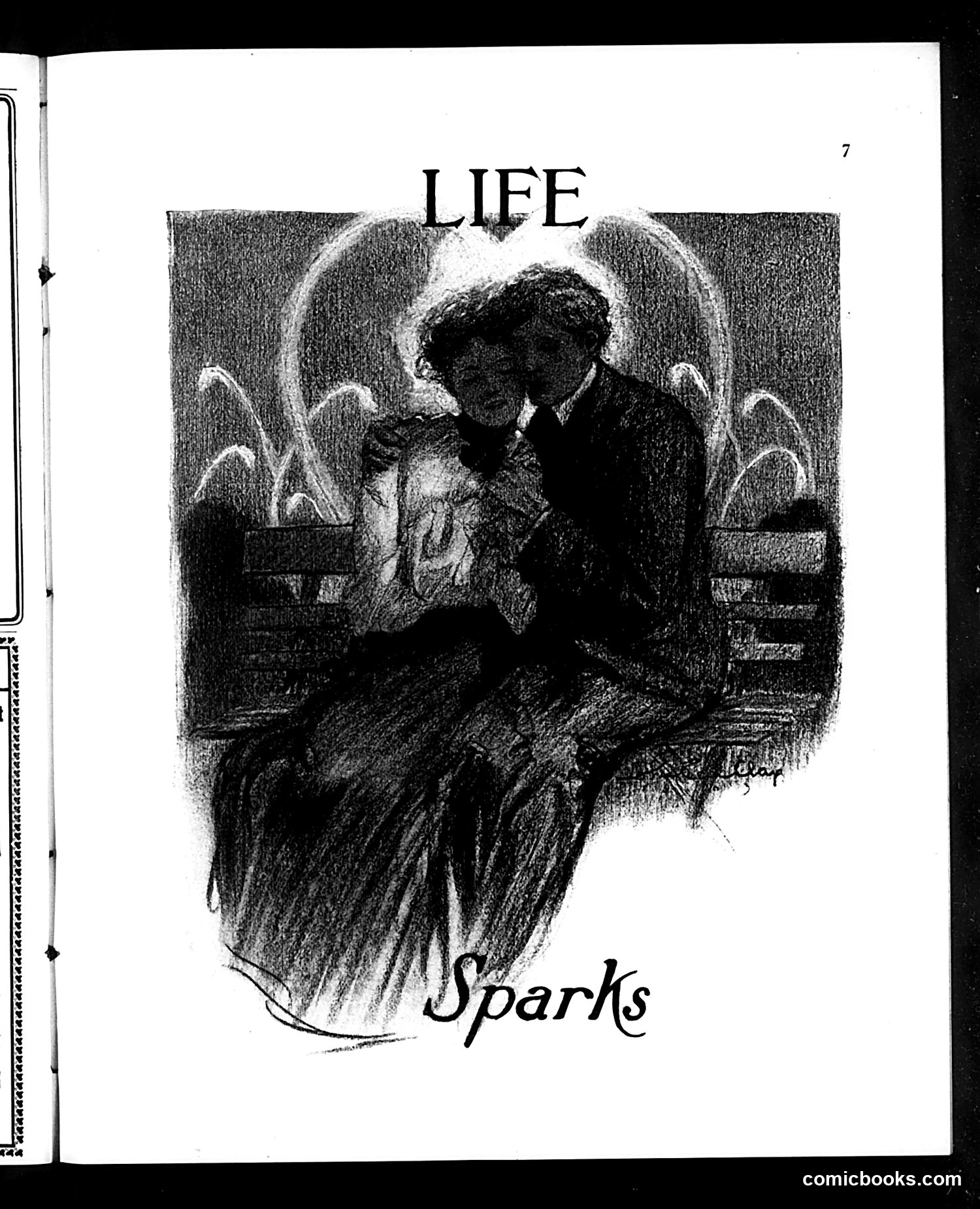
This appears to be a title page or section header for *Life* magazine, featuring an illustration signed by what looks like a period artist. The sketch depicts two figures in an intimate moment—a man leaning toward a woman in what seems to be an elegant interior setting, with decorative elements like mirrors or alcoves visible in the background. The title "LIFE" and artist signature "Sparks" frame romantic or domestic content. Without additional context or visible text explaining the specific subject matter, this likely represents either a romantic narrative installment, illustration for a story, or satirical commentary on courtship and social interactions—common themes in early 20th-century *Life* magazine's humorous and social critique content.
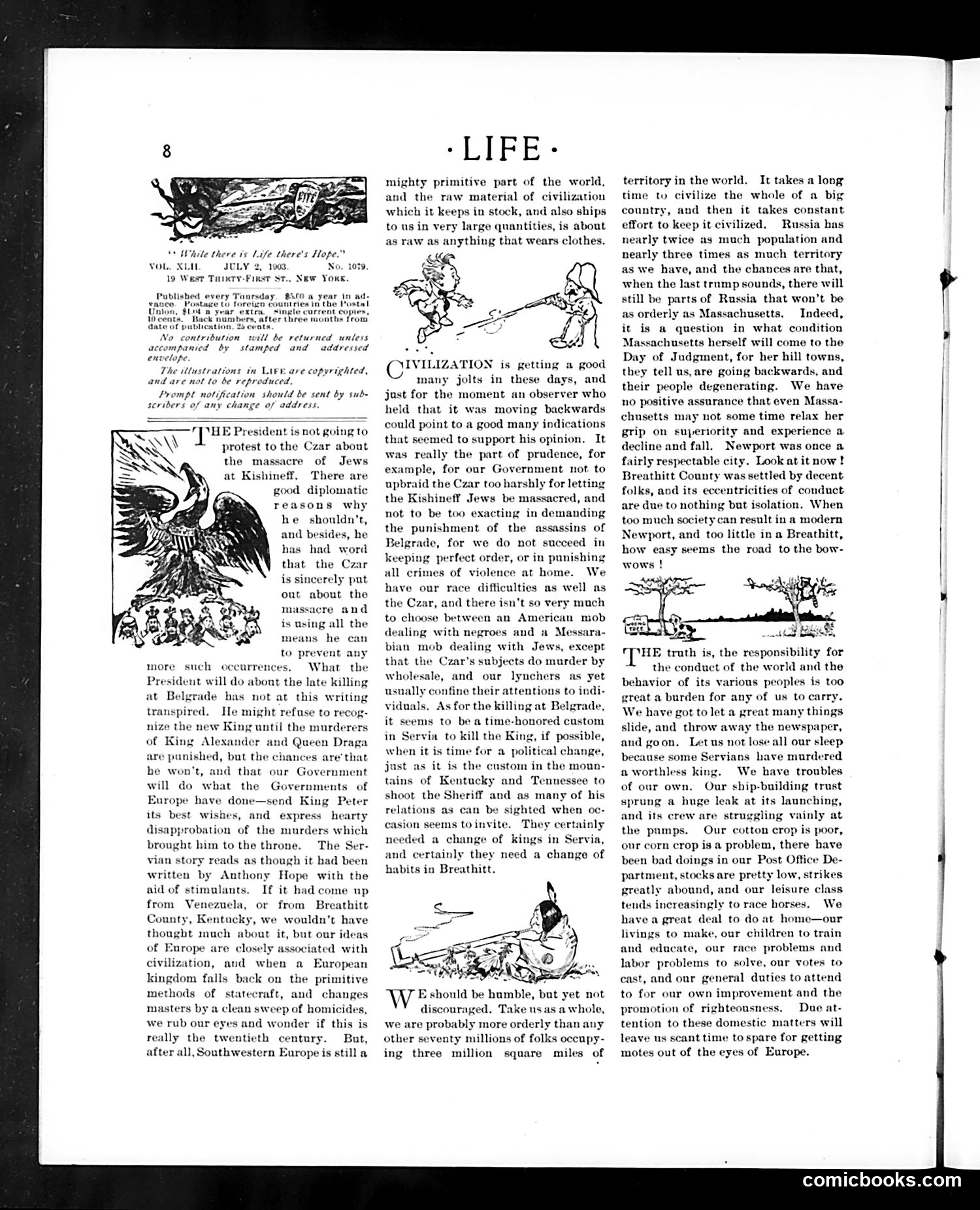
This *Life* magazine page contains editorial commentary on civilization and international relations, particularly critiquing American responses to Russian events. The text discusses the Czar's handling of the Kishineff massacre of Jews and debates whether the U.S. President should protest. The accompanying illustrations appear to be decorative rather than character-specific caricatures. The main argument condemns European savagery while acknowledging America's own social problems—lynchings, labor strife, and racial violence—making moral criticism of Russia's brutality somewhat hypocritical. The piece argues Americans should address domestic disorder before condemning foreign atrocities, suggesting that both nations face similar civilizational challenges and cannot claim moral superiority.
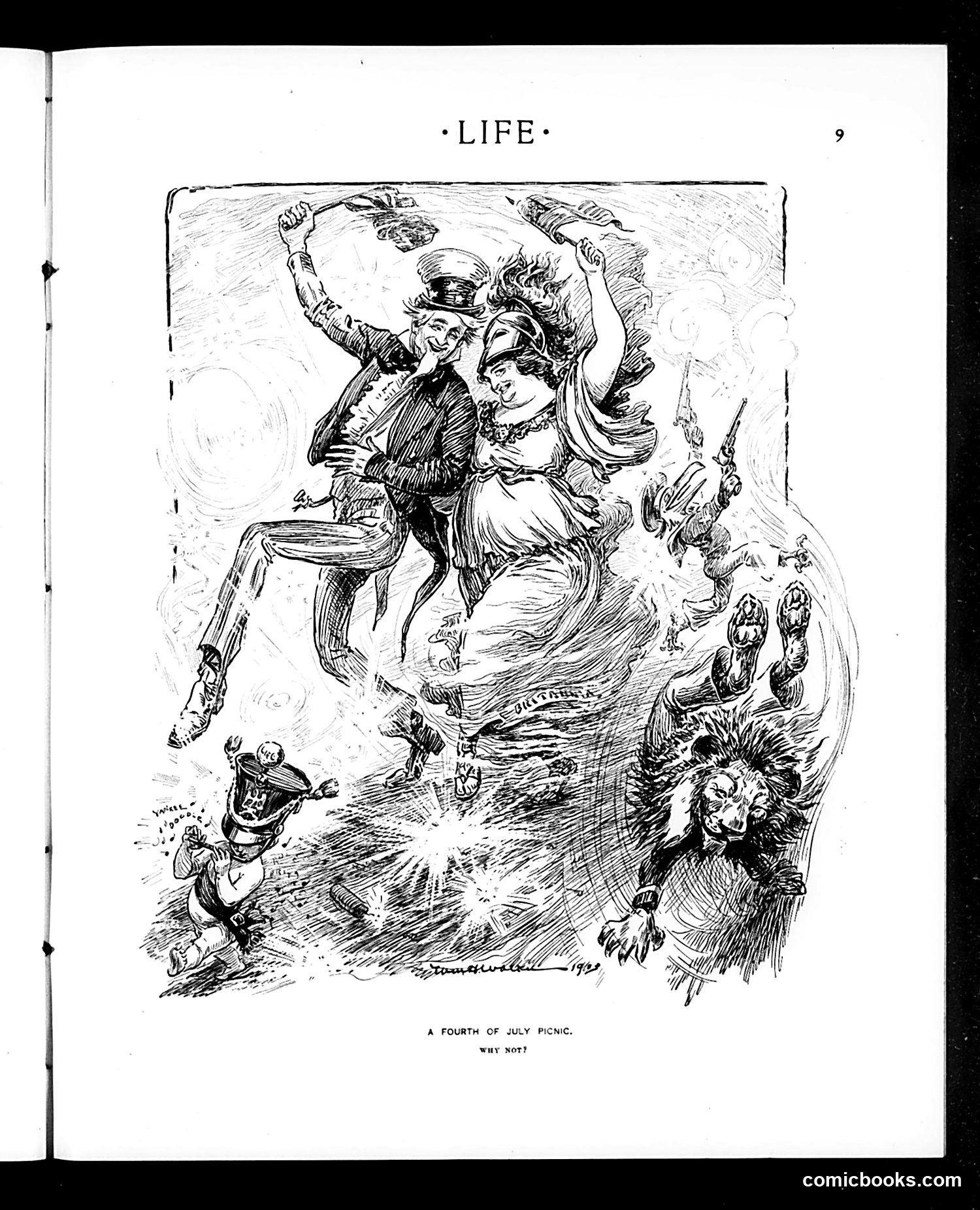
This Life magazine cartoon satirizes American Independence Day celebrations. The central figures appear to be Lady Liberty (the woman with flowing hair and classical dress) and Uncle Sam (the man in top hat), depicted in chaotic revelry amid explosions and flying debris. The "Why not?" caption suggests ironic commentary on the destructive nature of Fourth of July festivities—particularly the dangers of fireworks. Small figures around them scatter in panic as explosions occur, with what appears to be a lion or beast on the right side. The cartoon mocks the contradiction between the holiday's dignified patriotic ideals and the actual rowdy, potentially dangerous celebrations Americans practiced, featuring unregulated fireworks that caused injuries and fires. It's social satire about the gap between national mythology and messy reality.
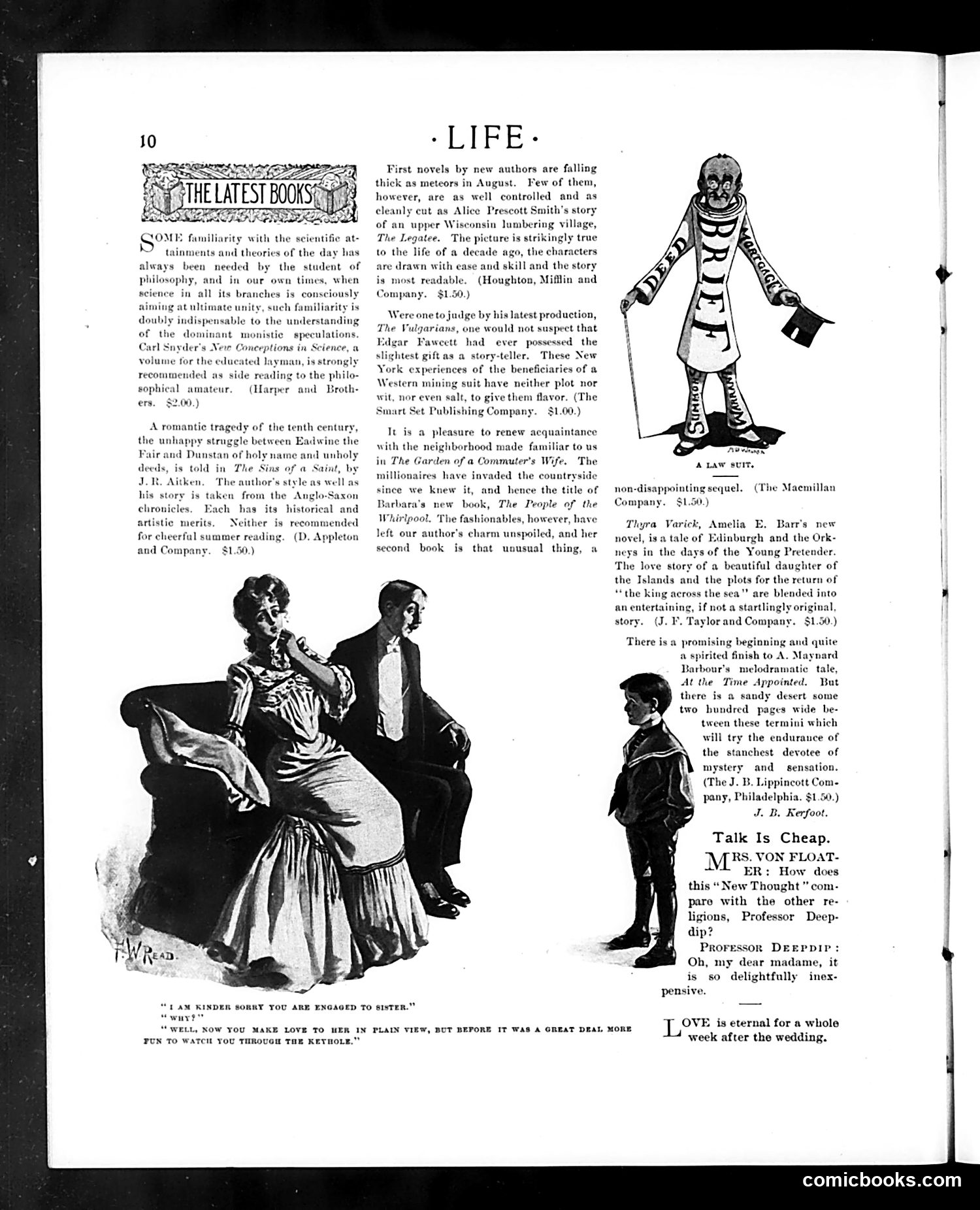
This page from *Life* magazine reviews new books, specifically literary fiction. The main cartoon (left side) illustrates a scene with dialogue: "I thought sorry you are engaged to sister," "wait," "Well, now you make love to her in plain view, but before it was a great deal more fun to watch you through the keyhole." The satire targets Victorian sexual hypocrisy—the joke being that courtship conducted openly under societal rules is less entertaining than secret, voyeuristic observation. This mocks the era's restrictive propriety while simultaneously suggesting the prurient interest lurking beneath respectable society. The right side contains literary reviews of contemporary novels, including titles like *The Legalee* and *The Vulgarians*. The small illustration of a boy appears unrelated to the main satire.
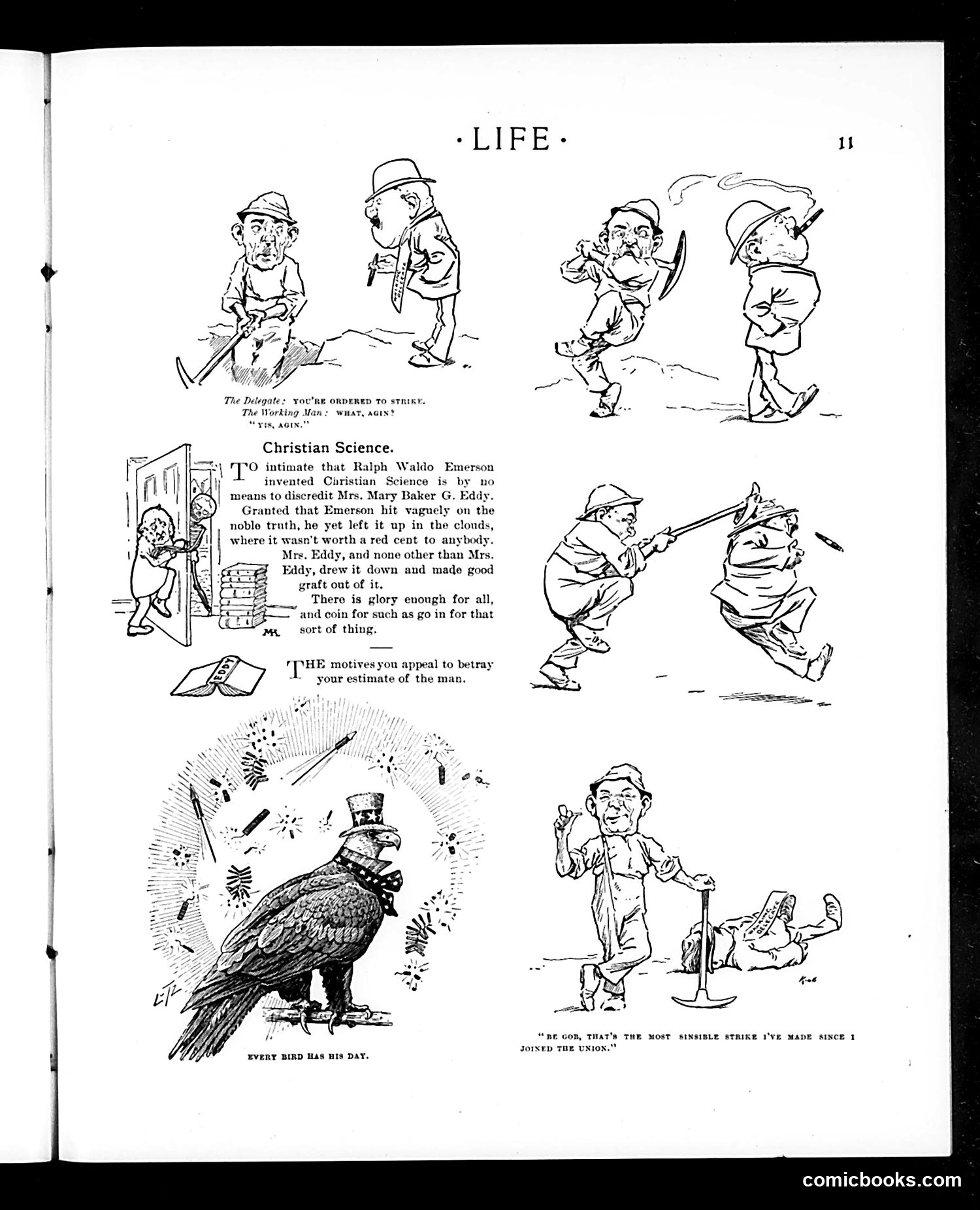
This page contains satirical cartoons about labor strikes and Christian Science. The top strip shows a delegate ordering a worker to strike, with the worker replying "Yes, agin'" — mocking repetitive strike actions. The main article criticizes Ralph Waldo Emerson's endorsement of Christian Science, founded by Mary Baker G. Eddy. The text suggests Emerson's vague philosophical support lent undeserved credibility to Eddy's religious movement, which the magazine dismisses as worthless. The accompanying cartoons ridicule Christian Science practitioners and their methods. The bird illustration captioned "Every bird has his day" appears to mock the movement's grandiose claims. The bottom cartoon features a man claiming his union membership represents "the most sensible strike I've made since I joined the union" — further satirizing labor activism as absurd and self-defeating.
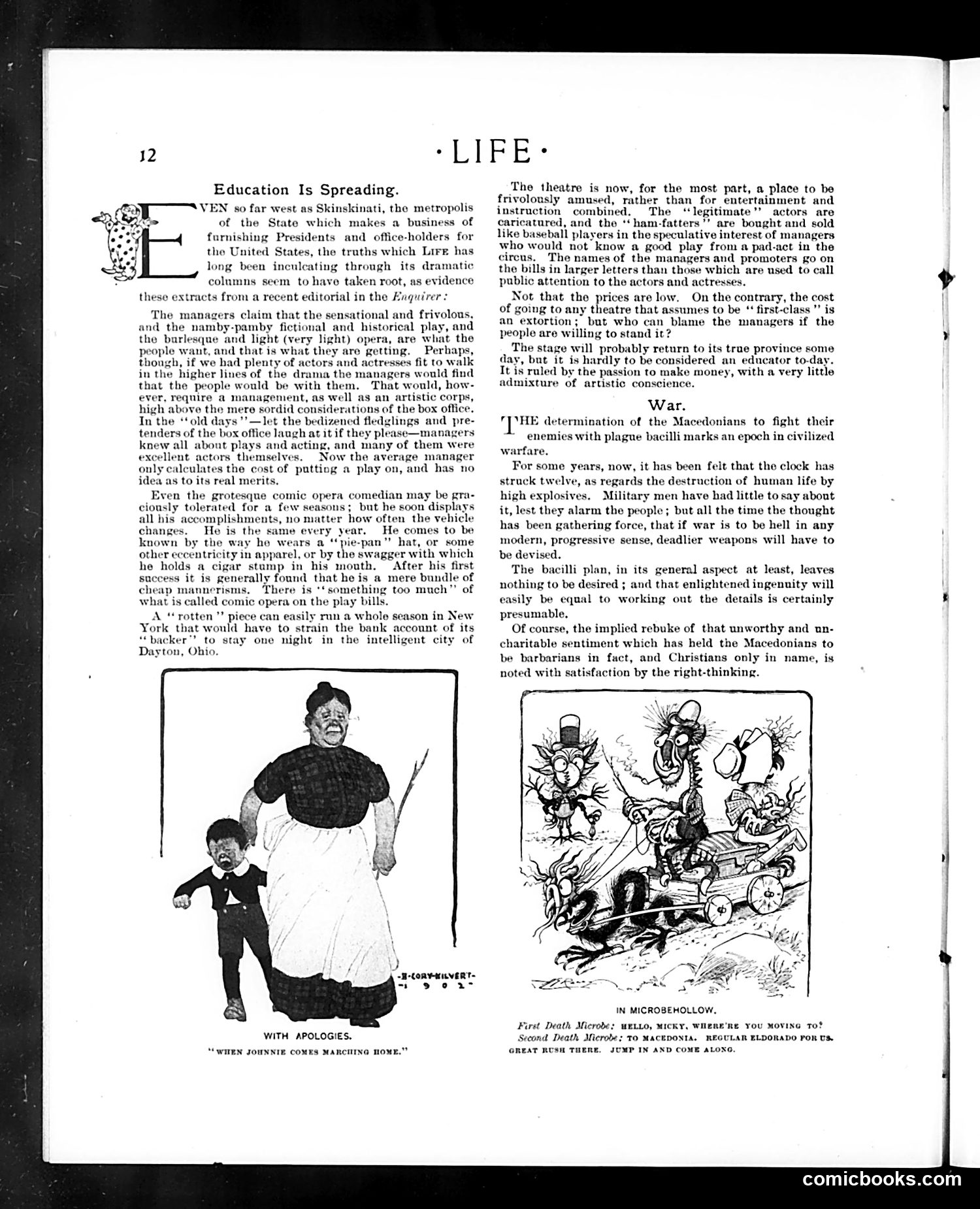
This page from *Life* magazine contains two distinct sections: **Left cartoon ("With Apologies")**: Shows a woman chasing a small child with a stick, captioned "When Johnnie Comes Marching Home." This satirizes the contrast between patriotic homecomings and domestic discipline—suggesting soldiers returning home may face their wives' pent-up frustrations rather than celebration. **Right cartoon ("In Microbenhallow")**: A chaotic scene of fantastical creatures in conflict, captioned as a dialogue between "First Death Microbe" and "Second Death Microbe" regarding Macedonia. This appears to satirize the Macedonian conflict through the lens of disease/warfare metaphors, likely referencing contemporary Balkan instability and military concerns. The page also discusses theater management and educational expansion in the accompanying text columns.
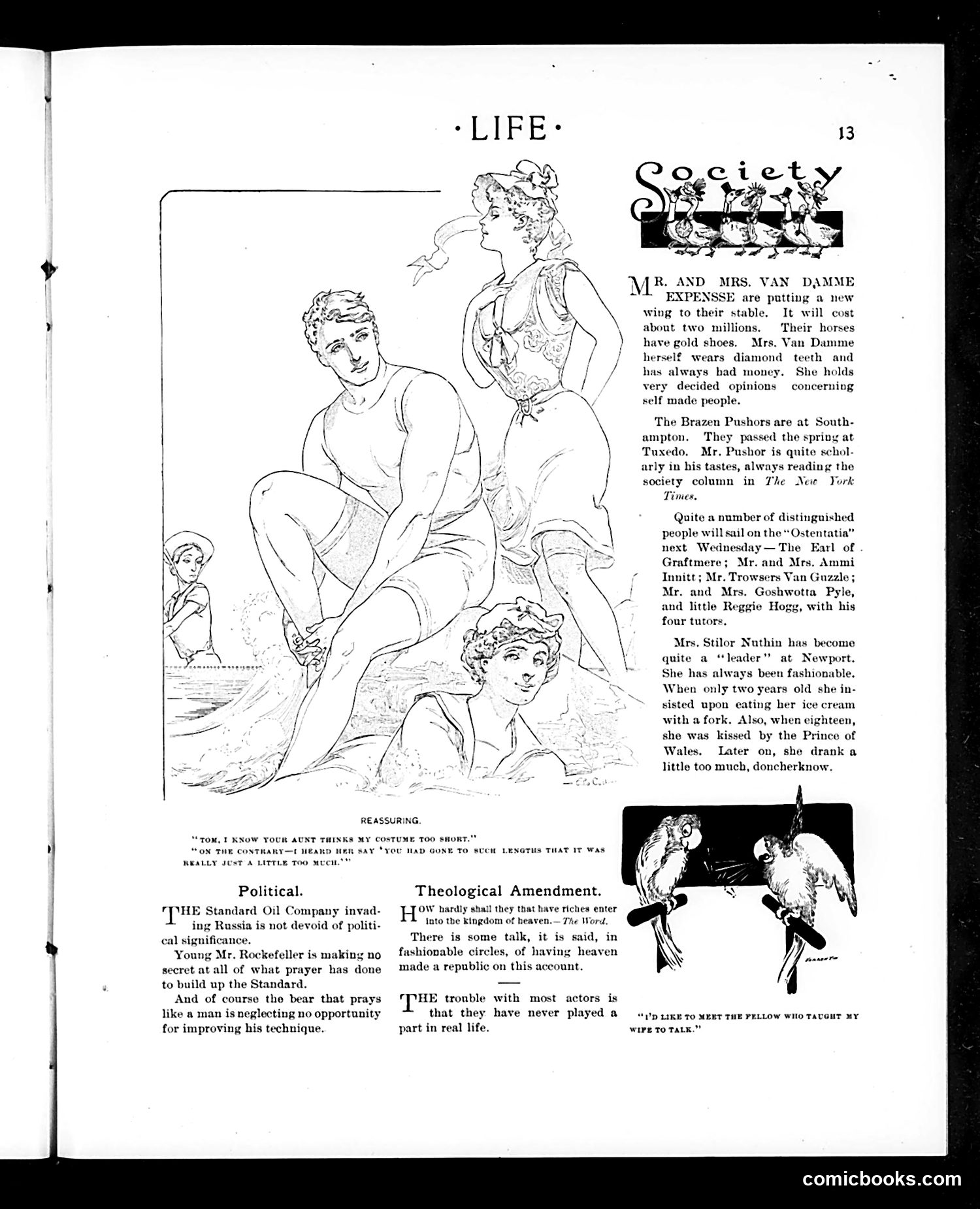
This page satirizes wealthy American society through multiple sections: **Main Cartoon ("Reassuring"):** A woman tells her husband his costume shows "too much," implying his physique is unflattering. The satire critiques wealthy men's vanity and physical appearance. **Society Column:** The satirical items mock the nouveau riche and aristocratic pretension—particularly Mrs. Van Damme, who wears "diamond teeth" and judges "self made people" despite having wealth herself. Other targets include the Brazen Pushors (whose name suggests vulgarity) and Mrs. Nuthin, whose trivial accomplishments (eating ice cream with a fork at age two, being kissed by the Prince of Wales) are presented as credentials for Newport society leadership. **Political Section:** Mocks young Rockefeller's public piety regarding Standard Oil's success, suggesting prayer is merely a public relations strategy. The Russian "bear that prays" reference likely alludes to Russia's Orthodox Christianity and Standard Oil's business interests there. **Theological Amendment:** Satirizes wealthy Christians by imagining heaven made "a republic" to accommodate the rich who normally wouldn't enter it according to scripture. The overall theme: American wealth, pretension, and hypocrisy.
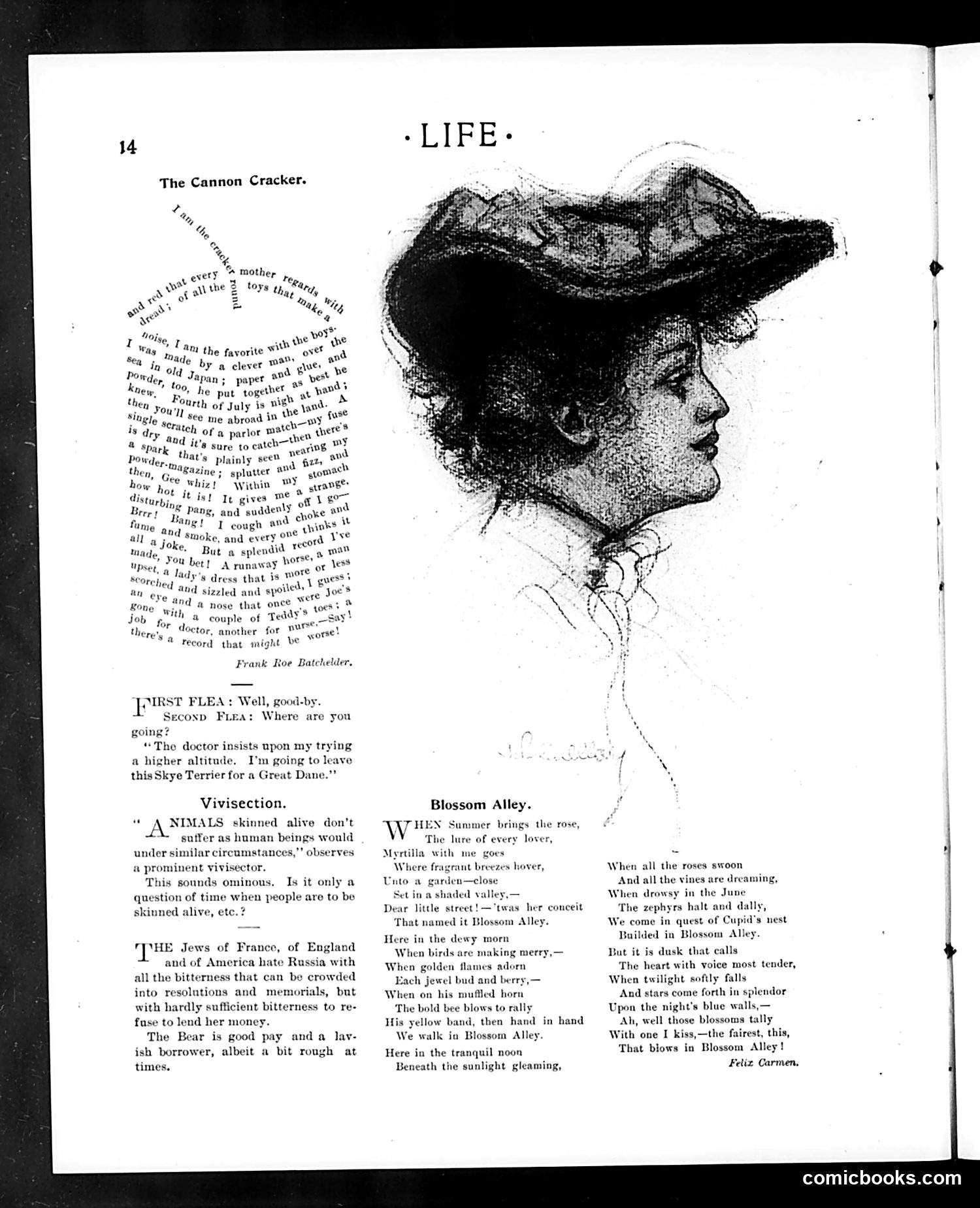
This page contains three satirical pieces typical of early 20th-century American humor: **"The Cannon Cracker"** (top): A monologue by a personified firecracker boasting of its destructive exploits—causing injuries, fires, and property damage. The satire targets Fourth of July celebrations and the casual acceptance of dangerous fireworks that routinely harmed people, particularly children. The joke exposes how Americans normalized this annual toll of injuries as entertainment. **"Vivisection" (bottom left)**: A brief commentary mocking the logic of animal-testing advocates who claimed animals don't suffer like humans. The satire darkly suggests this reasoning could justify human experimentation—exposing the absurdity of the vivisection defense. **"Blossom Alley"** (right): A sentimental poem about romantic courtship, likely included as light filler or gentle satire of saccharine Victorian love poetry. The page exemplifies *Life*'s mix of biting social commentary with whimsy and verse.
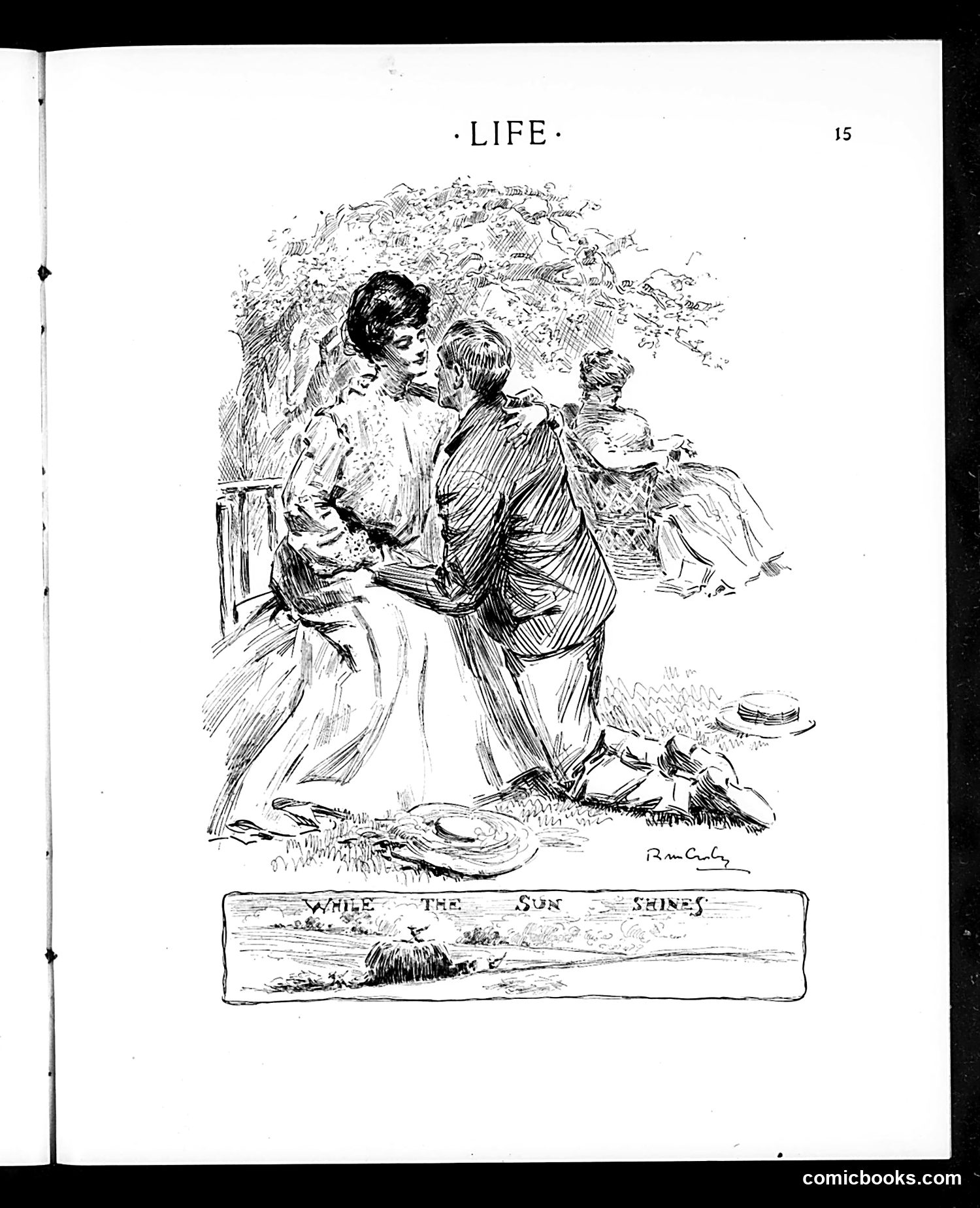
This page features a sketch titled "While the Sun Shines" depicting a domestic scene. The illustration shows a woman seated with children gathered around her in an outdoor setting with a tree. The composition suggests a leisurely, peaceful family moment. The title "While the Sun Shines" appears to reference the proverb "make hay while the sun shines"—meaning to take advantage of favorable circumstances. The artwork, signed by what appears to be a period illustrator, uses pen-and-ink technique typical of early 20th-century Life magazine illustrations. Without additional context or visible text explaining the satirical intent, the specific social or political commentary remains unclear, though the domestic subject matter suggests commentary on family life or leisure during pleasant weather.
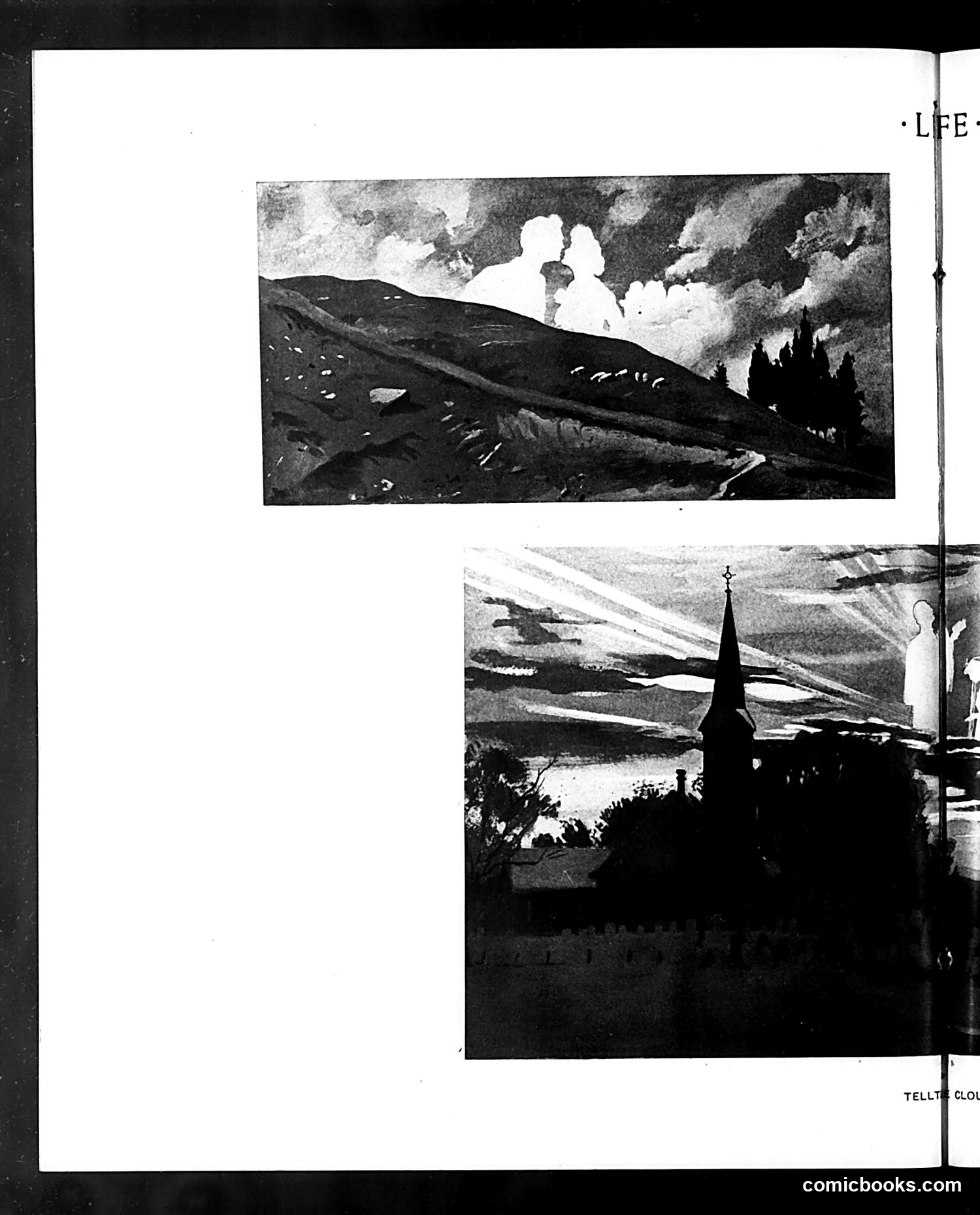
This page from *Life* magazine contains two black and white illustrations. The upper image depicts a dramatic landscape with hills, clouds, and what appears to be explosions or fire in the distance—possibly depicting a military or industrial scene. The lower image shows a church steeple silhouetted against a landscape with water and sky. Without visible captions or clearer text identifying the specific satire, context, or political commentary, I cannot definitively explain what these images represent or what point they're meant to convey. The juxtaposition of religious imagery (the church) with what may be destruction or conflict suggests possible commentary on faith during crisis, but this remains speculative without supporting text or historical attribution visible on the page.
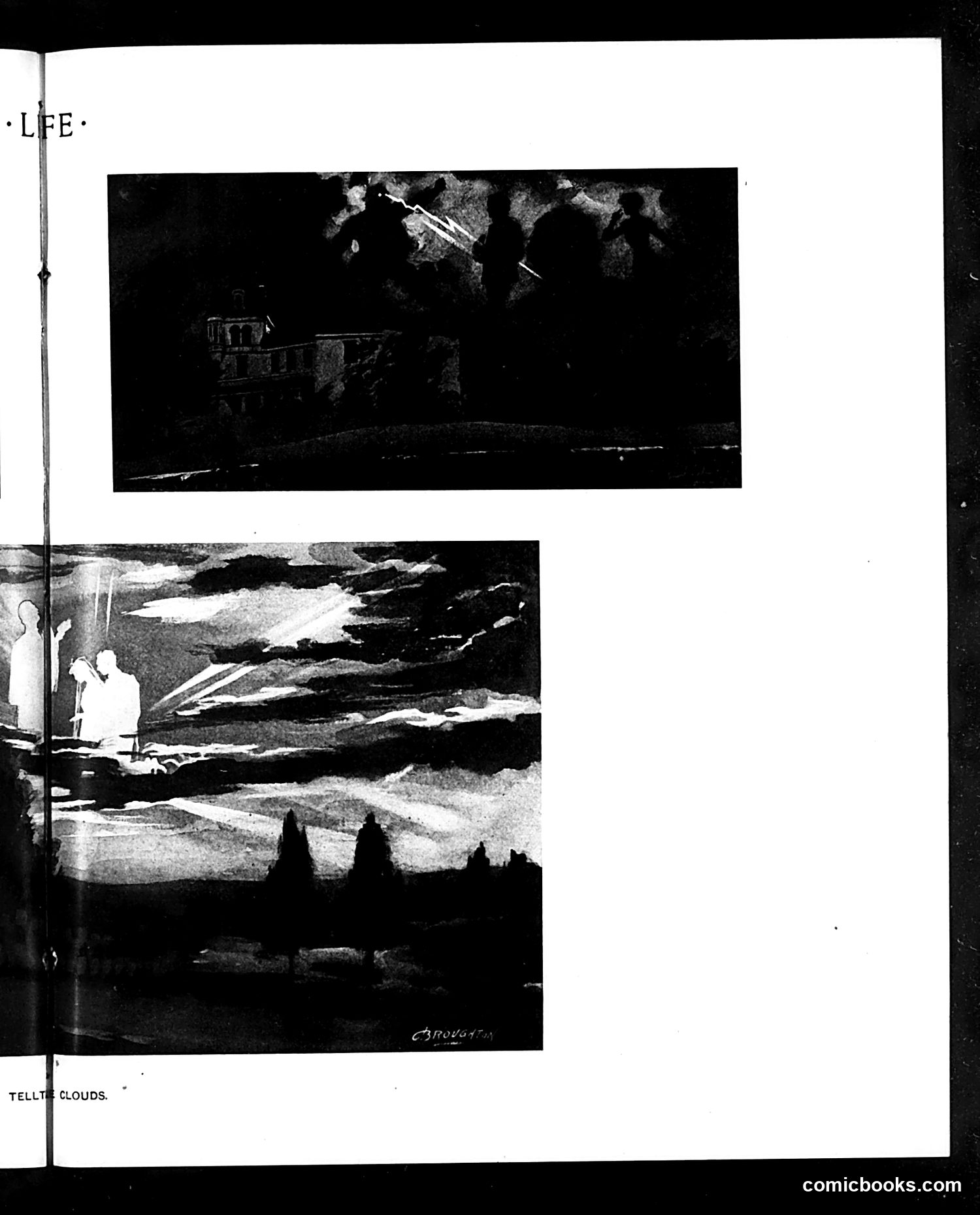
This page from *Life* magazine contains two black and white illustrations under the heading "TELL CLOUDS." The **top image** shows a nighttime scene with a building or structure silhouetted against a dramatic sky with clouds and what appears to be searchlights or lightning. The **bottom image** depicts figures observing a landscape with clouds, including what appear to be evergreen trees in silhouette against a cloudy sky. The page's title "TELL CLOUDS" suggests these are artistic or poetic interpretations of cloud formations—possibly inviting readers to see shapes or narratives in clouds, a common visual game. Without additional context or captions identifying specific figures or events, the exact satirical point remains unclear, though both images emphasize atmospheric drama and human observation of nature.
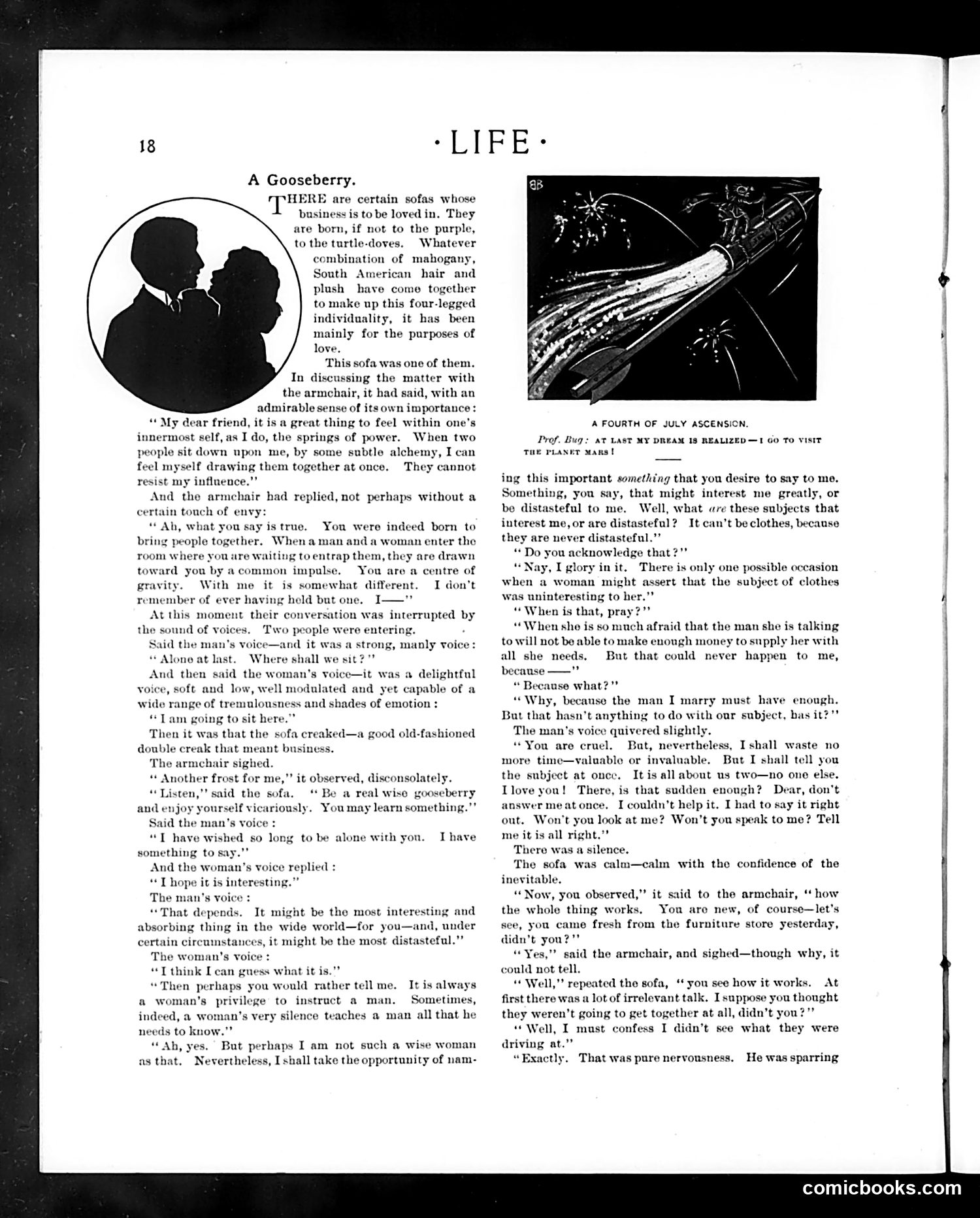
This page presents a humorous domestic comedy about courtship, told through personified furniture. The main illustration depicts silhouettes of a couple on a sofa—the actual subject of the joke. The satire mocks Victorian romance conventions by having the sofa and armchair discuss their "roles" in facilitating romance. The sofa boasts of its power to draw couples together through mysterious "alchemy," while the lonely armchair laments never hosting a romantic pair. When an actual couple arrives, the furniture's conversation becomes eavesdropping commentary on their stilted, over-formal courtship dialogue. The man launches into an elaborate, hesitant romantic declaration while the woman deflects with witty observations about clothes and money. The joke targets both genders: men's clumsy attempts at emotional expression and women's deflection through materialism—a common trope in period satire. The furniture's perspective allows the author to gently mock the artificial, self-conscious nature of upper-class romance. The term "gooseberry" (meaning an awkward third party) appears in the title as the armchair essentially plays this role.
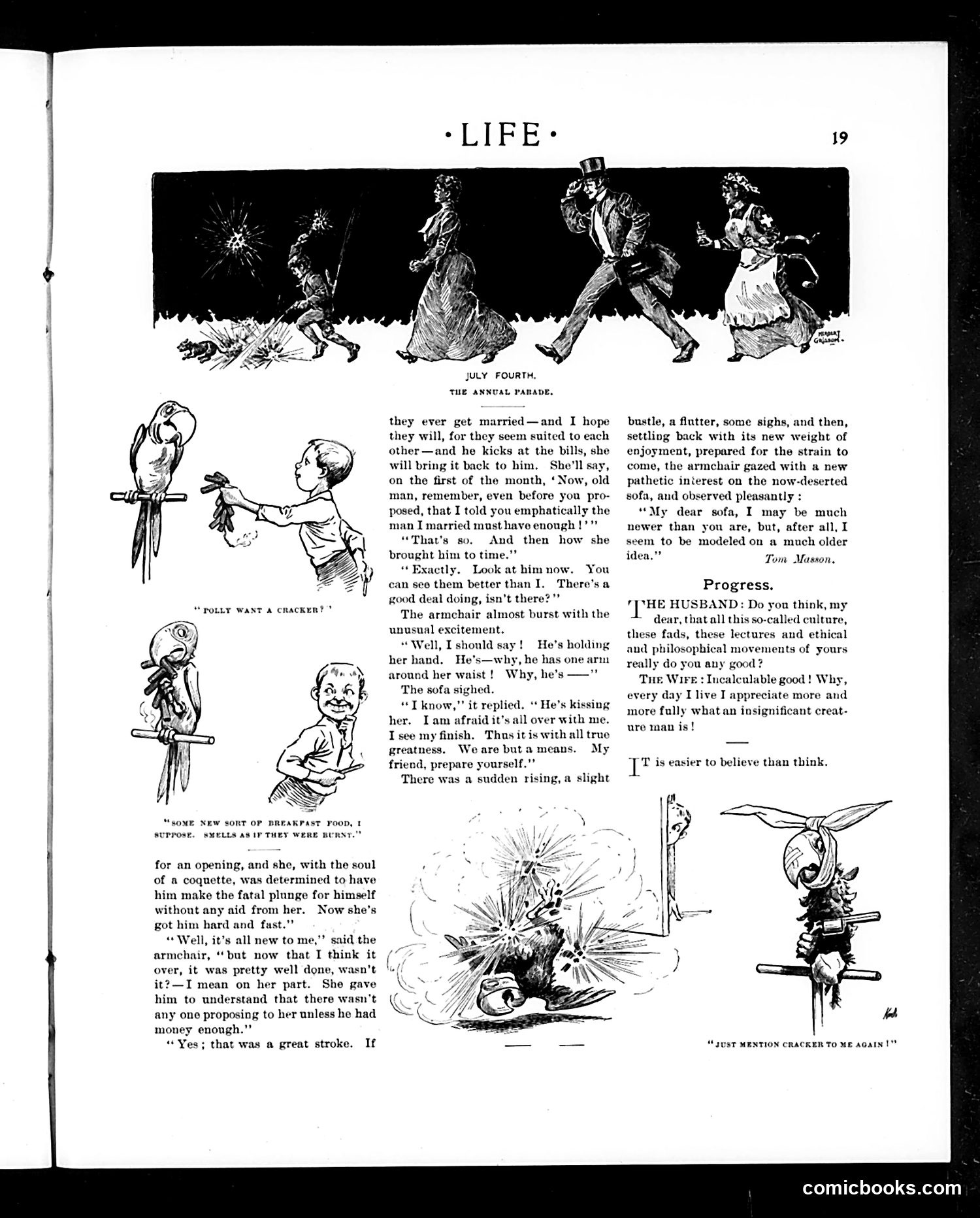
This page contains two satirical pieces typical of early 20th-century American humor: **"July Fourth: The Annual Parade"** (top) depicts a courtship narrative through dialogue between anthropomorphized furniture—an armchair and sofa. The satire mocks marriage dynamics: a woman strategically pursues a man by feigning disinterest, implying she'll only marry someone wealthy. The furniture "characters" observe the couple's romantic progress with commentary on courtship as calculated financial negotiation. The joke reflects period anxieties about marriage as economic transaction. **"Progress"** (bottom) uses domestic dialogue to satirize women's intellectual movements and culture. A husband questions whether his wife's engagement with lectures and philosophical ideas benefits her. She responds that such activities make her appreciate how "insignificant" men are—turning the ostensible self-improvement movement into an instrument of marital criticism. The humor lies in suggesting women's "progress" actually increases their contempt for their husbands. Both pieces use gentle mockery to comment on contemporary social changes regarding gender relations and marriage.
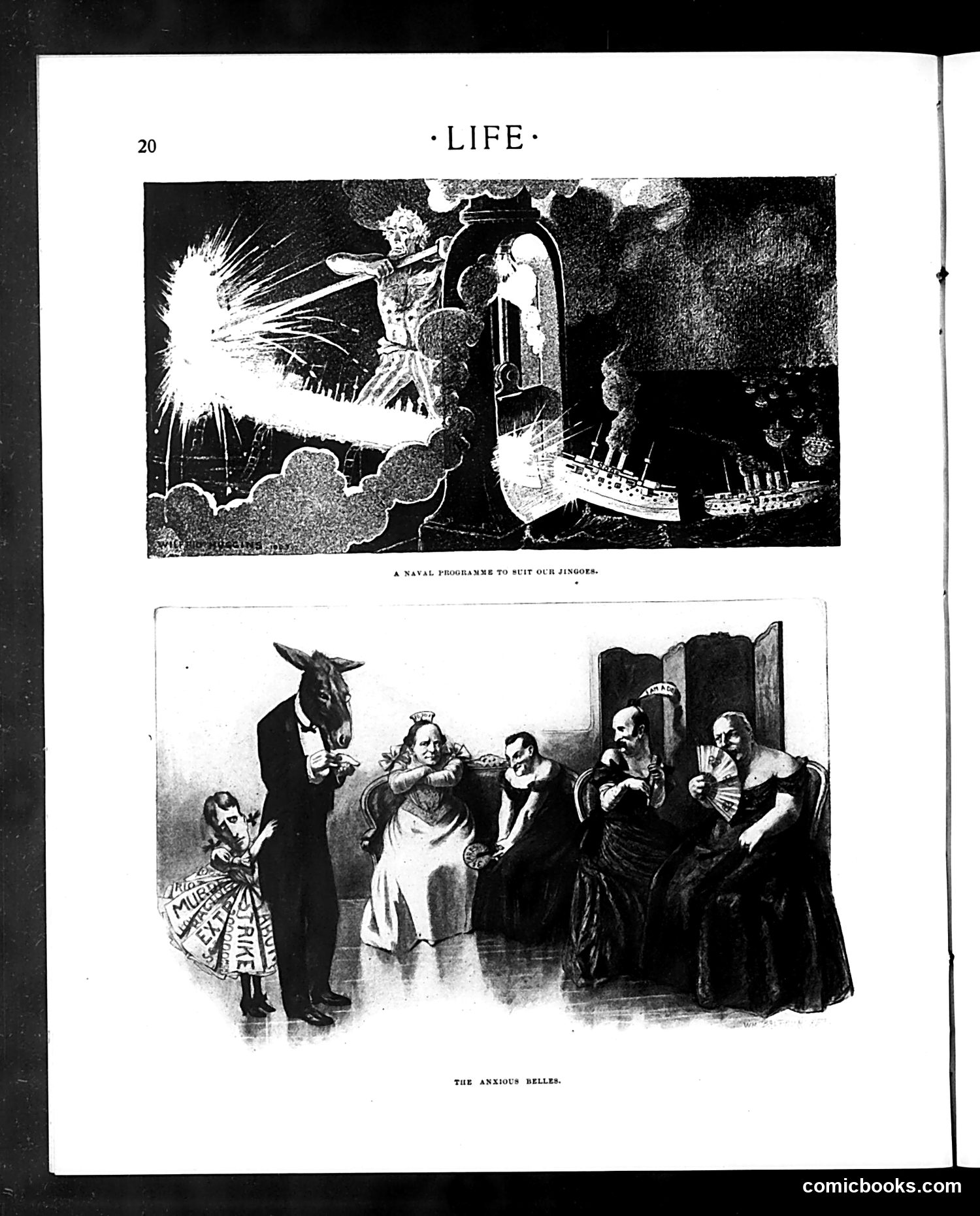
This page contains two political cartoons from *Life* magazine. **Top cartoon:** "A Naval Programme to Suit Our Jingoers" depicts military/naval expansion as a patriotic spectacle, with a figure wielding weapons amid explosions and ships. "Jingoers" refers to jingoists—those advocating aggressive nationalism and military buildup. **Bottom cartoon:** "The Anxious Belles" shows women in Victorian dress gathered anxiously while a man with a donkey head (likely representing a political figure or foolish leadership) addresses them. The women appear concerned, possibly satirizing female anxiety over masculine political decisions or military adventures that affect their lives. Both cartoons appear critical of aggressive nationalism and military expansion, suggesting such policies were driven by masculine bravado while causing legitimate concern among the general population.
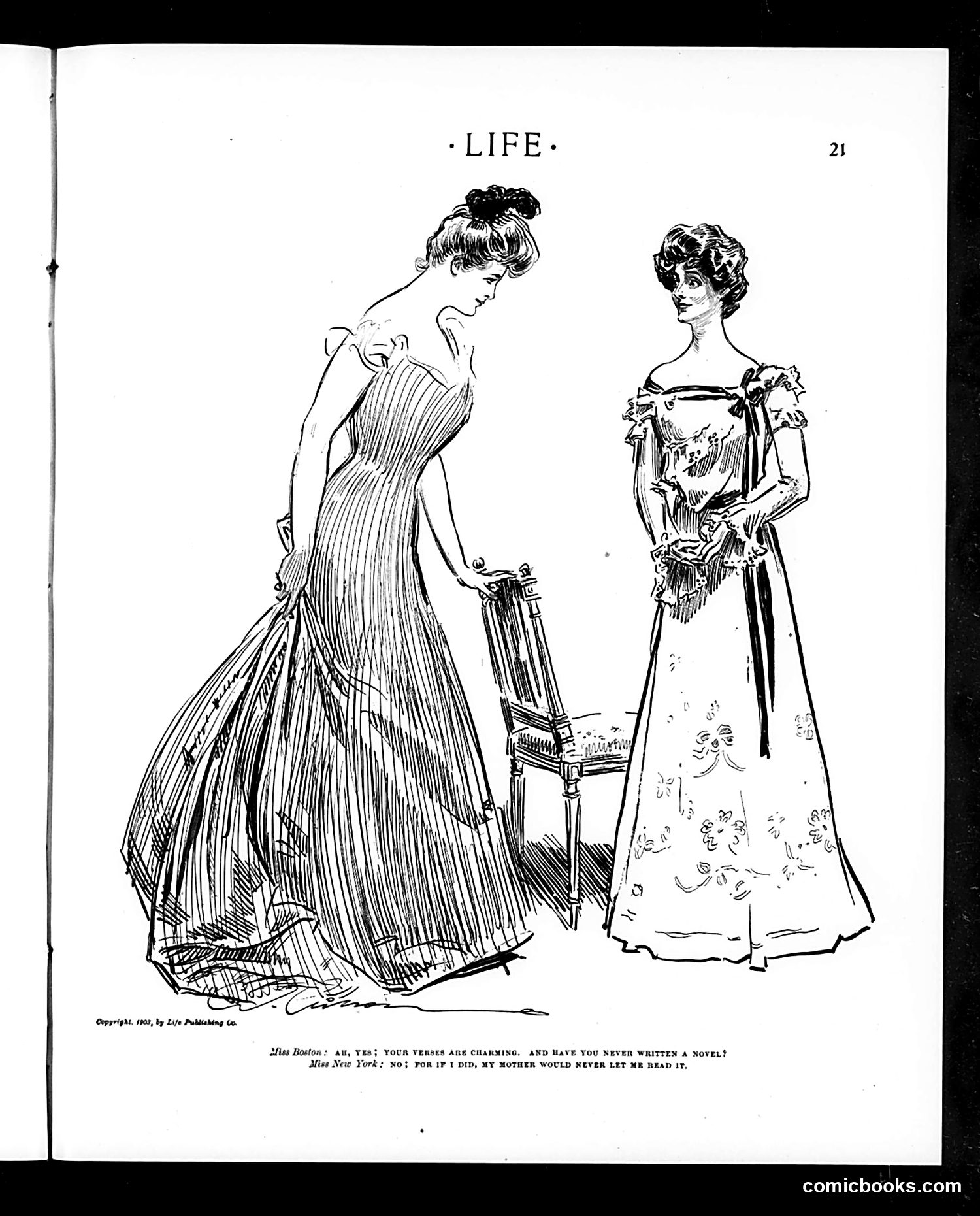
This is a satirical illustration from *Life* magazine (page 21) depicting two elegantly dressed women in early 1900s fashion. The dialogue reveals the joke: **Miss Boston** boasts that her verses are charming and asks if Miss New York has written a novel. **Miss New York** replies that she hasn't—and wouldn't dare, because her mother would never permit her to read it. The satire targets the era's restrictive attitudes toward women's intellectual pursuits and literature. It mocks the paradox where women are expected to create refined cultural works yet are simultaneously sheltered from "improper" reading material by their families. The joke implies that any novel Miss New York might write would be considered scandalous or morally unsuitable—even for its own author.
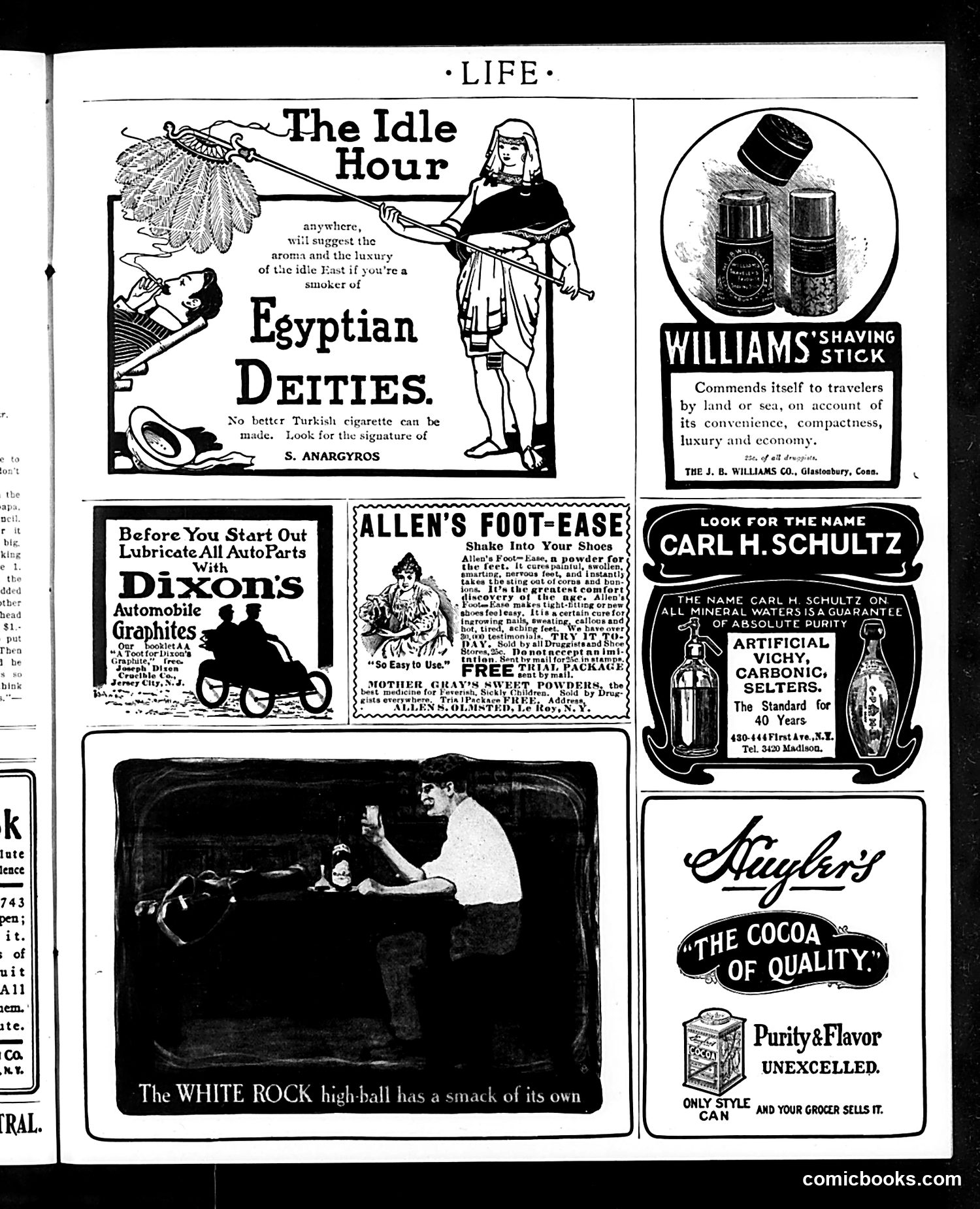
This is primarily an **advertising page** from Life magazine, not political satire. The main content consists of vintage product advertisements from approximately the early 1900s. The only notable "editorial" content is the top-left cartoon, "The Idle Hour," which satirizes leisure and exoticism. It depicts a lounging smoker being fanned by an Egyptian-styled figure, promoting Egyptian Deities cigarettes. The satire targets wealthy consumers' romantic fantasies about the "exotic East"—a common Orientalist trope of the era—mocking how smoking Turkish cigarettes promised to transport idle aristocrats to imagined luxury. The remaining advertisements promote mundane products: auto lubricant, foot powder, shaving cream, mineral water, cocoa, and high-ball glasses. They reflect early 20th-century consumer goods marketed through appeals to convenience, quality, and travel.
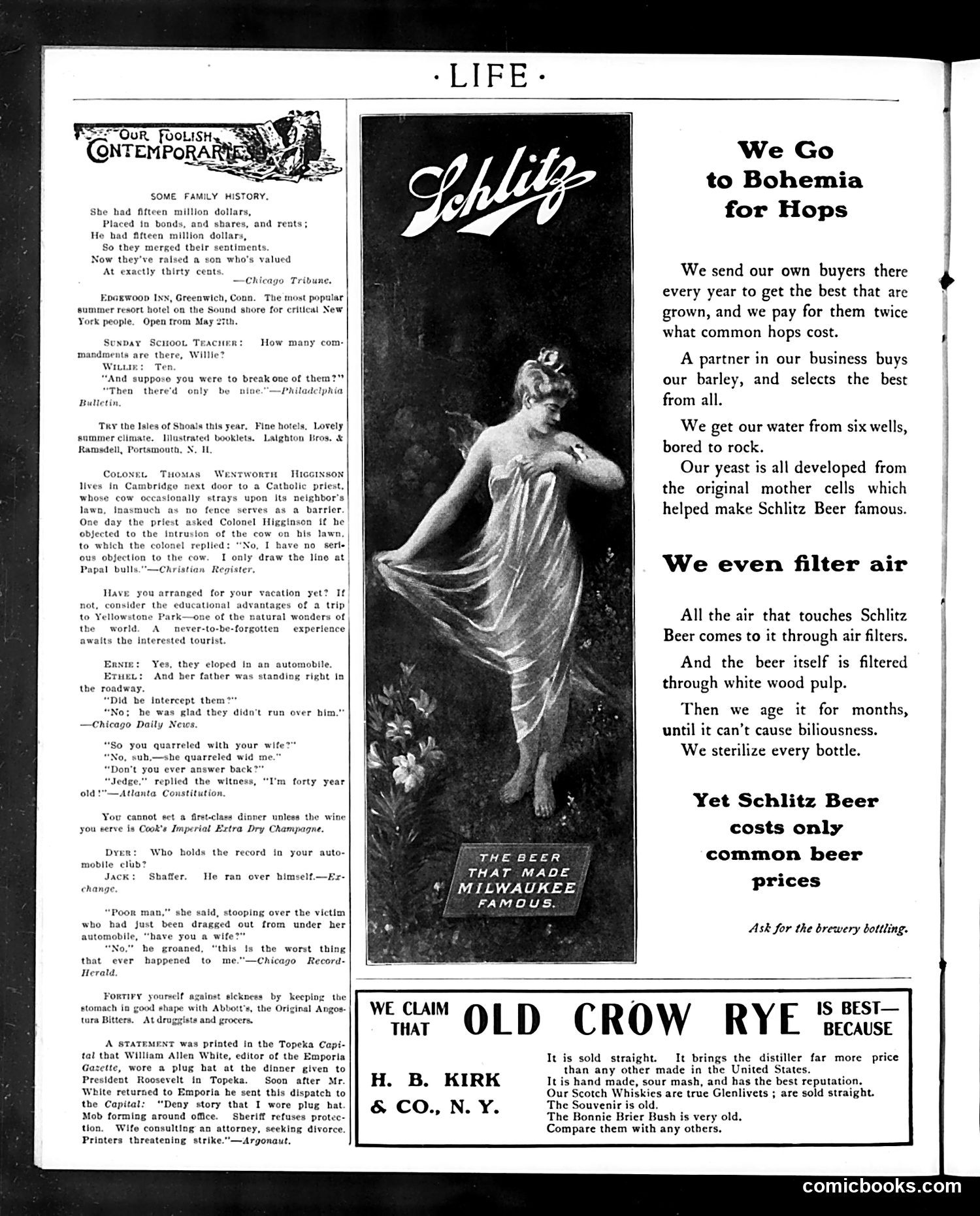
This page contains primarily **short humorous anecdotes and advertisements** rather than political cartoons. The "Our Foolish Contemporaries" section collects brief jokes satirizing **American social attitudes of the era**: - A quip about wealthy families merging fortunes to produce a worthless heir mocks inherited wealth and social climbing - A Sunday school joke about breaking commandments plays on childhood innocence - A pun about "Papal bulls" (Catholic church authority vs. literal cattle) targets religious pretension - A joke about a woman glad her father *didn't* run over her suitor satirizes dangerous early automobiles and reckless driving - References to marital quarrels, elopement, and divorce reflect anxieties about changing gender relations The advertisements for **Schlitz Beer** and **Old Crow Rye whiskey** are straightforward product promotions emphasizing quality and manufacturing processes, typical of pre-Prohibition American advertising. The overall tone is lighthearted social commentary on American materialism, religion, marriage, and technology—standard fare for Life's satirical humor of this period.
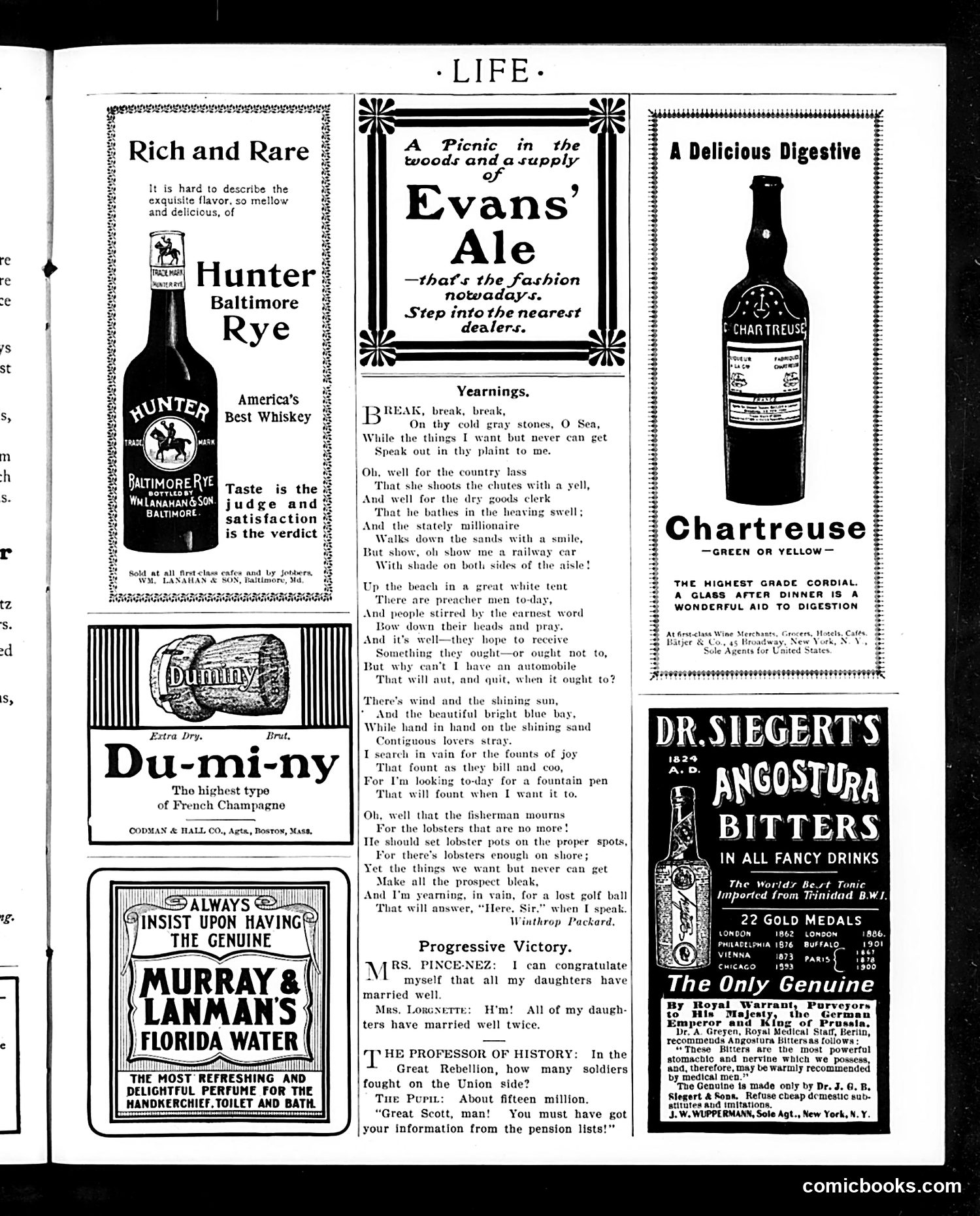
This page is primarily **advertisements** for alcoholic beverages (whiskey, ale, champagne, bitters, cordials) interspersed with satirical content typical of Life magazine's humor. The main satirical piece, "Yearnings" by Winthrop Packard, uses a Tennyson parody ("Break, break, break") to humorously contrast Victorian romantic ideals with mundane modern frustrations. The speaker observes people enjoying beach activities and love, yet yearns not for romance but for practical items: a railway car with shade, a working automobile, and a fountain pen that functions reliably. The satire mocks both romantic poetry and early-20th-century consumer frustrations with unreliable technology. "Progressive Victory" jokes about pension fraud: a professor questions a student's inflated estimate of Civil War soldiers, suspecting the figure comes from pension records—implying fraudulent claims padded the historical record. The advertisements reflect the era's casual marketing of alcohol as digestive aids and tonics, including imported cordials and "bitters" promoted for medicinal purposes—reflecting pre-Prohibition attitudes toward alcohol consumption.
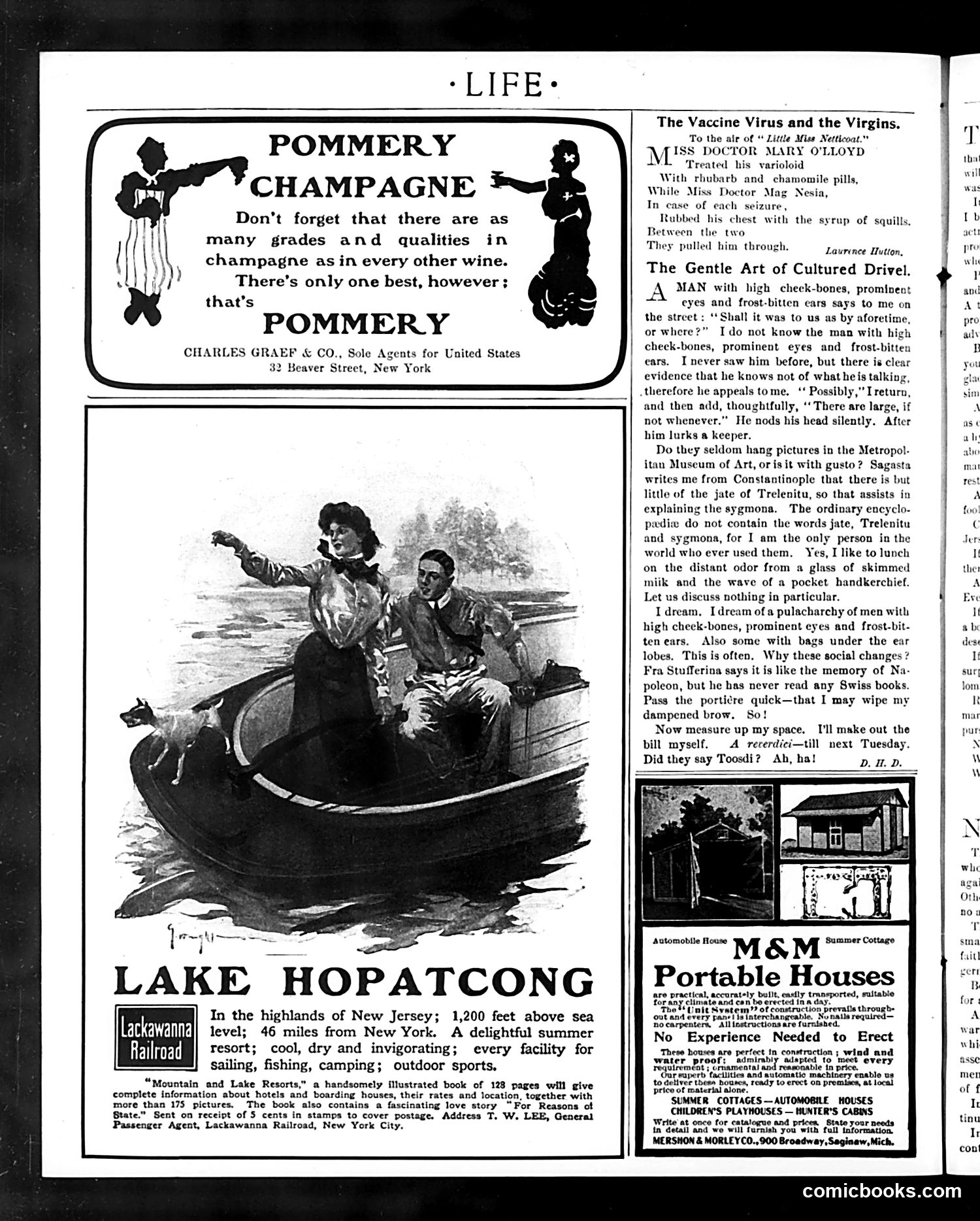
This page contains **primarily advertisements** mixed with satirical content typical of Life magazine's format. The **Pommery Champagne ad** (top) is straightforward marketing, positioning their brand as superior among competing champagne grades. The **Lake Hopatcong travel ad** promotes a New Jersey resort via the Lackawanna Railroad, highlighting outdoor recreation and a included "love story" pamphlet—common Victorian-era advertising tactics. The **satirical content** includes two pieces: "The Vaccine Virus and the Virgins" (a humorous song about treating illness with dubious remedies like rhubarb pills and syrup of squills) and "The Gentle Art of Cultured Drivel," which mocks pretentious small-talk and pseudo-intellectual conversation—poking fun at affected social posturing. The **M&M Portable Houses ad** showcases prefabricated housing, marketed as requiring no carpentry experience. Overall, this page blends commercial promotion with gentle satire of contemporary society, typical of Life's early 20th-century format.
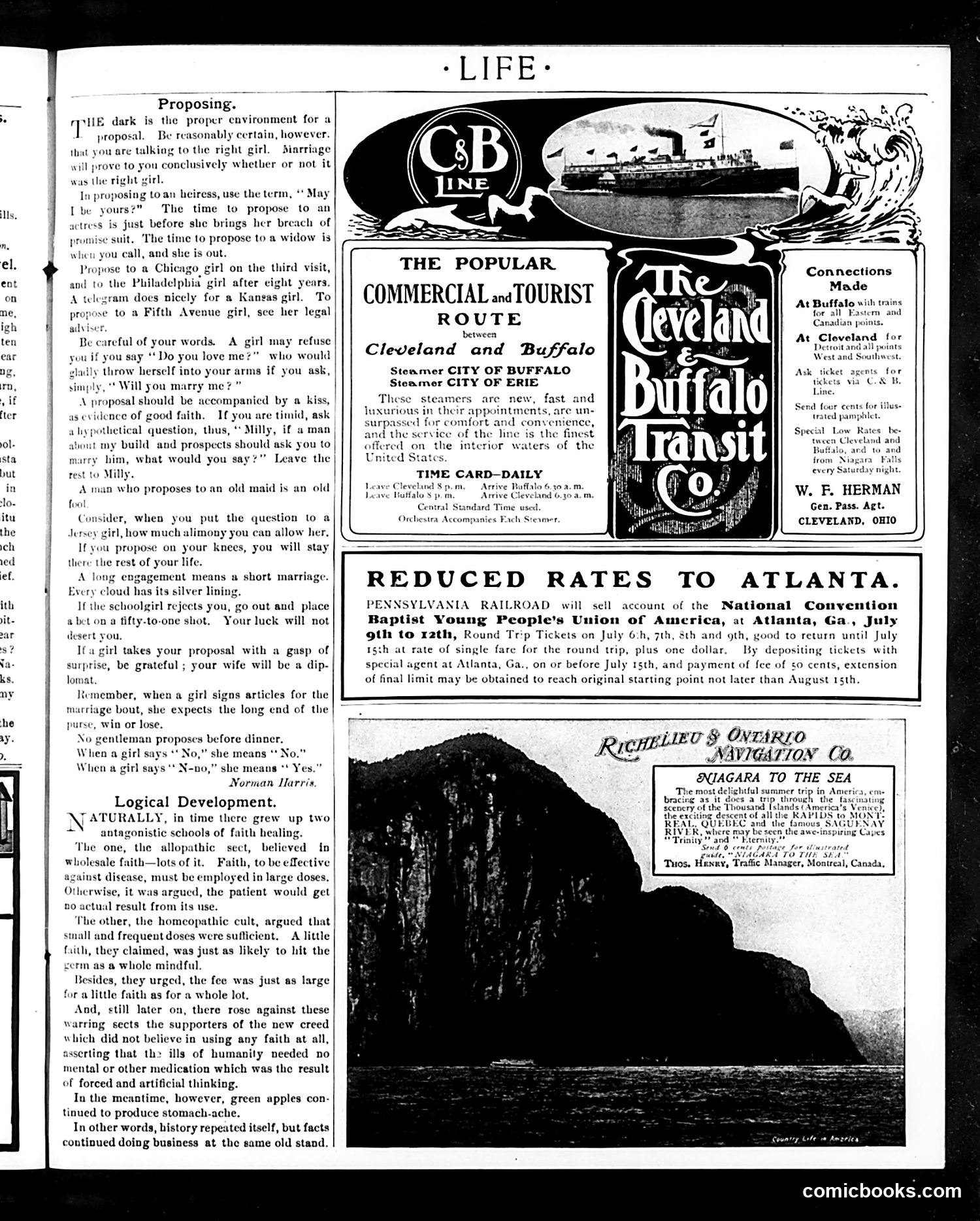
This page contains two distinct sections: **"Proposing" (left column):** A satirical advice column mocking courtship customs across American regions and social classes. It stereotypes girls from different cities—Chicago girls need three visits, Philadelphia girls require eight years, Kansas girls get telegrams—while poking fun at class anxieties (Fifth Avenue heiresses, actresses facing lawsuits). The humor relies on period-specific dating rituals and the assumption that women's responses to proposals vary predictably by geography and social status. **"Logical Development" (lower left):** A tongue-in-cheek essay contrasting "faith healing" sects (allopathic vs. homeopathic medicine)—satirizing contemporary debates over medical philosophy. The punchline: regardless of which healing philosophy wins, "green apples continued to produce stomach-ache"—facts outlast ideology. **Right side:** Ship and railroad advertisements, typical of *Life* magazine's revenue model. The satire assumes readers recognize these regional stereotypes and medical debates as recognizable contemporary controversies.
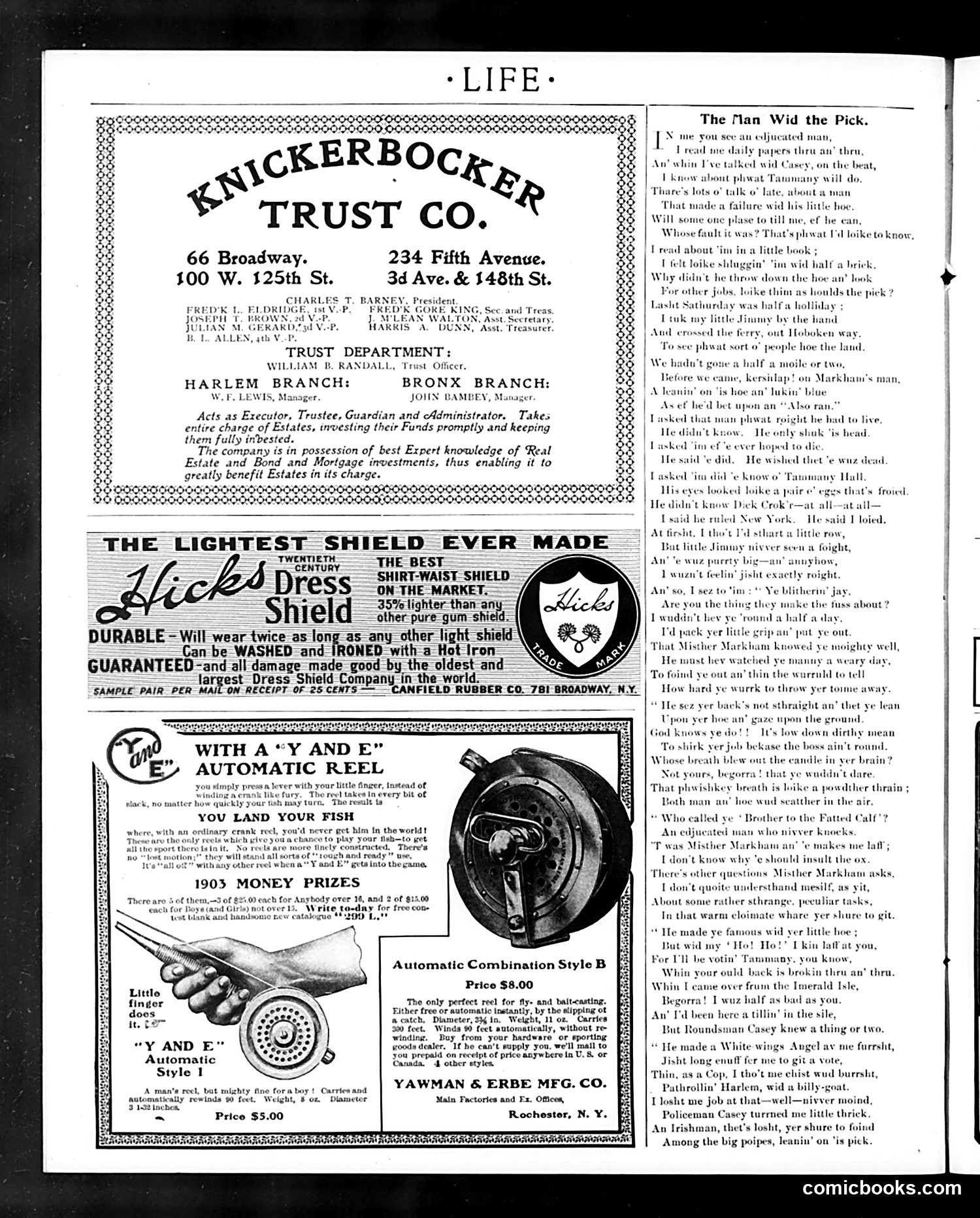
This page is primarily advertising, but the right column features a dialect poem titled "The Man Wid the Pick." Written in Irish-American working-class vernacular, it tells of a laborer who encounters an educated man bragging about his knowledge of politics and prominent figures like "Tammany" (Tammany Hall, NYC's Democratic political machine). The speaker—a working-class Irishman—takes his son to see this "educated" man working as a day laborer, hoping to expose him as a fraud. The poem's satire targets **pretentious intellectuals who claim authority over public affairs while actually powerless**, and implicitly critiques **Tammany Hall's political manipulation of working immigrants**. The humor relies on the contrast between the man's claims of sophistication and his actual menial station—a common Progressive-era criticism of urban political machines that promised much while exploiting immigrant labor.
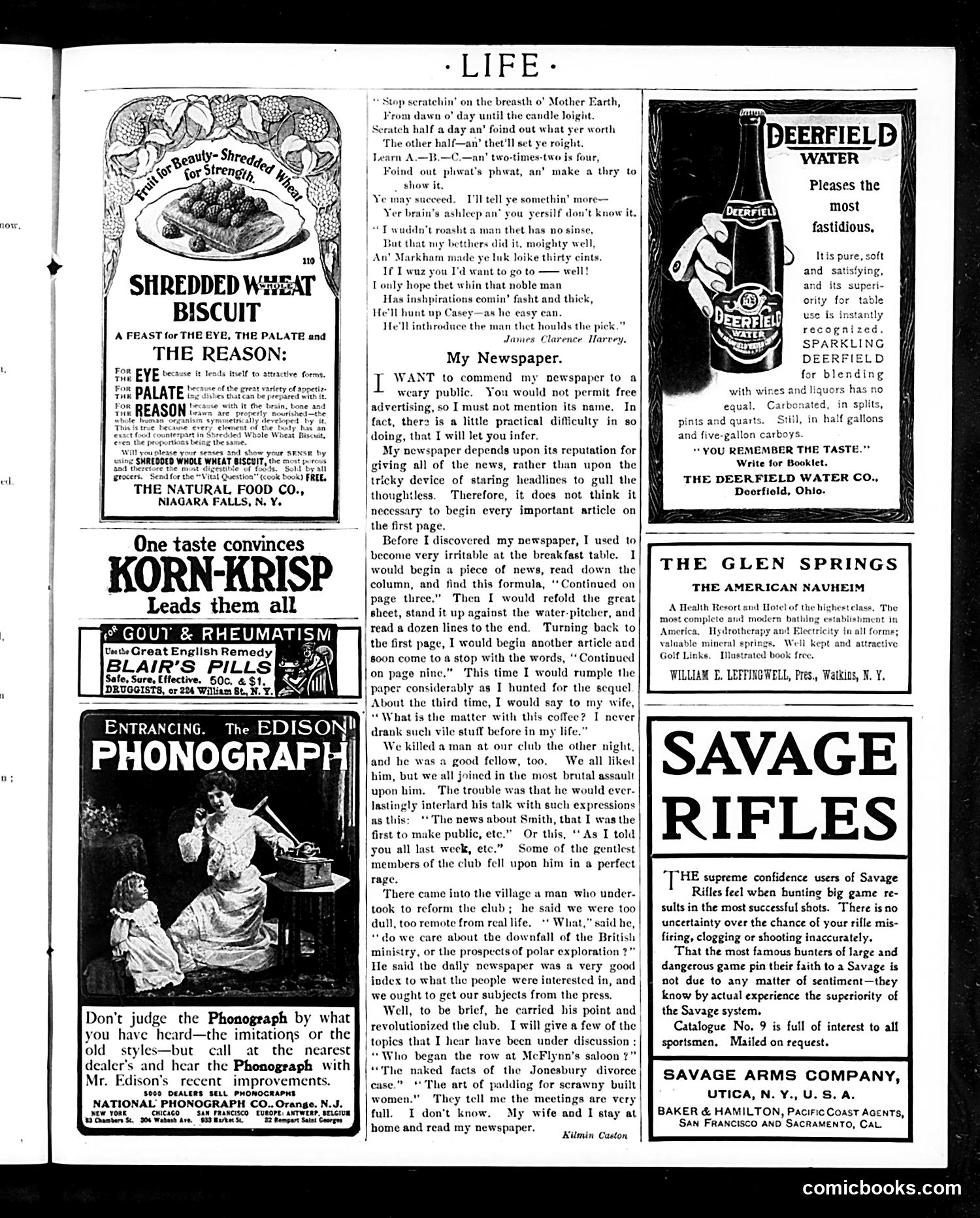
This page is primarily **advertisements and a satirical essay** about newspaper reading habits, not a political cartoon. The main content is "My Newspaper," a humorous essay by Kilburn Calder criticizing newspapers that bury story continuations on later pages. The author describes how readers become frustrated jumping between "page three" and "page nine" to finish articles, making breakfast irritable. He contrasts this with his own newspaper's practice of completing important stories on the first page. A secondary narrative satirizes a clubman who uses newspaper gossip to dominate conversations, constantly interrupting with "As I told you all last week..." His annoying habit provokes club members to physically assault him—a comedic exaggeration of social frustration with know-it-alls. The surrounding **advertisements** for Shredded Wheat Biscuit, Korn-Krisp cereal, Blair's Pills, Edison Phonograph, Deerfield Water, Savage Rifles, and Glen Springs Hotel are typical period product promotions with minimal satirical content.
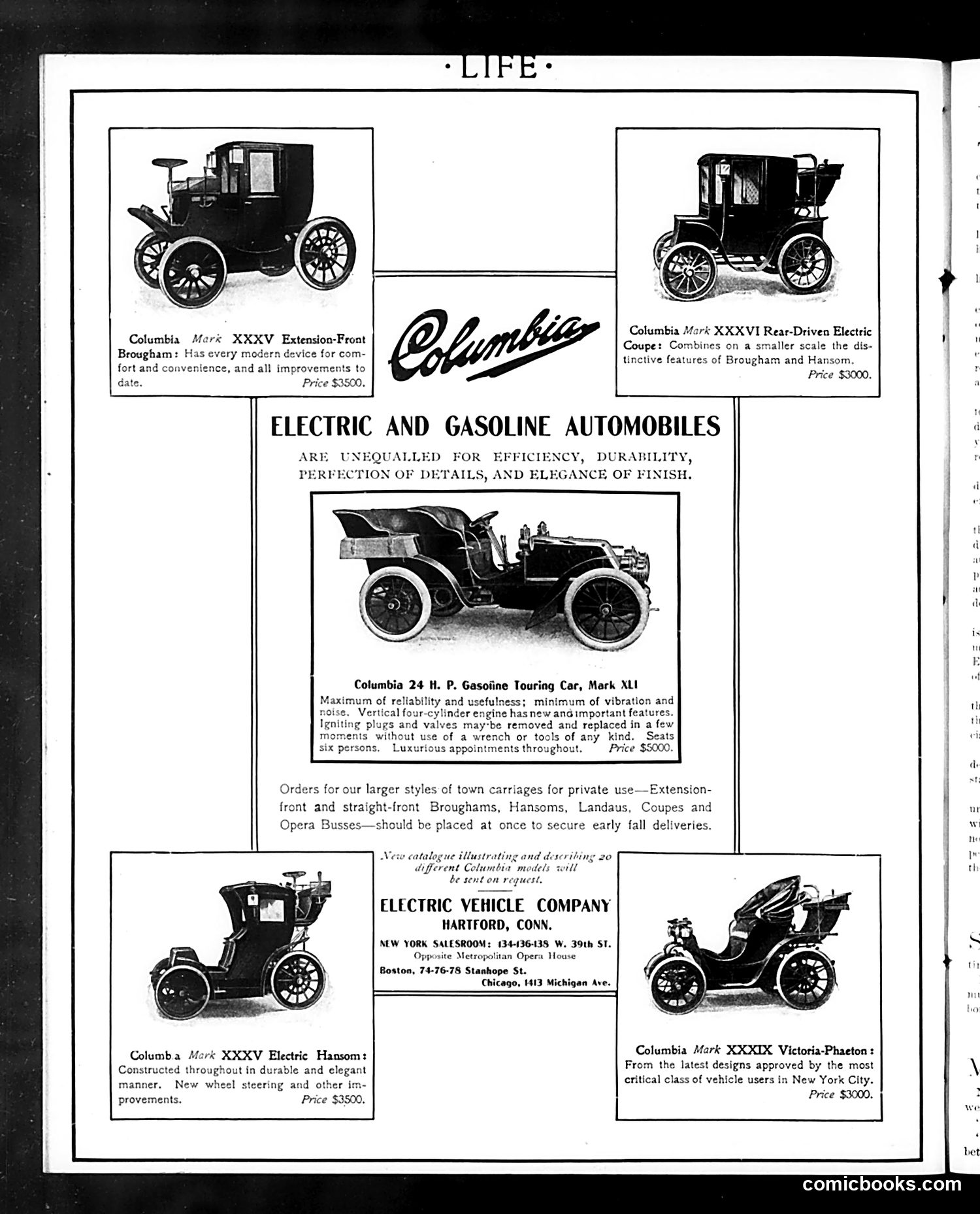
This is **not a cartoon or satire page**—it's a straightforward advertisement section from Life magazine showcasing Columbia automobiles made by the Electric Vehicle Company of Hartford, Connecticut. The page displays five different Columbia car models with prices ranging from $3,000 to $9,000, emphasizing both electric and gasoline options. The central text claims these vehicles are "unequalled for efficiency, durability, perfection of details, and elegance of finish." The historical context: This appears to be from the early 1900s when **electric vehicles competed seriously with gasoline cars**. The ad specifically juxtaposes electric and gasoline models, suggesting both technologies were viable alternatives. Electric cars were considered elegant, quiet, and reliable—particularly appealing to wealthy urban users in New York City. By modern standards, it's notable that electric vehicles were once a mainstream luxury option before gasoline engines ultimately dominated the market.
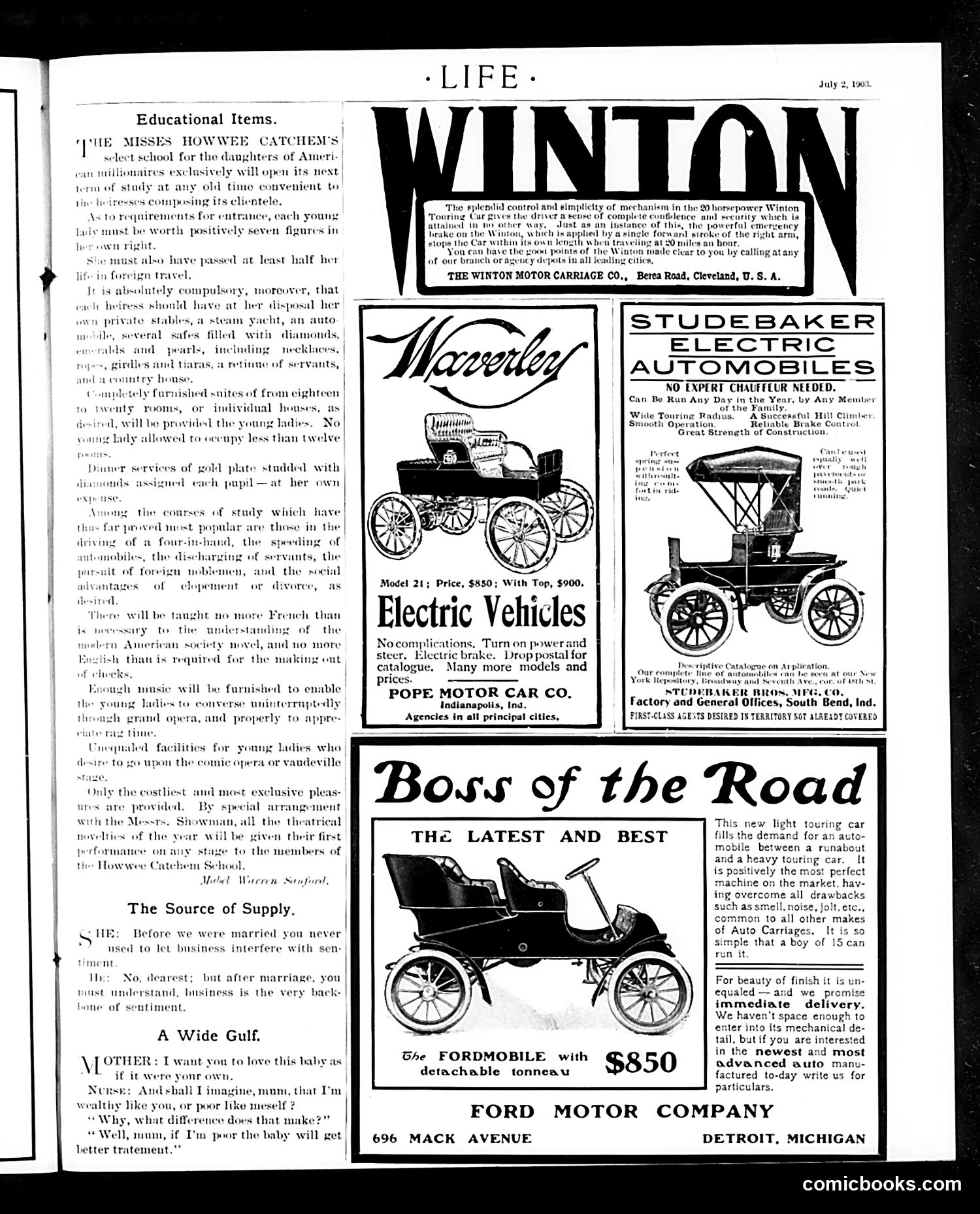
This page is primarily **advertising for early automobiles** (Winton, Studebaker Electric, Pope Motor Car, Ford), reflecting the emerging automobile industry's marketing to wealthy Americans. The satirical content appears in the "Educational Items" section, which mocks wealthy families' pretensions. It describes a fictional exclusive school for millionaires' daughters requiring students to be worth "seven figures" and possess private stables, diamonds, servants, and multiple furnished estates. The satire targets the conspicuous consumption and social snobbery of the ultra-wealthy. Two brief humor pieces follow: "The Source of Supply" jokes about how marriage transforms romantic sentiment into financial practicality, and "A Wide Gulf" presents class commentary—a nurse noting a poor caregiver would treat the baby differently than a wealthy one. The overall message reflects early 1900s American anxieties about wealth inequality and nouveau riche pretension, while simultaneously advertising luxury goods to that same wealthy audience—a tension typical of *Life* magazine's satirical approach.
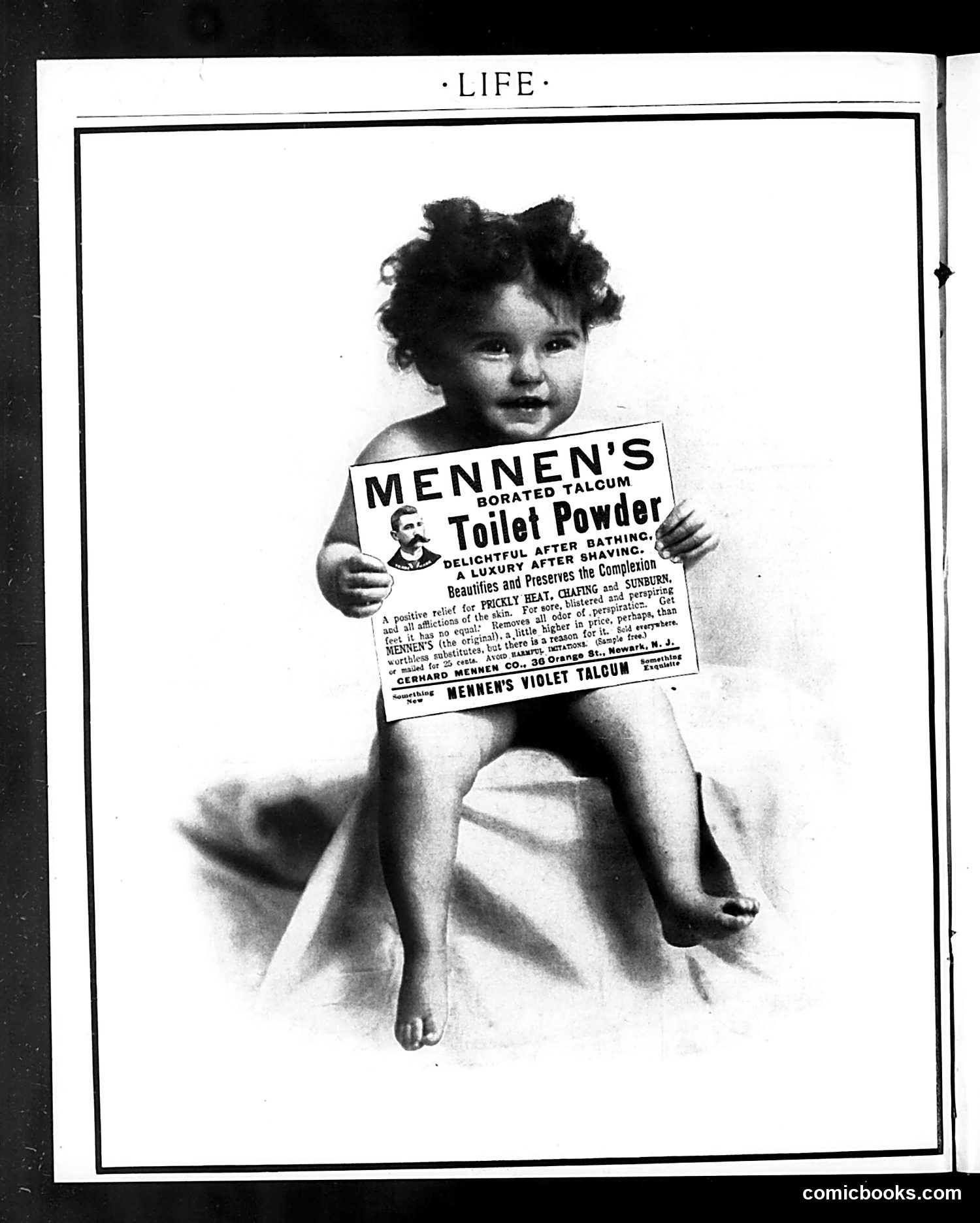
This is a **product advertisement**, not political satire or a cartoon. It appears in *Life* magazine and promotes "Mennen's Borated Talcum Toilet Powder." The ad features a young child holding the product's packaging. The advertisement emphasizes the powder as a luxury item for post-bathing use, claiming it "Beauties and Preserves the Complexion" and provides relief for prickly heat, chafing, and sunburn. The company, Gerhard Mennen Co. of Newark, New Jersey, also manufactured "Mennen's Violet Talcum" (noted at bottom). This reflects early 20th-century marketing conventions: using an innocent child to suggest the product's safety and gentleness for delicate skin. The ad makes no satirical point—it's straightforward commercial promotion typical of *Life's* advertising content.