
Life, 1903-07-02 · page 19 of 32
Life — July 2, 1903 — page 19: what you’re looking at
What you’re looking at
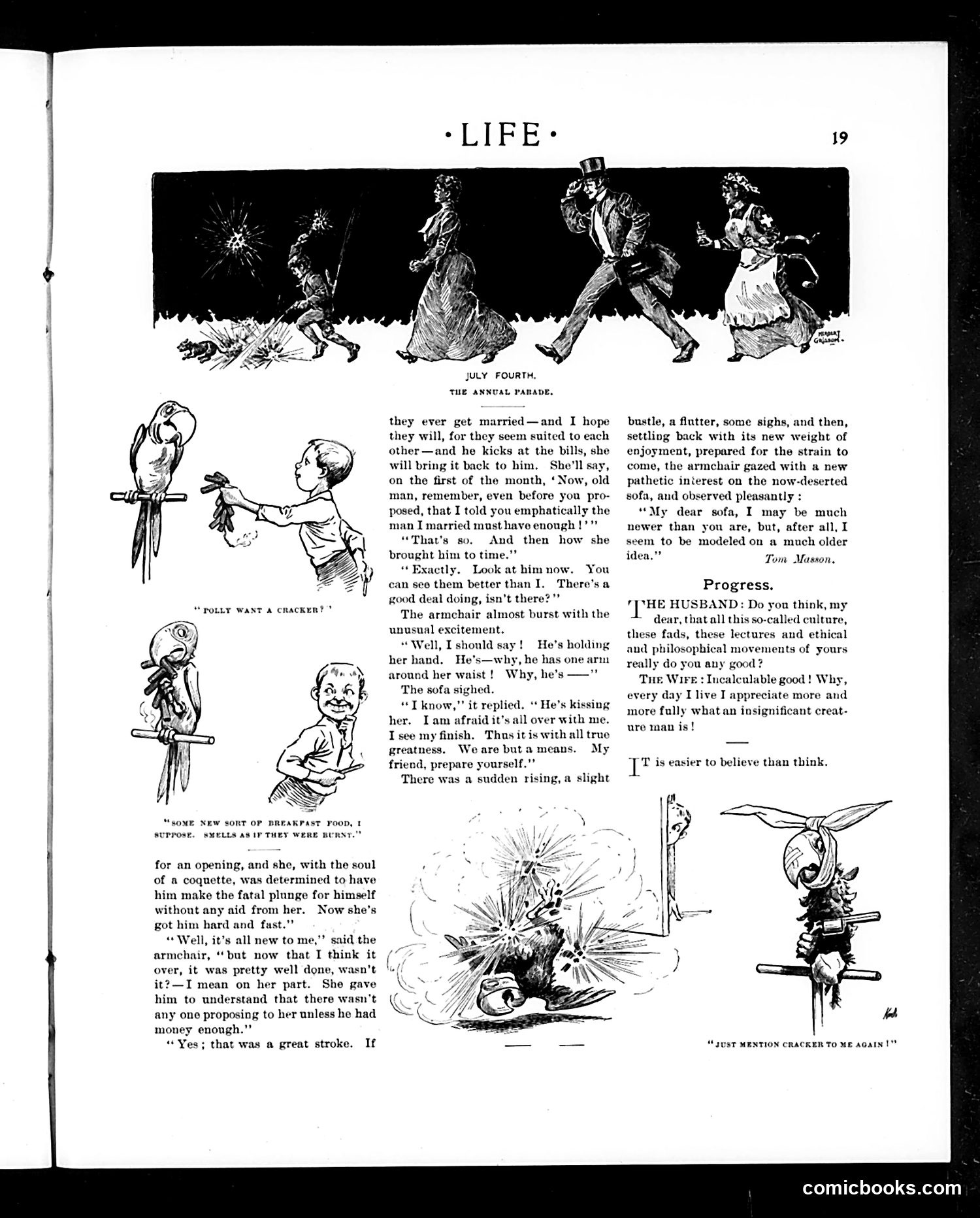
This page contains two satirical pieces typical of early 20th-century American humor: **"July Fourth: The Annual Parade"** (top) depicts a courtship narrative through dialogue between anthropomorphized furniture—an armchair and sofa. The satire mocks marriage dynamics: a woman strategically pursues a man by feigning disinterest, implying she'll only marry someone wealthy. The furniture "characters" observe the couple's romantic progress with commentary on courtship as calculated financial negotiation. The joke reflects period anxieties about marriage as economic transaction. **"Progress"** (bottom) uses domestic dialogue to satirize women's intellectual movements and culture. A husband questions whether his wife's engagement with lectures and philosophical ideas benefits her. She responds that such activities make her appreciate how "insignificant" men are—turning the ostensible self-improvement movement into an instrument of marital criticism. The humor lies in suggesting women's "progress" actually increases their contempt for their husbands. Both pieces use gentle mockery to comment on contemporary social changes regarding gender relations and marriage.
📄 Transcribed text from this page (OCR, searchable)
Machine-transcribed from the original scan — historical spelling and the odd misread are preserved.
“soz NEW SORT OP BREAKFAST YooD, 1 surrose. SMELLS ASIP THEY WERE BURNT.” for an opening, and she, with the soul of a coquette, was determined to have him make the fatal plunge for himself without any aid from her. Now she’s got him hard and fast.” «Well, it’s all new to me,”’ said the armchair, ‘but now that I think it over, it was pretty well done, wasn't it?—I mean on her part. She gave him to understand that there wasn't any one proposing to her unless he had money enough.”’ “Yes; that was a great stroke. If JULY FOURTH. THE ANNUAL PARADE, they ever get married—and I hope they will, for they seem suited to each other—and he kicks at the bills, she will bring it back to him, She'll say, on the first of the month, ‘ Now, old man, remember, even before you pro- posed, that I told you emphatically the man I married must have enough !’"" “That's so. And then how she brought him to time.”” “Exactly. Look at himnow. You can seo them better than I. There's a ood deal doing, isn’t there?” The armchair almost burst with the unusual excitement. “Well, [should say! He's holding her hand. He's—why, he has one arm around her waist! Why, he’s —” ‘The sofa sighed. “T know,” it replied. ‘* He’s kissing her. Iam afraid it’s all over with me. Isee my finish. Thus it is with all true greatness. Weare buta means. My friend, prepare yourself.” There was a sudden rising, a slight bustle, a flutter, some sighs, and then, settling back with its new weight of enjoyment, prepared for the strain to come, the armchair gazed with a new pathetic interest on the now-deserted sofa, and observed pleasantly : “My dear sofa, I may be much newer than you are, but, after all, I seem to be modeled on a much older idea. Tom Masson, Progress. ],‘HE HUSBAND: Do yon think, my dear, that all this so-called culture, these fads, these lectures and ethical and philosophical movements of yours really do you any good ? Tur Wire : Incalculable good! Why, every day I live I appreciate more and more fully what an insignificant creat- ure man is! is easier to believe than think, “JUST MENTION CRACKER To ME AGAIN !”” comicbooks.com