
A complete issue · 26 pages · 1902
Life — December 18, 1902
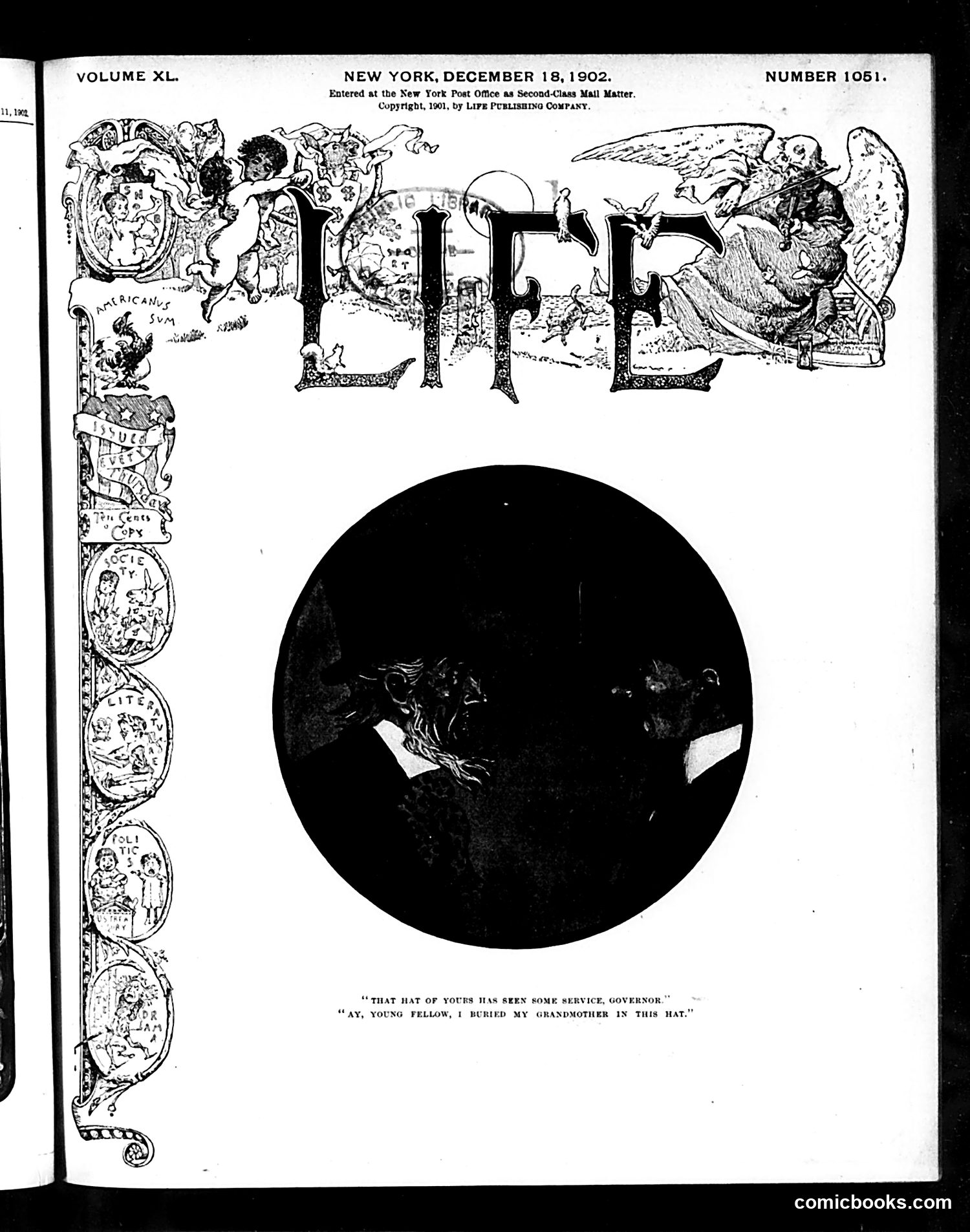
This is a Life magazine cover featuring an ornate decorative border and a large black circular illustration (likely a photograph or halftone image, now largely degraded). The caption reads: "That hat of yours has seen some service, Governor." / "Ay, young fellow, I buried my grandmother in this hat." The dialogue suggests political satire involving a governor character, playing on the worn condition of a hat as metaphor—possibly for a politician's long tenure, repeated use of old political strategies, or general age/wear from service. The specific governor referenced is unclear without additional context, though this period included various state governors in prominent positions. The humor relies on the absurdist claim about the hat's history.
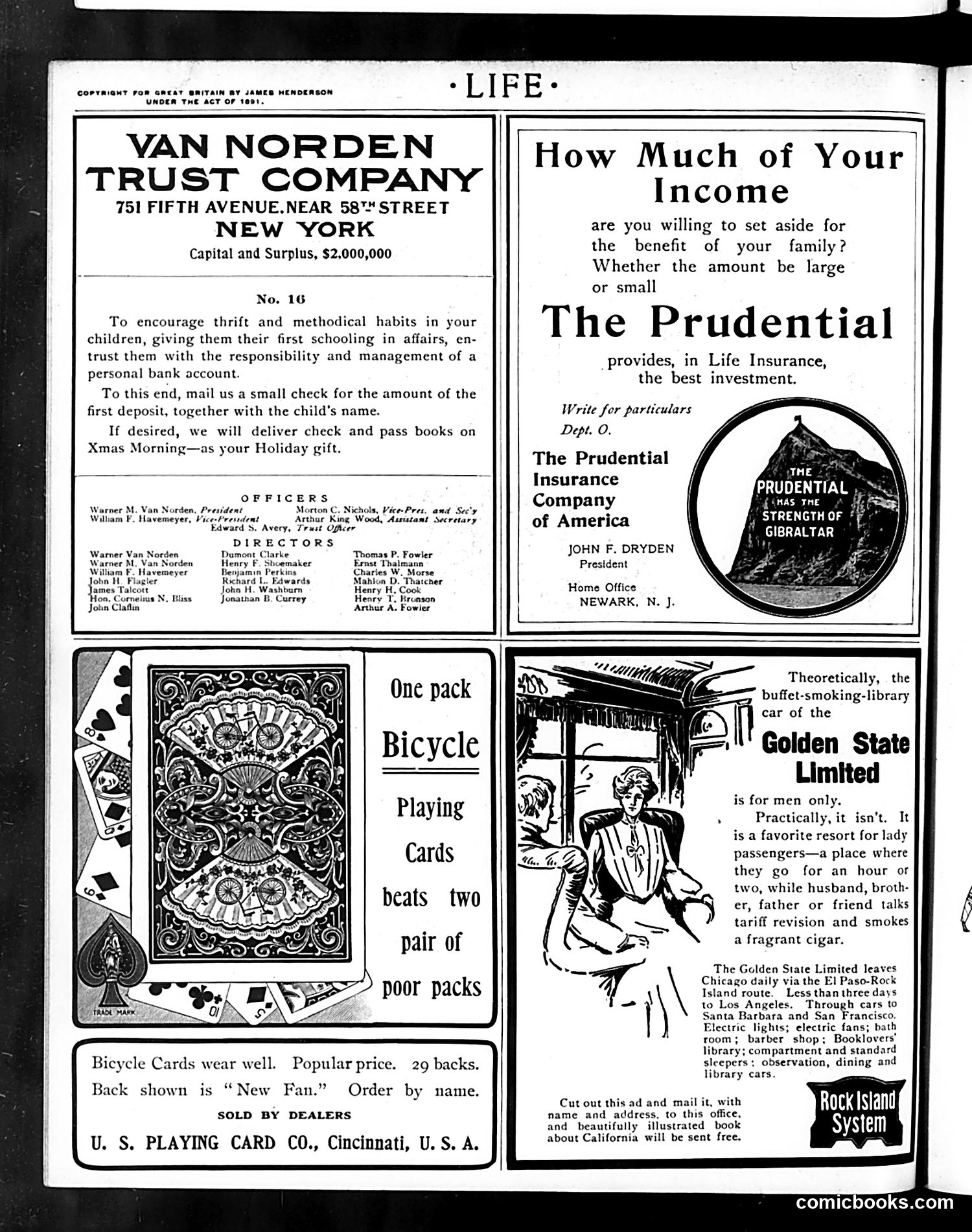
This page is primarily **advertising**, not satire or political commentary. It contains four commercial advertisements: 1. **Van Norden Trust Company** — a bank offering children's savings accounts 2. **The Prudential Insurance Company** — promoting life insurance as an investment 3. **Bicycle Playing Cards** — standard playing cards marketed as superior quality 4. **Golden State Limited** — a luxury train service operating between Chicago and California The only image with potential narrative content is the train advertisement, which depicts a woman in the observation car. The accompanying text describes the train's amenities (library, barber shop, dining car) and notes it's "for men only" in theory but used by families in practice. These are straightforward period advertisements with no apparent political satire or social commentary.
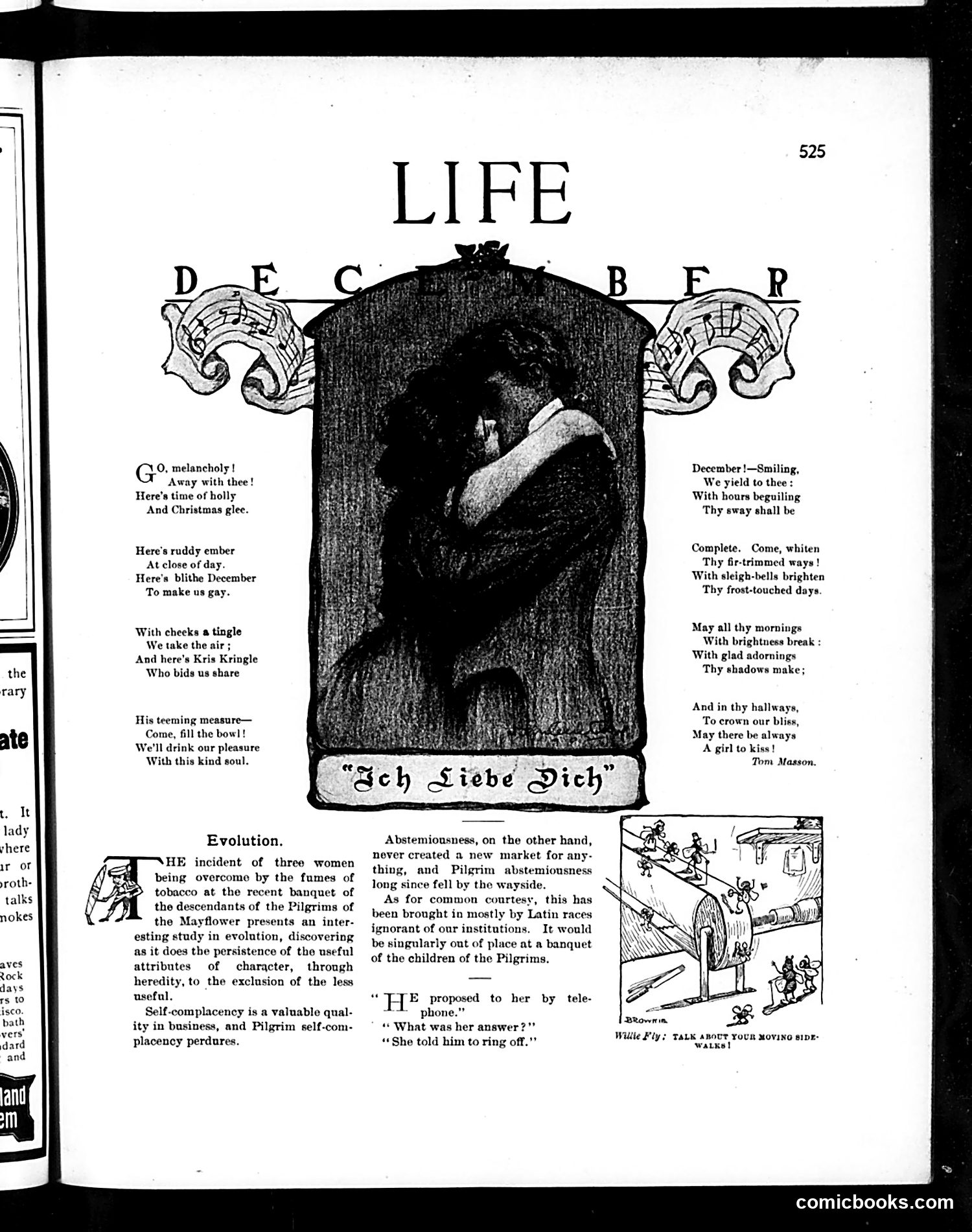
**Main Image**: "Ich Liebe Dich" ("I Love You" in German) - A sentimental portrait of a young woman in a contemplative pose, surrounded by romantic poetry about December and winter themes. **"Evolution" Section**: A satirical commentary on Pilgrim ancestry and social attitudes. The text critiques self-complacency among descendants of Pilgrims, arguing that focusing exclusively on useful hereditary traits while ignoring less desirable ones represents flawed thinking. It suggests this selective pride is inappropriately "out of place" in modern society. **Joke Panel**: A brief comedic anecdote about a telephone proposal and rejection, playing on emerging telephone technology as a modern courtship tool. The page blends sentimental imagery with social satire typical of early 20th-century Life magazine.
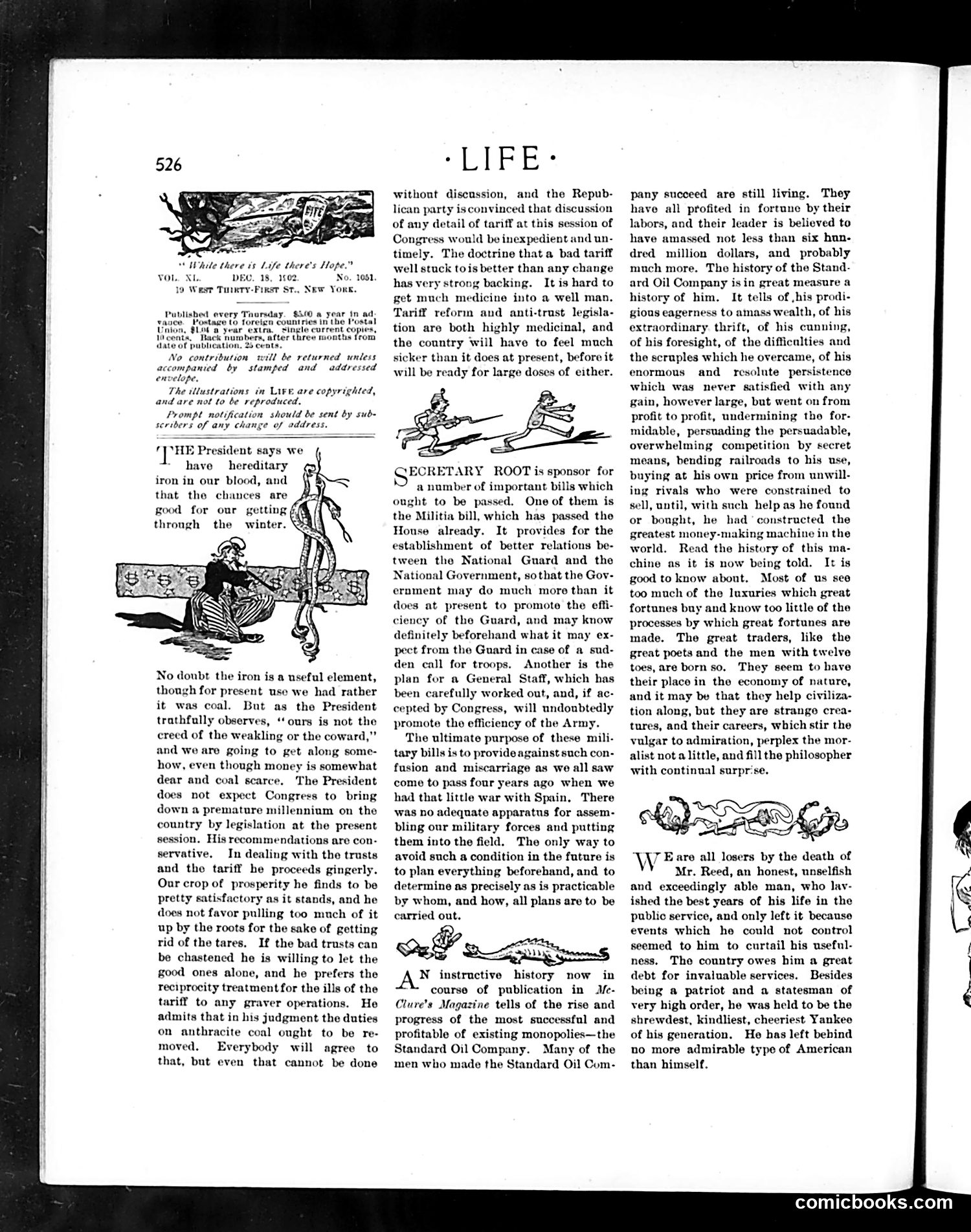
This page contains political commentary on tariff reform and military legislation rather than traditional political cartoons. The text discusses the President's support for protective tariffs and iron production, arguing such policies strengthen American industry and the economy. The cartoon illustrations are decorative rather than satirical—showing figures tied in knots or struggling, which visually reinforce the text's point that tariff policy is complex and contentious. The page also includes a tribute to a deceased public figure (Mr. Reed), described as an "honest, unselfish" patriot who served honorably. This appears to be a memorial section rather than satire. The overall tone is earnest political argument rather than sharp satire, advocating for protective economic policies and military preparedness.
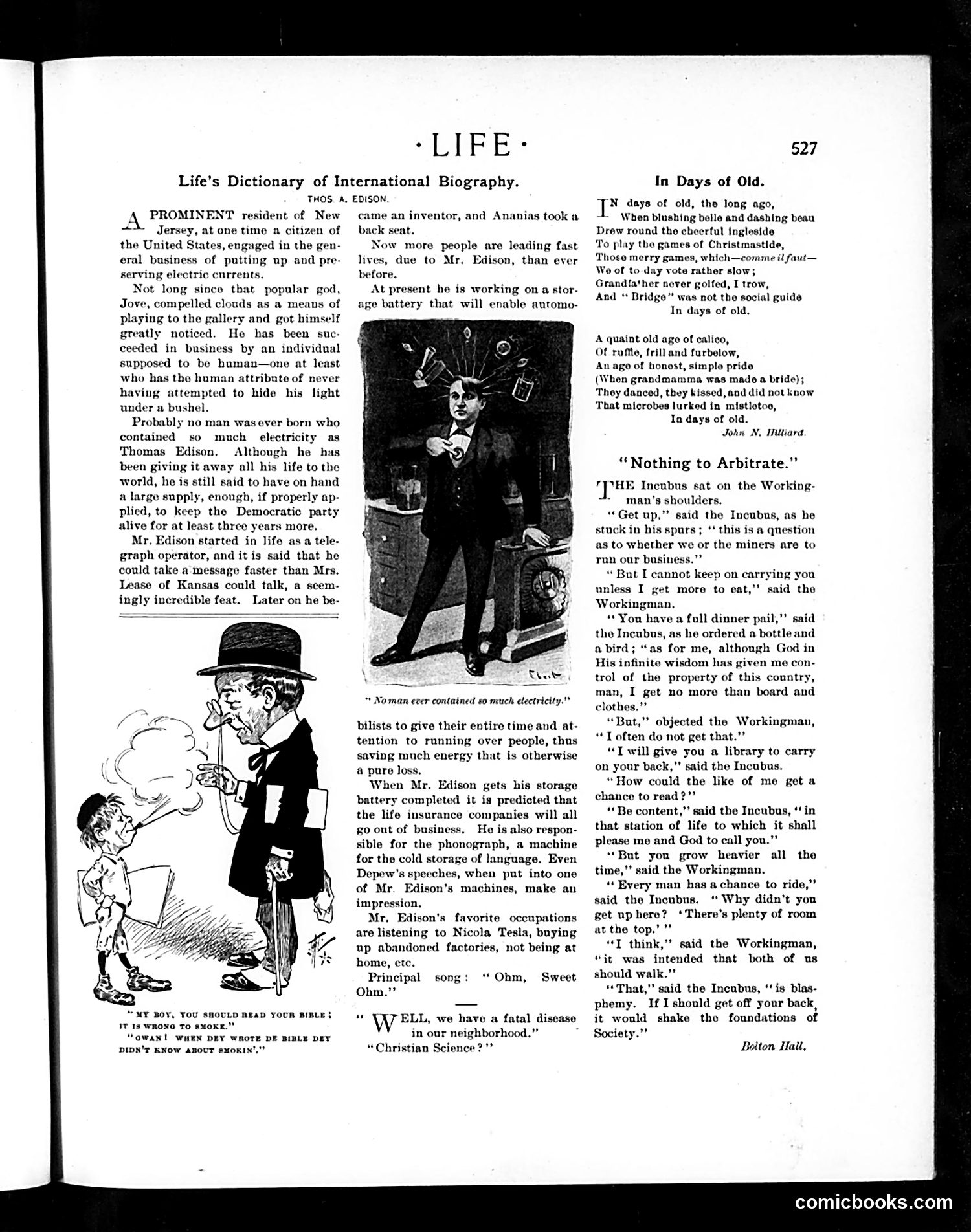
**Main Content:** A biographical entry on Thomas Edison by Thos. A. Edison, celebrating his prolific inventions and electrical innovations. The text emphasizes Edison's tireless work ethic and his importance to Democratic politics. **Left Cartoon:** A caricatured figure (likely Edison, given the context) rides a bicycle while smoking, depicted as a grotesque, exaggerated character. The caption mocks Bible reading: "MY BOY, YOU SHOULD READ YOUR BIBLE; IT IS WRONG TO SWORE" / "GWAN! WHEN MY WRITE OF BIBLE DEY DIDN'T KNOW 'BOUT SMOKIN'." This satirizes hypocrisy—the contrast between moral preaching and actual behavior. **Right Section:** "Nothing to Arbitrate" presents a dialogue between an Incubus and a Workingman disputing wages and working conditions, likely commentary on labor disputes of the era.
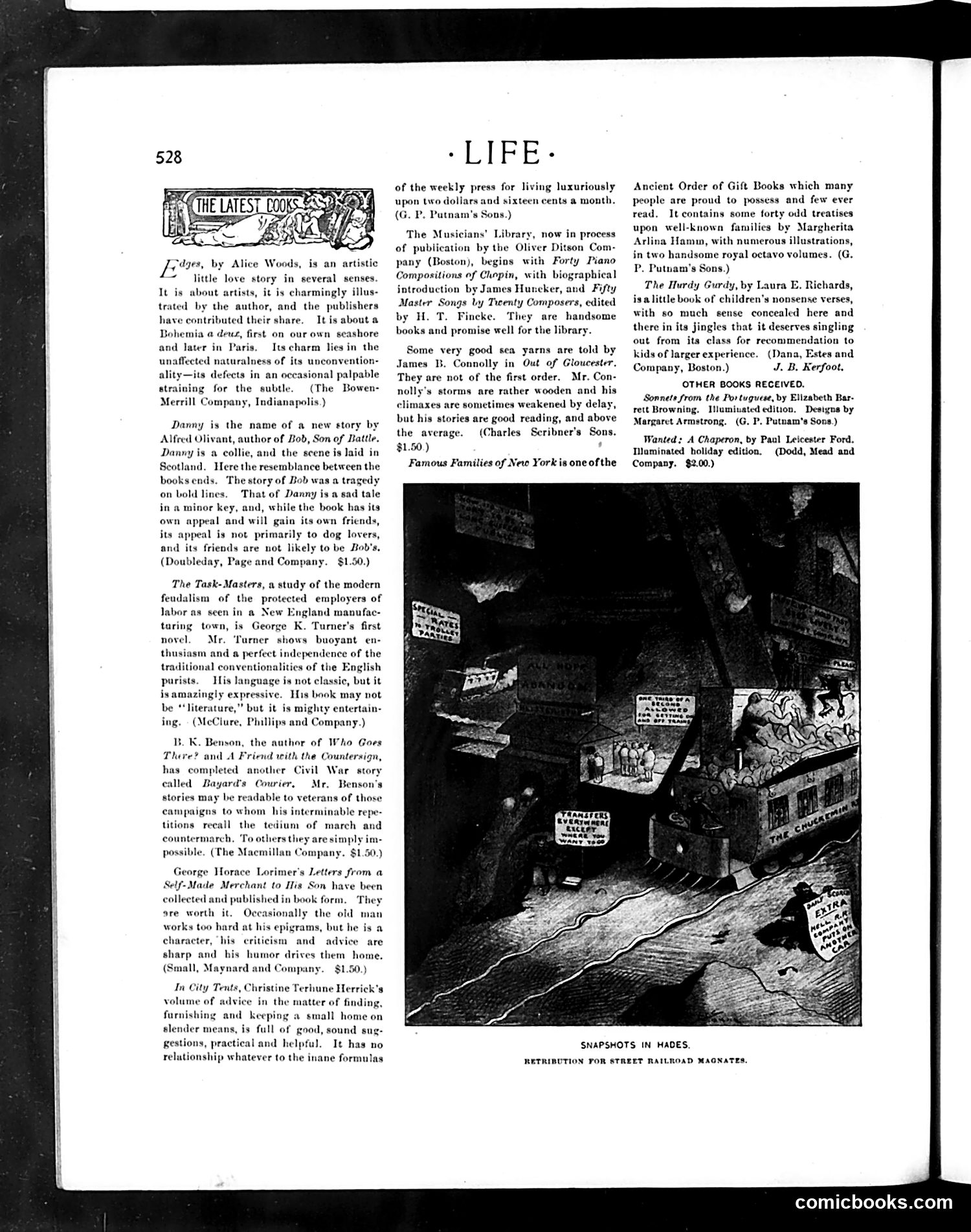
This cartoon depicts a satirical scene titled "Snapshots in Hades" showing "retribution for street railroad magnates." The image shows various figures (apparently corrupt railroad executives) experiencing punishment in Hell, surrounded by devilish imagery and torment. The satire targets street railroad (streetcar/trolley) company owners who were apparently viewed as villainous during this era. The "snapshots in Hades" conceit—showing their damnation—reflects Progressive-era outrage at railroad monopolies and their owners' exploitation practices. Without clearer labels identifying specific magnates, we cannot name individuals, but the cartoon exemplifies early 20th-century American satirical attacks on corporate greed and corrupt business practices that harmed the public.
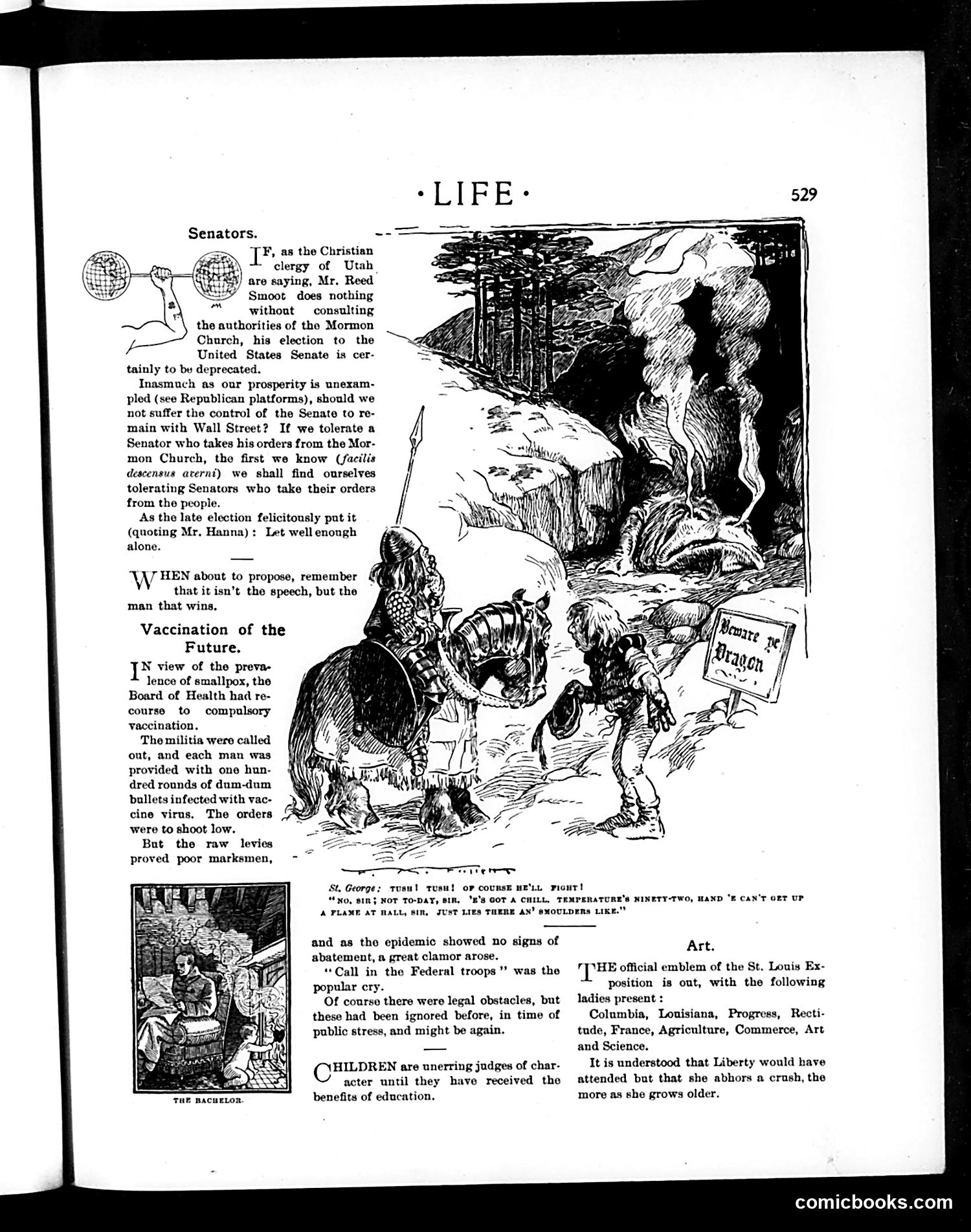
This page contains satirical commentary on Utah politics and public health. The main cartoon depicts a dragon labeled "Smallpox" confronting figures representing the Utah situation—likely referencing debates over compulsory vaccination and government authority. The text criticizes Senator Reed Smoot of Utah for making political decisions without consulting the Mormon Church leadership, sarcastically suggesting this breaks precedent. It then pivots to mock compulsory vaccination policies during a smallpox outbreak, depicting the enforcement as heavy-handed. The dragon imagery suggests disease as a threat, while the figures' apparent helplessness critiques government overreach in public health mandates. The overall tone is skeptical of both religious influence in politics and state vaccination requirements—issues that generated significant controversy in early 20th-century America.
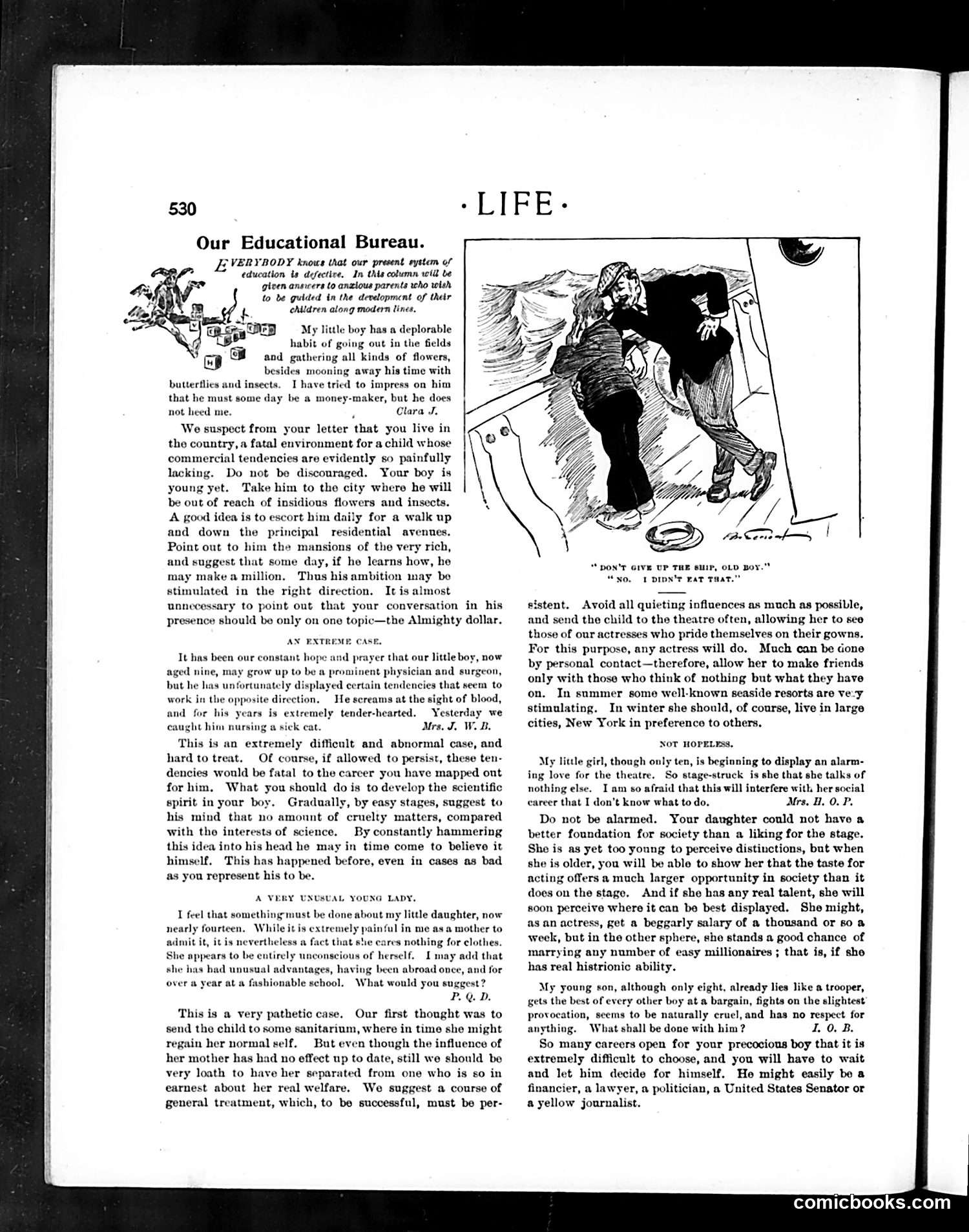
This page contains advice columns addressing child-rearing concerns, not political cartoons. The single illustration shows an adult and child on a street, captioned "Don't give up the ship, old boy" / "No, I didn't eat that." The columns discuss parental anxieties: one letter worries a boy gathering flowers lacks commercial ambition; another concerns a tender-hearted nine-year-old; a third describes a theatrical-obsessed ten-year-old girl; and a fourth addresses an apparently cruel eight-year-old boy. The "Educational Bureau" offers genteel advice emphasizing scientific child development, theater exposure for cultural cultivation, and career guidance. The satire targets middle-class parental neuroses and their conflicting aspirations—worrying simultaneously about their children's moral character, commercial success, and cultural refinement.
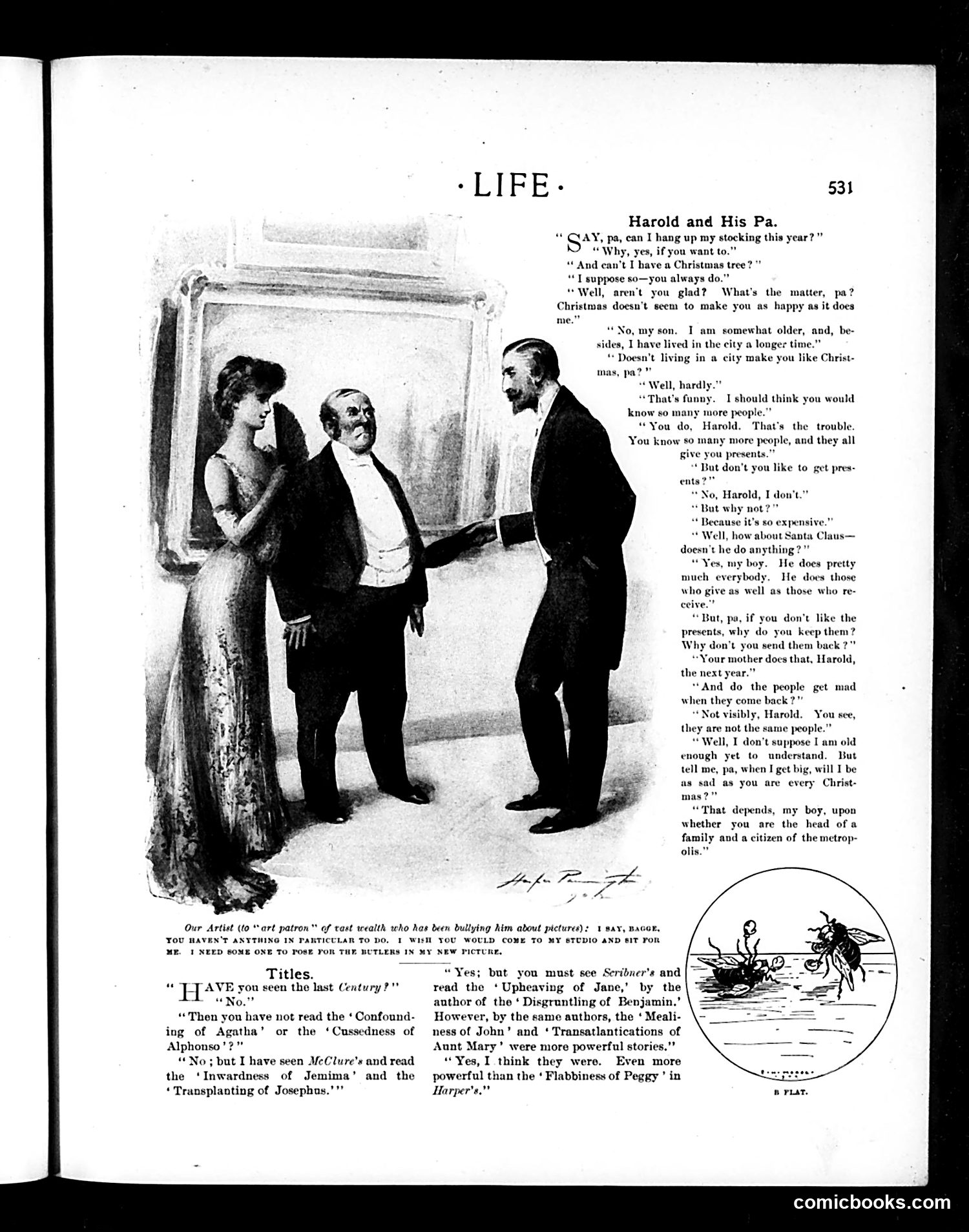
This page contains a humorous domestic dialogue between a father and son named Harold, illustrated by a sketch showing three figures in formal dress conversing indoors. The conversation centers on Christmas preparations—specifically whether Harold will hang stockings and obtain a Christmas tree. The father, identified as "Pa," expresses surprise that city living has made Harold less enthusiastic about Christmas traditions. The satire gently mocks modern urban life's impact on family customs. The dialogue touches on gift-giving anxieties and social obligations, with Pa suggesting that as head of household and "citizen of the metropolis," Harold's Christmas attitude should reflect responsibility and contentment. Below the main piece, a "Titles" section references other serialized stories from *Life* and *Harper's* magazines, suggesting this is part of the publication's regular fiction content.
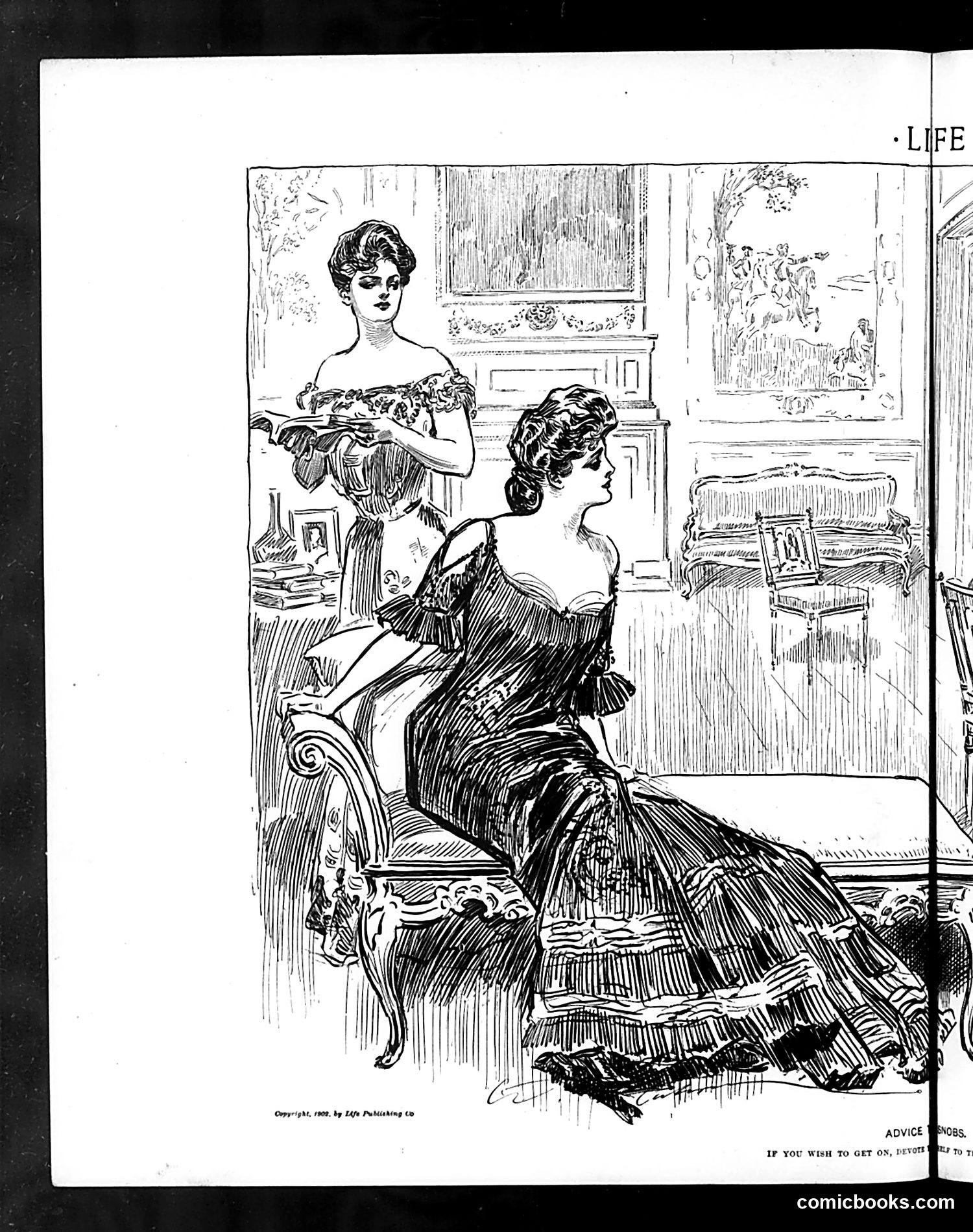
This appears to be a page from *Life* magazine featuring an illustration of two fashionable women in an elegant interior setting. The woman in the foreground sits in a decorative chair wearing an elaborate, heavily draped dark gown typical of early 1900s fashion. A second woman stands behind her holding flowers. The visible text fragments reference "ADVICE" and partial text about getting on, though the complete caption is cut off. Without the full caption or headline, the specific satirical point remains unclear, though it likely comments on women's fashion, social etiquette, or domestic life—common *Life* magazine targets. The artistic style and clothing suggest this dates to approximately 1900-1910. The copyright attribution mentions "Life Publishing Co."
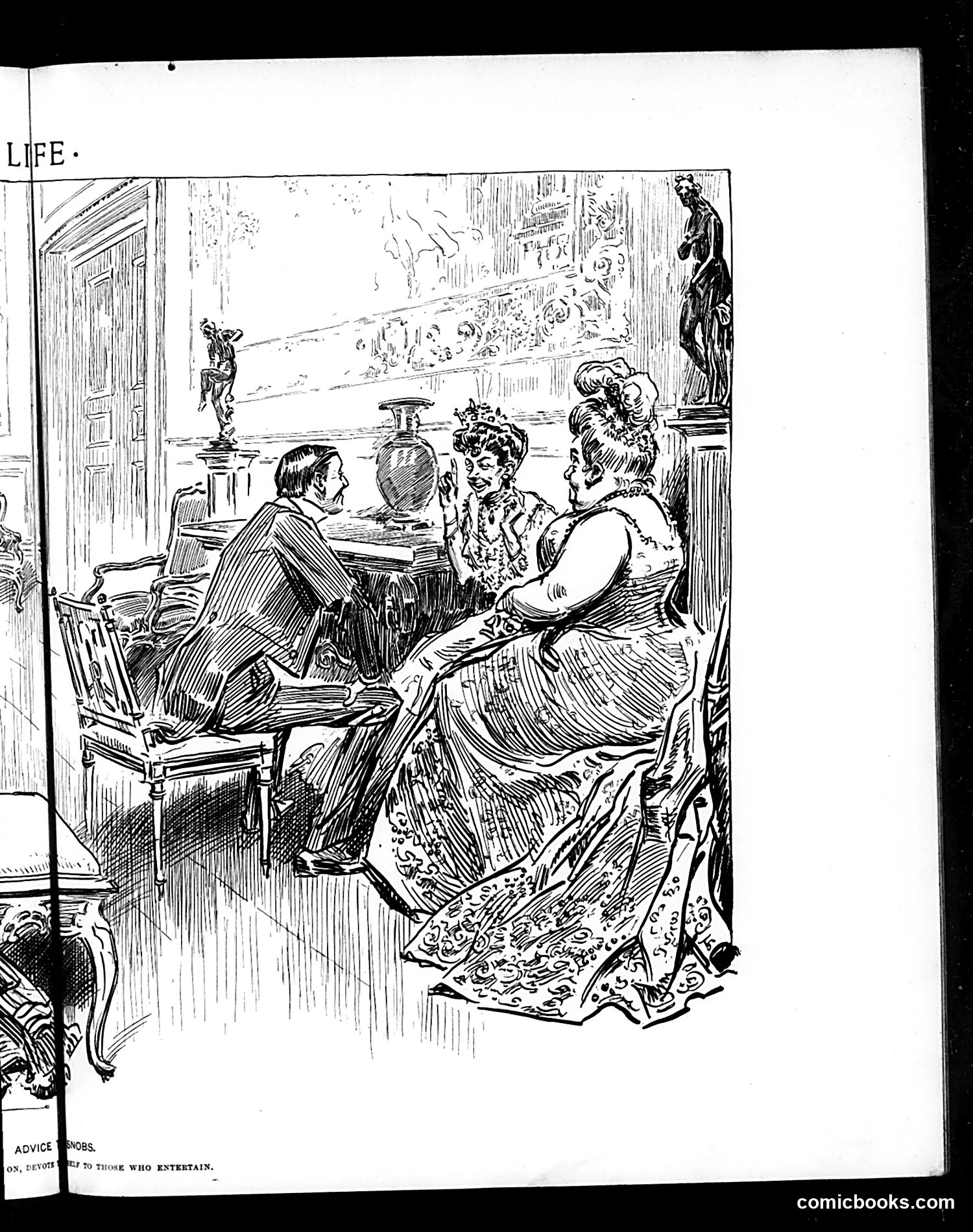
This page from *Life* magazine's "LIFE" section shows a social scene illustration titled (partially visible) "ADVICE FOR MOBS" with text mentioning "ON LIVING TO THOSE WHO ENTERTAIN." The sketch depicts four elegantly dressed people in what appears to be an upper-class interior—a man in a suit conversing with fashionably dressed women. The setting suggests a salon or drawing room with classical statuary visible in the background. The satire appears to mock wealthy socialites and their entertainment gatherings, likely offering ironic "advice" about hosting or social etiquette among the elite. The ornate clothing and refined setting contrast with the publication's satirical intent. Without the complete caption text visible, the specific social critique remains partially unclear, but this represents *Life* magazine's typical early 20th-century mockery of high society's pretensions.
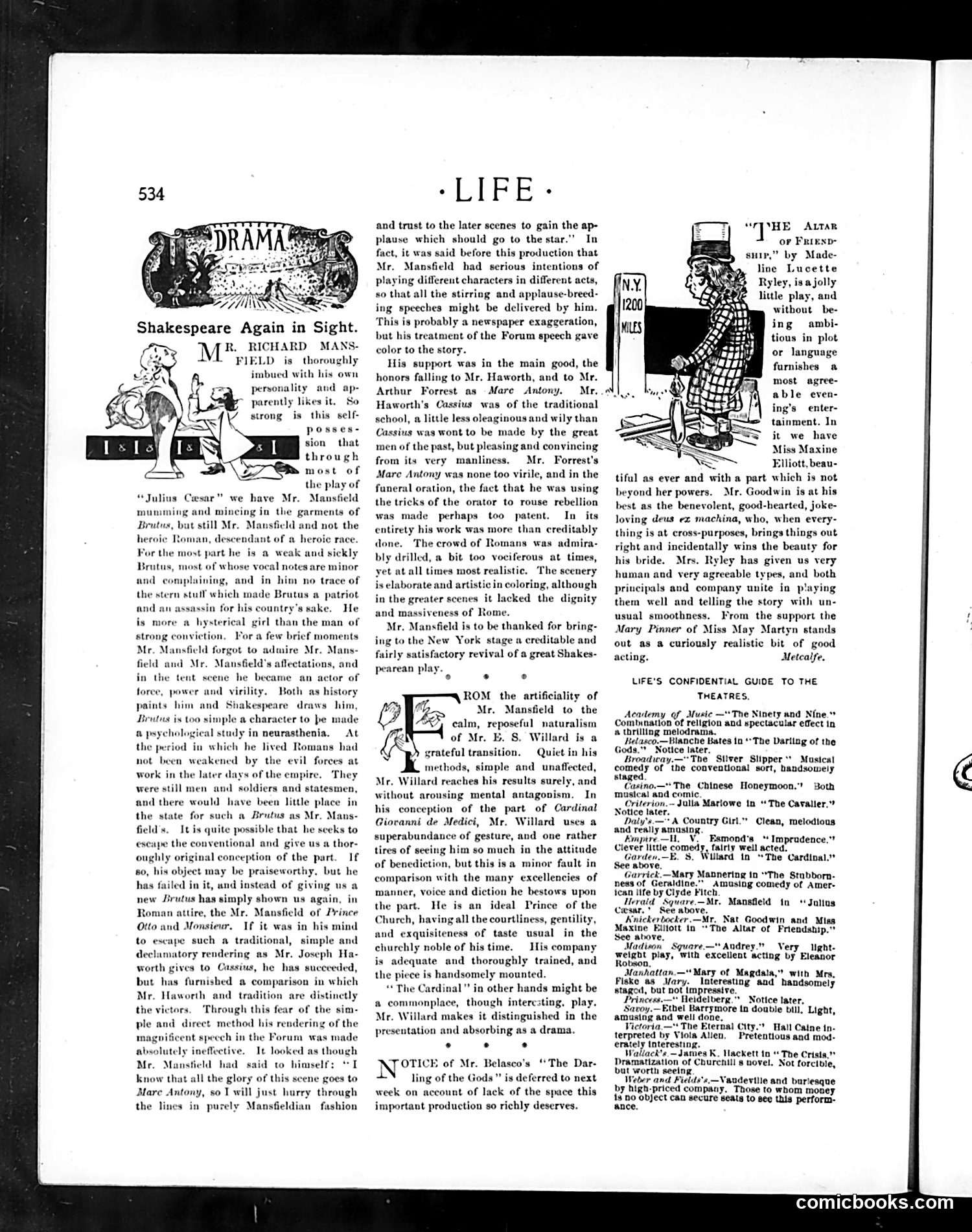
This page reviews theatrical productions, primarily Shakespeare's *Julius Caesar* and *Romeo and Juliet*, featuring actor Richard Mansfield in leading roles. The left cartoon depicts Mansfield as a theatrical figure surrounded by character masks, illustrating his range across multiple Shakespearean roles. The text praises his performance while noting he "drew him *Brutus* to laugh a character in the shade"—suggesting his interpretation was psychologically nuanced rather than conventionally heroic. The reviews discuss supporting actors, staging choices, and production quality. One sidebar advertises "Life's Confidential Guide to the Theatres," listing various contemporary plays and performances. The page is primarily drama criticism rather than political satire, focusing on early 1900s theatrical merit and performance analysis.
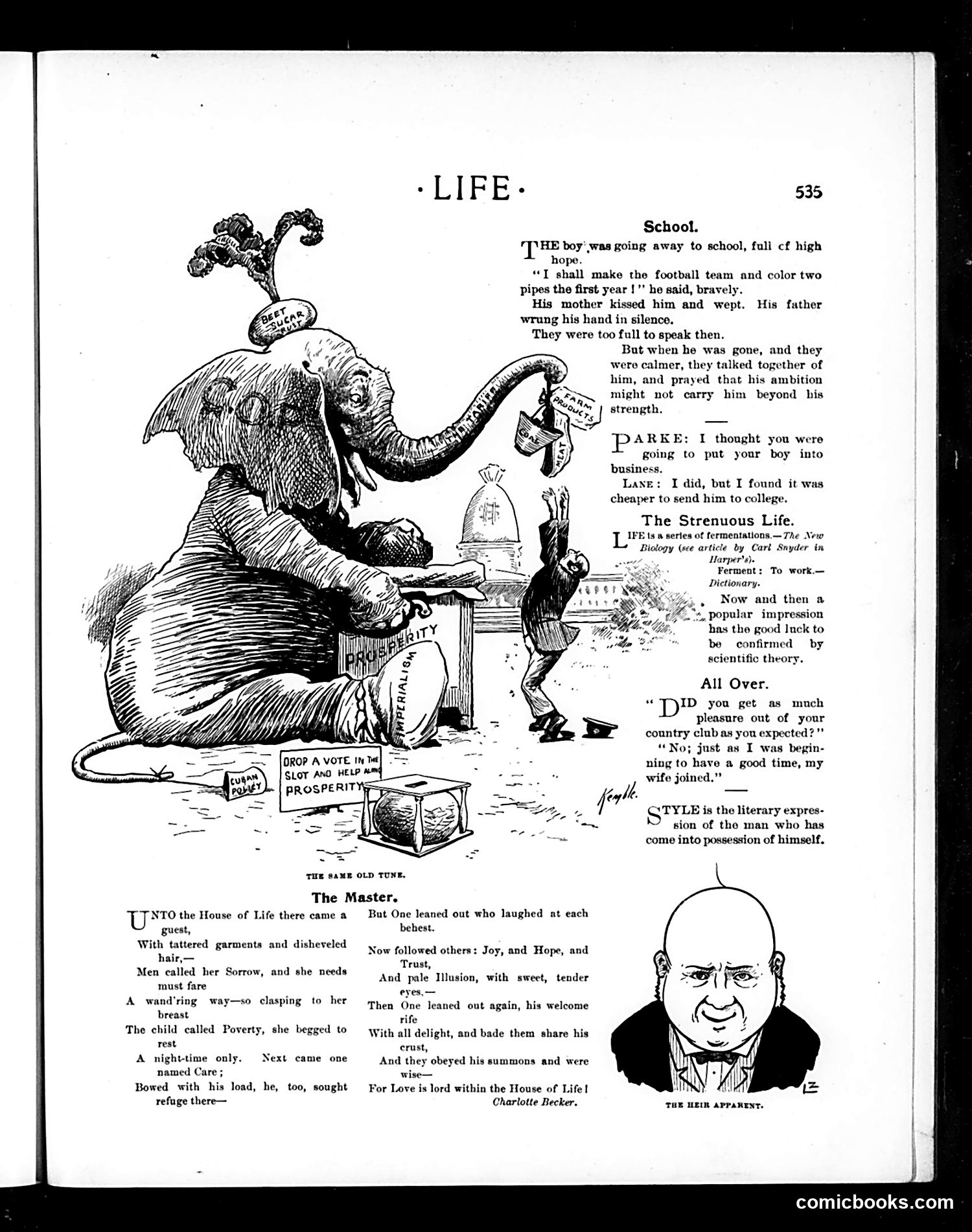
The page contains several satirical pieces typical of early 20th-century *Life* magazine: **"School"**: A sentimental vignette about a boy's college ambitions, followed by dialogue between "Darke" and "Lane" mocking the expense of education—the joke being that college costs more than apprenticing a boy into business. **"The Same Old Tune"**: A allegorical poem personifying abstract concepts (Sorrow, Poverty, Care, Joy, Hope) visiting "the House of Life," concluding that Love welcomes all. This appears to be serious literary content rather than satire. **Left illustration**: A large political cartoon labeled "The Same Old Tune" shows an elephant (likely representing Republican politics or wealth/establishment) dispensing items labeled "Prosperity" and "Vote," while figures below reference "Drop a Vote in the Slot and Help Prosperity"—satirizing the idea that voting or political action produces economic prosperity, depicted as a mechanical, cynical system. **Remaining pieces**: Brief humorous observations on life's contradictions (country clubs, style, ambition), typical of the magazine's satirical format.
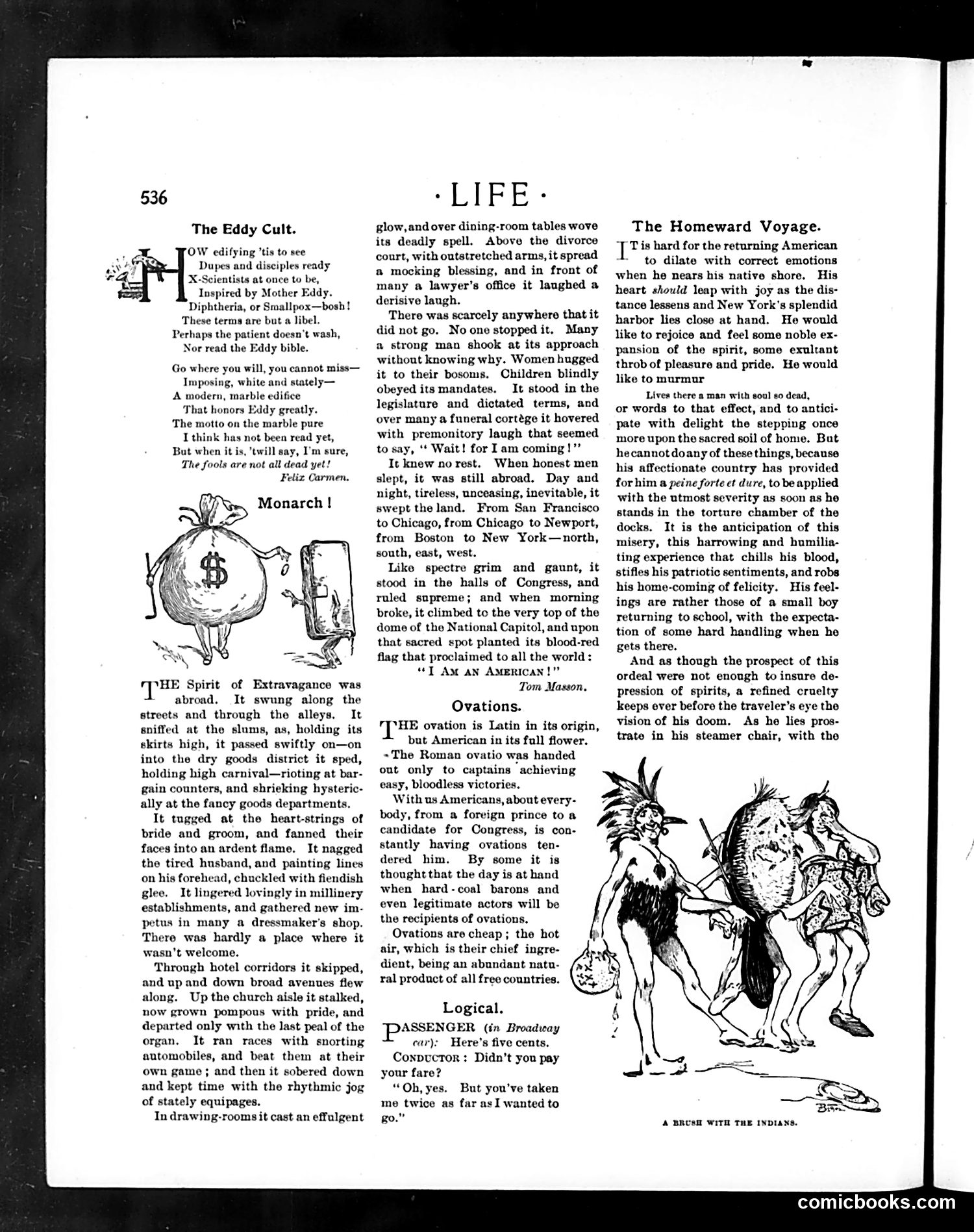
This page contains three satirical pieces targeting American social issues and follies: **"The Eddy Cult"** mocks Christian Science and its founder Mary Baker Eddy. The poem ridicules followers ("X-Scientists") who reject medical treatment for diseases like diphtheria and smallpox as mere "libels," trusting only Eddy's teachings. The satire suggests these believers are deluded—noting the marble churches built to honor Eddy while concluding "The fools are not all dead yet." **"Spirit of Extravagance"** personifies wasteful spending as a ghost haunting American society—from shopping districts to divorce courts to Congress itself. It represents frivolous consumerism consuming the nation from San Francisco to New York, even desecrating the Capitol dome with a proclamation of American excess. **"Ovations"** notes Americans give ceremonial ovations to nearly everyone (unlike Romans, who reserved them for military victories), fueled by cheap "hot air"—abundant in free countries. The page satirizes American gullibility, materialism, and inflated self-regard circa early 1900s.
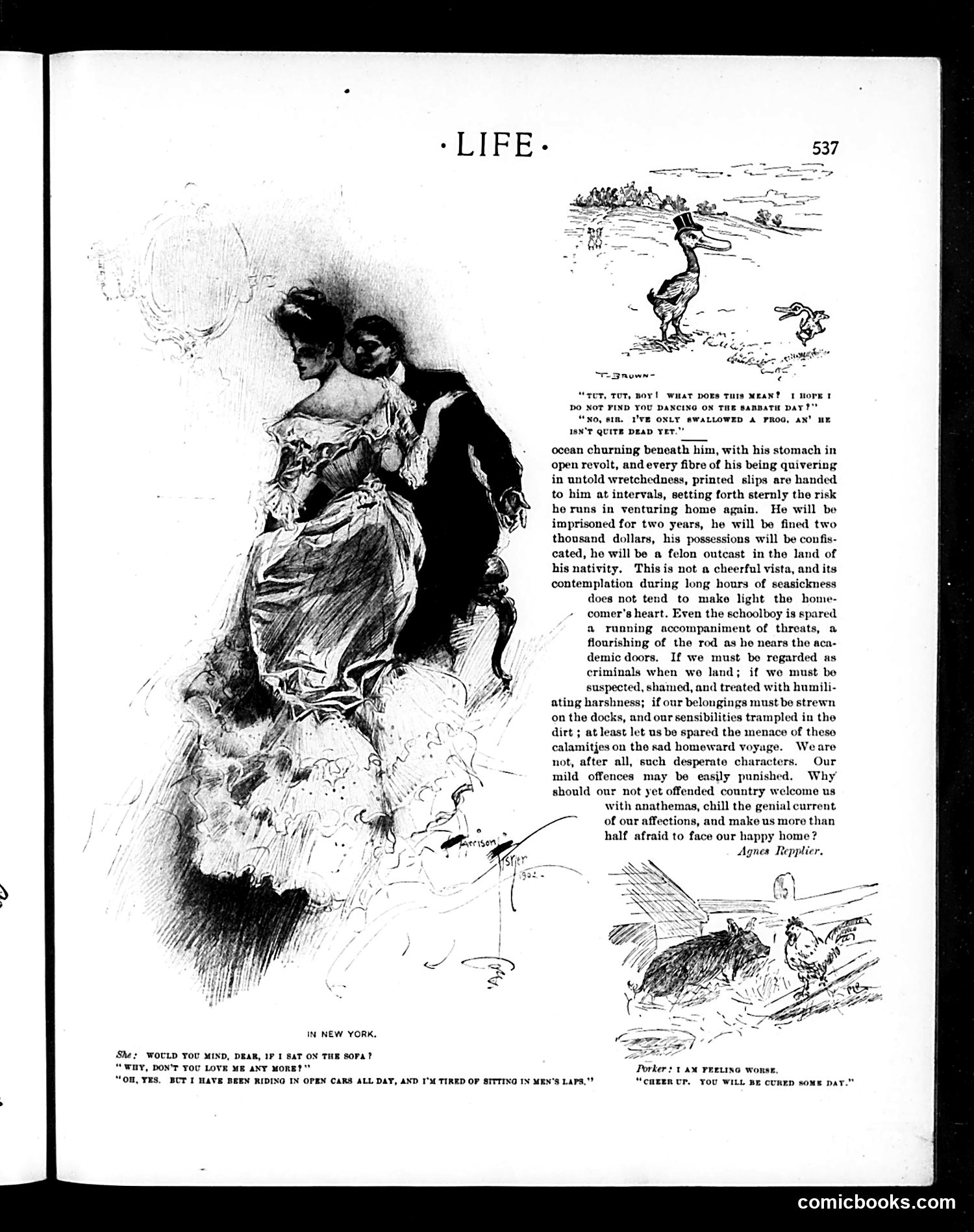
This page contains **two separate satirical pieces**: **Top section**: An essay by Agnes Repplier criticizing harsh U.S. immigration policies. The illustrated vignette shows an official interrogating a returning immigrant boy about breaking the Sabbath (dancing on Sunday). The text argues that returning Americans face cruel treatment—threats, searches, confiscation of belongings—making homecoming traumatic rather than joyful. Repplier advocates for more humane treatment of citizens re-entering the country. **Bottom section**: Two joke panels mocking modern urban life in New York. The first depicts a couple where the woman refuses to sit on the sofa because she's exhausted from "riding in open cars all day...sitting in men's laps"—likely referencing crowded public transportation. The second shows a porter consoling a weary woman, suggesting she'll eventually "be cured"—implying this exhaustion is an inevitable condition of city living. Both pieces use humor to critique contemporary American social conditions.
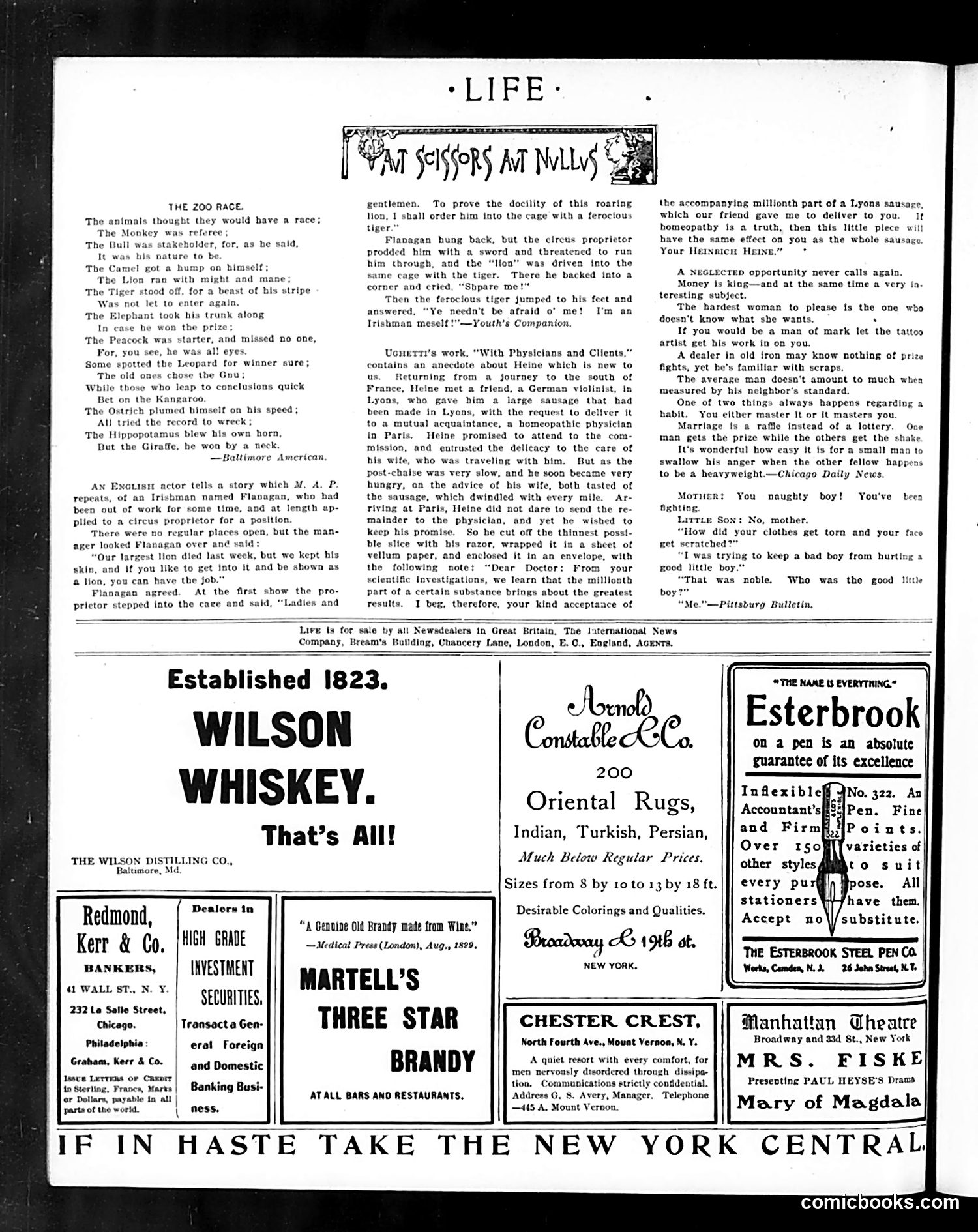
This page from *Life* magazine consists primarily of light humorous content rather than political satire. **"The Zoo Race"** is a whimsical poem where animals compete in a race, each characterized by stereotypical traits: the Monkey as referee, the Lion with his mane, the Peacock as starter ("all eyes"), and the Giraffe winning "by a neck." The humor is straightforward wordplay. Below are anecdotes: one about an Irishman (Flanagan) hired to wear a lion skin who discovers the "tiger" is also Irish; another about German poet Heine eating most of a Lyons sausage while traveling, then sending the remaining tiny slice to a homeopathic physician with a joke about homeopathy's infinitesimal doses. The page is primarily **advertisements** (Wilson Whiskey, Oriental Rugs, Esterbrook pens, etc.) with scattered aphorisms and notices for theatrical productions. There is no political commentary—it's entertainment and commercial content typical of early 20th-century *Life* magazine.
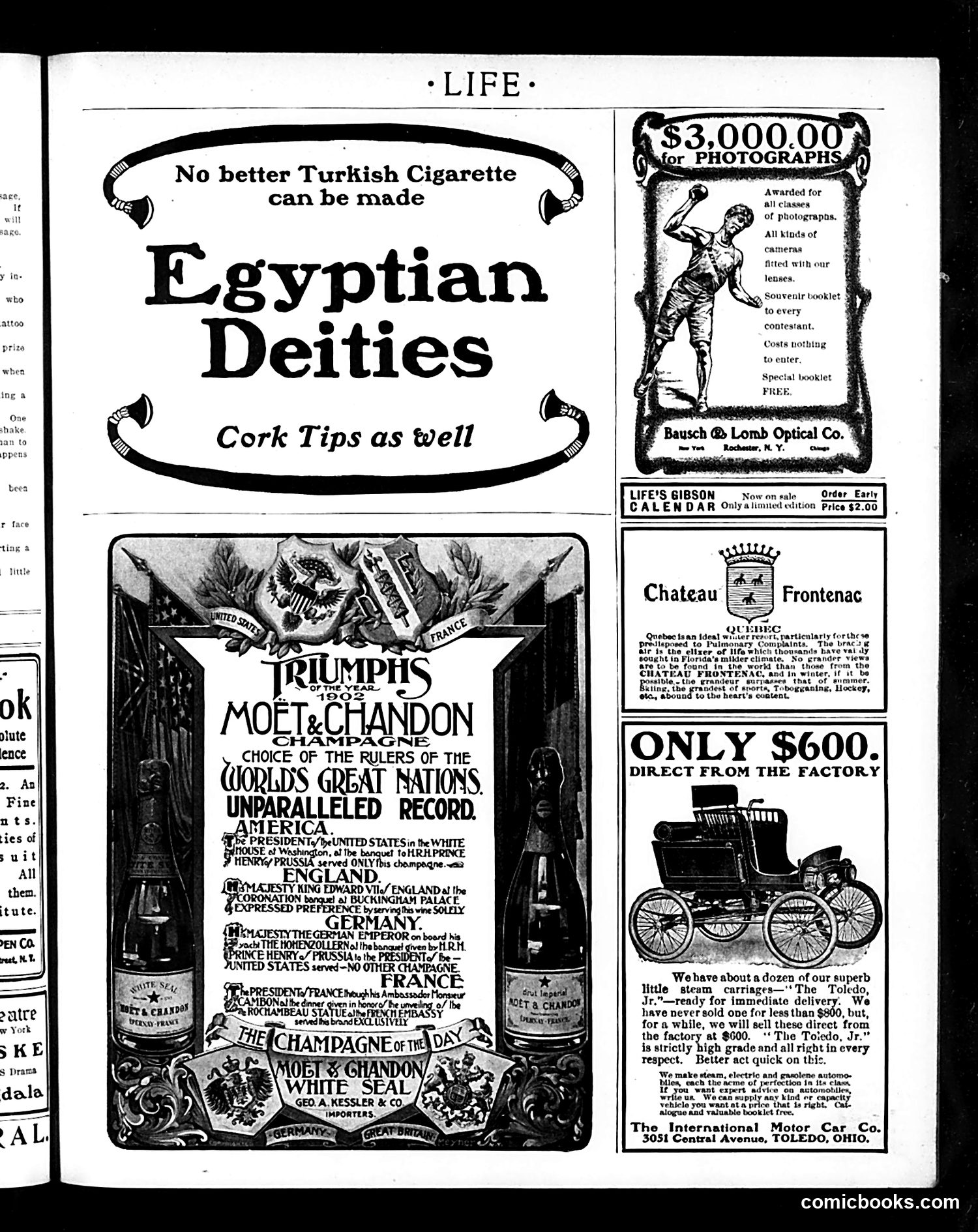
This page is primarily **advertising**, not political satire. It contains four commercial advertisements from the early 1900s: 1. **Egyptian Deities cigarettes** — promoting Turkish cigarettes with cork tips 2. **Bausch & Lomb Optical Co.** — offering a $3,000 photography prize and souvenir booklets 3. **Moët & Chandon champagne** — an elaborate advertisement claiming endorsement by rulers of major nations (United States, England, Germany, France), listing prestigious venues like Buckingham Palace 4. **International Motor Car Co.** — advertising "The Toledo, Jr." steam/electric/gasoline automobile for $600, directly from their factory in Toledo, Ohio The Moët & Chandon ad uses patriotic imagery and claims of royal/governmental approval to establish prestige. The Toledo car advertisement emphasizes affordability and direct-from-factory pricing as selling points. **No political cartoons or satire are present on this page.** It represents typical early-20th-century product marketing within a magazine context.
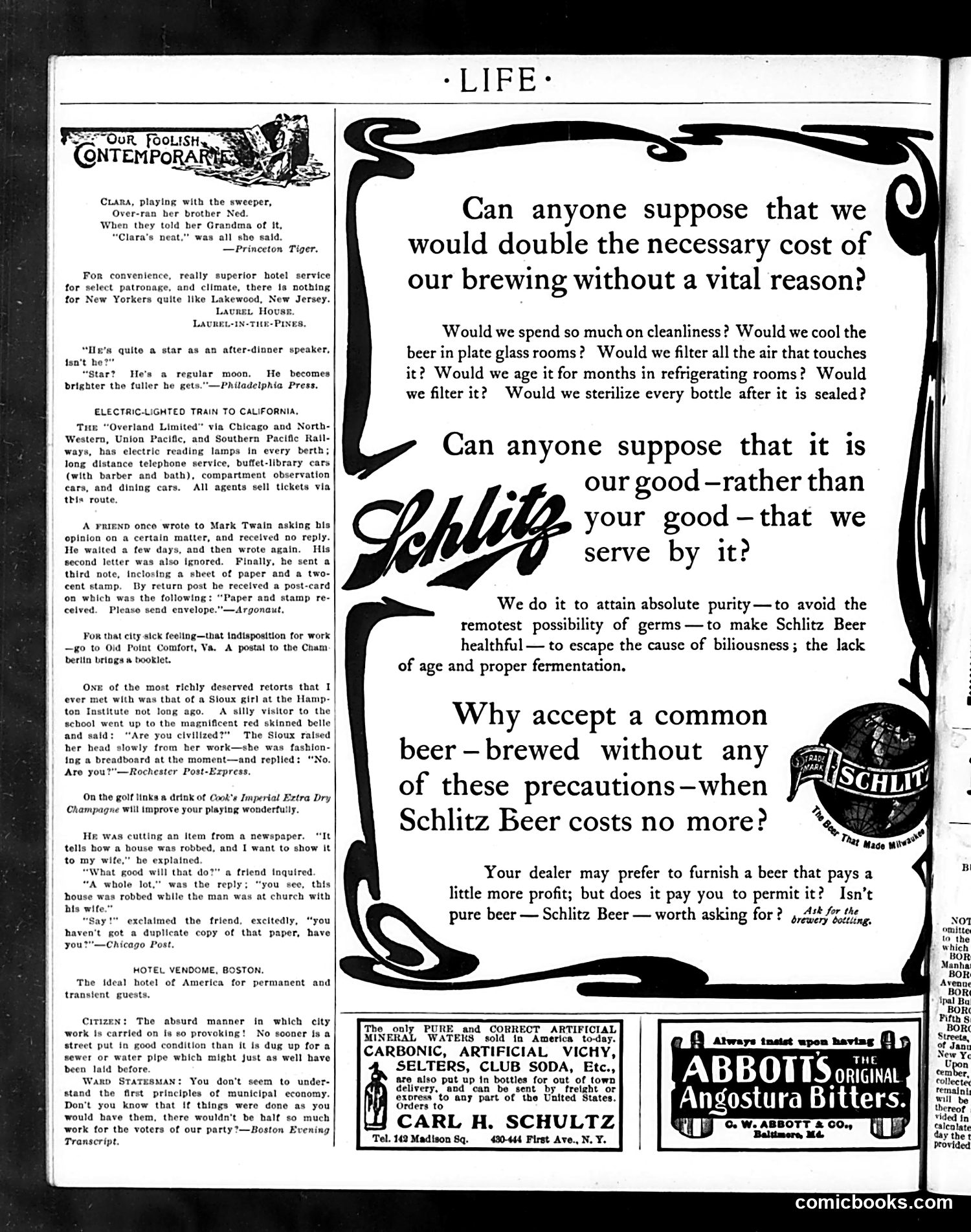
This page contains **satirical commentary mixed with advertising**, primarily featuring a large **Schlitz Beer advertisement**. The left column presents humorous anecdotes under "Our Foolish Contemporaries"—satirizing modern absurdities: a child's literal interpretation of a saying, a hotel recommendation, an anecdote about Mark Twain's dismissive postcard response to a persistent correspondent, and a pointed joke where a Sioux girl at Hampton Institute responds to a visitor's patronizing question "Are you civilized?" with "Are you?"—reversing the implied racial hierarchy and suggesting Western visitors lack proper civility. The dominant right-side advertisement argues for Schlitz Beer's superiority through its expensive purification methods (cleanliness, cooling, filtering, refrigeration, sterilization). The pitch suggests consumers should demand pure beer even if dealers profit less from cheaper alternatives. The page reflects early 1900s attitudes: paternalistic views toward Native Americans (Hampton Institute was an assimilationist boarding school), confidence in industrial "scientific" processing, and consumer messaging around purity and health.
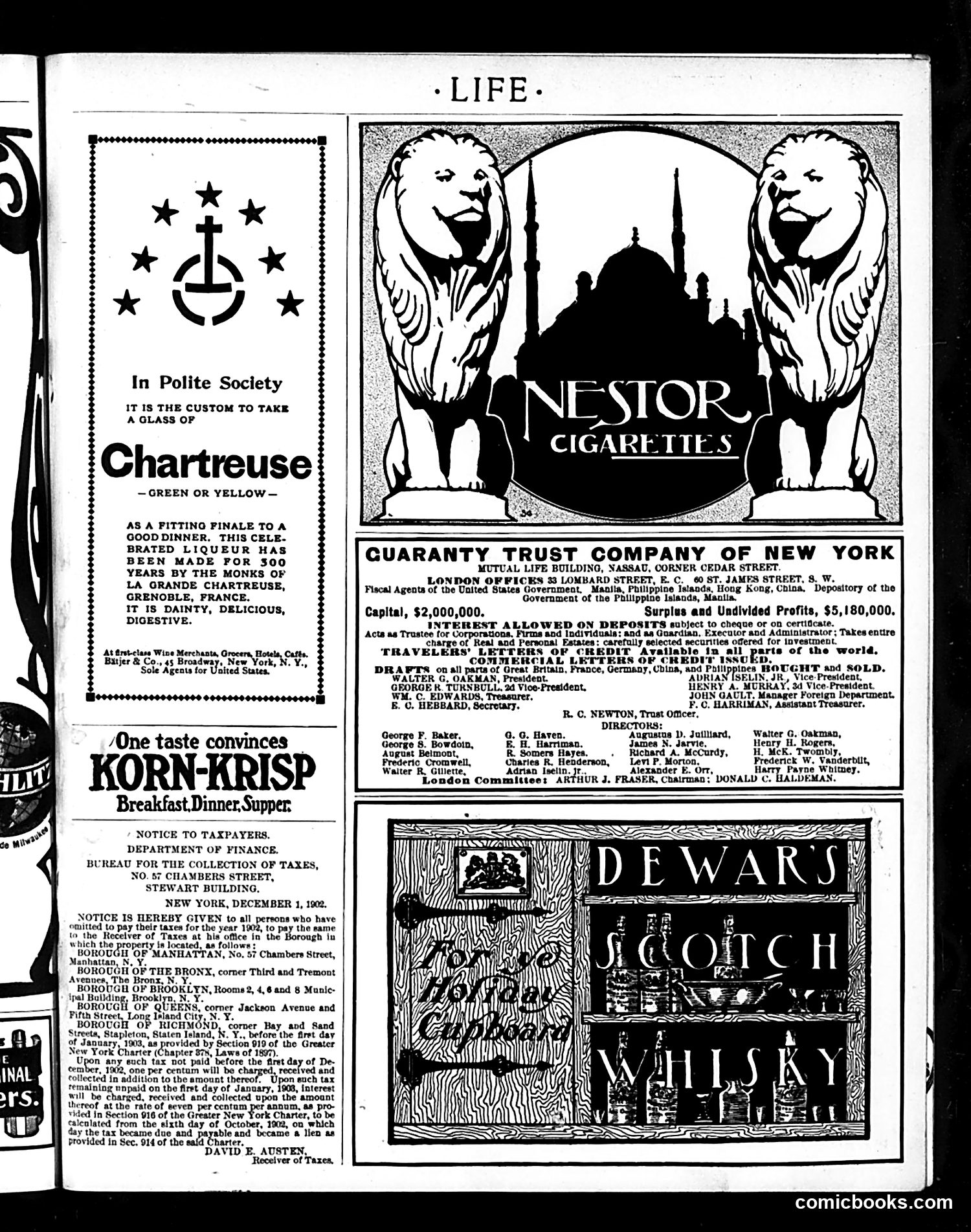
This page is primarily **advertising and official notices**, not satirical content. The ads include: - **Chartreuse liqueur**: A French digestif marketed as refined etiquette for after-dinner consumption among the wealthy - **Nestor Cigarettes**: Featured with lion mascots, appealing to upscale consumers - **Guaranty Trust Company**: A major New York financial institution advertising banking services, trust management, and letters of credit for international commerce - **Dewar's Scotch Whisky**: Luxury spirits advertising - **Korn-Krisp cereal**: A breakfast product A **tax notice** from New York's Department of Finance occupies significant space, reminding citizens of 1902 tax payment deadlines with penalties for late payment. The overall page reflects **Gilded Age consumer culture**—targeting wealthy readers with luxury goods, financial services, and international business opportunities. The tax notice serves a civic function. This is typical Life magazine content: upscale advertising alongside satirical articles elsewhere in the publication.
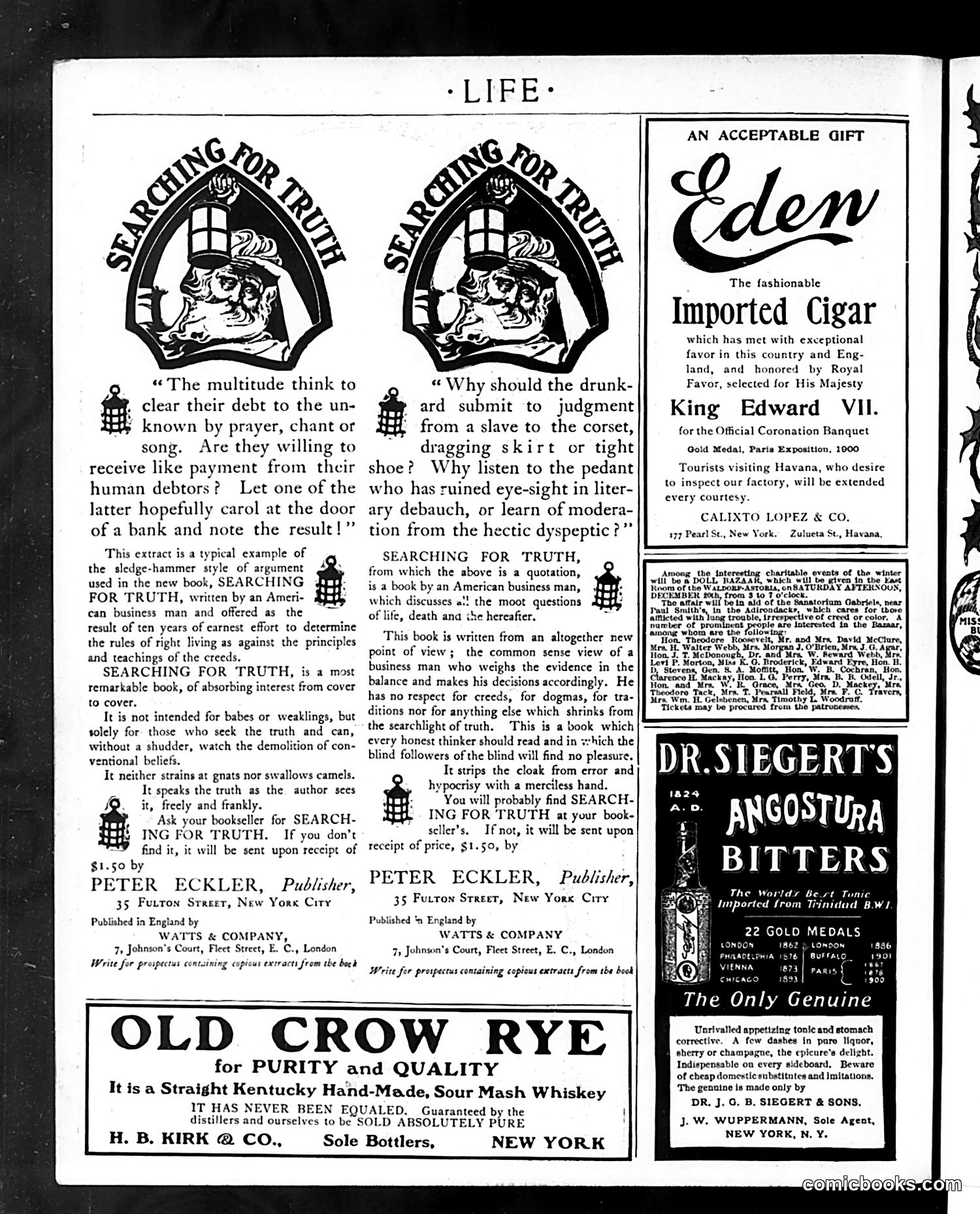
This page primarily features **advertisements** rather than editorial cartoons, but the prominent "Searching for Truth" book ads contain satirical social commentary. The ads quote the book's argument attacking **religious and social hypocrisy**: the author mocks conventional morality by asking why a drunkard should obey rules from someone enslaved to fashion (women in restrictive corsets), or why anyone should accept moral instruction from hypocrites damaged by their own excess. The satire targets **late 19th/early 20th-century Victorian social conventions**—particularly the contradiction between preached moral standards and actual behavior. The book advertises itself as offering "common sense" free from religious dogma and tradition, appealing to readers skeptical of established institutions. The surrounding advertisements (whiskey, cigars, cigars for King Edward VII's coronation) create ironic juxtaposition: promoting alcohol and luxury goods alongside critique of hypocrisy in moral authority—itself somewhat hypocritical positioning for a skeptical philosophy book.
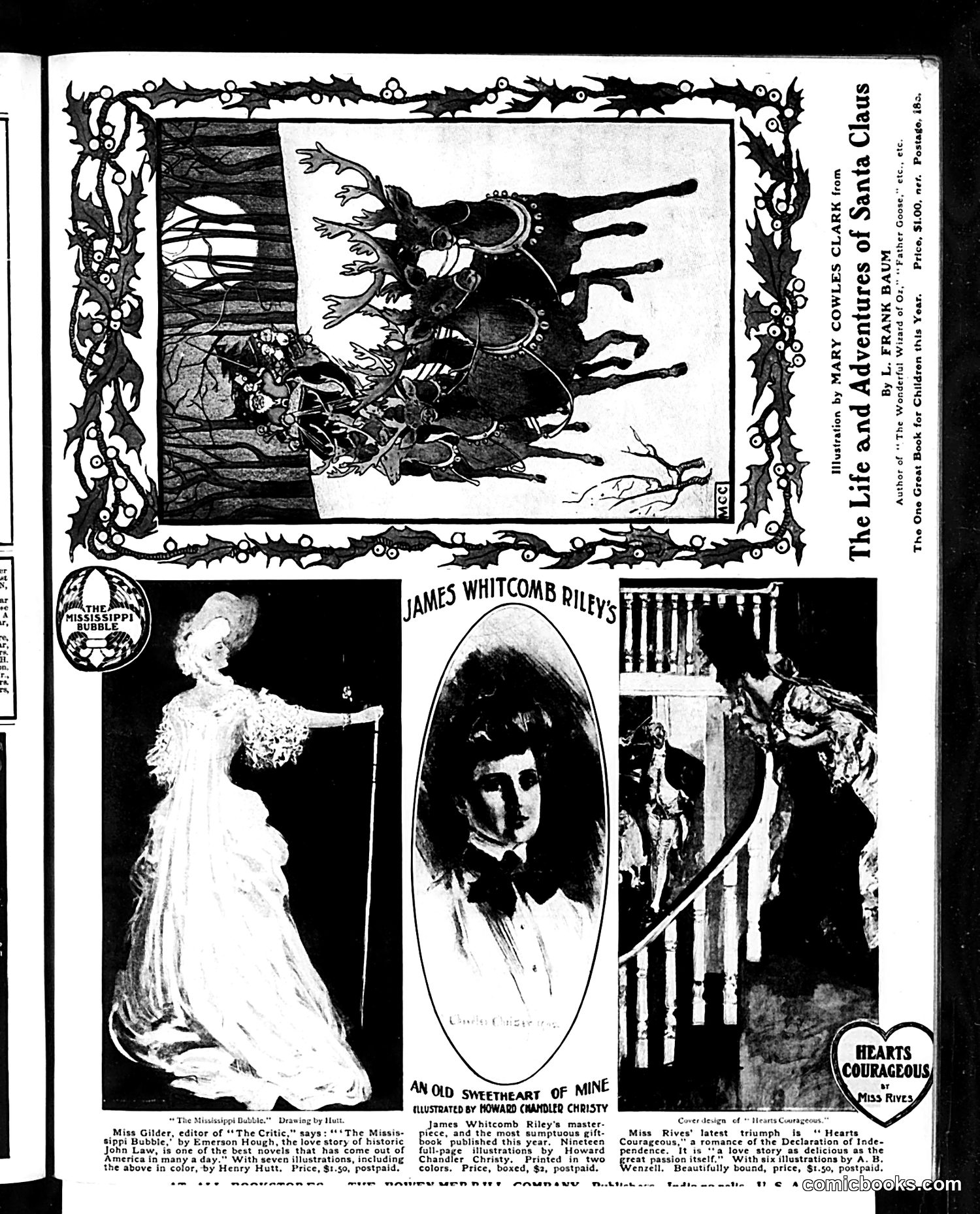
This page advertises three newly published books popular in early 1900s America: 1. **L. Frank Baum's "The Wonderful Wizard of Oz"** — illustrated by Mary Cowles Clark, promoted as "the one great book for children this year." 2. **Emerson Hough's "The Mississippi Bubble"** — a historical novel about John Law (the 18th-century Scottish financier), praised as one of America's best recent novels, with seven color illustrations. 3. **James Whitcomb Riley's poem collection "An Old Sweetheart of Mine"** — Riley was a famous American poet; this edition features lavish full-page illustrations by Howard Chandler Christy, a renowned illustrator of the era. The ornate decorative borders and portrait photographs of authors/illustrators reflect the era's aesthetic. This is essentially a literary advertisement page celebrating contemporary American literature and fine book production—not political satire, but rather promotional content typical of Life magazine's cultural coverage.
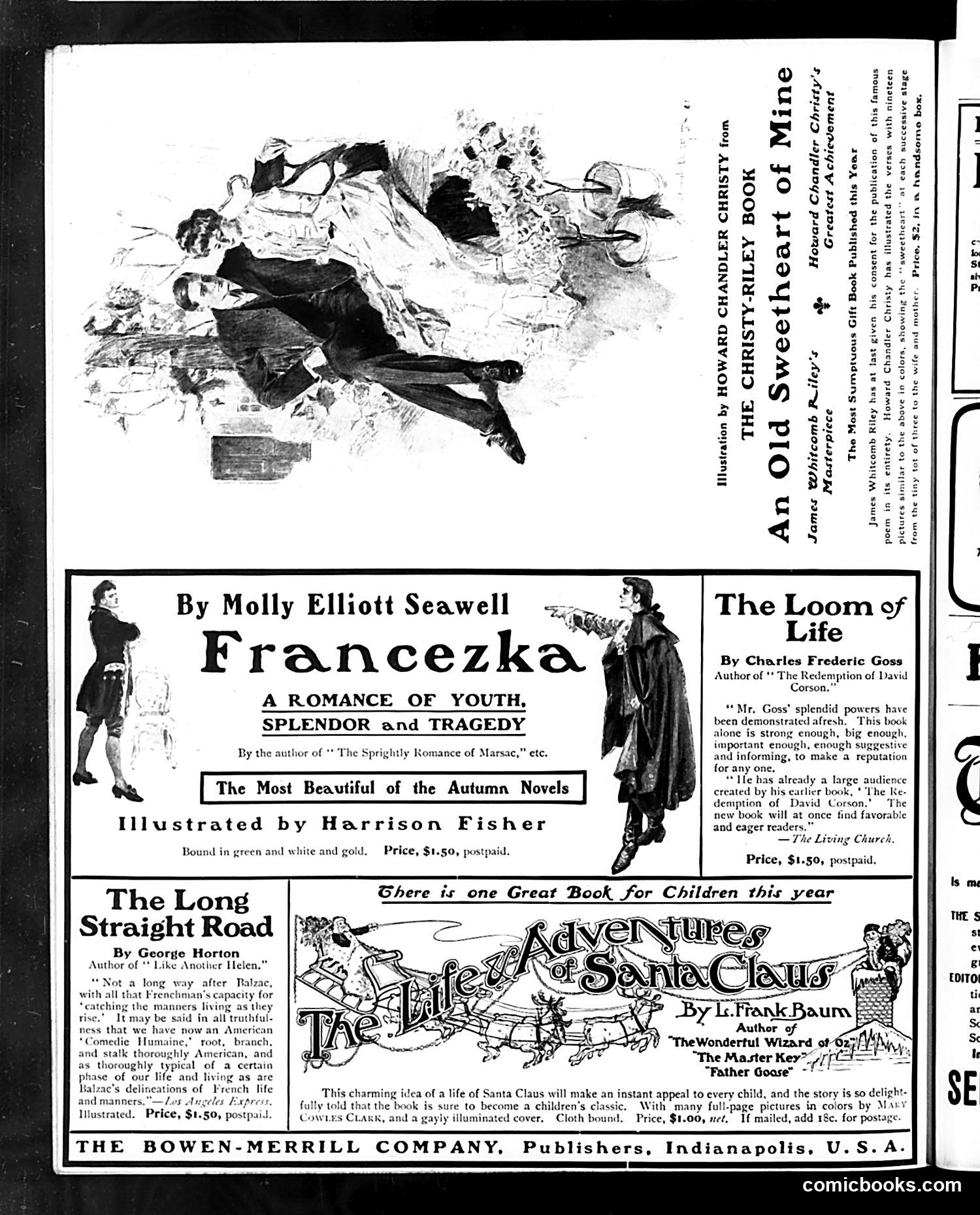
This is primarily a **book advertisement page**, not a political cartoon. It showcases autumn novel releases from The Bowen-Merrill Company, Indianapolis, circa early 1900s. The page advertises four books: 1. **Francezka** by Molly Elliott Seawell—a romance novel illustrated by Harrison Fisher, described as "a romance of youth, splendor and tragedy" 2. **The Loom of Life** by Charles Frederic Goss—praised as an important literary work 3. **The Long Straight Road** by George Horton—compared favorably to French realist literature 4. **The Adventures of Santa Claus** by L. Frank Baum—a children's book featuring Santa Claus, positioned as a future classic The top illustration appears to be promotional artwork for one of these novels, showing figures in period dress. This page reflects **turn-of-the-century American publishing**, emphasizing literary respectability and seasonal gift-giving. There is no political satire present.
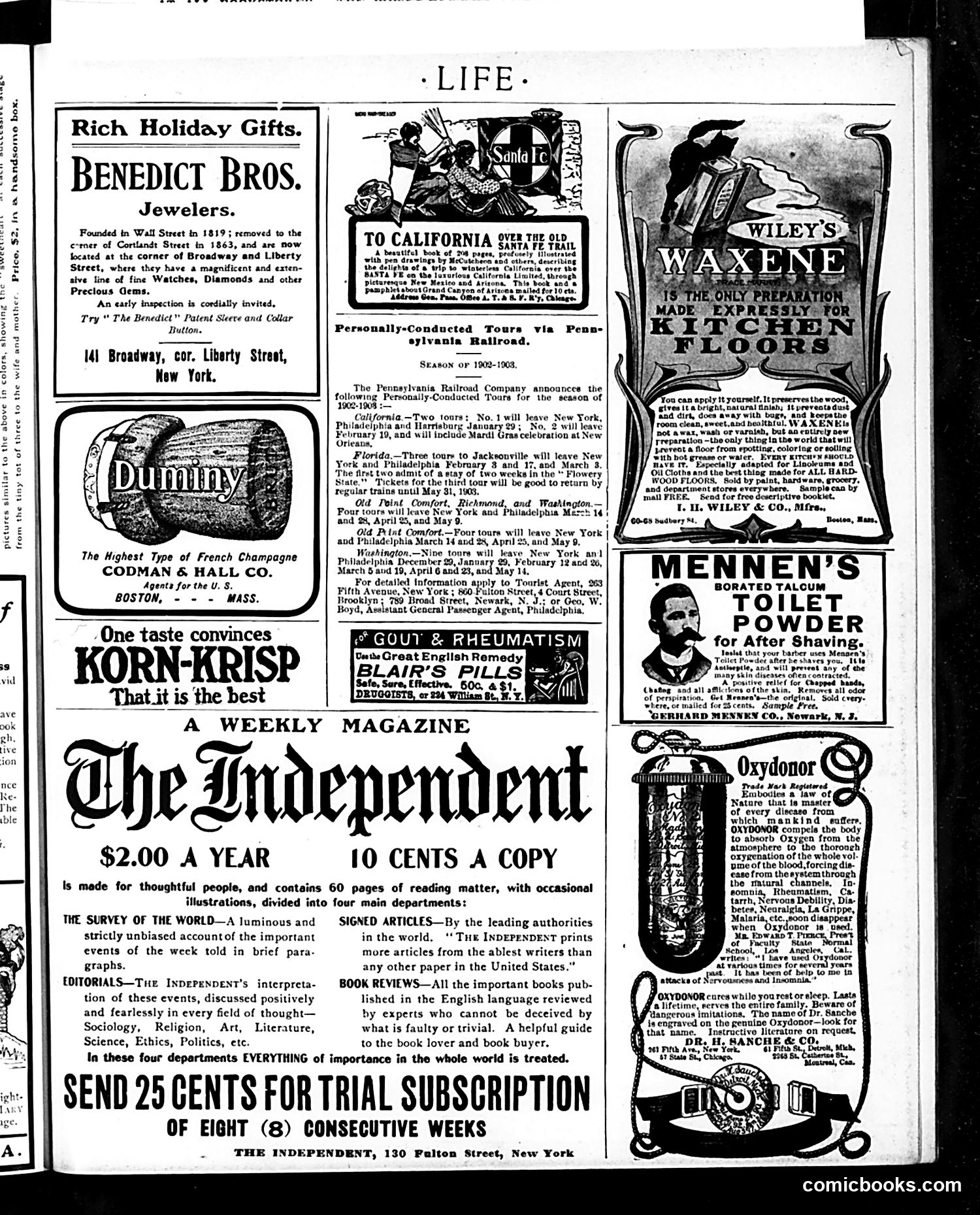
This is primarily an **advertising page** from Life magazine (circa 1902-1903), not a satirical cartoon page. The page promotes various consumer products and services typical of the Gilded Age: **Notable advertisements include:** - **Benedict Bros. Jewelers** (Broadway/Liberty Street) — luxury watches and diamonds for "rich holiday gifts" - **Pennsylvania Railroad tours** — "personally-conducted" excursions to California, Florida, and Washington, D.C., reflecting the era's growth in leisure travel for the wealthy - **Wiley's Waxene** — a wood floor polish product - **Mennen's Talcum Powder** and **Oxydonor** — patent medicines/wellness products typical of the era's largely unregulated health claims **Historical context for modern readers:** These advertisements reveal early 1900s consumer culture, the expansion of railroad tourism, and the prevalence of dubious medical products marketed without FDA oversight. The publication itself (The Independent) is promoted as a serious intellectual weekly for "thoughtful people." There are **no political cartoons visible** on this page—it functions as a commercial showcase rather than satirical content.
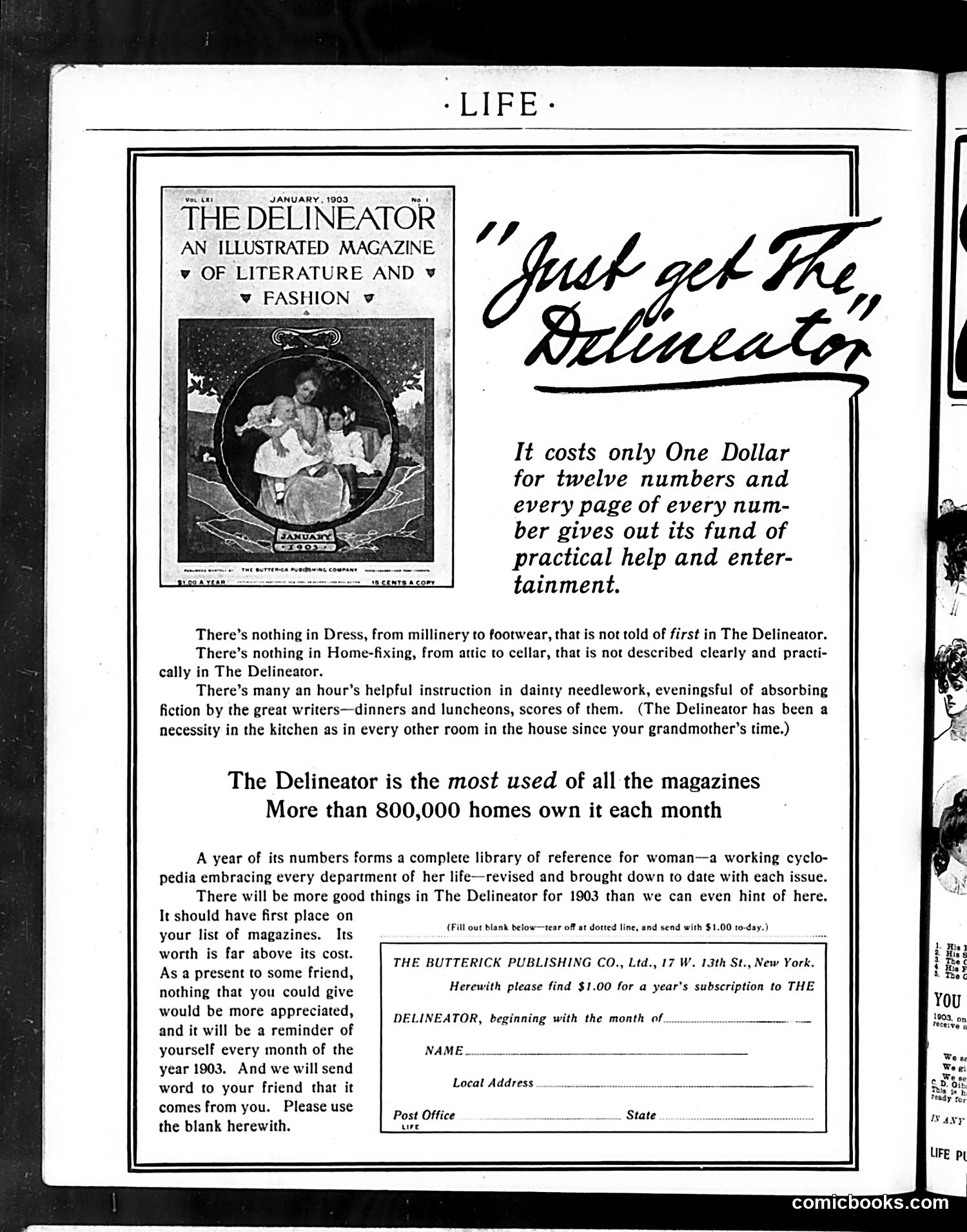
This is a full-page advertisement for *The Delineator*, a women's magazine published by Butterick Publishing Company. Rather than satire, it's a straightforward promotional pitch targeting female readers. The ad emphasizes the magazine's practical utility: it covers fashion, home improvement, needlework, and recipes—presenting itself as an essential domestic reference work ("a working encyclopedia embracing every department of her life"). The emphasis on "first place on your list of magazines" and claims of 800,000 monthly subscribers establishes market dominance. For modern readers: the price ($1 for twelve monthly issues) and the framing of household expertise as women's primary responsibility reflect early-1900s gender norms. The magazine positioned itself as indispensable to middle-class domestic life, making it an effective subscription pitch for the era.
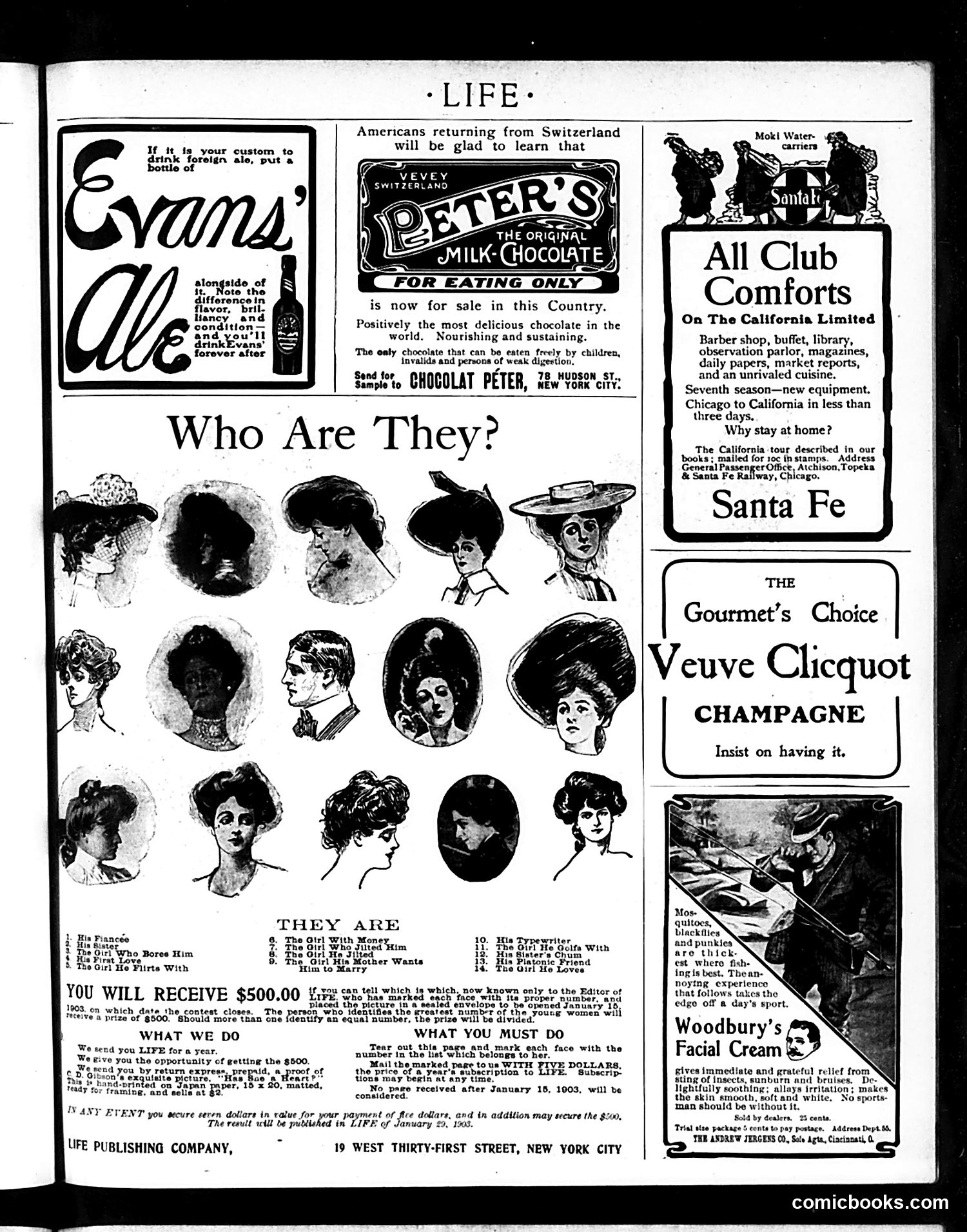
This page is primarily a **contest advertisement** rather than political satire. The central feature is a "guessing game" titled "Who Are They?"—presenting 15 illustrated female faces with labels like "The Girl with Money," "The Girl Who Jilted Him," and "The Girl He Loves." Readers were challenged to match each face to its description. The prize: $500 (a substantial sum in 1903) for correctly identifying the most faces, with entry requiring a $5 subscription to Life magazine. The surrounding advertisements—for Evans' Ale, Swiss chocolate, Santa Fe Railway, Veuve Clicquot champagne, and Woodbury's Facial Cream—reflect early 1900s luxury consumer culture targeting affluent readers. The contest exploits readers' interest in romantic intrigue and social types while monetizing engagement through subscription fees. No identified public figures appear to be caricatured; these are generic "types" of young women familiar to contemporary audiences.
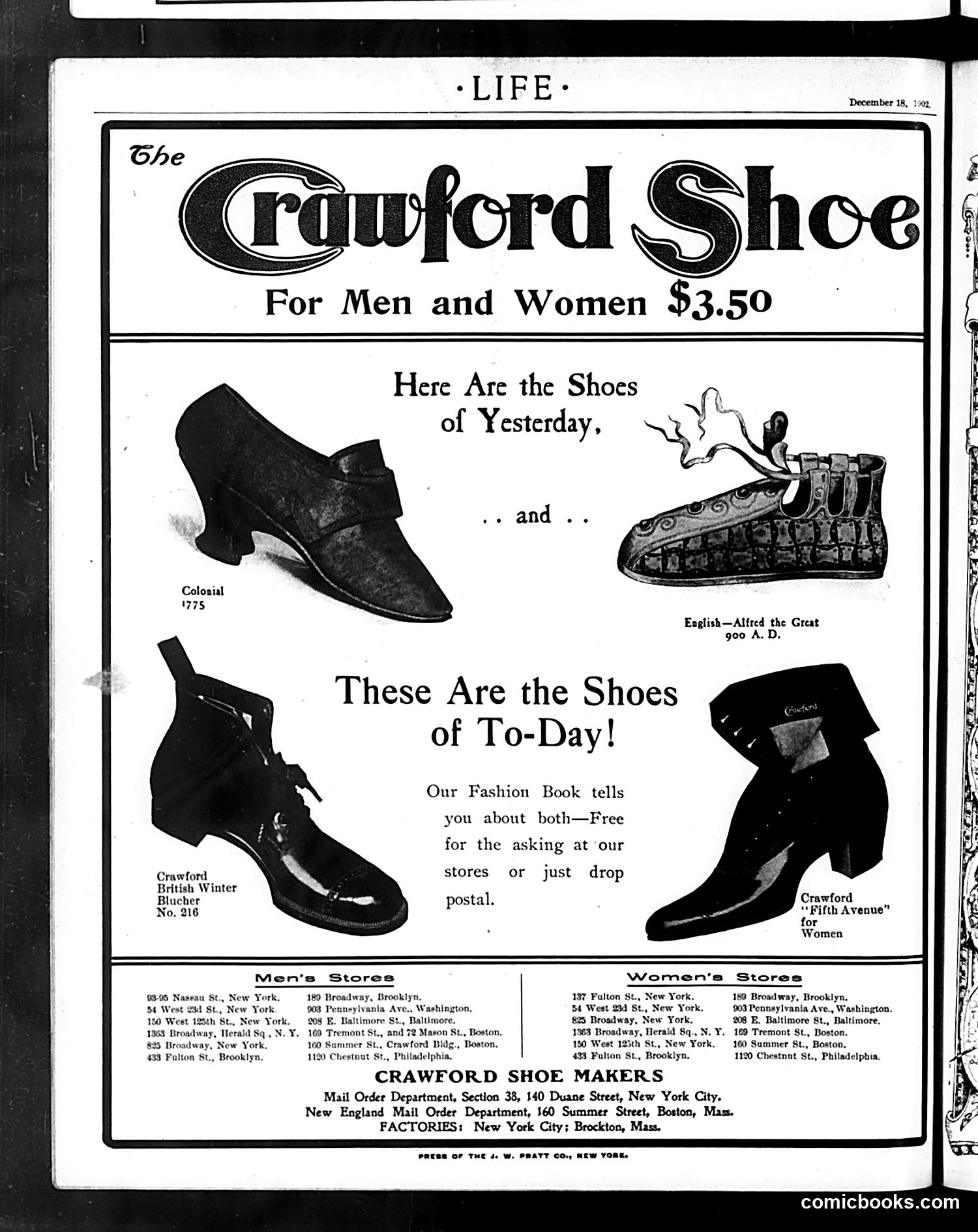
This is primarily a **shoe advertisement**, not political satire. It appears in *Life* magazine from December 18, 1902. The ad uses a historical comparison gimmick: it shows two ancient shoes ("Shoes of Yesterday") — a Colonial-era (1775) heel and an Anglo-Saxon shoe from around 900 A.D. — contrasted against two modern Crawford brand shoes ("Shoes of To-Day"), including a "British Winter Blucher" and a "Fifth Avenue" model for women. The implied message is that Crawford shoes represent modern progress and fashion compared to outdated historical footwear. The ad promotes the shoes at $3.50 and offers a free "Fashion Book" available at multiple store locations across New York, Brooklyn, Boston, Baltimore, Philadelphia, and Washington, or via mail order. This is straightforward commercial advertising using historical contrast as a marketing strategy—no political commentary or satire is evident.