
Life, 1902-12-18 · page 12 of 26
Life — December 18, 1902 — page 12: what you’re looking at
What you’re looking at
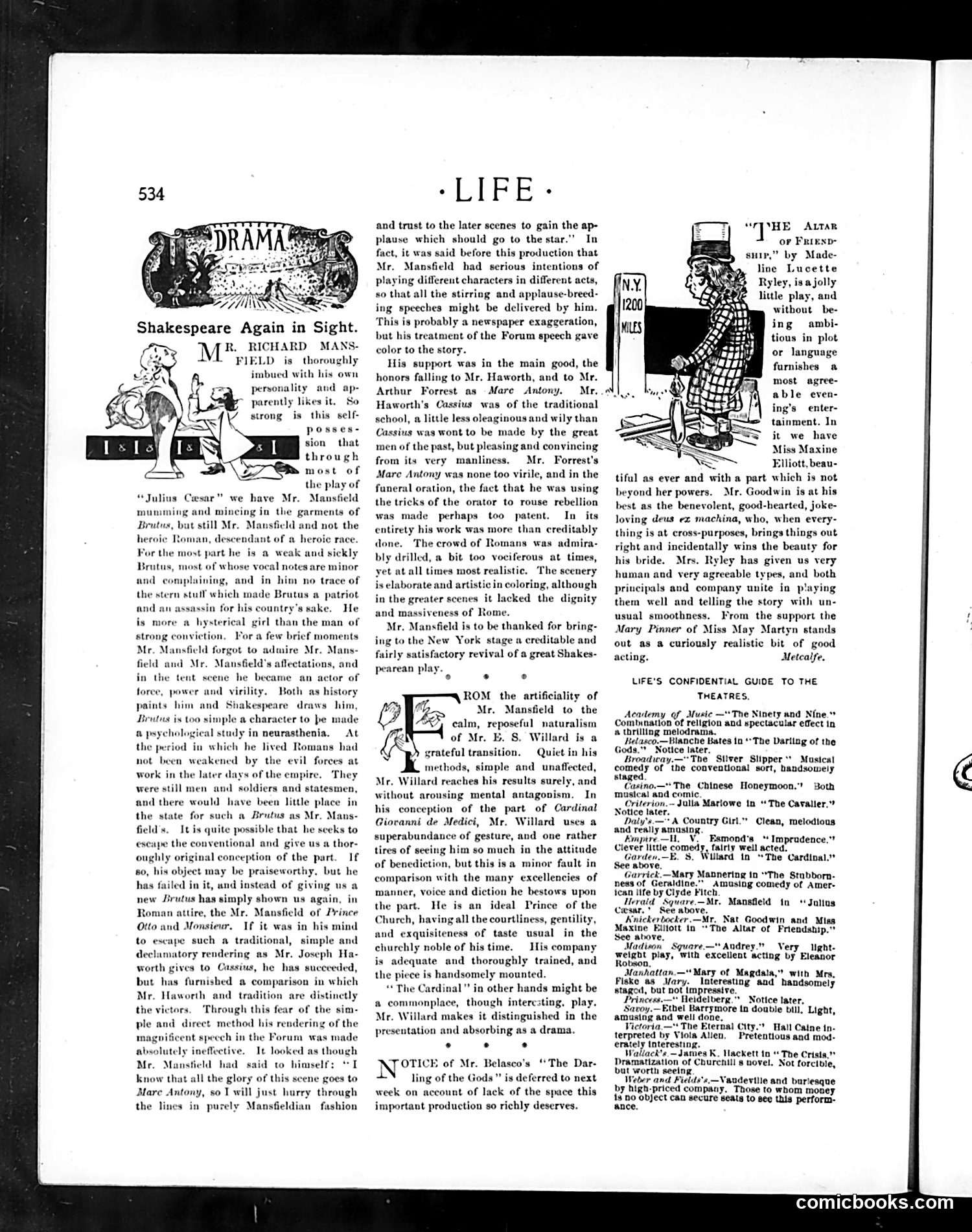
This page reviews theatrical productions, primarily Shakespeare's *Julius Caesar* and *Romeo and Juliet*, featuring actor Richard Mansfield in leading roles. The left cartoon depicts Mansfield as a theatrical figure surrounded by character masks, illustrating his range across multiple Shakespearean roles. The text praises his performance while noting he "drew him *Brutus* to laugh a character in the shade"—suggesting his interpretation was psychologically nuanced rather than conventionally heroic. The reviews discuss supporting actors, staging choices, and production quality. One sidebar advertises "Life's Confidential Guide to the Theatres," listing various contemporary plays and performances. The page is primarily drama criticism rather than political satire, focusing on early 1900s theatrical merit and performance analysis.
📄 Transcribed text from this page (OCR, searchable)
Machine-transcribed from the original scan — historical spelling and the odd misread are preserved.
Shakespeare Again in Sight. ME. RicHarp Max 2 M FIELD is thoroughly p=: the play of “Julius Cesar" we have Mr. Mansfield munining and mineing in the garments of Brutus, but still Mr. Mansfield and not the an, descendant of a heroic race. For the most part he is a weak and sickly Brutus, most of whose vocal notes are minor and complaining, and in him no trace of the stern stuif whieh made Brutus a patriot and an assassin for his country’s sake. He al girl than th Vor a few brief moments Mr. Mansfield forgot to admire Mr. Mans- field and Mr. Mansfield's affectations, and in the tent scene he became an actor of force, power and virility. Both as history paints him and Shakespeare draws him, Brutus is too simple a character to pe made a psychological study in neurasthenia, At the period in which he lived Romans had not been weakened by the evil forces at work in the pire. They were still men and soldiers and statesmen, and there would have been little place in the state for such a Brutus as Mr. Mans- field's. It is quite possible that he seeks to escape the conventional and give us a thor- oughly original conception of the part. If, 80, his object may be praiseworthy, but he has failed in it, and instead of giving us a new Brutus has simply shown us again, in Roman attire, the Mr. Mansfield of Prince Otto and Monsieur, If it was in his mind to escape such a traditional, simple and declamatory rendering as Mr. Joseph Ha- worth gives to Cassius, he has suceceded, but has furnished a comparison in which Mr. Haworth and tradition are distinctly the victors. Through this fear of the sim- ple and direct method his rendering of the magnificent specch in the Forum was made absolutely ineffective. It looked as though Mr. Mansticld had said to himself: “1 know that all the glory of this scene goes to Mare Antony, so I will just hurry through the lines in purely Mansfieldian fashion imbued with his own personality and ap- parently like strong is this self- posses- sion that through most of is more a hysteri n of strong ion. ter days of the -LIFE- and trust to the later scenes to gain the ap- plause which should go to the star.” In fact, it was said before this production that Mr. Mansfield had serious intentions of playing different characters in different acts, so that all the stirring and applause-breed- ing speeches might be delivered by him. This is probably a newspaper exaggeration, but his treatment of the Forum speech gave color to the story. His support was in the main good, the honors falling to Mr. Haworth, and to Mr. Arthur Forrest as Mare Antony. Mr, Haworth's Cassius was of the traditional school, a little less oleaginous and wily than Cassius was wont to be made by the great men of the past, but pleasing and convincing from its very manliness. Mr. Forrest's Mare Antony was none too virile, and in the funeral oration, the fact that he was using the tricks of the orator to rouse rebellion was made perhaps too patent. In its entirety his work was more than creditably done. The crowd of Romans was admira- bly drilled, a bit too vociferous at times, vet at all times most realistic, The scenery is elaborate and artistic in coloring, although in the greater scenes it lacked the dignity and massiveness of Rom Mr. Mansfield is to be thanked for bring- ng to the New York stage a creditable and fairly satisfactory revival of a great Shakes- pearean play : 7 ROM the artificiality of Mr. Mansfield to the calm, reposeful naturalism of Mr. EB. S. Willard is a grateful transition. Quiet in his hods, simple and unaffected, Mr. Willard reaches his results surely, and without arousing mental antagonism, In his conception of the part of Cardinal Giovanni de Medici, Mr. Willard uses a superabundance of gesture, and one rather tires of seeing him so much in the attitude of benediction, but this isa minor fault in comparison with the many excellencies of manner, voice and diction he bestows upon the part. He is an ideal Prince of the Church, having all the courtliness, gentility, and exquisiteness of taste usual in the churehly noble of his time. His company is adequate and thoroughly trained, and the piece is handsomely mounted. “The Cardinal” in other hands might be a commonplace, though interesting, play. Mr. Willard makes it distinguished in the presentation and absorbing as a drama. . . . Notece of Mr. Belasco’s ‘The Dar- AN ling of the Gods” is deferred to next week on account of lack of the space this important production so richly deserves. “pas ALTAR or Friesp- sup,” by Made- line Lucette Ryley, is a jolly little play, and without be- ing ambi- tious in plot or language furnishes a most agree- able even- ing’s enter- tainment. In it we have Miss Maxine Elliott, beau- tiful as ever and with a part which is not beyond her powers. Mr. Goodwin is at his best as the benevolent, good-hearted, joke- loving deus ez machina, who, when every- thing is at cross-purposes, brings things out right and incidentally wins the beauty for his bride. Mrs. Ryley has given us very human and very agreeable types, and both principals and company unite in playing them well and telling the story with un- usual smoothness. From the support the Mary Pinner of Miss May Martyn stands out as a curiously realistic bit of good acting. Metcalfe, N.Y. NILES LIFE’S CONFIDENTIAL GUIDE TO THE THEATRES, Acaitemy of, Music —The Ninety and Nine. Combination of religion and spectacular eect in thrilling melodrama. Belasco.— Blanche Bates in “The Darling of the Gods." Notice later. Broadway.—"The. Stiver Slipper Musical comedy of the conventional sort, handsomely stag Casino.—" The Chinese Honeymoon." Both musical and comic Criterion.— Julia Marlowe tn “The Cavaller.”” Notice lates Daly's.—* A Country Girl." Clean, melodious and really amusing. Empire—U, V. Esmond’s “ Impradence.”’ Gierer ttle comedy. fairly well acted. Garden.—E. 8, Willard in “The Cardinal.” above. Garrick.—Mary Mannering in “The Stabborn- ness of Geraldine.” Amusing comedy of Amer- tean life by Clyde Fitch. Herald Square.—Mr. Mansfield tn Caesar,’ See above. Knickerbocker.—Mr. Nat Goodwin and Miss Maxine Elllott tn “The Altar of Friendship.” See above, Madison’ Square— Andrey.” Very ight. weight play, With excellent acting by Eleanor Robson, Manhattan.—“Mary of Magdals,” with Mrs, Fiske as Mary. Interesting and’ handsomely stagod, but not impressive. Princess.—" Heidelberg,” Notice later. Savoy.—Ethel Barrymore tn double bill, Light, amusing and well done, Victoria. — The Eternal City. terpreted by Viola Allen, erately interesting. Wallack’s —James K, Mackett tn “The Crista,” Dramatization of Churchill 8 uovel. Not forcible, but worth seeing. Weber and Fietds's.—Vandeville and burlesque by high-priced company. Those to whom money 4s no object can secure seats to see this perform: ‘ance. “Jalios Hall Caine tn- Pretentious and mod- comicbooks.com