
Life, 1902-12-18 · page 6 of 26
Life — December 18, 1902 — page 6: what you’re looking at
What you’re looking at
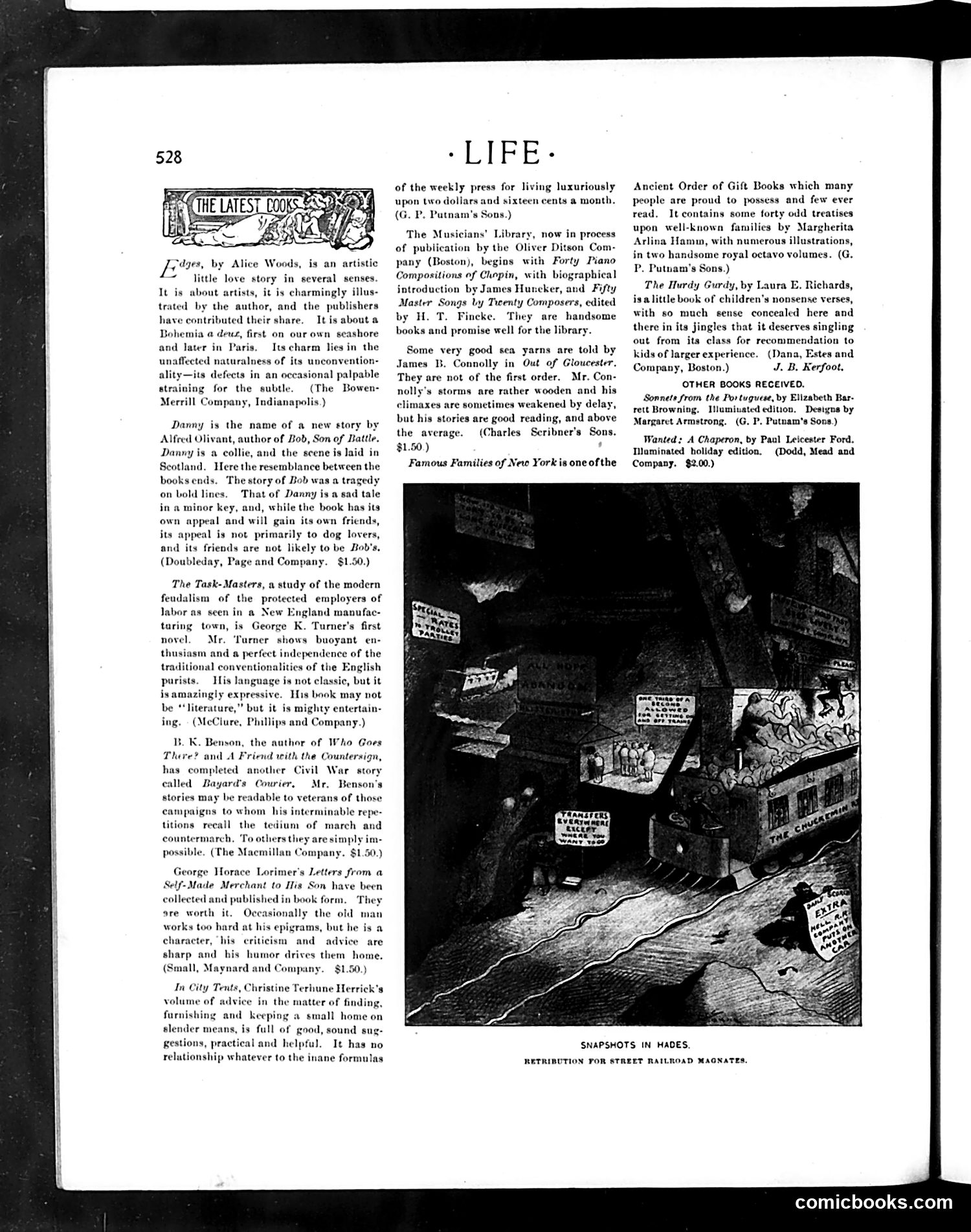
This cartoon depicts a satirical scene titled "Snapshots in Hades" showing "retribution for street railroad magnates." The image shows various figures (apparently corrupt railroad executives) experiencing punishment in Hell, surrounded by devilish imagery and torment. The satire targets street railroad (streetcar/trolley) company owners who were apparently viewed as villainous during this era. The "snapshots in Hades" conceit—showing their damnation—reflects Progressive-era outrage at railroad monopolies and their owners' exploitation practices. Without clearer labels identifying specific magnates, we cannot name individuals, but the cartoon exemplifies early 20th-century American satirical attacks on corporate greed and corrupt business practices that harmed the public.
📄 Transcribed text from this page (OCR, searchable)
Machine-transcribed from the original scan — historical spelling and the odd misread are preserved.
yas by Alice Woods, is an artistic ~ Jittle love story in several senses. pout artists, it is charmingly illus- the author, and the publishers ntributed their share, It is about Bohemia a deus, first on our own seashore and later in Paris, Its charm lies in the unaffected naturalness of its unconvention- ity i in an occasional palpable ning for the subtle. (The Bowen- ill Company, Indianapolis.) It is trated bh Danny is the name of a new story by Alfred Olivant, author of Bob, Son of Battle. Danny is a collie, and the scene is Jaid in Scotland. Here the resemblance between the books ends. The story of Bob was a tragedy on bold lines. That of Danny is asad tale in a minor key, and, while the book has its own appeal and will gain its own friends, its appeal is not primarily to dog lovers, and its friend: e not likely to be Bob's, (Doubleday, Page and Company. $1.50.) The Task-Masters, a study of the modern feudalism of the protected employers of Jabor as seen in a New England manufac- taring town, is George K. Turner's first novel. Mr. ‘Turner shows buoyant en- thusiasm and a perfect independence of the tradit ionalities of the English is not classic, but it . His book may not entertain- (MeCiure, Phillips and Company.) nal conve ing. I. K. Benson, the author of Who Goes There? and A Friend with the Countersign, has completed another Civil, War story called Bayard’s Courier, Mr. Bensor stories may be readable to veterans of those campaigns to whom his interminable repe- titions recall the tedium of march and countermarch, ‘To others they are simply possible. (The Macmillan Company. $1.50.) orge Horace Lorimer's Lette Self-Made Merchant to His Son ¥ in book form. pnally the o 3 froma ve been They man works too hard at his e chai igrams, but he is a acter, his criticism and are sharp and bis humor drives them home. (Small, Maynard and Company. $1.50.) advice In City Tents, Christine Terhune Herrick's volum in the matter of finding, furnishing and keeping a small home on slender means, is full of good, sound sng- gestions, practical and helpful. It has no relutionship whatever to the inane formulas ‘LIFE: of the weekly press for living luxuriously upon two dollars and sixteen cents a month. (G. P, Putnam's Sons.) The Musicians’ Library, now in process of publication by the Oliver Ditson Com- pany (Boston), begins with Forty Piano Compositions of Chopin, with biographical introduction by James Huncker, and Fifty Master Songs by Twenty Composers, edited by H. T. Fincke. They are handsome books and promise well for the library. Some very good sea yarns are told by James B. Connolly in Out of Gloucester. They are not of the first order. Mr. Con- nolly’s storms are rather wooden and his climaxes are sometimes weakened by delay, but his stories are good reading, and above the average. (Charles Scribner's Sons. $1.50.) Famous Families of New York is one ofthe Ancient Order of Gift Books which many people are proud to possess and few ever read. It contains some forty odd treatises upon well-known families by Margherita Arlina Hamm, with numerous illustrations, in two handsome royal octavo volumes. (G. P. Putnam's Sons.) The Hurdy Gurdy, by Laura E. Richards, isa little book of children’s nonsense verses, with so much sense concealed here and there in its jingles that it deserves singling out from its class for recommendation to kids of larger experience. (Dana, Estes and Company, Boston.) J. B. Kerfoot, OTHER BOOKS RECEIVED. Sonnets from the Portuguese, by Elizabeth Bar- rett Browning. Illumiuated edition, Designs by Margaret Armstrong. (G. P. Putnam's Sons.) Wanted: A Chaperon, by Paul Leicester Ford, Tlaminated holiday edition, (Dodd, Mead and Company. $2.00.) SNAPSHOTS IN HADES. RETRIBU ON FOR STREET RAILROAD MAGNATES, comicbooks.com