
Life, 1902-12-18 · page 4 of 26
Life — December 18, 1902 — page 4: what you’re looking at
What you’re looking at
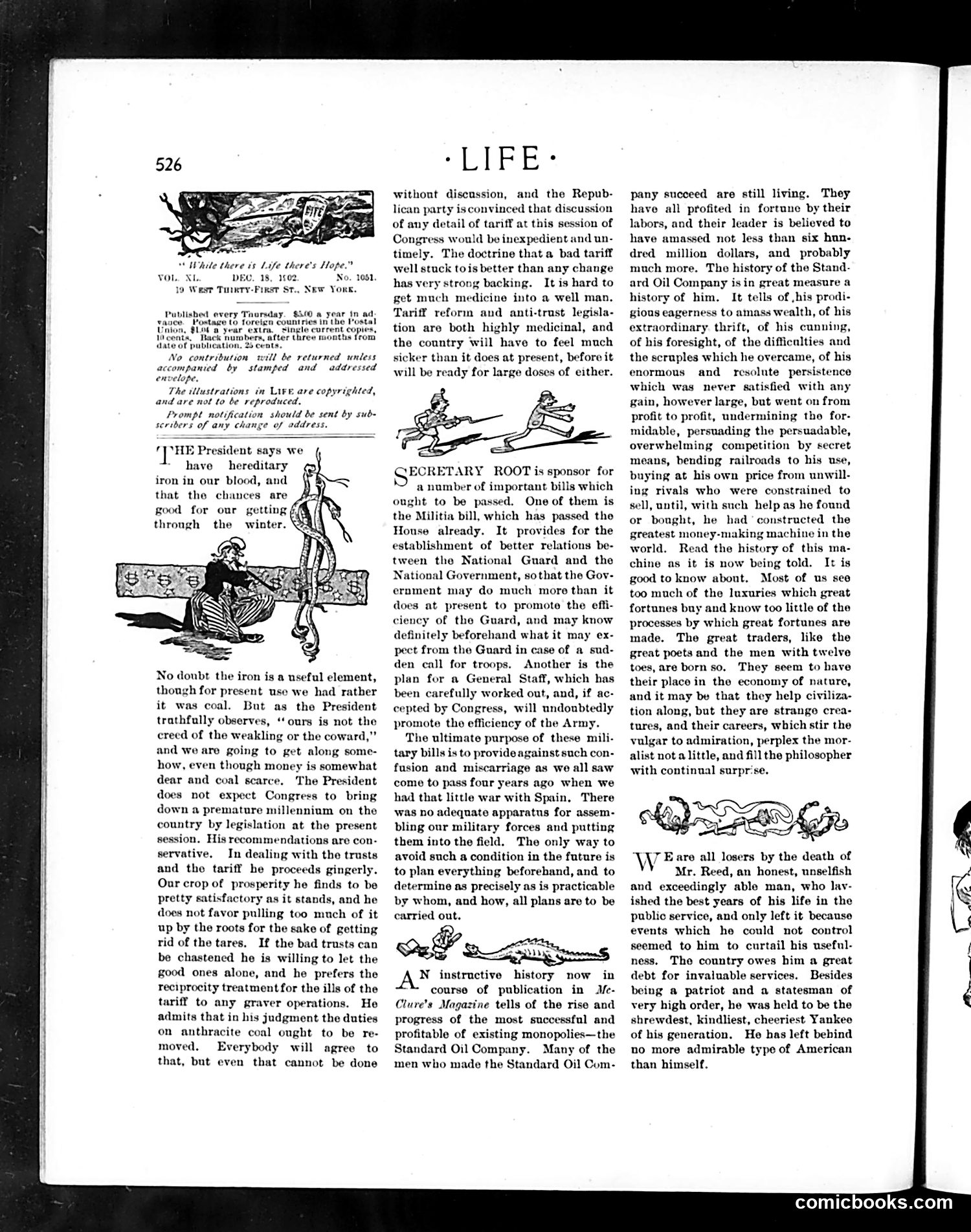
This page contains political commentary on tariff reform and military legislation rather than traditional political cartoons. The text discusses the President's support for protective tariffs and iron production, arguing such policies strengthen American industry and the economy. The cartoon illustrations are decorative rather than satirical—showing figures tied in knots or struggling, which visually reinforce the text's point that tariff policy is complex and contentious. The page also includes a tribute to a deceased public figure (Mr. Reed), described as an "honest, unselfish" patriot who served honorably. This appears to be a memorial section rather than satire. The overall tone is earnest political argument rather than sharp satire, advocating for protective economic policies and military preparedness.
📄 Transcribed text from this page (OCR, searchable)
Machine-transcribed from the original scan — historical spelling and the odd misread are preserved.
“While there is Life there's Hope.” vou. XL. DEC. 18, 1502. No. 1051. lo West TueTy-Finst St.. NEw Yore. No contribution will be returned unless accompanied by stamped and addressed envelope. The illustrations in LiFe are copyrighted, and are not to be reproduced. Prompt notification should be sent by sub- seribers of any change of address. ‘] (HE President says we have hereditary iron in our blood, and that the chances are good for our getting through the winter. No doubt the iron is a useful element, though for present use we had rather it was coal. But as the President trathfully observes, ‘‘ ours is not the creed of the weakling or the coward,” and we are going to get along some- how, even though money is somewhat dear and coal scarce, The President does not expect Congress to bring down a premature millennium on the country by legislation at the present session. His recommendations are con- servative. In dealing with the trusts and the tariff he proceeds gingerly. Onur crop of prosperity he finds to be pretty satisfactory as it stands, and he does not favor pulling too much of it up by the roots for the sake of getting rid of the tares. If the bad trusts can be chastened he is willing to let the good ones alone, and he prefers the reciprocity treatment for the ills of the tariff to any graver operations. He admits that in his judgment the duties on anthracite coal ought to be re- moved. Everybody will agree to that, but even that cannot be done » LIPE.* withont discussion, and the Repub- lican party isconvinced that discussion of any detail of tariff at this session of Congress would be inexpedient and un- timely. The doctrine that a bad tariff well stuck tois better than any change has very strong backing. It is hard to get much medicine into a well man. Tariff reform and anti-trust legisla- tion are both highly medicinal, and the country will have to feel much sicker than it does at present, before it will be ready for large doses of either. Sex ECRETARY ROOT is sponsor for a number of important bills which ought to be passed. One of them is the Militia bill, which has passed the House already. It provides for the establishment of better relations be- tween the National Guard and the National Government, sothat the Gov- ernment may do much more than it does at present to promote the effi- ciency of the Guard, and may know definitely beforehand what it may ex- pect from the Guard in case of a sud- den call for troops. Another is the plan for a General Staff, which has been carefully worked out, and, if ac- cepted by Congress, will undoubtedly promote the efficiency of the Army. The ultimate purpose of these mili- tary bills is to provide against such con- fusion and miscarriage as we all saw come to pass four years ago when we had that little war with Spain, There was no adequate apparatus for assem- bling our military forces and putting them into the field. The only way to avoid such a condition in the future is to plan everything beforehand, and to determine as precisely as is practicable by whom, and how, all plans are to be carried out. OP vias AX instructive history now in course of publication in AMe- Clure’s: Magazine tells of the rise and progress of the most successful and profitable of existing monopolies—the Standard Oil Company. Many of the men who made the Standard Oil Com- pany succeed are still living. They have all profited in fortune labors, and their leader is believed to have amassed not less than six hun- dred million dollars, and probably much more. The history of the Stand- ard Oil Company isin great measure a history of him. It tells of ,his prodi- gious eagerness to amass wealth, of his extraordinary thrift, of his cunning, of his foresight, of the difficalties and the scruples which he overcame, of his enormous and resolute persistence which was never satisfied with any gain, however large, but went on from profit to profit, undermining the for- midable, persuading the persuadable, overwhelming competition by secret means, bending railroads to his use, buying at his own price from unwill- ing rivals who were constrained to sell, until, with such help as he found or bought, he had ‘constructed the greatest money-making machine in the world. Read the history of this ma- chine as it is now being told. I is good to know about, Most of us seo too much of the luxuries which great fortunes buy and know too little of the processes by which great fortunes are made. The great traders, like the great poets and the men with twelve toes, are born so. They seem to have their place in the economy of nature, and it may be that they help civiliza- tion along, but they are strango crea- tures, and their careers, which stir the vulgar to admiration, perplex the mor- alist not a little, and fillthe philosopher with continual surprise. V 7 Eare all losers by the death of Mr. Reed, an honest, unselfish and exceedingly able man, who lav- ished the best years of his life in the public service, and only left it because events which he could not control seemed to him to curtail his useful- ness. The country owes him a great debt for invaluable services. Besides being a patriot and a statesman of very high order, he was held to be the shrewdest, kindliest, cheeriest Yankee of his generation, He has left behind no more admirable type of American than himself. comicbooks.com