
A complete issue · 22 pages · 1902
Life — September 4, 1902
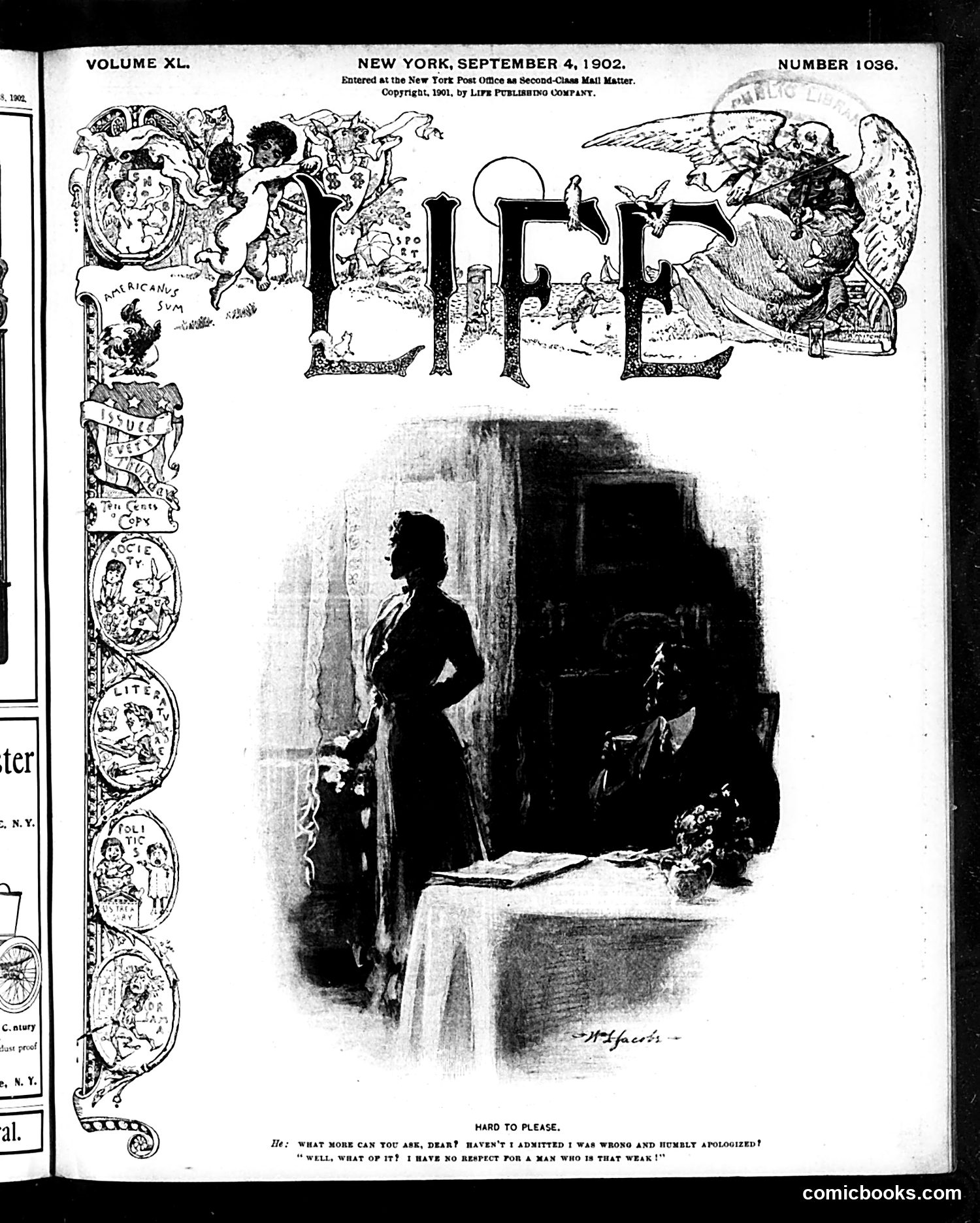
This page features a satirical cartoon titled "Hard to Please." The illustration shows a woman standing while confronting a seated man, with the caption dialogue: **Him:** "What more can you ask, dear? Haven't I admitted I was wrong and humbly apologized?" **Her:** "Well, what of it? I have no respect for a man who is that weak!" The cartoon satirizes gender relations and marriage dynamics of the Edwardian era. It mocks the impossible position men faced with women—damned whether they admit fault (viewed as weak) or refuse to apologize (viewed as obstinate). The joke targets female irrationality or unreasonable demands, reflecting common period attitudes about women's contradictory nature. The decorative masthead features classical and seasonal imagery typical of Life's artistic design.
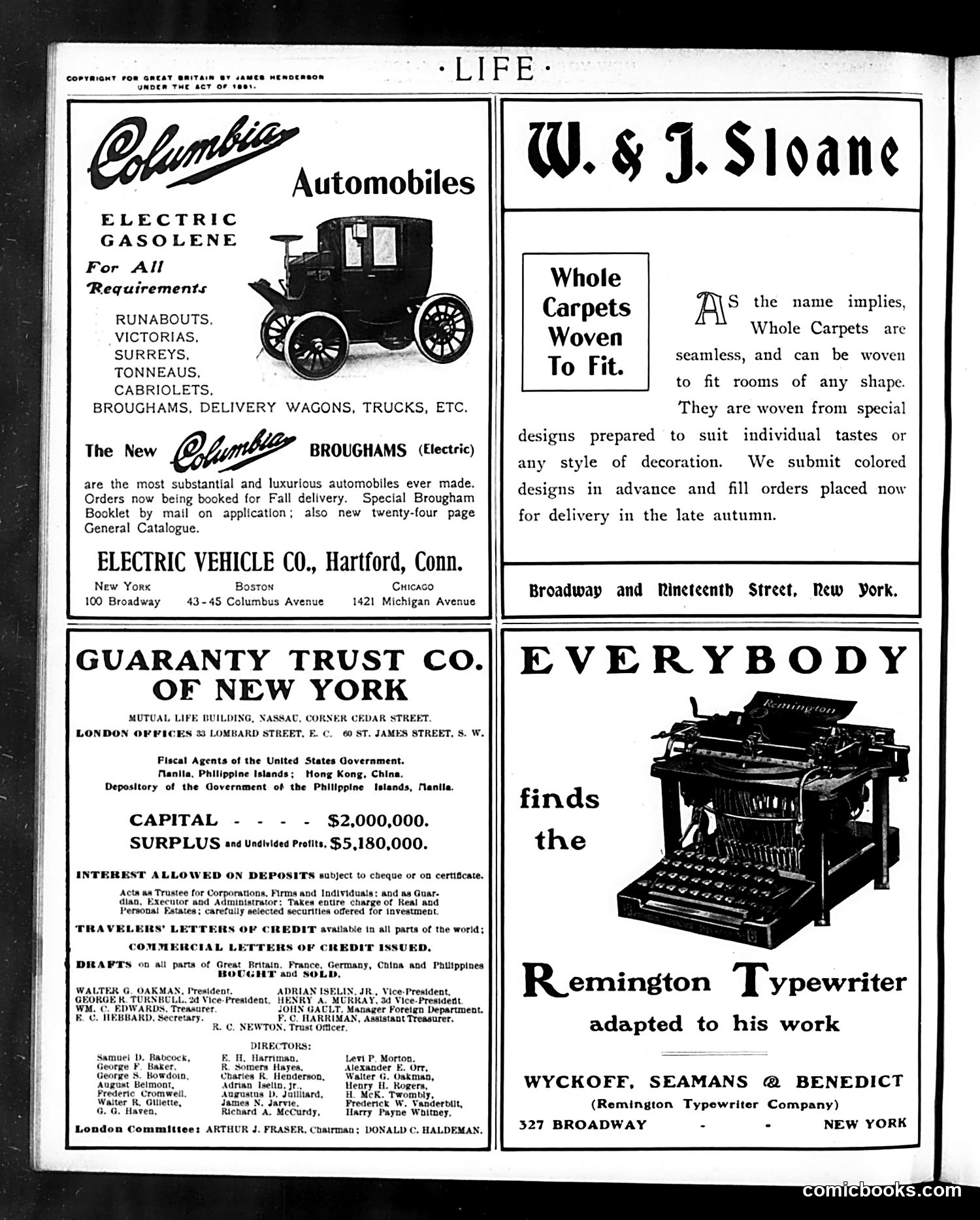
This page contains **no political cartoons or satirical content**. Instead, it is entirely composed of **advertisements** from the early 1900s: 1. **Columbia Automobiles** — promoting electric and gasoline vehicles 2. **W. & J. Sloane** — advertising custom-woven whole carpets for home decoration 3. **Guaranty Trust Co. of New York** — a financial institution listing capital and services 4. **Remington Typewriter** — featuring an illustration of their machine with the tagline "adapted to his work" The page represents typical *Life* magazine advertising rather than satirical editorial content. The ads target affluent readers with luxury goods (automobiles, custom carpets, financial services, office equipment), reflecting early-twentieth-century consumer culture and business expansion.
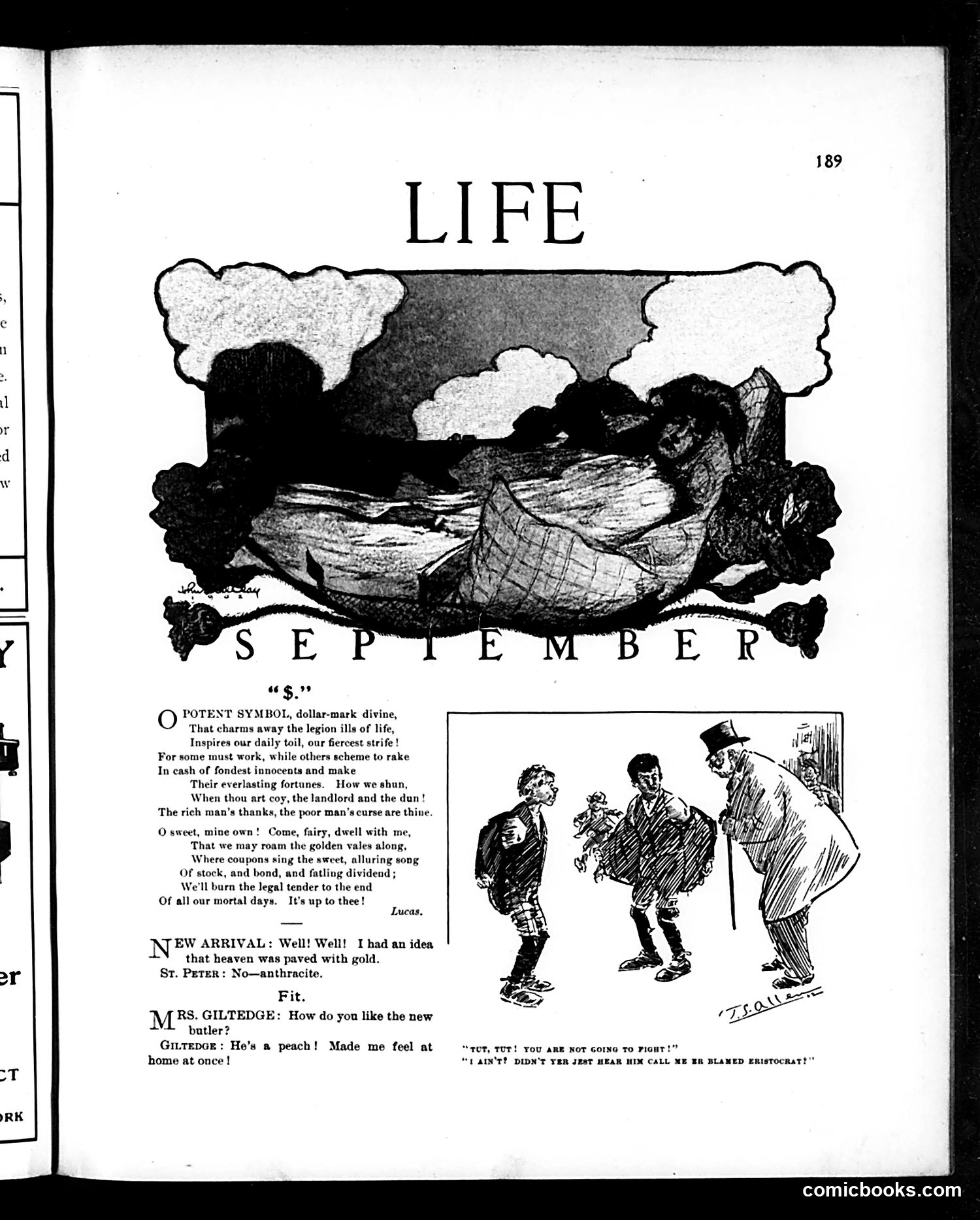
**Top Illustration:** A seasonal vignette showing a person resting in a hammock during September, with clouds and landscape. **Main Content:** A poem signed "Lucas" criticizing wealth inequality. It contrasts the rich's financial schemes ("stock, and bond, and fiting dividend") with working people's struggles, using the dollar sign ($) as a symbol of dividing society. **Comic Exchange:** A brief dialogue about a new butler, with one character praising him as "a peach" for making them "feel at home at once." **Bottom Cartoon:** Three men in what appears to be a confrontational scene, with caption "YET, TET! YOU ARE NOT GOING TO FIGHT?" and "I AIN'T DIDN'T YER FUST HEAD HIM CALL YE SE BLAMED ARISTOCRAT?" This satirizes class tensions and working-class resentment of wealthy elites, likely reflecting early 20th-century American social anxieties.
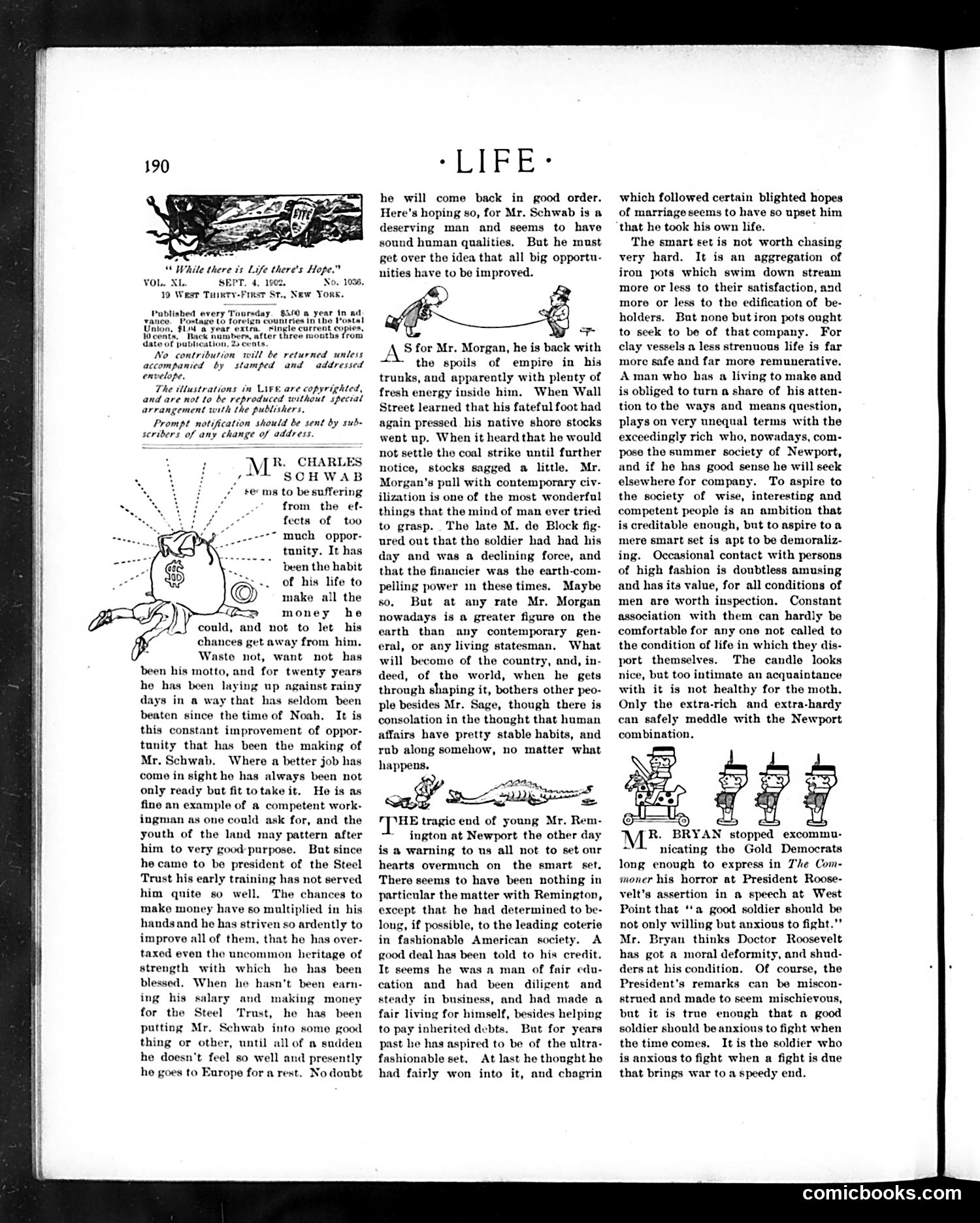
The main cartoon depicts **Charles Schwab**, identified in the text as a major industrialist. The illustration shows him as a large, bloated figure being manipulated like a puppet or held aloft—a visual metaphor for his power and influence in the business world. The accompanying article discusses Schwab's career trajectory, his relationship with the Steel Trust, and his aspirations within high society, particularly Newport's elite circles. The satire critiques how wealth and industrial power translate into social ambition and attempted respectability. The cartoon lampoons the nouveau riche—how industrial magnates like Schwab acquire enormous financial power but remain outsiders to established aristocratic society, attempting (and struggling) to gain acceptance through social climbing and competitive consumption.
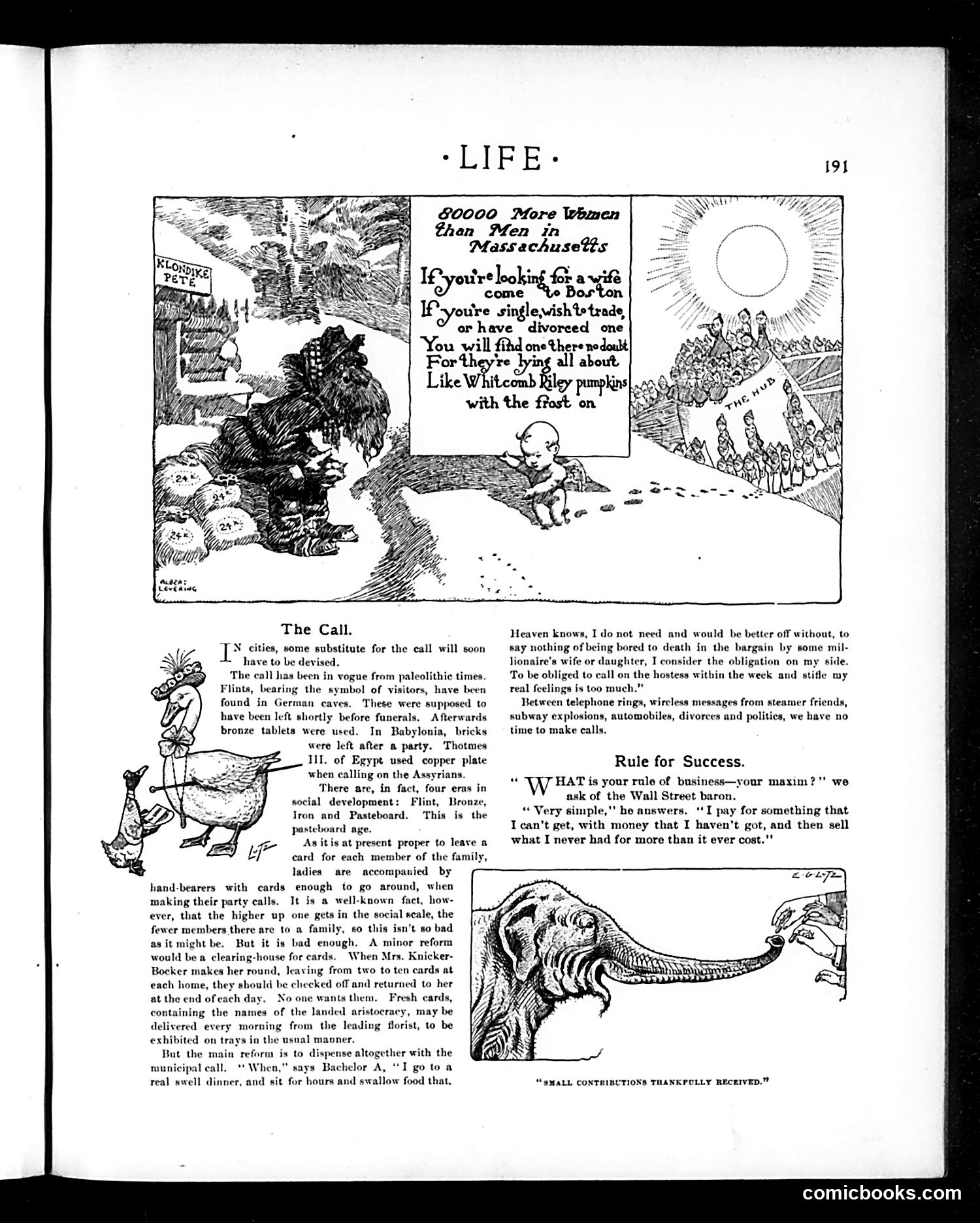
The top cartoon advertises Massachusetts as a destination for unmarried men and women seeking partners. It's a tongue-in-cheek recruitment pitch: men looking for wives, single women wanting to "trade," and divorcees will find abundant options in Boston, humorously compared to "Whitcomb Riley pumpkins with the frost on." The lower section contains two distinct pieces: "The Call" discusses historical calling customs and social etiquette around telephone calls and visiting cards, satirizing the elaborate social rules governing domestic life. "Rule for Success" features a brief interview where a businessman credits his success to buying items cheaply and reselling them at higher markups—a straightforward but amusing economic principle presented as business wisdom.
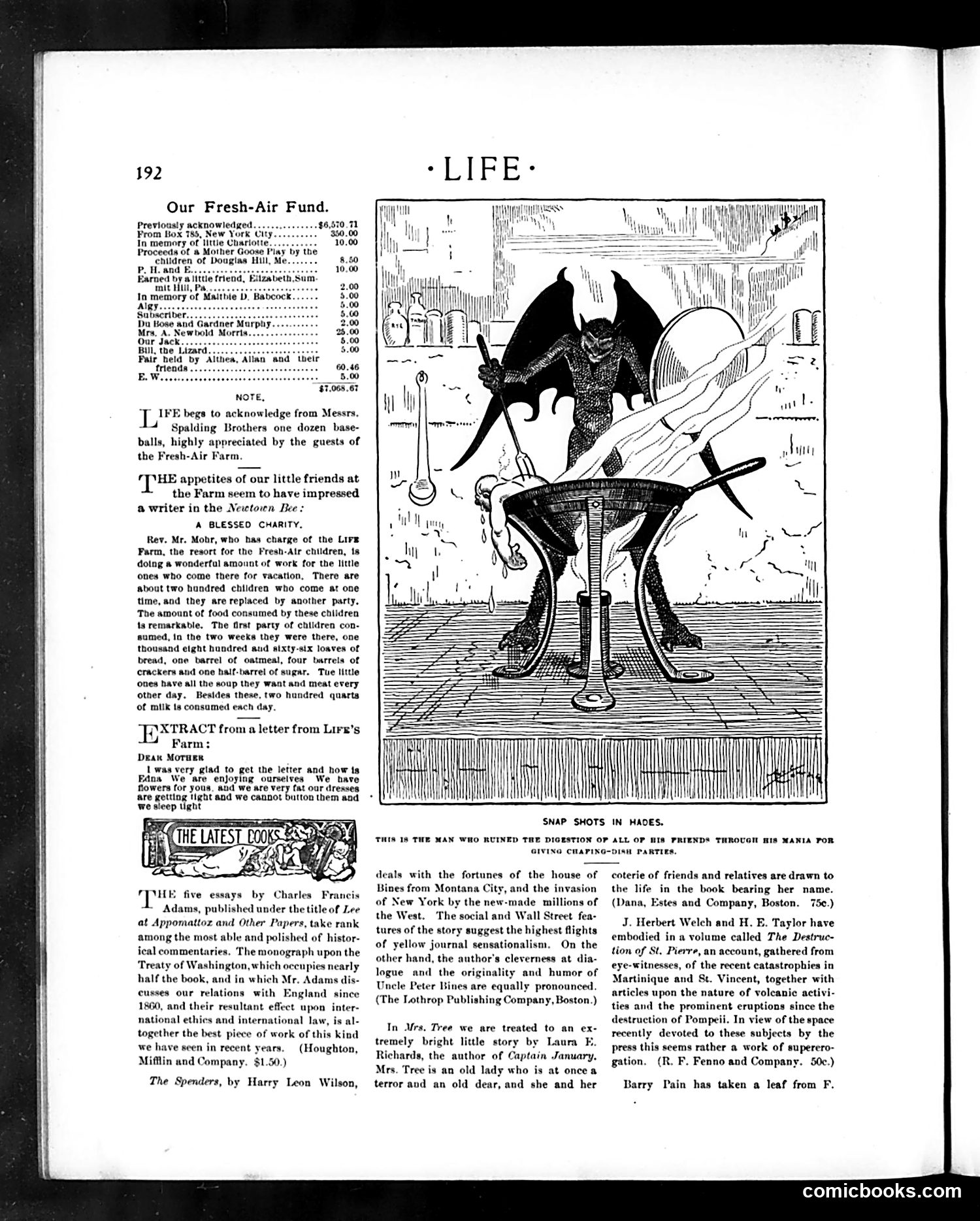
This cartoon depicts a skeletal, emaciated man being force-fed or having his digestive system examined, with the caption: "This is the man who ruined the digestion of all of his friends through his mania for giving charity-dinner parties." The satire targets excessive dinner-party giving as a social vice. The figure's skeleton-like appearance suggests that constant entertaining has literally consumed him—worn him to bones. The "Hades" setting frames this as a punishment for his obsessive hospitality. The joke plays on the era's social anxiety about status-signaling through lavish entertaining. By depicting the chronic host as a cautionary tale in hell, Life mocks both the man's compulsive generosity and his guests' resentment of being perpetually invited to these exhausting social obligations. It's social satire about middle-class entertainment excess.
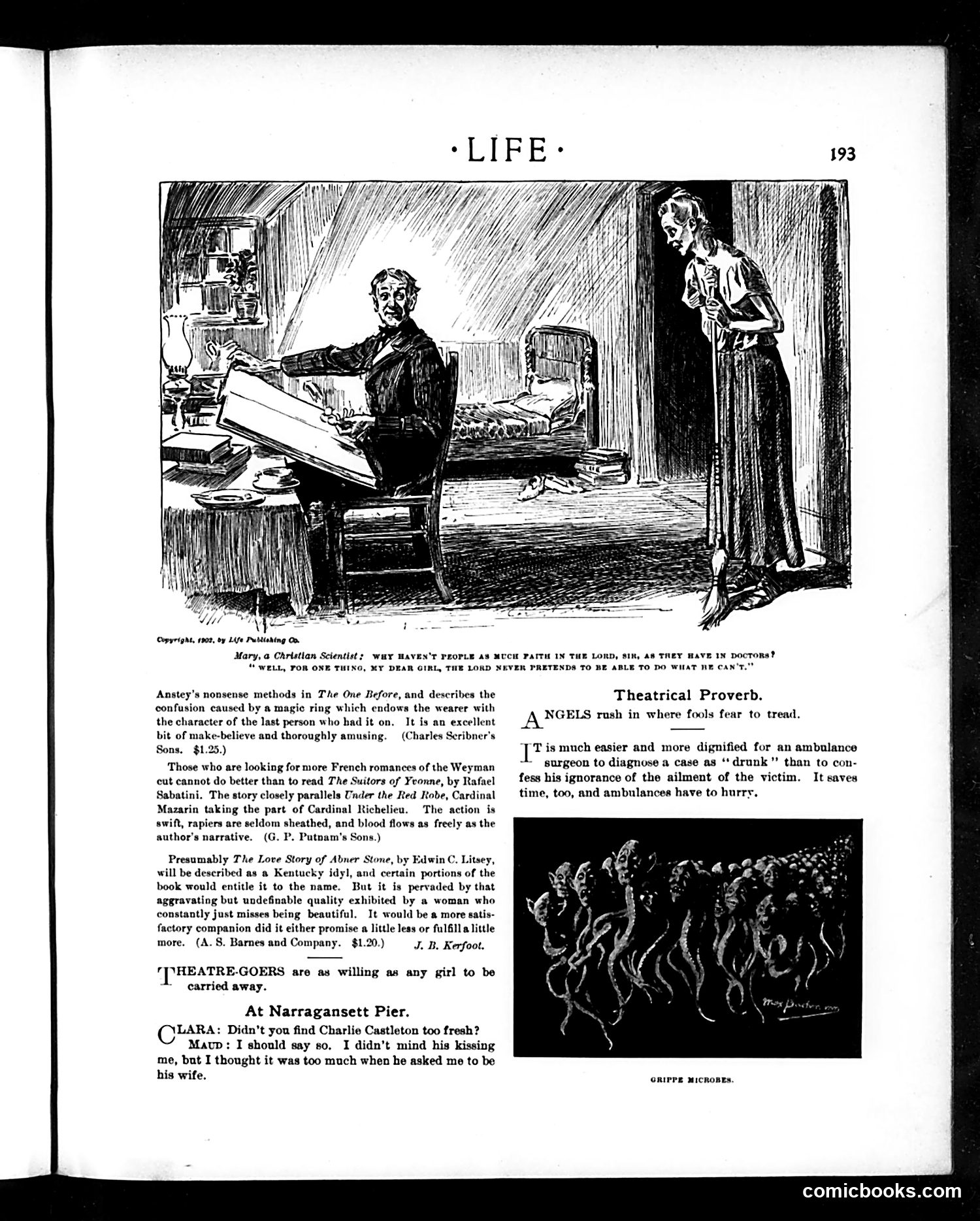
**Main Illustration (top):** A domestic scene depicting a man at a desk reading documents while a woman stands nearby in what appears to be a bedroom. The caption addresses "Mary, a Christian Scientist" questioning why Christian Scientists lack faith in doctors despite trusting in God. **Context:** This satirizes Christian Science, a religious movement that emphasized spiritual healing over medical treatment. The cartoon mocks the apparent contradiction—if believers trust divine providence, why refuse doctors? **Secondary Content:** - "Theatrical Proverb" section with brief satirical quips about theater and medical professionals - "At Narragansett Pier" dialogue joke about infidelity - Small illustration of "Grippe Microbes" (influenza bacteria) The page reflects early 20th-century American attitudes toward Christian Science and emerging germ theory.
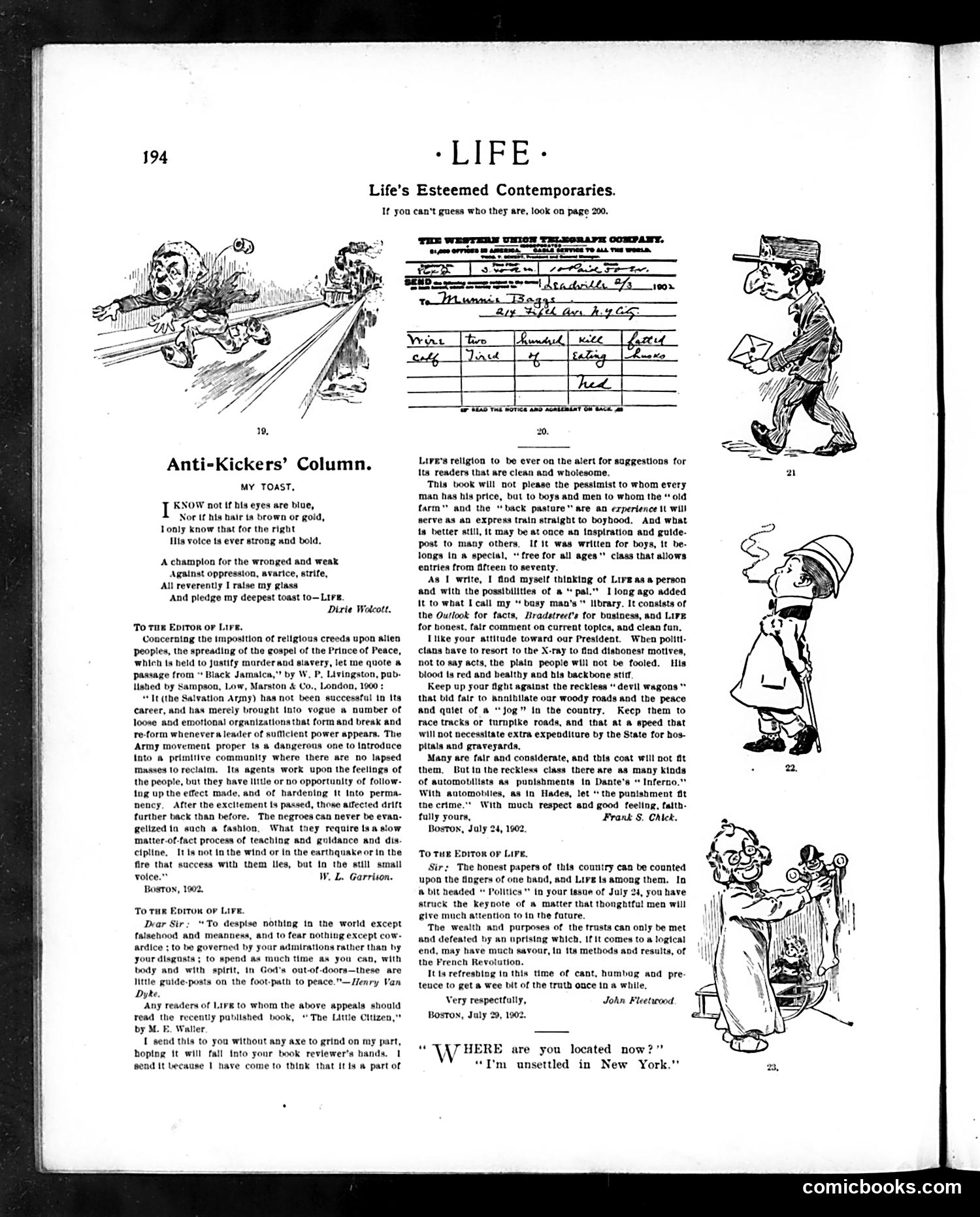
This page contains satirical commentary and cartoons on contemporary issues circa 1902. The **"Anti-Kickers' Column"** presents letters critiquing Life's editorial stance—particularly regarding religious content and social reform messaging that some readers found preachy. The cartoons (numbered 19-23) appear to be political/social satire, though specific figures are difficult to identify without clearer resolution. Image 19 shows what appears to be a confrontational scene; image 21 depicts a character in formal dress; image 23 shows figures in comedic poses. The text references debates about trusts, wealth distribution, and social class—common Progressive Era concerns. Without clearer identification of the caricatured figures, the specific political targets remain unclear, though the tone suggests critique of contemporary power structures and class tensions.
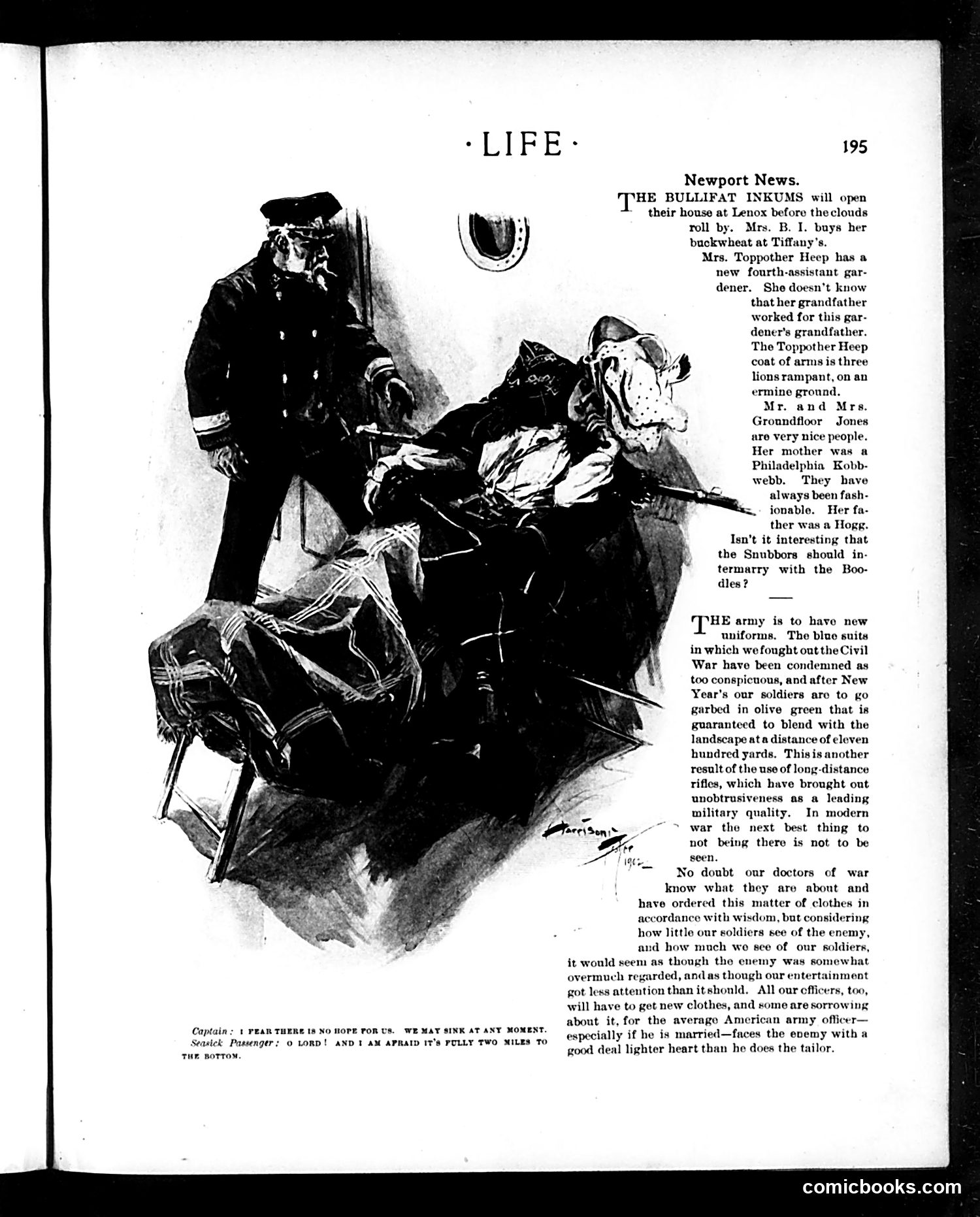
The main illustration depicts a dramatic seaside scene: a captain and seasick passenger aboard a ship in rough waters. The captain declares "I fear there is no hope for us. We may sink at any moment," while the terrified passenger responds "O Lord! and I am afraid it's fully two miles to the bottom." This is a humorous cartoon about seasickness and maritime anxiety—the joke being the passenger's absurd worry about the distance to the ocean floor when facing immediate sinking. The text discusses Newport News society gossip and, more significantly, critiques new U.S. Army uniforms (olive green replacing Civil War–era blue). The commentary sarcastically notes that soldiers rarely see enemies anyway, so uniform visibility matters little—a pointed comment on military strategy or visibility in modern warfare.
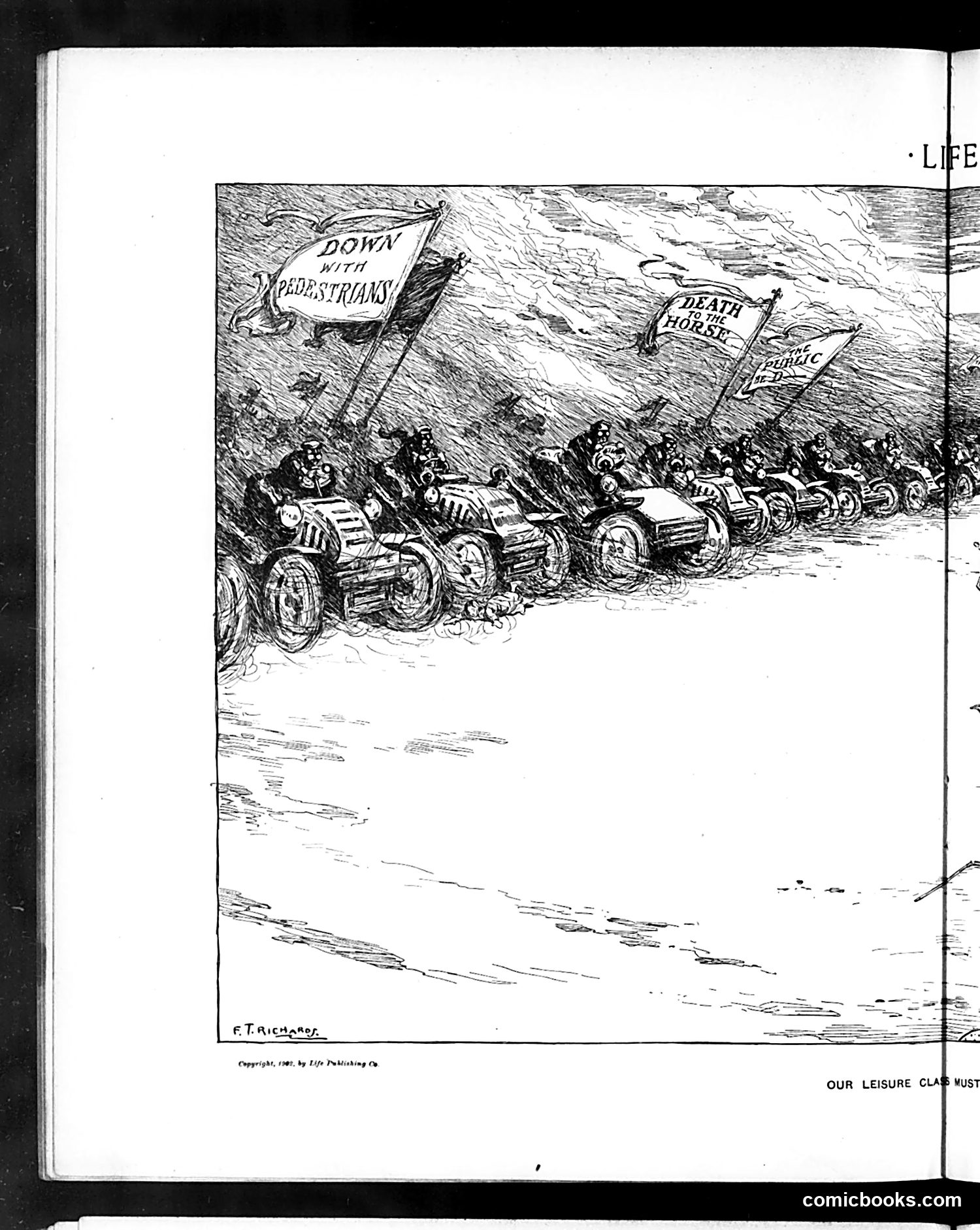
This satirical cartoon depicts a procession of automobiles carrying figures holding protest banners with messages like "DOWN WITH SPEED STRAINS," "DEATH TO THE HORSE," and "PANIC." The drawing appears to critique the early automobile industry and leisure-class adoption of cars. The satire works on multiple levels: the vehicles themselves are causing the very hazards they claim to oppose ("speed strains," "panic"), suggesting the contradiction between automobiles' promise of progress and their actual social costs—traffic dangers, pedestrian risks, and general chaos. The cartoon likely references early-1900s debates over automobile safety and their displacement of horse-drawn transportation. The title "OUR LEISURE CLASS MUST..." (partially cut off) suggests criticism of wealthy drivers and their reckless behavior. The artist is F.T. Aitcheson.
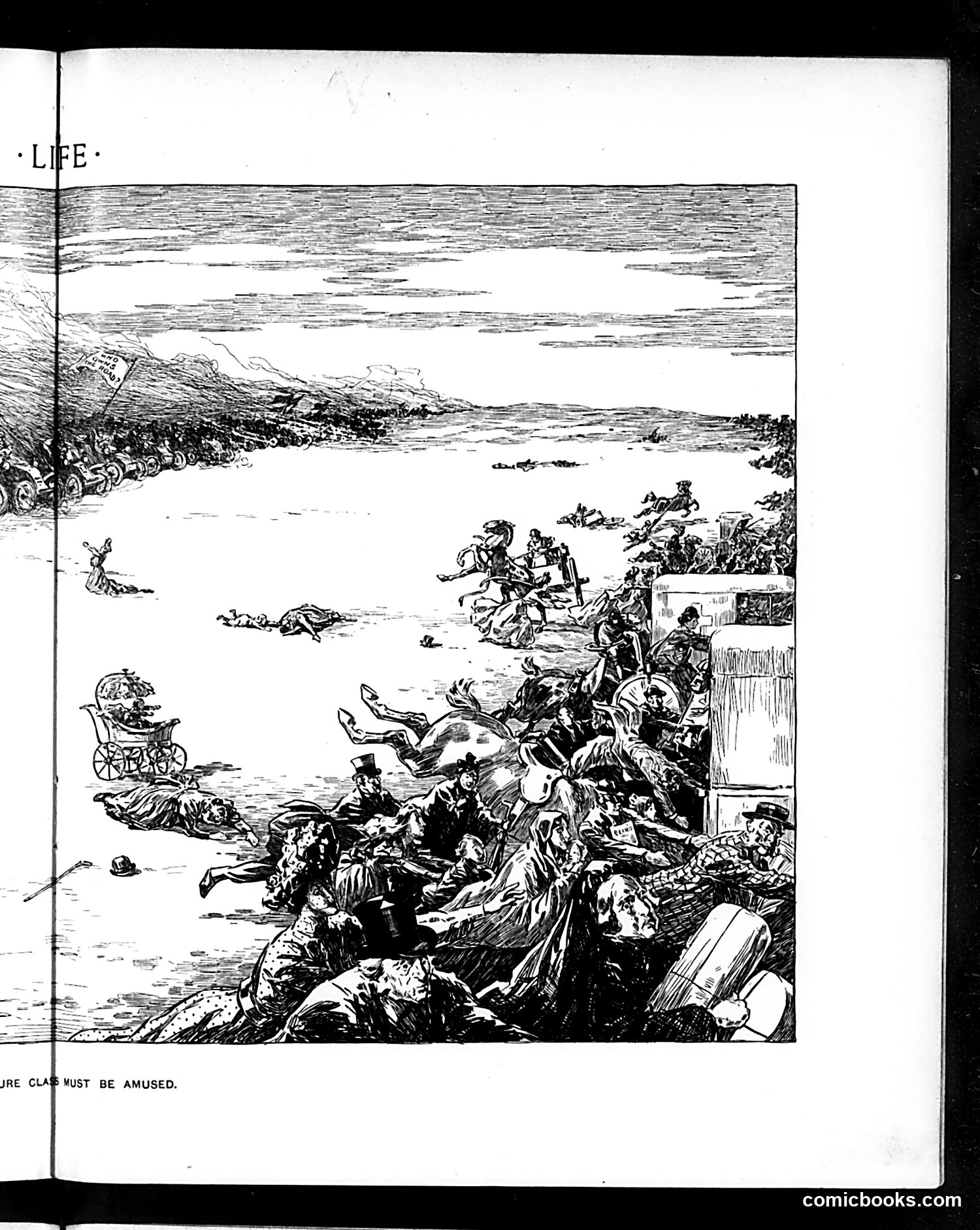
This is a satirical illustration from *Life* magazine titled "LEISURE CLASS MUST BE AMUSED." The cartoon depicts wealthy upper-class figures engaged in leisure activities by a waterside or beach setting. The composition shows elegantly dressed people in period clothing (appearing to be late 19th or early 20th century) relaxing, socializing, and enjoying recreational pursuits—carriages, boats, fashionable dress, and idle pastimes visible throughout. The satire targets the leisure class's dependence on constant amusement and entertainment as a defining characteristic of wealth. The crowded, chaotic scene suggests excess and frivolity. The title ironically comments on the perceived necessity for the wealthy to be perpetually entertained, likely critiquing their disconnection from productive labor and social responsibility during an era of significant class inequality.
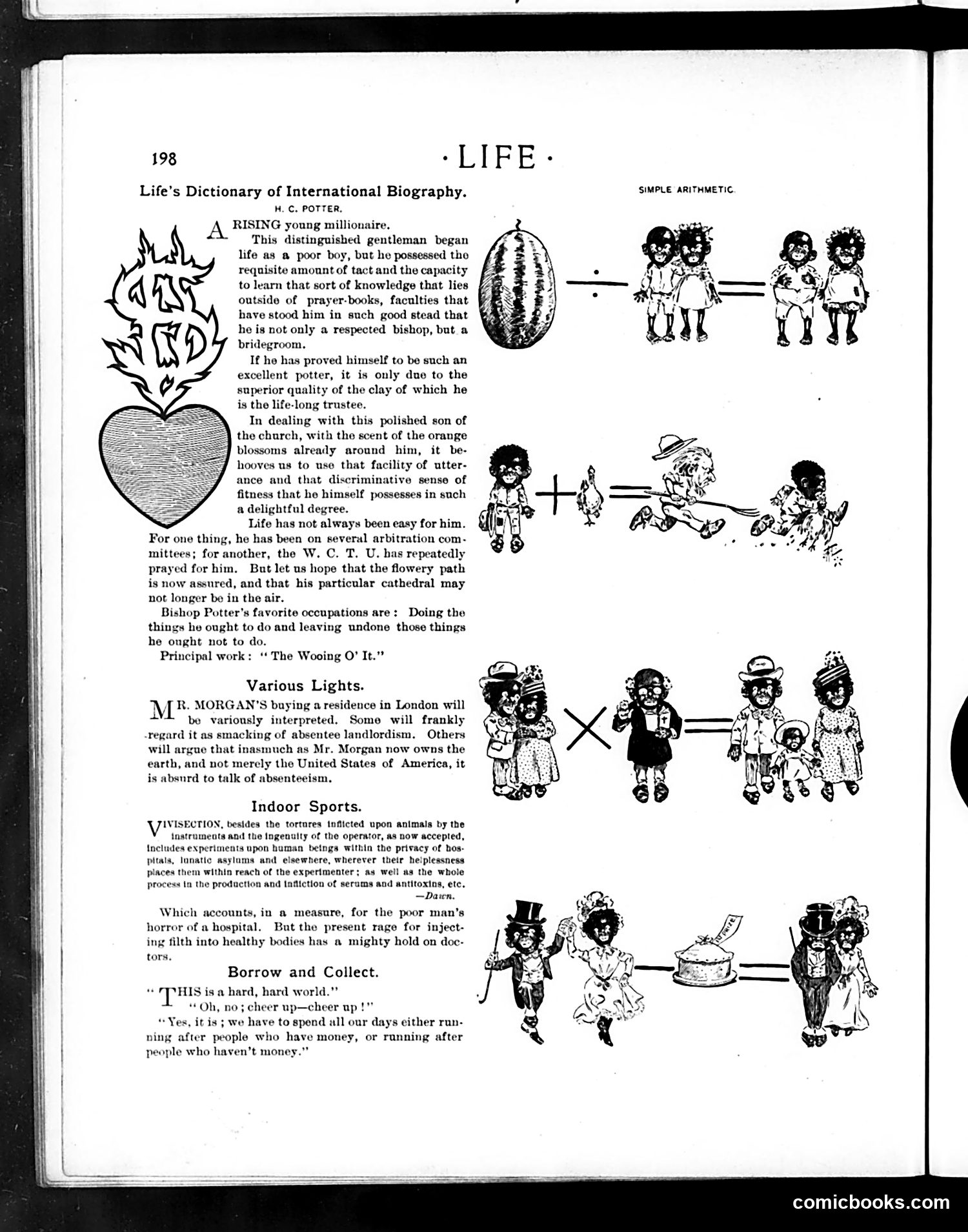
The right side of this page contains "Simple Arithmetic" — a series of visual equations using illustrated children and objects. These appear to be humorous illustrations demonstrating basic arithmetic principles through domestic and social scenarios (addition, subtraction, multiplication operations). The left side contains three brief satirical sections: a biography of a "rising young millionaire" (H.C. Potter), commentary on "Various Lights" regarding London property ownership, and sections on "Indoor Sports" and "Borrow and Collect." These are text-based social commentary pieces typical of Life magazine's satirical style, critiquing wealth, class pretensions, and daily social behaviors. The exact targets of the satire remain somewhat unclear without additional historical context about the specific events or figures referenced.
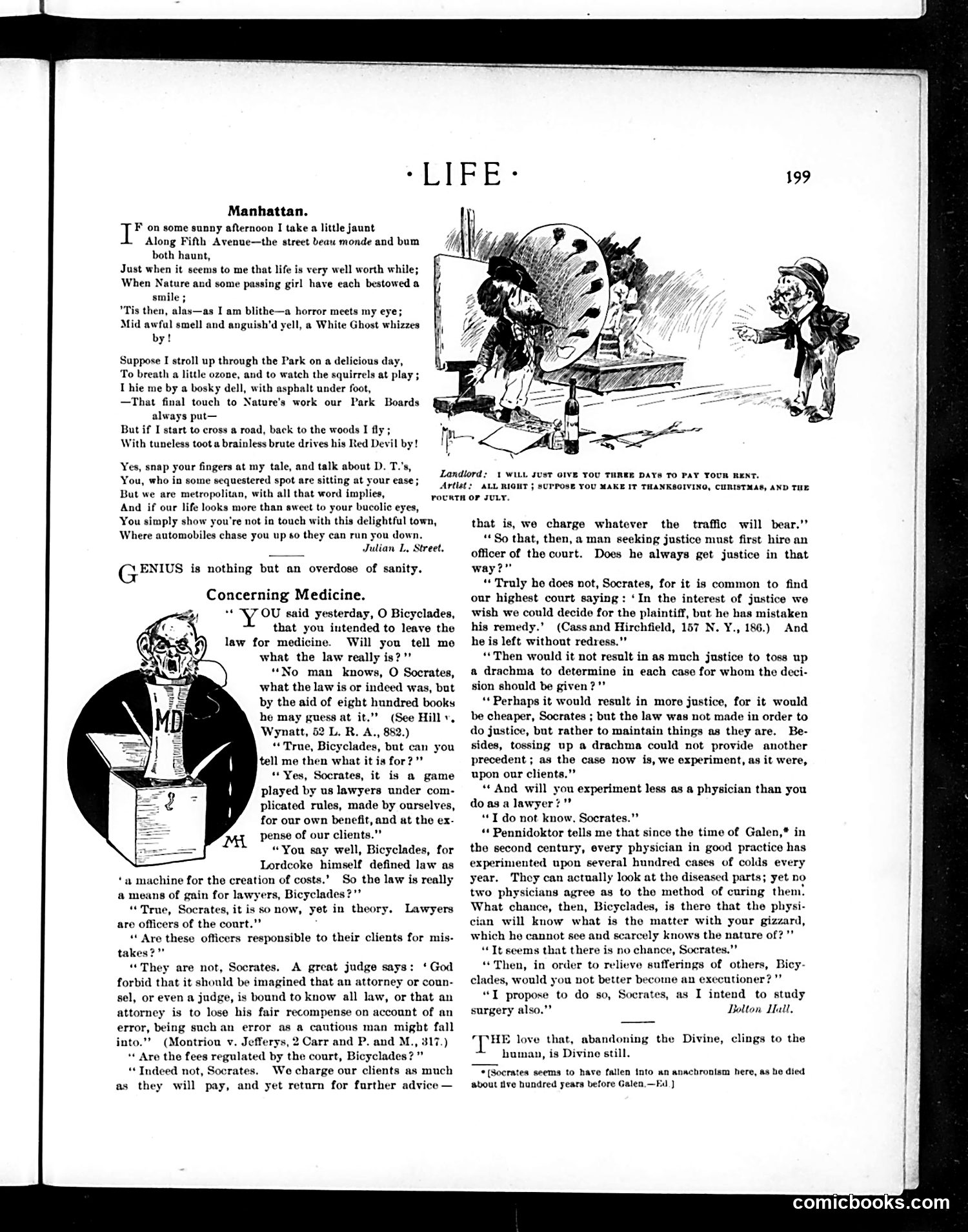
This page contains two distinct satirical pieces: **"Manhattan"** (top): A poem mocking Manhattan life, contrasting pleasant moments on Fifth Avenue and in Central Park with the terror of early automobiles. The accompanying cartoon shows a man operating an early motorcar as a menace to pedestrians. The satire targets the disruptive, dangerous intrusion of automobiles into urban life—presenting them as instruments of chaos that have literally invaded Nature itself (the Park Boards have added asphalt). **"Concerning Medicine"** (bottom): A Socratic dialogue mocking lawyers and the legal profession. Using the classical philosophical format, it satirizes lawyers as self-serving operators of a deliberately complicated system designed to generate fees rather than deliver justice. Key targets: the law is a "machine for the creation of costs," lawyers charge "whatever the traffic will bear," courts may deny justice on technicalities, and random chance (tossing a coin) might produce fairer outcomes than actual legal proceedings. Both pieces critique institutions disrupting ordinary life—automobiles and the legal system.
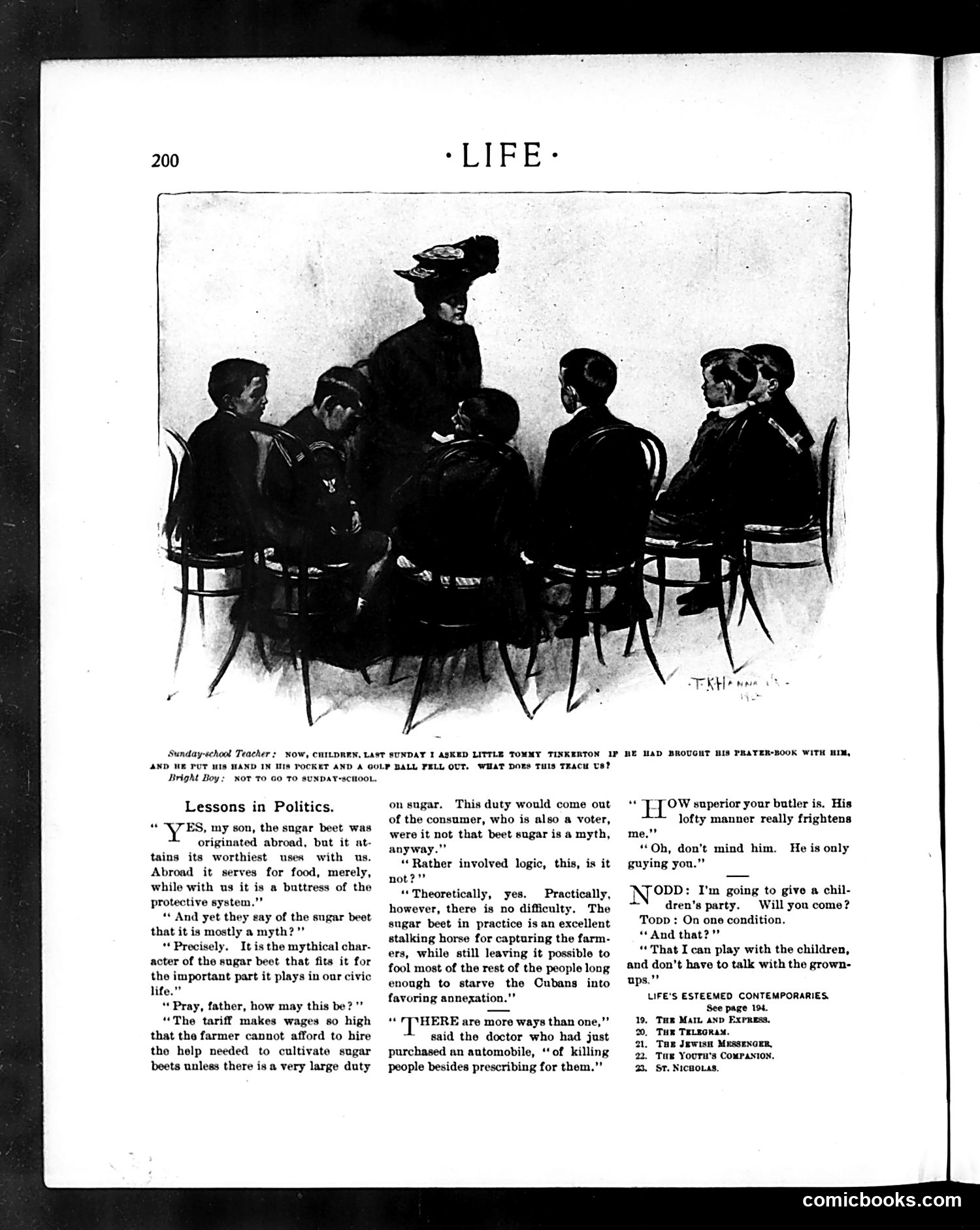
This page from *Life* magazine presents satirical commentary on early 20th-century American politics and social customs. **Top cartoon:** A Sunday school teacher tells the famous anecdote about a boy finding a golf ball in church, asking what lesson it teaches. The "bright boy" answers: don't go to Sunday school—satirizing both juvenile irreverence and the perceived hypocrisy of religious institutions. **Main article, "Lessons in Politics":** A father lectures his son about the sugar beet tariff—a protectionist policy that artificially inflates domestic sugar prices. The satire exposes the logical contradiction: the tariff supposedly helps American farmers, yet farmers can't actually afford labor costs without impossibly high duties. The father cynically admits it's a "myth" designed to fool voters while harming consumers and—remarkably—to force Cuba into annexation through economic starvation. This reflects actual early-1900s debates over imperial expansion and protective tariffs. **Bottom vignettes:** Brief jokes mocking class pretension (snobbish butlers) and social awkwardness (adults uncomfortable with children). The overall thrust: satirizing political duplicity, economic sophistry, and imperialist ambitions.
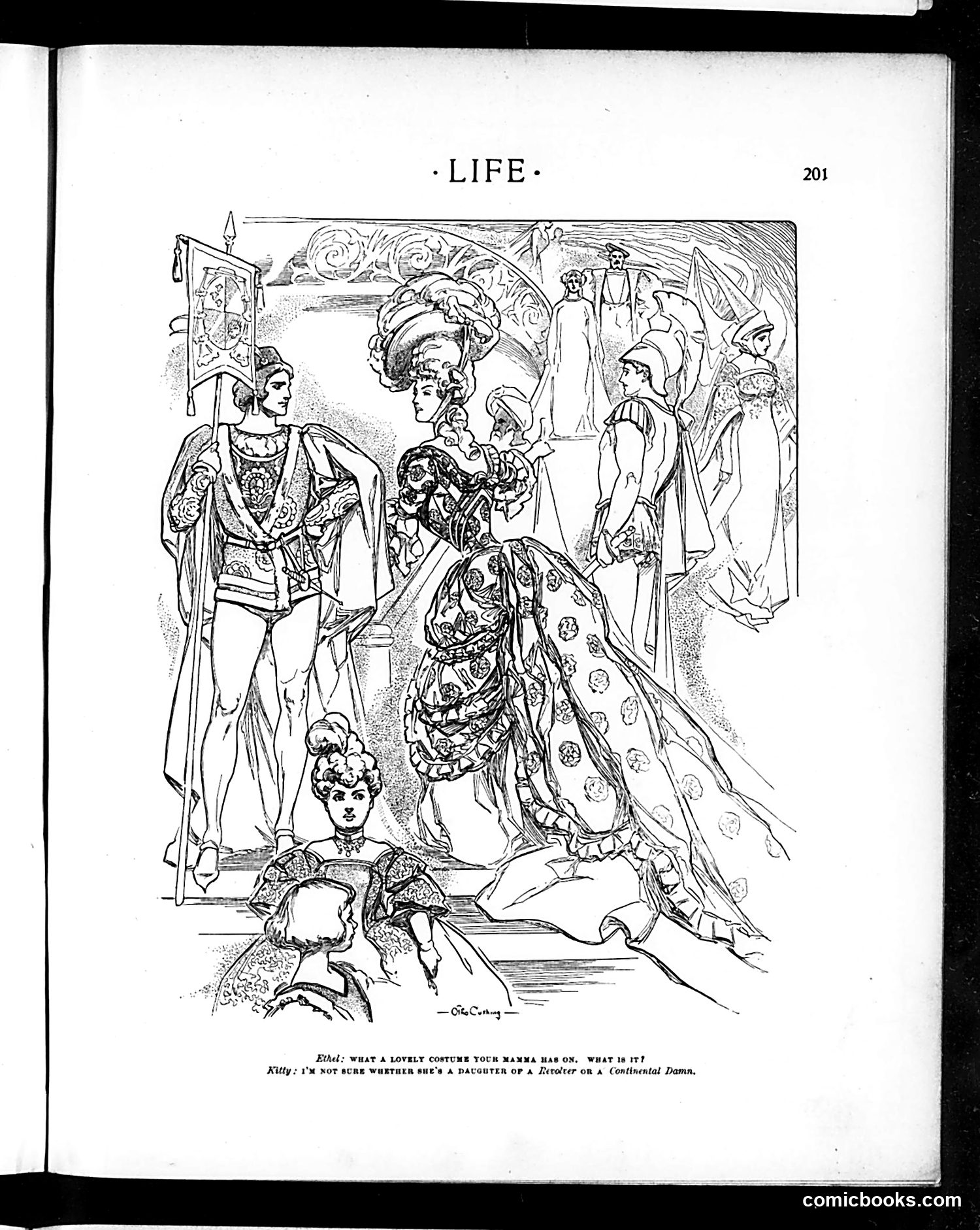
This is a single-panel cartoon satirizing aristocratic pretension and genealogical claims. The dialogue reveals the joke: **Edith** asks about a woman's elaborate costume, questioning its authenticity. **Kitty** responds that she's unsure whether the wearer is "a daughter of a *Duvelier* or a *Continental Drama*"—a humorous confusion between a real aristocratic lineage and theatrical performance. The satire mocks wealthy women who adopt elaborate period costumes (the figure wears ornate, heavily decorated robing) to appear aristocratic, when their actual genealogy may be theatrical or invented rather than genuinely noble. The exaggerated costume and the other elaborately dressed figures in the background suggest a high-society event where appearances and claims of status matter more than actual pedigree.
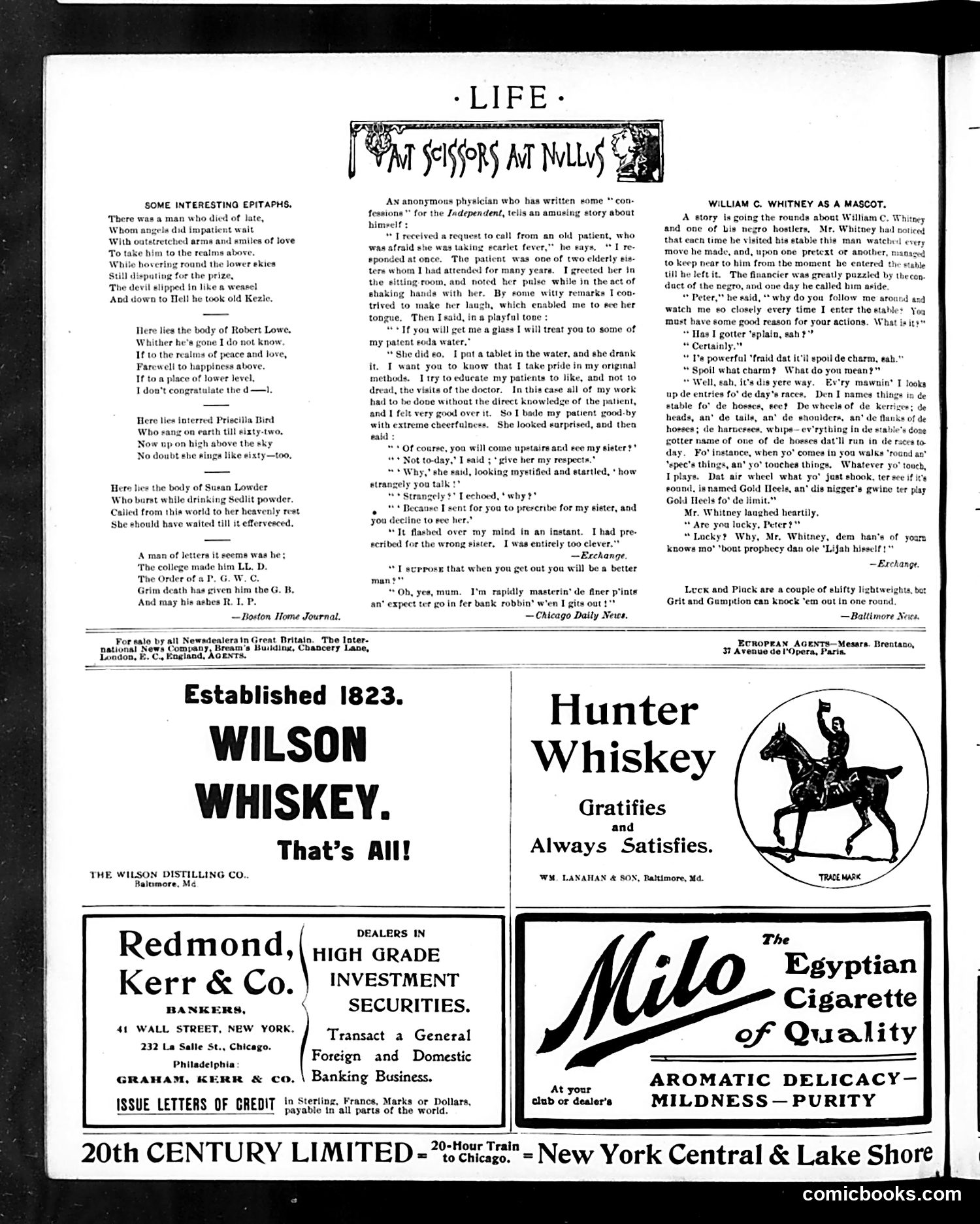
This page contains humorous epitaphs (mock tombstones) and anecdotes typical of *Life* magazine's satirical content. The epitaphs mock various deaths—a man who died of "fate," a woman who sang constantly, another who burst while taking Seidlitz powder (a laxative). The longer pieces include a physician's story about accidentally prescribing a "patent soda water" tablet to treat scarlet fever, and an anecdote about William C. Whitney (a wealthy financier) whose stable worker follows him obsessively. The worker explains he names racehorses after whatever Whitney touches—so touching things brings him luck betting on those horses. The humor relies on wordplay, irony, and the era's casual attitudes toward death and medical practice. The page is primarily advertising below, promoting Wilson Whiskey, Hunter Whiskey, banking services, and Milo Egyptian Cigarettes—typical for *Life* magazine from this period.
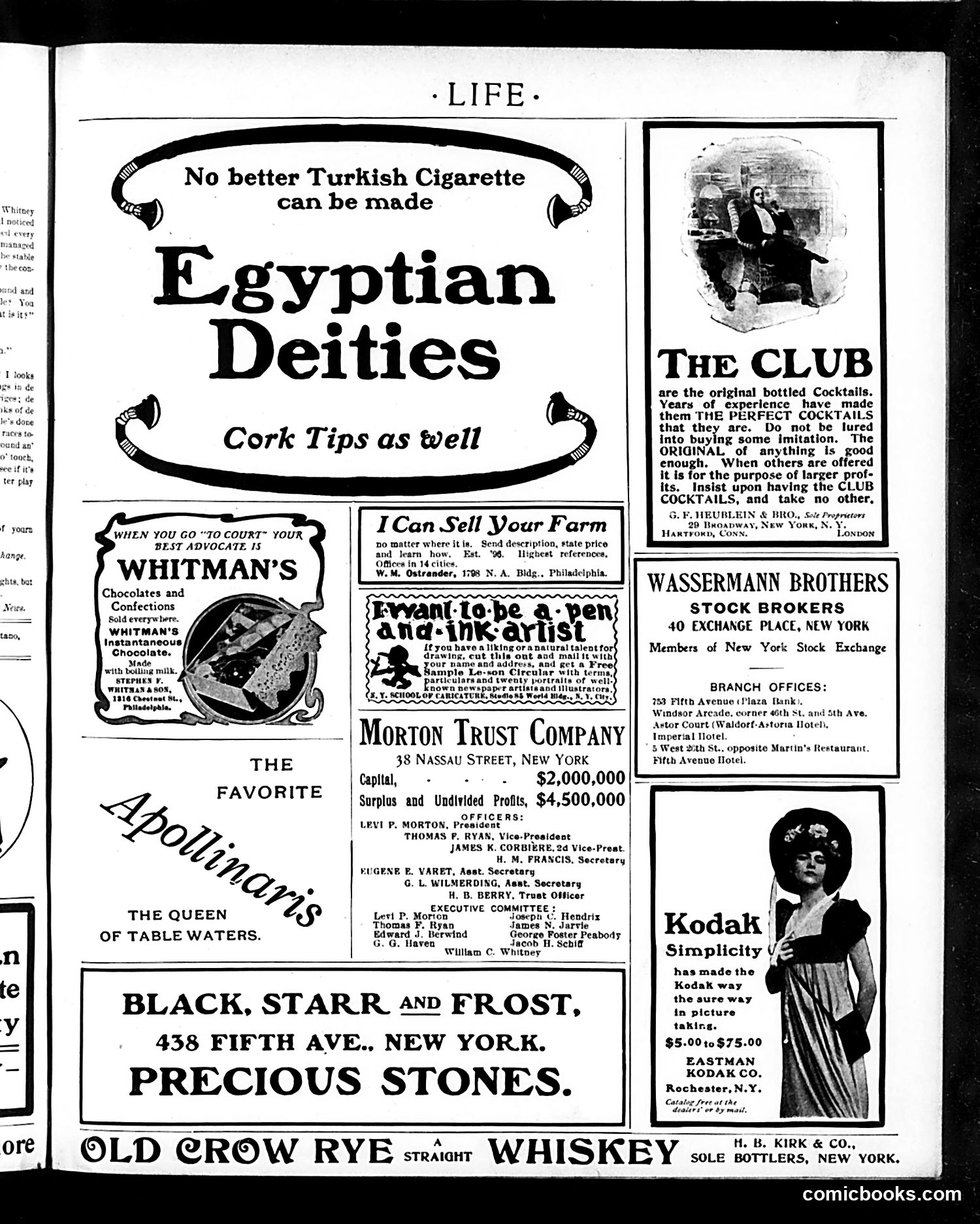
This is primarily an **advertising page** from Life magazine, not a satirical cartoon page. The layout features multiple commercial advertisements typical of early 20th-century publications. The ads include luxury goods (Egyptian Deities cigarettes, Whitman's chocolates, precious stones from Black Starr and Frost) and financial services (Morton Trust Company, Wassermann Brothers stock brokers). There's also a Kodak camera advertisement and spirits (Old Crow Rye whiskey). One small element appears to be recruitment-oriented: a notice seeking artists or illustrators to submit work. The page reflects the magazine's business model—mixing editorial content with paid advertising from upscale merchants targeting wealthy readers. The advertisements themselves contain no apparent political satire or social commentary; they're straightforward product promotion. Without additional context about Life's editorial stance during this period, no specific satirical message is evident from the advertising content shown.
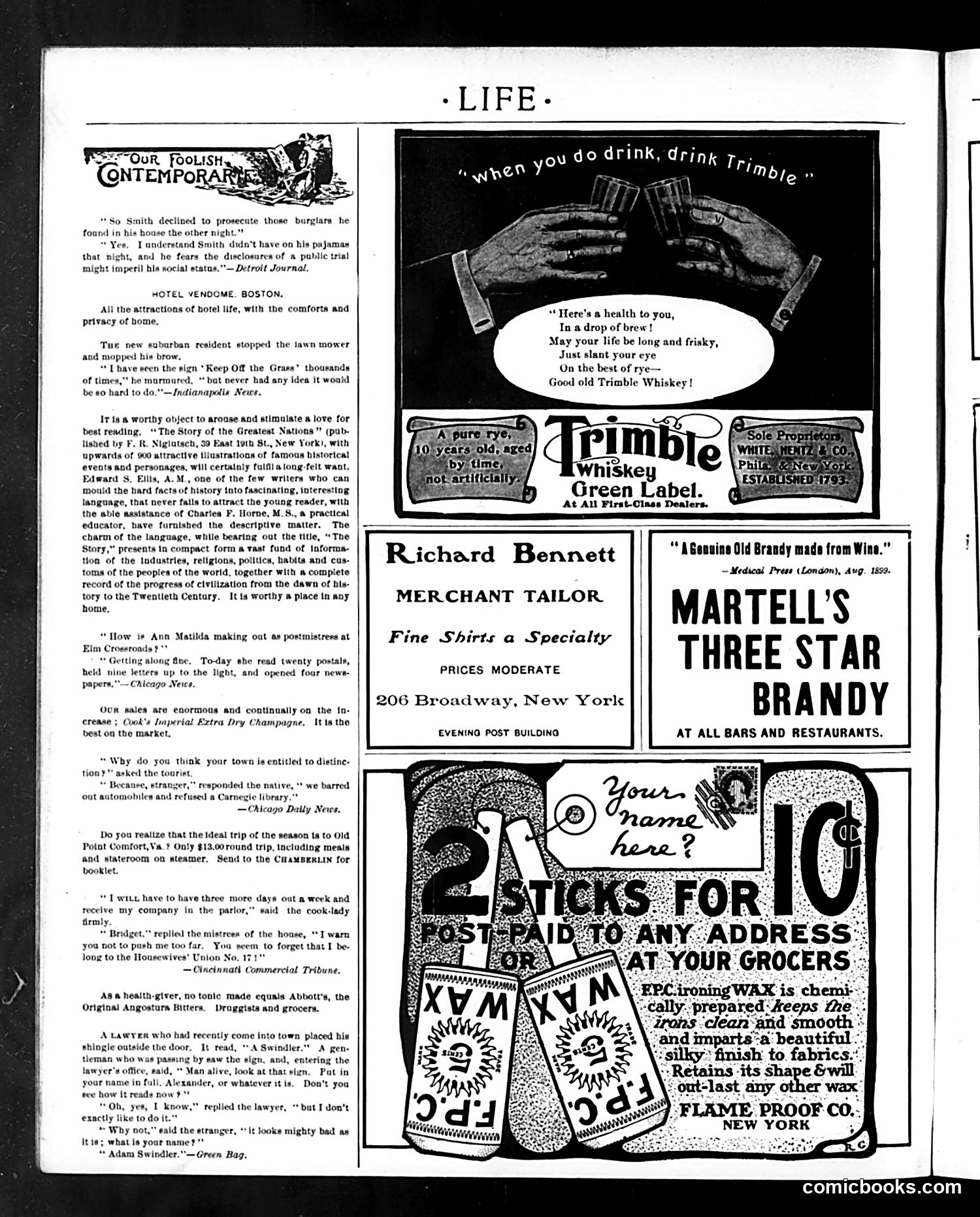
This page from *Life* magazine is primarily **advertising and humor anecdotes** rather than political cartooning. The content includes: **"Our Foolish Contemporaries"** section: A series of brief satirical jokes mocking social pretensions and absurdities of the era, including: - A man avoiding prosecution for burglary to protect his reputation - A suburban resident frustrated by "Keep Off the Grass" signs - A postmistress who reads others' mail - A lawyer whose shingle reads "A Swindler" These are gentle social satire targeting middle-class anxieties about propriety, property, and status. **Advertisements dominate the page**: promoting Trimble Whiskey, Martell's Brandy, Richard Bennett merchant tailoring, and FPC ironing wax—typical turn-of-century luxury goods marketing. The humor relies on recognizing period social conventions (concern with scandal, labor union organizing, privacy invasion) that modern readers would need historical context to fully appreciate. No specific political figures or events are referenced.
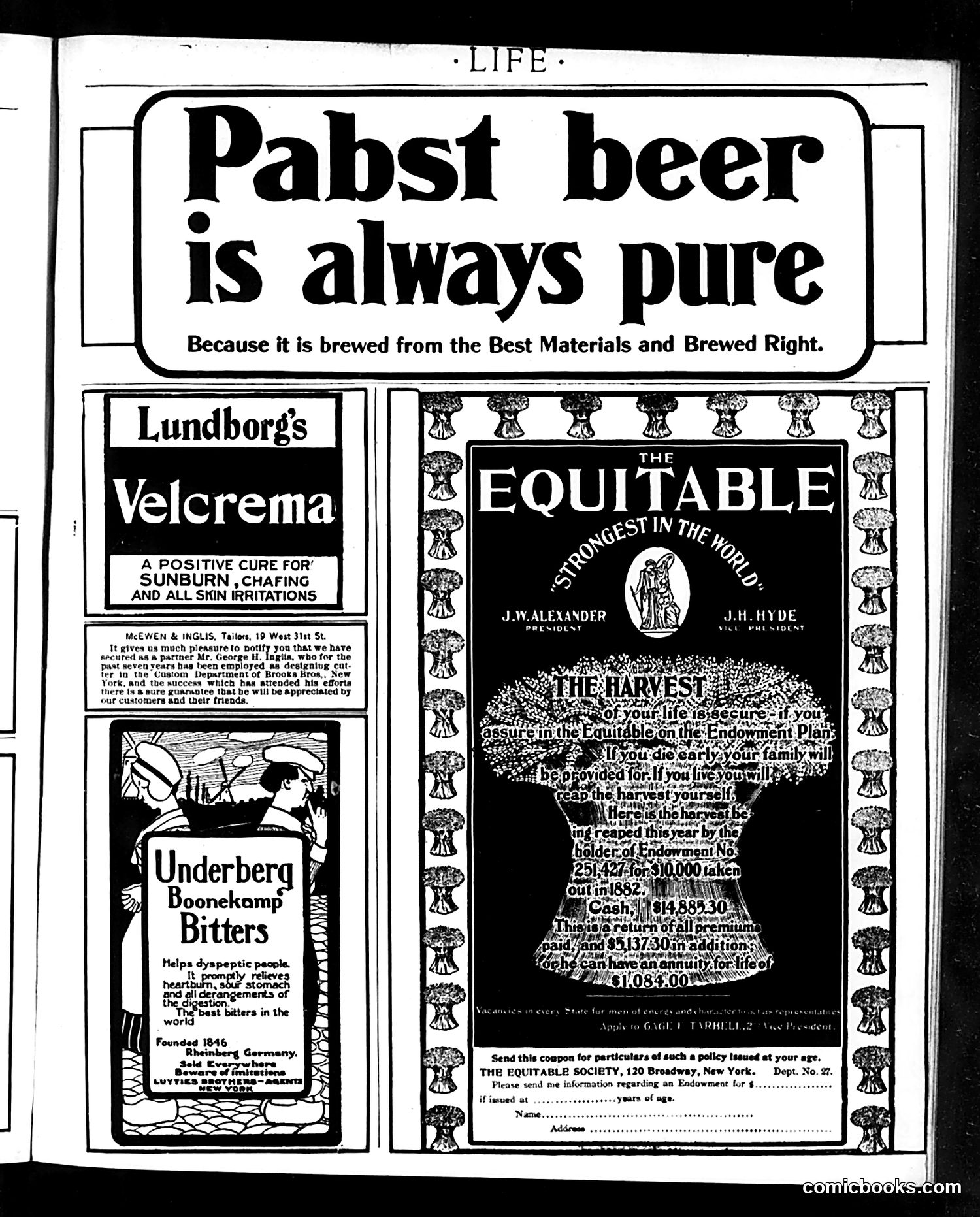
This page is primarily **advertisements**, not satire or political commentary. It showcases four competing products from the early 1900s: **Pabst Beer** dominates the top with a straightforward purity claim—common marketing during an era when food safety was a legitimate concern (pre-FDA regulation). **Lundborg's Velcrema**, **Underberg Boonekamp Bitters**, and **The Equitable Society** insurance occupy the lower sections. These ads reflect period anxieties: skin irritation remedies, digestive bitters (marketed for dyspepsia—a catch-all stomach complaint), and life insurance as family financial protection. The Equitable ad notably emphasizes "The Harvest of Your Life"—appealing to mortality fears while promising endowment returns. **No political cartoons or satire appear here.** The page simply demonstrates early 20th-century consumer culture: patent medicines, alcohol-based tonics marketed as remedies, and emerging insurance products—all making grand health and security claims with minimal regulation.
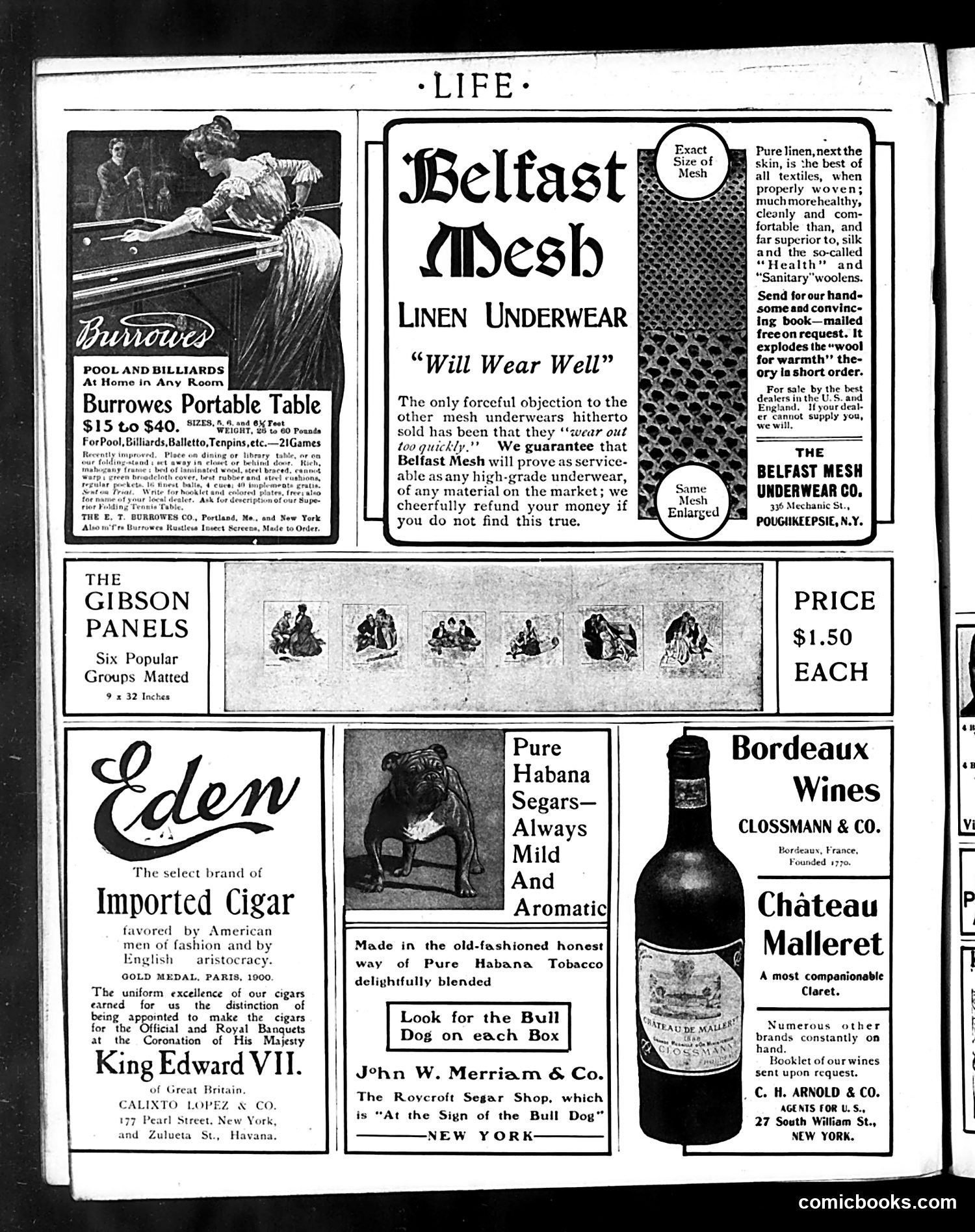
This is **not a cartoon or satirical content page**, but rather a full-page advertisement section from Life magazine. The page contains multiple luxury product advertisements typical of early 20th-century American periodicals: **Key ads include:** - **Burrowes Portable billiards tables** (pool/recreation) - **Belfast Mesh linen underwear** (emphasizing durability and health benefits over wool) - **Gibson Panels** (Charles Dana Gibson artwork prints) - **Eden imported cigars** (positioned as used at King Edward VII's coronation) - **Pure Habana cigars** from John W. Merriam & Co. - **Bordeaux wines and Chateau Malleret** (French luxury items) The ads target wealthy American consumers, emphasizing quality, imported goods, and status markers (royal endorsements, aristocratic approval). There is **no political satire or commentary**—this is straightforward commercial advertising reflecting consumer culture and class aspirations of the Edwardian era.
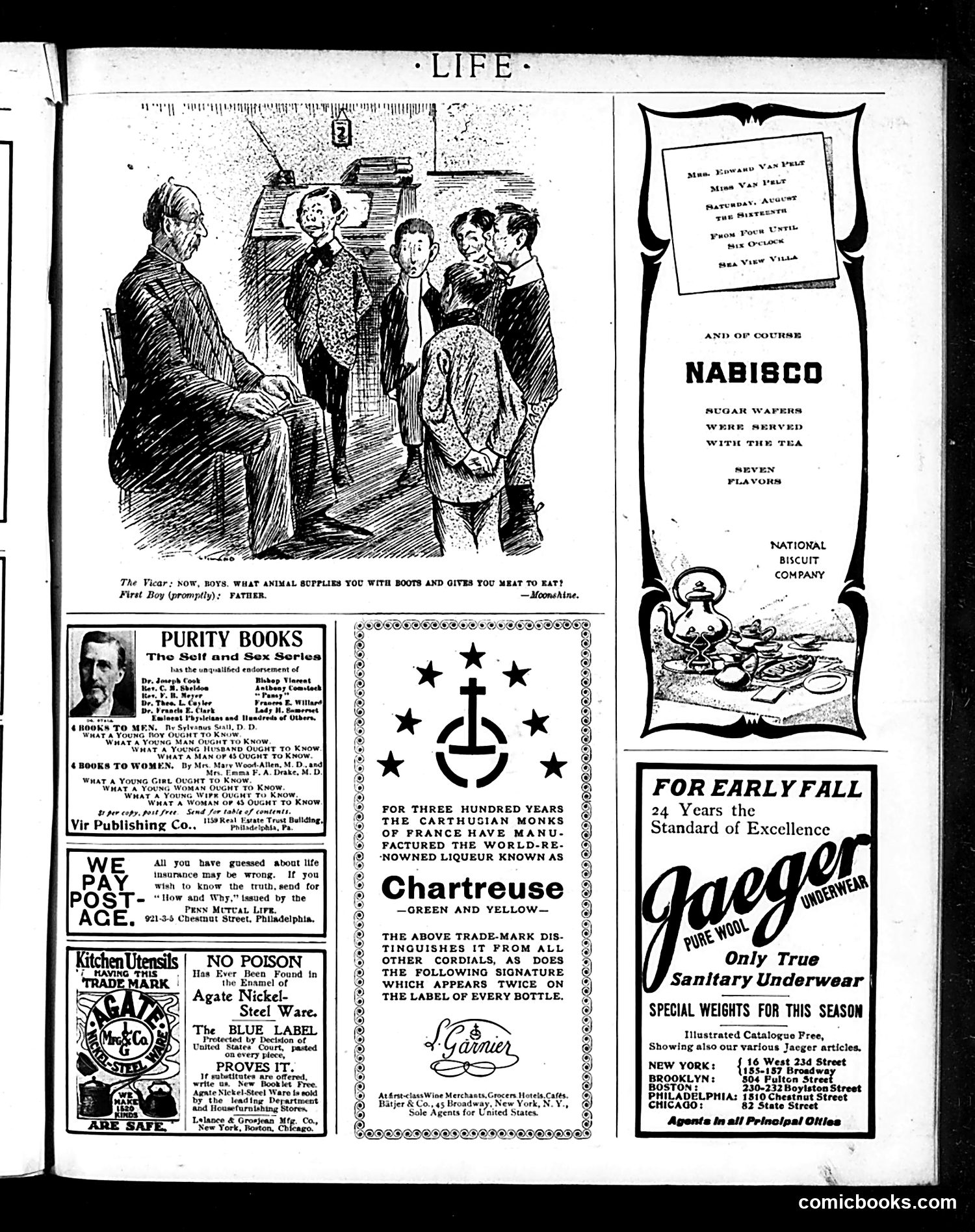
This page is primarily **advertising with one cartoon**. The main cartoon depicts a vicar asking boys a religious instruction question: "What animal supplies you with boots and gives you meat to eat?" A boy answers "Pater" (Latin for father)—a dark joke suggesting fathers are exploited for their labor and resources, much like animals. The satire critiques the economic burden placed on fathers as family breadwinners during this era. It's simultaneously a play on the boy's Latin knowledge and a sardonic commentary on paternal sacrifice. The page also advertises "Purity Books" about sexual education and relationships for women and young people—reflecting early 20th-century efforts to provide frank, scientific information on sexuality. Other ads promote Nabisco products, Chartreuse liqueur, Jaeger underwear, and kitchen utensils, typical of the magazine's mixed content model.
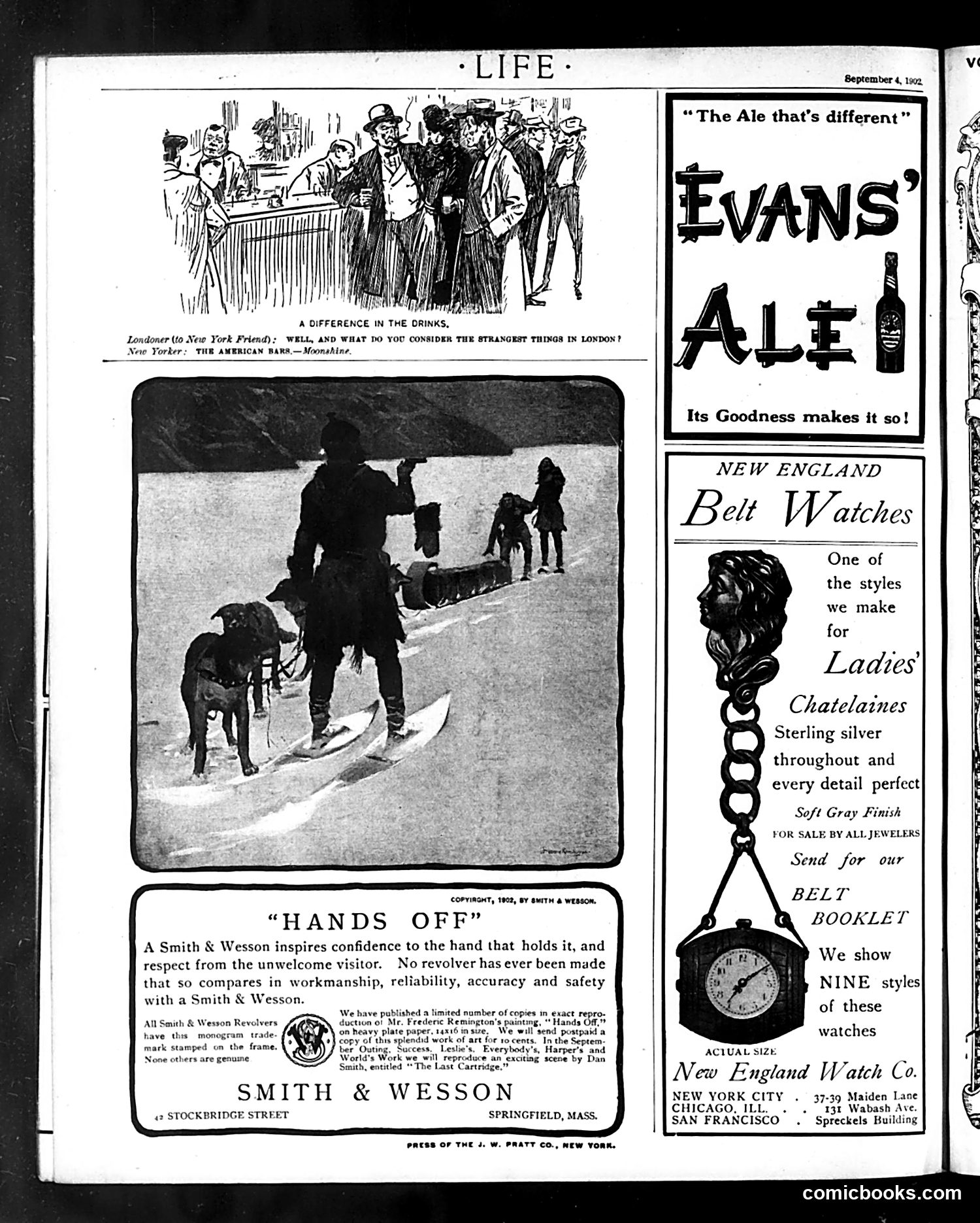
This cartoon satirizes American bars operating in London during the early 1900s. A Londoner asks a New York visitor what he finds strangest in London; the New Yorker responds that it's "the American bars"—calling them "Moonshine." The joke relies on dual meaning: "moonshine" literally refers to illegally distilled whiskey (associated with America), but also suggests these bars are fraudulent or inferior imitations. The cartoon implies American drinking establishments in London were either serving poor-quality liquor or were simply out of place in British culture. This reflects tensions between American and British cultures at the turn of the century, with Americans abroad sometimes viewed as crude or unsophisticated. The satire targets both American drinking culture and the presumption of American establishments attempting to transplant their customs to England.