
Life, 1902-09-04 · page 13 of 22
Life — September 4, 1902 — page 13: what you’re looking at
What you’re looking at
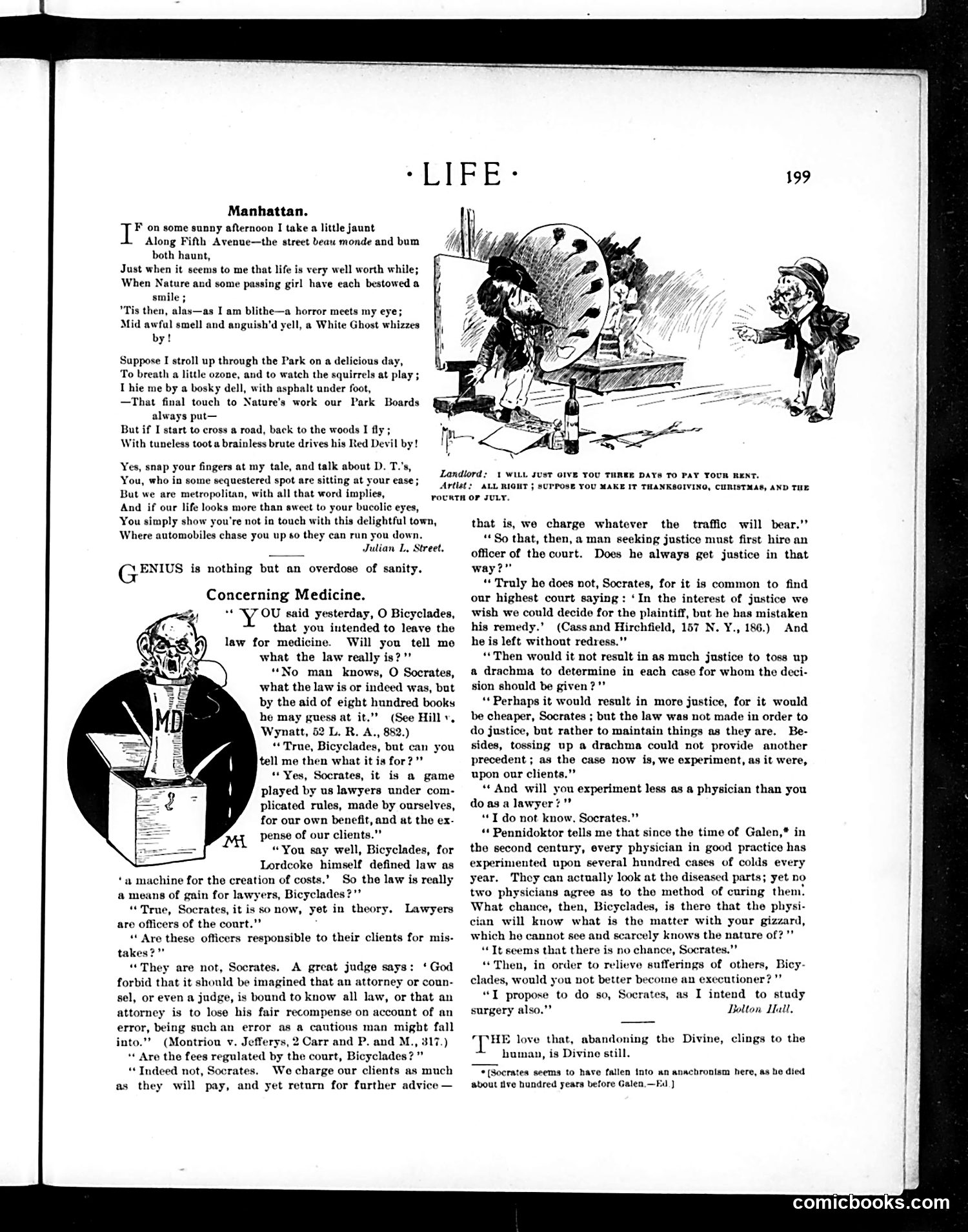
This page contains two distinct satirical pieces: **"Manhattan"** (top): A poem mocking Manhattan life, contrasting pleasant moments on Fifth Avenue and in Central Park with the terror of early automobiles. The accompanying cartoon shows a man operating an early motorcar as a menace to pedestrians. The satire targets the disruptive, dangerous intrusion of automobiles into urban life—presenting them as instruments of chaos that have literally invaded Nature itself (the Park Boards have added asphalt). **"Concerning Medicine"** (bottom): A Socratic dialogue mocking lawyers and the legal profession. Using the classical philosophical format, it satirizes lawyers as self-serving operators of a deliberately complicated system designed to generate fees rather than deliver justice. Key targets: the law is a "machine for the creation of costs," lawyers charge "whatever the traffic will bear," courts may deny justice on technicalities, and random chance (tossing a coin) might produce fairer outcomes than actual legal proceedings. Both pieces critique institutions disrupting ordinary life—automobiles and the legal system.
📄 Transcribed text from this page (OCR, searchable)
Machine-transcribed from the original scan — historical spelling and the odd misread are preserved.
Manhattan. y* on some sunny afternoon I take a little jaunt Along Fifth Avenue—the street beau monde and bum both haunt, Just when it seems to me that life is very well worth while; When Nature and some passing girl have each bestowed a smile ; ‘Tis then, alas—as I am blithe—a horror meets my eye; Mid awfal smell and anguish’d yell, a White Ghost whizzes by! Suppose I stroll up through the Park on a delicious day, To breath a little ozone, and to watch the squirrels at play ; Thie me by a bosky dell, with asphalt under foot, —That final touch to Nature's work our Park Boards always put— But if I start to cross a road, back to the woods I fly ; With tuneless toot a brainless brute drives his Red Devil by! Yes, snap your fingers at my tale, and talk about D. T.’s, You, who in some sequestered spot are sitting at your ease; But we are metropolitan, with all that word implies, And if our life looks more than sweet to your bucolic eyes, You simply show you're not in touch with this delightful town, Where automobiles chase you up so they can run you down. Julian L, Street. GENUS is nothing but an overdose of sanity. Concerning Medicine. “YOU said yesterday, O Bicyclades, that you intended to leave the law for medicine. Will you tell me what the law really is?”” “No man knows, O Socrates, what the law is or indeed was, but by the aid of eight hundred books he may guess at it.” (See Hilly. Wynatt, 52 L, R. A., 882.) “True, Bicyclades, but can you tell me then what it is for?’* “Yes, Socrates, it is a game played by us lawyers under com- plicated rules, made by ourselves, for our own benefit, and at the ex- pense of our clients.” “You say well, Bicyclades, for Lordcoke himself defined law as ‘a machine for the creation of costs.’ So the law is really a means of gain for lawyers, Bicyclades?”” “True, Socrates, it is so now, yet in theory, Lawyers are officers of the court.”” . “* Are these officers responsible to their clients for mis- takes?” “They are not, Socrates. A great judge says: ‘God forbid that it should be imagined that an attorney or coun- sel, or even a judge, is bound to know all law, or that an attorney is to lose his fair recompense on account of an error, being such an error as a cautious man might fall into.” (Montriou v. Jefferys, 2 Carr and P. and M., 317.) “ Are the fees regulated by the court, Bicyclades?” “Indeed not, Socrates. We charge our clients as much as they will pay, and yet return for farther advice — Landtord: Artist : YOURTH OF JULY. I WILL JUST OIVE TOU THREE DAYS TO PAY YOUR RENT. ALL RIGHT ; SUPPOSE YOU MAKE IT THANKSGIVING, CHRISTMAS, AND THE that is, we charge whatever the traffic will bear.” “*So that, then, a man seeking justice must first hire an officer of the court. Does he always get justice in that way?” “Truly he does not, Socrates, for it is common to find our highest court saying: ‘In the interest of justice we wish we could decide for the plaintiff, but he has mistaken his remedy.’ (Cass and Hirchfield, 157 N. Y., 186.) And he is left without redress.” “Then would it not result in as much justice to toss up a drachma to determine in each case for whom the deci- sion should be given?” ‘Perhaps it would result in more justice, for it would be cheaper, Socrates ; but the law was not made in order to do justice, but rather to maintain things as they are. Be- sides, tossing up a drachma could not provide another precedent ; as the case now is, we experiment, as it were, upon our clients.” “And will you experiment less as a physician than you do asa lawyer?" “I do not know, Socrates.” “ Pennidoktor tells me that since the time of Galen,* in the second century, every physician in good practice has experimented upon several hundred cases of colds every year. They can actually look at the diseased parts; yet no two physicians agree as to the method of curing them: What chance, then, Bicyclades, is there that the ph: cian will know what is the matter with your gizzard, which he cannot see and scarcely knows the nature of?" “It seems that there is no chance, Socrates.”” “Then, in order to relieve sufferings of others, Bicy- clades, would you not better become an executioner?” “I propose to do so, Socrates, as I intend to study surgery also.” Bolton Hall. ‘THE love that, abandoning the Divine, clings to the human, is Divine still. * (Socrates seems to have fallen into xn anachronism here, as he died about ve hundred yeara before Galen.—Ed } comicbooks.com