
Life, 1902-09-04 · page 14 of 22
Life — September 4, 1902 — page 14: what you’re looking at
What you’re looking at
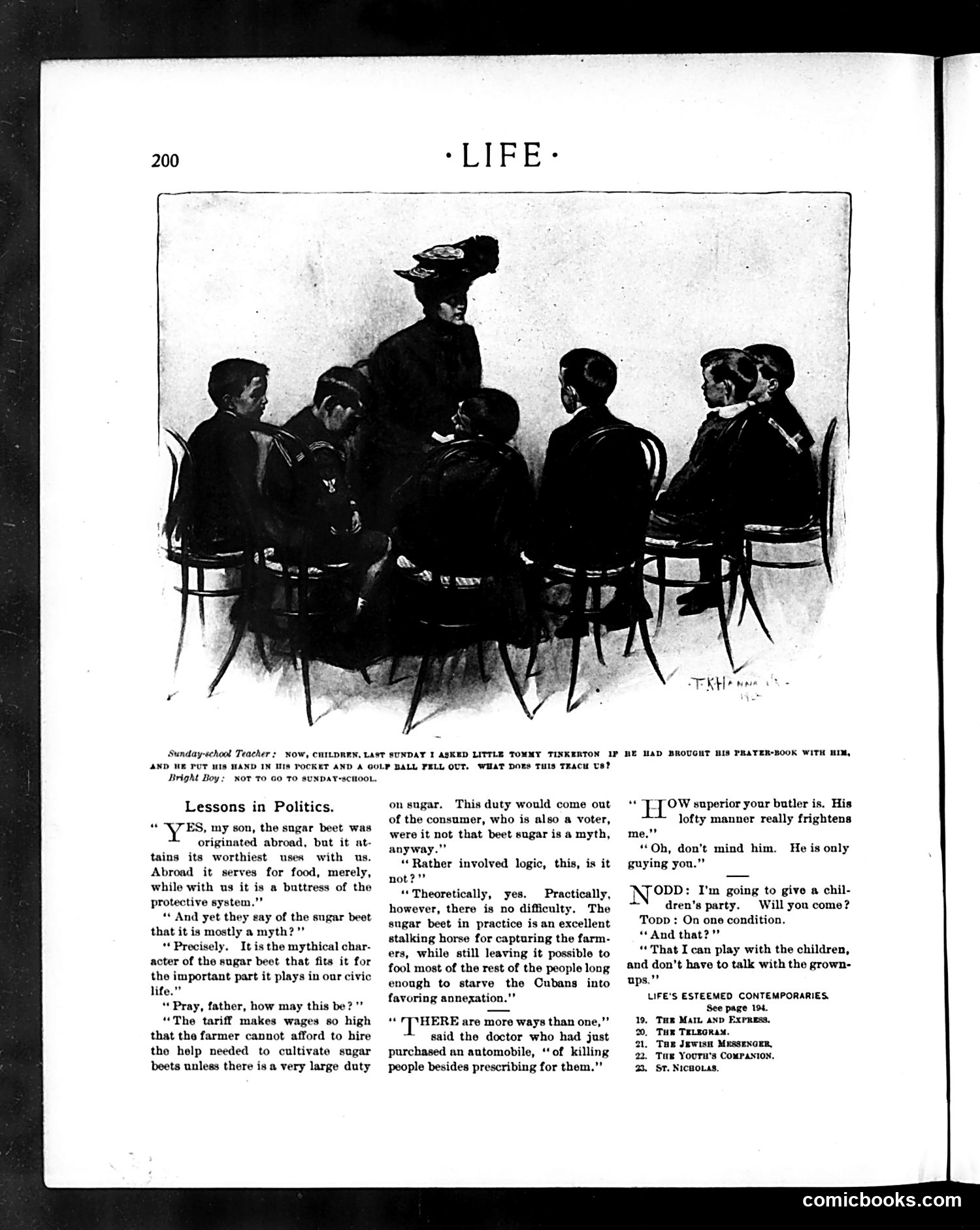
This page from *Life* magazine presents satirical commentary on early 20th-century American politics and social customs. **Top cartoon:** A Sunday school teacher tells the famous anecdote about a boy finding a golf ball in church, asking what lesson it teaches. The "bright boy" answers: don't go to Sunday school—satirizing both juvenile irreverence and the perceived hypocrisy of religious institutions. **Main article, "Lessons in Politics":** A father lectures his son about the sugar beet tariff—a protectionist policy that artificially inflates domestic sugar prices. The satire exposes the logical contradiction: the tariff supposedly helps American farmers, yet farmers can't actually afford labor costs without impossibly high duties. The father cynically admits it's a "myth" designed to fool voters while harming consumers and—remarkably—to force Cuba into annexation through economic starvation. This reflects actual early-1900s debates over imperial expansion and protective tariffs. **Bottom vignettes:** Brief jokes mocking class pretension (snobbish butlers) and social awkwardness (adults uncomfortable with children). The overall thrust: satirizing political duplicity, economic sophistry, and imperialist ambitions.
📄 Transcribed text from this page (OCR, searchable)
Machine-transcribed from the original scan — historical spelling and the odd misread are preserved.
Sunday-schoot Teacher : AND HE PUT M18 HAND IN HIS POCKET AND A OOLP BALL FELL OUT. WHAT Doxs TuIs TEACH US? Bright Boy: xot 70 G0 To suNDAY-scHooL. Lessons in Politics. ““ \7 ES, my son, the sugar beet was originated abroad, but it at- tains its worthiest uses with us. Abroad it serves for food, merely, while with us it is a buttress of the protective system.’’ “* And yet they say of the sugar beet that it is mostly a myth? ’’ “Precisely. It is the mythical char- acter of the sugar beet that fits it for the important part it plays in our civic life.” “ Pray, father, how may this be? "’ “The tariff makes wages so high that the farmer cannot afford to hire the help needed to cultivate sugar beets unless there is a very large duty on sugar, This duty would come out of the consumer, who is also a voter, were it not that beet sugar is a myth, anyway.” “Rather involved logic, this, is it not?" “Theoretically, yes. Practically, however, there is no difficulty. The sugar beet in practice is an excellent stalking horse for capturing the farm- ers, while still leaving it possible to fool most of the rest of the people long enough to starve the Cubans into favoring annexation.” at T ‘HERE are more ways than one,”’ 2 said the doctor who had just purchased an automobile, ‘of killing people besides prescribing for them.” NOW, CHILDREN, LAST SUNDAY I ASKED LITTLE TOMMY TINKERTON IP HE WAD BROUGHT HIS PRATER-BOOK WITH HIM, “ HOw, superior your butler is. His lofty manner really frightens me."” “Oh, don’t mind him. guying you.” He is only Nop: I'm going to give a chil- dren's party. Will you come? Topp : On one condition. “And that?’’ “That I can play with the children, and don’t have to talk with the grown- ups.’”” LIFE'S ESTEEMED CONTEMPORARIES. See page 194. . THe MAIL AND EXPRESS, . THR TELEGRAM. . Tae Jewish MussENGER, . Tuk YourH's COMPANION. St. NICHOLAS. comicbooks.com