
Life, 1902-09-04 · page 4 of 22
Life — September 4, 1902 — page 4: what you’re looking at
What you’re looking at
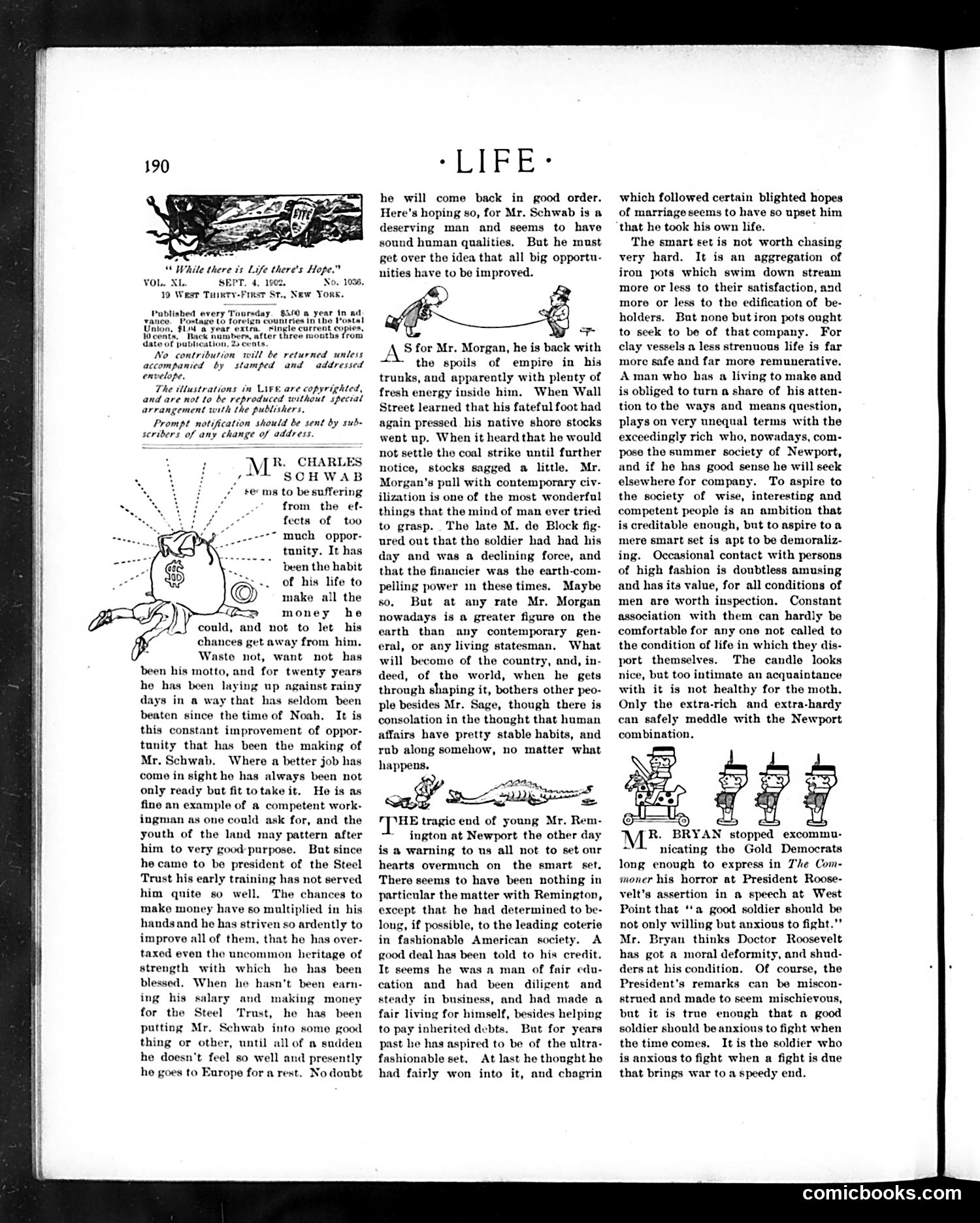
The main cartoon depicts **Charles Schwab**, identified in the text as a major industrialist. The illustration shows him as a large, bloated figure being manipulated like a puppet or held aloft—a visual metaphor for his power and influence in the business world. The accompanying article discusses Schwab's career trajectory, his relationship with the Steel Trust, and his aspirations within high society, particularly Newport's elite circles. The satire critiques how wealth and industrial power translate into social ambition and attempted respectability. The cartoon lampoons the nouveau riche—how industrial magnates like Schwab acquire enormous financial power but remain outsiders to established aristocratic society, attempting (and struggling) to gain acceptance through social climbing and competitive consumption.
📄 Transcribed text from this page (OCR, searchable)
Machine-transcribed from the original scan — historical spelling and the odd misread are preserved.
‘“* While there is Life there's Hope.” VOL. XL. T. 4, 1902. c 19 West Tuiety-Finst § Published day. $3"0 @ year in ad. Tauce. Fostage (o foreign countries in tho Postal Union, fina year extra, single nt copies, ts. Rack nui ‘after three mouths from date of publication ‘ats No contribution will be returned untess accompanied by stamped and addressed envelope. The illustrations in Lite. are copyrighted, and are not to be reproduced without special arrangement with the publishers. Prompt notification should be sent by sub- seribers of any change of address. _M*. CHARLES ji SCHWAB ‘ser ms to be suffering from the ef- fects of too ---* much oppor- tunity. It has been the habit of his life to make all the money he yy could, and not to let his chances get away from him. Waste not, want not has been his motto, and for twenty years he has been laying up against rainy days in a way that has seldom been beaten since the time of Noah. It is this constant improvement of oppor- tunity that has been the making of Mr. Schwab. Where a better job has come in sight he has always been not only ready but fit totake it. He is as fine an example of a competent work- ingman as one could ask for, and the youth of the land may pattern after him to very good purpose. But since he came to be president of the Steel Trust his early training has not served him quite so well. The chances to make money have so multiplied in his hands and he has striven so ardently to improve all of them, that he has over- taxed even the uncommon heritage of strength with which he has been blessed. When he hasn't been earn- ing his salary and making money for the Steel Trust, he has been putting Mr. Schwab into some good thing or other, until all of a sudden he doesn’t feel so well and presently he goes to Europe for a rest. No doubt x Ta LIFE he will come back in good order. Here's hoping so, for Mr. Schwab is a deserving man and seems to havo sound human qualities. But he must get over the idea that all big opportu- nities have to be improved. S for Mr. Morgan, he is back with the spoils of empire in his trunks, and apparently with plenty of fresh energy inside him. When Wall Street learned that his fateful foot had again pressed his native shore stocks went up. When it heard that he would not settle the coal strike until further notice, stocks sagged a little. Mr. Morgan's pull with contemporary civ- ilization is one of the most wonderful things that the mind of man ever tried to grasp. The late M. de Block fig- ured out that the soldier had had his day and was a declining force, and that the financier was the earth-com- pelling power 1n these times. Maybe so. But at any rate Mr. Morgan nowadays is a greater figure on the earth than any contemporary gen- eral, or any living statesman. What will become of the country, and, in- deed, of the world, when he gets through shaping it, bothers other peo- ple besides Mr. Sage, though there is consolation in the thought that human affairs have pretty stable habits, and rub along somehow, no matter what happens. bl sd tragic end of young Mr. Rem- ington at Newport the other day is a warning to us all not to set our hearts overmuch on the smart set. There seems to have been nothing in particular the matter with Remington, except that he had determined to be- long, if possible, to the leading coterie in fashionable American society. A good deal has been told to his credit. It seems he was a man of fair edu- cation and had been diligent and steady in business, and had made a fair living for himself, besides helping to pay inherited debts. But for years past he has aspired to be of the ultra- fashionable set. At last he thonght he had fairly won into it, and chagrin which followed certain blighted hopes of marriage seems to have so upset him that he took his own life. The smart cet is not worth chasing very hard. It is an aggregation of iron pots which swim down stream more or less to their satisfaction, and more or less to the edification of be- holders. But none but iron pots ought to seek to be of thatcompany. For clay vessels a less strenuous life is far morc safe and far more remunerative. Aman who has a living to make and is obliged to turn a share of his atten- tion to the ways and means question, plays on very unequal terms with the exceedingly rich who, nowadays, com- pose the summer society of Newport, and if he has good sense he will seek elsewhere for company. To aspire to the society of wise, interesting and competent people is an ambition that is creditable enough, but to aspire toa mere smart set is apt to be demoraliz- ing. Occasional contact with persons of high fashion is doubtless amusing and has its value, for all conditions of men are worth inspection. Constant association with them can hardly be comfortable for any one not called to the condition of life in which they dis- port themselves. The candle looks nice, but too intimate an acquaintance with it is not healthy for the moth. Only the extra-rich and extra-hardy can safely meddle with the Newport combination, ©) R. BRYAN stopped excommu- nicating the Gold Democrats long enough to express in The Com- moner his horror at President Roose- velt’s assertion in a speech at West Point that ‘¢a good soldier should be not only willing but anxious to fight.’’ Mr. Bryan thinks Doctor Roosevelt has got a moral deformity, and shud- ders at his condition. Of course, the President's remarks can be miscon- strued and made to seem mischievous, but it is true enongh that a good soldier should be anxious to fight when the time comes, It is the soldier who is anxious to fight when a fight is due that brings war to a speedy end. comicbooks.com