
Life, 1902-09-04 · page 5 of 22
Life — September 4, 1902 — page 5: what you’re looking at
What you’re looking at
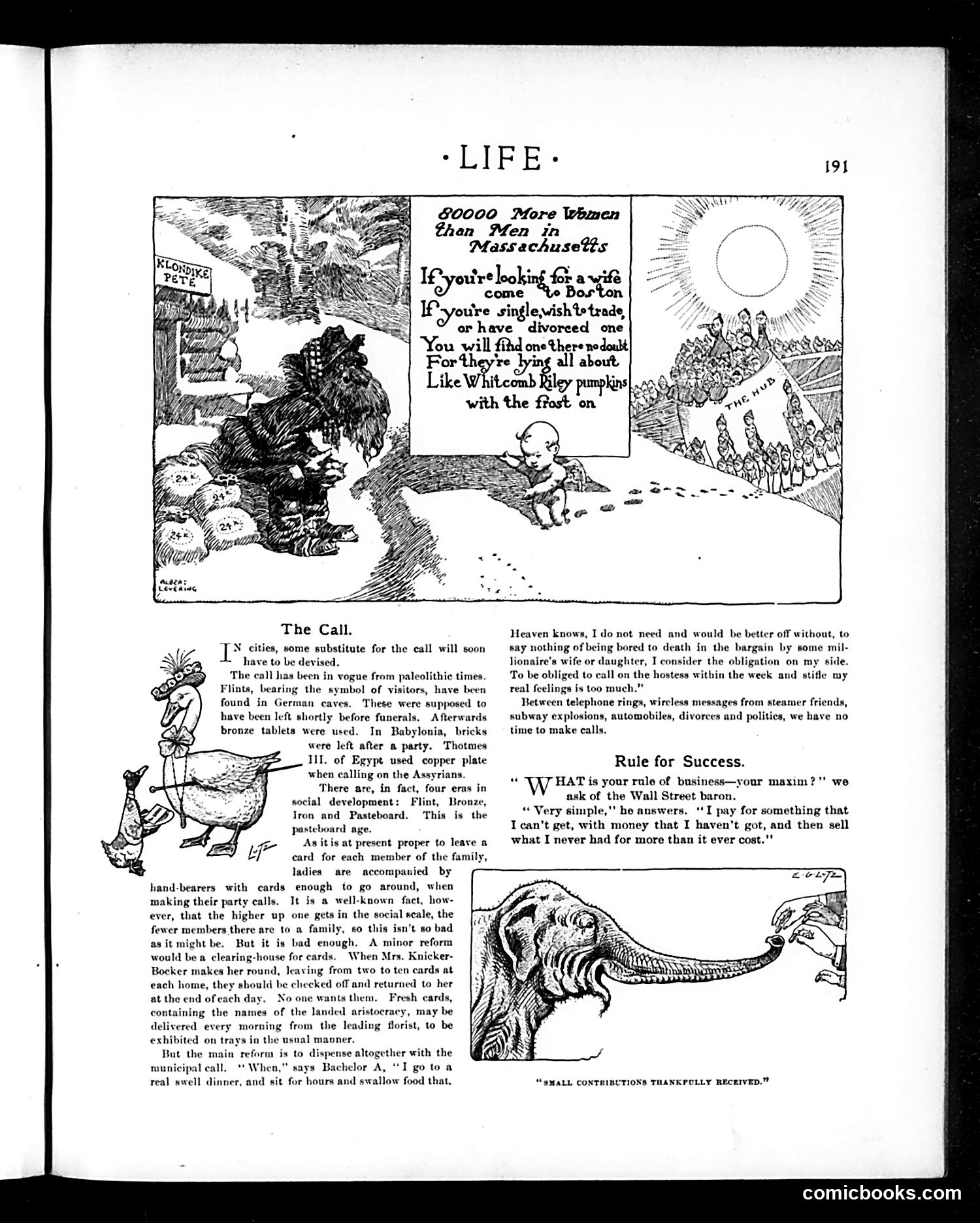
The top cartoon advertises Massachusetts as a destination for unmarried men and women seeking partners. It's a tongue-in-cheek recruitment pitch: men looking for wives, single women wanting to "trade," and divorcees will find abundant options in Boston, humorously compared to "Whitcomb Riley pumpkins with the frost on." The lower section contains two distinct pieces: "The Call" discusses historical calling customs and social etiquette around telephone calls and visiting cards, satirizing the elaborate social rules governing domestic life. "Rule for Success" features a brief interview where a businessman credits his success to buying items cheaply and reselling them at higher markups—a straightforward but amusing economic principle presented as business wisdom.
📄 Transcribed text from this page (OCR, searchable)
Machine-transcribed from the original scan — historical spelling and the odd misread are preserved.
80000 More Wemen then Men in Massachusetts If-you're leo ing for a-wife come Boston IP-youre single wish te trade, or have divorced one You will fihd one there nedoult| For they're lying all about Line wees ley pumpkins} on 6 with the frost on } The Call. cities, some substitute for the call will soon have to be devised. The call has been in vogue from paleolithic times. Flints, bearing the symbol of visitors, have been found in German caves. These were supposed to have been left shortly before funerals, Afterwards bronze tablets were used. In Babylonia, bricks were left after a party. Thotmes III. of Egypt used copper plate when calling on the Assyrians. There are, in fact, four eras in social development: Flint, Bronze, Tron and Pasteboard. This is the pasteboard age. As itis at present proper to leave a card for each member of the family, ladies are accompanied by hand-bearers with cards enough to go around, when making their party calls. It is a well-known fact, how- ever, that the higher up one gets in the social scale, the fewer members there are to a family, so this isn't so bad asitmight be. But it is bad enough, A minor reform would be a clearing-house for cards. When Mrs. Knicker- Bocker makes her round, leaving from two to ten cards at each home, they should be checked off and returned to her at the end ofeach day. No one wants them. Fresh cards, containing the names of the landed aristocracy, may be delivered e morning from the leading florist, to be exhibited on the usual manner. But the main reform is to dispense altogether with the municipal call, ** When,” says pelor A, “I go to a real swell dinner, and sit for hours and swallow food that, Heaven knows, I do not need and would be better off without, to say nothing of being bored to death in the bargain by some lionaire's wife or daughter, I consider the obligation on my To be obliged to call on the hostess within the week and stifle my real feelings is too much.” Between telephone rings, wircless messages from steamer friends, subway explosions, automobiles, divorces and politics, we have no time to make calls. Rule for Success. “PV HAT is your rule of basiness—your maxim?" wo ask of the Wail Street baron. “Very simple,” ho auswers. ‘I pay for something that I can't get, with money that I haven't got, and then sell what I never had for more than it ever cost."” “SMALL CONTRIBUTIONS THANKPOLLY RECEIVED.” comicbooks.com