
Life, 1902-09-04 · page 6 of 22
Life — September 4, 1902 — page 6: what you’re looking at
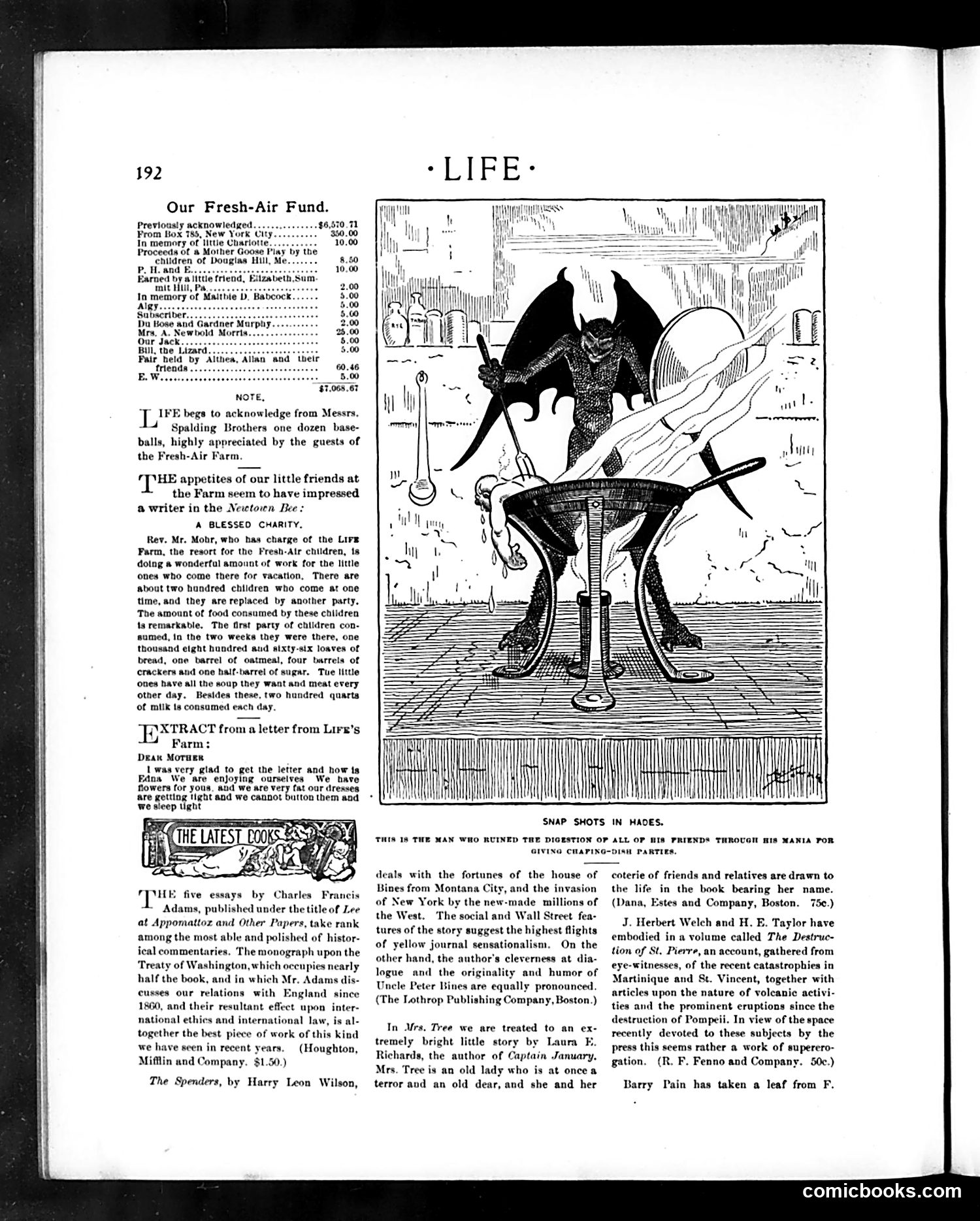
What you’re looking at
This cartoon depicts a skeletal, emaciated man being force-fed or having his digestive system examined, with the caption: "This is the man who ruined the digestion of all of his friends through his mania for giving charity-dinner parties." The satire targets excessive dinner-party giving as a social vice. The figure's skeleton-like appearance suggests that constant entertaining has literally consumed him—worn him to bones. The "Hades" setting frames this as a punishment for his obsessive hospitality. The joke plays on the era's social anxiety about status-signaling through lavish entertaining. By depicting the chronic host as a cautionary tale in hell, Life mocks both the man's compulsive generosity and his guests' resentment of being perpetually invited to these exhausting social obligations. It's social satire about middle-class entertainment excess.
📄 Transcribed text from this page (OCR, searchable)
Machine-transcribed from the original scan — historical spelling and the odd misread are preserved.
192 Our Fresh-Air Fund. Previously acknowledged. - $6,870.71 From Box 185, New York City 350.00 8.50 10.00 iay by the eeByecen algs sssssees I IFE begs to acknowledge from Messrs, 4 Spalding Brothers one dozen base- balls, highly appreciated by the guests of the Fresh-Air Farm, THE appetites of our little friends at. the Farm seem to have impressed a writer in the Newtown Bee: A BLESSED CHARITY, Rev. Mr. Mobr, who has charge of the Lirs Farm, the resort for the Fresh-Atr children, 18 doing & wonderfal amount of work for the little ones who come there for vacation, There are ‘About two hundred children who come at one time, and they are replaced by another party, ‘Tne amount of food consumed by these children ts remarkable, The frat party of children con- sumed, In the two weeks they were there, one thousand eight hundred aud alxty-stx loaves of bread, one barrel of oatmeal, four barrels of crackers and one half-barrel of sugar. Tue litte ones have all the soup they want and meat every other day. Besides these, two hundred quarts of milk 1s consumed each day. PoxtRaAct from a letter from Lire’s. Farm: Dean Moruee Iwas very glad to get the letter and how ts Fdna We are enjoying ourselves We have flowers for yous. aud we are very fat our dresses are getting tight and we cannot button them and We sleep tight spi five essays by Charles Francis Adams, published under the title of Lee at Appomattoz and Other Papers, take rank among the most able and polished of histor- ical commentaries. The monograph upon the ‘Treaty of Washington, which occupies nearly half the book, and in which Mr. Adams dis- cusses our relations with England since 1860, and their resultant effect upon inter- national ethies and international law, is al- together the best piece of work of this kind we have seen in recent years. (Houghton, Mifflin and Company. $1.50.) The Spenders, by Harry Leon Wilson, i ages i i i ta i SNAP SHOTS IN HADES. THIS 18 THE MAN WHO RUINED THE DIGESTION OF ALL OP HIS FRIENDS THROUGH HIS MANIA POR GIVING CHAPING-DISH PARTIES. deals with the fortunes of the house of Bines from Montana City, and the invasion of New York by the new-made millions of the West. The social and Wall Street fea- tures of the story suggest the highest flights of yellow journal sensationalism. On the other hand, the author's cleverness at dia- logue and the originality and humor of Uncle Peter Iines are equally pronounced (The Lothrop Publishing Company, Boston.) In Mrs, Tree we are treated to an ex- tremely bright little story by Laura EF. Richards, the author of Captain January, Mrs. Tree is an old lady who is at oncea terror and an old dear, and she and her coterie of friends and relatives are drawn to the life in the book bearing her name. (Dana, Estes and Company, Boston. 75¢.) J. Herbert Welch and H. E. Taylor have embodied in a volume called The Destruc- tion of St, Pierre, an account, gathered from eye-witnesses, of the recent catastrophies in Martinique and St. Vincent, together with articles upon the nature of volcanic activi- ties and the prominent eruptions since the destruction of Pompeii. In view of the space recently devoted to these subjects by the press this seems rather a work of superero- gation. (R. F. Fenno and Company. 50c.) Barry Pain has taken a leaf from F. comicbooks.com