
A complete issue · 20 pages · 1901
Life — December 19, 1901
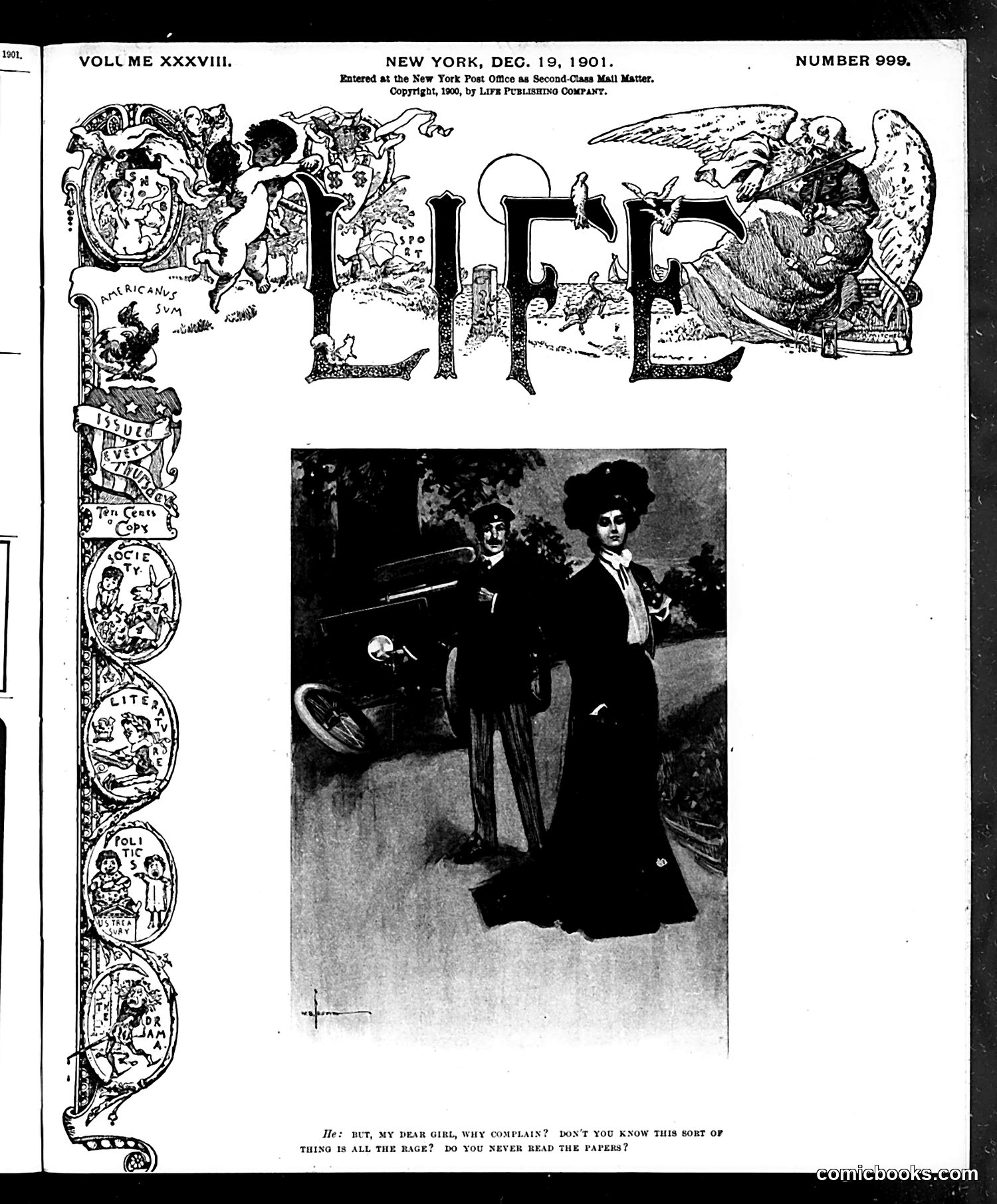
This page from Life magazine's satirical section features an ornate decorative header spelling "LIFE" with classical and allegorical imagery. Below is a photograph showing two people in formal Edwardian dress - a man in a suit and top hat and a woman in a long dark coat and hat, standing near what appears to be early automobile equipment. The caption reads: "HE: BUT, MY DEAR GIRL, WHY COMPLAIN? DON'T YOU KNOW THIS SORT OF THING IS ALL THE RAGE? DO YOU NEVER READ THE PAPERS?" The satire likely mocks the then-novel automobile as a fashionable but unreliable contraption - the woman appears frustrated while the man defends the vehicle's popularity despite its obvious problems. This reflects early-1900s skepticism about motor vehicles as expensive, temperamental status symbols rather than practical transportation.
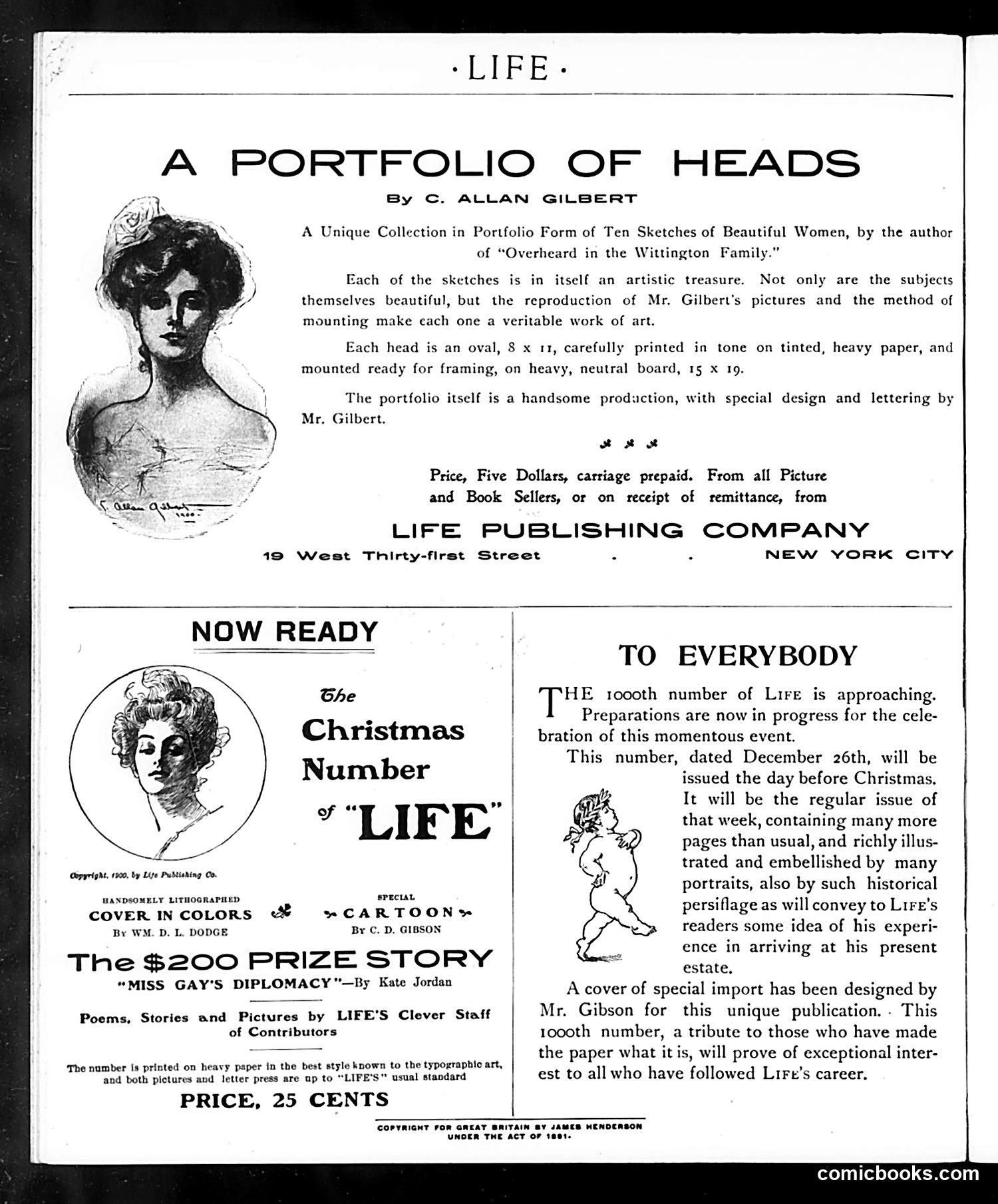
This page is primarily **advertising and announcements** rather than political satire. It announces: 1. **"A Portfolio of Heads"** by C. Allan Gilbert—a collection of ten sketches of women, priced at five dollars, sold by Life Publishing Company 2. **Life's upcoming Christmas Number** (100th issue, dated December 26th), which will feature: - A special cover in color by William D. Dodge - A cartoon by C. D. Gibson - A prize story titled "Miss Gay's Diplomacy" by Kate Jordan - Extra pages with portraits and historical content 3. The Christmas issue costs 25 cents The page contains no identifiable political figures or satirical commentary—it's a period publishing house promoting upcoming products and special issues to readers.
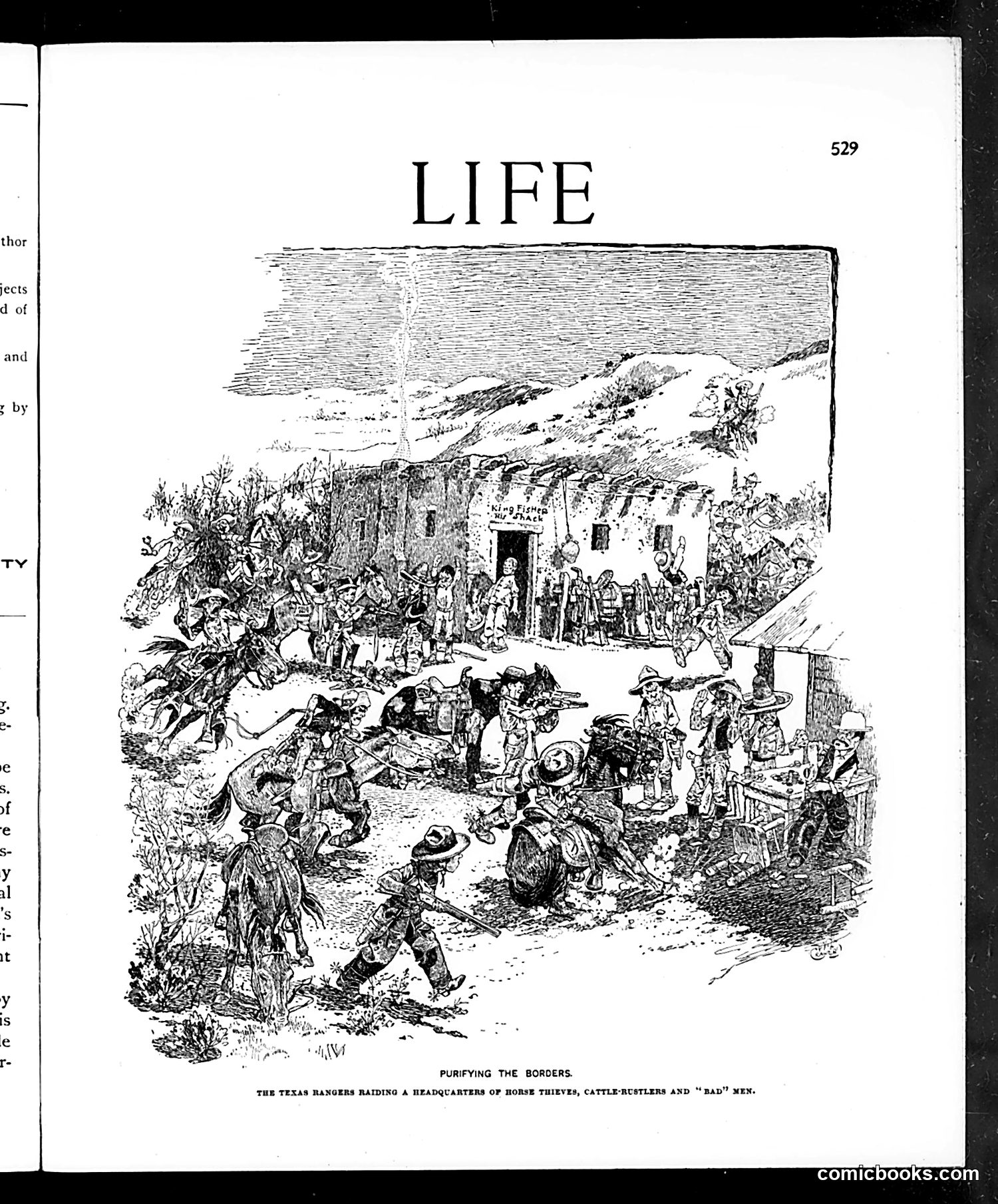
This illustration depicts Texas Rangers raiding a headquarters of "horse thieves, cattle rustlers and 'bad' men" along the Texas-Mexico border. The sketch shows armed lawmen conducting what appears to be a violent confrontation at a simple adobe structure, with figures scattered across the ground and buildings. The satire likely comments on frontier law enforcement and vigilantism in the American Southwest during the late 19th century. The term "purifying" in the caption suggests ironic commentary on extrajudicial violence—the Rangers' methods are presented as rough frontier justice rather than formal law. The inclusion of "bad men" alongside organized criminals reflects period anxieties about border lawlessness and the violent methods used to combat it.
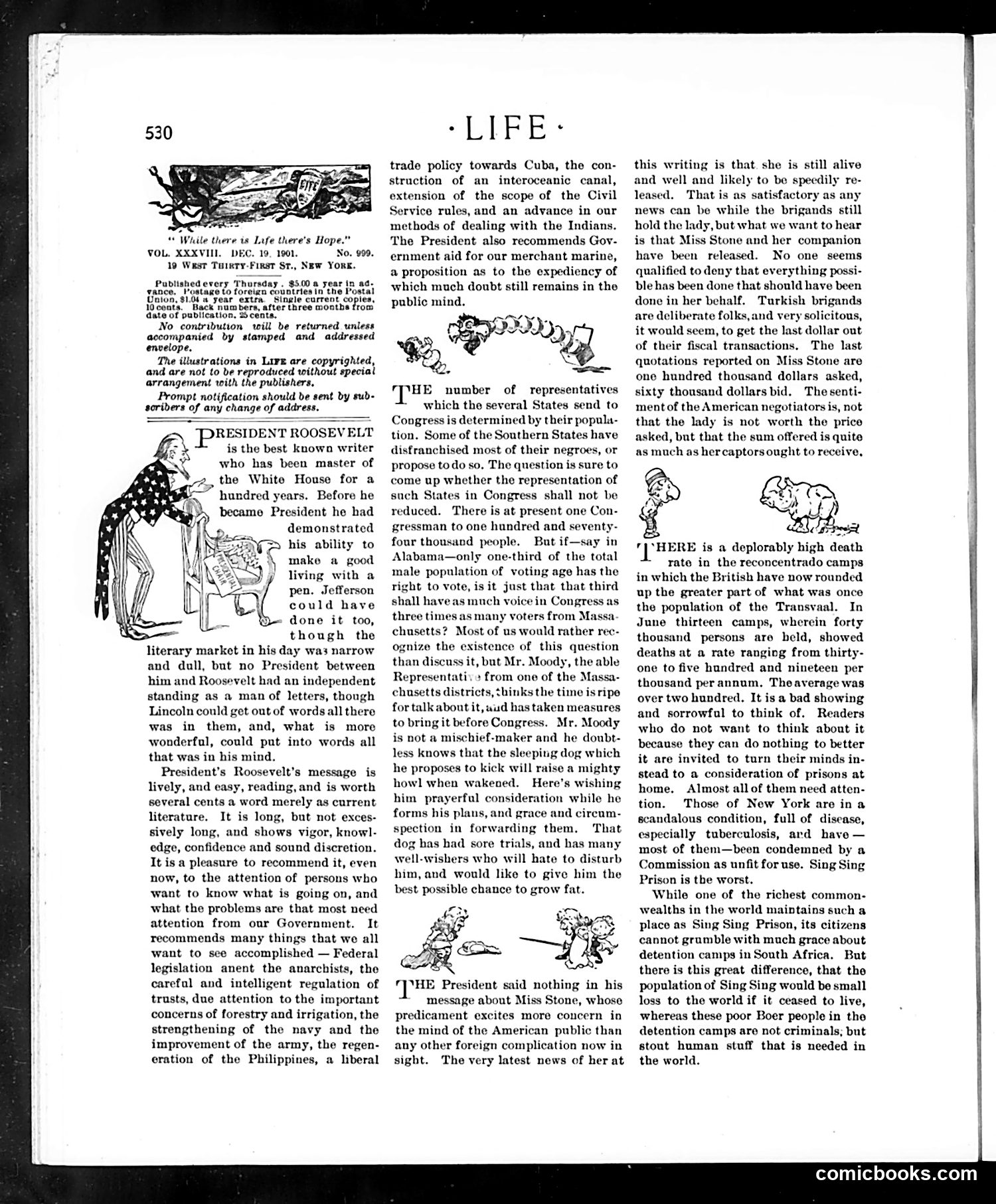
The page contains editorial commentary on President Theodore Roosevelt rather than political cartoons. The text praises Roosevelt as "the best known writer who has been master of the White House for a hundred years," noting his literary skill and independent character. The accompanying illustrations are decorative vignettes—small sketches of figures in various poses—rather than specific political commentary. The editorial discusses congressional representation tied to population, mentions the problematic conditions in British detention camps during the Boer War, and references the Sing Sing Prison system. These reflect contemporary Progressive Era concerns about democratic representation, imperial conflicts, and prison reform. The page is primarily text-based political commentary rather than satirical cartooning.
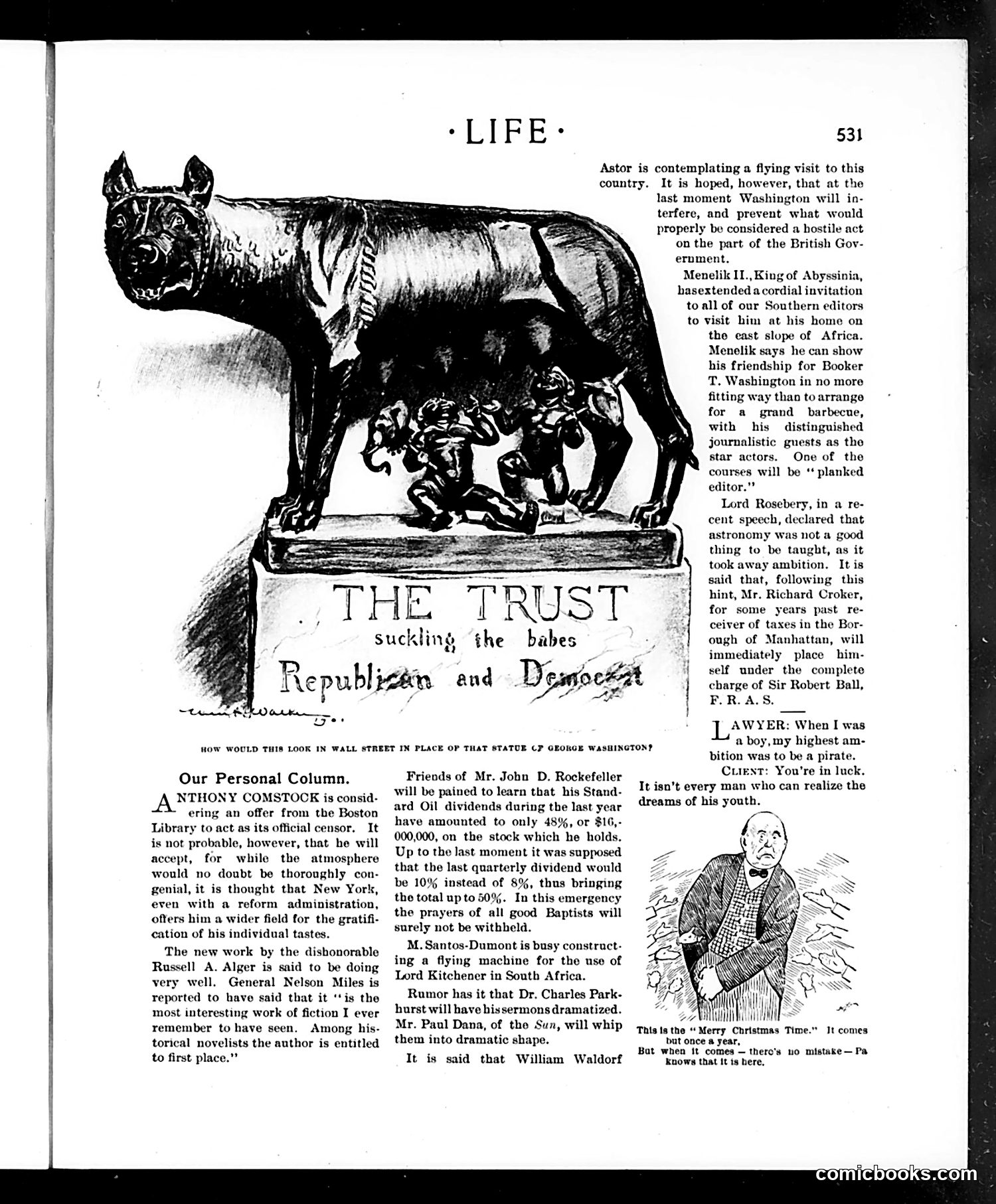
The main cartoon depicts a cow standing on a pedestal labeled "THE TRUST suckling the babes Republican and Democrat." This is a classical satirical image critiquing monopolistic business trusts (large corporate combinations that dominated American politics in this era). The cow represents a trust that "suckles" both major political parties equally—suggesting that Republicans and Democrats alike are dependent on and controlled by big business interests. The caption pointedly asks: "HOW WOULD THIS LOOK IN WALL STREET IN PLACE OF THAT STATUE OF GEORGE WASHINGTON?"—implying that corporate trusts have effectively replaced democratic values at the nation's financial center. This reflects Progressive-era concerns about trust power corrupting American democracy.
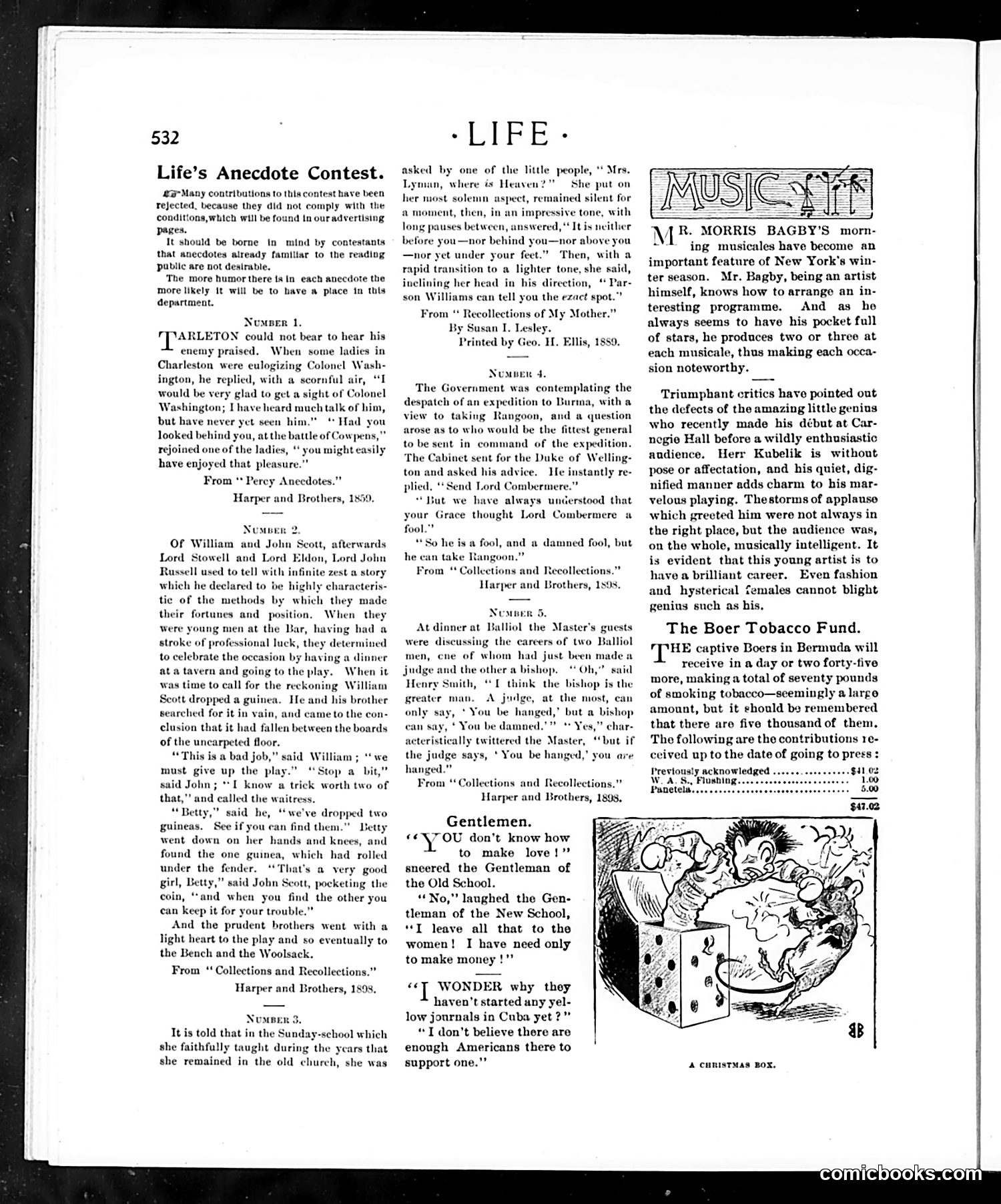
This page contains several unrelated sections: anecdote contest entries, music criticism, and a brief humor section titled "Gentlemen." The cartoon labeled "A CHRISTMAS BOX" depicts cherubs or putti (baby angels) playing in/around a large dice or gift box — a generic holiday illustration without apparent political satire. The "Gentlemen" section presents a dialogue joke contrasting Old School and New School attitudes: the Old School gentleman values making love; the New School gentleman prioritizes making money. A Cuban yellow-journal question follows, suggesting American media expansion into Cuba. The page's main content focuses on literary anecdotes and a notice about tobacco fund contributions for Boer prisoners in Bermuda during the Second Boer War (1899-1902). No specific political cartoons with identifiable figures appear on this page.
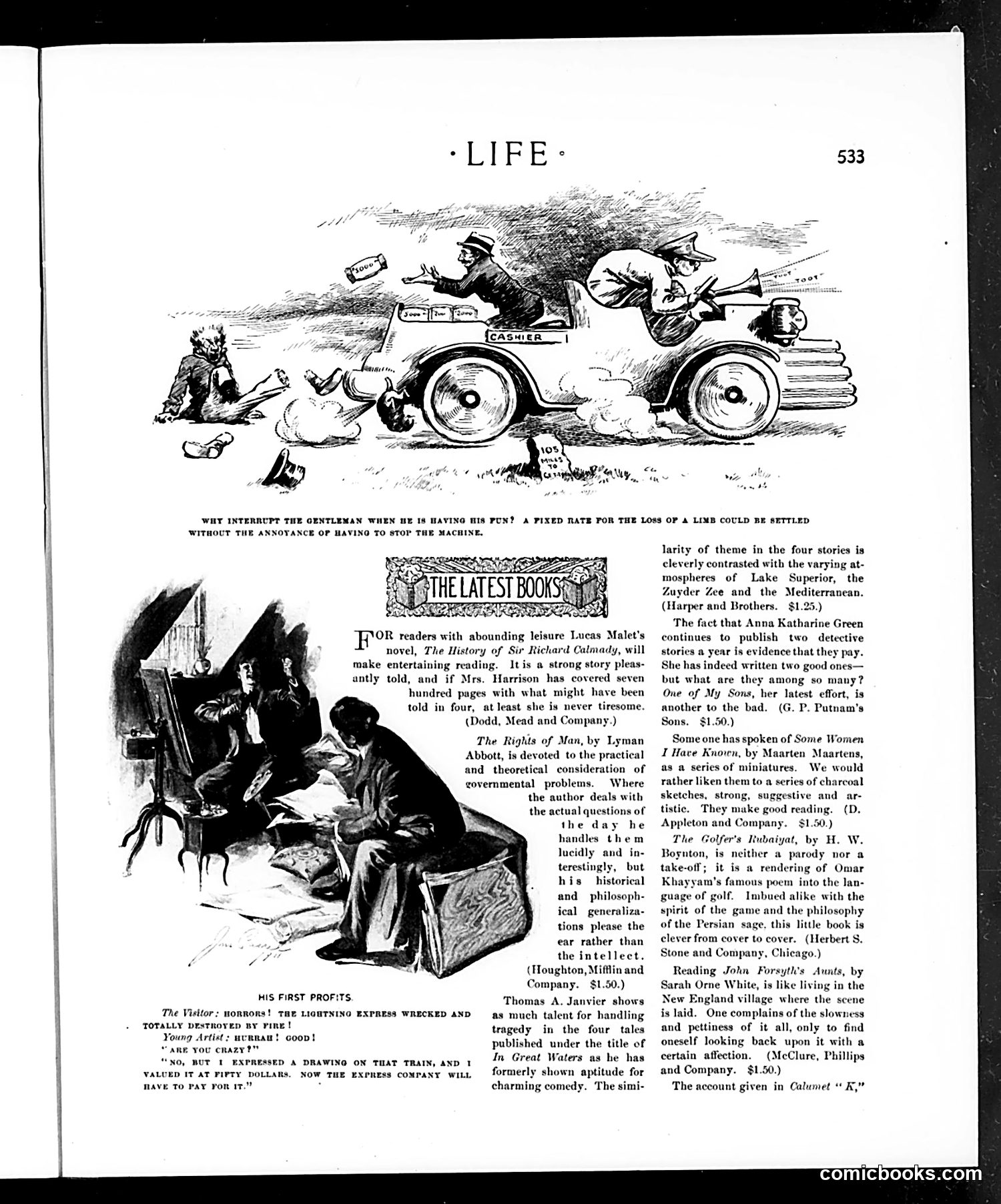
**The Main Cartoon:** The top illustration shows two men in a motorcar labeled "CASHIER" speeding away with money bags, while a frustrated gentleman on the left (possibly a bank or store owner) stands helplessly. The caption asks: "Why interrupt the gentleman when he is having his fun? A fixed rate for the loss of a lime could be settled without the annoyance of having to stop the machine." **The Satire:** This appears to satirize early automobile culture and reckless driving. The joke contrasts the driver's enjoyment with property damage—he'd rather pay a flat fee for damages than be inconvenienced by stopping. It mocks both the cavalier attitude of wealthy motorists and the absurdity of insurance/liability schemes being proposed to handle automobile accidents. **Context:** This reflects genuine early-1900s concerns about dangerous, unregulated automobiles and the social friction between wealthy drivers and the public.
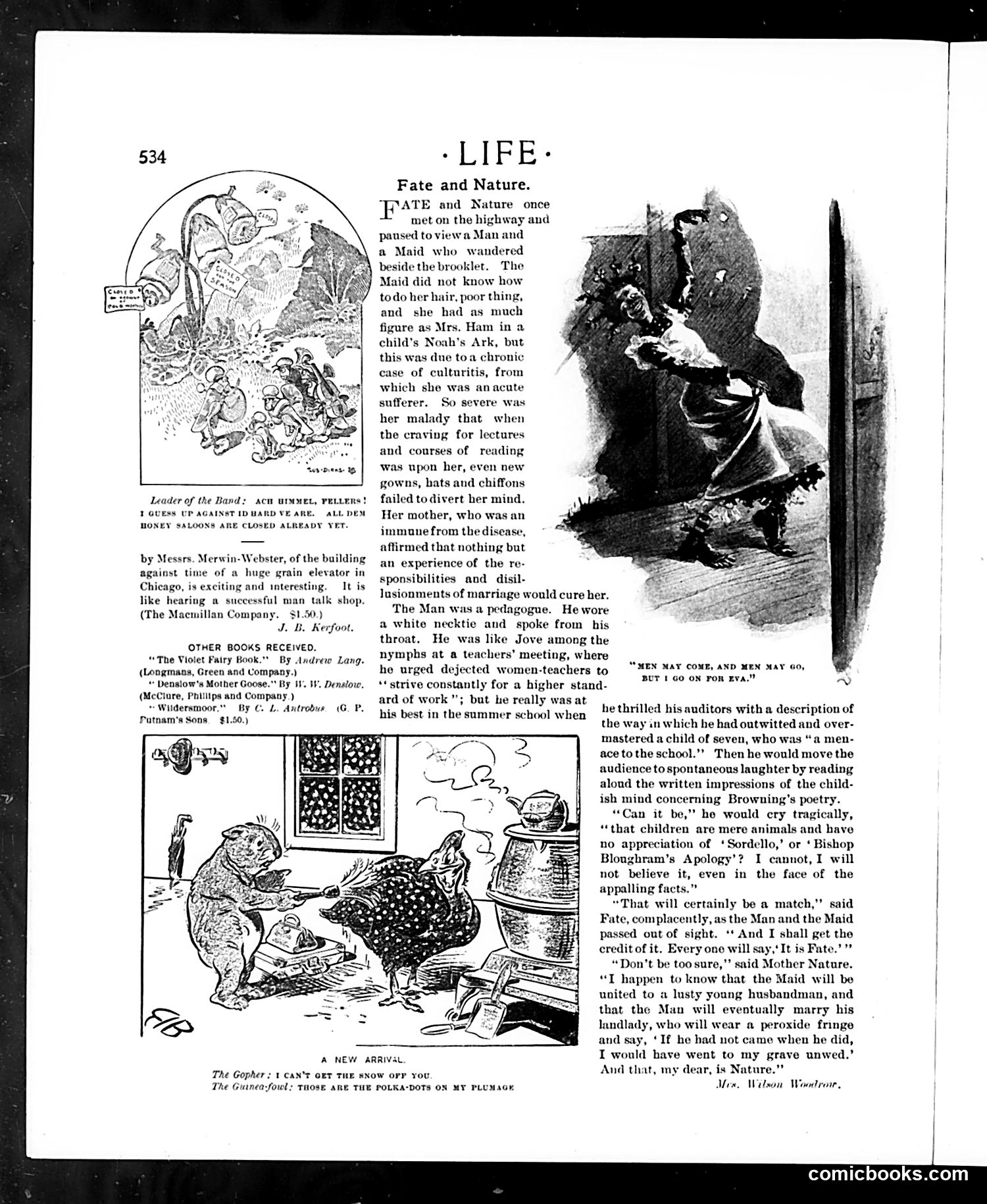
This page presents a allegorical story about social class and marriage prospects. "Fate" and "Nature" (personified as characters) discuss a poor, chronically ill Maid they encounter. A well-dressed, pedagogue Man also appears. The satire mocks Victorian attitudes about marriage and social mobility. The Man lectures about education and poetry, yet Fate predicts he'll eventually marry a wealthy widow ("perinside fringe"), implying his pretensions to intellectual refinement mask mercenary motivations. The bottom cartoon shows comic domestic chaos—a Gopher and Guinea-fowl arguing over housekeeping duties, illustrating tensions between servants or household animals. The overall message critiques both romantic delusions among the poor and the superficiality of educated gentlemen seeking advantageous marriages. The tone is cynical about human nature and social aspiration.
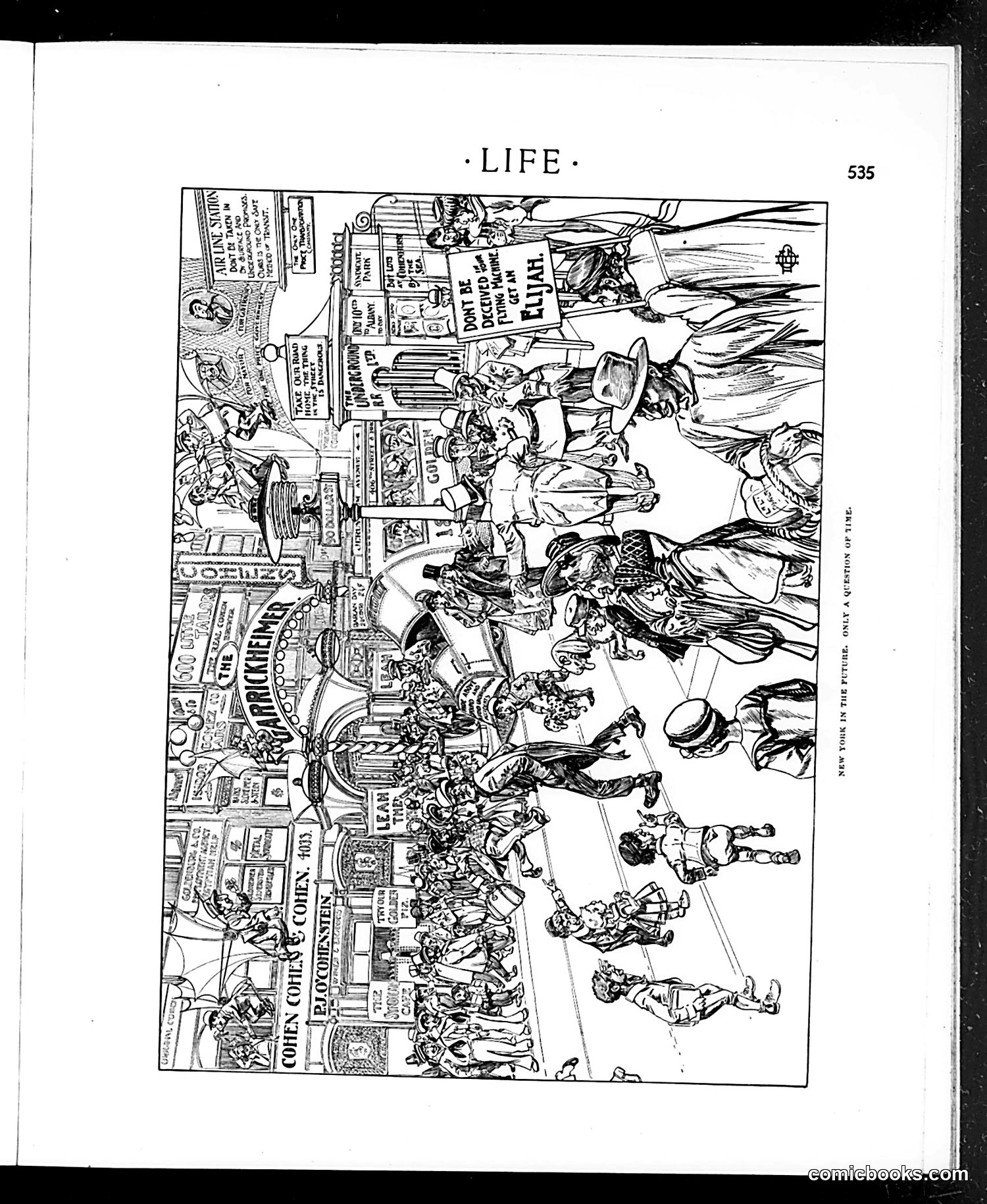
This page from *Life* magazine (page 535) contains a densely detailed satirical illustration rendered upside-down, requiring rotation to read properly. The cartoon appears to depict a crowded street scene or public gathering with numerous figures, buildings, and text labels integrated throughout. While the image quality and orientation make precise identification difficult, the style is consistent with early 20th-century *Life* magazine satirical commentary on American urban life, commerce, or politics. Multiple figures appear to be caricatured, and various commercial signs and storefronts are visible within the scene. **I cannot reliably identify specific political figures or the exact satirical target without clearer legibility of the text labels throughout the illustration.** To provide accurate historical interpretation, the image would need higher resolution or proper orientation confirmation.
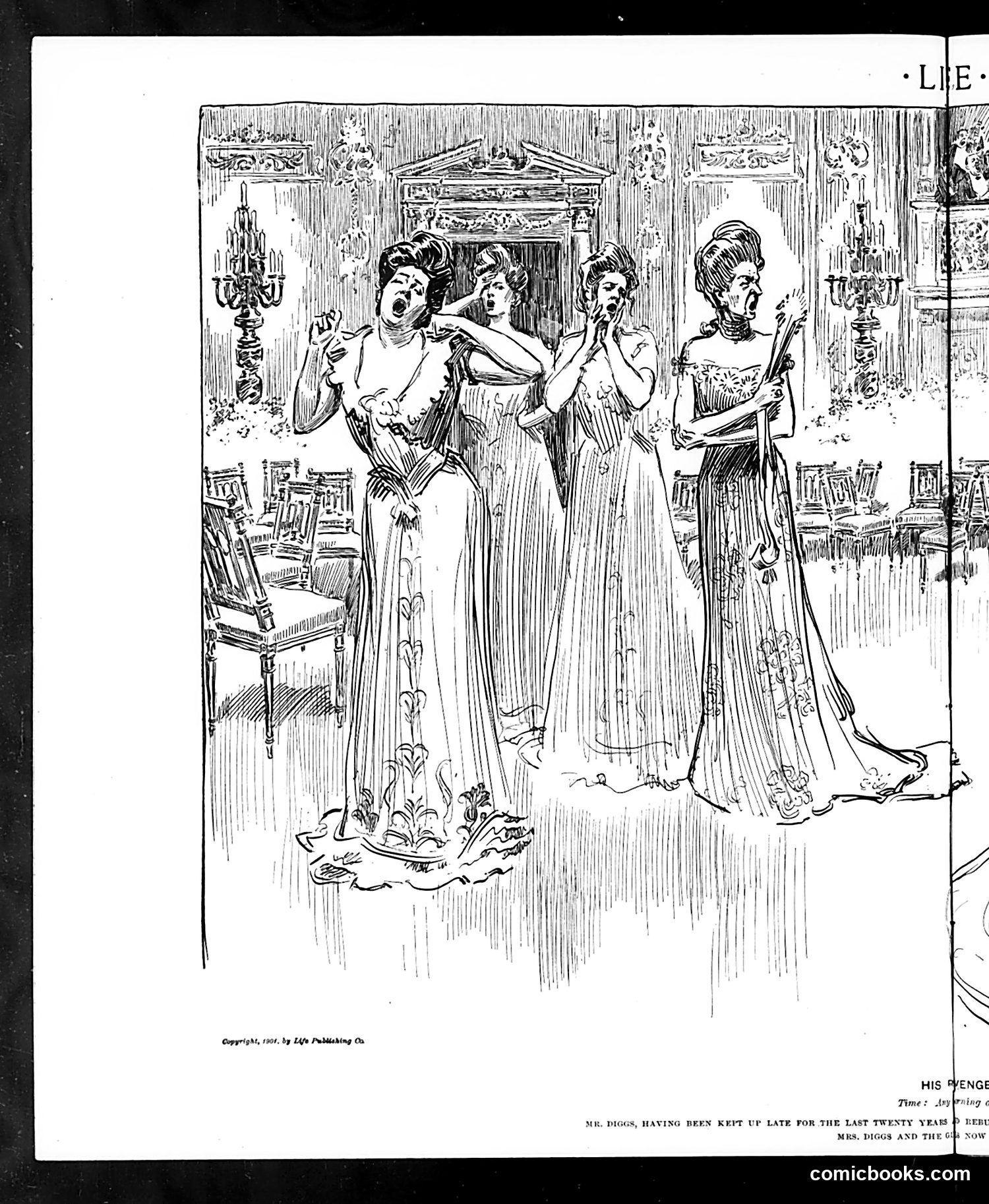
This is a satirical illustration from *Life* magazine (copyright 1901) depicting four elegantly dressed women in a formal interior setting. The caption reads: "MRS. DIGGS, HAVING BEEN KEPT UP LATE FOR THE LAST TWENTY YEARS MRS. DIGGS AND THE G[?]" The cartoon appears to satirize the social exhaustion of maintaining high society standards. The women's exaggerated expressions and postures suggest fatigue or distress despite their refined appearance and expensive gowns. The ornate setting—with candelabras, decorative furnishings, and formal arrangement—emphasizes the contrast between outward elegance and inward weariness. The humor targets wealthy women trapped in endless social obligations ("kept up late"), suggesting social satire about the demanding nature of upper-class society life and expectations for women's participation in it.
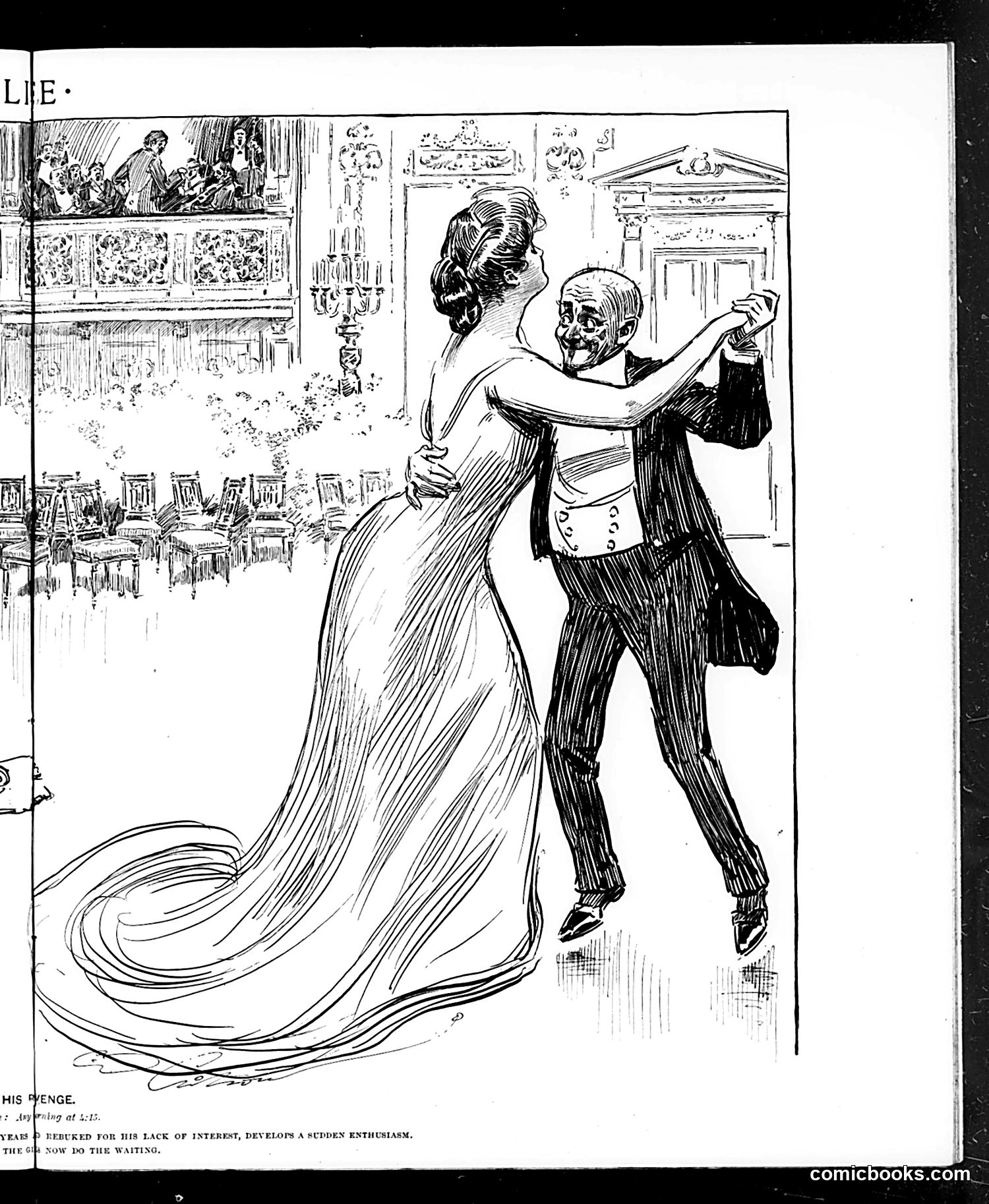
This Life magazine cartoon depicts a couple at what appears to be a formal ball or opera house. The man, dressed in formal evening wear, dances with a woman in an elaborate gown with a long train. The caption references "his vengeance" and mentions someone being "reduced for his lack of interest" developing "sudden enthusiasm," with text suggesting "the old now do the waiting." The satire appears to target gender dynamics in courtship and social events. The joke likely mocks a situation where a man, previously indifferent to a woman, suddenly shows interest once she gains attention from others—a commentary on male vanity and competitive romantic behavior. The "vengeance" likely refers to the woman finally reciprocating interest strategically to provoke jealousy.
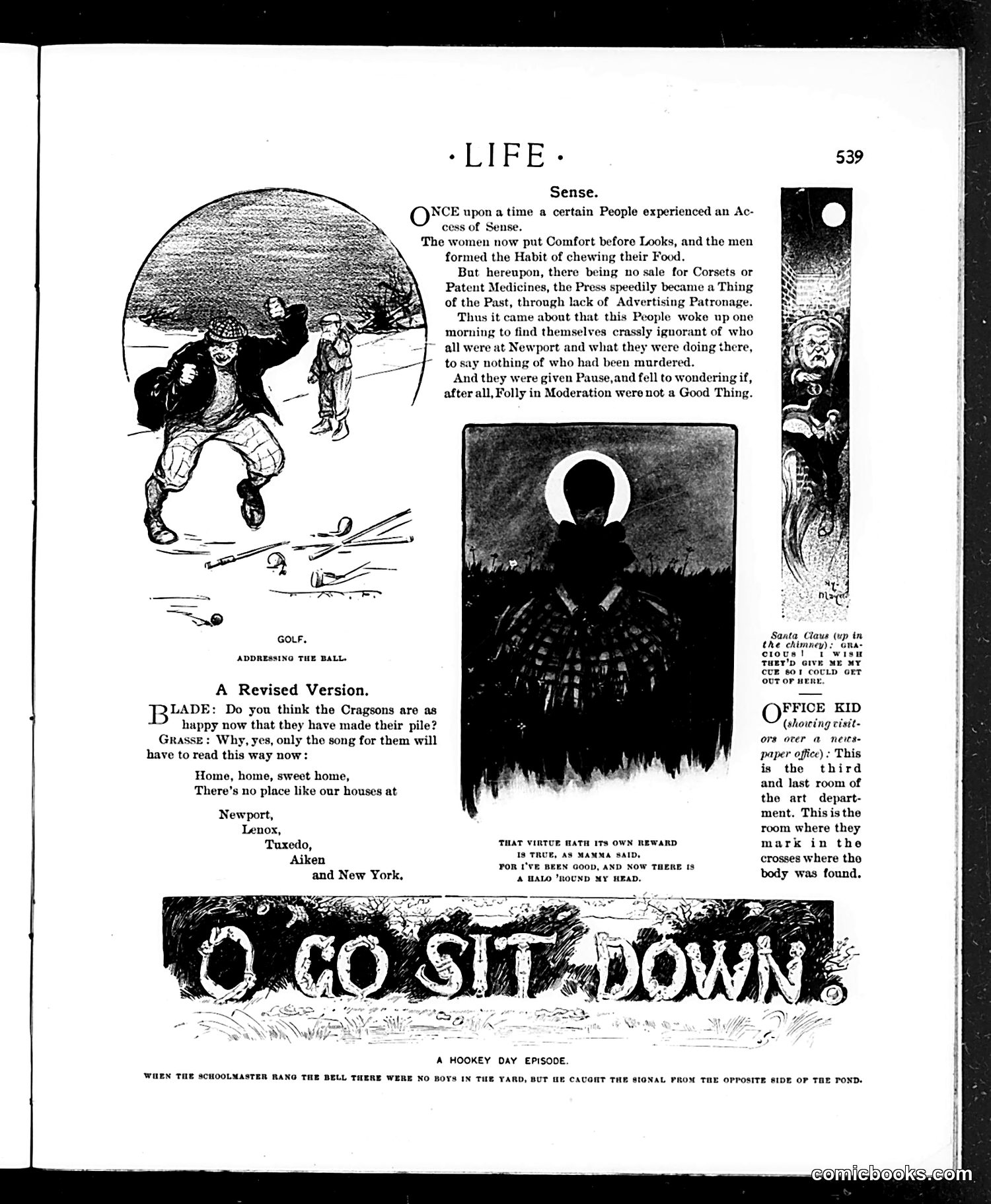
This page satirizes American society's dependence on vanity and sensationalism. The main editorial "Sense" mocks how society prioritizes gossip, fashion, and scandal over substantive living. It imagines a hypothetical people who adopt comfort over appearance and proper eating habits—only to discover newspapers collapse without advertising revenue from corsets and patent medicines, leaving them ignorant of society news and murders. The "Revised Version" dialogue jokes that wealthy families (the "Cragsons") must update their sentimental songs to reference their expensive homes (Newport, Lenox, Tuxedo, New York)—wealthy enclaves where the newly rich display status. Minor cartoons include office and school episodes providing light humor. The overall message critiques American materialism, consumer culture's grip on media, and society's obsession with wealthy scandals over genuine well-being. The tone is characteristic of Life's early 20th-century satirical style.
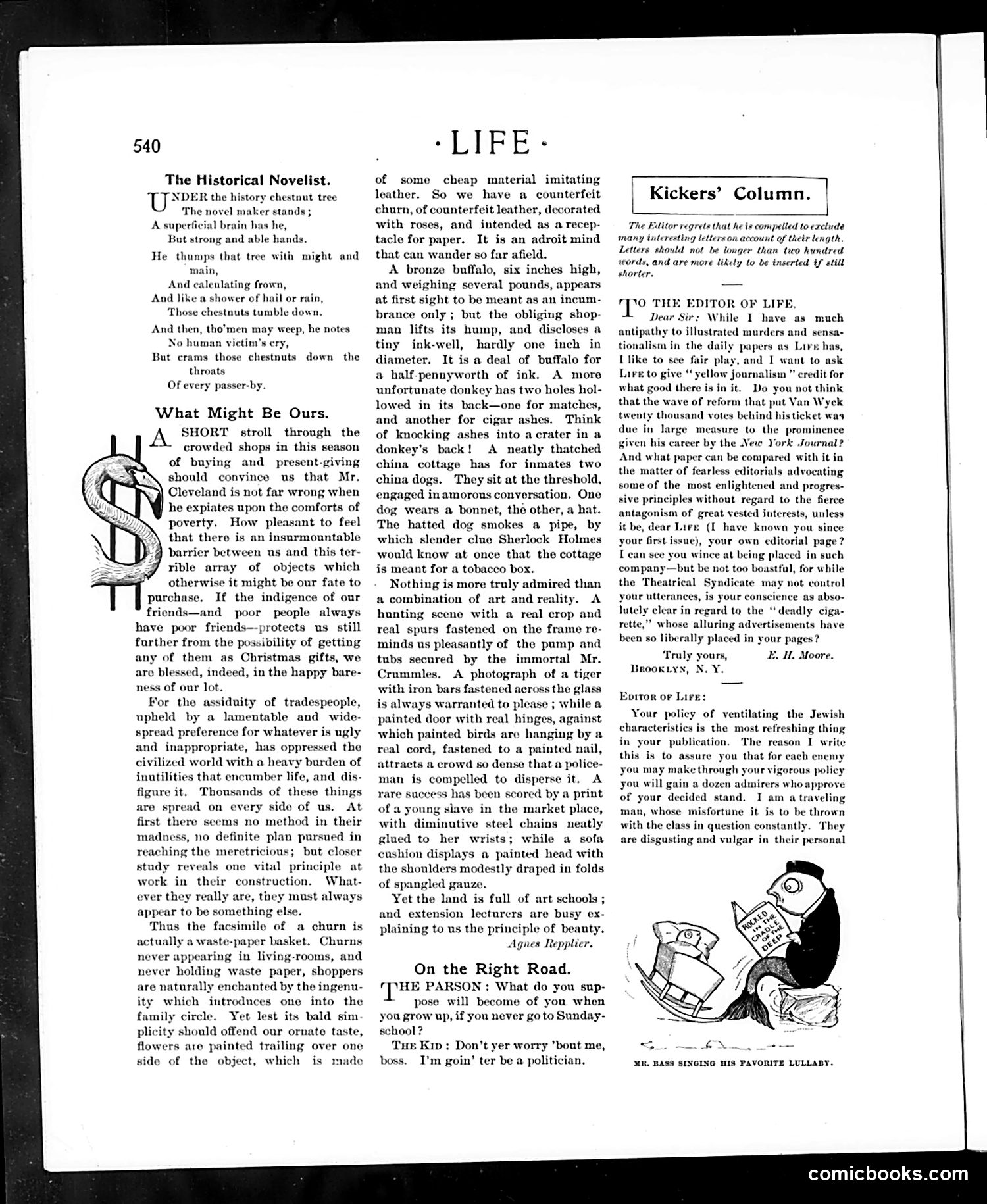
This article satirizes the absurd decorative objects flooding 1880s-90s shops during the Christmas season. The author mocks manufacturers who disguise functional items as ornaments through deceptive design. Examples include: a waste-paper basket styled as a churn (which wouldn't naturally appear in living rooms), a bronze buffalo hiding a tiny inkwell in its hump, and a donkey with holes for matches and cigar ash in its back. A china cottage contains two china dogs; one smokes a pipe to indicate it's a tobacco box. The satire targets both manufacturers' "ingenuity" and consumers' willingness to buy impractical, ugly items simply because they're disguised as something else. The author argues this represents a broader cultural principle: beautiful objects must always "appear to be something else" to sell, reflecting society's confused taste and the "heavy burden of inutilities that encumber life."
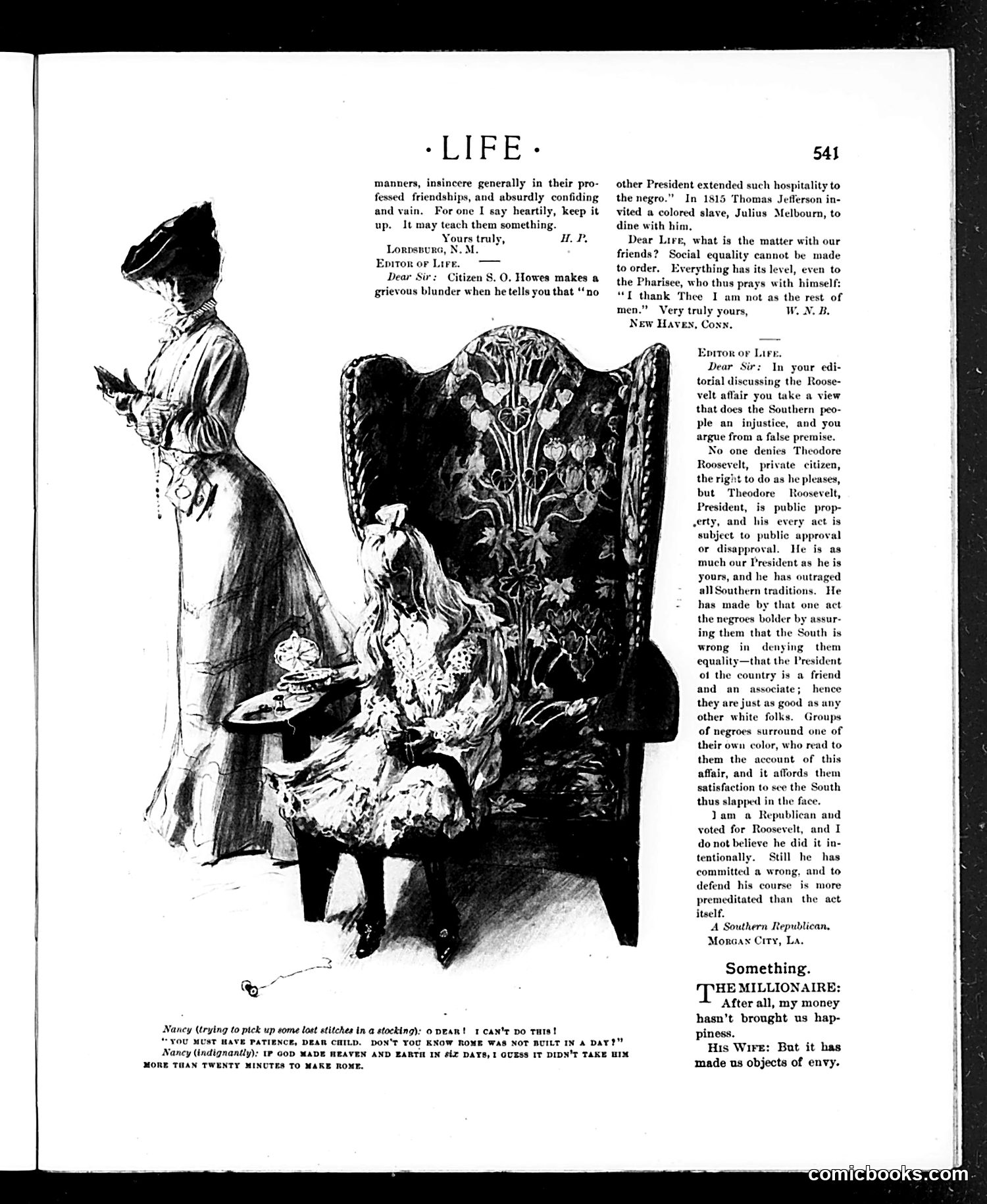
The main cartoon depicts **Nancy**, a maid or servant, struggling to knit. An older woman advises patience, noting Rome wasn't built in a day. Nancy responds indignantly that God created heaven and earth in six days—satirizing impatience and the absurdity of deflating expectations based on divine precedent. The page's letters address **Theodore Roosevelt's 1901 dinner with Booker T. Washington**, a Black educator. Southern correspondents express outrage, arguing the President violated Southern racial traditions and emboldened Black citizens. One Republican voter, though supporting Roosevelt, calls his action a "wrong." The final cartoon contrasts **a millionaire couple**: he laments that wealth hasn't brought happiness; she counters it has made them envied. This satirizes the hollow satisfaction of material wealth and social status divorced from genuine contentment—a common Life magazine theme critiquing Gilded Age excess.
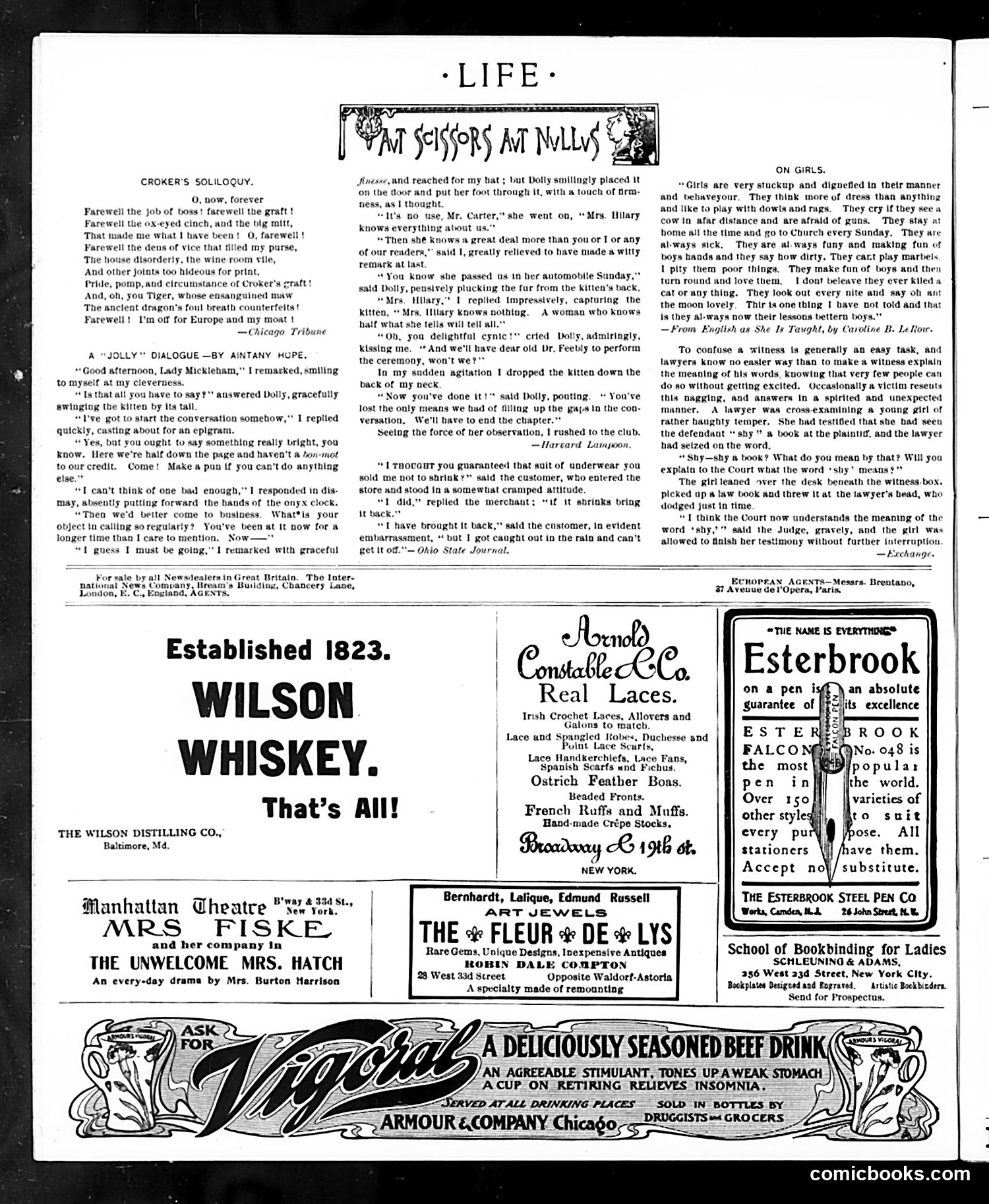
This page contains two distinct pieces of satire: **"Croker's Soliloquy"** (top left) parodies Shakespeare's *Othello*, with the protagonist renouncing his life of political corruption. "Croker" likely refers to Richard Croker, the notorious Tammany Hall boss, famous for New York machine politics and graft. The satire mocks his criminal enrichment through vice operations ("dens of vice," "wine-room") and announces his departure to Europe—a common refuge for disgraced politicians. **"A Jolly Dialogue"** (center) is a romantic comedy featuring characters debating whether to elope; the humor derives from witty banter about keeping secrets from a woman named "Mrs. Hilary." **"On Girls"** (right column) satirizes children's attempts at essay writing, presenting humorously contradictory observations about girls (they're vain yet cry easily, religious yet mischievous). The page is primarily **advertising**—Wilson Whiskey, theatrical productions, and commercial products dominate the lower half.
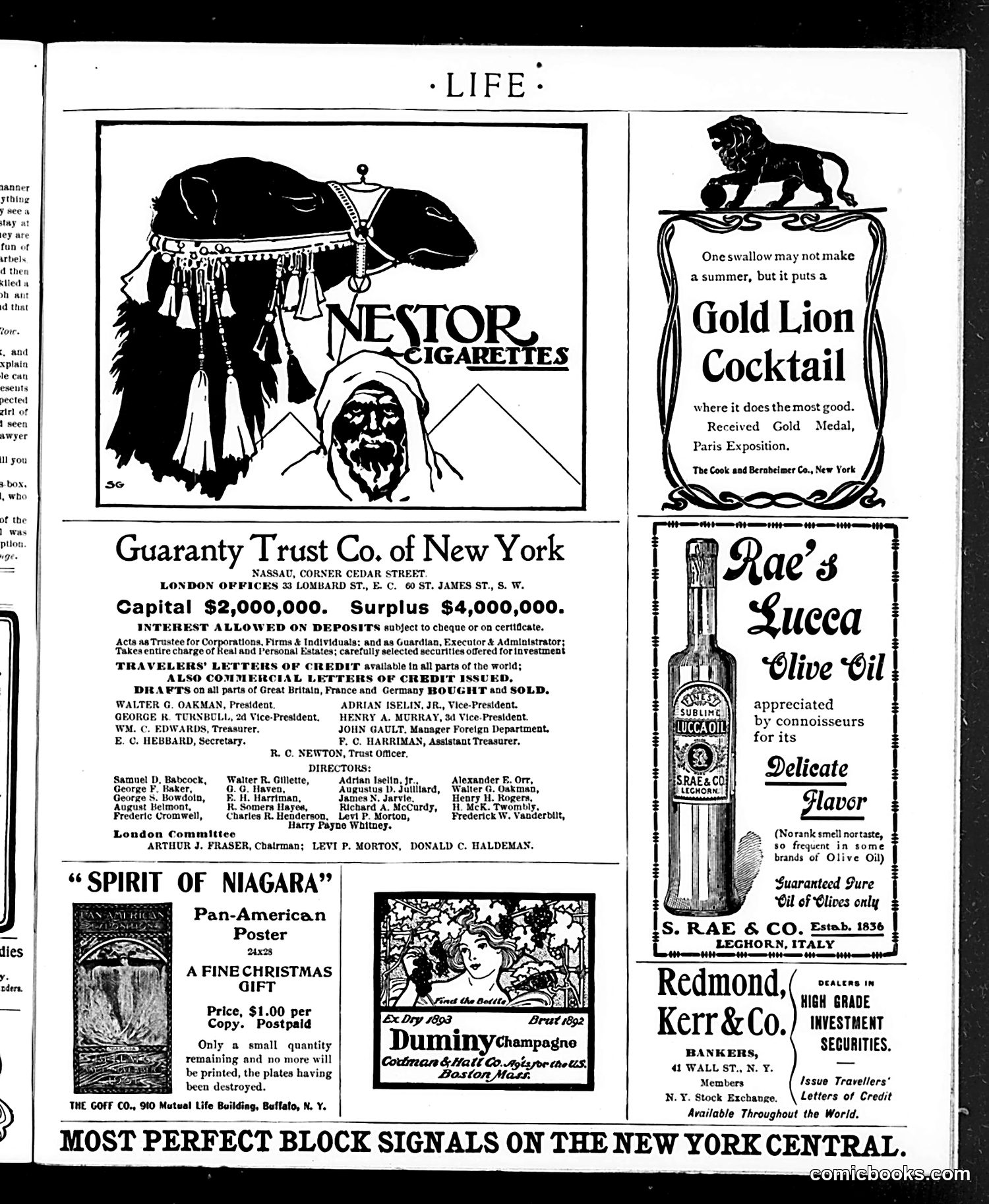
This page is primarily **advertisements and financial notices**, not political satire. It appears from a early 1900s issue of *Life* magazine. The main content includes: - **Nestor Cigarettes ad**: Features an orientalist camel image—typical early 20th-century advertising using exotic imagery to appeal to consumers - **Gold Lion Cocktail**: A liquor advertisement; the caption's humor ("One swallow may not make a summer") is a pun on the drink name - **Guaranty Trust Co.**: A major financial institution advertisement listing prominent wealthy directors (Vanderbilt, Belmont, etc.)—reflecting the financial power concentration of the Gilded Age - **Spirit of Niagara poster**: A Christmas gift item - **Duminy Champagne and Rae's Olive Oil**: Luxury import advertisements The page demonstrates early 1900s consumer culture targeting wealthy readers, with minimal editorial content. The references are chiefly to luxury goods and banking institutions rather than political commentary.
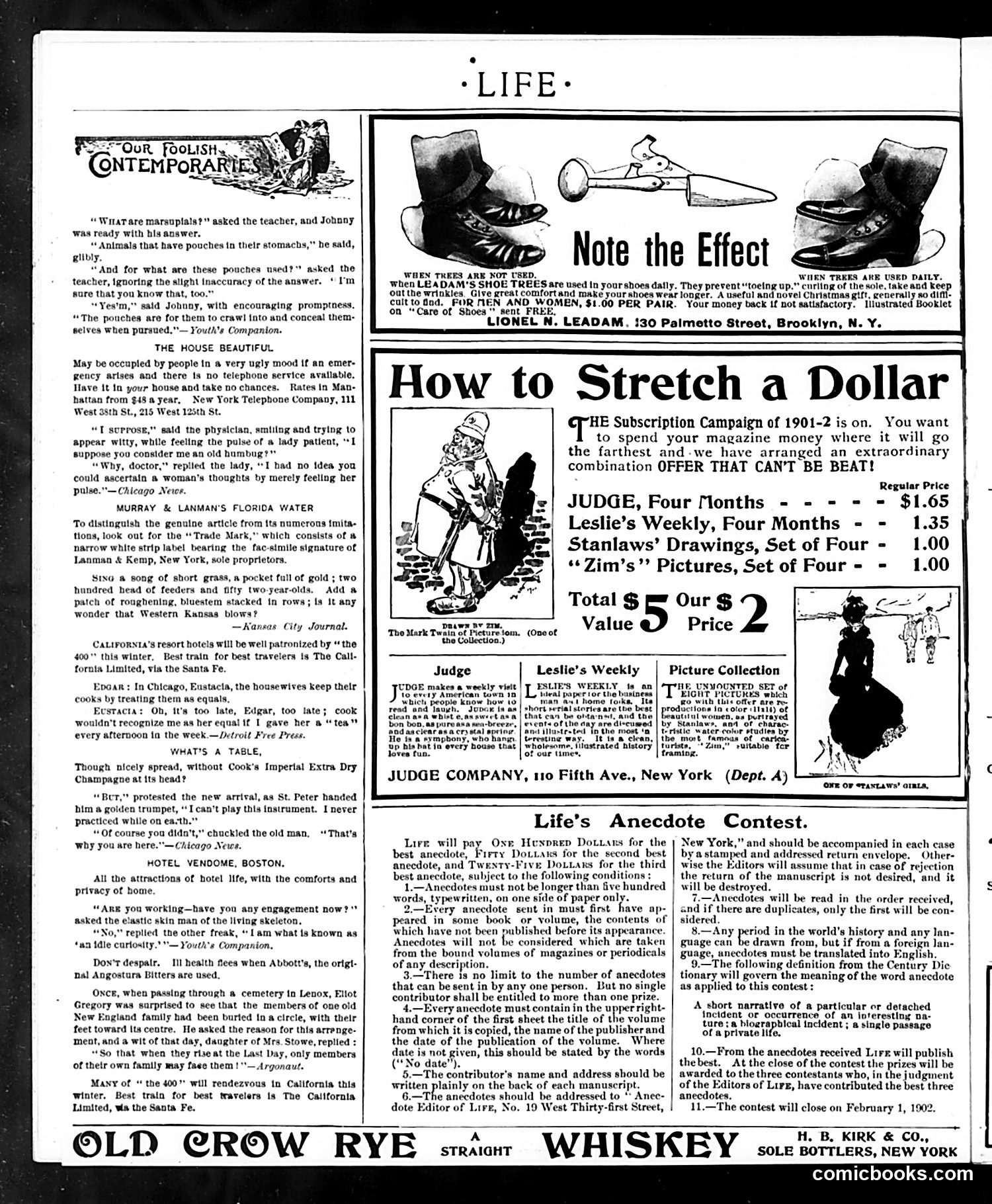
This page from Life magazine (early 1900s) is primarily **advertising and humor columns**, not political satire. The content includes: **Humorous anecdotes** mocking everyday situations: a child misdefining marsupials, a doctor's patient making witty observations, and various domestic scenarios—typical of Life's satirical humor columns. **Product advertisements** dominate the page: shoe trees, telephone service, champagne, Florida water, and whiskey. These reflect early 1900s consumer goods marketing. **A subscription campaign** ("How to Stretch a Dollar") offers Judge magazine bundles at discount—not political commentary, but magazine promotion. **An anecdote contest** soliciting reader submissions for $100 prize. The one cartoon visible ("Our Foolish Contemporaries") appears to be a small editorial piece, but the text is too small to decipher clearly. Overall, this is a typical turn-of-the-century Life page: light humor, advertisements, and reader engagement campaigns rather than pointed political satire.
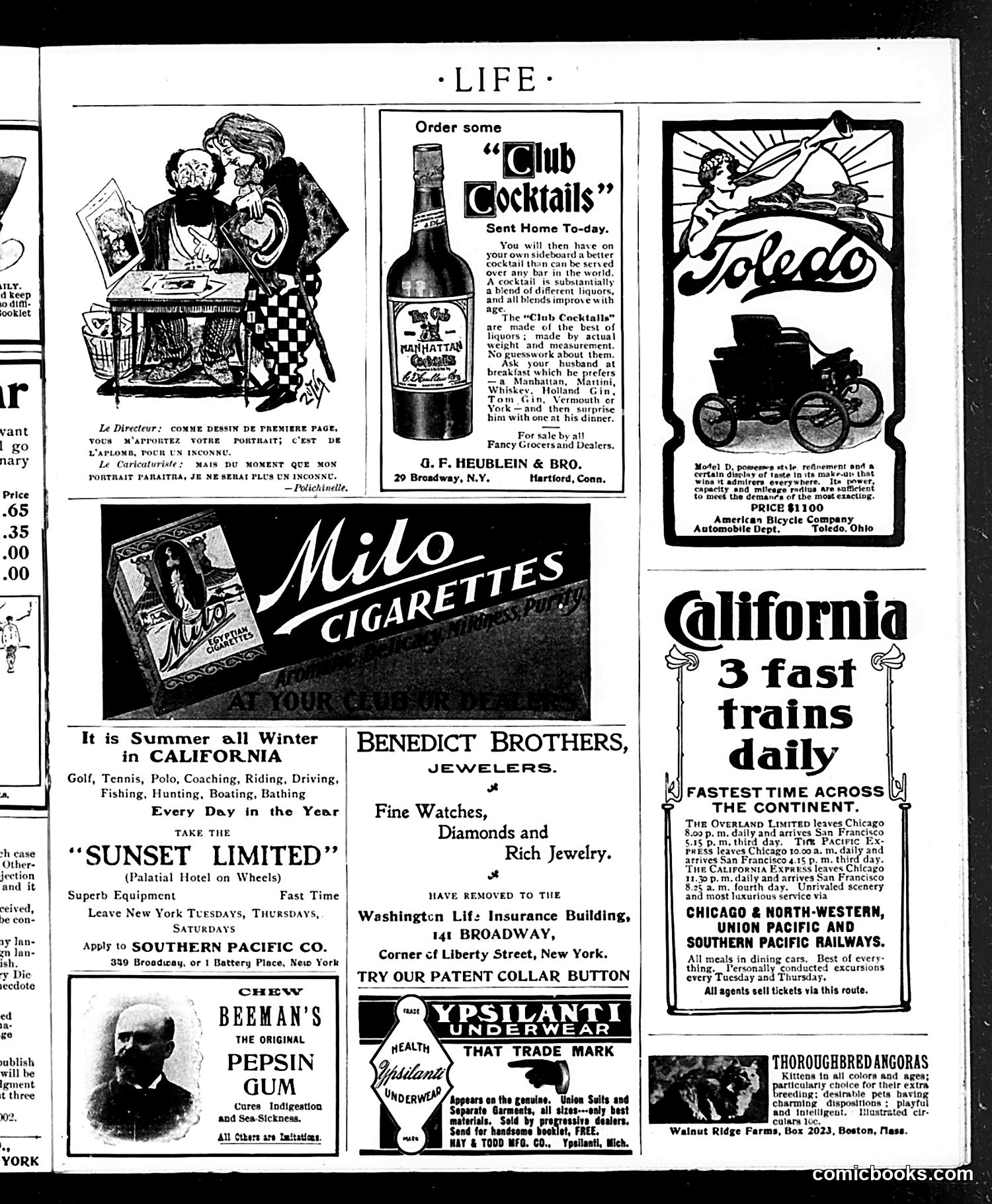
This page is primarily **advertising**, typical of early 20th-century magazines. The single cartoon at top-left is French, showing a director and caricaturist in dialogue. The caricaturist argues that once his portrait appears in print, he'll no longer be unknown—a light joke about the power of published imagery to create fame. The rest consists of product advertisements: Club Cocktails (pre-mixed drinks for home delivery), Milo Cigarettes, Toledo bicycles, California train travel, Beeman's Pepsin Gum (marketed as digestive aid), Benedict Brothers jewelry, Ypsilanti underwear, and Thoroughbred Angora kittens. Notable to modern readers: the prominent alcohol advertising (pre-Prohibition era), health claims for gum and underwear, and the leisurely California tourism pitch emphasizing year-round sports. The French caption reflects Life's earlier sophistication and European cultural references.
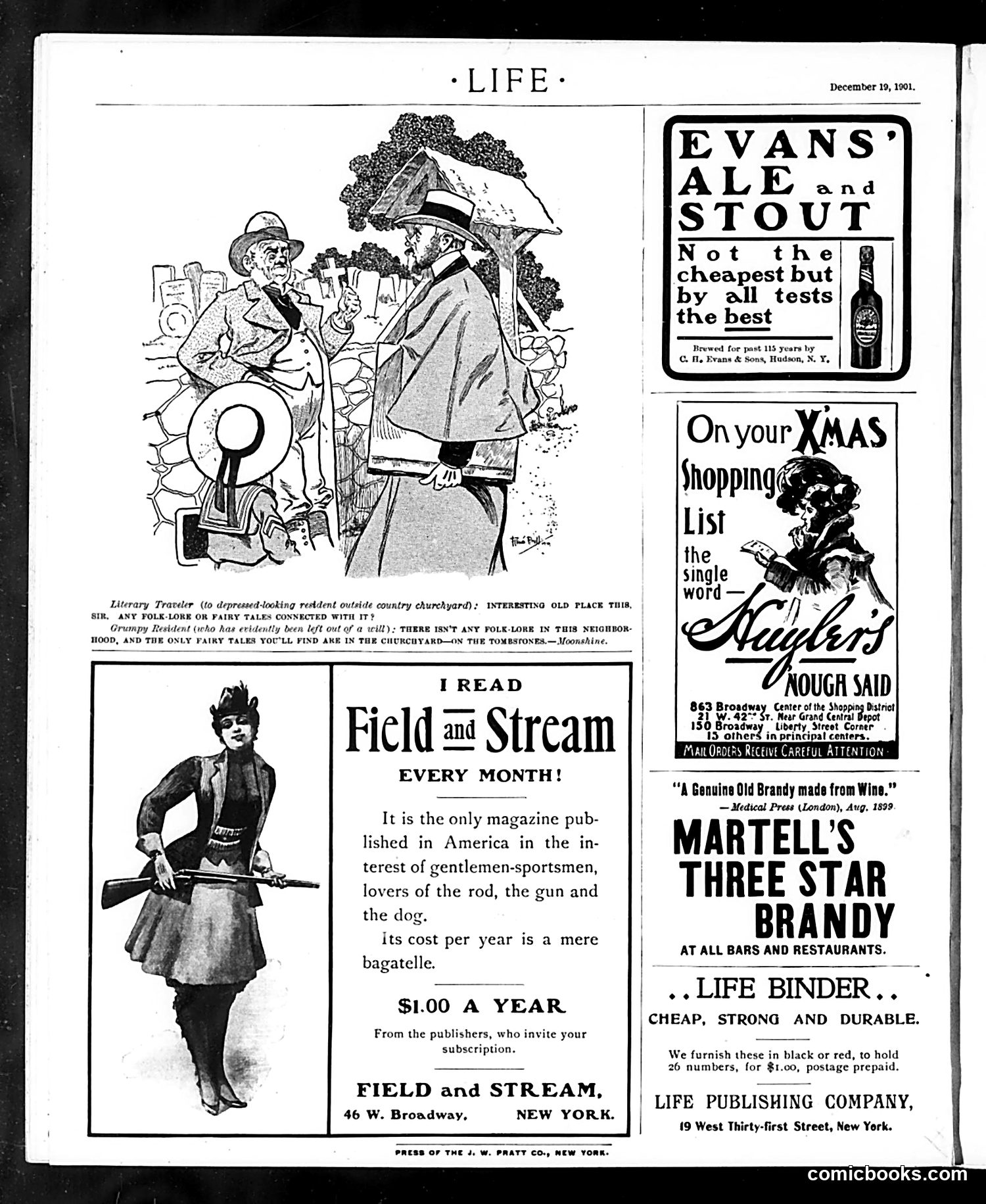
The main cartoon satirizes rural pessimism. A curious "Literary Traveler" asks a depressed villager outside a churchyard about local folklore and fairy tales. The resident bitterly replies that there's no folk-lore in the neighborhood—the only "fairy tales" are on the tombstones (implying lies on gravestones, or perhaps that death is the only story worth telling). The joke mocks the resident's joyless outlook and suggests rural communities lack the romantic heritage or storytelling traditions urban visitors might expect. It's titled "Moonshine," likely meaning the response is bitter nonsense. The rest of the page consists of period advertisements: Evans' Ale and Stout, Martell's Three Star Brandy, Field and Stream magazine ($1/year), Naylor's department store, and Life Binder subscriptions—typical commercial content for a satirical weekly magazine of this era.