
Life, 1901-12-19 · page 7 of 20
Life — December 19, 1901 — page 7: what you’re looking at
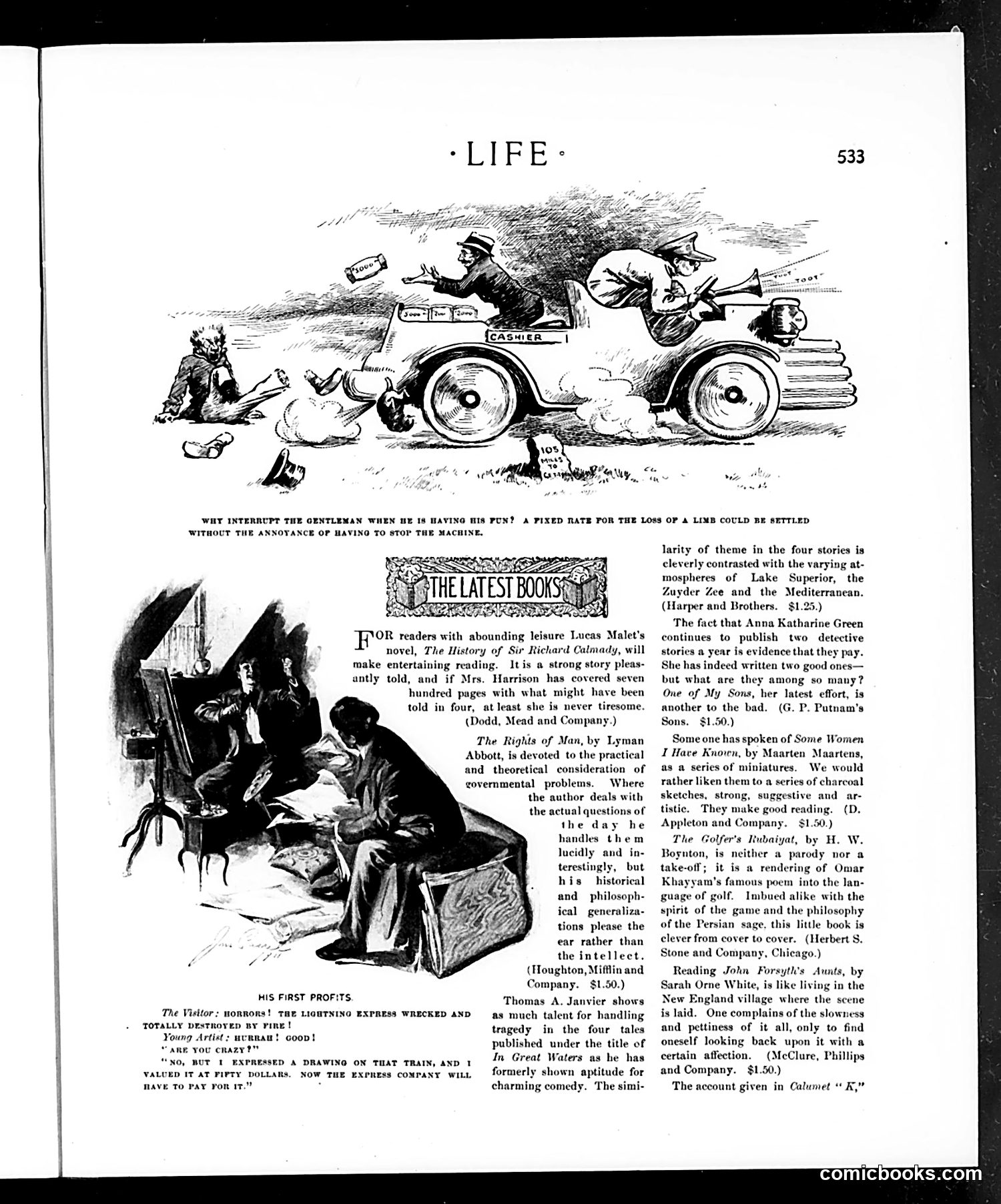
What you’re looking at
**The Main Cartoon:** The top illustration shows two men in a motorcar labeled "CASHIER" speeding away with money bags, while a frustrated gentleman on the left (possibly a bank or store owner) stands helplessly. The caption asks: "Why interrupt the gentleman when he is having his fun? A fixed rate for the loss of a lime could be settled without the annoyance of having to stop the machine." **The Satire:** This appears to satirize early automobile culture and reckless driving. The joke contrasts the driver's enjoyment with property damage—he'd rather pay a flat fee for damages than be inconvenienced by stopping. It mocks both the cavalier attitude of wealthy motorists and the absurdity of insurance/liability schemes being proposed to handle automobile accidents. **Context:** This reflects genuine early-1900s concerns about dangerous, unregulated automobiles and the social friction between wealthy drivers and the public.
📄 Transcribed text from this page (OCR, searchable)
Machine-transcribed from the original scan — historical spelling and the odd misread are preserved.
WHY INTERRUPT THE GENTLEMAN WHEN UE 14 HAVING M18 PUN? A PIXED RATE FOR THE LOss OF A LIMB COULD BE SETTLED WITHOUT THE ANNOYANCE OF HAVING TO STOP THE MACHINE. The Visitor; wonrors TOTALLY DestnoyeD BY <p ELATESO HIS FIRST PROFITS. TRE LIGHTNING EXPRESS WRECKED AND vine! Young Artist: ucwnau! coop! “ane you crazy? “No, BUT I VALUED IT AT PIPTY Ave To PAY Yon 17. XPRESSED A DRAWING ON THAT TRAIN, AND 1 LLARS. NOW THE EXPRESS COMPANY WILL RCA Ke Fe readers with abounding leisure Lucas Malet's novel, The History of Sir Richard Catmady, will make entertaining reading. It antly told, and if Mrs. Harrison has covered seven hundred pages with what might have been told in four, atleast she is never tiresome. (Dodd, a strong story pleas- Mead and Company.) The Rights of Man, by Lyman Abbott, is devoted to the practical and theoretical consideration of governmental problems. Where the author deals with the actual questions of the day he handles them lucidly and in- terestingly, but his historical and _ philosoph- ical generaliza- tions please the ear rather than the intellect. (Houghton, Mifflinand Company. $1.50.) Thomas A. Janvier shows as much talent for handling tragedy in the four tales published under the title of In Great Waters as he has formerly shown aptitude for charming comedy. The simi- larity of theme in the four stories is cleverly contrasted with the varying at- mospheres of Lake Superior, the Zuyder Zee and the Mediterranean. (Harper and Brothers. $1.25.) ‘The fact that Anna Katharine Green continues to publish two detective stories a year is evidence that they pay. She has indeed written two good ones— but what are they among so many? One of My Sons, her latest effort, is another to the bad. (G. P. Putnam's Sons. $1.50.) Some one has spoken of Some Women I Have Known, by Maarten Maartens, as a series of miniatures. We would rather liken them to a series of charcoal sketches, strong, suggestive and ar- tistic. They make good reading. (D. Appleton and Company. $1.50.) The Golfer's Rubaiyat, by H. W. Bosnton, is neither a parody nor a take-off; it is a rendering of Omar Khayyam's famous poem into the lan- guage of golf. Imbued alike with the spirit of the game and the philosophy of the Persian sage. this little book is clever from cover to cover. (Herbert S. Stone and Company, Chicago.) Reading John Forsyth’s Aunts, by Sarah Orne White, is like living in the New England village where the scene is laid. One complains of the slowness and pettiness of it all, only to find oneself looking back upon it certain affection. (McClure, Phillips and Company. $1.50.) The account given in Calumet “ K,” comicbooks.com