
Life, 1901-12-19 · page 12 of 20
Life — December 19, 1901 — page 12: what you’re looking at
A restored page from Life, 1901-12-19. Page through the whole issue in the reader above.
📄 Transcribed text from this page (OCR, searchable)
Machine-transcribed from the original scan — historical spelling and the odd misread are preserved.
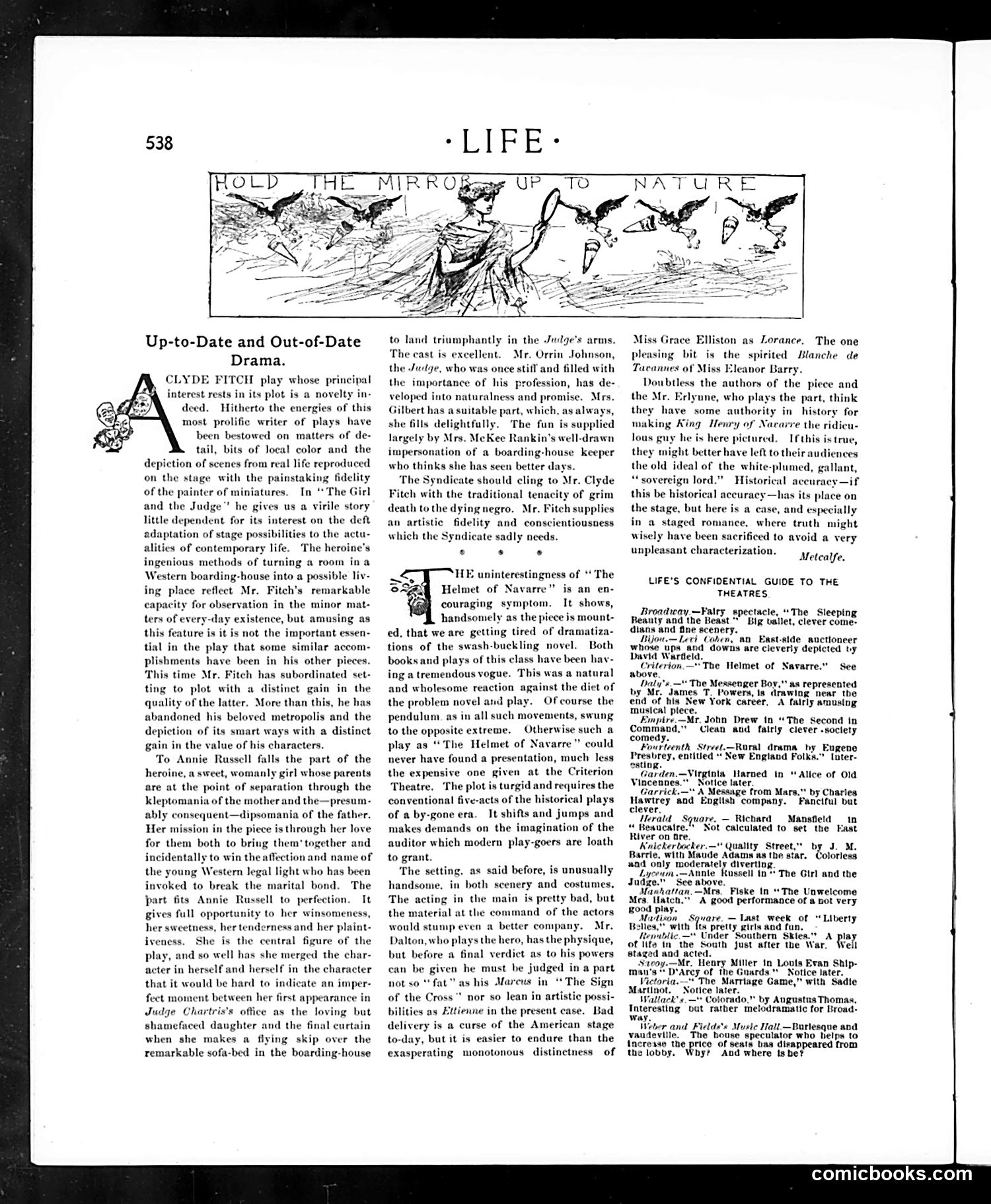
# LINPIE Up-to-Date and Out-of-Date Drama. CLYDE FITCH play whose principal interest rests in its plot is a novelty in- deed. Hitherto the energies of this most prolific writer of plays have been bestowed on matters of de- tail, bits of local color and the depiction of scenes from real life reproduced on the stage with the painstaking fidelity of the painter of miniatures. In The Girl and the Judge” he gives us a virile story little dependent for its interest on the deft adaptation of stage possibilities to the actu- alities of contemporary life. The heroine's ingenious methods of turning a room ina Western boarding-house into a possible liv- ing place reflect Mr. Fitch's remarkable capacity for observation in the minor mat- ters of every-day existence, but amusing as this feature is it is not the important essen- tial in the play that some similar accom- plishments have been in his other p This time Mr. Fitch has subordinated set- ting to plot with a distinct gain in the quality of the latter, More than this, he has abandoned his beloved metropolis and the depiction of its smart ways with a distinct gain in the value of his characters. To Annie Russell falls the part of the heroine, a sweet, womanly girl whose parents are at the point of separation through the kleptomania of the mother and the—presum- ably consequent—dipsomania of the father. Her mission in the piece is through her love for them both to bring them’ together and incidentally to win the affection and name of the young Western legal light who has been invoked to break the marital bond. ‘The part fits Annie Russell to perfection. It gives full opportunity to her winsomeness, her sweetness, her tenderness and her plaint- iveness. She is the central figure of the play, acter in herself and herself in the character that it would be hard to indicate an imper- fect moment between her first appearance in Judge Chartris the loving but shamefaced daughter and the final curtain when she makes a flying skip over the remarkable sofa-bed in the boarding-house and so well has she merged the char- office to land triumphantly in the Judge's arms. The cast is excellent. Mr. Orrin Johnson, the Jutge, who was once stiff and filled with the importance of his profession, has de- veloped into naturalness and promise. Mrs. bert has a suitable part, which, as always, she fills delightfully. ‘The fun is supplied largely by Mrs. McKee Rankin’s well-drawe impersonation of a boarding-house keeper who thinks she has seen better days. The Syndicate should cling to Mr. Clyde Fitch with the traditional tenacity of grim death to the dying negro. Mr. Fitch supplies an artistic fidelity and conscientiousness which the Syndicate sadly needs. * . . HE uninterestingness of * The Helmet of Navarre” is an en- couraging symptom. It shows, handsomely as the piece is mount- ed, that we are getting tired of dramatiza- tions of the swash-buckling novel. Both books and plays of this class have been hav- ing a tremendous vogue. This was a natural and wholesome reaction against the diet of the problem novel aud play. Of course the pendulum. as in all such movements, swung to the opposite extreme. Otherwise such a play as “The Helmet of Navarre” could never have found a presentation, much less the expensive one given at the Criterion Theatre. The plot is turgid and requires the conventional five-acts of the historical plays of aby-gone era. It shifts and jumps and makes demands on the imagination of the auditor which modern play-goers are loath to grant. ‘The setting. as said before, is unusually handsome, in both scenery and costumes. ‘The acting in the main is pretty bad, but the material at the command of the actors would stump even a better company. Mr. Dalton, who plays the hero, has the physique, but before a final verdict as to his powers n be given he must be judged in a part not so “fat” as his Marcus in “The Sign of the Cross” nor so lean in artistic pos bilities as Eltienne in the present case. Bad delivery is a curse of the American stage to-day, but it is easier to endure than the exasperating monotonous distinctness of race Elliston as Lorance, The one pleasing bit is the spirited Blanche de Tacannes of Miss Eleanor Barry. Doubtless the authors of the piece and the Mr. Erlynne, who plays the part, think they have ‘some authority in history for making King Henr re the ridicu- lous guy he is here pictured. If this istrue, ht better have left to their audiences the old ideal of the white-plumed, gallant, “sovereign lord.” Historical accuracy—if this be historical accuracy —has its place on the stage, but here is a case, and especially in a staged romance, where truth might wisely have been sacrificed to avoid a very unpleasant characterization. Metcalfe. LIFES CONFIDENTIAL GUIDE TO THE THEATRES, Broadway —Falry spectacle, “The Sleeptny Reatity und the Beast “big vailet, clever come: dians and fine scenery. Bijou.—Leth Cohen, an East-alde auctioneer whose ups and downs are cleverly depicted by David Warfeld. Criterion. —"" The Helmet of Navarre. above. Daly's, —" The Messenger Boy," as represented by Mr. James T. Powers, is drawing near the end of his New York career, A fairly amusing musical plece. Empire.—Mr. Joon Drew in “The Second in Command, Clean and fairly clever .society comedy. Fourteenth Street.—Roral drama by Eugene Presbrey, entitled “ New England Folks.” tnter- esting. Garden.—Virginla Narned in “Alice of Old Vincennes.” Notice later. Garrick. A Message from Mars," by Charles Hawtrey and English company. Fanciful but clever. Werald Square. — Richard Mansfield tn “ Beaucalre.” Not calculated to set the East River on ore, Naickerbocker.—" Quallty Street," by J. M. Barrie, with Maude Adams as the star. Colorless aad only moderately diverting Lyceum .—Aunte Kussell to“ The Girl and the Judge." See above. Manhattan. —Mrs. Fiske in “The Unwelcome Mra, Hatch.” A good performance of a not very good play. Matison Square, — Last week of “Liberty Belles," with {ta pretty girls and fun. c.—* Under Southern Sklea.* A pla; he South Just after the War. W staged and acted. Stcoy.—Mr. Henry Miller in Louts Evan Ship- man’s * D'Arcy of the Gnards "Notice later. Victoria.“ The Marrtage Game,” with Sadie Martinot. | Notice later. Watlack’s,—* Colorado,” by Augustus Thomas, Interesting but rather melodramatic for Broad: way, Weber and Fields's Muste Halt —Burlesque and vaudeville. The house speculator who helps to facrouse the price of seats as disappeared from the lobby, Why? And where ts bet comicbooks.com