
Life, 1901-12-19 · page 4 of 20
Life — December 19, 1901 — page 4: what you’re looking at
What you’re looking at
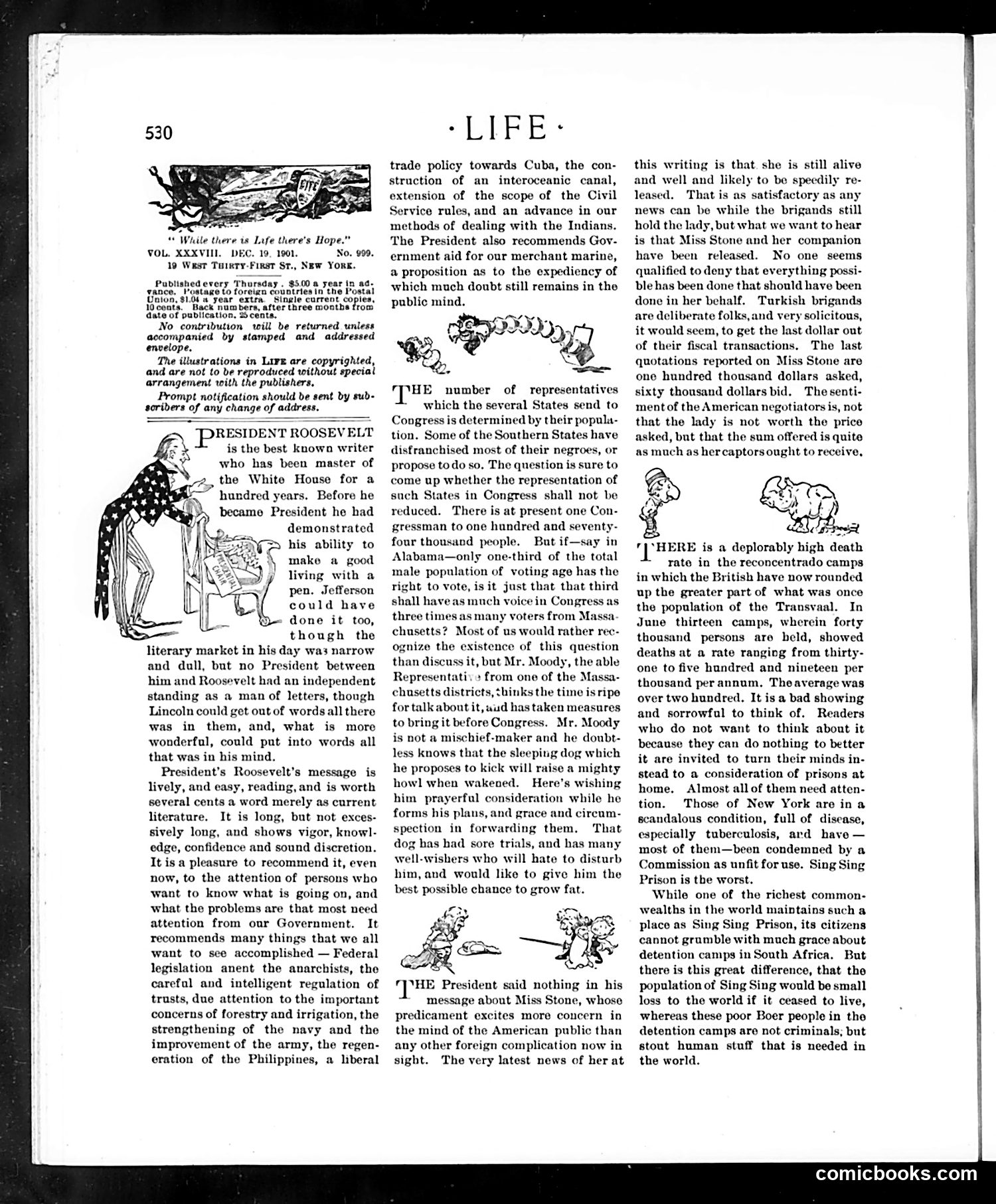
The page contains editorial commentary on President Theodore Roosevelt rather than political cartoons. The text praises Roosevelt as "the best known writer who has been master of the White House for a hundred years," noting his literary skill and independent character. The accompanying illustrations are decorative vignettes—small sketches of figures in various poses—rather than specific political commentary. The editorial discusses congressional representation tied to population, mentions the problematic conditions in British detention camps during the Boer War, and references the Sing Sing Prison system. These reflect contemporary Progressive Era concerns about democratic representation, imperial conflicts, and prison reform. The page is primarily text-based political commentary rather than satirical cartooning.
📄 Transcribed text from this page (OCR, searchable)
Machine-transcribed from the original scan — historical spelling and the odd misread are preserved.
10 Wrst Tutery-Finst Sr., NEW YORK. Pavlished every hursday . $5,000 year in ad. tage to foreign countries in the Postal 7 $1.0t a year exten, ‘Single current copies, 1conts. “Back numbers, after three months from date of publication, cents, No contribution twill be returned unless accompanied by stamped and addressed envelope. ‘The illustrations in Live are copyrighted, and are not to be reproduced without special arrangement with the publishers, Prompt notification should be sent by sub- soribers of any change of addres RESIDENT ROOSEVEL! p is the best known writer who has been master of , the White House for a * hundred years, Before he became President he had demonstrated res his ability to \ make a good living with a pen. Jefferson could have done it too, though the literary market in his day was narrow and dull, but no President between him and Roosevelt had an independent standing as a man of letters, though Lincoln could get out of words all there was in them, and, what is more wonderful, could put into words all that was in his mind. President's Roosevelt's message is lively, and easy, reading, and is worth several cents a word merely as current literature. It is long, but not exces- sively long, and shows vigor, knowl- edge, confidence and sound discretion. It is a pleasure to recommend it, even now, to the attention of persons who want to know what is going on, and what the problems are that most need attention from our Government. It recommends many things that we all want to see accomplished — Federal legislation anent the anarchists, the carefal and intelligent regulation of trusts, due attention to the important concerns of forestry and irrigation, the strengthening of the navy and the improvement of the army, the regen- eration of the Philippines, a liberal LUPE trade policy towards Cuba, the con- struction of an interoceanic canal, extension of the scope of the Civil Service rules, and an advance in our methods of dealing with the Indians. The President also recommends Gov- ernment aid for our merchant marine, a proposition as to the expediency of which much doubt still remains in the public mind. HE number of representatives which the several States send to Congress is determined by their popula- tion. Some of the Southern States have disfranchised most of their negroes, or propose to do so. The question is sure to come up whether the representation of such States in Congress shall not be reduced. There is at present one Con- gressman to one hundred and sevent four thousand people. But if—say Alabama—only one-third of the total male population of voting age has the right to vote, is it just that that third shall have as much voice in Congress as three times as many voters from Ma chusetts? Most of us would rather rec- ognize the existence of this question than discuss it, but Mr. Moody, the able Representati\ +» from one of the Massa- chusetts districts, Shinks the time is ripe for talk about it, wud has taken measures to bring it before Congress. Mr. Moody is not a mischief-maker and he doubt- less knows that the sleeping dog which he proposes to kick will raise a mighty howl when wakened. Here's wishing him prayerful consideration while he forms his plans, and grace and circum- spection in forwarding them, ‘That dog has had sore trials, and has many well-wishers who will hate to disturb him, and would like to give him the best possible chance to grow fat. (THE President said nothing in his message about Miss Stone, whose predicament excites more concern in the mind of the American public than any other foreign complication now in sight. The very latest news of her at this writing is that. she is still alive and well and likely to be speedily re- leased. That is as satisfactory as any news can be while the brigands still hold the lady, but what we want to hear is that Miss Stone and her companion have been released. No one seems qualified to deny that everything possi- ble has been done that should have been done in her behalf. Turkish brigands are deliberate folks, and very solicitous, it would seem, to get the last dollar out of their fiscal transactions, The last quotations reported on Miss Stone are one hundred thousand dollars asked, sixty thousand dollars bid. The senti- mentof the American negotiators is, not that the lady is not worth the price asked, but that the sum offered is quite as much as hercaptors ought to receive, ‘| ‘HERE is a deplorably high death rate in the reconcentrado camps in which the British have now rounded up the greater part of what was once the population of the Transvaal. In June thirteen camps, wherein forty thousand persons are held, showed deaths at a rate ranging from thirty- one to five hundred and nineteen per thousand per annum. Theaverage was over two hundred. It is a bad showing and sorrowful to think of. Readers who do not want to think about it because they can do nothing to better it are invited to turn their minds in- stead to a consideration of prisons at home, Almost all of them need atten- tion. Those of New York are in a scandalous condition, full of disease, especially tuberculosis, ard have — most of them—been condemned by a Commission as unfit for use. Sing Sing Prison is the worst. While one of the richest common- wealths in the world maintains such a place as Sing Sing Prison, its citizens cannot grumble with much grace about detention camps in South Africa. But there is this great difference, that the population of Sing Sing would be small loss to the world if it ceased to live, whereas these poor Boer people in the detention camps are not criminals; but stout human stuff that is needed in the world. comicbooks.com