
Life, 1901-12-19 · page 8 of 20
Life — December 19, 1901 — page 8: what you’re looking at
What you’re looking at
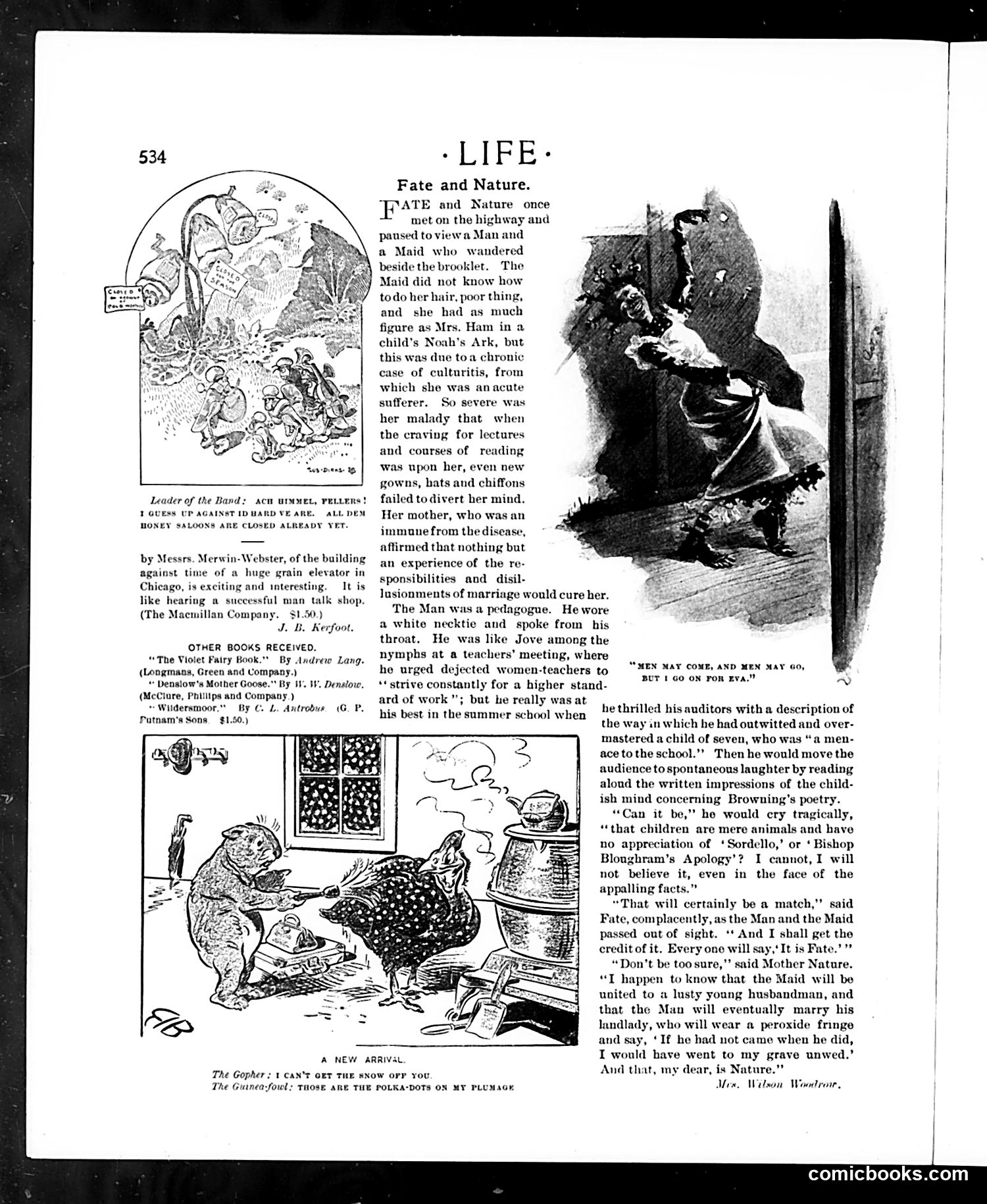
This page presents a allegorical story about social class and marriage prospects. "Fate" and "Nature" (personified as characters) discuss a poor, chronically ill Maid they encounter. A well-dressed, pedagogue Man also appears. The satire mocks Victorian attitudes about marriage and social mobility. The Man lectures about education and poetry, yet Fate predicts he'll eventually marry a wealthy widow ("perinside fringe"), implying his pretensions to intellectual refinement mask mercenary motivations. The bottom cartoon shows comic domestic chaos—a Gopher and Guinea-fowl arguing over housekeeping duties, illustrating tensions between servants or household animals. The overall message critiques both romantic delusions among the poor and the superficiality of educated gentlemen seeking advantageous marriages. The tone is cynical about human nature and social aspiration.
📄 Transcribed text from this page (OCR, searchable)
Machine-transcribed from the original scan — historical spelling and the odd misread are preserved.
* Reapente tp Leader of the Band: ach uramet, veLLens! 1 GUESS UP AGAINST IDHARD VE ARE. ALL pes HONEY SALOONS ARE CLOSED ALREADY YET. by Messrs. Merwin- Webster, of the building against time of a huge grain elevator in Chicago, is exciting and interesting, It is like hearing a successful man talk shop. (The Macmillan Company. $1.50.) J.B. Kerfoot. OTHER BOOKS RECEIVED. “The Violet Fairy Book.” By Andrew Lang. (Longmans, Green and Company.) « Denslow's Mother Goose." By IV’ 1. Denslow, (McClure, Phillips and Company.) + Wildersmoor."" By CL. Antrobus (G. P. Putnam's Sons $1.50.) -LIFE- Fate and Nature. a Ee and Nature once met on the highway and paused to viewa Man and a Maid who wandered beside the brooklet. The Maid did not know how todo her hair, poor thing, and she had as much figure as Mrs. Ham in a child’s Noah's Ark, but this was due toa chronic case of culturitis, from which she was anacute sufferer. So severe was her malady that when the craving for lectures and courses of reading was upon her, even new gowns, hats and chiffons failed to divert her mind. Her mother, who was an immune from the disease, affirmed that nothing but an experience of the r sponsibilities and di Jusionments of marriage would cure her. The Man was a pedagogue. He wore a white necktie and spoke from his throat. He was like Jove among the nymphs at a teachers’ meeting, where he urged dejected women-teachers to “ strive constantly for a higher stand- ard of work"; but he really was at his best in the summer school when “MEN MAY COME, AND MEN MAY Go, BUT 1 GO ON FoR Eva.” he thrilled his auditors with a description of the way in which he had outwitted and over- A NEW ARRIVAL, The Gopher; 1 CAN'T GET THE SNOW OFF YOU. The Guinea-fowl: THOSE ARE TUB POLKA-DOTS ON MY PLUMAGY mastered a child of seven, who was “a men- ace tothe school.”” Then he would move the audience to spontaneous laughter by reading aloud the written impressions of the child- ish mind concerning Browning's poetry. “Can it be,’’ he would cry tragically, “that children are mere animals and have no appreciation of ‘Sordello,’ or ‘ Bishop Bloughram’s Apology’? I cannot, I will not believe it, even in the face of the appalling facts.” “That will certainly be a match,” said Fate, complacently, as the Man and the Maid passed out of sight. ‘* And I shall get the credit of it. Every one will say,‘It is Fate.’ “Don’t be too sure,” said Mother Nature. “I happen to know that the Maid will be united to a lusty young husbandman, and that the Man will eventually marry his landlady, who will wear peroxide fringe and say, ‘If he had not came when he did, I would bave went to my grave unwed.’ And that, my dear, is Nature.” Mrs, Welson Woodrow, comicbooks.com