
Life, 1901-12-19 · page 14 of 20
Life — December 19, 1901 — page 14: what you’re looking at
What you’re looking at
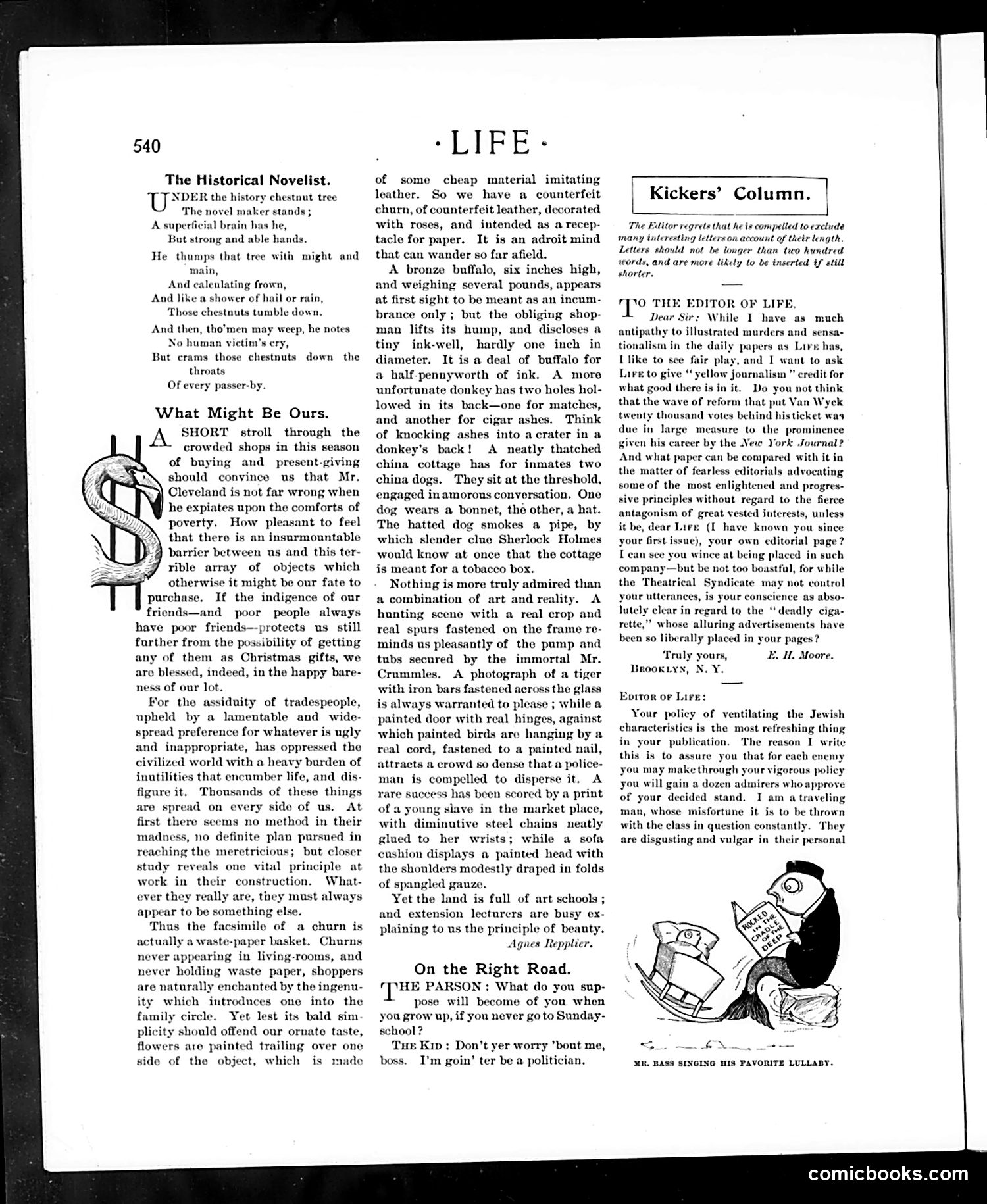
This article satirizes the absurd decorative objects flooding 1880s-90s shops during the Christmas season. The author mocks manufacturers who disguise functional items as ornaments through deceptive design. Examples include: a waste-paper basket styled as a churn (which wouldn't naturally appear in living rooms), a bronze buffalo hiding a tiny inkwell in its hump, and a donkey with holes for matches and cigar ash in its back. A china cottage contains two china dogs; one smokes a pipe to indicate it's a tobacco box. The satire targets both manufacturers' "ingenuity" and consumers' willingness to buy impractical, ugly items simply because they're disguised as something else. The author argues this represents a broader cultural principle: beautiful objects must always "appear to be something else" to sell, reflecting society's confused taste and the "heavy burden of inutilities that encumber life."
📄 Transcribed text from this page (OCR, searchable)
Machine-transcribed from the original scan — historical spelling and the odd misread are preserved.
540 The Historical Novelist. U ‘DER the history chestnut tree The novel maker stands; A superficial brain has he, But strong and able hands. He thumps that tree with might and mai And calculating frown, And like a shower of hail or rain, Those chestnuts tumble down, And then, tho'men may weep, he notes No human victim's ery, But crams those chestnuts throats Of every passer-by. down the What Might Be Ours. SHORT stroll through the crowded shops in this season of buying and _present-giving should convince us that Mr. Cleveland is not far wrong when he expiates upon the comforts of poverty. How pleasant to feel that there is an insurmountable barrier between us and this ter- rible array of objects which otherwise it might be our fate to purchase. If the indigence of our frionds—and poor people always have poor friends—protects us. still further from the possibility of getting any of them as Christmas gifts, we aro blessed, indeed, in the happy bare- ness of our lot. For the assiduity of tradespeople, upheld by a lamentable and wide- spread preference for whatever is ugly and inappropriate, has oppressed the civilized world with a heavy burden of inutilities that encumber life, and dis- figure it. Thousands of these things are spread on every side of us. At first there scems no method in their madness, no definite plan pursued in reaching the meretricious; but closer study reveals one vital principle at work in their construction. What- ever they really are, they must always appear to be something else. Thus the facsimile of a churn is actually a waste-paper basket. Churns never appearing in living-rooms, and never holding waste paper, shoppers are naturally enchanted by the ingenu- yy which introduces one into the family circle. Yet lest its bald sim should offend our ornate taste, “rs are painted trailing over ono side of the object, which is made ‘LIPE + of some cheap material imitating leather. So we have a counterfeit churn, of counterfeit leather, decorated with roses, and intended as a recep- tacle for paper. It is an adroit mind that can wander so far afield. A bronze buffalo, six inches high, and weighing several pounds, appears at first sight to be meant as an incum- brance only ; but the obliging shop man lifts its hump, and discloses a tiny ink-well, hardly one inch in diameter. It is a deal of buffalo for a half-pennyworth of ink. A more unfortunate donkey has two holes hol- lowed in its back—one for matches, and another for cigar ashes. Think of knocking ashes into a crater in a donkey's back! A neatly thatched china cottage has for inmates two china dogs. They sit at the threshold, engaged in amorous conversation. One dog wears a bonnet, the other, a hat. The hatted dog smokes a pipe, by which slender clue Sherlock Holmes would know at once that the cottage is meant for a tobacco box. Nothing is more truly admired than a combination of art and reality. A hunting scene with a real crop and real spurs fastened on the frame re- minds us pleasantly of the pump and tubs secured by the immortal Mr. Crummles, A photograph of a tiger with iron bars fastened across the glass is always warranted to please ; while a painted door with real hinges, against which painted birds are hanging by a real cord, fastened to a painted nail, attracts a crowd so dense that a police- man is compelled to disperse it. A rare success has been scored by a print of a young slave in the market place, with diminutive steel chains neatly glued to her wrists; while a sofa cushion displays a painted head with the shoulders modestly draped in folds of spangled gauze. Yet the land is full of art schools ; and extension lecturers are busy ex- plaining to us the principle of beauty. Agnes Repplicr. On the Right Road. [HE PARSON : What do you sup- pose will become of you when you grow up, if you never go to Sunday- school? Tur Kip: Don't yer worry "bout me, boss. I'm goin’ ter be a politi ‘ian. Kickers’ Column. Ln The Editor regrets that he ts compelted toexcude many interesting letters on account of their length. Letters should not be longer than to hundred words, and are more likely to be inserted if stilt shorter. ry°O THE EDITOR OF LIFE. Dear Sir: While I have as much antipathy to illustrated murders and sensa- tionalism in the daily papers as Lire has, I like to sce fair play, and I want to ask Lire to give “ yellow journalism ” credit for what good there is in it. Do you not think that the wave of reform that put Van Wyck twenty thousand votes behind histicket was due in large measure to the prominence given his career by the New York Journal? And what paper can be compared with it in the matter of fearless editorials advocating some of the most enlightened and progres- sive principles without regard to the fierce antagonism of great vested interests, unless it be, dear Lire ({ have known you since your first issue), your own editorial page? T can sce you wince at being placed in such company—but be not too boastful, for while the Theatrical Syndicate may not control your utterances, is your conse as abso- lutely clear in regard ta the “deadly ciga- rette,” whose alluring advertisements have been so liberally placed in your pages? ‘Tru Brook iyy E. H. Moore, of ventilating the Jewish is the most refreshing thing in your publication. The reason I write this is to assure you that for each enemy you may make through your vigorous polie you will gain a dozen admirers who appro of your decided stand. I am a traveling man, whose misfortune it is to be thrown with the class in question constantly. ‘They are disgusting and vulgar in their personal MM, BASS SINGING IIS FAVORITE LULLABY. comicbooks.com