
A complete issue · 20 pages · 1901
Life — January 31, 1901
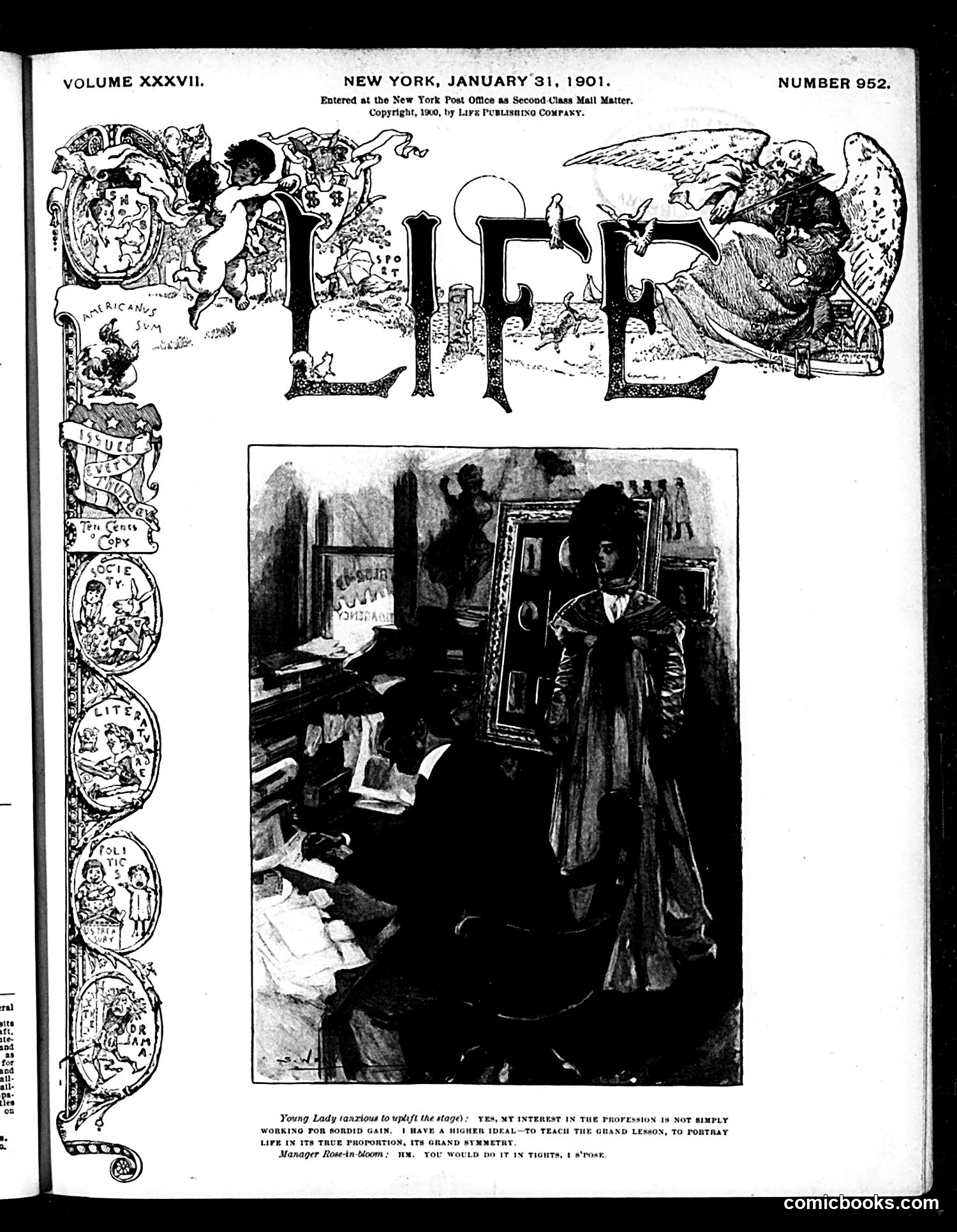
The decorative header "LIFE" features allegorical figures and cherubs typical of turn-of-the-century design. The photograph below shows what appears to be an artist's studio or workspace, with figures examining or discussing artwork. The caption references a conversation about the profession of art, with one speaker asserting that "success in the profession is not simply working for sordid gain" but rather teaching "grand lessons, to fortify life in its true proportion, its grand symmetry." The dialogue suggests a debate about artistic purpose—whether art should prioritize commercial success or moral/educational uplift, a common tension in early 1900s cultural discourse. The studio setting and formal dress indicate this concerns serious artistic practice rather than commercial illustration. The satire's specific target remains unclear from the visible text, though it appears to critique either pretentious artistic philosophy or the gap between artists' ideals and commercial reality.
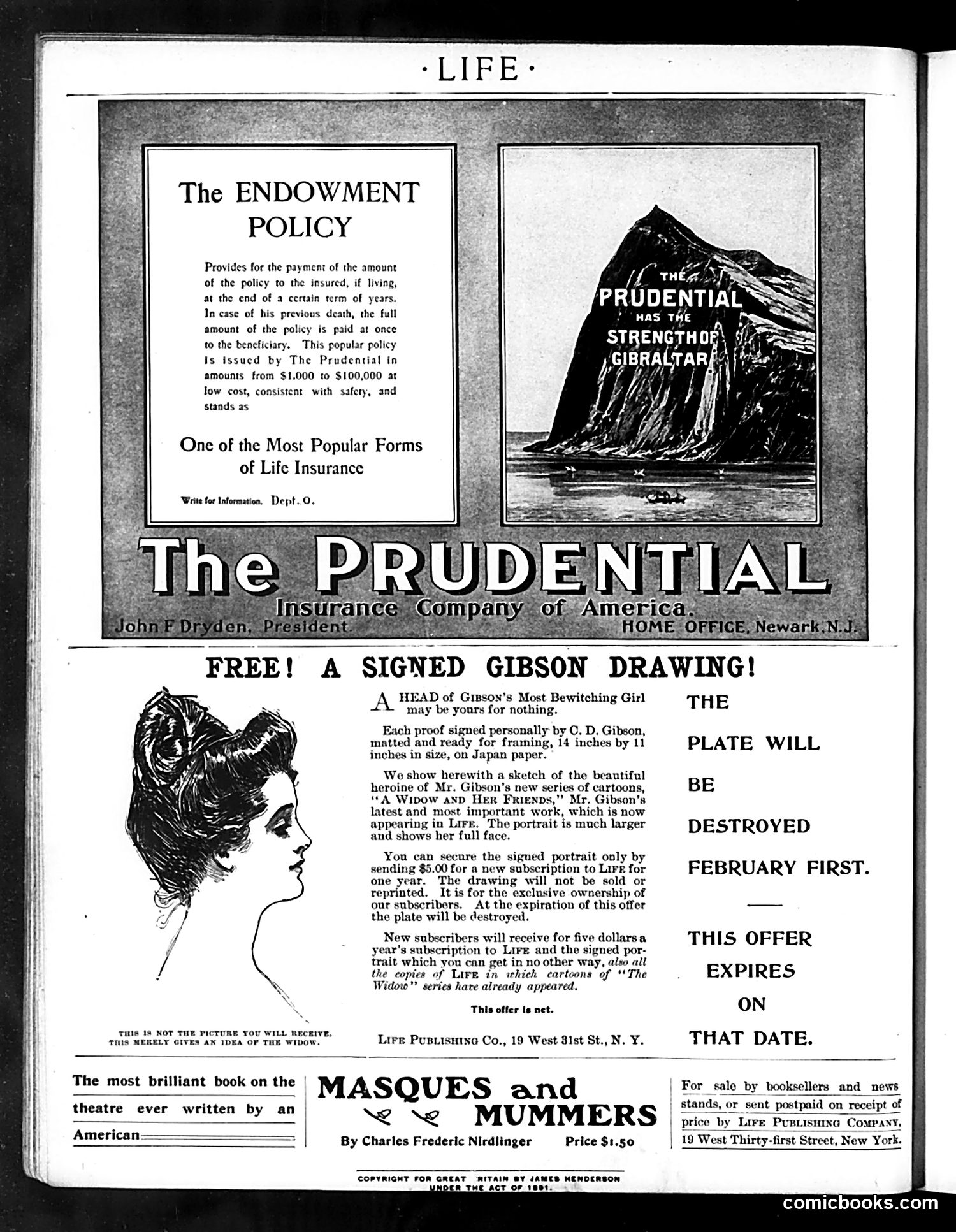
This page is **primarily advertising** rather than satirical content. The top half features two ads: one for The Prudential Insurance Company's "Endowment Policy" and another promoting a free signed Gibson Drawing offer from Life Publishing Company. The Gibson Drawing ad features a profile sketch of a young woman's face in the classical "Gibson Girl" style—the idealized feminine beauty standard popularized by illustrator Charles Dana Gibson in the early 1900s. The offer promises subscribers a signed original drawing for $5, with a deadline of February 1st. The bottom advertises "Masques and Mummers," described as "the most brilliant book on the theatre ever written by an American," by Charles Frederic Nirdlinger, priced at $1.50. No political satire is evident on this page.
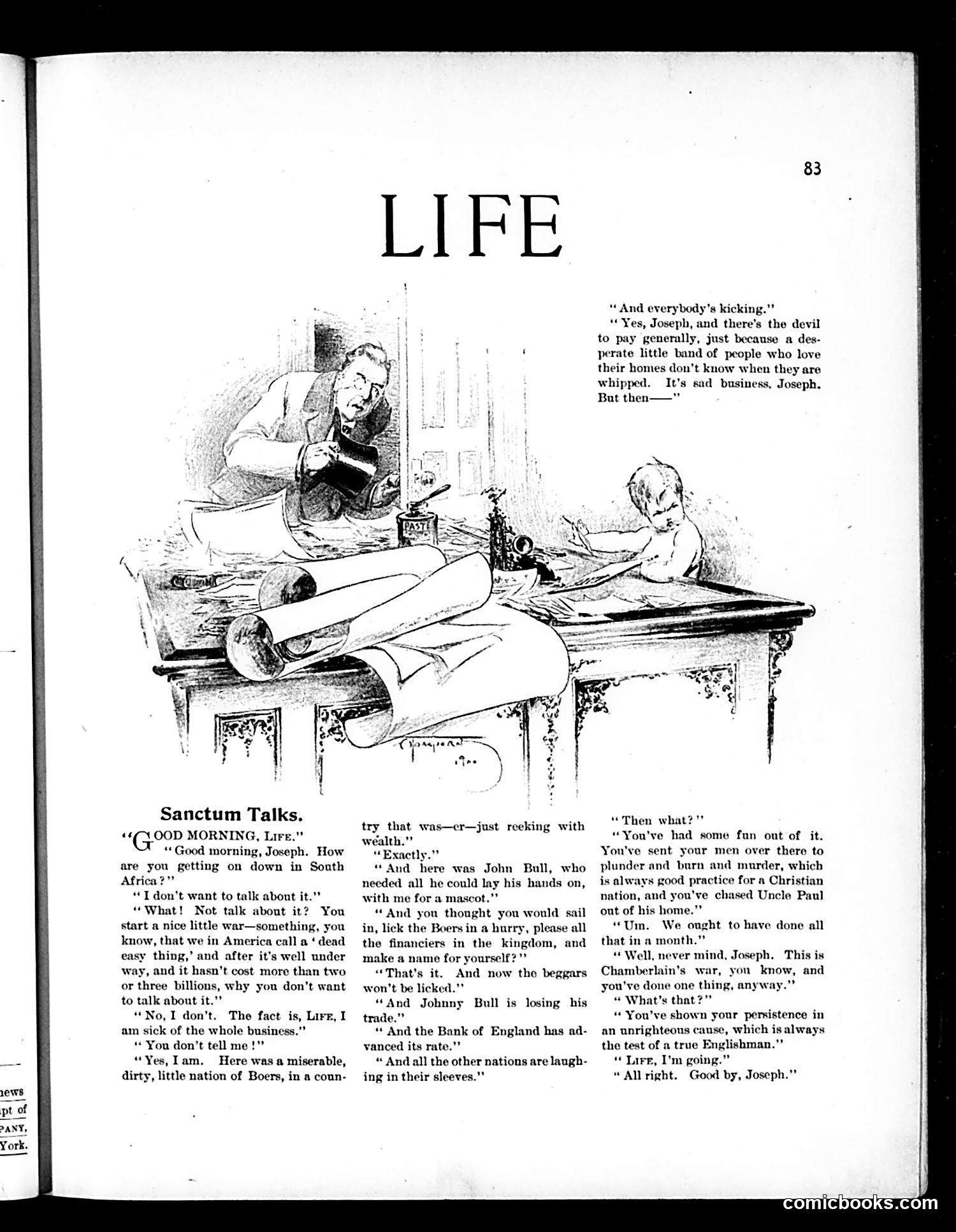
This page contains a satirical dialogue titled "Sanctum Talks" between two figures: an older man (likely an editor or authority figure) and "Joseph," discussing the Boer War and British imperial policy. The cartoon ridicules British justifications for the conflict in South Africa. Joseph defends the war as necessary, claiming Britain must act decisively. The editor counters that this "unrighteous cause" damages Britain's moral standing, particularly among other nations who mock British conduct. The illustration shows the figures at a desk with papers and documents, emphasizing the bureaucratic nature of their discussion. The satire criticizes how governments rationalize military interventions while undermining their own stated principles—a timeless political critique that resonated with American readers skeptical of British imperialism around 1900.
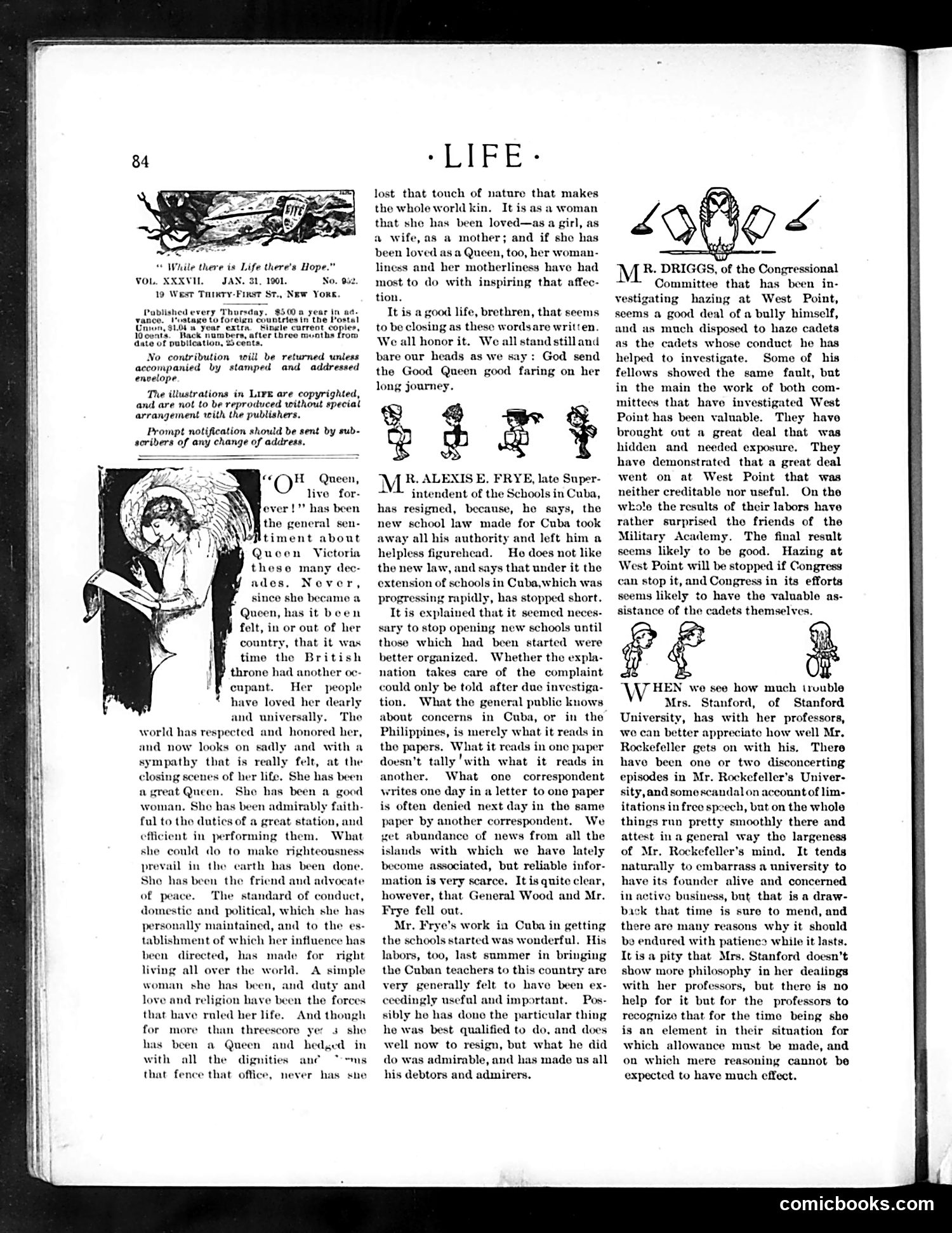
This page contains two main articles with accompanying illustrations discussing early 1900s institutional controversies. The left article, titled "Oh Queen, Live Forever!" criticizes the resignation of **Mr. Alexis E. Frye**, Superintendent of Schools in Cuba. The piece defends Frye's work establishing Cuban schools, noting he faced opposition from those who felt the new school law removed his authority too quickly. The article portrays his resignation as a loss for Cuban education. The right article discusses trouble at **Stanford University** involving Mrs. Stanford and Professor Rockefeller. It addresses scandals or controversies affecting the university's reputation and suggests that allowances must be made for the difficulties such situations create for institutions. Both articles critique institutional mismanagement and defend reform-minded administrators facing opposition.
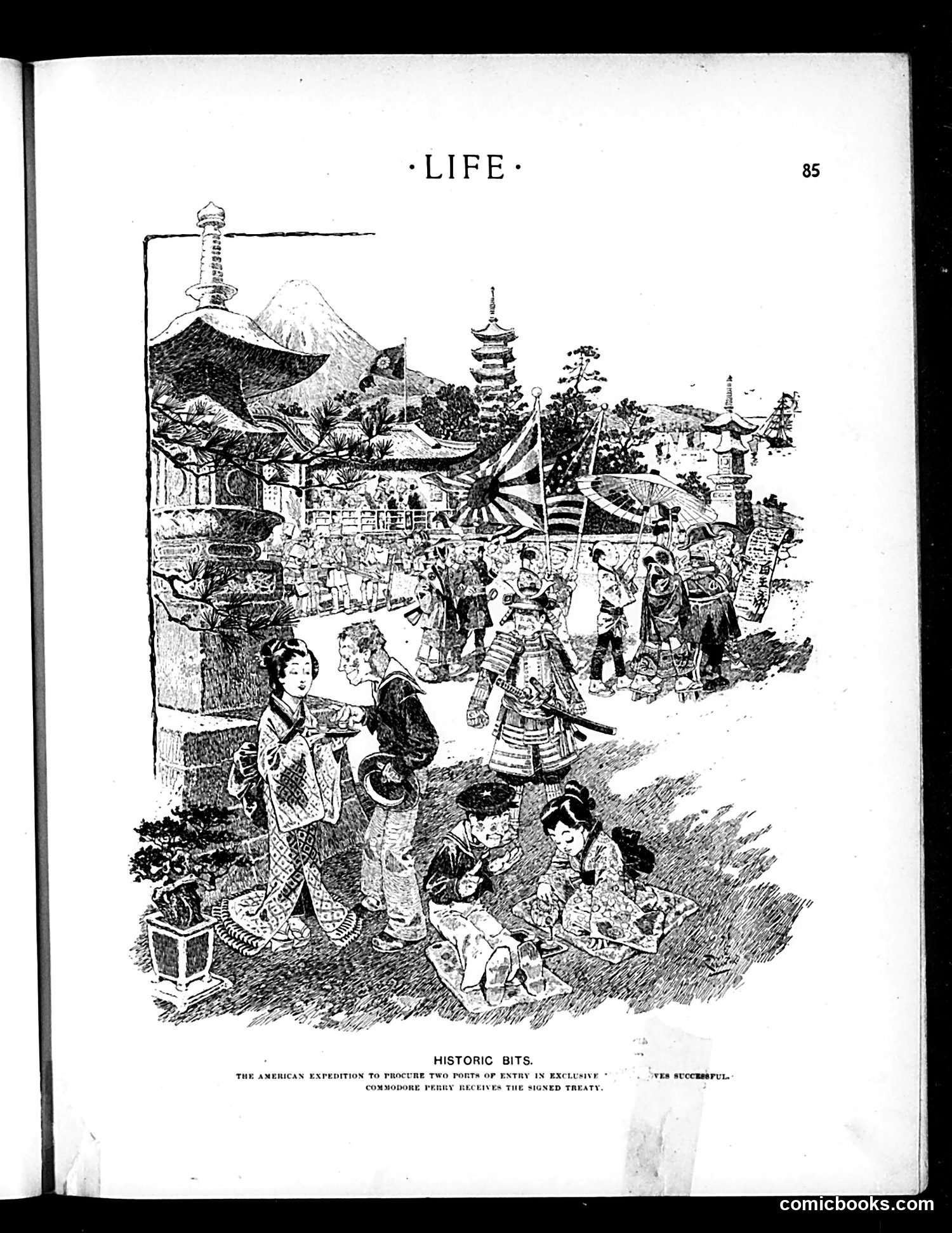
This satirical illustration depicts "The American Expedition to Procure Two Ports of Entry in Exclusive Territories" where "Commodore Perry Receives the Signed Treaty." The cartoon references Commodore Matthew Perry's 1853-1854 expedition to Japan, which forcibly opened Japanese ports to American trade through military intimidation. The image satirizes this as cultural imperialism: American naval vessels and officials impose themselves upon Japan's landscape, complete with flags, weapons, and military personnel crowding the scene. The foreground shows Japanese figures—including what appears to be geishas and civilians—dwarfed by the American military presence. The background displays traditional Japanese architecture (pagodas, temples) being overwhelmed by Western intrusion. The satire critiques American expansionism and the treaty's coercive nature, presenting it as an unwelcome invasion rather than mutual diplomacy.
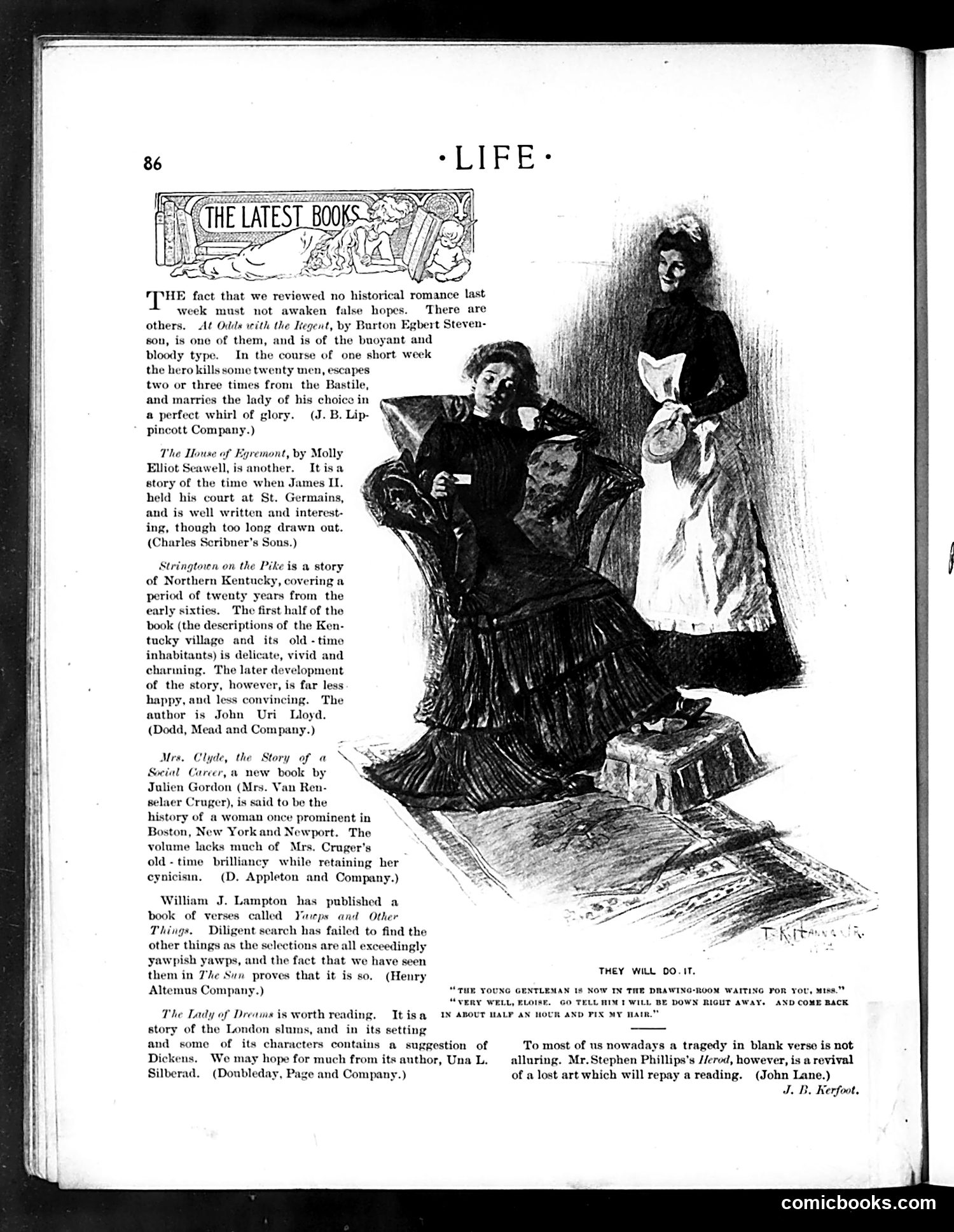
This page reviews contemporary books rather than presenting political satire. The main illustration, captioned "They Will Do It," depicts a domestic scene: a young woman in a drawing room while two other figures (likely her suitor and a chaperone) converse. The caption references the young gentleman waiting and mentions fixing hair—suggesting a humorous commentary on courtship rituals and social propriety of the era. The reviews discuss historical romances and literary works, including titles like "At Odds with the World" and "Stringtown on the Pike." The tone is lighthearted literary criticism typical of Life's cultural commentary, focusing on contemporary fiction rather than political messaging or social satire.
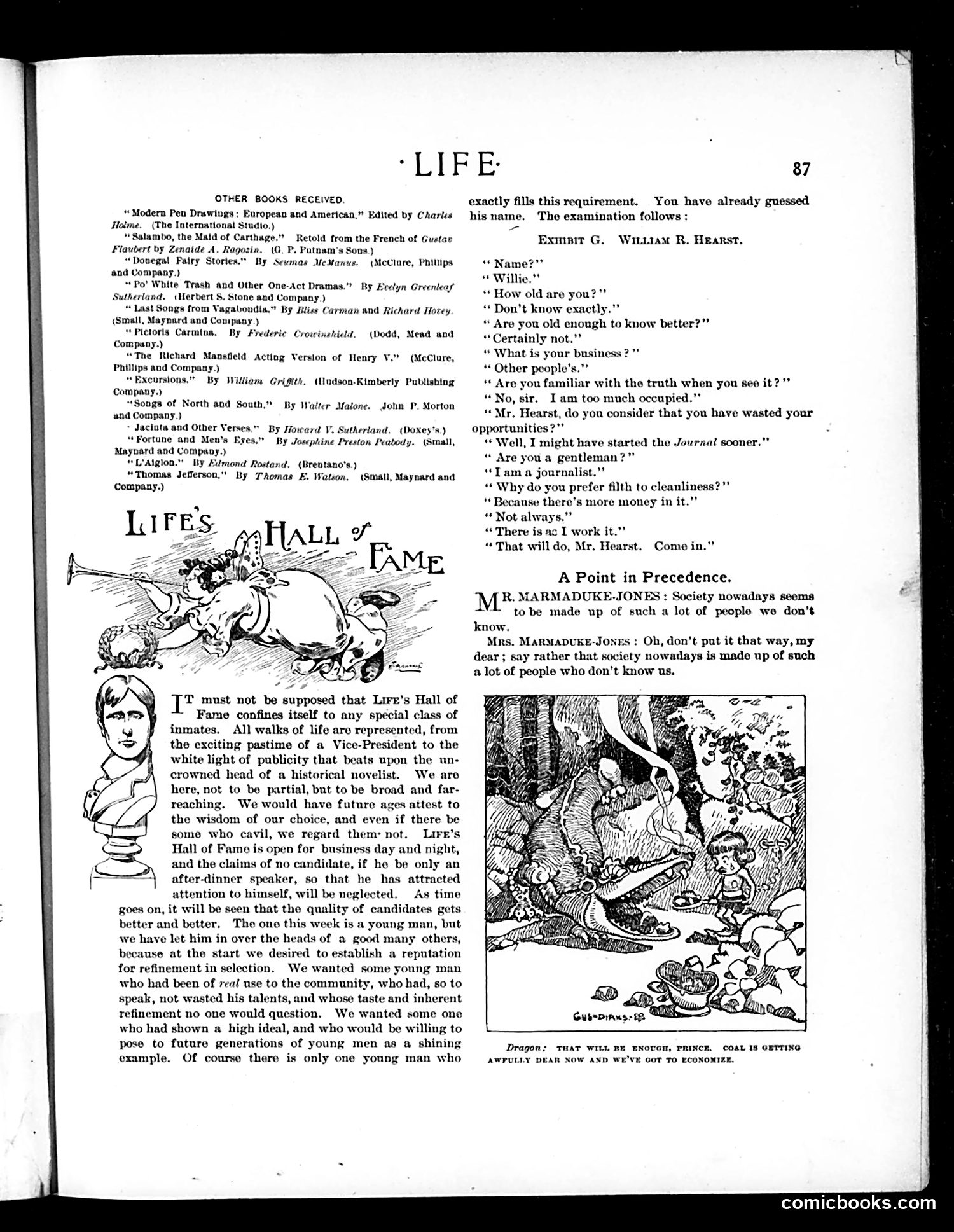
This page introduces a satirical feature celebrating worthy individuals. The masthead illustration shows classical figures in a playful, crowded composition—typical of Life's irreverent style. The text explains the "Hall of Fame" isn't exclusive but broadly inclusive, honoring people across all walks of life from presidents to historical figures. Life's editors note they're selecting a young man as their inaugural honoree—someone of integrity and talent who can serve as a "shining example" to future generations. They explicitly sought someone previously unknown to the public, establishing a reputation from scratch rather than celebrating existing fame. The right panel contains a dialogue ("A Point in Precedence") and an illustration, though the specific figures and social commentary they reference are unclear from this image alone.
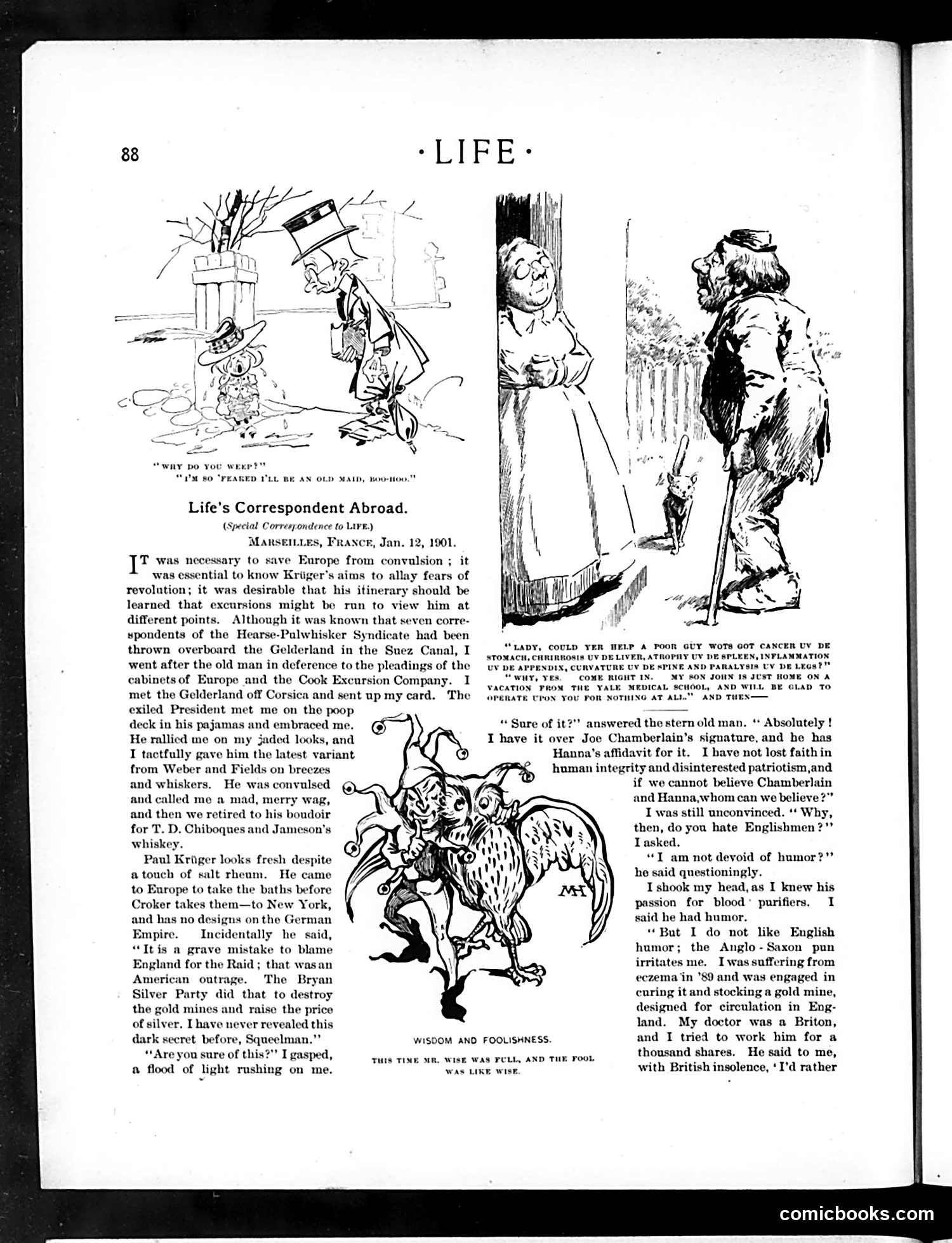
This is a satirical piece dated January 12, 1901, from Marseilles, France. The main cartoon depicts European political instability, illustrated by a demonic figure labeled "Wisdom and Foolishness" surrounded by chaos—representing revolutionary upheaval and political turmoil threatening Europe. The accompanying text describes a correspondent's travels through European political/diplomatic circles, mentioning specific figures and incidents (including references to the Dreyfus Affair context and colonial conflicts). The satirical angle critiques both European political dysfunction and English attitudes toward continental problems. The right-side sketch shows figures in conversation, likely satirizing diplomatic encounters or political discussions of the period. Overall, the page uses humor to comment on European instability and Anglo-European relations circa 1900-1901.
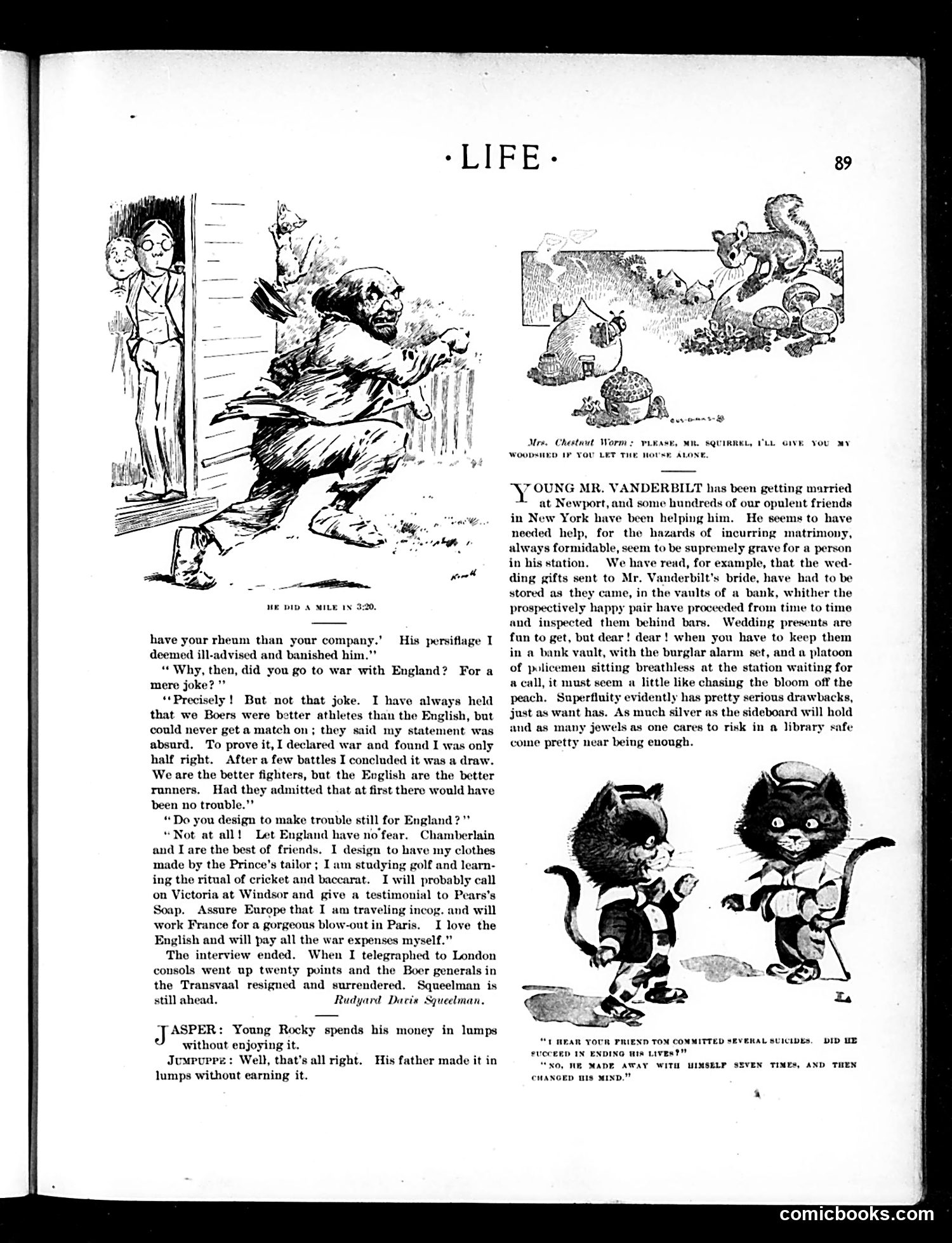
This page contains three distinct cartoons from *Life* magazine: 1. **"He Did a Mile in 3:20"** (left): Shows a disheveled man being ejected from a doorway, satirizing speed or haste. 2. **Main article/cartoon** (center-right): Discusses young Mr. Vanderbilt's upcoming marriage at Newport. The satire mocks wealthy wedding customs—specifically the absurdity of storing expensive gifts in bank vaults with burglar alarms rather than displaying them, and how superfluity becomes a practical burden ("just as want has"). 3. **Cat cartoon** (bottom-right): Two anthropomorphic cats with a caption about "Rocky" squandering money without earning it, contrasting with his father who earned his wealth without spending it. This is social commentary on inherited versus self-made wealth. The page satirizes Gilded Age excess and upper-class contradictions.
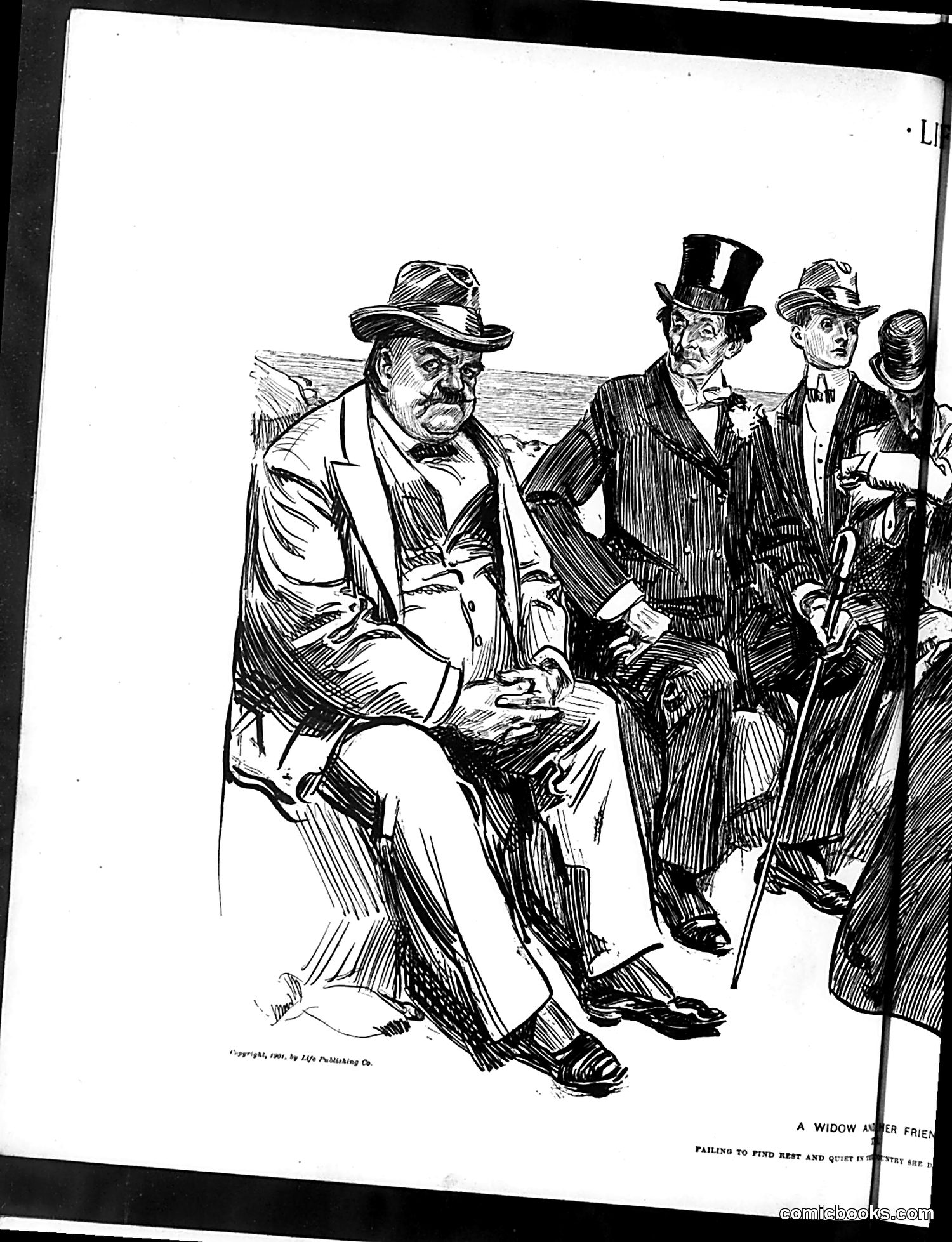
This Life magazine cartoon satirizes a wealthy widow seeking financial advice. The central figure—a stout, prosperous-looking man seated prominently—appears to be a financial advisor or banker consulted by the widow (visible at right with her companions). The partially visible caption reads "...failing to find rest and quiet in any try she h[as]..." suggesting the widow is restlessly seeking solutions, possibly to manage her late husband's estate or investments. The satirical point likely mocks either the widow's anxiety about finances, the self-interested advice-givers surrounding her, or the social expectation that wealthy widows require male guidance for money matters—a common target of Life's social satire during the Gilded Age.
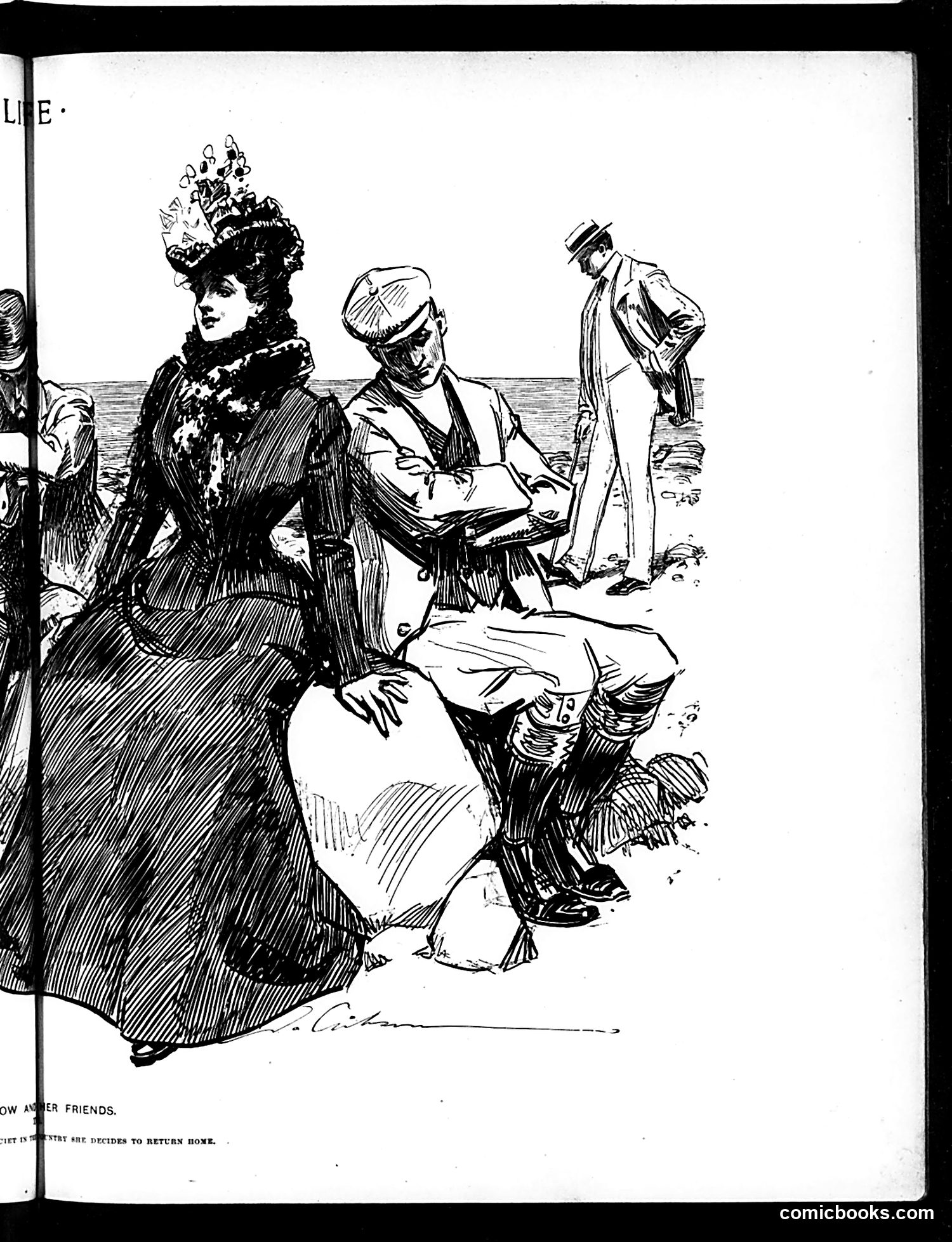
This appears to be a satirical illustration from *Life* magazine depicting a social scene, likely from the early 1900s based on the artistic style and clothing. The image shows a well-dressed woman with an elaborate feathered hat seated prominently on the left, with a man sketching or taking notes beside her. Two other men in suits observe in the background. The partially visible text references "friends" and someone deciding "to return home." The satire likely mocks either: - Upper-class social pretension and the woman's ostentatious fashion - The practice of society portraiture or social documentation - Romantic or matrimonial scenarios among the wealthy Without clearer text or artist attribution visible, the specific social commentary remains unclear, though it clearly ridicules fashionable society through caricature and observation of human behavior.
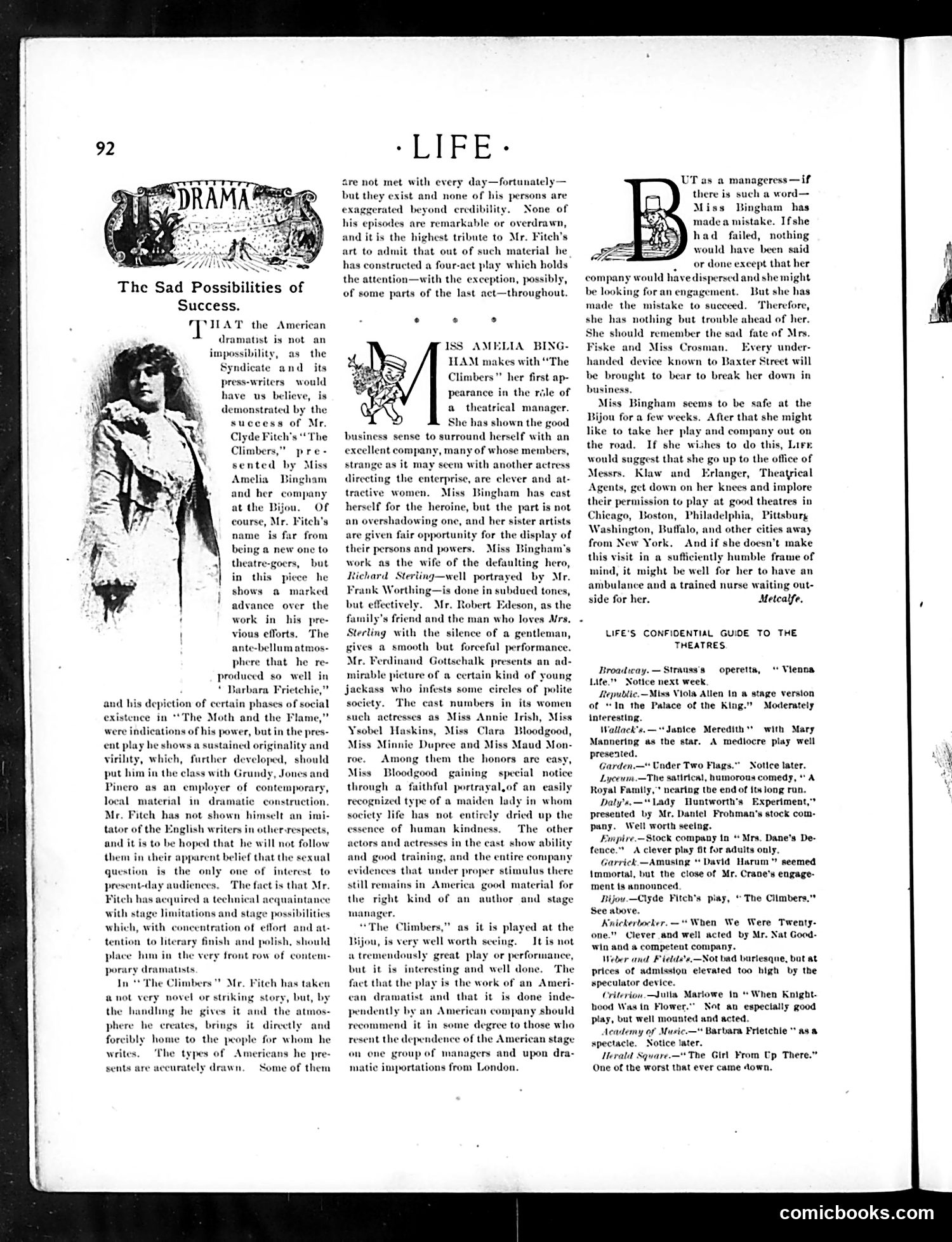
This page features theatrical drama criticism rather than political satire. The main article, "The Sad Possibilities of Success," critiques American dramatist Clyde Fitch's play "The Climbers," starring Amelia Bingham as a theatrical manager. The accompanying illustration shows Amelia Bingham in costume. The text praises the production's craftsmanship while cautioning that Fitch's success might lead him away from serious dramatic work toward commercial entertainment. The critic notes Bingham's "good business sense" in surrounding herself with excellent supporting actresses and actors. The article includes a section titled "Life's Confidential Guide to the Theatres" recommending various current productions. This is primarily theater criticism content, not political commentary.
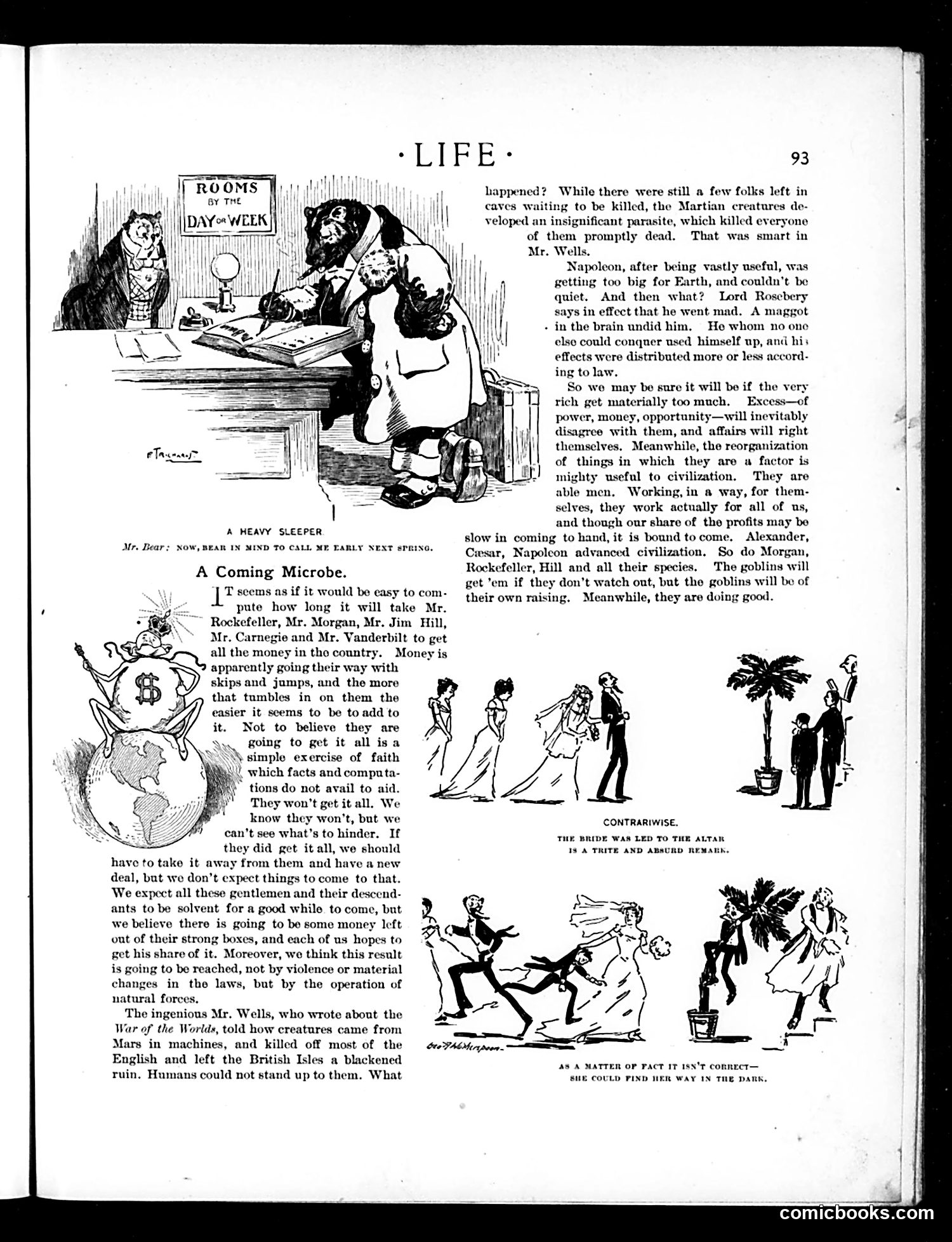
This editorial cartoon mocks wealthy industrialists of the Gilded Age—Rockefeller, Morgan, Carnegie, Vanderbilt, and Hill—who were rapidly consolidating America's wealth. The author argues these magnates won't ultimately monopolize all money because natural forces will limit excess power. The satire invokes H.G. Wells' *War of the Worlds*: just as Martian invaders were defeated by an insignificant parasite, the author suggests wealthy elites will self-destruct through their own excess—becoming "too big" and unstable like Napoleon (whom the text claims "went mad"). The implication is darkly humorous: rather than violent revolution or legal reform removing their wealth, their own greed and corruption will create the conditions for their downfall. The "coming microbe" is metaphorical—an inevitable, self-generated force of destruction. The cartoons below offer lighter social commentary on marriage and courtship conventions.
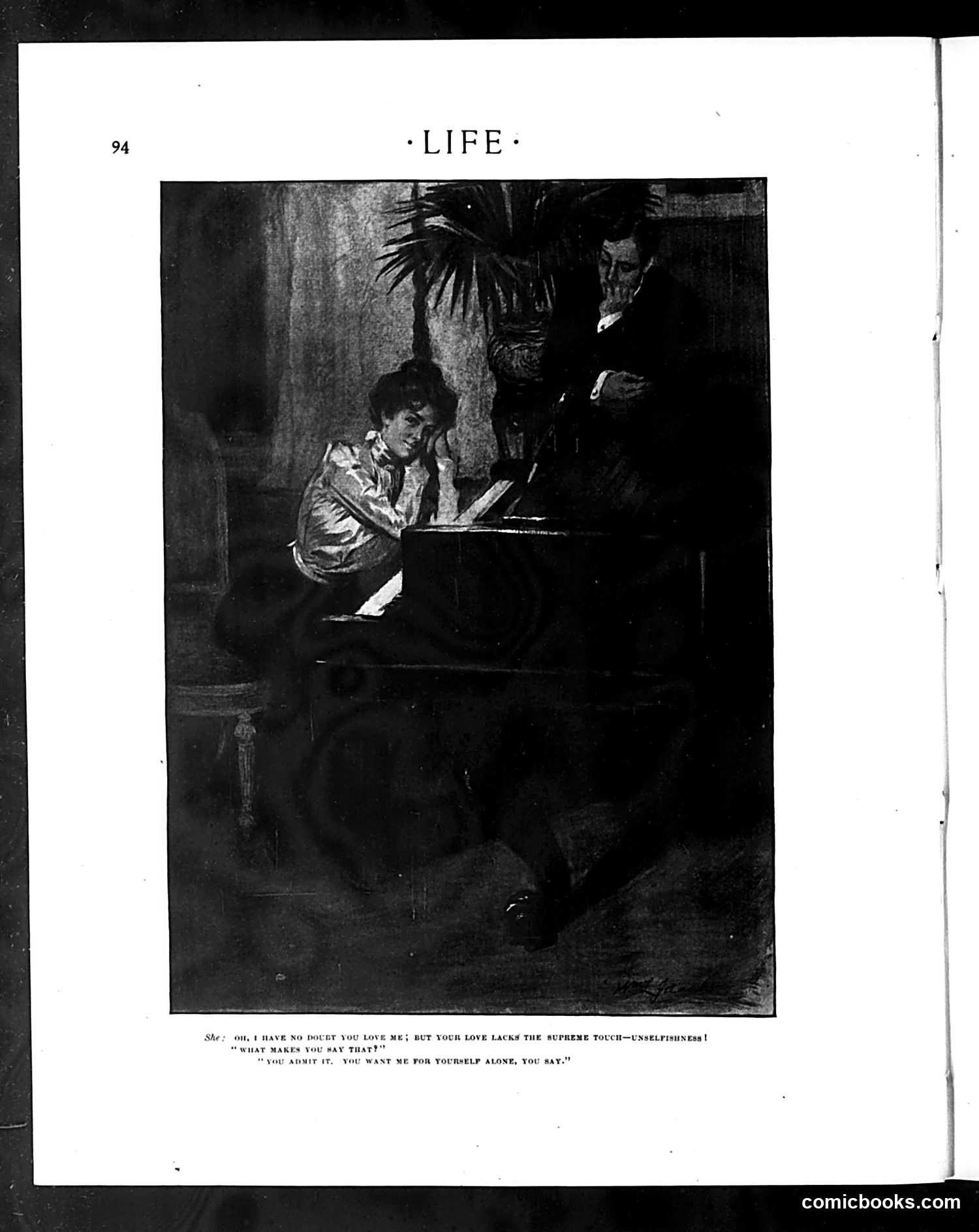
This page depicts a dramatic scene of domestic conflict. A woman sits at a writing desk while a man stands behind her in shadow, appearing confrontational. The dialogue reveals the satirical point: The woman says she has "no doubt you love me; but your love lacks the supreme touch—unselfishness!" The man responds: "What makes you say that?" She answers: "You want me for yourself alone, you say." The satire critiques male selfishness in relationships—the man claims to love his wife yet desires her exclusively for himself, which the woman identifies as fundamentally selfish rather than truly unselfish love. The cartoon mocks the paradox of possessive "love" and likely reflects early-20th-century debates about marriage equality and women's independence.
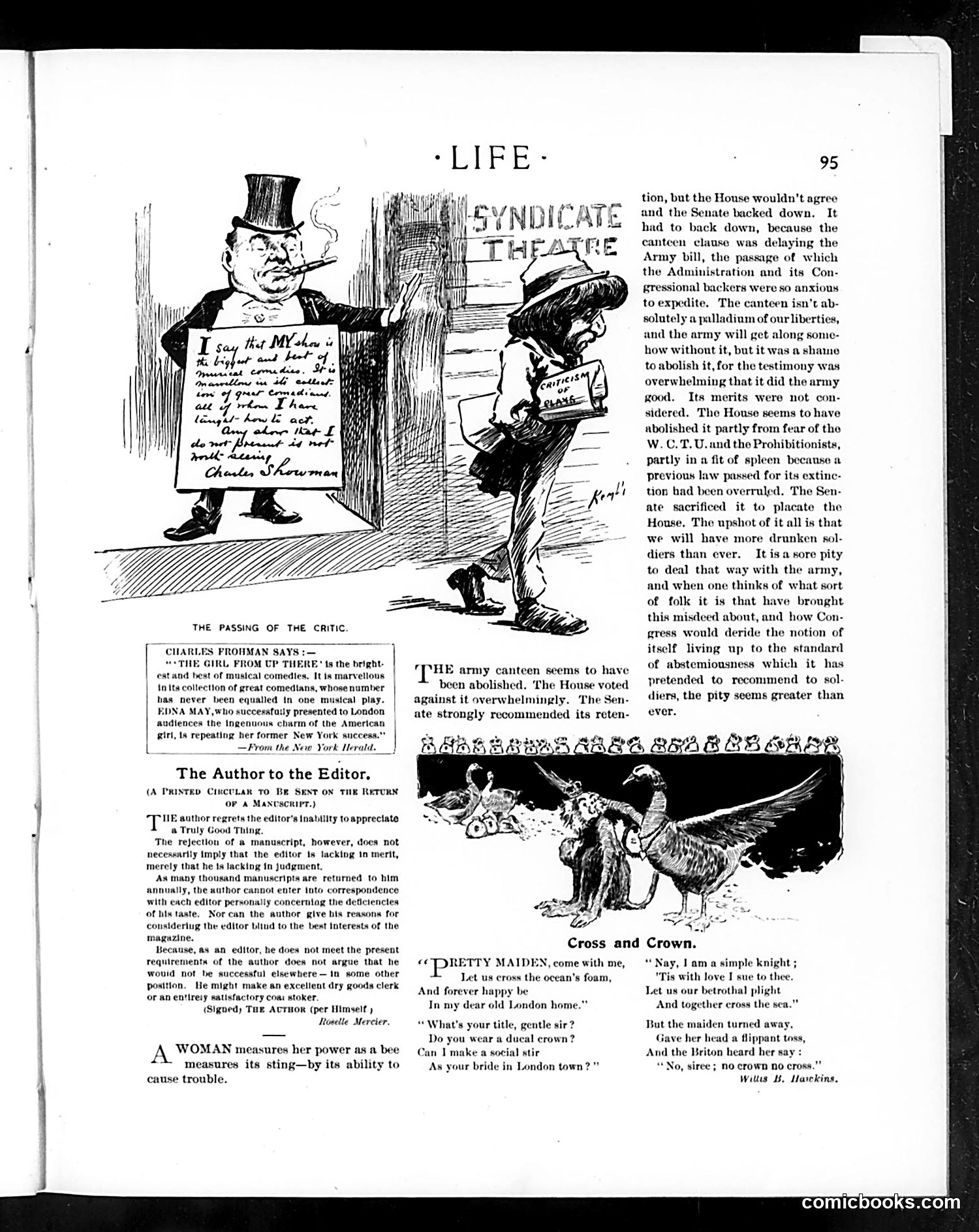
**"The Passing of the Critic"** satirizes theater producer Charles Frohman's excessive praise of the musical "The Girl from Up There." The cartoon shows Frohman holding an inflated testimonial while a female figure (likely representing the actress Edna May or critical taste generally) walks away dismissively. The satire targets Frohman's hyperbolic claims that the play features "great comedians" whose number "has never been equalled." **"The Author to the Editor"** is a humorous form letter mocking rejected writers who blame editors for lacking judgment rather than accepting their work's merit. It sardonically suggests failed authors might better suit other occupations like dry goods clerk. **"Cross and Crown"** is a light poem satirizing American women's materialism: a British knight proposes marriage to an American woman, but she demands he be titled nobility ("a ducal crown"). When he admits he's only a simple knight, she refuses, preferring wealth and status to love. The page reflects early-1900s tensions between American and British culture, artistic pretension, and gender attitudes about marriage and social ambition.
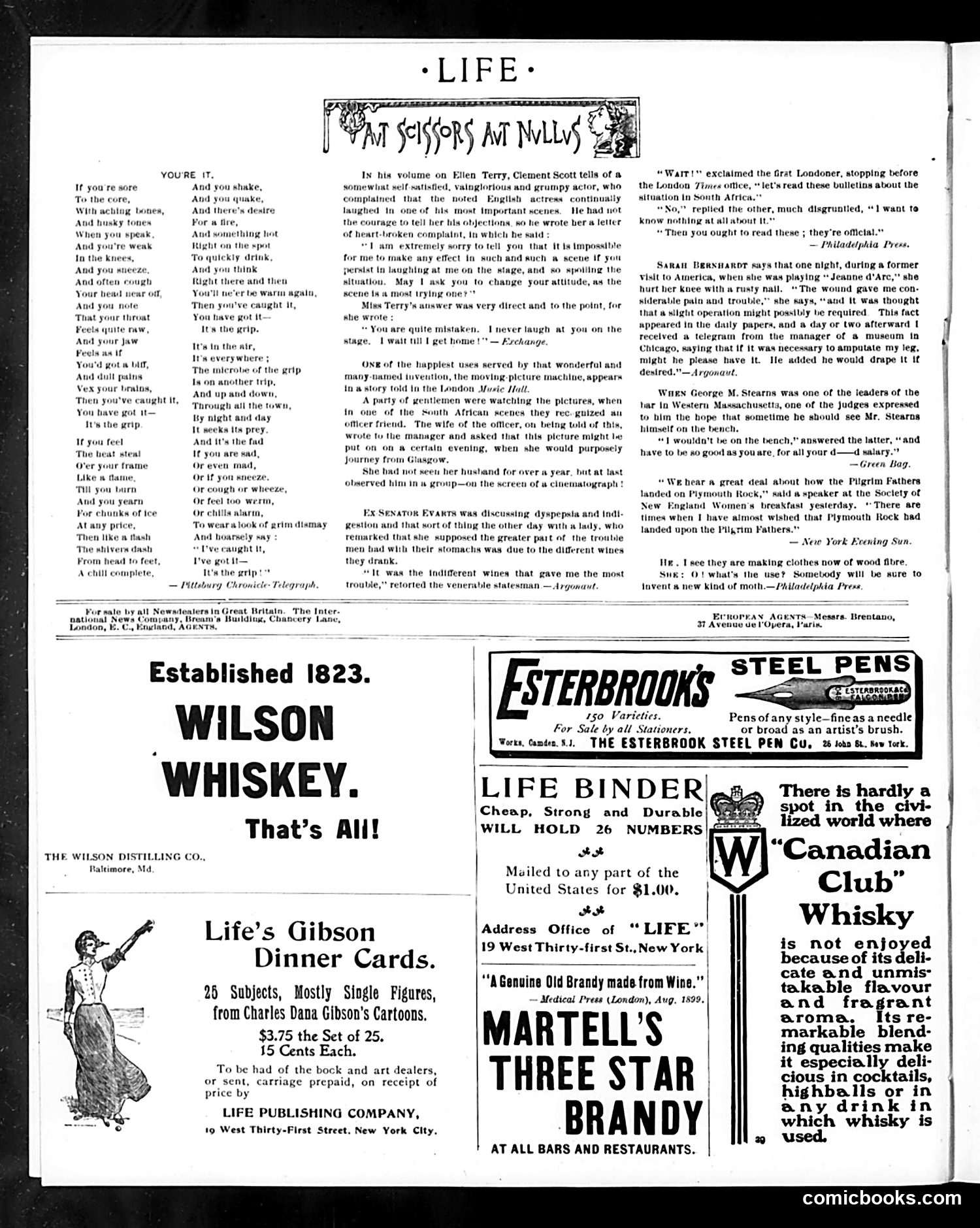
This page from *Life* magazine (a now-defunct American satirical weekly, not the photo magazine) is primarily **advertising and filler content** rather than editorial cartoons. The main content includes: - **"I'm Scissors Ant Nullus"** — a humorous poem about having the flu ("the grip"), using wordplay and visual puns typical of early 20th-century humor. - **Anecdotes about theatrical figures** — brief satirical stories about actress Ellen Terry, Sarah Bernhardt, and others, mocking vanity, hypochondria, and pretension among performers and public figures. - **One joke about the Pilgrim Fathers** — a speaker at a women's breakfast quips that Plymouth Rock should have landed on the Pilgrims, not vice versa, mocking their historical reverence. The **satire targets** include theatrical ego, the fashionable ailment of "indigestion," and American sentimentality about colonial history. The rest of the page consists of period advertisements (Wilson Whiskey, Esterbrook Steel Pens, Martell's Brandy). This reflects *Life*'s role as a humor and satire magazine for educated urban audiences.
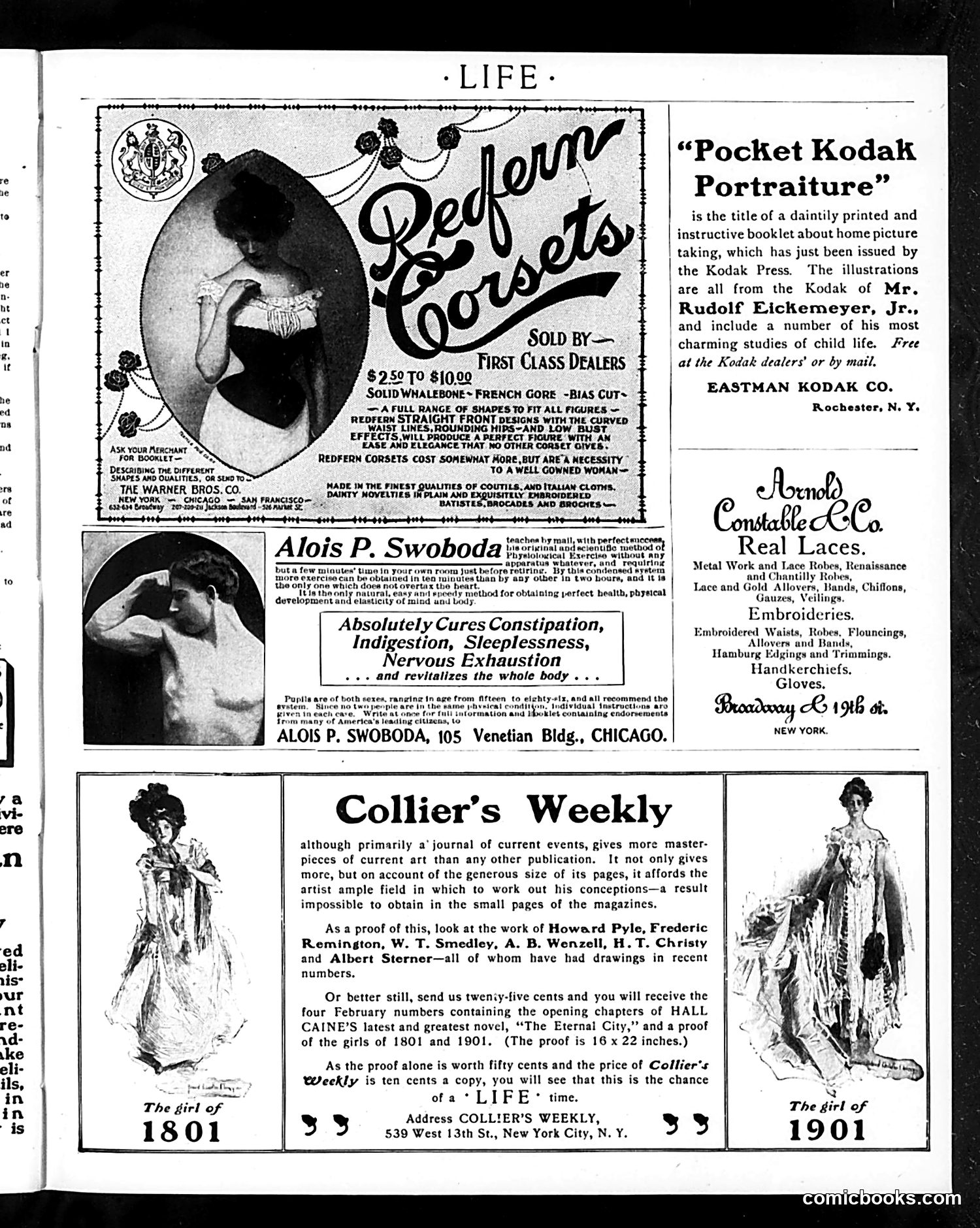
This is primarily an **advertising page** with minimal editorial content. The ads showcase turn-of-the-century consumer goods and services: **Key advertisements:** 1. **Redfern Corsets** - emphasizes achieving an idealized female silhouette through whalebone construction, reflecting rigid Victorian beauty standards 2. **Alois P. Swoboda** - promotes a physical exercise system claiming to cure constipation, indigestion, and nervous exhaustion; represents the era's pseudoscientific health trends 3. **Kodak** - advertises the new "Pocket Kodak," marketing amateur home photography as an accessible hobby 4. **Arnold Constable & Co.** - luxury lace and embroidery goods for the wealthy 5. **Collier's Weekly** - promotes their magazine by emphasizing superior illustration quality and announcing Hall Caine's serial novel "The Eternal City," with comparative illustrations of "the girl of 1801" versus "1901," subtly suggesting modern women's evolving fashions The page reflects early-1900s consumer culture, emerging photography technology, and idealized femininity through both fashion and advertising rhetoric.
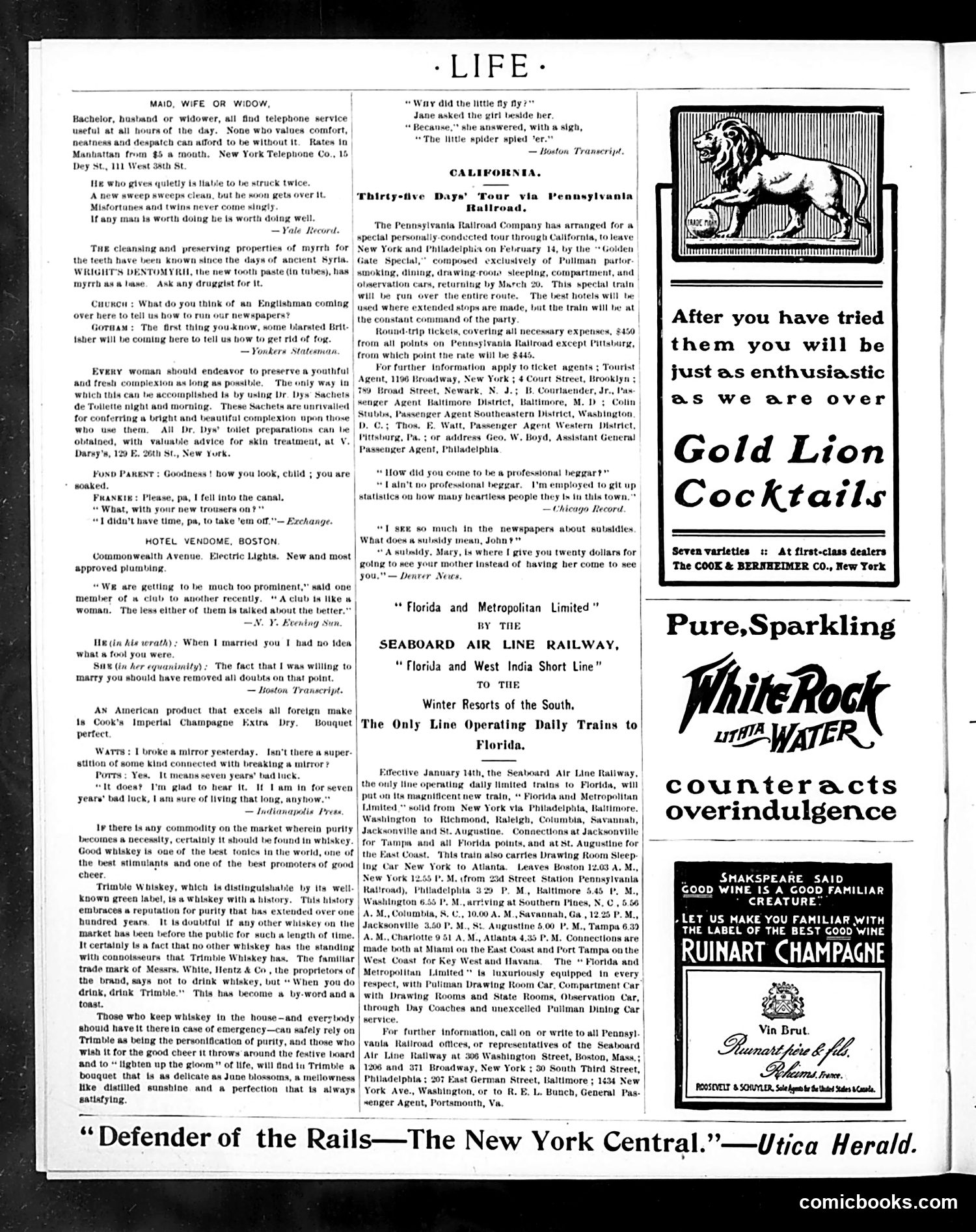
This is primarily an **advertising and humor page** from Life magazine, with no significant political cartoons. The content consists of: **Humorous Quips & Jokes**: Brief, satirical one-liners on gender relations, social behavior, and everyday absurdities—typical of Life's format. Examples include marital squabbles and observations about club gossip. **Period Advertisements**: Multiple full ads for products including telephone service, toothpaste, champagne, whiskey, and railroad travel—reflecting early 20th-century consumer culture. **The Single Visual Element**: A woodcut illustration of a lion, accompanying an ad for "Gold Lion Cocktails." **Notable Content**: An advertisement for the Seaboard Air Line Railway promoting Florida winter tourism and train service. The page reflects Life's identity as a **humor and lifestyle magazine for affluent readers**, blending satirical commentary on middle/upper-class behavior with commercial advertising. There are no identifiable political figures or events being lampooned—just gentle social satire typical of the era.
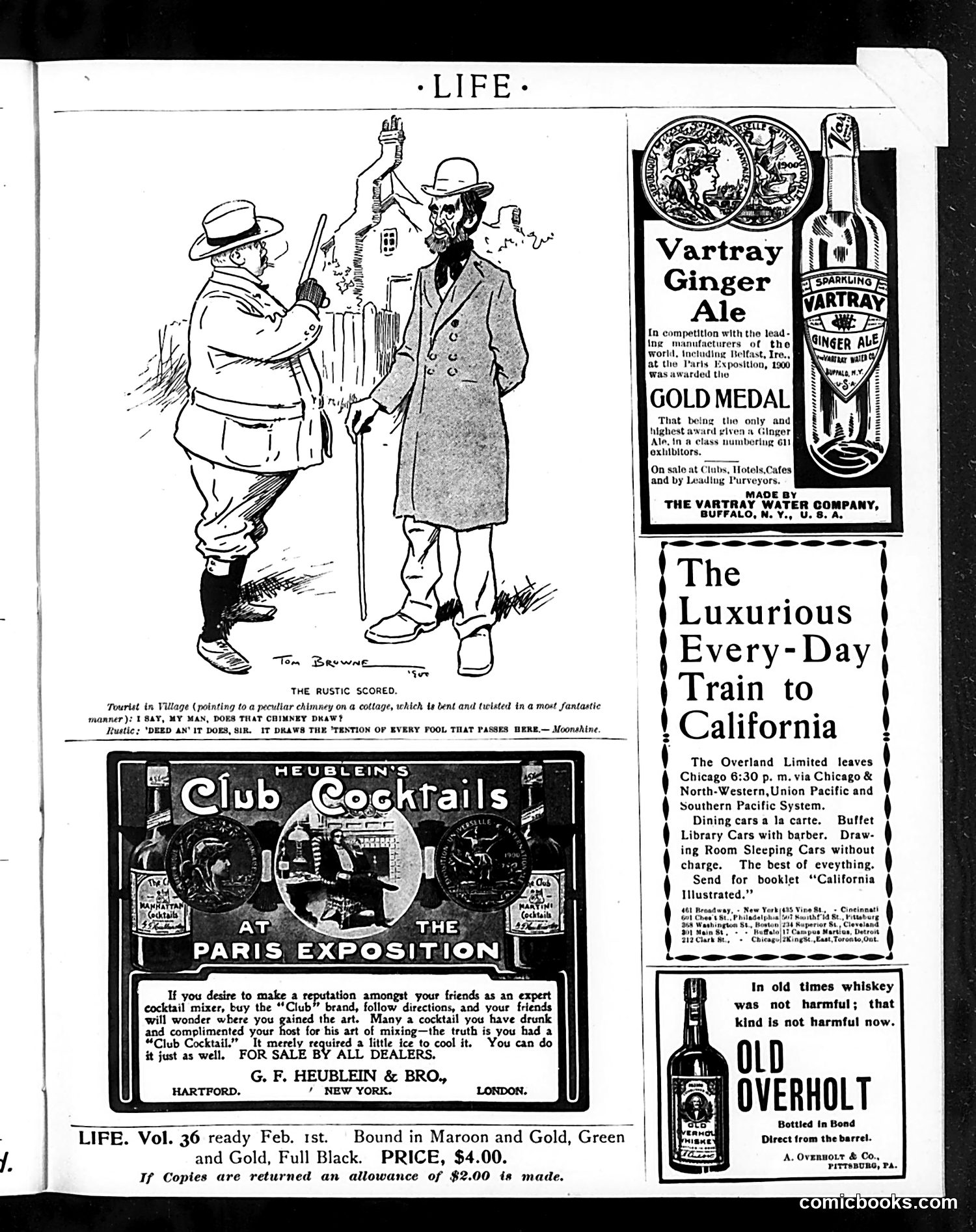
This single-panel cartoon satirizes the gap between appearance and substance. A well-dressed tourist points out a grotesquely twisted chimney on a cottage, asking if it draws properly. The rural resident replies that it certainly does draw—attention from every fool passing by. The joke mocks pretentious or ostentatious design choices that sacrifice function for showiness. The "rustic" character, despite his humble station, delivers the witty comeback that exposes the tourist's naïveté. This reflects a common Life magazine theme: urban sophistication often loses to rural common sense. The bent chimney represents anything impractical made merely to attract notice—a social criticism delivered through a working-class character's sharp observation.
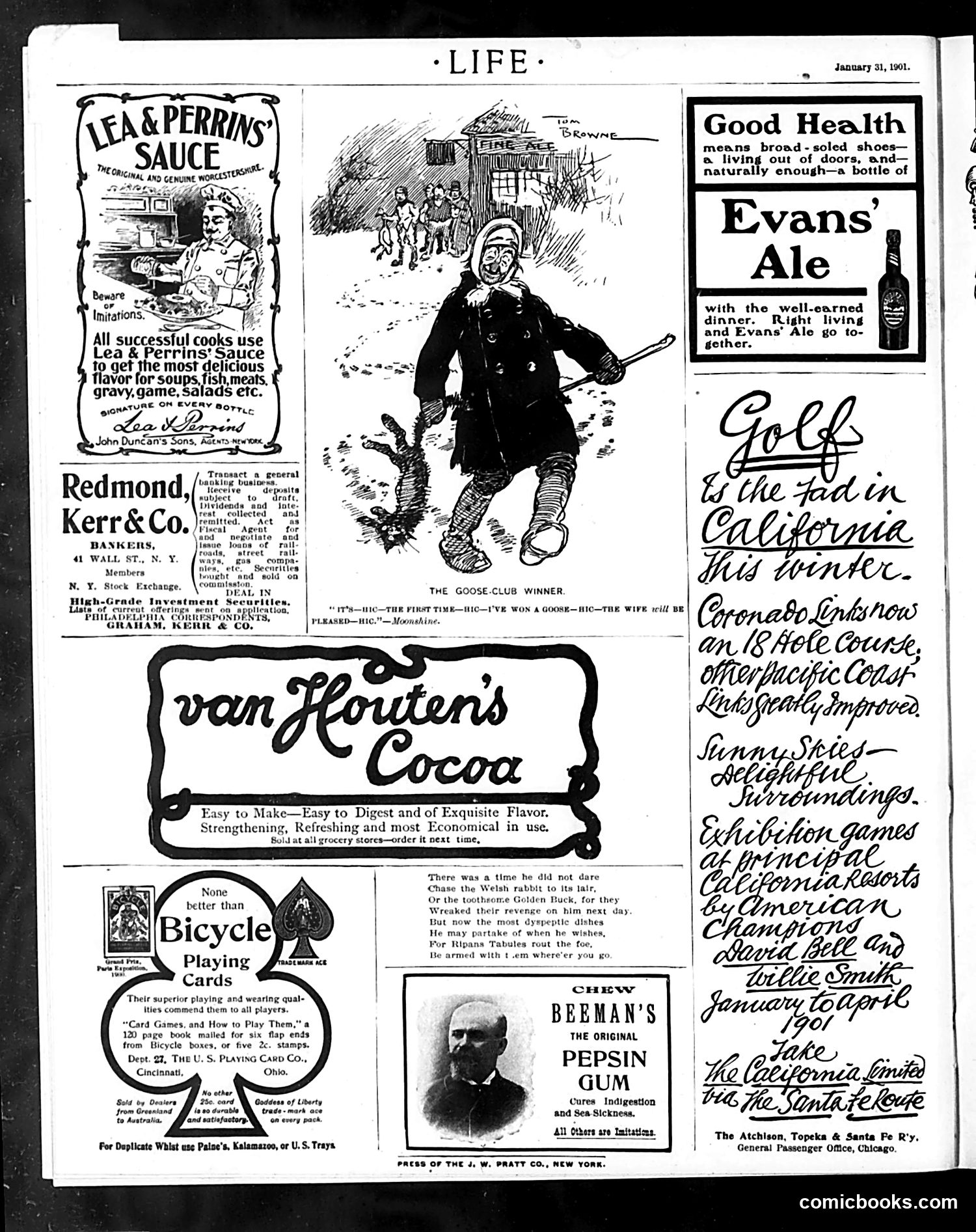
The central cartoon depicts a drunk man staggering home after winning at "the Goose Club" (a gambling establishment), boasting he's won a goose for his wife—though he's clearly intoxicated ("HIC"—hiccupping). The joke plays on marital anxiety: he's worried the wife will be displeased, suggesting domestic tension over his drinking and gambling habits. The page is otherwise dominated by **patent medicine and consumer product advertisements**—Lea & Perrin's Sauce, Evans' Ale, Beeman's Pepsin Gum (claiming to cure indigestion), Ripans Tabules (digestive aid), and Bicycle Playing Cards. These ads reflect the era's unregulated marketing of dubious health remedies and the magazine's revenue model. The accompanying poem about Ripans Tabules humorously promises the product allows eating any indigestible food without consequence—typical of exaggerated early 1900s advertising claims later regulated by food and drug laws.