
Life, 1901-01-31 · page 12 of 20
Life — January 31, 1901 — page 12: what you’re looking at
What you’re looking at
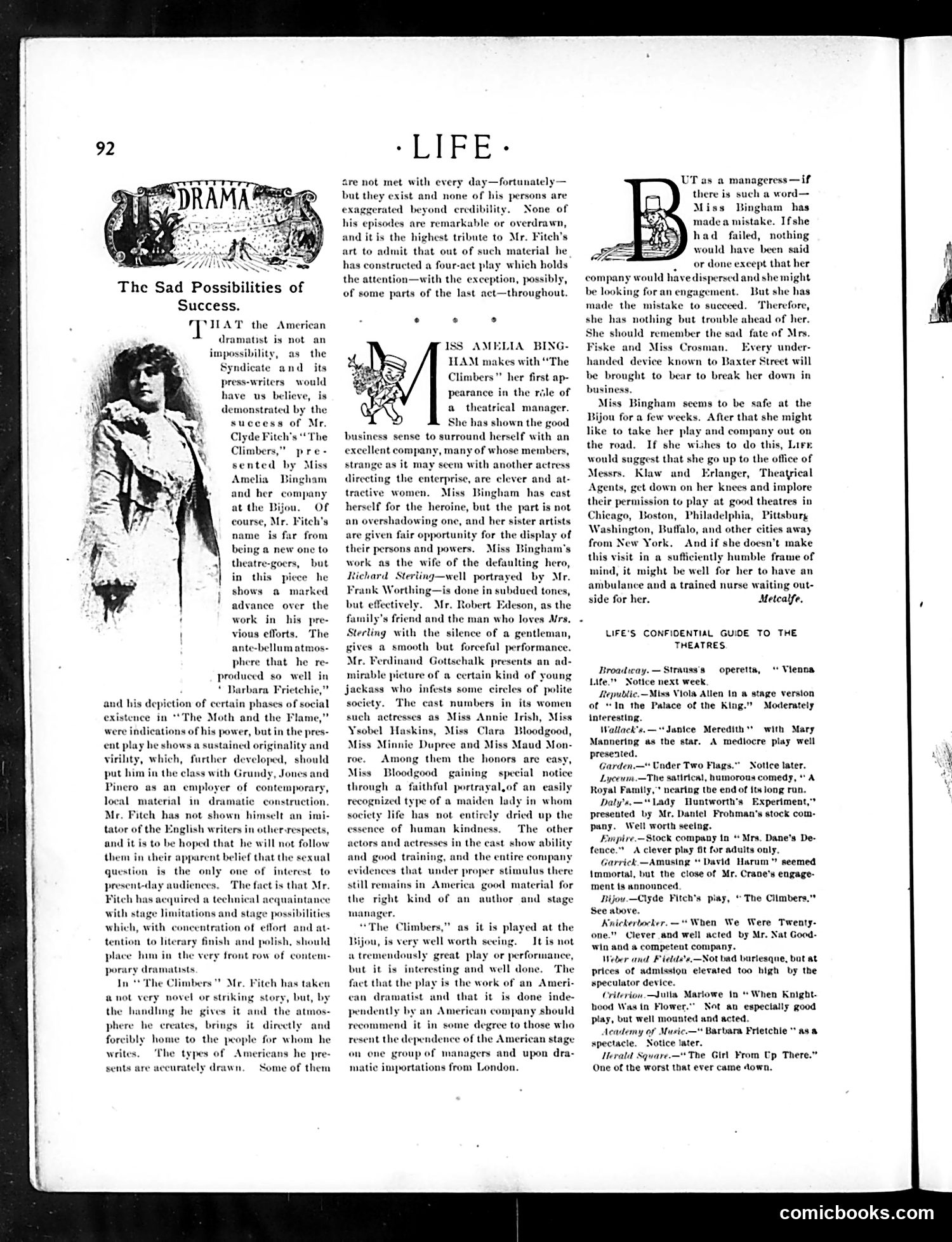
This page features theatrical drama criticism rather than political satire. The main article, "The Sad Possibilities of Success," critiques American dramatist Clyde Fitch's play "The Climbers," starring Amelia Bingham as a theatrical manager. The accompanying illustration shows Amelia Bingham in costume. The text praises the production's craftsmanship while cautioning that Fitch's success might lead him away from serious dramatic work toward commercial entertainment. The critic notes Bingham's "good business sense" in surrounding herself with excellent supporting actresses and actors. The article includes a section titled "Life's Confidential Guide to the Theatres" recommending various current productions. This is primarily theater criticism content, not political commentary.
📄 Transcribed text from this page (OCR, searchable)
Machine-transcribed from the original scan — historical spelling and the odd misread are preserved.
The Sad Possibilities of Success. pues the American dramatist is not an impossibility, as the Syndicate and its press-writers would have us believe, is demonstrated by the success of Mr. Clyde Fitch's “The Climbers," pre- sented by Miss Amelia Bingham and her company at the Bijou. Of course, Mr. Fitch's name far from being a new one to but theatre-gocrs, in this shows a advance over the work in his pre- vious efforts. The ante-bellum atmos- phere that he re produced so well in * Barbara Frietchie,” and his depiction of certain phases of social existence in *'The Moth and the Flame,” were indications of his power, but in the pres- ined originality and which, further developed, should put him in the class with Grundy, Jones and Pinero as an employer of contemporary, local material in dramatic construc Mr. Fitch has not shown himselt an im tator of the English writers in othersrespects, and it is to be hoped that he will not follow them in their apparent belief that the sexual question is the only one of present-day aud: interest’ to neces. The fact is that Mr. ch has acquired a technic with sta quaintance possibilities which, with concentration of effort and at- tention to literary finish and polish, should place him in the very front row of contem- porary dramatists In he Climbers" Mr. Fitch has taken A not very novel or striking story, but, by the handling he gives it and the phere he creates, brings it directly and forcibly home to the people for whom he writes. ‘The types of Americans he pre- sents are aecurately drawn, Some of them atmos- ‘LIFE * are not met with every day—fortunately— but they exist and none of his persons are exaggerated beyond credibility. None of his episodes are remarkable or overdrawn, and itis the highest tribute to Mr. Fitch's art to admit that out of such material he has constructed a four-act play which holds the attention—with the exception, possibly, of some parts of the last act—throughout. ° ISS AMELIA BING- HAM makes with “The Climbers” her first ap- arance in the rile of a theatrical manager. She has shown the good business sense to surround herself with an excellent company, many of whose members, strange as it may seem with dirceting the enterpris tractive women. other actress are rand at- Miss Bingham has cast herself for the heroine, but the part is not an overshadowing one, and her sister artists are given fair opportunity for the display of their persons and powers. Miss Bingham’s work as the wife of the defaulting hero, Richard Sterling—well portrayed by Mr. Frank Worthing—is done in subdued tones, but effectively. Mr. Robert Edeson, as the family’s friend and the man who loves Mrs. Sterling with the silence of a gentleman, gives a smooth but forceful performance. Mr. Ferdinand Gottschalk presents an ad- mirable picture of a certain kind of young jackass who infests some circles of polite society. The cast numbers in its women such actresses as Miss Annie Irish, Miss Ysobel Haskins, Miss Clara Bloodgood, Miss Minnie Dupree and Miss Maud Mon- roe. Among them the honors are easy, Miss Bloodgood gaining special notice through a faithful portrayal,of an easily recognized type of a maiden lady in whom socicty life has not entirely dried up the essence of human kindness. The other actors and actresses in the cast show ability and good training, and the entire company evidences that under proper stimulus there still remains in America good material for the right kind of an author and stage : Climbers,” as it is played at the Lijou, is very well worth seeing. It is not a tremendously great play or performance, but it is interesting and well done. The fact that the play is the work of an Ameri- » dramatist and that it is done inde- pendently by an American company should recommend it in some degree to those who resent the dependence of the American stage on one group of managers and upon dra- matic importations from London. UT as a manageress—if there is such a word— Miss Bingham has madea mistake. Ifshe had failed, nothing would have been said . or done except that her vould have dispersed and she might be looking for an eng: But she has made the wi to succeed. ‘Therefore, she has nothing but trouble ahead of he She should remember the sad fate of M Fiske and Miss Crosman. E handed device known to Baxter Street will be brought to bear to break her down in business. Miss Bingham seems to be safe at the Bijou for a few weeks. After that she might like to take her play and company out on the road. If she wishes to do this, Lirx would suggest that she go up to the office of Messrs. Klaw and Erlanger, Theatrical Agents, get down on her knees and implore their permission to play at good theatres in Chicago, Boston, Philadelphia, Pitts Washington, Buffalo, and other from New York, And if she doesn’t make this visit in a sufficiently humble frame of mind, ht be well for her to have an ambulance and a trained nurse waiting out- side for her. Metcalfe, ment. LIFE’S CONFIDENTIAL GUIDE TO THE THEATRES, Broadway. — Strauss’ Life.” Notice next week Republic. —Mixs Viola Allen tn @ stage version of “In the Patace of the King.” Moderately interesting. Wallack’s.—“ Janice Meredith ** Mannering as the star. presented. Garden der Two Flags.” Notice later. Lyceum.—The satirical, humorous comedy, A Royal Family,” nearing the endof its long run, Daly’s.—" Lady Huntworth’s Experiment,” Presented by Mr, Dantel Frohman’s stock com- pany. Well worth seeing. Empire.—Stock company tn “ Mra. Dane's De- fence.” A clever play fit for adults only. Garrick —Amusing “ David Harum" seemed Immortal, but the close of Mr. Crane's engage- ment ts annonnced Bijou.—Clyde Fitch's play, * The Citmber See above. Knickerbocker. = When We Were Twenty- one.” Clever and well acted by Mr. Nat Good- win and a competent company. Weber and Fietds's,—Not bad bariesque, bat at prices of admission elevated too high by the speculator device. Criterion. Julia Martowe tn * When Knight bood Was in Flower.’ Not an especially good play, but well mounted and acted. leatemy of Music.— Barbara Frietchie * asa spectacle. Notice later. Meralit Square.—" The Girl From Up There.” One of the worst that ever came down, operetta, Vienna with Mary A mediocre play well comicbooks.com