
Life, 1901-01-31 · page 15 of 20
Life — January 31, 1901 — page 15: what you’re looking at
What you’re looking at
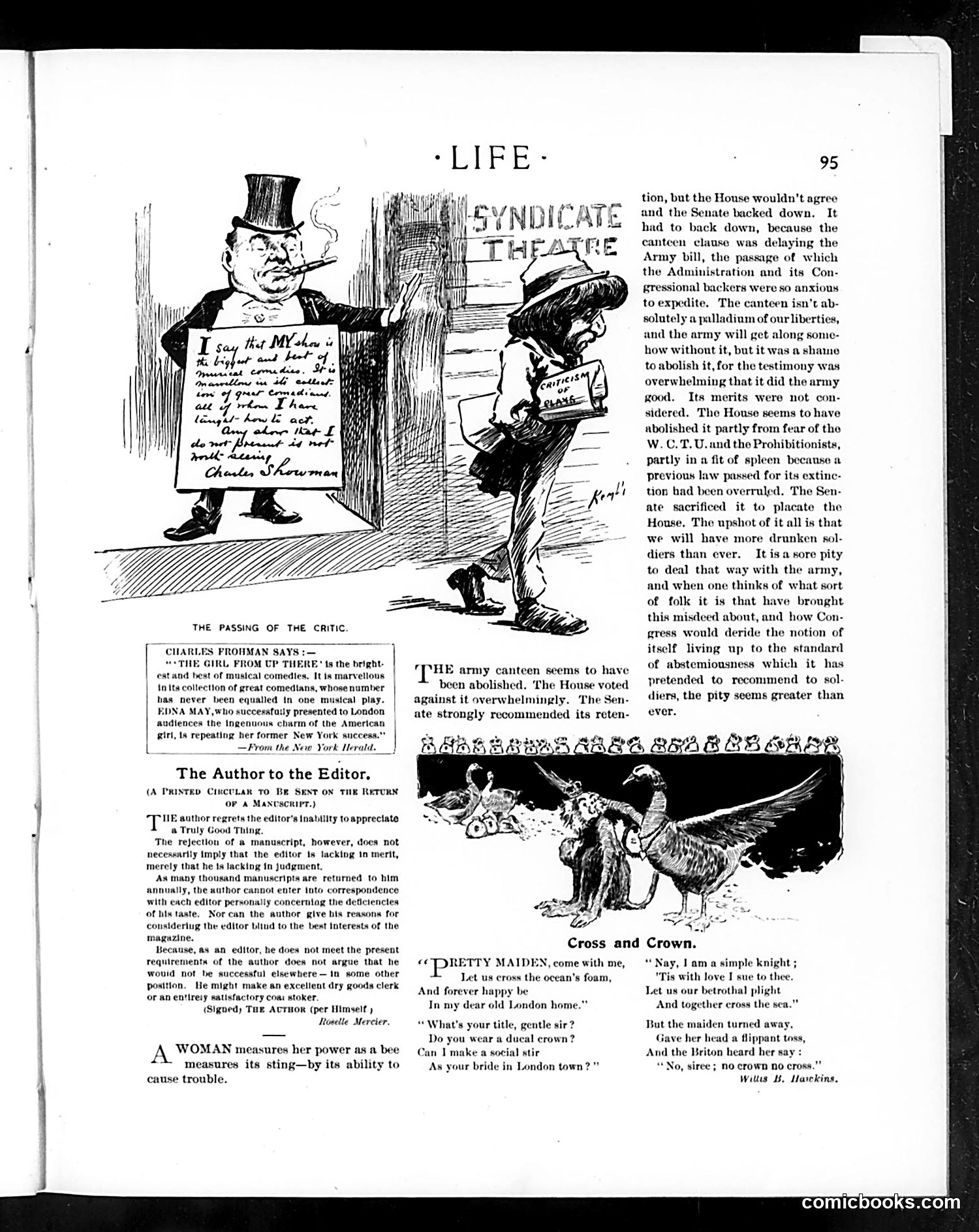
**"The Passing of the Critic"** satirizes theater producer Charles Frohman's excessive praise of the musical "The Girl from Up There." The cartoon shows Frohman holding an inflated testimonial while a female figure (likely representing the actress Edna May or critical taste generally) walks away dismissively. The satire targets Frohman's hyperbolic claims that the play features "great comedians" whose number "has never been equalled." **"The Author to the Editor"** is a humorous form letter mocking rejected writers who blame editors for lacking judgment rather than accepting their work's merit. It sardonically suggests failed authors might better suit other occupations like dry goods clerk. **"Cross and Crown"** is a light poem satirizing American women's materialism: a British knight proposes marriage to an American woman, but she demands he be titled nobility ("a ducal crown"). When he admits he's only a simple knight, she refuses, preferring wealth and status to love. The page reflects early-1900s tensions between American and British culture, artistic pretension, and gender attitudes about marriage and social ambition.
📄 Transcribed text from this page (OCR, searchable)
Machine-transcribed from the original scan — historical spelling and the odd misread are preserved.
Nene THE PASSING OF THE CRITIC. FROHMAN SAYS | THE GIRL FROM UP TH isthe bright: | nd best of musical comedies, It is marvellous: In {ts collection of great comedians, whose number has never been equalled tn one musical play. EDNA MAY, who successtatly presented to London audiences the ingenuous charm of the American girt, is repeating her former New York success.” | _—From the New York Herald. _} The Author to the Editor. (A PRINTED CIUCCLAK TO Be SENT ON THE ReTURN ov A Maxvscrirr.) THE author regrets the editor's inabuity toappreciate a Truly Good Thing. The rejection of a manuscript, however, docs not necessarily tmply that the editor t* lacking tn merit, merely that he 1s lacking in Judgment, As many thousand manuscripts are returned to bim annually, the author cannot enter into correspondence with exch editor personally concerntag the defictencles of his taste. Nor can the author give bis reasons for considering the editor blind to the best Interests of the magazine. Because, as an editor, he does not meet the present requirements of the author does not argue that he would not be successful elsewhere —in some other position, He might make an excellent dry goods clerk Or an entirely satisfactory coai stoker. (Signed) Taz Acruon (per Himself» Roselle Mercier. WOMAN measures her power as a bee measures its sting—by its ability to cause trouble. been abolished. The House voted against it overwhelmingly. The Sen- ate strongly recommended its reten- 95 tion, but the House wouldn't agree and the Senate backed down. It had to back down, because the canteen clause was delaying the Army Dill, the passage of which the Administration and its Con- gressional backers were so anxious to expedite. The canteen isn’t ab- solutely a palladium of our liberties, and the army will get along some- how withont it, but it was a shame to abolish it, for the testimony was overwhelming that it did the army good. Its merits were not con- sidered. The House seems to have abolished it partly from fear of the W. C.T. U. und the Prohibitionists, partly ina fit of spleen because a previous law passed for its extinc- tion had been overruled, The Sen- ate sacrificed it to placate the House. The upshot of it all is that we will have more drunken sol- diers than ever. It is a sore pity to deal that way with the army, and when one thinks of what sort. of folk it is that have brought this misdeed about, and how Con- gress would deride the notion of itself living up to the standard of abstemiousness which it has pretended to recommend to sol- diers, the pity seems greater than ever. Cross and Crown. “oe RETTY MAIDEN, come with me, Let us cross the ocean's foam, And forever happy be In my dear old London home.” “What's your title, gentle sir? Do you wear a ducal crown? Can Fmake a social stir As your bride in London town?” “Nay, 1 ama simple knight ; "Tis with love I sue to thee. Let us our betrothal | And together cross the sea.” But the maiden turned away, Gave her head a flippant toss, And the Briton heard her say : “No, siree ; no crown no cross.”” Wills 8, Harckins.