
Life, 1901-01-31 · page 4 of 20
Life — January 31, 1901 — page 4: what you’re looking at
What you’re looking at
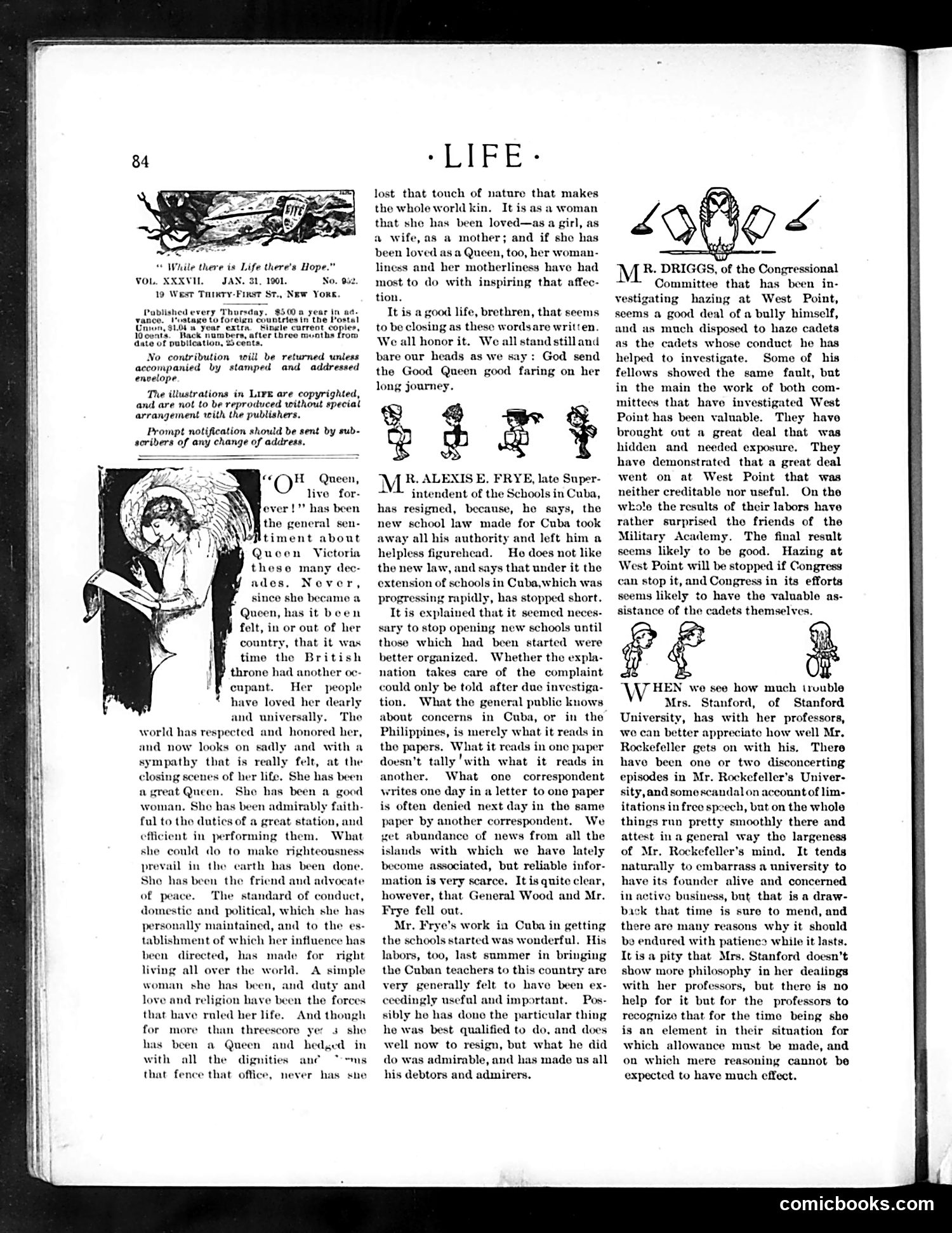
This page contains two main articles with accompanying illustrations discussing early 1900s institutional controversies. The left article, titled "Oh Queen, Live Forever!" criticizes the resignation of **Mr. Alexis E. Frye**, Superintendent of Schools in Cuba. The piece defends Frye's work establishing Cuban schools, noting he faced opposition from those who felt the new school law removed his authority too quickly. The article portrays his resignation as a loss for Cuban education. The right article discusses trouble at **Stanford University** involving Mrs. Stanford and Professor Rockefeller. It addresses scandals or controversies affecting the university's reputation and suggests that allowances must be made for the difficulties such situations create for institutions. Both articles critique institutional mismanagement and defend reform-minded administrators facing opposition.
📄 Transcribed text from this page (OCR, searchable)
Machine-transcribed from the original scan — historical spelling and the odd misread are preserved.
31, 1901. No. 952. 19 West Trixry-Finst St., New Yorn. lishedevery Thursday, $5000 year in je Vostage to foreign countries tn the Pos! Los a Year extra. Single current co ack numbers, after Lbree munths date of publication, 2 cents, No contribution will be returned unless accompanied by stamped and addressed envelope. rom The illustrations in Lire are copyrighted, and are not to be reproduced without special arrangement with the publishers. Prompt notification should be sent by sub- scribers of any change of address, Queen, OC) ever !”? has been the general sen- timent about Queen Victoria these many dec- ades. Never, since she became a Queen, has it been felt, in or out of her country, that it was time the British throne had another oc- cupant. Her people have loved her dearly and universally, The world has respected and honored her, and now looks on sadly and with a sympathy that is really felt, at the closing scenes of her life. She has been agreat Queen. She has been a good woman, She has been admirably faith- ful to tho duties of a great station, and efficient in performing them, What she could do to make righteousness prevail in the carth has been done. She has been the friend and advocate of pe: The standard of conduct, domestic and political, which she has personally maintained, and to the es- tablishment of which her influence has been directed, has made for right living all over the world. A simple woman she has been, and duty and Jove and religion have been the forces that have roled her life. And though for more than threescore ye: 4 she has been a Queen and hedged in with all the dignities ané that fence that office, never has she LIFE lost that touch of nature that makes the whole world kin. It is as a woman that she has been loved—as a girl, as a wife,as a mother; and if she has been loved as a Queen, too, her woman- liness and her motherliness have had most to do with inspiring that affec- tion. It is a good life, brethren, that seems to be closing as these words are written. We all honor it. We all stand still and bare our heads as we say: God send the Good Queen good faring on her long journey. eof} M R. ALEXIS E, FRYE, late Super- “"\ intendent of the Schools in Cuba, has resigned, because, he says, the new school law made for Cuba took away all his authority and left him a helpless figurehead. He does not like the new law, and says that under it the extension of schools in Cuba,which was progressing rapidly, has stopped short. It is explained that it seemed neces- sary to stop opening new schools until those which had been started were better organized. Whether the expla- nation takes care of the complaint could only be told after due investiga- tion, What the general public knows about concerns in Cuba, or in the Philippines, is merely what it reads in tho papers, What it reads in one paper doesn’t tally'with what it reads in another. What one correspondent writes one day in a letter to one paper is often denied next day in the same paper by another correspondent. We get abundance of news from all the islands with which we have lately become associated, but reliable infor- mation is very scarce, It is quite clear, however, that General Wood and Mr. Frye fell out. Mr. Frye’s work in Cuba in getting the schools started was wonderful. His labors, too, last summer in bringing the Cuban teachers to this country are very generally felt to have been ex- ceedingly useful and important. Pos- sibly he has done the particular thing he was best qualified to do, and does well now to resign, but what he did do was admirable, and has made us all his debtors and admirers. 4oflo< R. DRIGGS, of the Congressional Committee that has been in- are hazing at West Point, seems a good deal of a bully himself, and as much disposed to haze cadets as the cadets whose conduct he has helped to investigate. Some of his fellows showed the same fault, but in the main the work of both com- mittees that have investigated West Point has been valuable. They have brought out a great deal that was hidden and needed exposure, They have demonstrated that a great deal went on at West Point that was neither creditable nor useful. On the wkole the results of their labors have rather surprised the friends of the Military Academy. The final result seems likely to be good. Hazing at West Point will be stopped if Congress can stop it, and Congress in its efforts seems likely to have the valuable as- sistance of the cadets themselves. we see how much uvuble Mrs. Stanford, of Stanford University, has with her professors, we can better appreciate how well Mr. Rockefeller gets on with his, There have been one or two disconcerting episodes in Mr. Rockefeller’s Univer- sity, and somescandalon account of lim- itations in free speech, but on the whole things run pretty smoothly there and attest ina general way tho largeness of Mr, Rockefeller’s mind, It tends naturally to embarrass a university to have its founder alive and concerned in active business, but that is a draw- back that time is sure to mend, and there are many reasons why it should be endured with patiencs while it lasts. Itis a pity that Mrs. Stanford doesn’t show more philosophy in her dealings with her professors, but there is no help for it but for the professors to recognize that for the time being she is an element in their situation for which allowance must be made, and on which mere reasoning cannot be expected to have much effect. comicbooks.com