
Life, 1901-01-31 · page 6 of 20
Life — January 31, 1901 — page 6: what you’re looking at
What you’re looking at
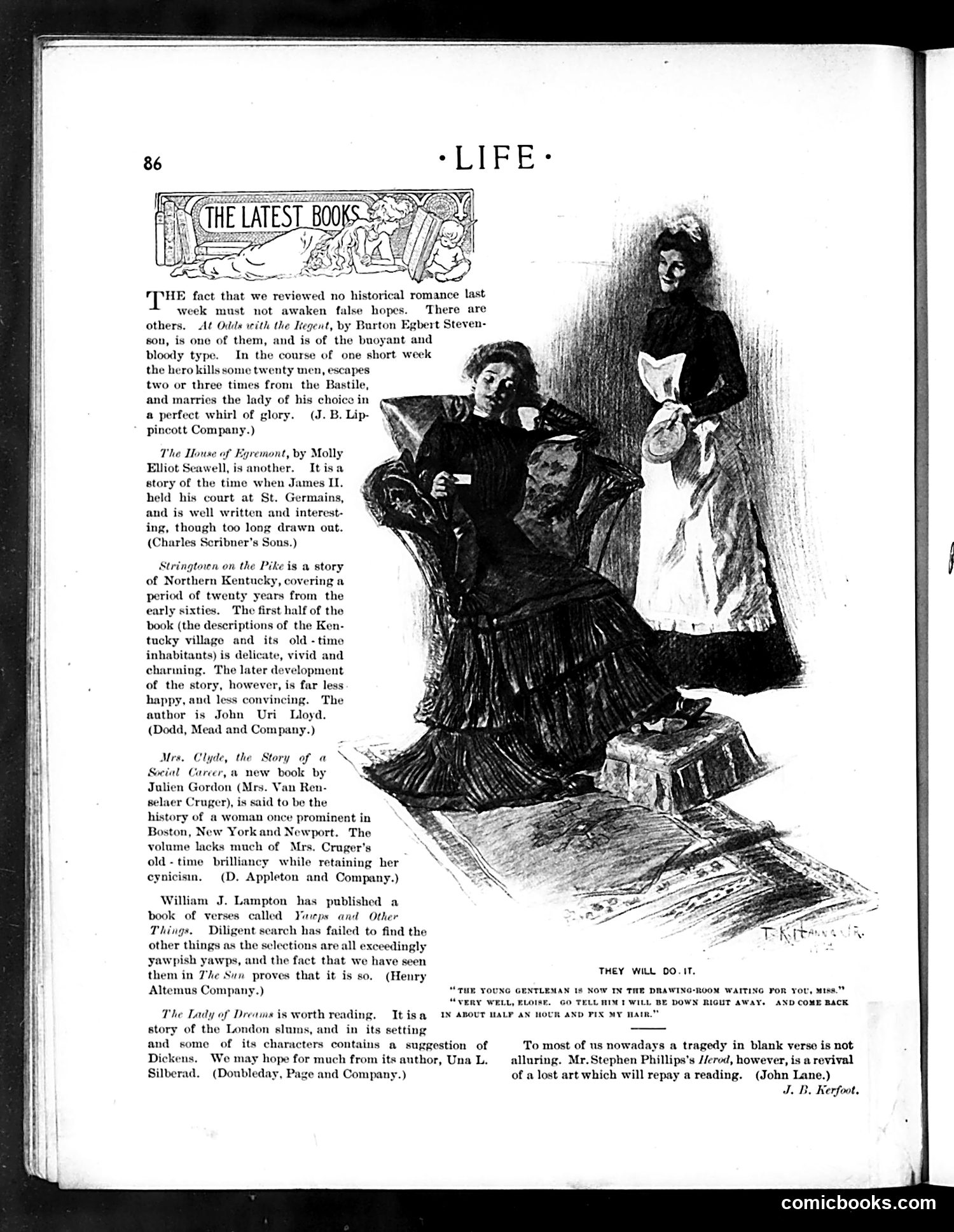
This page reviews contemporary books rather than presenting political satire. The main illustration, captioned "They Will Do It," depicts a domestic scene: a young woman in a drawing room while two other figures (likely her suitor and a chaperone) converse. The caption references the young gentleman waiting and mentions fixing hair—suggesting a humorous commentary on courtship rituals and social propriety of the era. The reviews discuss historical romances and literary works, including titles like "At Odds with the World" and "Stringtown on the Pike." The tone is lighthearted literary criticism typical of Life's cultural commentary, focusing on contemporary fiction rather than political messaging or social satire.
📄 Transcribed text from this page (OCR, searchable)
Machine-transcribed from the original scan — historical spelling and the odd misread are preserved.
“THE LATEST TPHE fact that we reviewed no historical romance last week must not awaken false hopes. There are others. At Odds with the Kegent, by Burton Egbert Steven- sou, is one of them, and is of the buoyant and bloody type. In the course of one short week the hero kills some twenty men, escapes two or three times from the Bastil and marries the lady of his choice in a perfect whirl of glory. (J. B. Lip- pincott Company.) The House of Egremont, by Molly Elliot Seawell, is another, It isa story of the time when James II. held his court at St. Germains, and is well written and interest- ing, though too long drawn out. (Charles Scribner's Sons.) Stringtown on the Pike is a story of Northern Kentucky, covering a period of twenty years from the early sixties. The first half of the book (the descriptions of the Ken- tucky village and its old -time inhabitants) is delica: and. charming. The later de opment of the story, however, is far less happy, and less convincing. The author is John Uri Lloyd. (Dodd, Mead and Company.) Mrs. Clyde, the Story of a Sveial Career, a new book by Julien Gordon (Mrs. Van Ren- selaer Cruger), is said to be the history of a woman once prominent in Boston, New York and Newport. The volume lacks much of Mrs, Cruger’s old-time brilliancy while retaining her cynicisin. (D. Appleton and Company.) William J. Lampton has published a book of verses called Yurps and Other Things. Diligent search has failed to find the other things as the selections are all exceedingly yawpish yawps, and the fact that we have seen them in The Sun proves that it is so. (Henry THEY: WHEE (00,1 Altemus Company.) “TUR YOUNG GENTLEMAN 18 NOW IN THE DRAWING-ROOM WAITING FoR YoU, mtss.”* “VERY WELL, ELOISE. GO TELL MIM 1 WILL BE DOWN RIGUT AWAY. AND COME BACK The Lady of Dreams is worth reading, It is@ IN ABOUT MALY AN HOUR AND PIX MY MarR.” story of the London slums, and in its setting and some of its characters contains a suggestion of To most of us nowadays a tragedy in blank verse is not Dickens. We may hope for much from its author, Una L. alluring. Mr. Stephen Phillips's //erod, however, is a revival Silberad. (Doubleday, Page and Company.) of a lost art which will repay a reading. (John Lane.) J.B. Kerfoot. comicbooks.com