
A complete issue · 20 pages · 1900
Life — April 12, 1900
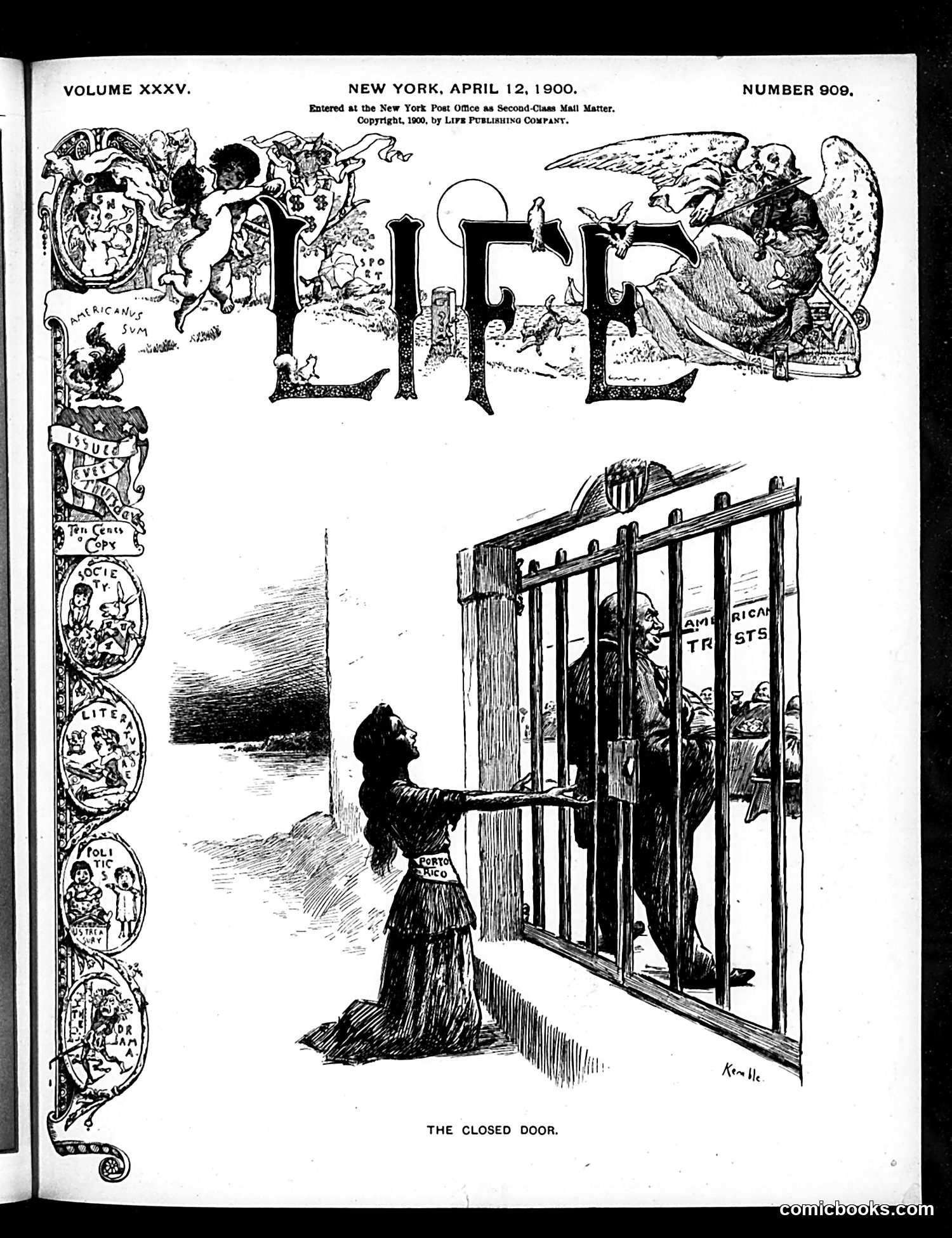
This cartoon depicts a woman in classical dress (appearing to represent a nation or allegorical figure) kneeling before a closed door marked "American Trust." Inside the door, shadowy figures are visible—likely representing wealthy industrialists or monopoly leaders. The satire criticizes American monopolies and trusts of the Gilded Age, suggesting they exclude ordinary citizens from economic opportunity. The woman's supplicant posture emphasizes powerlessness against closed corporate interests. The decorative border with international symbols suggests global implications. The title "The Closed Door" references exclusionary business practices. This reflects turn-of-the-century Progressive Era concerns about trusts controlling markets and limiting access for ordinary Americans—a major political issue during Theodore Roosevelt's early presidency.
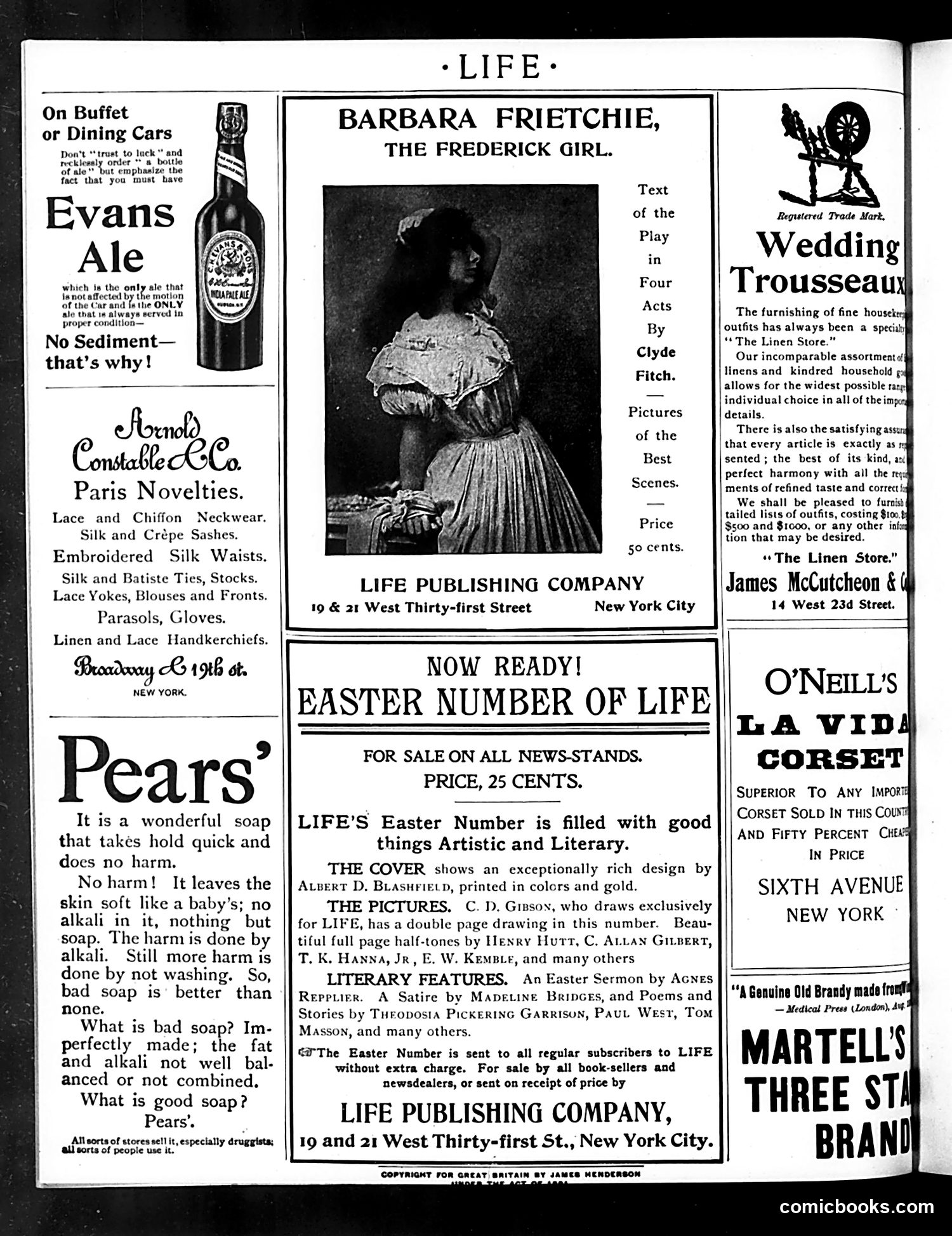
This page is **primarily advertising** with minimal editorial cartoon content. The central feature is a theatrical advertisement for "Barbara Frietchie, the Frederick Girl," a stage play based on Clyde Fitch's text, published by Life Publishing Company. The accompanying photograph shows a woman in period costume, likely from the play. The surrounding ads promote consumer goods typical of the era: Evans Ale, Pears' soap, Arnold Constable & Co. novelties, Wedding Trousseaux linens, O'Neill's corsets, and Martell's brandy. There is also promotion for Life's Easter Number, priced at 25 cents. This appears to be a standard magazine page mixing theatrical promotion with commercial advertisements rather than political satire or editorial cartooning.
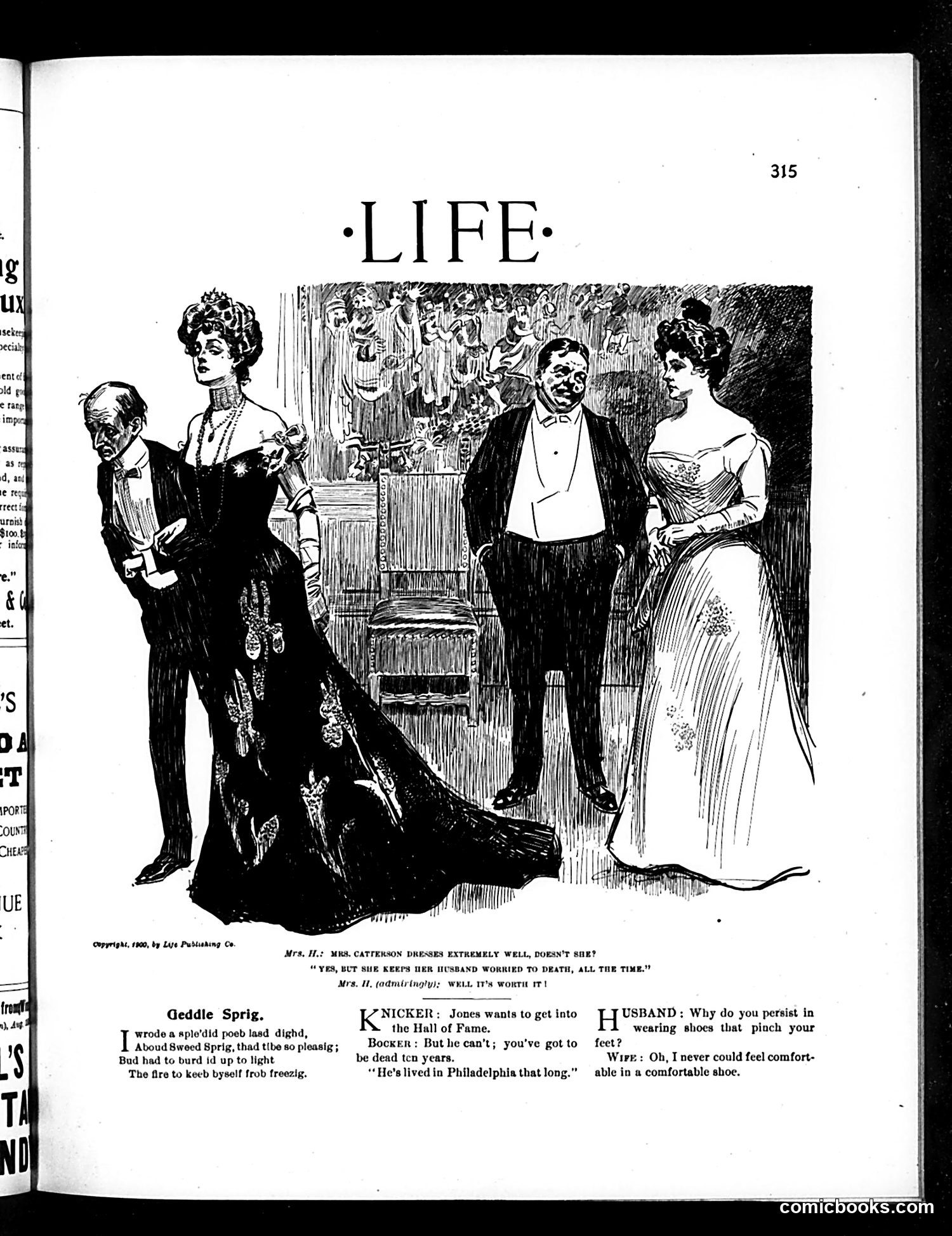
This page features a satirical illustration of high society etiquette. The main cartoon depicts four elegantly dressed figures at what appears to be a formal event, with a woman in an elaborate gown with a prominent train. The caption reads: "Mrs. H.: 'Miss Catterson dresses extremely well, doesn't she?' 'Yes, but she keeps her husband worried to death all the time.' Mrs. H. (admiringly): 'Well! It's worth it!'" Below is a poem titled "Geddie Sprig" about a poorly-behaved guest, followed by brief comic dialogue about social climbing and uncomfortable shoes. The satire targets upper-class pretension—suggesting that fashionable women justify expensive dress by the worry it causes their husbands, and that suffering (uncomfortable shoes) is an acceptable price for social status. It mocks both conspicuous consumption and the era's gender dynamics around female fashion.
This page contains satirical editorial commentary rather than political cartoons. The main article critiques **Mr. Hillis**, a young Chicago clergyman from a church in Brooklyn, who recently delivered a sermon attacking Presbyterian doctrine—specifically the concept of predestination. The satire mocks Hillis for declaring Presbyterian theology "inexplicable and unnecessary," arguing such bold theological criticism from a young minister is foolish and dangerous to organized religion. The page also discusses wealthy Chicagoans relocating to New York (suggesting Chicago's declining prestige), Cuba's orphan crisis following American intervention, and Cecil Rhodes's conduct during the Kimberley siege. The small illustrations are decorative rather than satirical commentary.
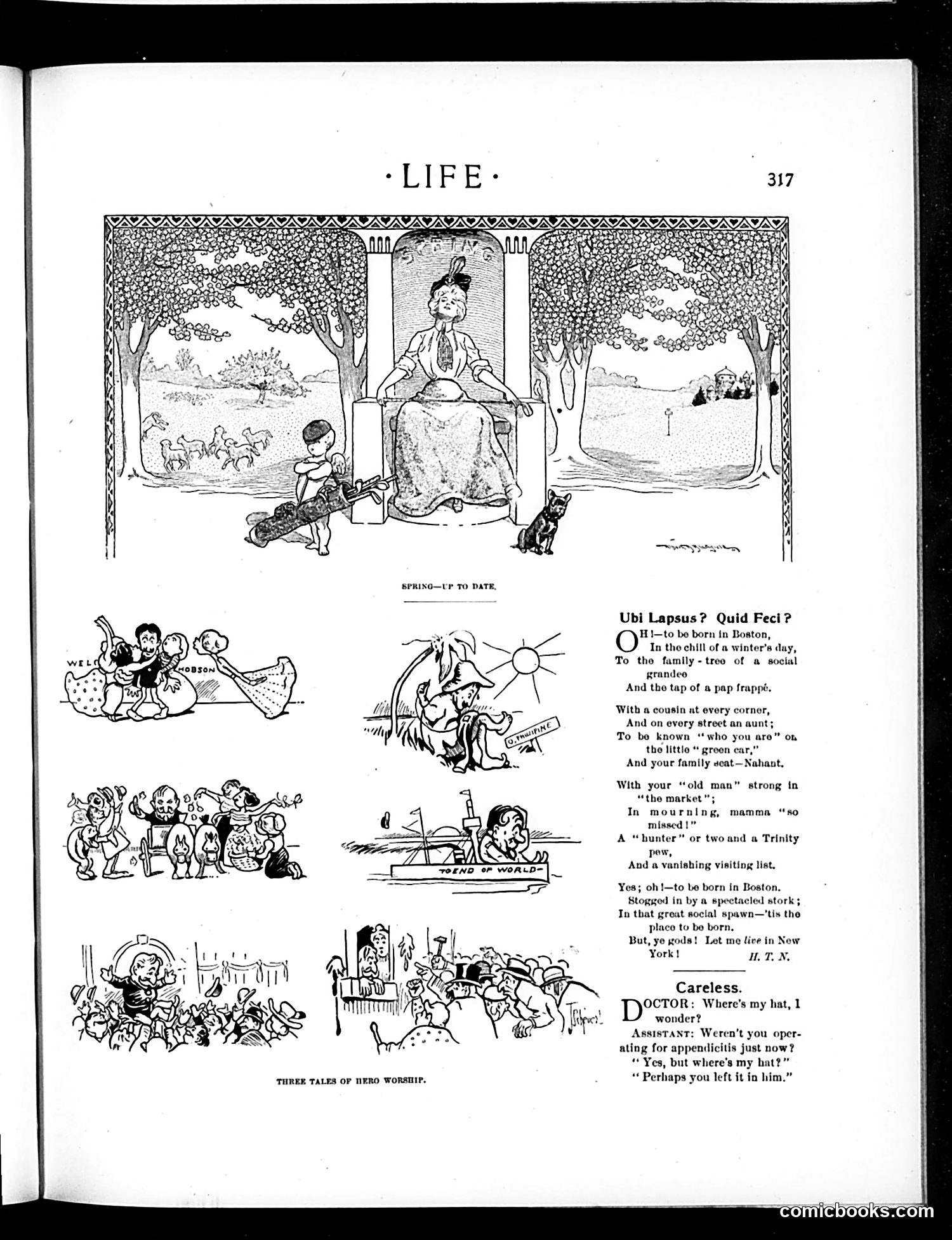
The top cartoon "Spring-Up to Date" depicts an idle wealthy woman in a hammock, attended by servants and a small child, embodying leisure-class leisure. The accompanying smaller illustrations labeled "Three Tales of Hero Worship" show children in various scenarios—playing, boating, and in crowded scenes—satirizing how children emulate different social types. The poem "Ubi Lapsus? Quid Feci?" (Latin: "Where did I fall? What did I do?") mocks upper-class Boston aspirations, referencing "Nahant" (an elite resort) and the pretentious markers of old-money status: market connections, mountain visits, and social visiting lists. The final joke "Careless" plays on absent-mindedness about a hat, typical light humor for the era. The satire targets idle wealth and class pretension.
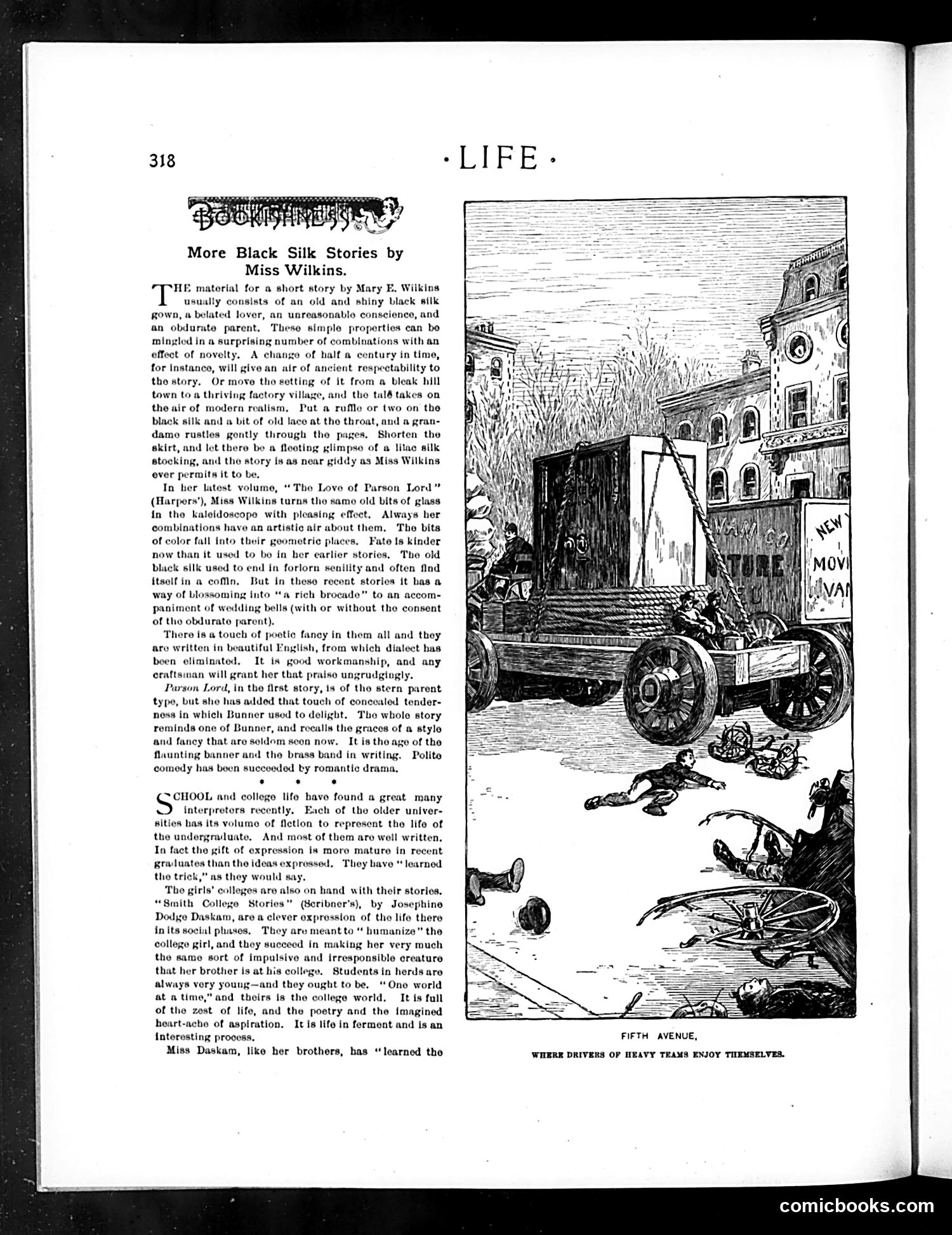
This illustration satirizes the chaos and danger created by heavy commercial trucks on New York's Fifth Avenue. The image shows a street scene with overturned cargo, scattered goods, and what appears to be abandoned or wrecked vehicles amid the debris of urban traffic. The caption's sardonic tone—suggesting truck drivers "enjoy themselves"—mocks the actual situation: heavy freight vehicles were causing significant disruption, accidents, and property damage on what was (and remains) one of Manhattan's most prestigious shopping streets. This reflects early 20th-century urban anxieties about motorized vehicles disrupting established city life and commerce, particularly the conflict between industrial transportation needs and residential/retail district preservation.
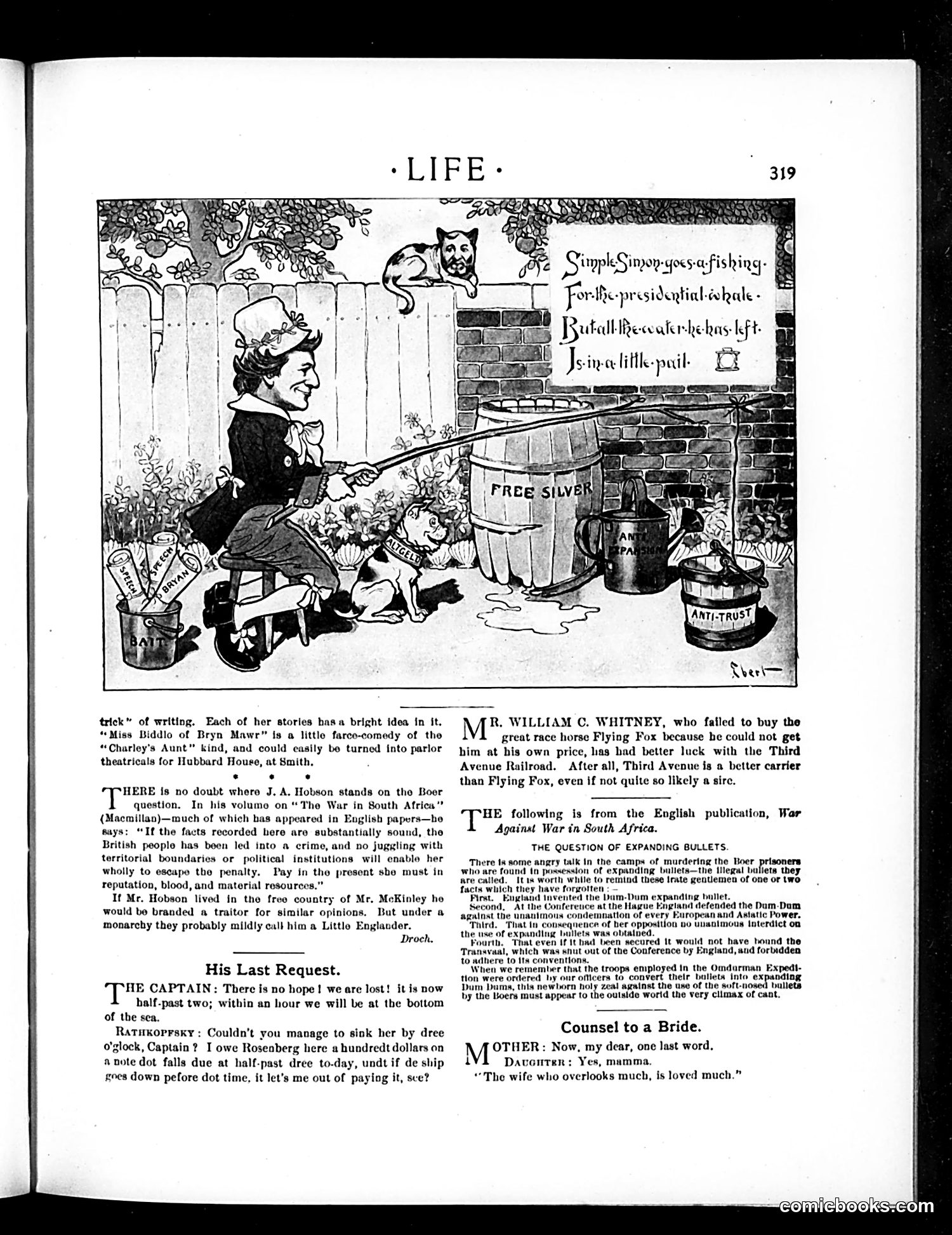
The main cartoon depicts a woman fishing in a barrel labeled "FREE SILVER" while cats labeled "ANTI-TRUST" surround her. The accompanying text references political debates of the era. The satire appears to criticize monetary policy and trust-busting efforts—likely from the early 1900s based on the "Free Silver" reference (a major late-19th-century political issue). The woman represents either a political figure or the public being fooled by promises of "free silver" while corporate monopolies ("anti-trust" concerns) lurk nearby as threats. The poem above suggests political naiveté: Simple Simon goes fishing "for the presidential whale" but "Rueful Reuben has been left / Is in a little putt," mocking those pursuing unrealistic political goals. The page also contains anecdotes about notable figures and unrelated satirical pieces, typical of *Life* magazine's format.
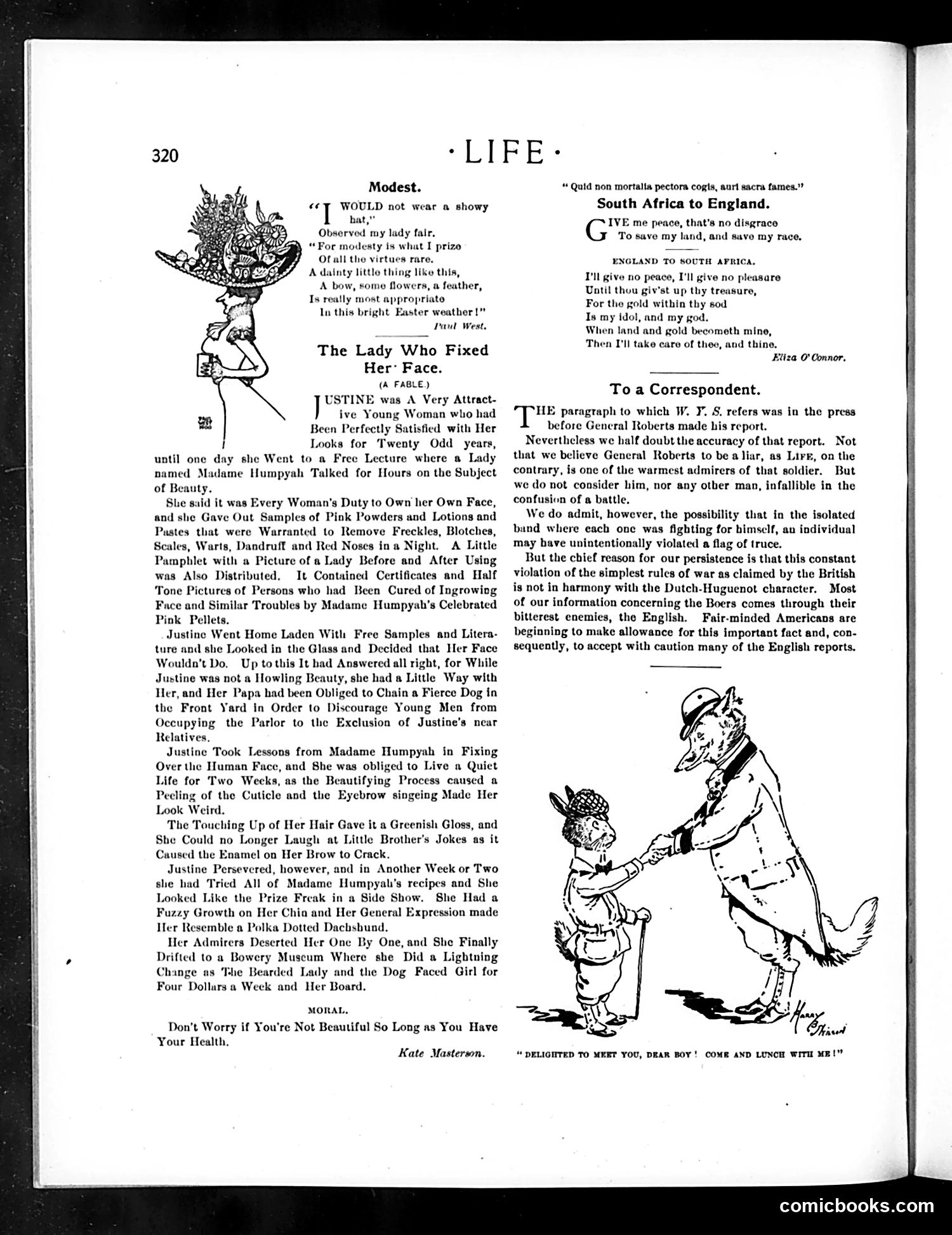
This page contains a satirical fable titled "The Lady Who Fixed Her Face," mocking the beauty industry's promises. The story follows Justine, who becomes obsessed with cosmetic treatments and beauty products advertised to remove freckles and blemishes. After pursuing various remedies, she ironically ends up displayed in a museum as a "Bearded Lady" attraction—the moral being that excessive vanity leads to absurdity. The accompanying cartoon shows two figures, likely representing an American and a British person meeting, with caption "Delighted to meet you, dear boy! Come and lunch with me!" The page also includes poetry about colonial relations between England and South Africa, suggesting tensions over resource extraction ("the gold within thy soil"). The satire targets both women's obsession with appearance and imperial commercial interests.
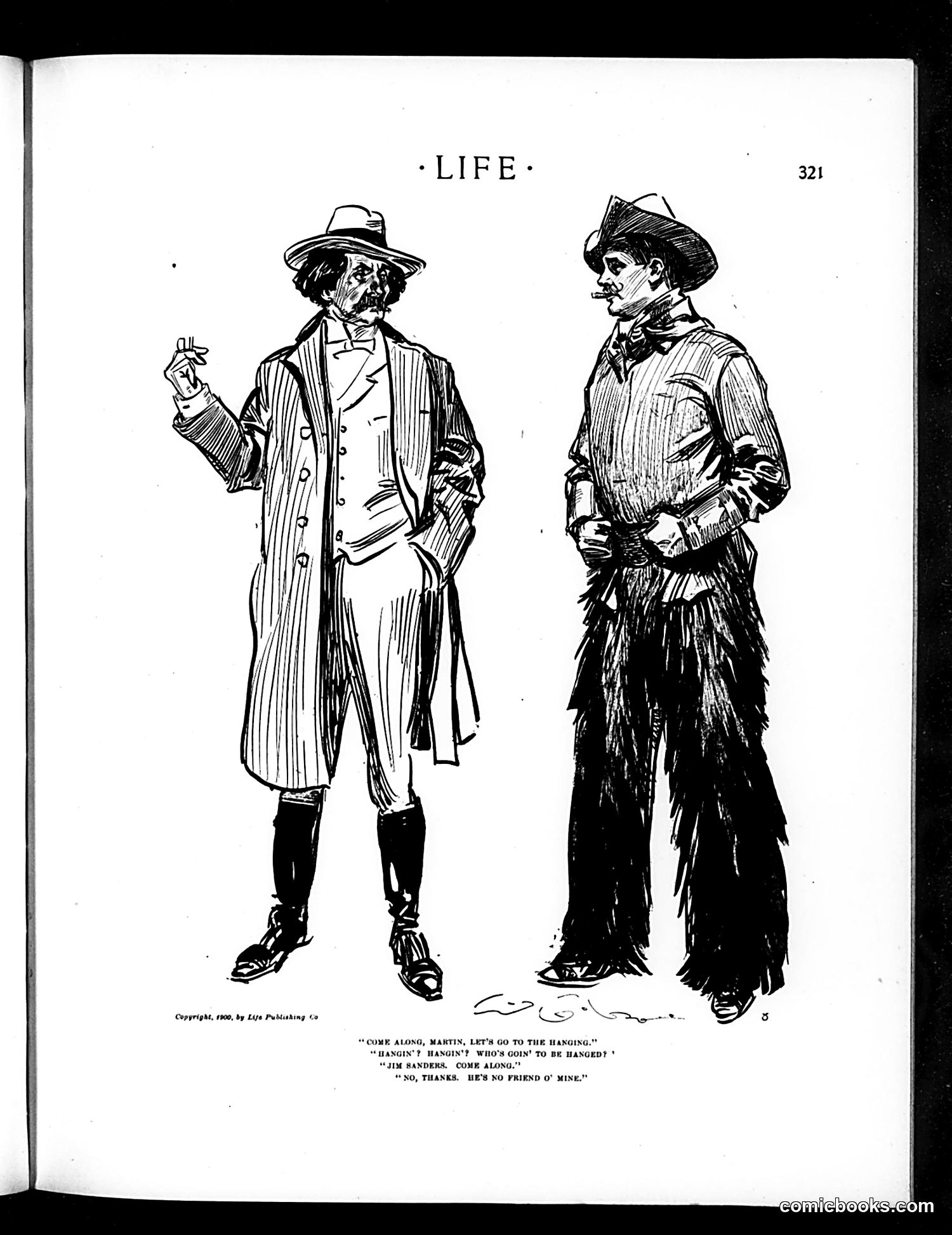
This is a satirical cartoon depicting two men in Western attire discussing a hanging. The figure on the left, dressed in a long coat and hat, appears to be persuading the rougher-dressed man on the right (wearing chaps) to participate in an execution. The dialogue reads: "Come along, Martin, let's go to the hanging" / "Hangin'? Hangin'? Who's goin' to be hanged?" / "Jim Sanders. Come along." / "No, thanks. He's no friend o' mine." The joke satirizes frontier vigilante justice and casual attitudes toward violence in the Old West. The punchline—that the man won't attend because he has no personal relationship with the condemned—mocks the arbitrary brutality and social nature of mob executions, treating capital punishment as mere entertainment dependent on acquaintance rather than justice.
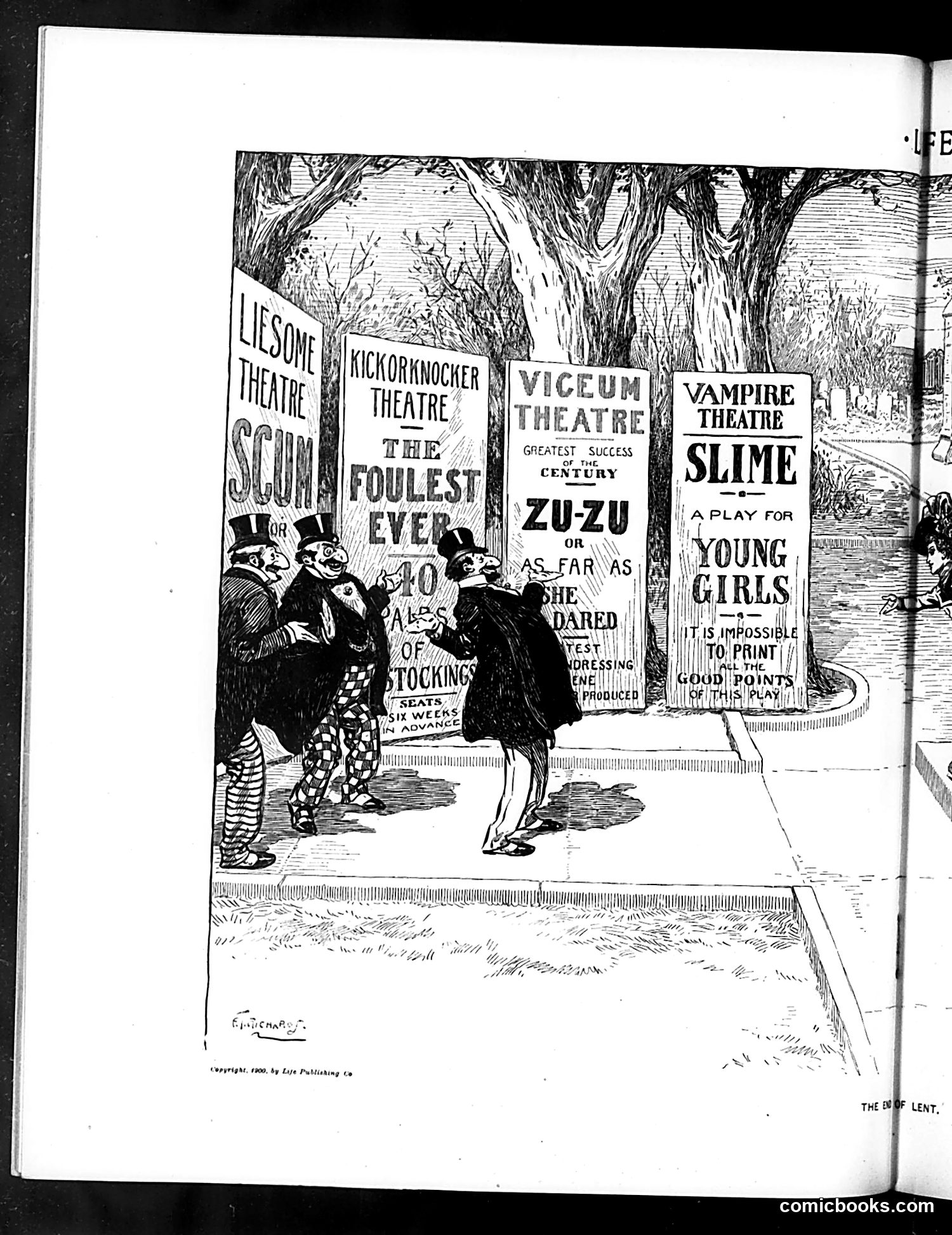
This is a satirical illustration showing theater-goers examining playbill advertisements outside what appears to be a London theatre. The sketch depicts four well-dressed figures in Victorian-era clothing (top hats and formal dress) reading marquees for various theatrical productions. The humor targets the sensationalism and absurdity of theatre advertising at the time. The visible show titles—"The Foulest Ever," "Zu-Zu," and "Slime: A Play for Young Girls"—are deliberately ridiculous, with the last playbill noting "It is impossible to print the good points of this play," mocking the desperate marketing tactics of theatres competing for audiences. The cartoon satirizes how theatre producers resorted to outrageous, contradictory, or meaningless claims to attract patrons, whether through shocking content, exoticism, or self-undermining advertisements. This reflects broader Victorian-era concerns about entertainment degradation and commercial excess in popular culture.
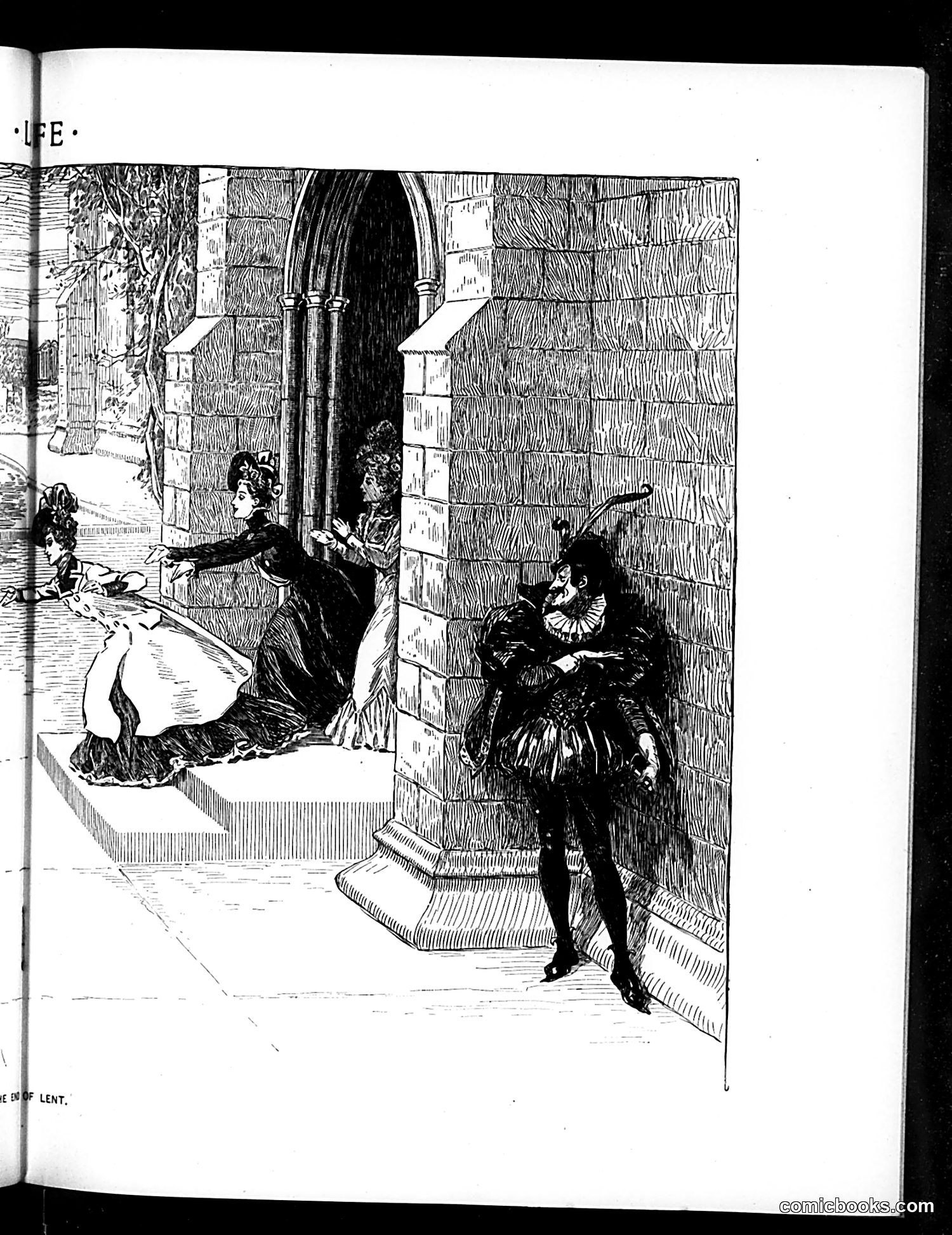
This is a satirical illustration showing two elegantly dressed figures in what appears to be a doorway or architectural passage. The figure on the left sits reclined in a dramatic pose, while the figure on the right stands and appears to be gesturing or speaking. Both wear elaborate period clothing with ruffled collars and dark, formal attire. The illustration's style and composition suggest social commentary on courtship or romantic interaction among the upper classes. The exaggerated postures and theatrical staging imply satire of affected behavior or pretentiousness in high society. However, without clearer text identifying the specific figures or referencing a particular historical event, person, or scandal, I cannot definitively explain what political or social situation this cartoon targets. The artistic style suggests late 19th-century publication, but the precise subject remains unclear from the visible image alone.
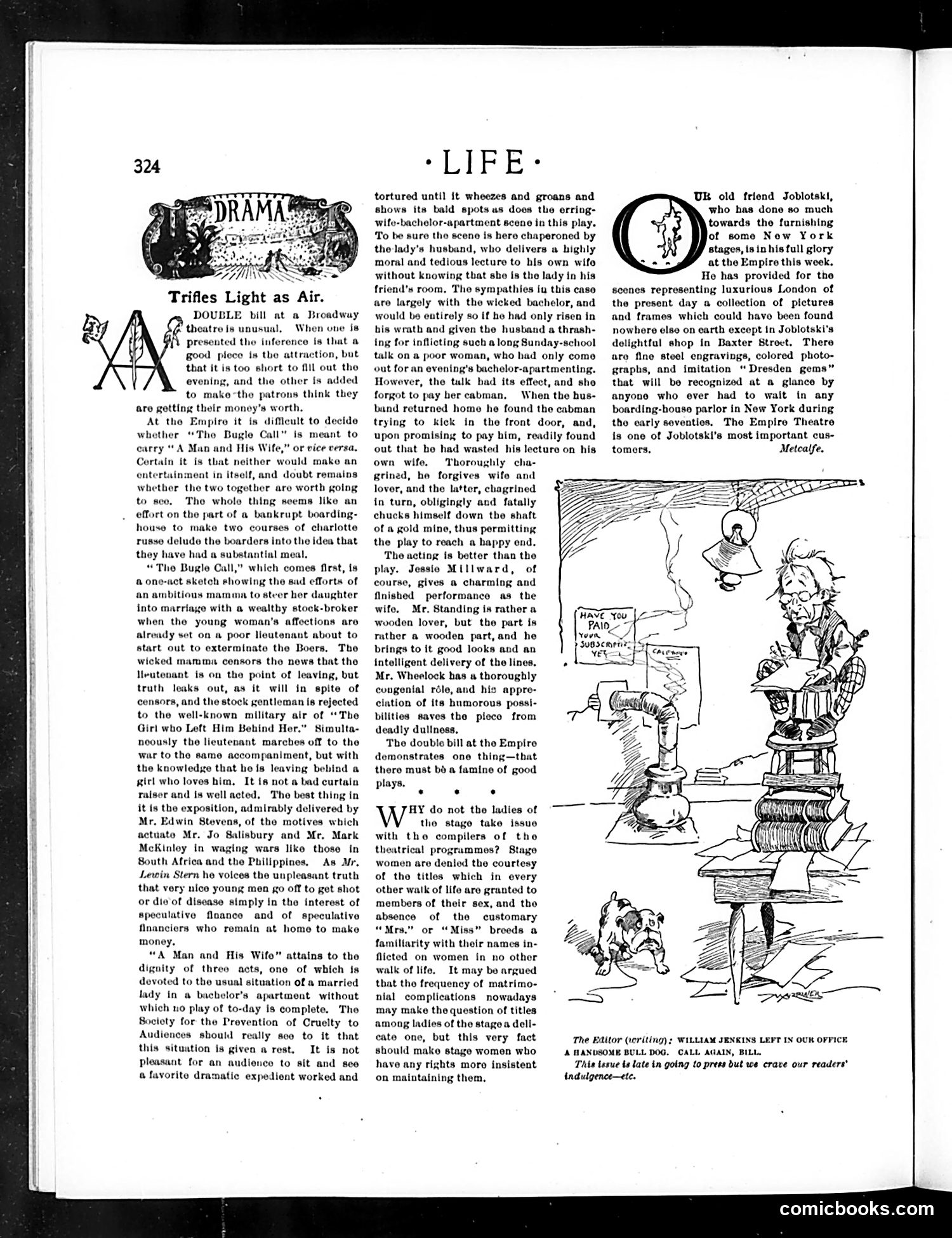
This page reviews Broadway theatrical productions, specifically critiquing "Trifles Light as Air" at the Empire Theatre. The main illustration depicts a caricatured theater critic sitting atop a precariously stacked pile of books, papers, and theatrical materials, appearing overwhelmed and comically unstable—a visual metaphor for critics drowning in theatrical programming. The satire targets the theatrical establishment's apparent indifference to quality: the text notes that stage women lack proper courtesy titles ("Mrs." or "Miss"), and criticizes how theatrical programs exploit actresses. The cartoonist mocks both the abundance of mediocre plays flooding Broadway and the critics forced to review them endlessly. The illustration's precarious tower suggests the unsustainable nature of constant theatrical production.
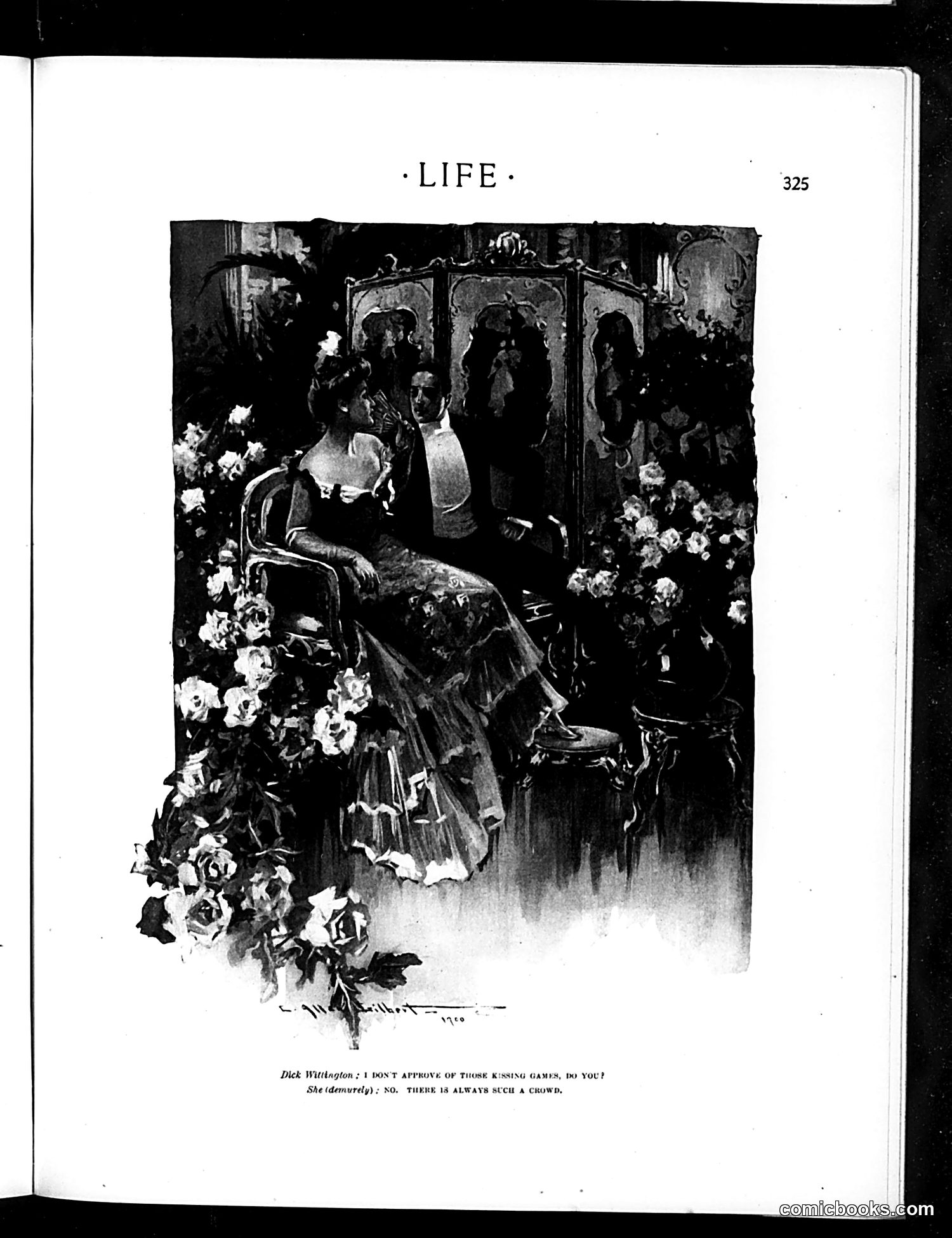
This cartoon depicts a social scene centered on "kissing games"—parlor games popular in early 20th-century courtship. The male figure (Dick Wittington, likely referencing the English nursery-rhyme character) expresses disapproval of such games to a young woman. Her demure response—"No, there is always such a crowd"—suggests she objects not to kissing games themselves, but to the *public nature* of the activity. The satire mocks both figures: his prudish disapproval and her hypocritical objection based on audience size rather than principle. The elaborate floral setting and formal dress indicate an upper-class social gathering. The cartoon satirizes the era's courtship conventions and the contradictions between stated morality and actual social practice.
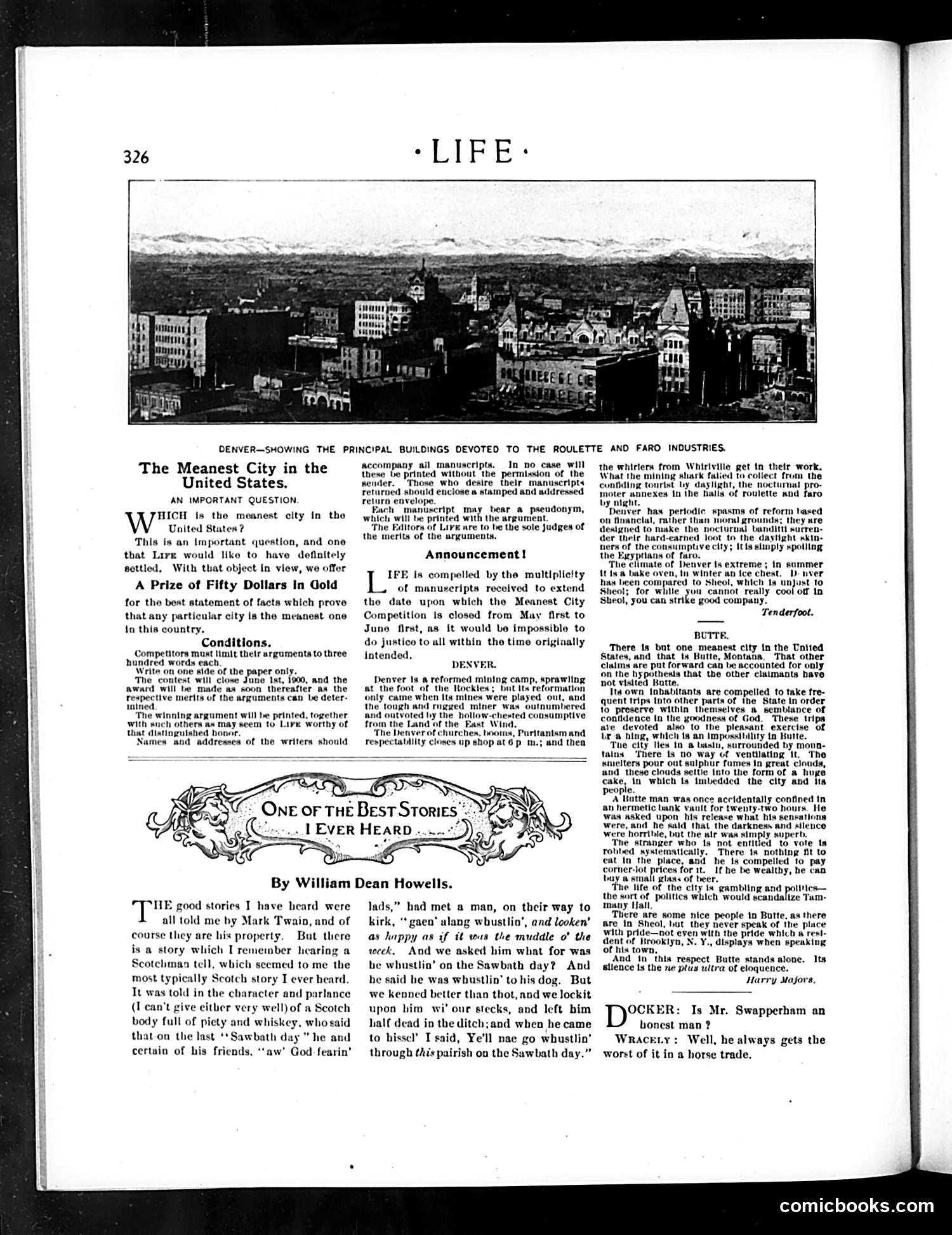
This page contains a **contest announcement** and **satirical essay** rather than traditional political cartoons. **The Contest:** Life magazine solicits readers' arguments (in 300 words) for which American city is "meanest"—offering $50 gold prize. The deadline was extended from May to June 1900. **The Satire:** The page includes an essay on **Denver**, which Life satirizes as hypocritical and corrupt. The photograph caption mockingly labels Denver's buildings as devoted to "roulette and faro industries" (gambling). The accompanying essay by an unnamed author (signed "Tenderfoot") attacks Denver as a "reformed mining camp" where daytime "skin-ners" (con artists) replacing nighttime gamblers essentially pursue the same exploitation. The climate extremes are mocked as worse than biblical Sheol—at least Sheol offers "good company." **The Howells Piece:** Below, William Dean Howells reprints a Scots dialect anecdote about religious hypocrisy—a man whistling on the Sabbath is violently attacked by self-righteous "pious" men, establishing thematic continuity about sanctimoniousness masking cruelty.
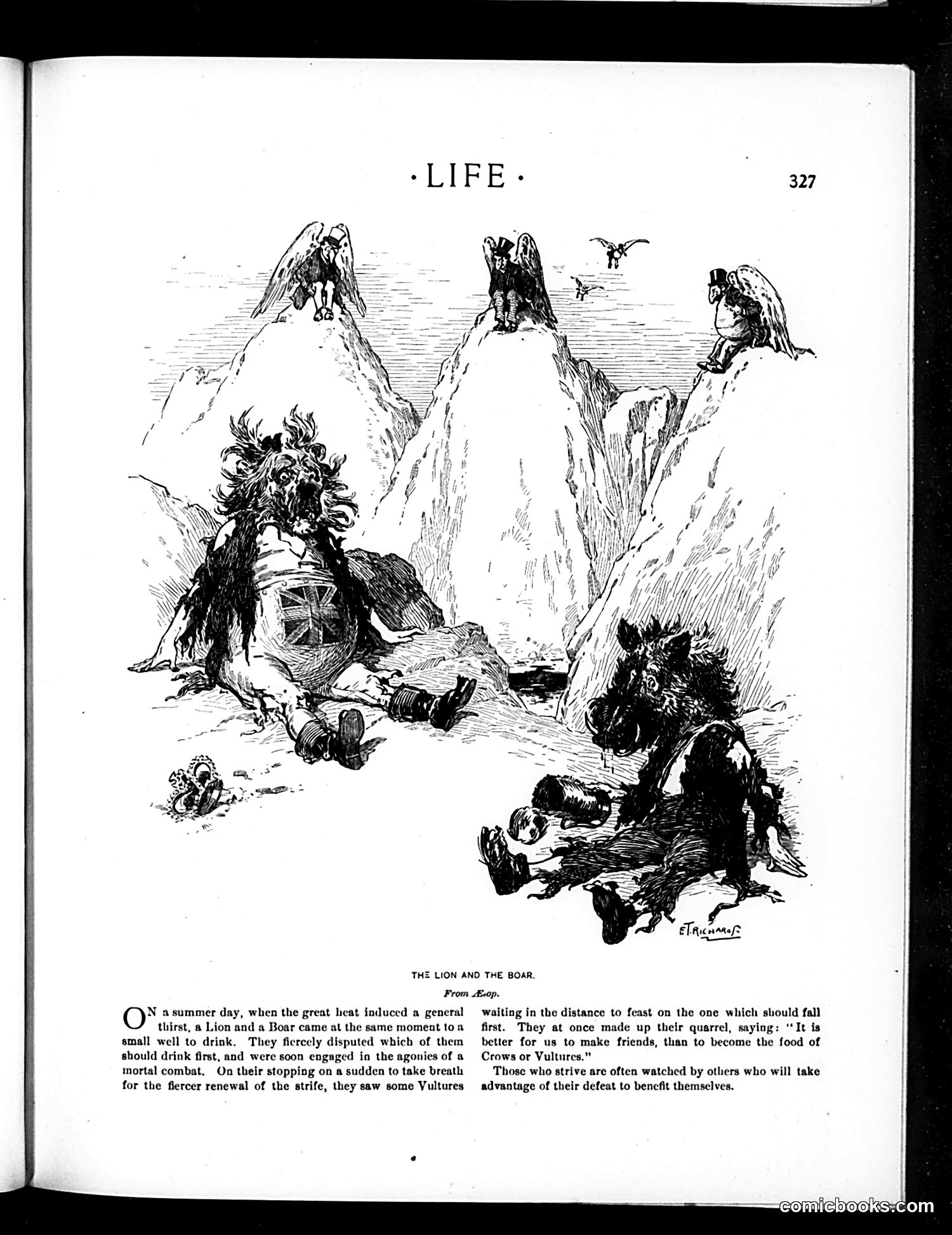
This is an illustrated Aesop's Fable about conflict and self-interest. A lion and boar fight over drinking rights at a well, but pause when they notice vultures circling overhead—waiting to scavenge whichever animal falls. Recognizing their mutual danger, they make peace. The moral applies universally: **rivals who fight each other may be exploited by opportunistic third parties**. The fable suggests that enemies should recognize when external threats make cooperation preferable to conflict. In historical context, this likely resonated as political commentary during periods of international tension or domestic conflict, implying that fighting parties risk being devoured by outside powers or interests. The "vultures" represent those who profit from others' misfortune—a timeless satirical warning about unintended consequences of prolonged disputes.
This is primarily a **text and advertising page** from Life magazine, not a political cartoon page. The content includes: **Literary pieces:** "An Old Story" (romantic poem about fading love) and two humorous anecdotes—one about a German father's test predicting his son will become a politician, another about a husband arriving home late. **Commentary section:** Brief satirical quips about contemporary topics (Khaki clothing fashions, Shakespeare performances, WWI references like "The Cry from the Transvaal" alluding to the Boer War), and complaints about London's Punch magazine being tedious. **The "Pal Scissors at Nulla" masthead** appears decorative, introducing this miscellaneous collection. The page primarily showcases **period humor and social observation** rather than visual satire, alongside advertisements for Wilson Whiskey, Esterbrook Steel Pens, and White Rock Water. The tone reflects turn-of-the-century genteel humor typical of Life magazine's early decades.
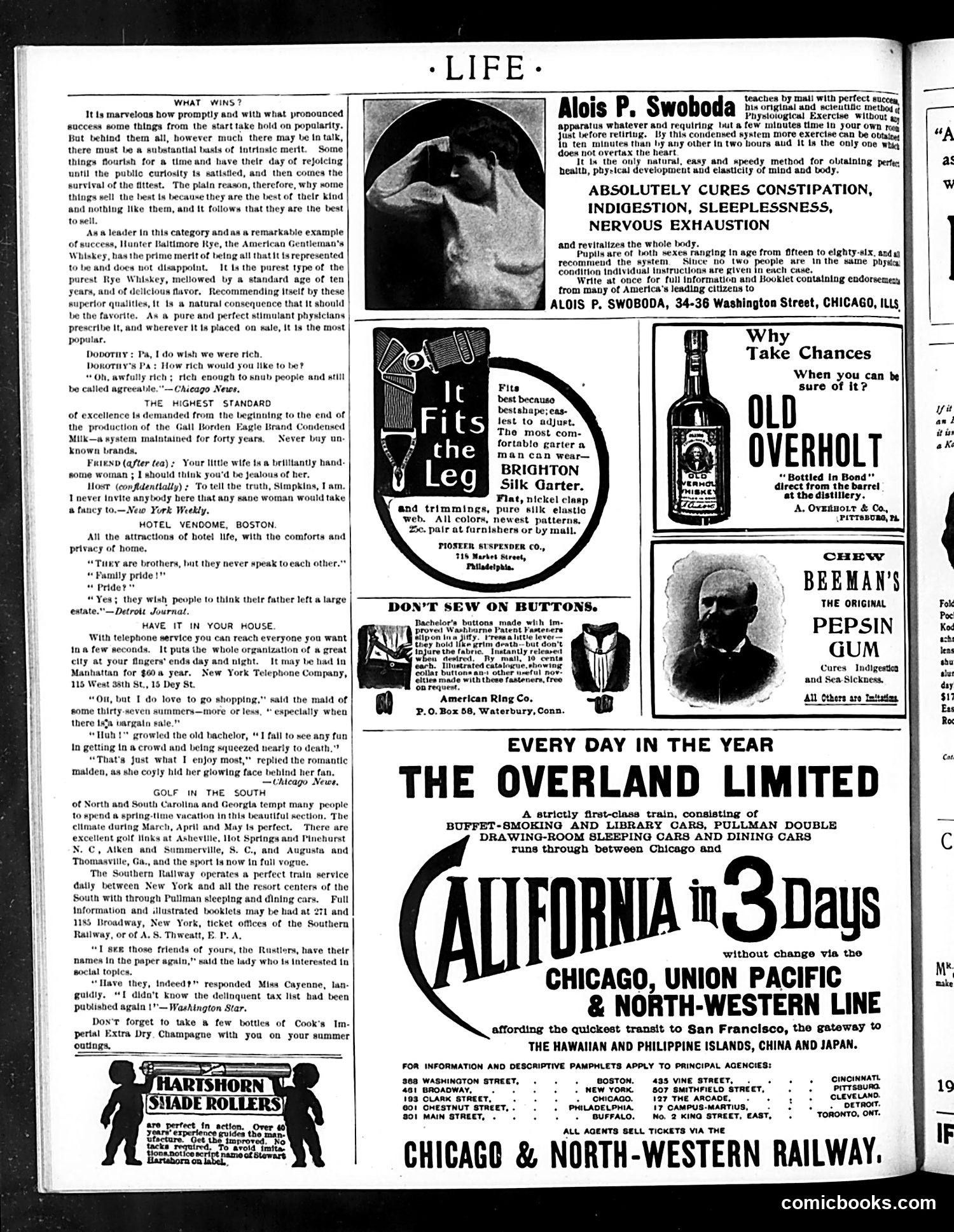
This page from *Life* magazine consists primarily of **advertisements and filler content** rather than political cartoons. The "editorial" sections are brief humorous anecdotes and social commentary typical of the era. **Notable content:** The opening essay "What Wins?" discusses Hunter Baltimore Rye whiskey—praising its success through "intrinsic merit." This is essentially advertising disguised as editorial commentary. **The jokes** are mild social humor: a dialogue about wishing to be rich enough to "snub people," a husband admitting he avoids inviting attractive women to avoid his wife's jealousy, and a reference to family pride between estranged brothers. **Advertisements dominate**: Alois P. Swoboda's mail-order exercise system, Old Overholt whiskey, Beeman's Pepsin Gum, Brighton Silk Garters, and the Chicago & North-Western Railway's California service. There are **no political cartoons** on this page. The small illustrations accompanying ads (like the Hartshorn Shade Rollers image) are purely commercial. This appears to be a standard early-20th-century magazine page mixing light humor with advertising revenue.
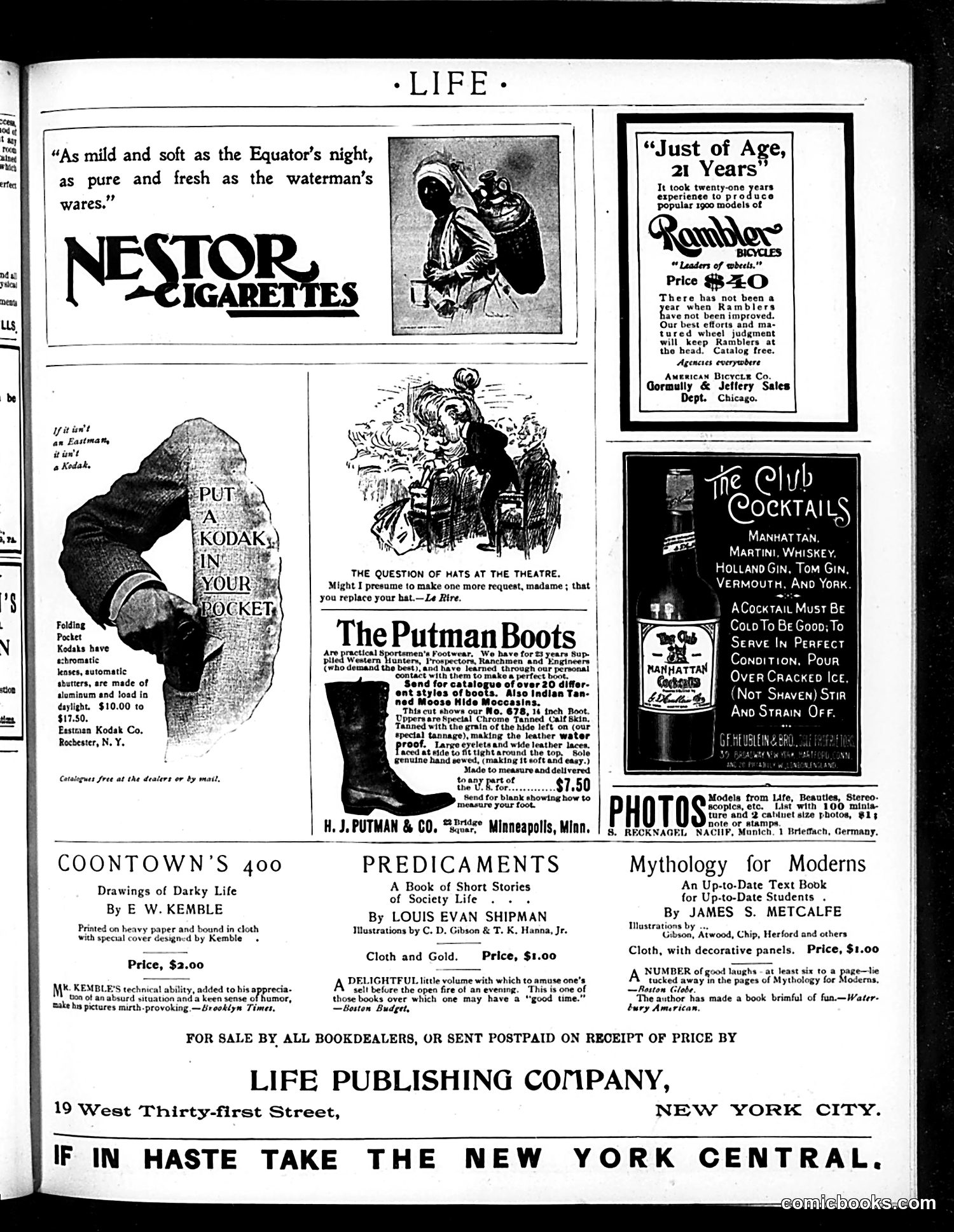
This page is primarily **advertising**, with one notable cartoon and multiple product/book advertisements typical of early 1900s Life magazine. **The Cartoon:** "The Question of Hats at the Theatre" depicts a social complaint: a woman wearing an elaborate hat at a theater performance blocks other patrons' views. The caption, attributed to *Le Rire* (a French publication), humorously requests she remove it. This reflects a genuine historical annoyance—women's oversized, feathered hats were notorious theater obstructions during this era. **Notable Advertisement:** "Coontown's 400" by E.W. Kemble advertises a book of drawings described as "Darky Life." This reflects the racist caricature tradition common in American publications of this period, though the specific content isn't visible here. **Other Ads:** The page includes practical products (Putman Boots, Rambler Bicycles, Kodak cameras) and aspirational items (Club Cocktails), representing typical consumer goods marketed through Life's pages to educated, middle-class readers.
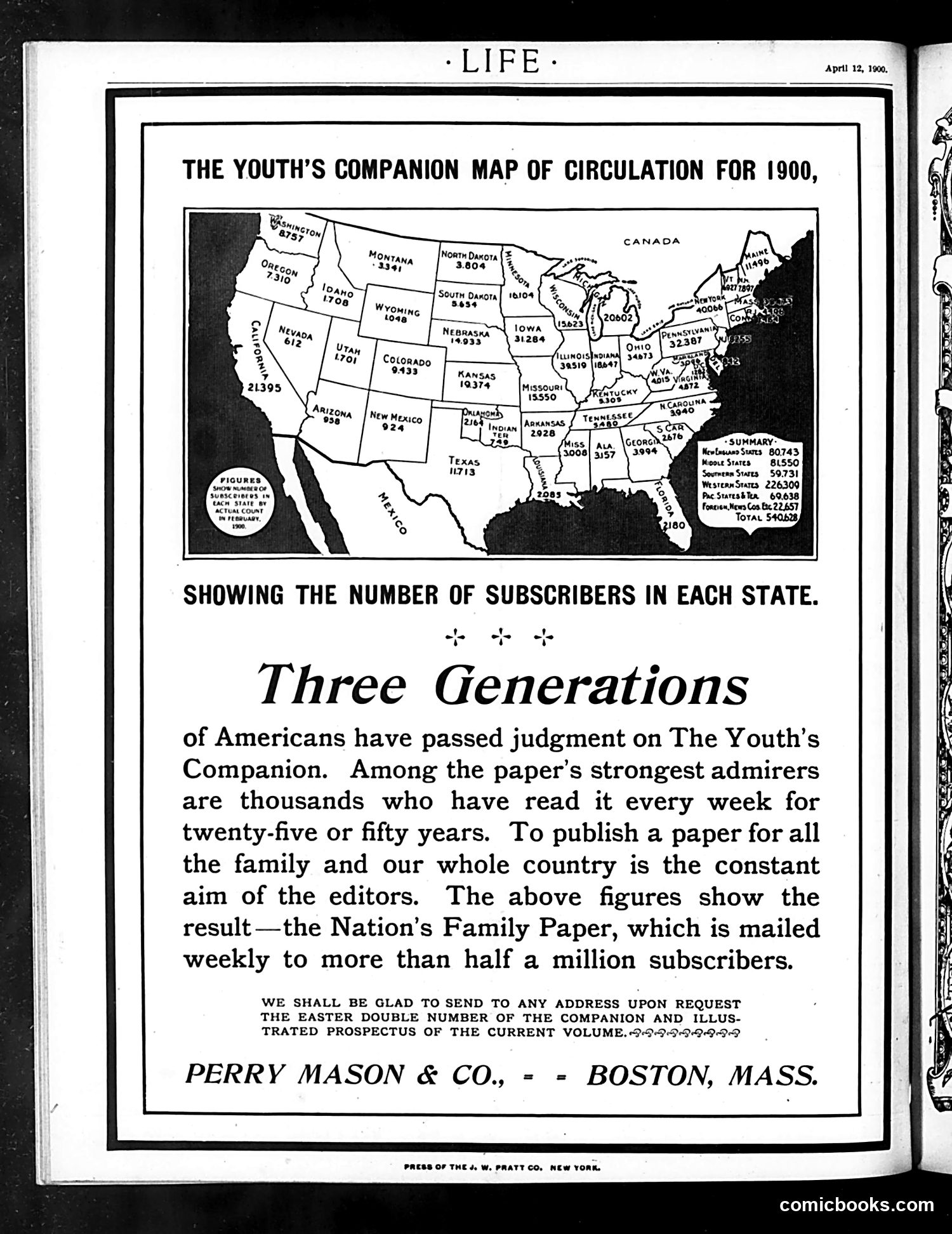
This page is primarily **advertising, not satire or political commentary**. It's a promotional advertisement for *The Youth's Companion*, a family magazine published by Perry Mason & Co. in Boston. The centerpiece is a U.S. map showing subscriber numbers by state as of 1900—a data visualization meant to demonstrate the publication's nationwide reach and commercial success. The accompanying text appeals to tradition and family values, claiming three generations of Americans have read the publication weekly for 25-50 years, positioning it as "the Nation's Family Paper." The ad emphasizes the magazine's circulation (over half a million subscribers) as proof of quality and trustworthiness. This is straightforward commercial promotion using geographical distribution data and appeals to longevity and broad appeal—marketing tactics common in turn-of-the-century American print media.