
Life, 1900-04-12 · page 7 of 20
Life — April 12, 1900 — page 7: what you’re looking at
What you’re looking at
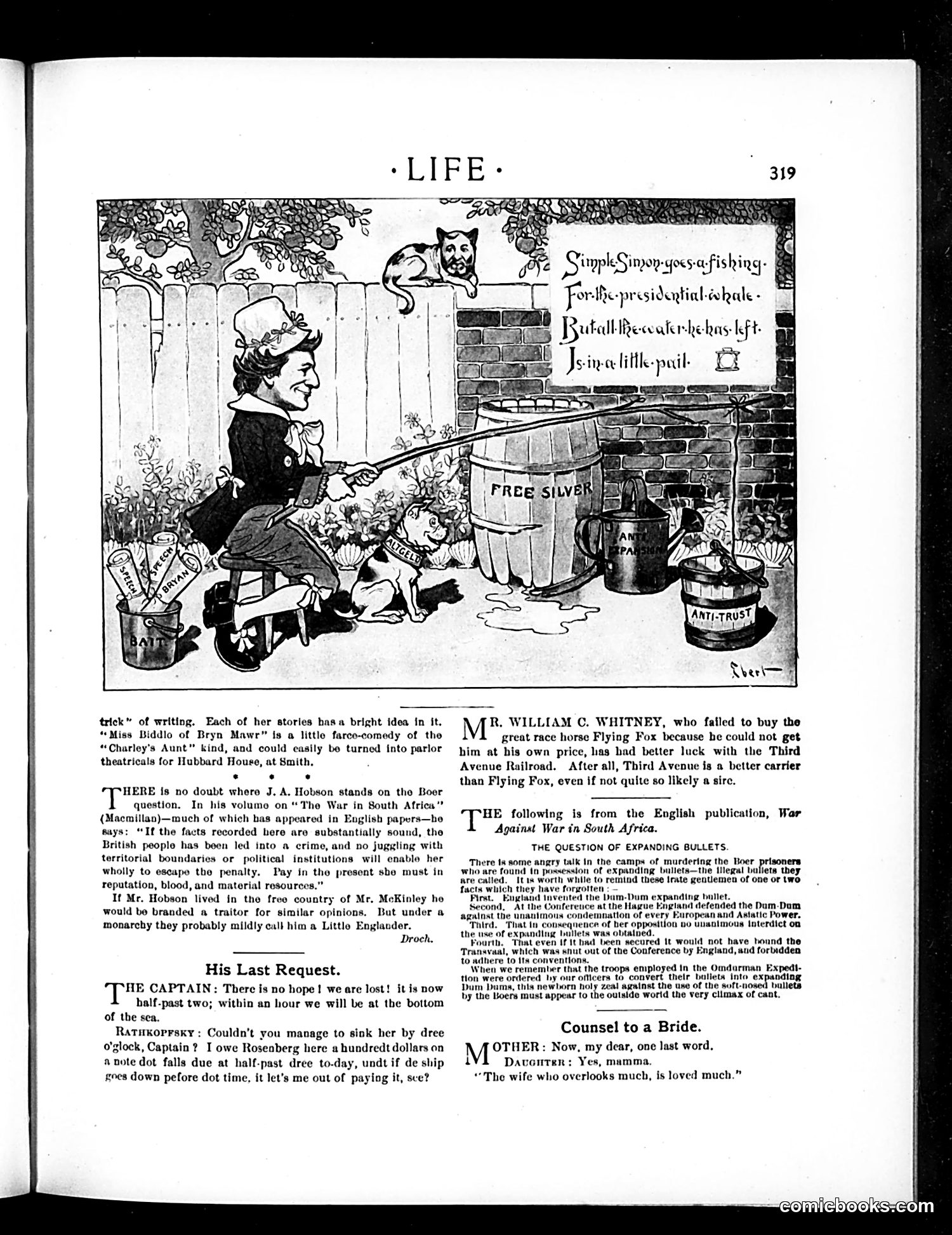
The main cartoon depicts a woman fishing in a barrel labeled "FREE SILVER" while cats labeled "ANTI-TRUST" surround her. The accompanying text references political debates of the era. The satire appears to criticize monetary policy and trust-busting efforts—likely from the early 1900s based on the "Free Silver" reference (a major late-19th-century political issue). The woman represents either a political figure or the public being fooled by promises of "free silver" while corporate monopolies ("anti-trust" concerns) lurk nearby as threats. The poem above suggests political naiveté: Simple Simon goes fishing "for the presidential whale" but "Rueful Reuben has been left / Is in a little putt," mocking those pursuing unrealistic political goals. The page also contains anecdotes about notable figures and unrelated satirical pieces, typical of *Life* magazine's format.
📄 Transcribed text from this page (OCR, searchable)
Machine-transcribed from the original scan — historical spelling and the odd misread are preserved.
trick” of writing. “Miss Biddlo of Bryn Mawr” is a little farco-comedy of the “Charley's Aunt” kind, and could easily be turned into parlor theatricals for Hubbard House, at Smith, * 6« «6 HERE is no doubt whoro J. A. Hobson stands on tho Boor question. In his volume on“ The War in South Africa’? (Macmillan)—much of which bas appeared in English papers—bo says: “If the facts recorded here aro substantially sound, tho British people has been led into a crime, and no juggling with territorial boundaries or politica! institutions will enable her wholly to escape the penalty. Pay in the present sbe must in reputation, blood, and material resources.” It Mr. Hobson lived in the free country of Mr. McKinley ho would be branded a traitor for similar opinions, But under a monarchy they probably mildly call him a Little Englander. Droch. His Last Request. HE CAPTAIN: There is no hope! we are lost! it is now half-past two; within an hour we will be at the bottom of the sea, Ratikoprsky : Couldn’t you manage to sink her by dree o'glock, Captain? I owe Roseoberg here a hundredt dollars on a note dot falls due at half-past dree to-day, undt if de ship goes down pefore dot time, it let’s me out of paying it, sve? Each of her stories basa bright idea in it. Simpl Simor-goesafishing : Forti presidential cokale : Butealt Recoalerkekas: left R, WILLIAM C. WHITNEY, who failed to buy the I great race horse Flying Fox because he could not get him at bis own price, has bad better luck with the Third Avenue Railroad. After all, Third Avenue is a better carrier than Flying Fox, even if not quite so likely a sire. HE following is from the English publication, War Against War in South Africa. THE QUESTION OF EXPANDING BULLETS. ‘There 14 some angry talk In the camps of murdering the Boer prisoners who are found tn possession of expanding bullets—the tlegal bullets they are called. It ta worth while to remind these Irate genUemen of one or two facts which they have forgotten : — pugland invented the Dam-Dum expanding bullet. Second, At the C at the Hague England defended the Dum-Dam agalnst the unautmous condemnation of every European and Astatic Power. ‘Third. That in conseqnence of her opposition bo unanimous Ioterdict on the use of expanding bullets was obtained. Fourth, That even if Chad been secured It would not have hound the vaal, which was «nut out of the Conference by England, and forbidden to adhere to It# conventions. When we remember that the troops employed In the Omdarman Expedt- tion were ordered by our officera to convert thelr balieta into expanding: Dum bums, this newborn holy zeal against the use of the soft-nosed bullets by the Boers must appear to the outside world the very climax of cant, Counsel to a Bride. M OTHER: Now, my dear, one last word. Davonten: Yes, mamma. “The wife who overlooks much, is loved much.”