
Life, 1900-04-12 · page 4 of 20
Life — April 12, 1900 — page 4: what you’re looking at
What you’re looking at
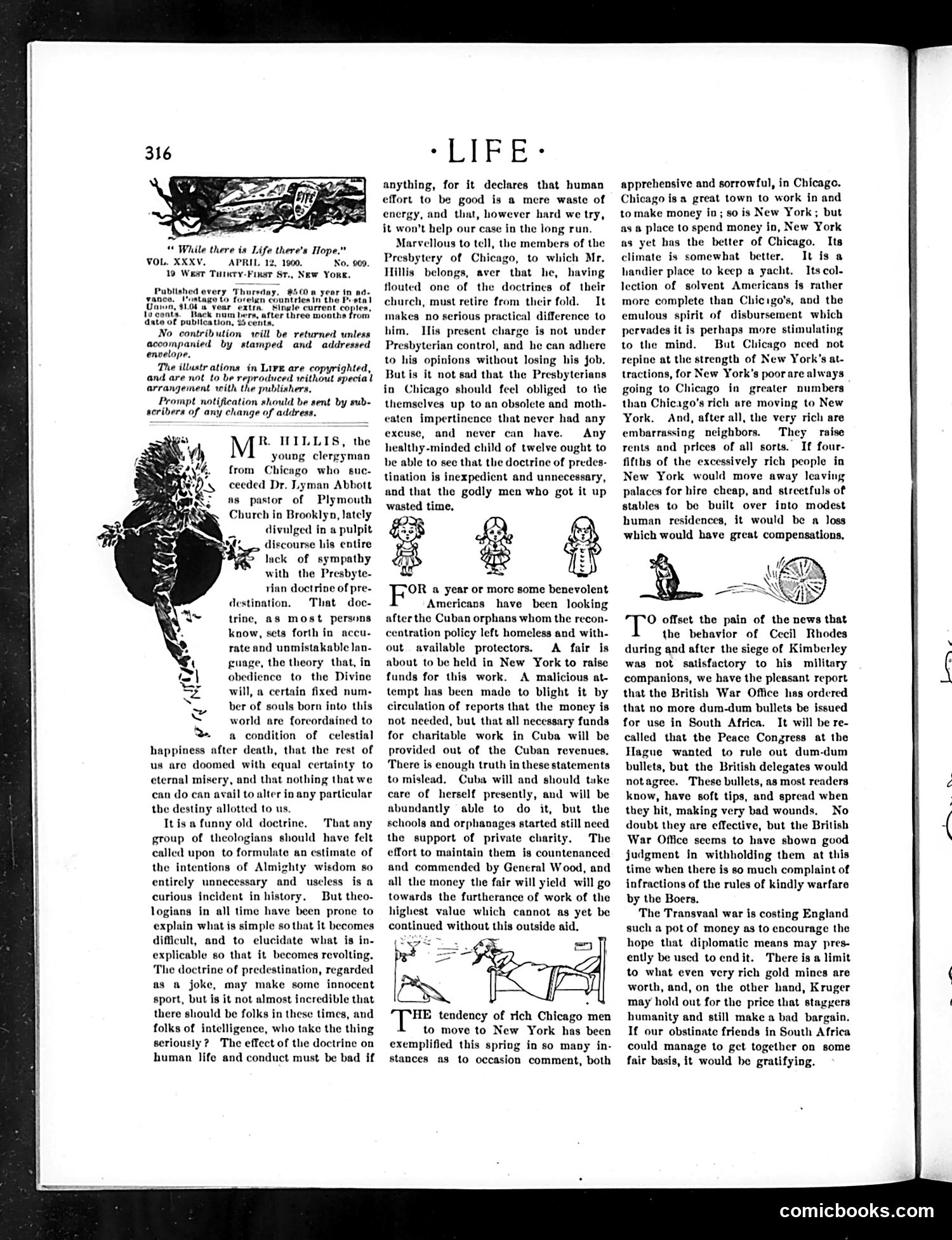
This page contains satirical editorial commentary rather than political cartoons. The main article critiques **Mr. Hillis**, a young Chicago clergyman from a church in Brooklyn, who recently delivered a sermon attacking Presbyterian doctrine—specifically the concept of predestination. The satire mocks Hillis for declaring Presbyterian theology "inexplicable and unnecessary," arguing such bold theological criticism from a young minister is foolish and dangerous to organized religion. The page also discusses wealthy Chicagoans relocating to New York (suggesting Chicago's declining prestige), Cuba's orphan crisis following American intervention, and Cecil Rhodes's conduct during the Kimberley siege. The small illustrations are decorative rather than satirical commentary.
📄 Transcribed text from this page (OCR, searchable)
Machine-transcribed from the original scan — historical spelling and the odd misread are preserved.
“ While there is Life there's Hope." VOL. XXXV. APRIL 12, 1900. 19 Wesr Tutwry-Finst Sr, Published every ‘Thursday. ‘08 year in ad~ vance. Mustage to foreign countries in the Pestal Uniwn, $1.06 & year extra. Single current copies, lg cents. Back num bers, after three months from dato of publication, 35 cents, No contribution will be returned unless accompanied by stamped and addressed envelope. The illustrations in Live are copyrighted, and are not to be reproduced without special arrangement with the publishers, Prompt notification should be sent by sub- scribers of any change of address. M* WILLIS, the young clergyman Z, from Chicago who suc. )s\ ceeded Dr. Lyman Abbott as pastor of Plymouth Church in Brooklyn, lately divulged in a pulpit * discourse his entire > lack of sympathy with the Presbyte- rian doctrine of pre- destination, That doc- trinec, as most persons know, sets forth in accu- rate and unmistakable Jan- guage, the theory that, in obedience to the Divine will, a certain fixed num- ber of souls born into this world are foreordained to 2% a condition of celestial happiness after death, that the rest of us are doomed with equal certainty to eternal misery, and that nothing that we can do can avail to alter in any particular the destiny allotted to us. It isa funny old doctrine. That any group of theologians should have felt called upon to formulate an estimate of the intentions of Almighty wisdom so entirely unnecessary and useless is a curious incident in history. But theo- logians in all time have been prone to explain what is simple so that it becomes difficult, and to elucidate what is in- explicable so that it becomes revolting. The doctrine of predestination, regarded as a joke, may make some innocent sport, but is it not almost incredible that there should be folks in these times, and folks of intelligence, who take the thing seriously? The effect of the doctrine on human life and conduct must be bad if *LIFE- anything, for it declares that human effort to be good is a mere waste of energy, and that, however hard we try, it won't help our case in the long run. Marvellous to tell, the members of the Presbytery of Chicago, to which Mr. Hillis belongs, aver that he, having flouted one of the doctrines of their church, must retire from their fold. It makes no serious practical difference to him, His present charge is not under Presbyterian control, and he can adhere to his opinions without losing his job. But is it not sad that the Presbyterians in Chicago should feel obliged to tie themselves up to an obsolete and moth- eaten impertinence that never had any excuse, and never can have. Any healthy-minded child of twelve ought to be able to sec that the doctrine of predes- tination is inexpedient and unnecessary, and that the godly men who got it up wasted time, ‘S) iy. ‘OR a year or morc some benevolent Americans have been looking afterthe Cuban orphans whom the recon- centration policy left homeless and with- out available protectors. A fair is about to be held in New York to raise funds for this work. A malicious at- tempt has been made to blight it by circulation of reports that the money is not needed, but that all necessary funds for charitable work in Cuba will be provided out of the Cuban revenues, There is enough truth in these statements to mislead, Cuba will and should tuke care of herself presently, and will be abundantly able to do it, but the schools and orphanages started still need the support of private charity. The effort to maintain them is countenanced and commended by General Wood, and all the money the fair will yield will go towards the furtherance of work of the highest value which cannot as yet be continued without this outside aid. oe E = lan are tendency of rich Chicago men to move to New York has been exemplified this spring in so many in- stances as to occasion comment, both apprehensive and sorrowful, in Chicago. Chicago is a great town to work in and to make money in; so is New York; but as a place to spend money in, New York as yet has the better of Chicago. Its climate is somewhat better, It is a handier place to keep a yacht. Its col- lection of solvent Americans is rather more complete than Chicigo’s, and the emulous spirit of disbursement which pervades it is perhaps more stimulating to the mind. But Chicago need not repine at the strength of New York’s at- tractions, for New York's poorare always going to Chicago in greater numbers than Chicago's rich are moving to New York. And, after all, the very rich are embarrassing neighbors. They raise rents and prices of all sorts. If four- fifths of the excessively rich people in New York would move away leaving palaces for hire cheap, and streetfuls of stables to be built over into modest human residences, it would be a loss which would have great compensations, 'O offset the pain of the news that the behavior of Cecil Rhodes during and after the siege of Kimberley was not satisfactory to his military companions, we have the pleasant report that the British War Office has ordered that no more dum-dum bullets be issued for use in South Africa. It will be re- called that the Peace Congress at the Hague wanted to rule out dum-dum bullets, but the British delegates would notagree. These bullets, as most readers know, have soft tips, and spread when they hit, making very bad wounds, No doubt they are effective, but the British War Office seems to have shown good judgment in withholding them at this time when there is so much complaint of infractions of the rules of kindly warfare by the Boers. The Transvaal war is costing England such a pot of money as to encourage the hope that diplomatic means may pres- ently be used to endit. There is a limit to what even very rich gold mincs are worth, and, on the other hand, Kruger may hold out for the price that staggers humanity and still make a bad bargain. If our obstinate friends in South Africa could manage to get together on some fair basis, it would be gratifying. comicbooks.com