
Life, 1900-04-12 · page 12 of 20
Life — April 12, 1900 — page 12: what you’re looking at
What you’re looking at
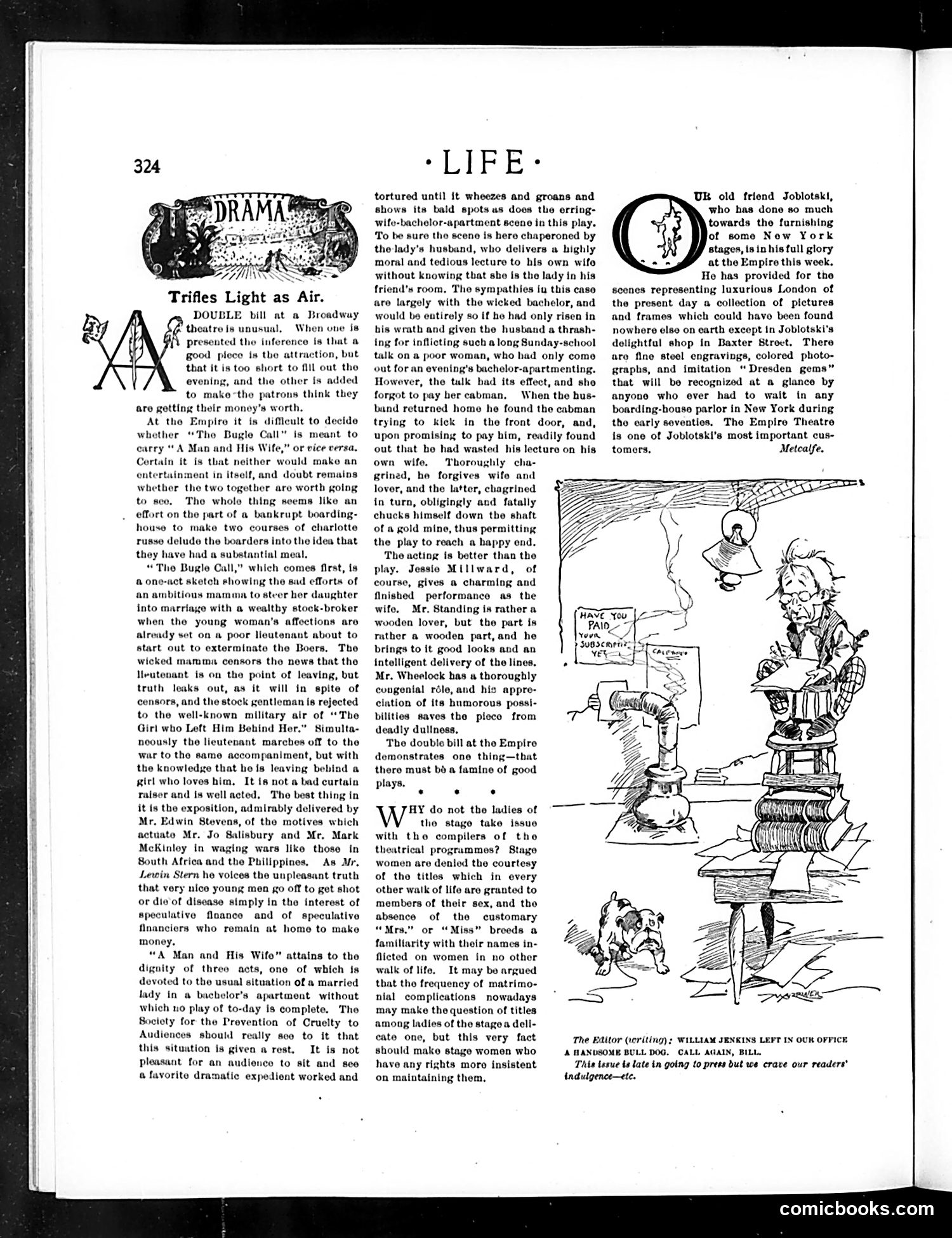
This page reviews Broadway theatrical productions, specifically critiquing "Trifles Light as Air" at the Empire Theatre. The main illustration depicts a caricatured theater critic sitting atop a precariously stacked pile of books, papers, and theatrical materials, appearing overwhelmed and comically unstable—a visual metaphor for critics drowning in theatrical programming. The satire targets the theatrical establishment's apparent indifference to quality: the text notes that stage women lack proper courtesy titles ("Mrs." or "Miss"), and criticizes how theatrical programs exploit actresses. The cartoonist mocks both the abundance of mediocre plays flooding Broadway and the critics forced to review them endlessly. The illustration's precarious tower suggests the unsustainable nature of constant theatrical production.
📄 Transcribed text from this page (OCR, searchable)
Machine-transcribed from the original scan — historical spelling and the odd misread are preserved.
Trifles Light as Air. DOUBLE bill at a Broadway theatre is unusual, When one is presented the inference is that a good pleco is the attraction, but that it is too short to fill out the evening, and the other is added to mako-the patrons think they are gotting their money’s worth, At the Empire it is diMfleult to decide whether “Tho Bugle Call” is meant to carry “A Man and His Wife,” or vice versa, Certain it is that neither would make an entertainment in itself, and doubt remains whether the two together are worth going to seo, The whole thing seems like an effort on the part of a bankrupt boarding- house to make two courses of charlotte russe delude the boarders into the idea that they have had a substantial meal, “The Bugle Call,” which comes first, is a one-act sketch showing the sad efforts of an ambitious mamma to steer her daughter into marriage with a wealthy stock-broker when the young woman's affections aro already set on a poor lieutenant about to start out to exterminate the Boers, Tho wicked mamma censors tho news that the Heutenant is on the point of leaving, but truth leaks out, as it will in spite of censors, and the stock gentleman is rejected to the well-known military air of “The Girl who Left Him Behind Her.” Simulta- neously the lieutenant marches off to the war to tho same accompaniment, but with the knowledge that he is leaving bebind a girl who loves him, It is not a bad curtain raiser and 1s well acted. Tho best thing in it is the exposition, admirably delivered by Mr, Edwin Stevens, of the motives which actuato Mr. Jo Salisbury and Mr. Mark McKinley in waging wars like those in South Africa and the Philippines, As Mr. Lewin Stern ho voices the unpleasant truth that very nico young men go off to get shot or die of disease simply in the interest of speculative floance and of speculative financiers who remain at home to mako money. “A Man and His Wife” attains to the dignity of three acts, one of which ts devoted to the usual situation of a married lady in a bachelor’s apartment without which no play of to-day Is complete. The Bocioty for the Prevention of Cruelty to Audiences should really see to it that this situation is given a rest, It is not pleasant for an audience to sit and seo 4 favorite dramatic expedient worked and LIFE tortured until {t wheezes and groans and shows its bald spots as does the erring- wife-bachelor-apartment sceno in this play. ‘To be sure the scene is hero chaperoned by the lady's husband, who delivers a highly moral and tedious lecture to his own wifo without knowing that she fs the lady in his friend's room, The sympathies iu this caso aro largely with the wicked bachelor, and would be entirely so if be had only risen in bis wrath and given the husband a thrash- ing for inflicting such a long Sunday-school talk on a poor woman, who had only como out for an evening's bachelor-apartmenting. However, the tulk bad its effect, and sho forgot to pay her cabman, When the hus- band returned home he found the cabman trying to kick in the front door, and, upon promising to pay him, readily found out that ho had wasted his lecturo on his own wife, Thoroughly cha- grined, he forgives wife and lover, and the latter, chagrined in turn, obligingly and fatally chucks himself down the shaft of a gold mine, thus permitting the play to reach a happy end. Tho acting is better than tho play. Jessio Millward, of course, gives a charming and finished performance as the wife. Mr, Standing is rather a wooden lover, but the part is rather a wooden part,and hoe brings to It good looks and an Ee intelligent delivery of the lines. Mr. Wheelock bas thoroughly congenial réle, and his appre- ciation of its humorous possi- bilities saves the pleco from deadly dullness, Tho double bill at tho Empire demonstrates one thing—that there must bd a famine of good plays, . . HY do not tho ladies of the stage take issue with the compilers of the theatrical programmes? Stago women are denied the courtesy of tho titles which in every other walk of life are granted to members of their sex, and tho absence of the customary “Mrs.” or “Miss” breeds a familiarity with their names in- flicted on women in no other walk of life, It may be argued that tho frequency of matrimo- nial complications nowadays may make the question of titles among ladies of tho stagoa dell- cate one, but this very fact should mako stage women who have any rights moro insistent on maintaining them, UE old friend Joblotski, who bas done so much towards tho furnishing lof some Now York stages, 1s in hisfull glory at the Empire this week. He has provided for tho scones representing luxurious London of the present day a collection of pictures and frames which could havo been found nowhere else on earth except in Joblotski's delighttal shop in Baxter Stroct. There aro fine steel engravings, colored photo- graphs, and imitation “Dresden gems” that will bo recognized at a glanco by anyone who ever had to walt in any boarding-bouso parlor in Now York during the early seventies, The Empiro Theatre is one of Joblotski’s most important cus- Metcalfe. tomers, Suasenrie The Editor (teriting); WILLIAM JENKINS LEFT IN OUR OFFICE A HANDSOME BULL DOG. Thta issue ts late in going Co press but we crave our readers’ indulgence—ete. CALL AGAIN, BILL, comicbooks.com