
A complete issue · 20 pages · 1898
Life — May 19, 1898
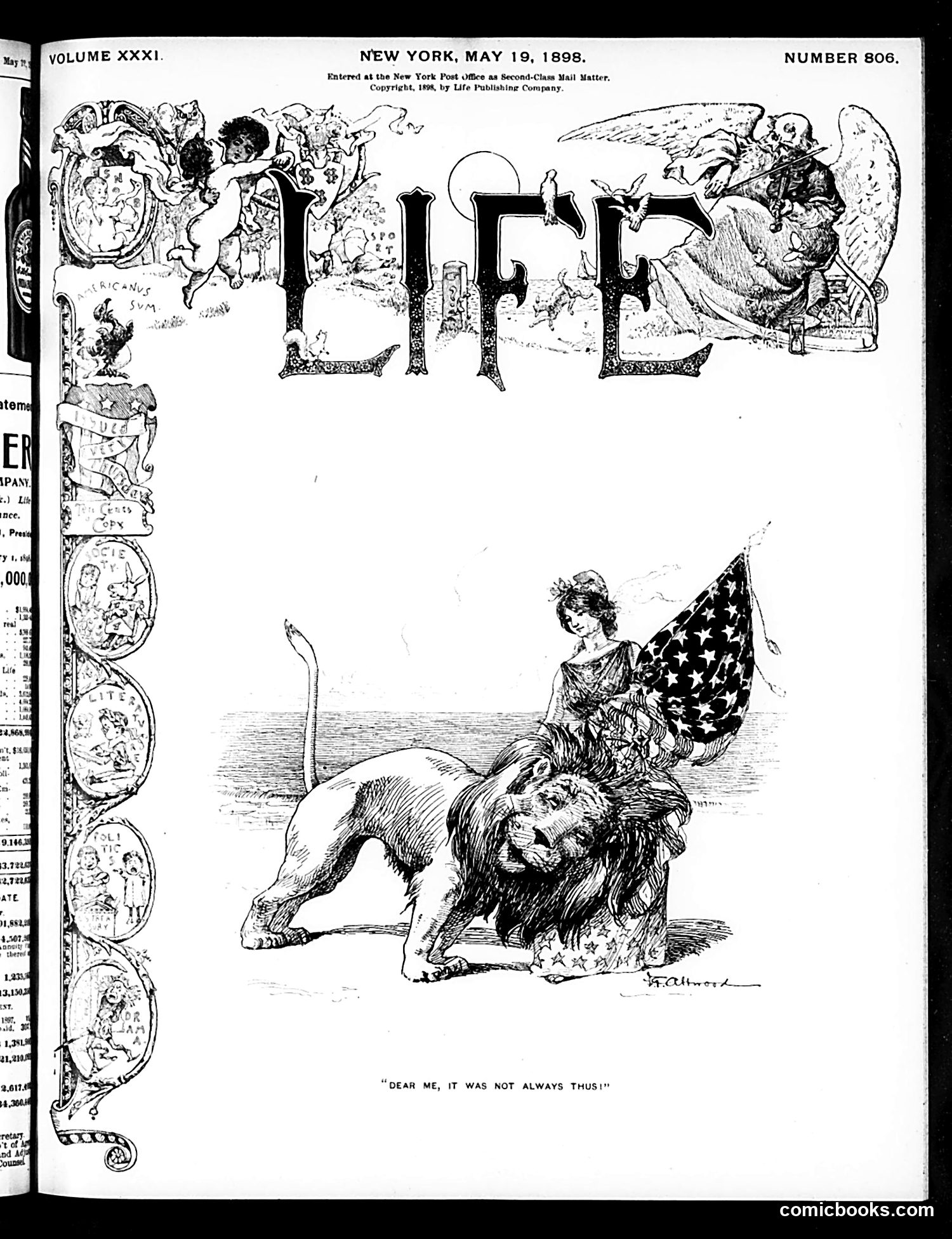
The main cartoon depicts a woman riding an aggressive bulldog wearing an American flag. The caption reads "DEAR ME, IT WAS NOT ALWAYS THUS!" This is political satire about American imperialism during the Spanish-American War (1898). The woman represents America or Liberty; the bulldog represents American military aggression or expansionist policy. The caption suggests nostalgia for a supposedly gentler, less militaristic past. The image critiques how quickly American foreign policy had become combative and expansionist. The flag-draped bulldog symbolizes American power now directed outward rather than inward—a dramatic shift the cartoonist presents ironically through the woman's surprised commentary that this wasn't "always" how things were.
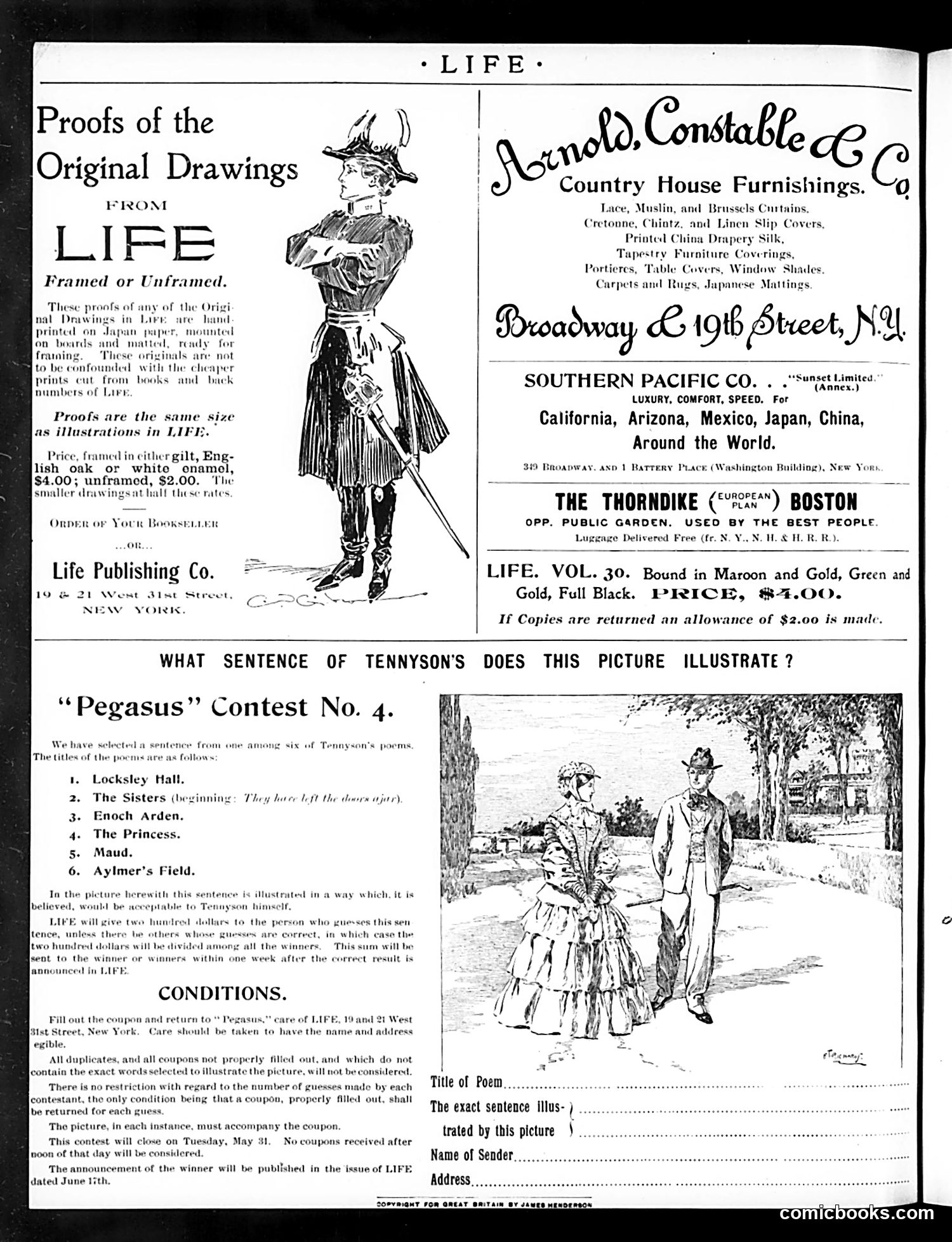
This page is primarily **advertising and a literary contest**, not political satire. The left side advertises Life magazine's framed artwork and the Life Publishing Company. The center contains ads for Arnold Constable furnishings, Southern Pacific railroad, and a Boston hotel. The main content is a **"Pegasus" Contest No. 4**: readers must match a Tennyson poem to an illustration showing a man and woman in period dress on a country road. Six poem titles are listed (Locksley Hall, The Sisters, Enoch Arden, The Princess, Maud, Aylmer's Field). Contestants fill out a coupon identifying which poem the picture illustrates. The winner receives publication in Life. This reflects the era's popular literary games and Life's role as a general-interest magazine combining humor, literature, and commerce.
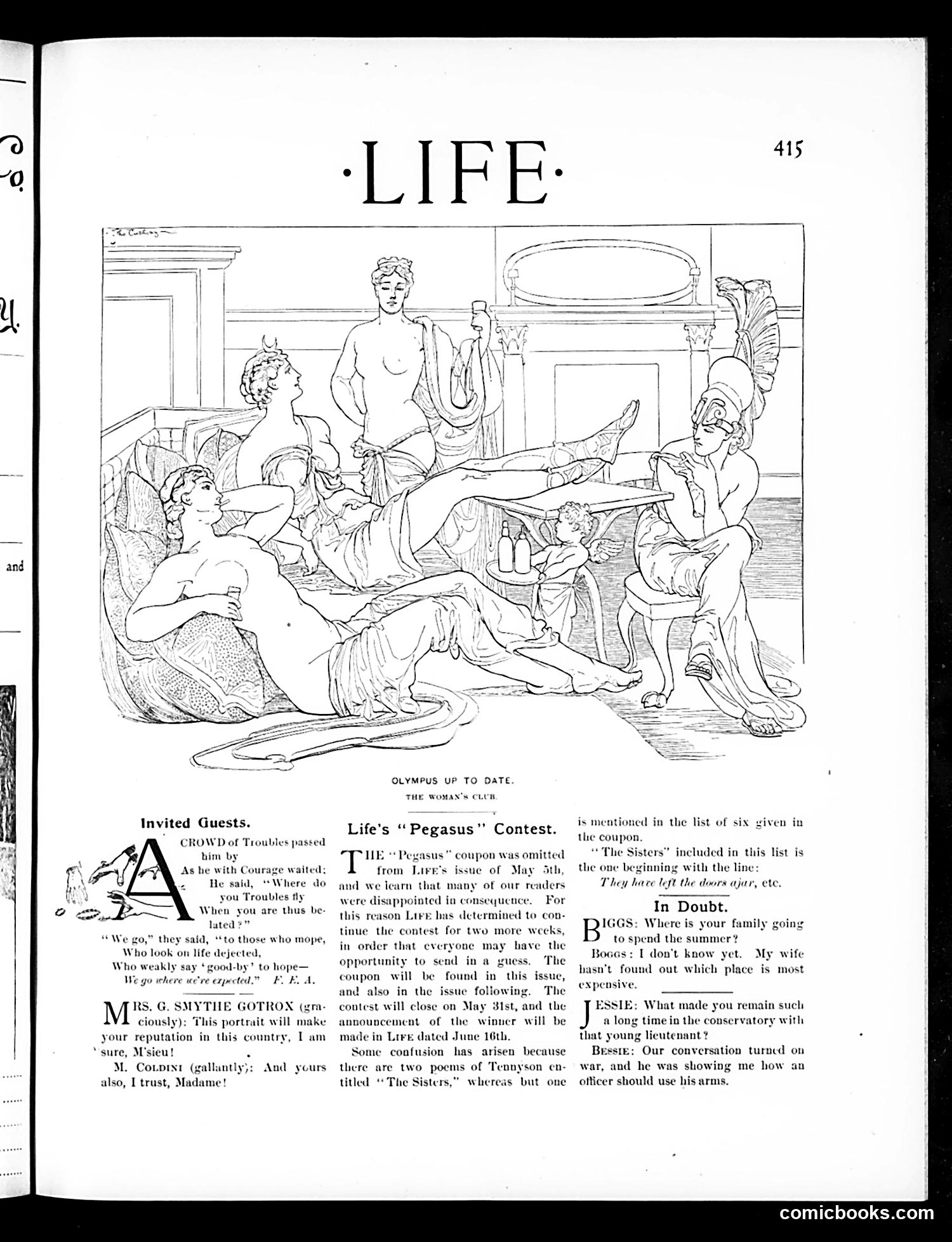
This page features "Olympus Up to Date: The Woman's Club," a satirical drawing depicting classical Greek/Roman gods and goddesses in a modern social setting, apparently at a women's club gathering. The cartoon mocks the pretensions of contemporary women's clubs by equating their members with mythological figures. The figures recline and socialize in classical poses, suggesting these organizations aspired to intellectual and cultural sophistication while actually engaging in idle gossip and socializing. The accompanying text discusses Life's "Pegasus" contest and includes humorous dialogue snippets mocking various social types—particularly women concerned with reputation, status, and trivial matters of etiquette and expense. The satire targets the earnest self-importance of women's clubs and their members' social pretensions during this era.
This page contains editorial commentary rather than cartoons. The text discusses the Spanish-American War, specifically addressing Commodore Dewey's naval victory at Manila. The author questions whether the U.S. Navy should receive sole credit for America's military success, arguing that Army regiments also performed competently. The second section critiques President McKinley's recent cabinet appointments, particularly the selection of Adlai Stevenson as Secretary of State (likely an error in the OCR or article). The writer suggests appointments should be based on merit rather than political patronage, and expresses concern about loyalty within the Republican administration. The illustration shows period military figures but lacks clear satirical punch without identifying specific individuals depicted.
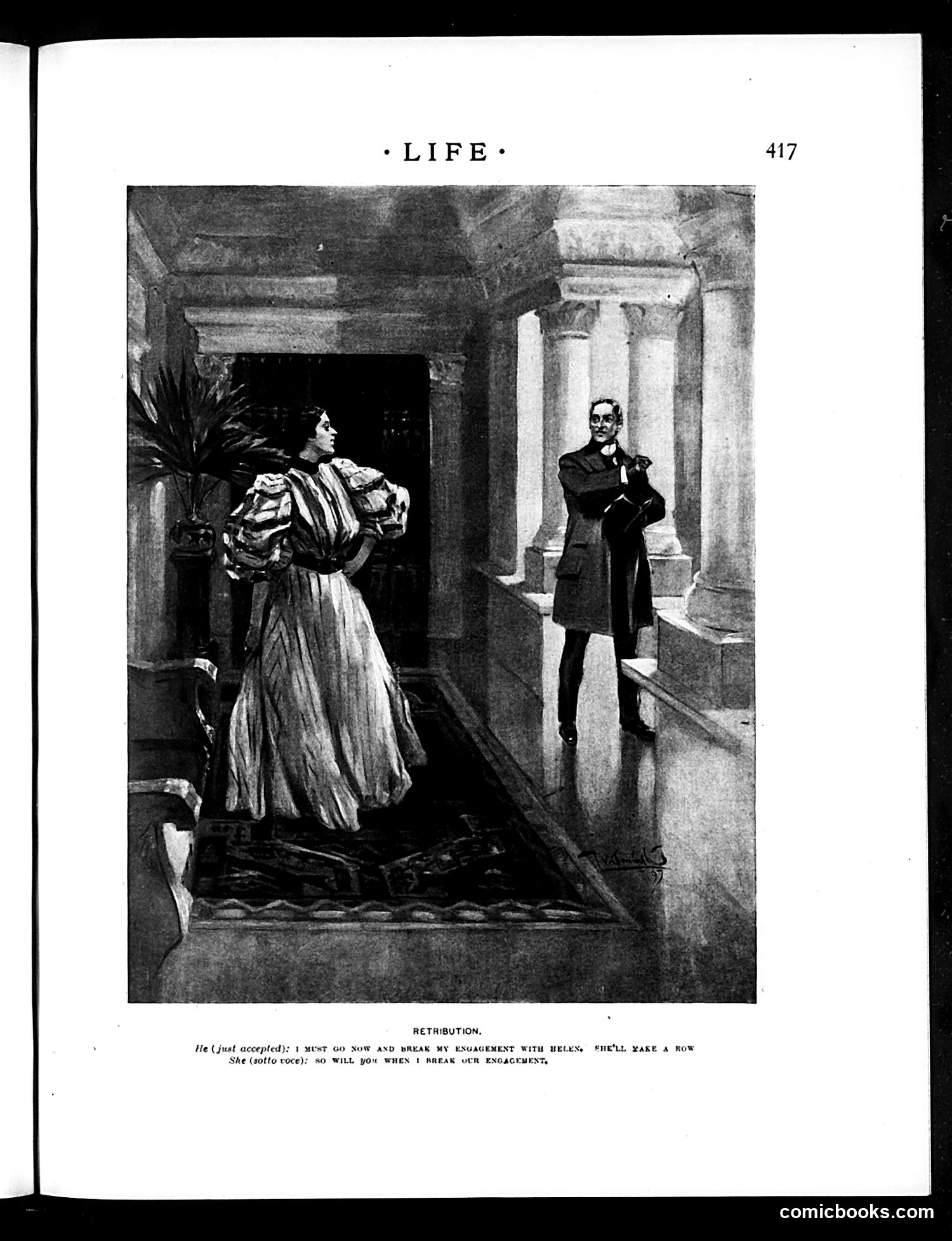
This illustration depicts a domestic conflict scene titled "Retribution." A woman in an elaborate, expensive-looking dress confronts a man in formal attire in what appears to be a classical interior with columns. The caption reads: "He (just accepted): 'I must do now and break my engagement with Helen. She'll make a row.' She (sotto voce): 'So will you when I break our engagement.'" The satire targets the social conventions and power dynamics of romantic engagements in early 20th-century America. The woman's threat of public retaliation ("make a row") represents her limited but potent social weapon—public embarrassment—against a man who wishes to abandon her for another woman. The joke hinges on the irony that both parties threaten the same consequence, suggesting mutual vulnerability despite apparent gender power imbalances of the era.
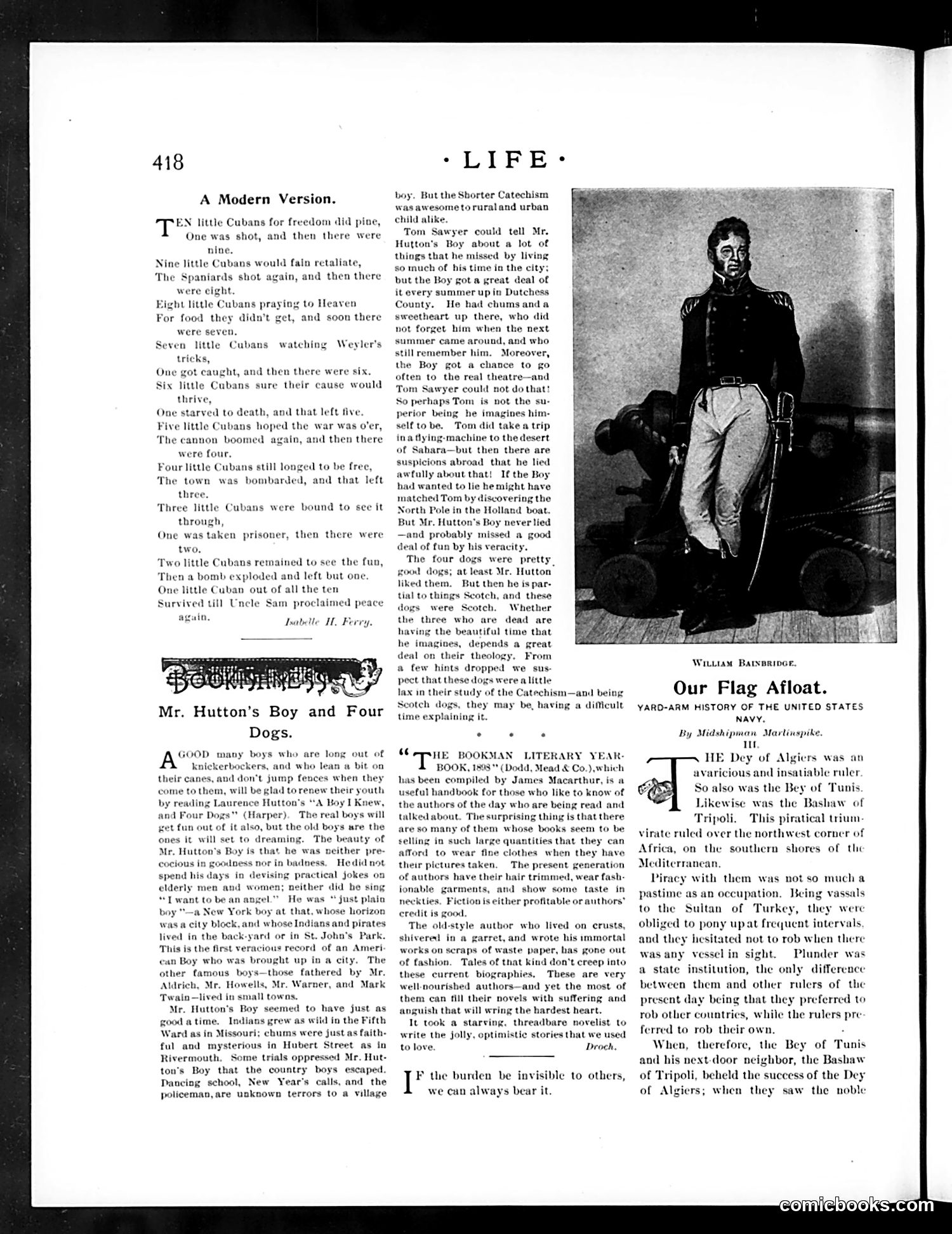
This page contains three distinct pieces, not political cartoons: 1. **"A Modern Version"** — A poem parodying "Ten Little Indians," counting down "little Cubans" through various wartime scenarios (shooting, starvation, capture). This appears to reference the Spanish-American War or Cuban independence conflict, satirizing the period's American involvement in Cuban affairs. 2. **"Mr. Hutton's Boy and Four Dogs"** — A sentimental narrative about a boy and his dogs during wartime, emphasizing patriotism and sacrifice. Not satirical. 3. **"Our Flag Afloat"** — A serious historical piece about the U.S. Navy, featuring William Bainbridge and discussing Mediterranean naval operations against Barbary pirates and the Bey of Algiers. The page mixes satire with straightforward patriotic content typical of Life magazine's era.
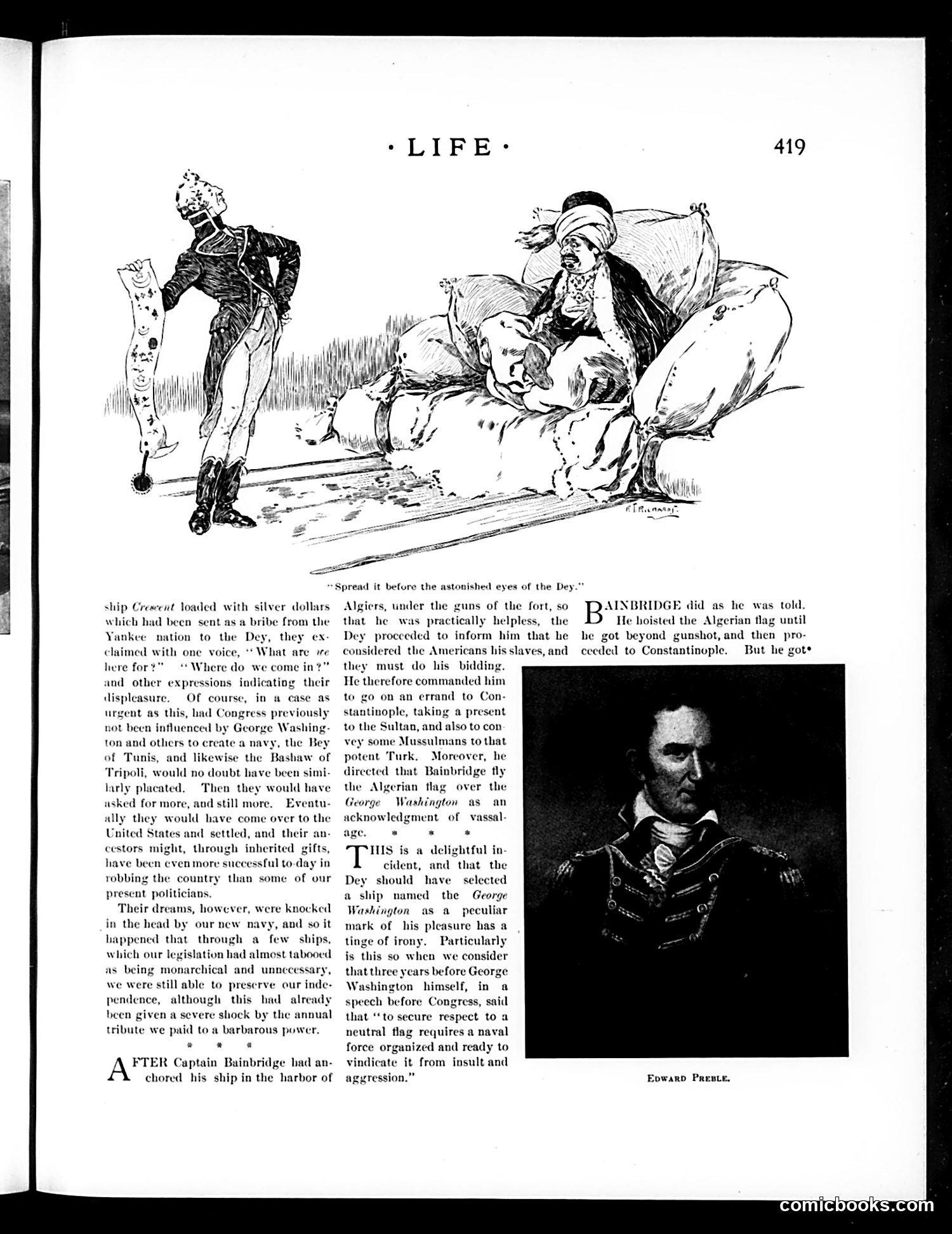
**The Cartoon:** The top illustration depicts a fashionable military officer showing off an ornate document to a group of peasants or common people huddled on the ground, captioned "Spread it before the astonished eyes of the Day." **The Context:** The accompanying text discusses Captain Bainbridge anchoring a ship in Tunis harbor. The ship was loaded with silver dollars as a bribe—the U.S. was essentially paying tribute to the Barbary States (North African powers) to avoid naval attacks. The article notes the irony that this appeasement contradicted American independence principles. **The Satire:** The cartoon mocks the humiliation of the young U.S. Navy, reduced to paying tribute to foreign powers rather than defending American interests militarily. The peasants' bewilderment suggests public embarrassment at this diplomatic capitulation.
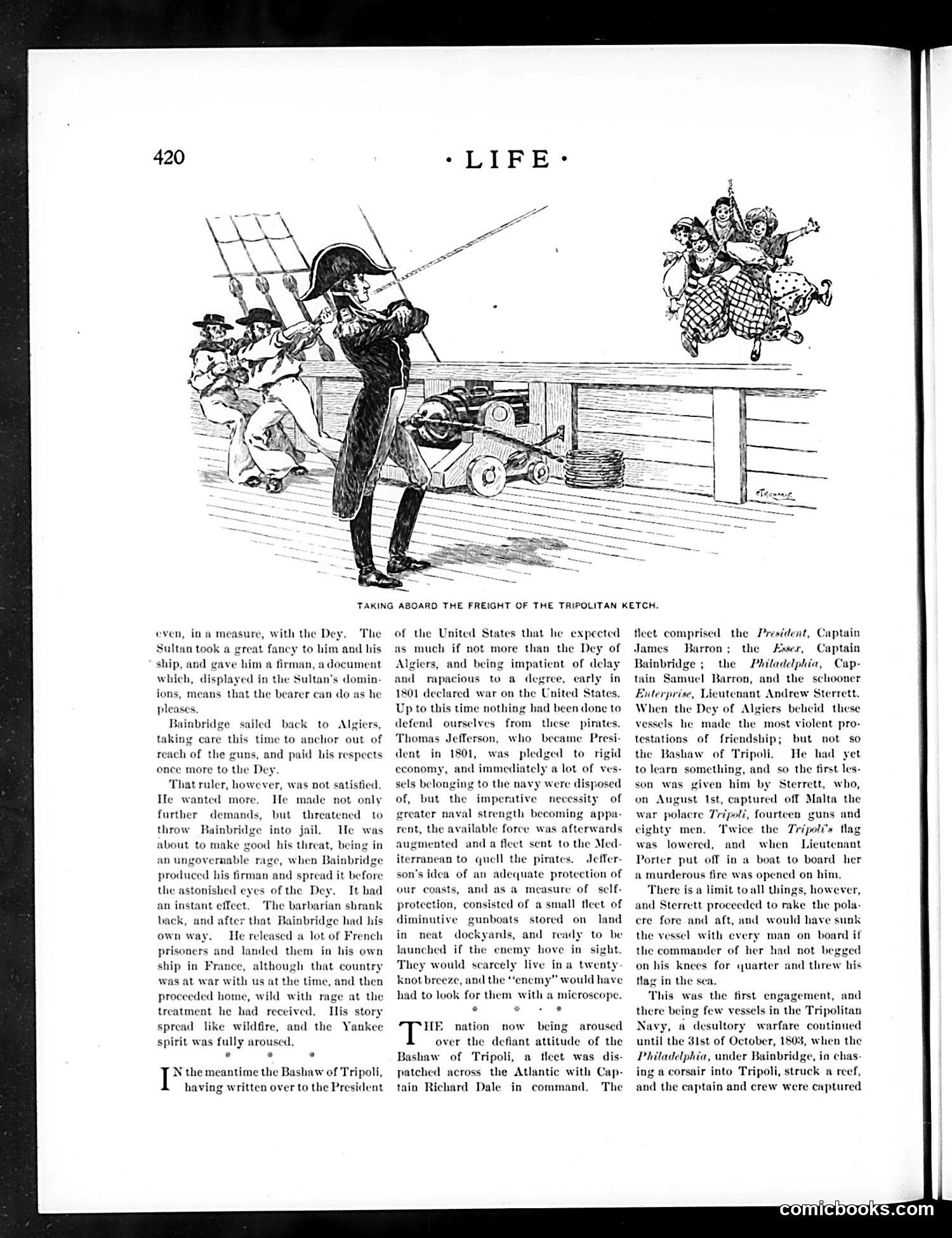
This cartoon satirizes early American naval conflicts with Barbary pirates (around 1801-1804, based on the text's reference to Thomas Jefferson). The central figure in Napoleon-style military dress appears to represent an American naval officer or official boarding a captured pirate vessel. The "freight" being loaded—depicted as cherubic figures on the right—likely represents prisoners or hostages. The joke plays on the double meaning of "freight" (cargo versus burden/responsibility). The text discusses Jefferson-era naval conflicts and references the Bashaw of Tripoli, indicating this mocks American efforts to deal with pirate threats while simultaneously suggesting the complications these conflicts created—treating military victories as if they were commercial transactions.
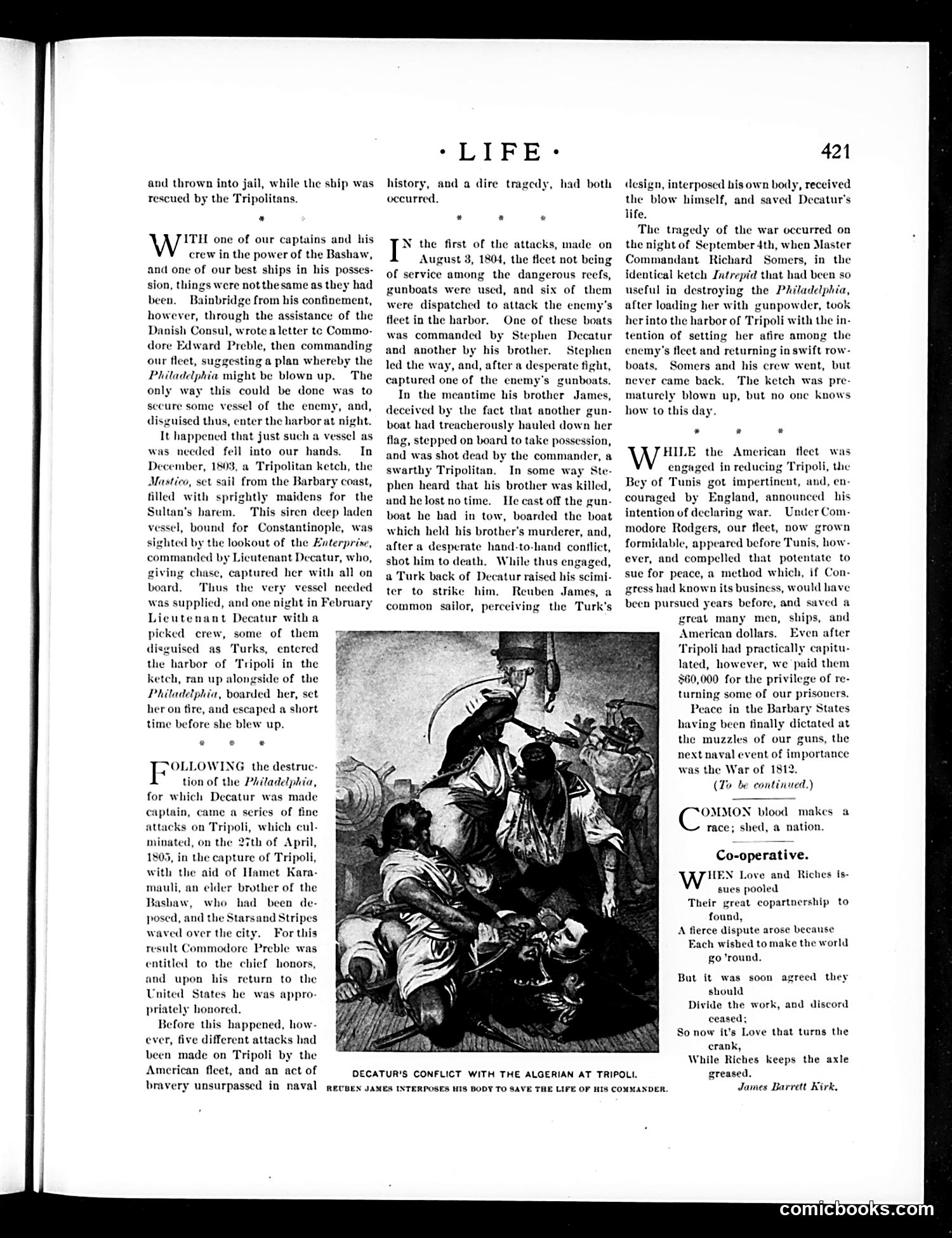
This page contains historical narrative about early 19th-century naval warfare, specifically describing attacks on Tripoli during the Barbary Wars (around 1804-1805). The central illustration depicts **Decatur's Conflict with the Algerian at Tripoli**, showing a dramatic hand-to-hand combat scene between American sailors and North African corsairs. The text describes Captain Decatur's military operations against Barbary pirates and discusses subsequent American naval conflicts, including references to the War of 1812. The article concludes with a lighthearted poem titled "Co-operative" by James Barrell Kirk about Love and Riches. This is not satire but rather historical journalism paired with patriotic narrative and unrelated verse—typical of Life's mixed-content format from this era.
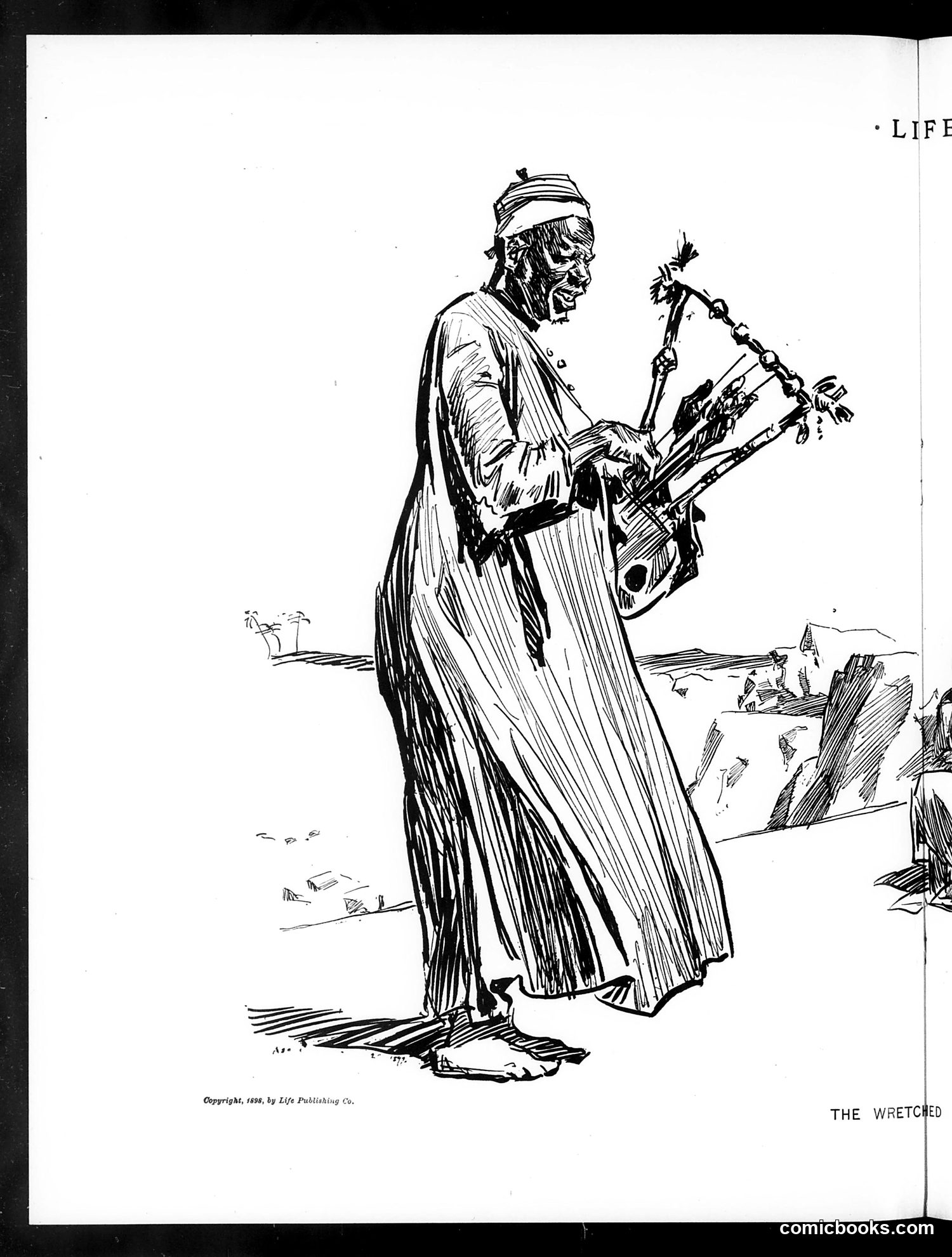
This political cartoon depicts an elderly, gaunt figure in robes holding a stringed instrument (appears to be a lute or similar) in what seems to be a devastated landscape with ruins in the background. The title "The Wretched" suggests social commentary on poverty or misery. The figure's skeletal appearance, tattered clothing, and desolate surroundings indicate he represents the downtrodden poor or displaced persons. The musical instrument is unclear in its symbolic meaning—possibly suggesting the "song" of the suffering, or perhaps ironically contrasting artistic refinement with material destitution. Without dating or attribution details visible, the specific historical context remains unclear, though the artistic style suggests early-to-mid 20th century. The satire critiques the suffering of common people amid societal decay.
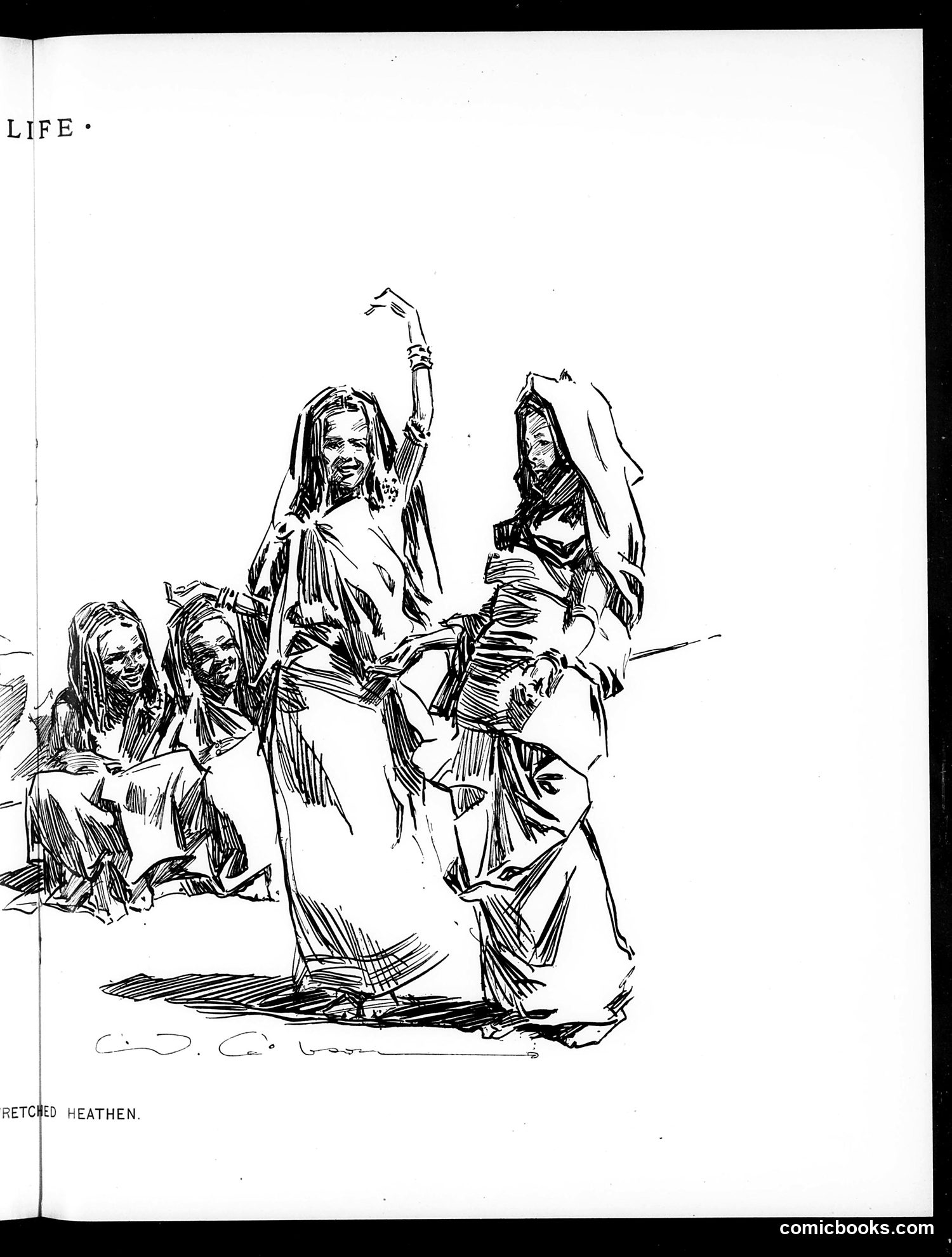
This sketch depicts what appears to be a religious or missionary scene, showing figures in robes or religious garments. The title "Retched Heathen" combines "wretched" with "retched" (vomited), creating a crude pun. The satire likely mocks 19th-century missionary efforts or religious conversion campaigns. The grouping—with some figures kneeling or subordinate while others stand elevated—suggests commentary on the power dynamics and condescension inherent in such missionary work. The crude wordplay in the title reinforces the satirical mockery. Without additional context about Life magazine's publication date, the specific figures remain unclear, but the cartoon appears to satirize contemporary attitudes toward religious conversion and the perceived arrogance of those undertaking missionary work.
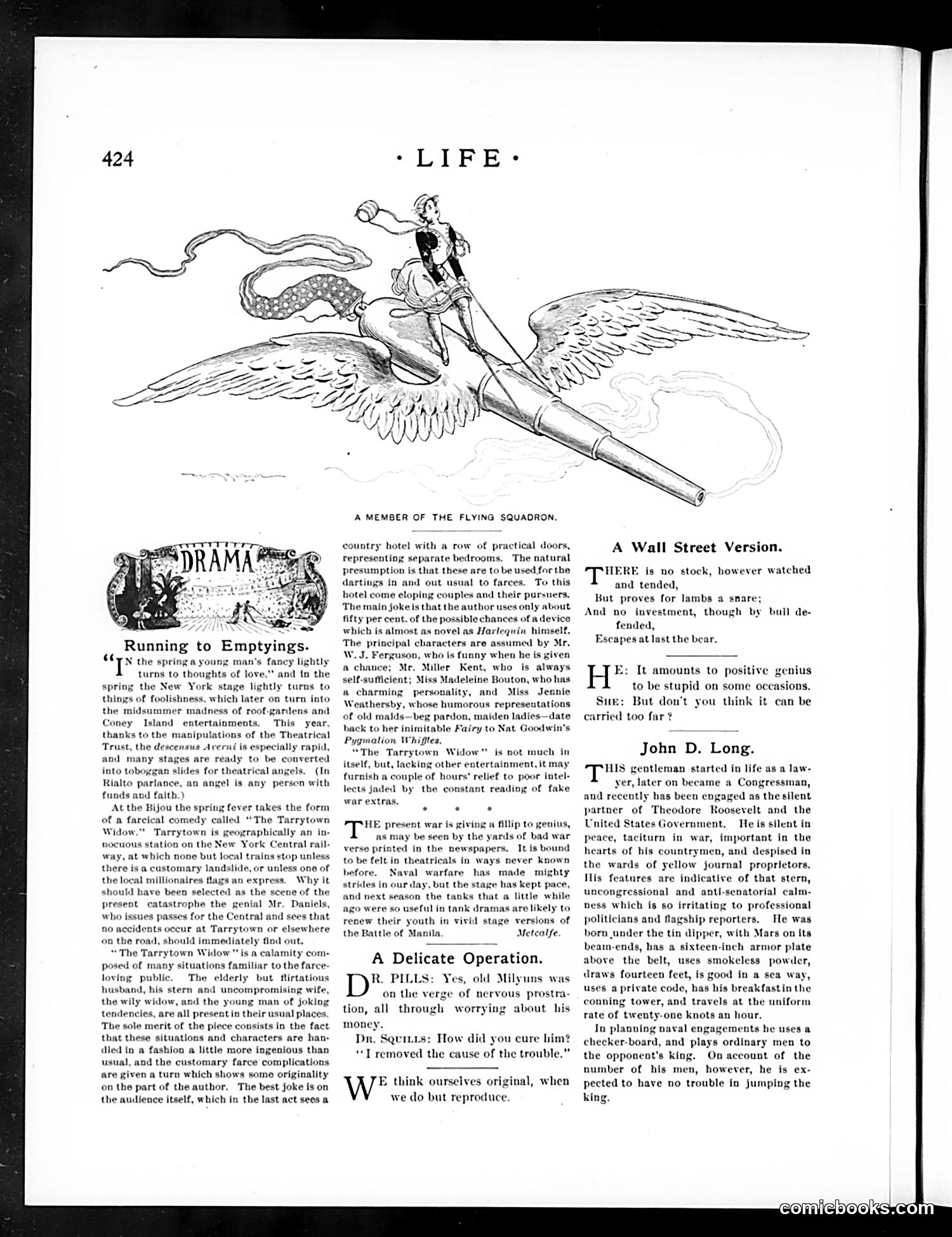
The main illustration shows a person riding a winged creature labeled "A Member of the Flying Squadron," satirizing aerial warfare during what appears to be World War I. The figure wields a sword and lasso, suggesting both military combat and theatrical absurdity. The page contains three separate articles critiquing theatrical productions. "Running to Emptyings" mocks a comedy's thin plot relying on slapstick. "A Wall Street Version" jokes about lambs as snares. "A Delicate Operation" features a dialogue between characters named Pills and Squills about curing nervousness through removing "the cause of trouble." These pieces exemplify Life magazine's satirical approach: blending commentary on contemporary entertainment, war, and social anxieties with witty wordplay and illustrated humor aimed at educated readers.
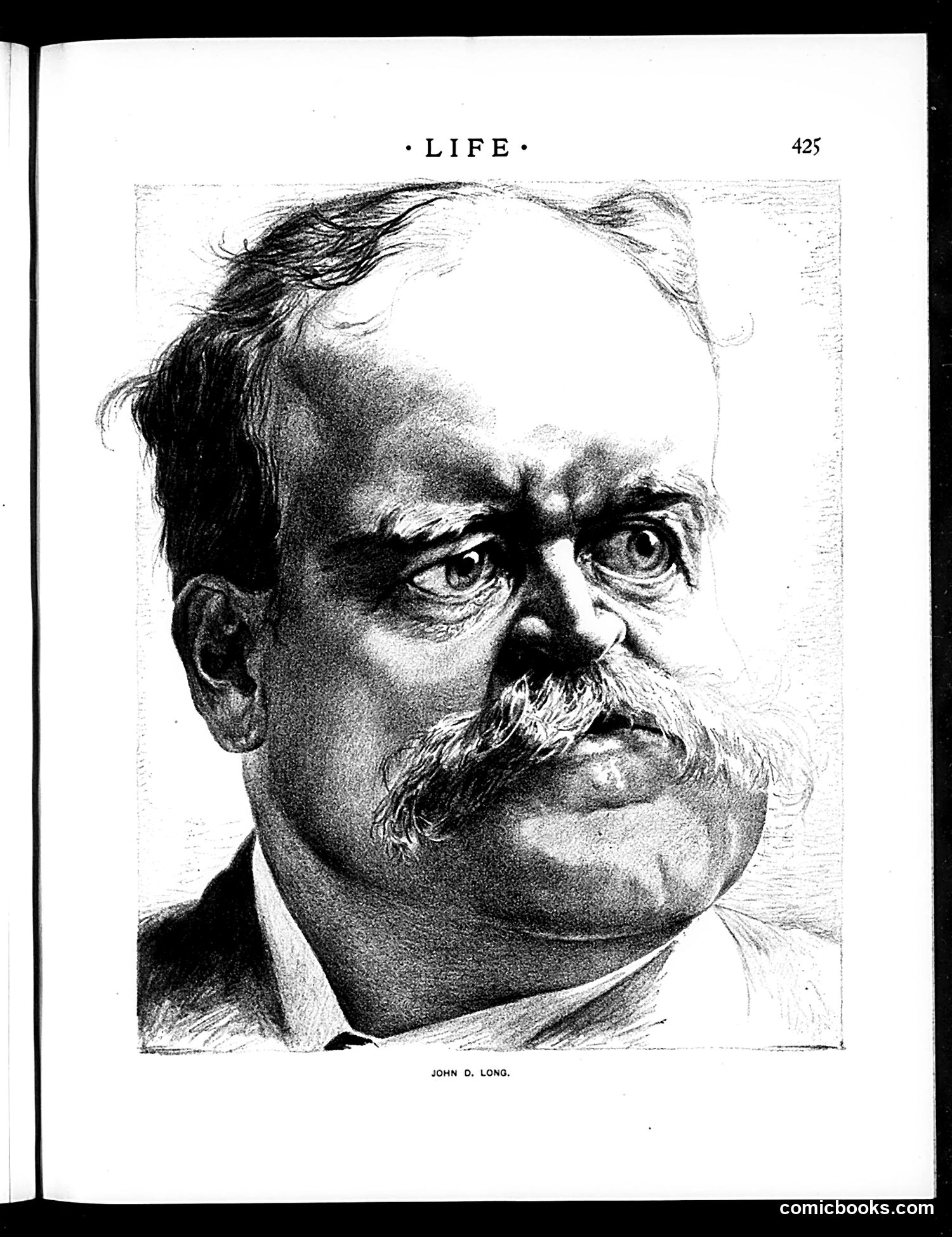
This page from *Life* magazine (page 425) presents a portrait sketch of **John D. Long**, identified by the caption below the image. The illustration is a serious biographical or editorial portrait rather than a satirical cartoon. Long appears to have been a notable public figure of the period, rendered in detailed pen-and-ink style typical of *Life*'s portraiture. Without additional context from surrounding articles on this page, I cannot determine the specific reason for his inclusion or what political/social commentary, if any, the portrait was meant to convey. The prominent placement suggests he was someone readers would recognize as significant to contemporary events or politics.
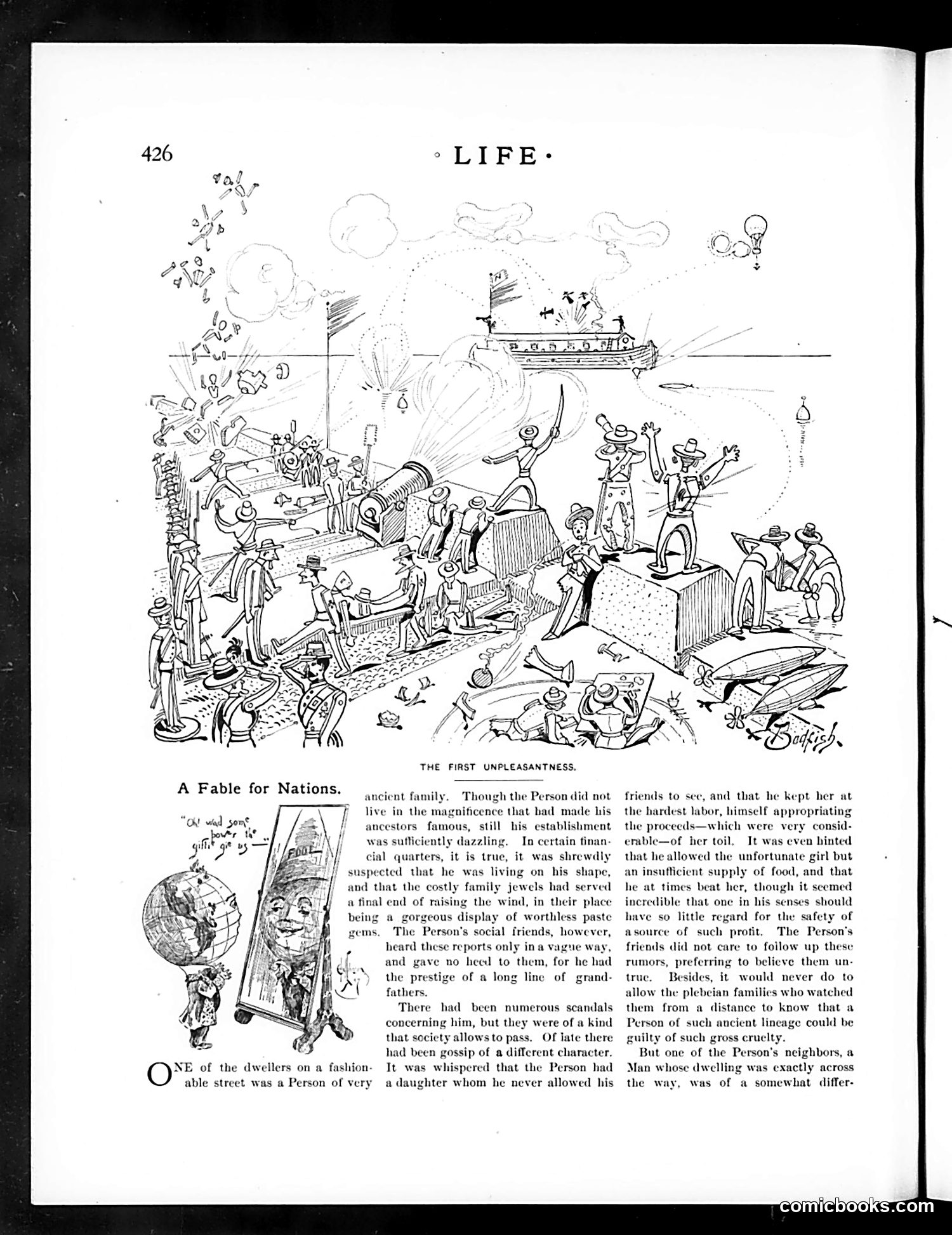
This is a fable satirizing wealthy aristocratic families maintaining false respectability while exploiting those beneath them. "The Person" represents an old-money family living on appearance rather than actual wealth—their "costly family jewels" have been sold, replaced by worthless paste. The central scandal concerns a hidden daughter kept in harsh labor, her earnings stolen by the father. The satirical point: the Person's social circle ignores obvious cruelty because acknowledging it would expose their own complicity in a corrupt system. They prefer comfortable lies to uncomfortable truths. The elaborate carnival-like illustration above depicts chaotic social activity—suggesting the shallow frivolity masking systemic abuse. This likely critiques Gilded Age exploitation and the deliberate blindness of polite society to industrial-era labor abuses, particularly of women and the working poor.
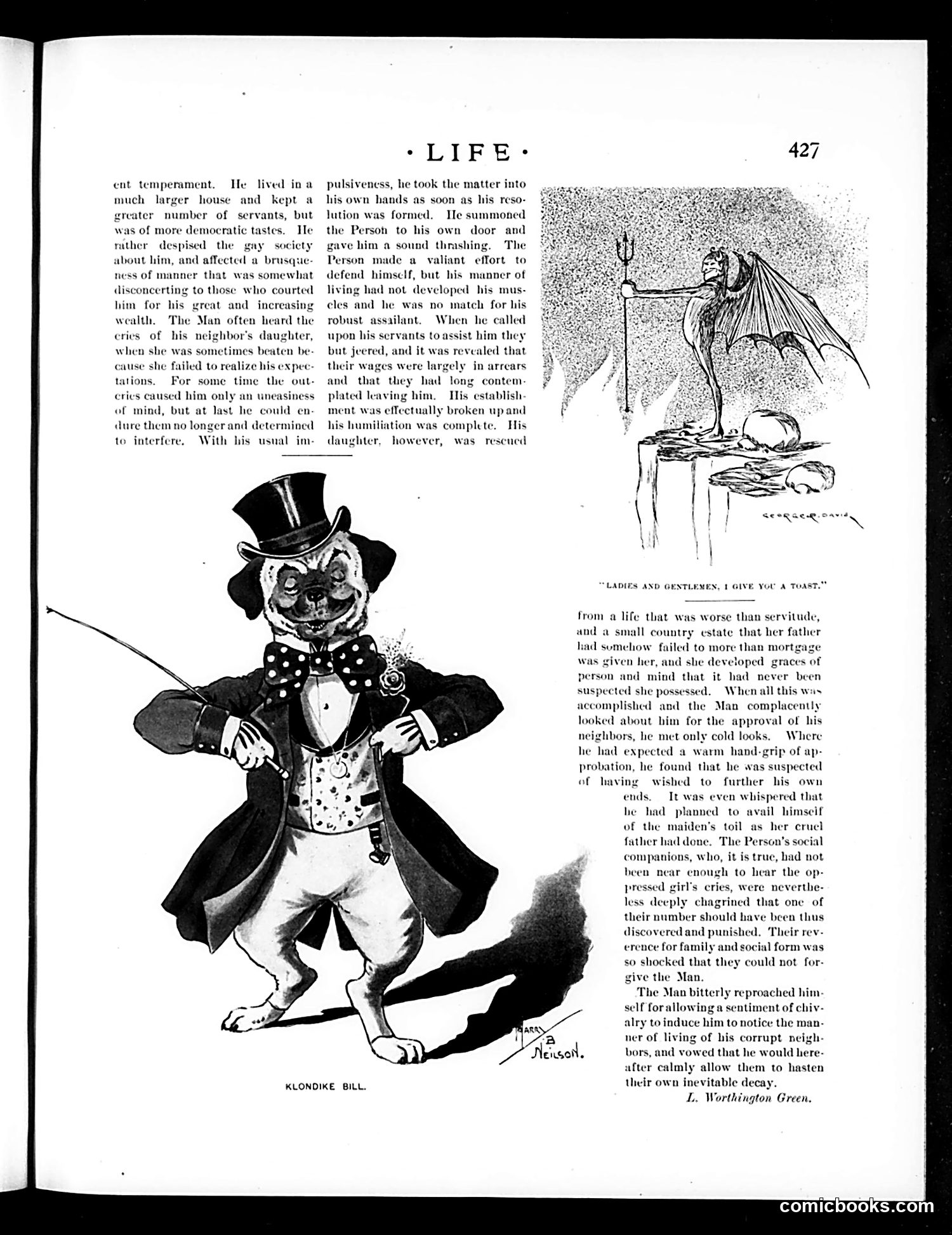
This page contains a moral fable by L. Worthington Green about class, hypocrisy, and social ostracism. **The Story:** A wealthy, decent man intervenes when he hears a neighbor (called "the Person") brutally mistreating his daughter. The wealthy man confronts the abusive neighbor, thrashes him, and rescues the girl—who flourishes under kind treatment. **The Satire:** Despite doing the right thing, the wealthy man is coldly rejected by his own social circle. His neighbors—who never heard the girl's cries and value "family and social form" above human welfare—punish him for exposing their peer's brutality. The twist: the man's own motives are questioned and suspected. **The Point:** This critiques upper-class moral cowardice and conformity. Society protects its own even when complicit in cruelty. The cartoon of "Klondike Bill" (left) appears unrelated—likely a separate humorous illustration. The fable suggests that doing good in a corrupt society brings isolation, not gratitude—a pessimistic view of social reform.
This page contains two distinct pieces: **Top: Naval Arms Race Satire** A humorous poem mocking escalating military technology. It depicts each new warship being sunk by an even newer vessel type—"protected cruiser" defeated by man-of-war, then torpedo-boat, then "destroyer of destroyers," continuing absurdly until "ten times wrecker of destroyers" appears. The satire critiques the futility of endless technological competition in warfare, suggesting each "advance" merely creates vulnerability to the next innovation. **Bottom: Thomas B. Reed Interview** A sketch of Speaker of the House Thomas B. Reed in a barbershop, famously withdrawn and laconic. The African American barber attempts conversation while Reed stares fixedly at a doorknob, responding only in lengthy, philosophical non-sequiturs about his baldness. The humor derives from Reed's reputation for sardonic wit and his deliberate avoidance of conventional social pleasantries—he's so absorbed in thought that he won't engage normally. Both pieces satirize contemporary American figures and concerns through absurdist humor.
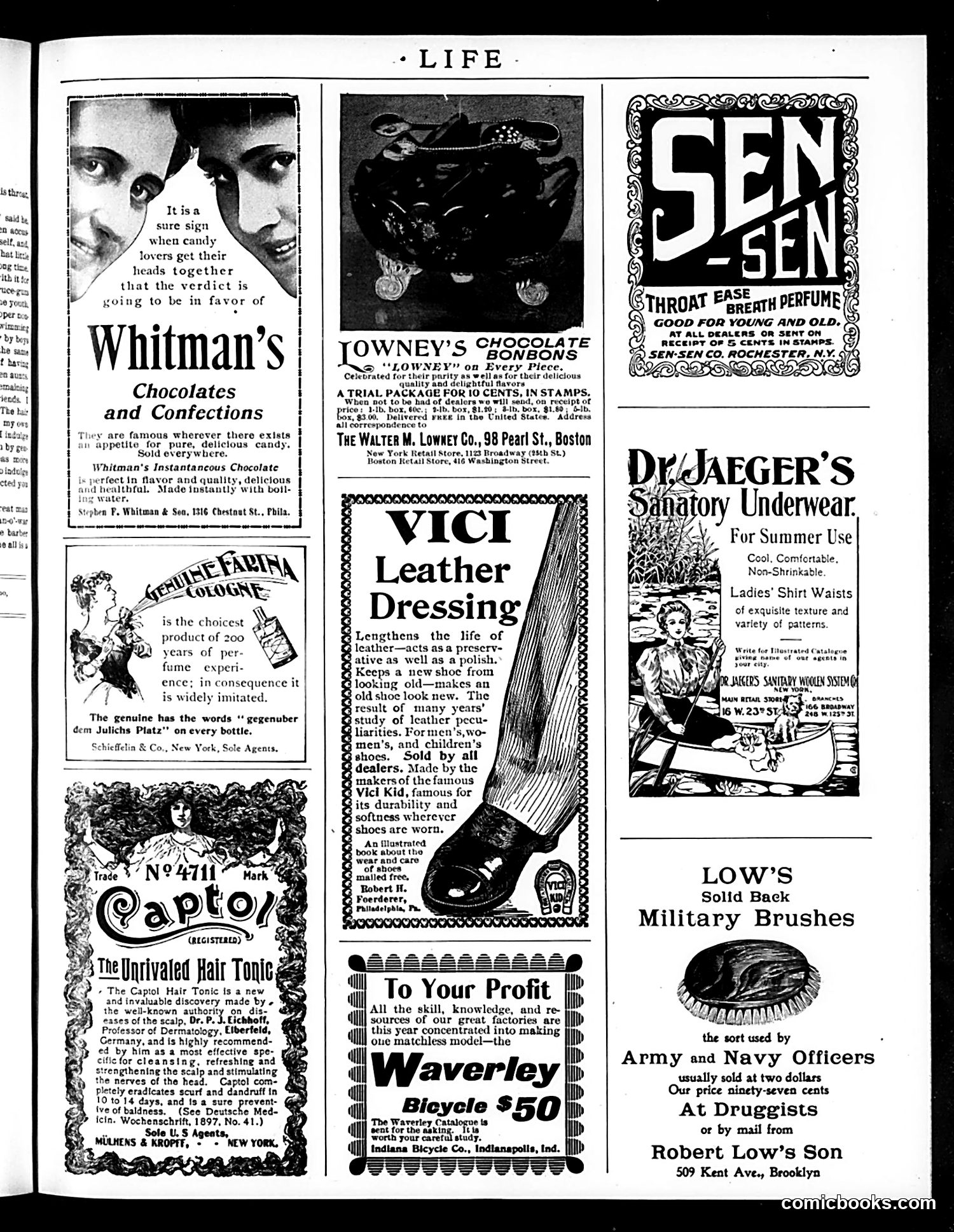
This page is primarily **advertising**, not political satire or comics. It contains roughly a dozen product advertisements typical of early 20th-century Life magazine, including: - Whitman's and Lowney's chocolates - Genuine Farina cologne (with German origins noted) - Capitol Hair Tonic (a scalp treatment by a German dermatologist) - Vici Leather Dressing - Sen-Sen throat lozenges/perfume - Dr. Jaeger's sanitary underwear - Waverley bicycles - Low's military brushes The only notable detail is that **several products emphasize German expertise and origins** (the hair tonic's German doctor-inventor, the cologne's German pedigree)—reflecting pre-WWI American consumer confidence in German manufacturing quality, before anti-German sentiment would later shift such marketing approaches. There is no cartoon or satirical content visible on this page. It's a straightforward advertising section.
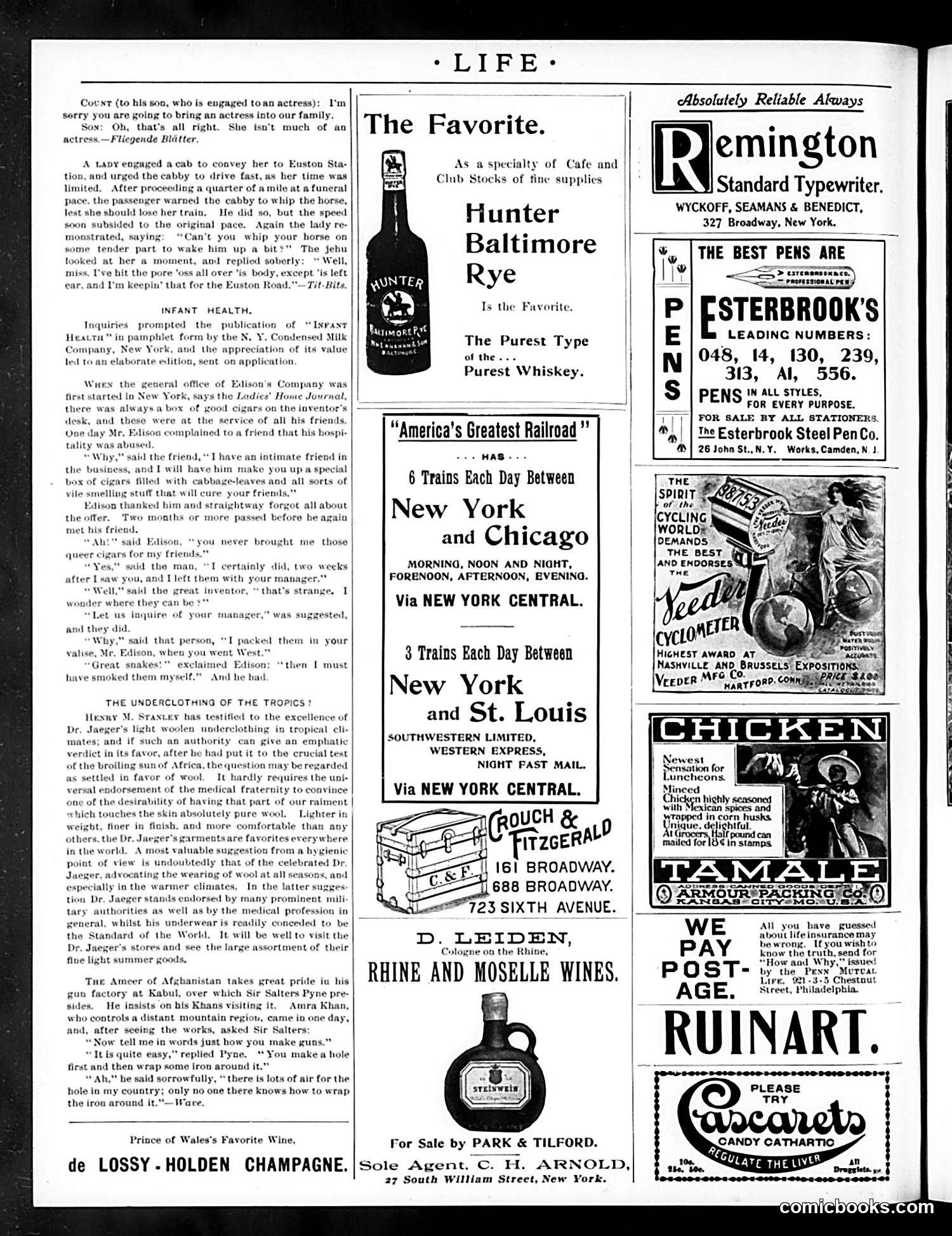
This page is **primarily advertising** with interspersed satirical anecdotes rather than political cartoons. The visible humor pieces are brief jokes: 1. **Count and actress joke**: A dated class-consciousness gag mocking snobbery about marrying into theater. 2. **Cab driver story**: Working-class humor about a tired horse—the cabby has beaten every body part except the left ear, which he's "keeping" for the final stretch to Euston Station. The joke relies on absurdist logic and cockney dialect. 3. **Edison anecdote**: A story claiming inventor Thomas Edison received cigars as a gift, forgot them in a packed valise while traveling, and unknowingly smoked them later—attributed humor to Edison's absentmindedness. The remaining content consists of product advertisements (typewriters, pens, wines, railways, clothing) typical of late-19th/early-20th-century magazine commerce. No clear political satire is evident on this particular page.
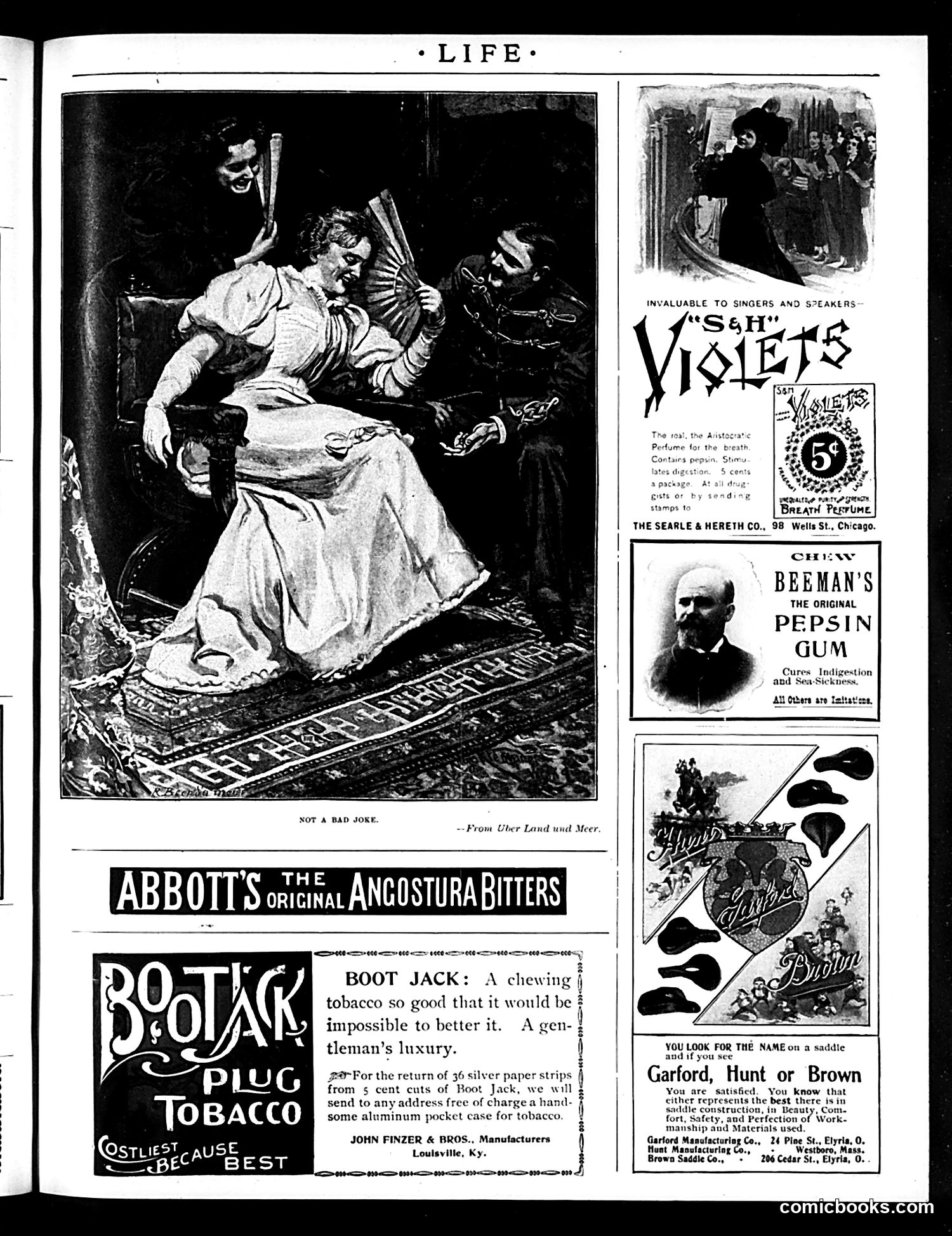
The main cartoon, titled "Not a Bad Joke," depicts a scene from a European source (*Über Land und Meer*). It shows a woman in classical dress seated with three masked figures—likely representing Death, the Devil, and another supernatural entity—gathered around her in a darkly comedic scenario. The joke appears to play on the woman's precarious position among these ominous companions, though the specific satirical reference is unclear without additional context. The page is primarily filled with **period advertisements** for tobacco products (Boot Jack, Abbott's Angostura Bitters), chewing gum (Beeman's Pepsin Gum), breath perfume, and saddle manufacturers. These ads reflect early 20th-century consumer goods and marketing strategies, including premium offers (aluminum pocket cases) to encourage repeat purchases. The content reveals little overt political satire; instead, it showcases Life's mixed format of humor, illustration, and commercial advertising typical of the era.
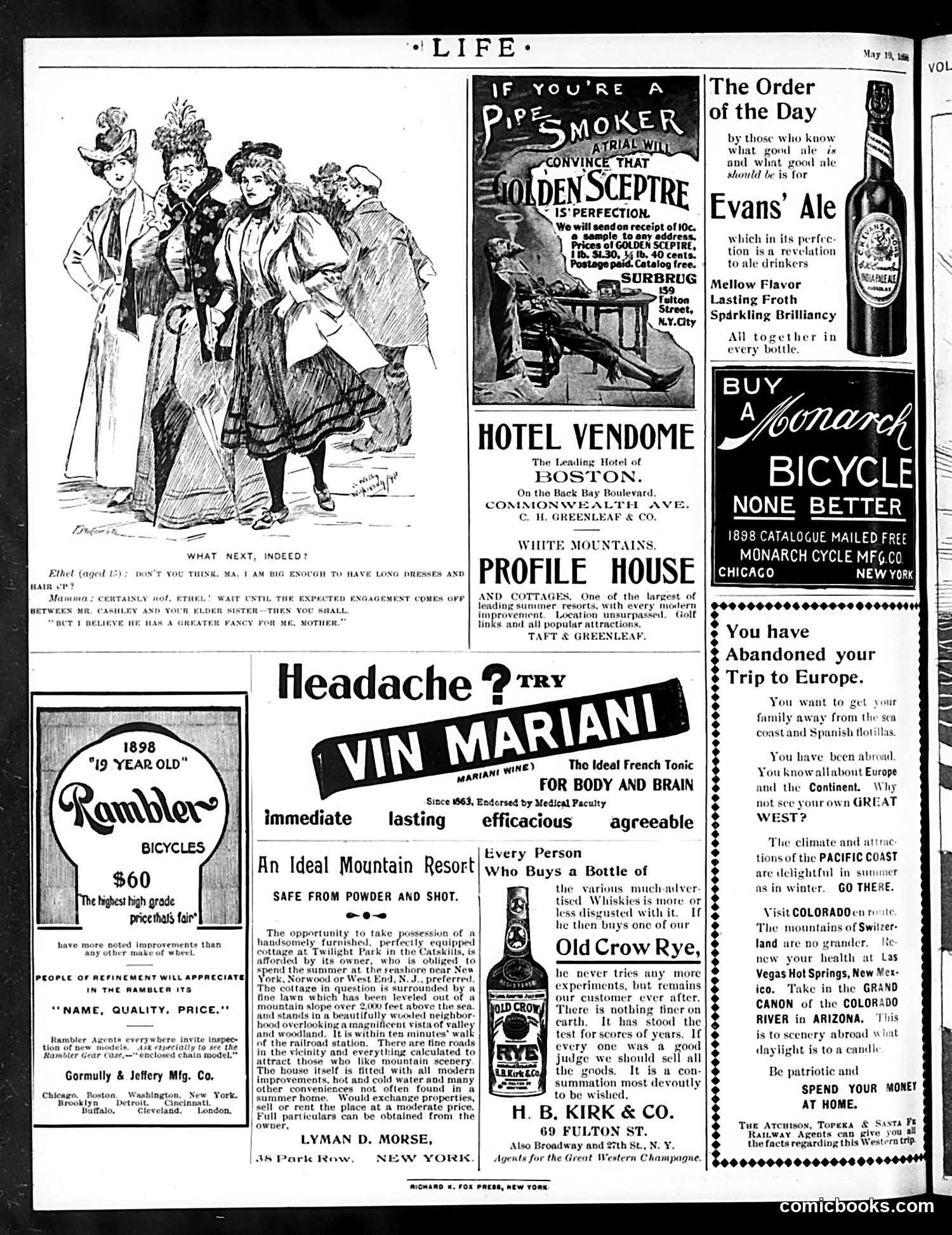
This page is primarily **advertisements with one cartoon**. ## The Cartoon ("What Next, Indeed?") The sketch depicts a mother with her young daughter Ethel (age 3) and other fashionably dressed women. Ethel asks if she can have long dresses, and her mother refuses, saying to wait for her "expected engagement." The daughter responds she believes the man "has a greater fancy" for her. **The satire targets**: The absurdity of Victorian marriage culture—specifically how girls were socialized from infancy toward matrimony. The humor lies in the child's precocious understanding that courtship involves male preference ("fancy"), mocking how society reduced women's value to marriageability and how young girls internalized these expectations. The rest is period advertising: bicycles (Rambler, Monarch), whiskey (Old Crow Rye), wine tonics, mountain resorts, and a patriotic appeal encouraging Americans to vacation domestically rather than Europe (likely reflecting Spanish-American War anxieties of 1898).