
Life, 1898-05-19 · page 12 of 20
Life — May 19, 1898 — page 12: what you’re looking at
What you’re looking at
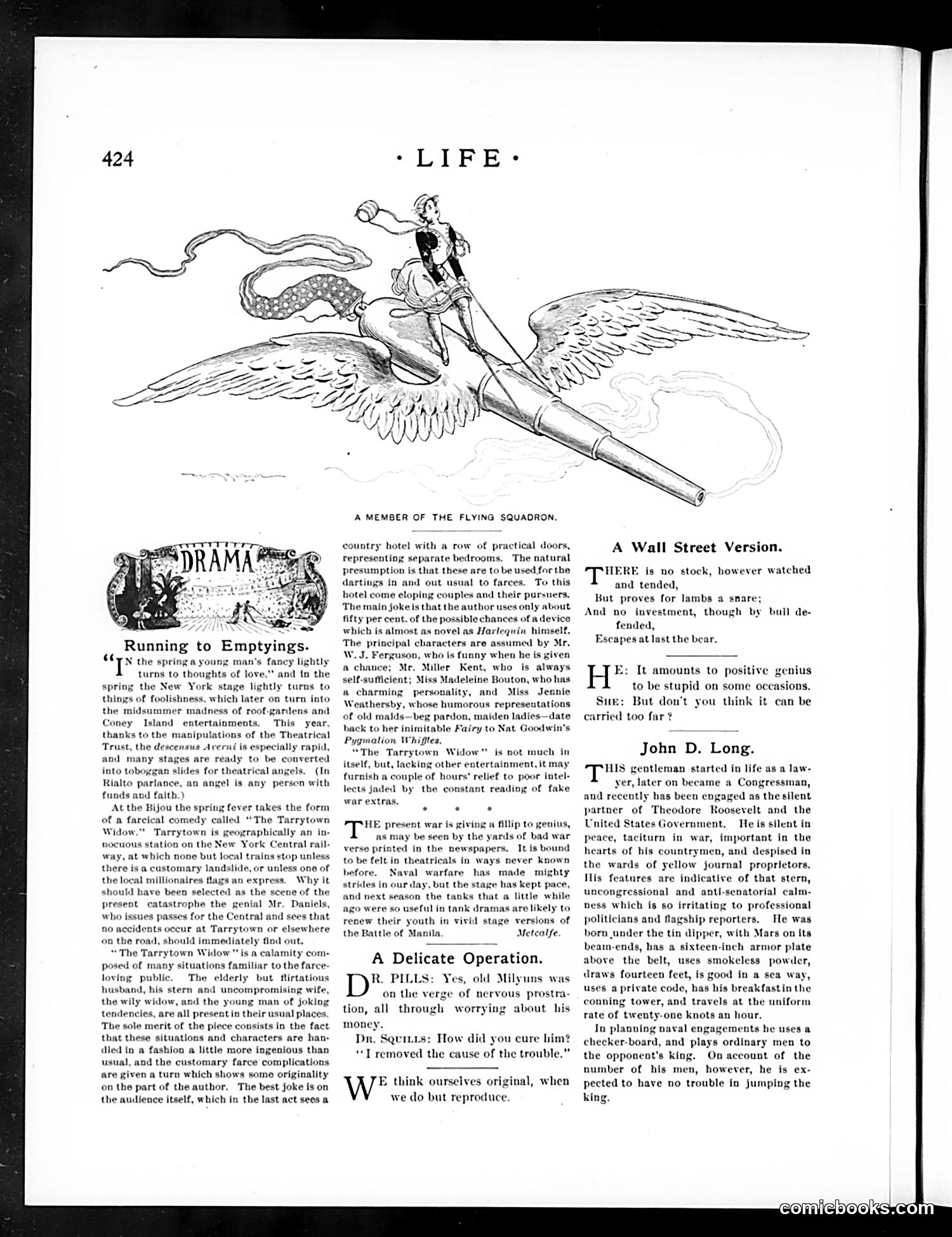
The main illustration shows a person riding a winged creature labeled "A Member of the Flying Squadron," satirizing aerial warfare during what appears to be World War I. The figure wields a sword and lasso, suggesting both military combat and theatrical absurdity. The page contains three separate articles critiquing theatrical productions. "Running to Emptyings" mocks a comedy's thin plot relying on slapstick. "A Wall Street Version" jokes about lambs as snares. "A Delicate Operation" features a dialogue between characters named Pills and Squills about curing nervousness through removing "the cause of trouble." These pieces exemplify Life magazine's satirical approach: blending commentary on contemporary entertainment, war, and social anxieties with witty wordplay and illustrated humor aimed at educated readers.
📄 Transcribed text from this page (OCR, searchable)
Machine-transcribed from the original scan — historical spelling and the odd misread are preserved.
See Running to Emptyings. COTN the spring a young man’s fancy lightly turns to thoughts of love," and in the spring the New York stage lightly turns to things of foolishness, which later on turn into the midsummer madness of roof-gardens and Cone Island entertainments. This year, thanks to the manipulations of the Theatrical Trust, the descensus Averni is especially rapid, and many stages are ready to be converted into toboggan slides for theatrical (in Rialto parlance, an angel is any person with funds and faith.) At the Bijou the spring fever takes the form of a farcical comedy called “The Tarrytown Widow." Tarrytown is geographically an in- nocuous station on the New York Central rail- way, at which none but local trains stop unless there is a customary landslide, or unless one of the local millionaires flags an express. Why it should bave been selected as the scene of the present catastrophe the genial Mr. Daniels, who issues passes for the Central and sees t no accidents occur at Tarrytown or elsewhere 2 the road, should immediately find out. fhe Tarrytown Widow "is a calamity com- posed of many situations familiar to the farce- loving public. The elderly but flirtatious husband, his stern and uncompromising wife, the wily wid and the young man of joking tendencies, are all present in their usual places. The sole merit of the piece consists in the fact that these situations and characters are han- died in a fashion a little more ingenious than usual, and the customary farce complications are given a turn which shows some originality on the part of the author. The best joke is on the audience itself, which in the last act sees a ngels, A MEMBER OF THE FLYING SQUADRON, country hotel with a row of practical doors, representing separate bedrooms, The natural presumption is that these are to be used forthe dartings in and out usual to farces, To this hotel come eloping couples and their pursuers. The main joke is that the author uses only about fifty per cent. of the possible chances of adevico which is almost as novel as Harlequin himself. ‘The principal characters are assumed by Mr. W. J. Ferguson, who is funny when he is given a chance; Mr. Miller Kent, who is always self-sufficient; Miss Madeleine Bouton, who has a charming personality, and Miss Jennie Weathersby, whose humorous represeutations of old malds—beg pardon, maiden ladies—date hack to her inimitable Fairy to Nat Goodwin's Pygmalion Whifttes. “The Tarrytown Widow" is not much in itself, but, lacking other entertainment, it may furnish a couple of hours’ relief to poor intel- lects jaded by the constant reading of fa warextras, | 7” P HE present war is giving a fillip to genius, as may be seen by the yards of bad verso printed in the newspapers. It is bound to be felt in theatricals in ways never known before. Naval warfare has made mighty strides in our day, but the stage has kept pace, and next season the tanks that a little while ago were so useful in tank dramas are likely to renew their youth in vivid stage versions of the Battle of Manila Metcalfe A Delicate Operation. R. PILLS: Yes, old Milyuns was on the verge of nervous prostra- tion, all through worrying about his money. Dr. Squitts: How did you cure him? “T removed the cause of the trouble.” E think ourselves original, when we do but reproduce. A Wall Street Version. TERE is no stock, however watched and tended, Kut proves for lambs a snare; And no investment, though by bull de- fended, Escapes at last the bear. H It amounts to positive genius to be stupid on some occasions. Sue: But don’t you think it can be carried too far? John D. Long. HIS gentleman started in life as a law- yer, later on became a Congressman, and recently has been engaged as the silent partner of Theodore Roosevelt and the United States Government. He is silent in peace, taciturn in war, important in the hearts of his countrymen, and despised in the wards of yellow journal proprietors. Ilis features are indicative of that stern, uncongressional and anti-senatorial calm- ness which is so irritating to professional politicians and flagship reporters. He was born under the tin dipper, with Mars on its beain-ends, has a sixteen-inch armor plate above the belt, uses smokeless powder, draws fourteen feet, is good in a sea way, uses a private code, bas his breakfastin the conning tower, and travels at the uniform rate of twenty-one knots an hour. In planning naval engagements he uses a checker-board, and plays ordinary men to the opponent's king. On account of the number of his men, however, he is ex- pected to have no trouble in jumping the king.