
Life, 1898-05-19 · page 4 of 20
Life — May 19, 1898 — page 4: what you’re looking at
What you’re looking at
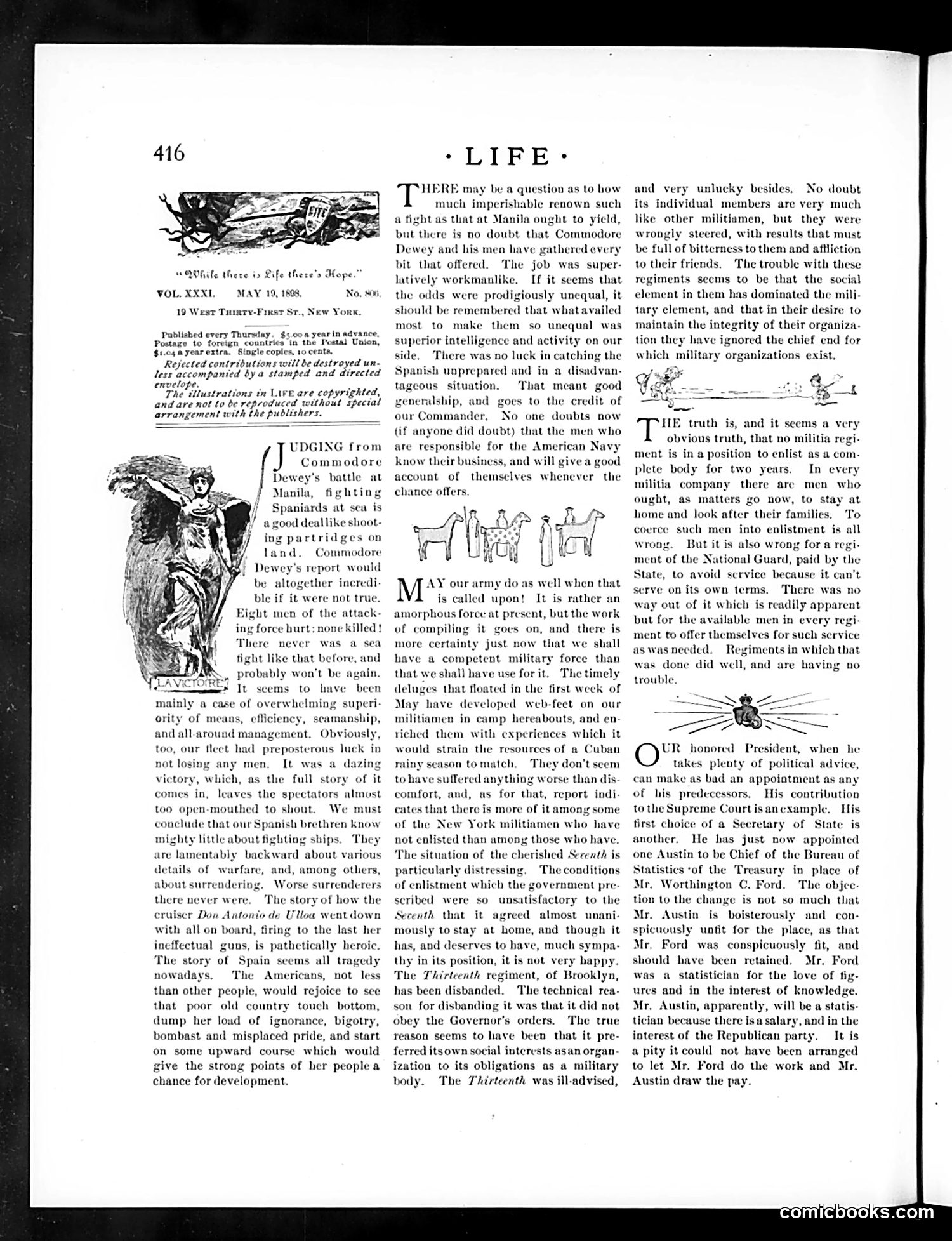
This page contains editorial commentary rather than cartoons. The text discusses the Spanish-American War, specifically addressing Commodore Dewey's naval victory at Manila. The author questions whether the U.S. Navy should receive sole credit for America's military success, arguing that Army regiments also performed competently. The second section critiques President McKinley's recent cabinet appointments, particularly the selection of Adlai Stevenson as Secretary of State (likely an error in the OCR or article). The writer suggests appointments should be based on merit rather than political patronage, and expresses concern about loyalty within the Republican administration. The illustration shows period military figures but lacks clear satirical punch without identifying specific individuals depicted.
📄 Transcribed text from this page (OCR, searchable)
Machine-transcribed from the original scan — historical spelling and the odd misread are preserved.
“OWhile Mere is Life there's Hope.” VOL. XI, MAY 19, 1898, No, NOs, 19 West Tuinty-Finst St., New York. Published every Thursday. $5.00. yearin advance, Postage to foreign countries in the Postal Union, $r.cgayearextra, Single copies, 10 cents, Rejected contributions will be destroyed un- less accompanied by a stamped and directed envelope. ; . The illustrations in Live are copyrighted, and are not to be reproduced without special arrangement with the publishers. UDGING from Dewey's battle at Manila, fighting yaniards at sea is a good deal like shoot- ing partridges land. Commodore Dewey's report would be altogether incredi ble if it were not true. it men of the attack- ing force hurt: none killed! There never was fight like that befor MK probably won't be >» It scems to © mainly a case of overwhelming superi- ority and all-around management. Obviously, too, our tlect had preposterous luck in not losing any men victory, which, as the full story of it comes in, leaves the spectators almost too open-mouthed to shout. We must conclude that our Spanish brethren know mighty little about fighting ships. They a sea and gain. been of means, efficiency, seamanship, It was a dazing are lamentably backward about various details of warfare, and, among others, Worse surrenderers there never were. The story of how the cruiser Don Antonio de Ulloa wentdown with all on board, firing to the last her ineffectual guns, is pathetically heroic, The story of Spain scems all tragedy nowadays. The Americans, not less than other people, would rejoice to see that poor old country touch bottom, dump her load of ignorance, bigotry, bombast and misplaced pride, and start on some upward course which would give the strong points of her people a chance for development. about surrendering. -LIFE- HERE may be a question as to how much imperishable renown such a fight as that at Manila ought to yield, but there is no doubt that Commodore Dewey and his men have gathered every bit that offered. The job was super- latively workmanlike. If it seems that the odds were prodigiously unequal, it should be remembered that what availed most to make them so unequal was superior intelligence and activity on our side. There was no luck in catching the Spanish unprepared and in a disadvan- tagcous situation, That meant good generalship, and goes to the credit of our Commander, No one doubts now (if anyone did doubt) that the men who are responsible for the American Navy know their business, and will give a good account of themselves whenever the chance offers. AY our army do as well when that is called upon! It is rather an amorphous force at present, but the work of compiling it gocs on, and there more certainty just now that we sha have a competent military force than that we shall have use for it. iy deluges that floated in the first week of May have developed web-feet on our militiamen in camp hereabouts, and en- riched them with experiences which it would strain the resources of a Cuban rain: They don’t seem to have suffered anything worse than dis- comfort, and, as for that, report indi- cates that there is more of it amor of the New York militiamen who hav not enlisted than among those who have. The situation of the cherished Secenth i particularly distressing. The conditions of enlistment which the government pre- scribed were so unsatisfactory to the Secenth that it agreed almost unani- mously to stay at home, and though it has, and deserves to have, much sympa- thy in its position, it is not very happy. The Thirteenth regiment, of Brooklyn, has been disbanded, The technical rea- son for disbanding it was that it did not obey the Governor's orders. The true reason seems to have been that it pre- ferred itsown social interests asan organ- ization to its obligations as a military body. The Thirteenth was ill-advised, season to match. and very unlucky besides. No doubt its individual members are very much like other militiamen, but they were wrongly steered, with results that must be full of bitterness to them and aflliction to their friends. The trouble with these regiments seems to be that the social element in them has dominated the mili- tary clement, and that in their desire to maintain the integrity of their organiza- tion they have ignored the chief end for which military organizations exist. IIE truth is, and it seems a very obvious truth, that no militia regi- ment is ina position to enlist as a com- plete body for two years. In every militia company there are men who ought, as matters go now, to stay at home and look after their families, To coerce such men into enlistment is all wrong. But it is also wrong for a regi- ment of the National Guard, paid by the State, to avoid service because it can’t serve on its own terms, There was no way out of it which is readily apparent but for the available men in every re; ment to offer themselves for such service aswasneedcd. Regiments in which that was done did well, and are having no trouble, eae —S= FF UR takes plenty of political advice, can make as bad an appoiatment as any honored President, when he of his predecessors. His contribution tothe Supreme Court isanexample. His first choice of a Secretary of State is another, He has just now appointed one Austin to be Chief of the Bureau of Statistics ‘of the Treasury in place of Mr. Worthington C. Ford. The objec- tion to the change is not so much that Mr. Austin is boisterously and con- spicuously unfit for the place, as that Mr. Ford was conspicuously fit, and should have been retained. Mr. Ford was a statistician for the love of fig- urcs and in the interest of knowledge. Mr. Austin, apparently, will be a statis tician because there isa salary, and in the interest of the Republican party. It is a pity it could not have been arranged to let Mr. Ford do the work and Mr. Austin draw the pay.