
Life, 1898-05-19 · page 14 of 20
Life — May 19, 1898 — page 14: what you’re looking at
What you’re looking at
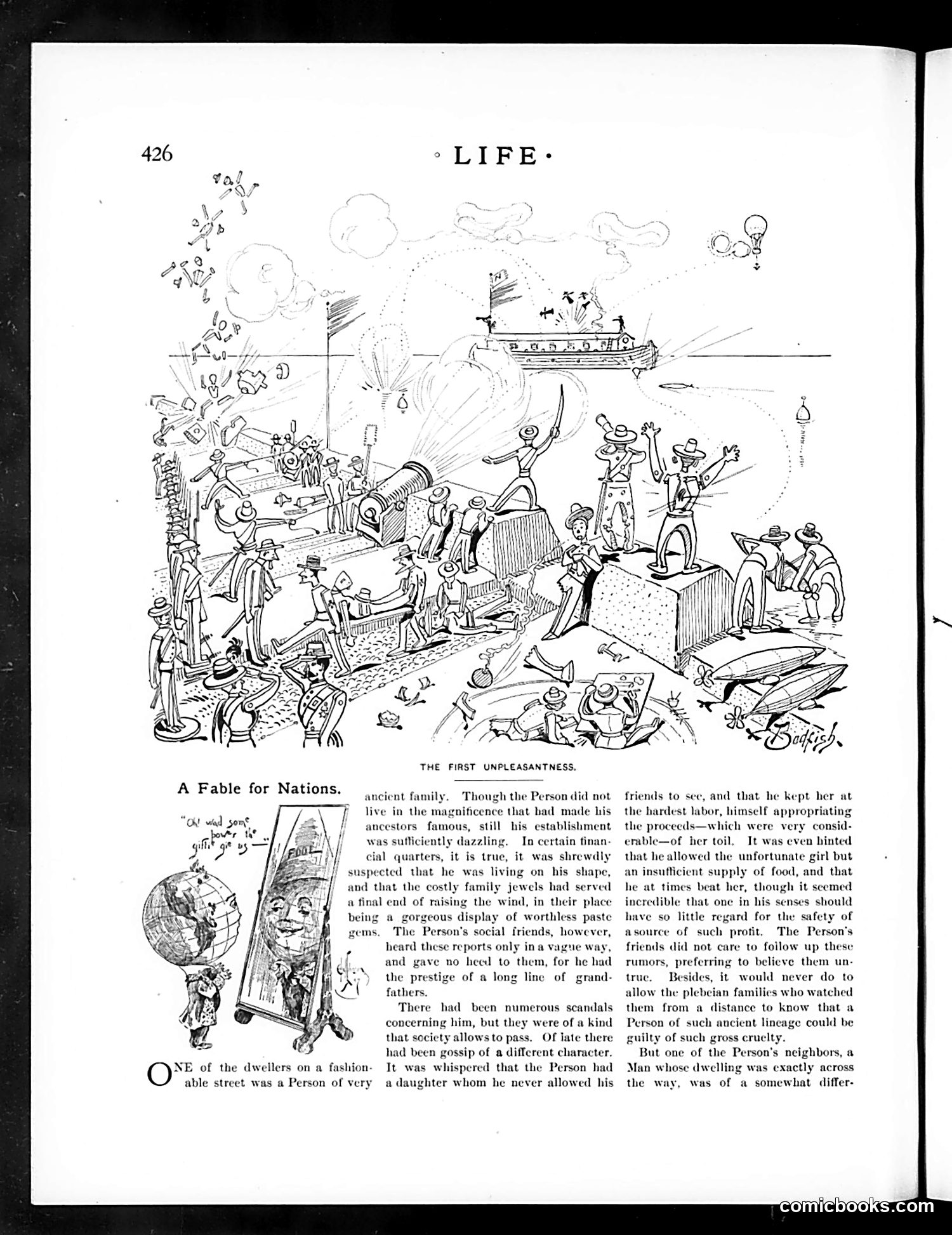
This is a fable satirizing wealthy aristocratic families maintaining false respectability while exploiting those beneath them. "The Person" represents an old-money family living on appearance rather than actual wealth—their "costly family jewels" have been sold, replaced by worthless paste. The central scandal concerns a hidden daughter kept in harsh labor, her earnings stolen by the father. The satirical point: the Person's social circle ignores obvious cruelty because acknowledging it would expose their own complicity in a corrupt system. They prefer comfortable lies to uncomfortable truths. The elaborate carnival-like illustration above depicts chaotic social activity—suggesting the shallow frivolity masking systemic abuse. This likely critiques Gilded Age exploitation and the deliberate blindness of polite society to industrial-era labor abuses, particularly of women and the working poor.
📄 Transcribed text from this page (OCR, searchable)
Machine-transcribed from the original scan — historical spelling and the odd misread are preserved.
A Fable for Nations. NE of the dwellers on a fashion able street was a Person of very THE FIRST UNPLEASANTNESS, ancient family. Though the Person did not live in the magnificence that bad made his ancestors famous, still his establishment was sutticiently dazzling. In certain tinan- cial quarters, it is true, it. was shrewdly suspected that he was living on his shape, and that the costly family jewels had served a final end of raising the wind, in their place being a gorgeous display of worthless paste The Person's social friends, however, heard these reports only ina vague way, and gave no heed to them, for he had the prestige of a long linc of grand- fathers. There had been numerous scandals concerning him, but they were of a kind that y allows to pass. Of iate there had been gossip of a different character. It was whispered that the Person had a daughter whom he never allowed his gems, friends to see, and that he kept her at the hardest labor, himself appropriating the procecds—which were very consid- erable—of her toil, It was even hinted that he allowed the unfortunate girl but an insufficient supply of food, and that he at times beat her, though it seemed incredible that one in his senses should have so little regard for the safety of asource of such protit, The Person's friends did not care to follow up these rumors, preferring to believe them un- truc. Besides, it. would never do to allow the plebcian families who watched them from a distance to know that a Person of such ancient lineage could be guilty of such gross ty. But one of the Person's neighbors, a Man whose dwelling was exactly across the way, was of a somewhat differ.