
Life, 1898-05-19 · page 6 of 20
Life — May 19, 1898 — page 6: what you’re looking at
What you’re looking at
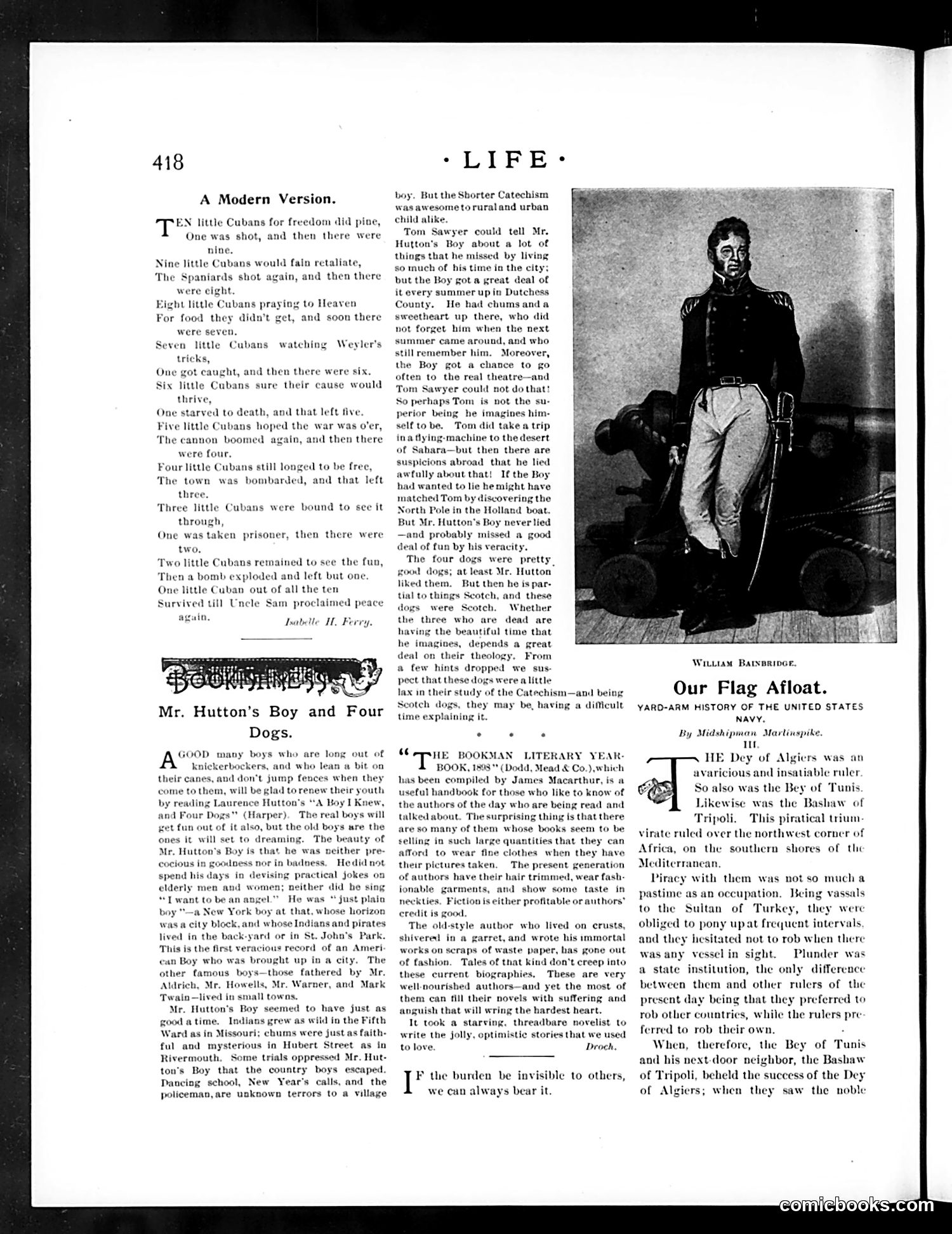
This page contains three distinct pieces, not political cartoons: 1. **"A Modern Version"** — A poem parodying "Ten Little Indians," counting down "little Cubans" through various wartime scenarios (shooting, starvation, capture). This appears to reference the Spanish-American War or Cuban independence conflict, satirizing the period's American involvement in Cuban affairs. 2. **"Mr. Hutton's Boy and Four Dogs"** — A sentimental narrative about a boy and his dogs during wartime, emphasizing patriotism and sacrifice. Not satirical. 3. **"Our Flag Afloat"** — A serious historical piece about the U.S. Navy, featuring William Bainbridge and discussing Mediterranean naval operations against Barbary pirates and the Bey of Algiers. The page mixes satire with straightforward patriotic content typical of Life magazine's era.
📄 Transcribed text from this page (OCR, searchable)
Machine-transcribed from the original scan — historical spelling and the odd misread are preserved.
418 A Modern Version. ‘ little Cubans for freedom did pine, One was shot, and then there were nine. Nine little Cubans would fain retaliate, The Spaniards shot again, and then there were eight Eight little Cubans praying to Heaven For food they didn’t get, and soon there were seven. Seven little Cubans tricks, One got caught, and then there were six. Six little Cubans sure their cause would thrive, One starved to death, and that left five Five little Cubans hoped the war was o'er, The cannon boomed again, and then there were four, Four little Cubans still lon; The town was three. Three little Cubans were bound to see it through, One was taken two, Two little Cubans remained to see the fun, Then a bomb exploded and left but one. One little Cuban out of all the ten Survived till Uncle Sam proclaimed peace Isablle H, Fervy. watching Weyler’s ed to be free, bombarded, and that left prisoner, then there were again, Mr. Hutton’s Boy and Four Dogs. As? many boys who are long out of knickerbockers, and who lean a bit on their canes, and don't jump fences when they come to them, will be glad to renew their youth dling Laurence Hutton’s “A Boy I Knew, 1 Four Dogs" (Harper). The real boys will get fun out of it also, but the old boys are the ones it will set to dreaming. The beauty of Mr. Hutton’s Boy is that he was neither pre goodness nor in badness. Hedid not spend his days in devising practical jokes on elderly men and women; neither did be sing “Twant to be an angel.” He was “ just plain boy "a New York boy at that, whose horizon was a city block, and whose Indians and pirates lived in the back-yard of in St. a's Park. This is the first veracious record of an Ameri. can Boy who was brought up in a city, The other famous boys—those fathered by Mr. Aldrich, Mr. Howells, Mr. Warner, and) Mark ‘Twain —lived in small towns. Mr. Hutton’s Boy seemed to have just as good atime. Indians grew as witd in the Fifth Ward as in Missouri; chums were just as faith- ful and mysterious in Hubert Street as in Rivermouth. Some trials oppressed Mr. Hut- ton’s Boy that the country boys escaped Dancing school, New Year's calls, and the policeman,are unknown terrors to a village by re cocious *LIFE: boy. But the Sborter Catechism was awesome toruraland urban child alike. Tom Sawyer could tell Mr. Hutton's Boy about a lot of things that he missed by living so much of his time in the city: but the Boy gota great deal of it every summer up in Dutchess unty. He had chums anda sweetheart up there, who did not forget him when the next summer came around, and who still remember him. Moreover, the Boy got a chance to go often to the real theatre—and Tom Sawyer could not dothat! So perhaps Tom is not the su- perior being he imagines him- self tobe, Tom did take a trip ina fying-machine to the desert of Sahara—but then there are ns abroad that he lied awfully about that! Ifthe Boy had wanted to lie he might have matched Tom by discovering the North Pole in the Holland boat. But Mr. Hutton's Boy never lied —and probably mi deal of fun by his The four dogs were pretty good dogs; at least Mr. Hutton’ liked them, But then he is par- tial to things Scotch, and these dogs were Scotch. Whether the three who are dead are having the beautiful time that he imag depends a great deal on their theology, From a few hints dropped we sus- pect that these dogs were alittle lax in their study of the Catechism—and being optch dogs, they may be, having a diMcult time explaining it. “CARHE BOOKMAN LITERARY YEAR- BOOK, 1808" (Dodd, Mead & Co.),which has been compiled by James Macarthur, is a useful handbook for those who like to know of the authors of the day who are being read and tuulked about. The surprising thing is that there are so many of them whose books seem to be selling in such large quantities that they can afford to wear fine clothes when they have their pictures taken. The present generation of authors have their hair trimmed, wear fash. ionable garments, and show so taste in neckties, Fiction is either profitable or authors’ credit is good. The old-style author who lived on crusts, hivered in a garret,and wrote his immortal works on scraps of waste paper, bas gone out of fashion. Tales of that kind don’t creep into these current biographies, These are very well-nourished authors—and yet the most of them can fill their novels with suffering and anguish that will wring the hardest heart. It took a starving, threadbare novelist to write the jolly, optimistic stories that we used to love. Droch, J * the burden be invisible to others, we can always bear it. Wittiam Batsprinor, Our Flag Afloat. YARD-ARM HISTORY OF THE UNITED STATES NAVY. By Midshipman Martinspike. ut HE Dey of Algiers was an avaricious and insatiable ruler So also was the Bey of Tunis Likewise was the Bashaw 0! Tripoli, This piratical trium, virate ruled over the northwest corner of Africa, on the southern shores of the Mediterranean. Piracy with them was not so mucha pastime as an occupation. Being vassals to the Sultan of Turkey, they were obliged to pony upat frequent intervals and they hesitated not to rob when there was any vessel in sight. Plunder was a state institution, the only difference between them and other rulers of the present day being that they preferred to rob other countries, while the rulers prc ferred to rob their own, : When, therefore, the Bey of Tunis and his next-door neighbor, the Bashaw of Tripoli, beheld the success of the Dey of Algiers; when they saw the noble