
Life, 1898-05-19 · page 8 of 20
Life — May 19, 1898 — page 8: what you’re looking at
What you’re looking at
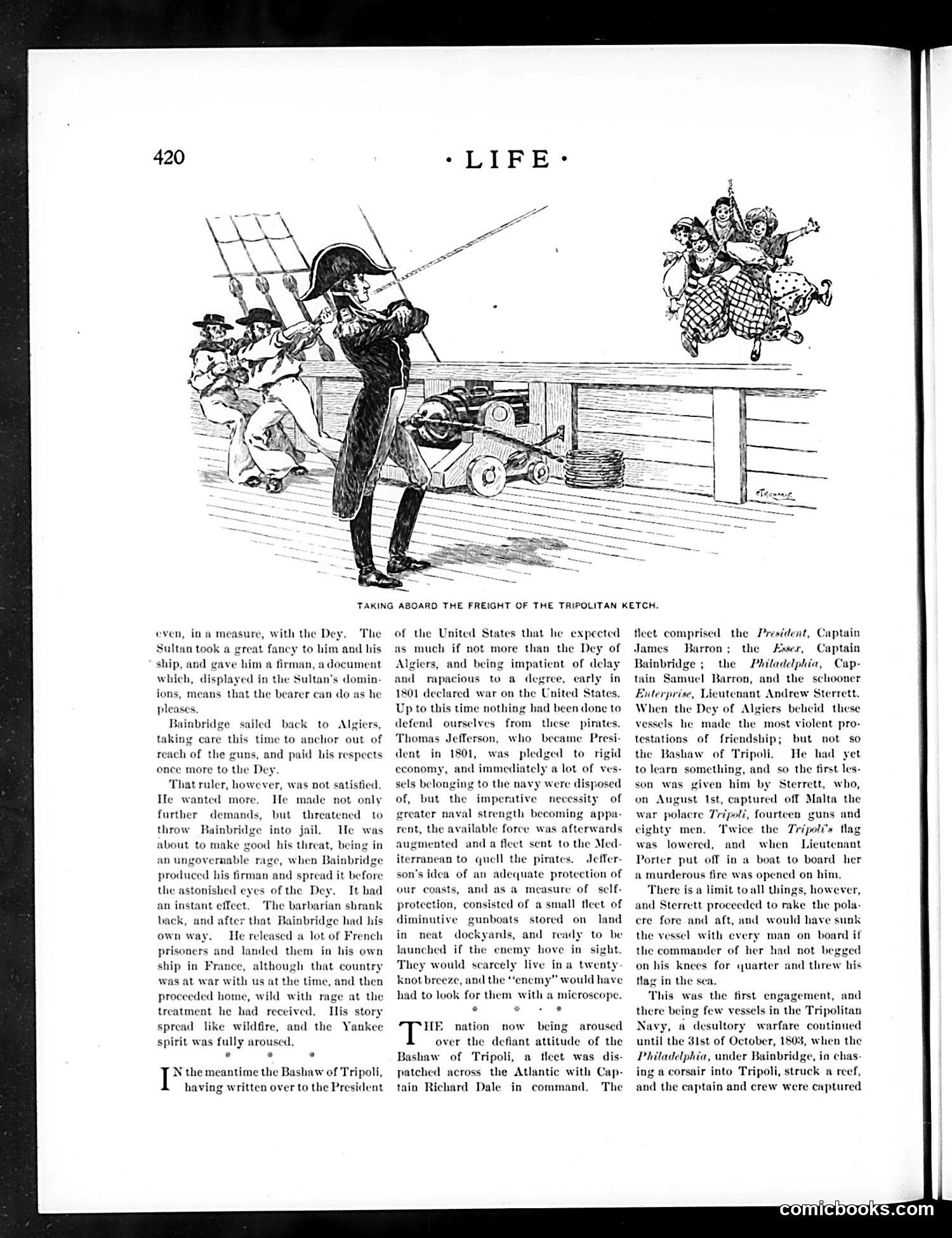
This cartoon satirizes early American naval conflicts with Barbary pirates (around 1801-1804, based on the text's reference to Thomas Jefferson). The central figure in Napoleon-style military dress appears to represent an American naval officer or official boarding a captured pirate vessel. The "freight" being loaded—depicted as cherubic figures on the right—likely represents prisoners or hostages. The joke plays on the double meaning of "freight" (cargo versus burden/responsibility). The text discusses Jefferson-era naval conflicts and references the Bashaw of Tripoli, indicating this mocks American efforts to deal with pirate threats while simultaneously suggesting the complications these conflicts created—treating military victories as if they were commercial transactions.
📄 Transcribed text from this page (OCR, searchable)
Machine-transcribed from the original scan — historical spelling and the odd misread are preserved.
TAKING ABOARD THE FREIGHT OF THE TRIPOLITAN KETCH. even, ina measure, with the Dey. The Sultan took a great fancy to him and his ship, and gave him a firman, adocument which, displayed in the Sultan's domin- ions, means that the bearer can do as he pleases, Bainbridge sailed back to Algiers, taking care this time to anchor out of reach of the guns, and paid his respects once more to the De That ruler, however, was not satisfied. Ife wanted more. He made not only further demands, but threatened to throw Bainbrid into jail. He was about to ma 1 his threat, being in an ungovernable rage, when Bainbridge produced his firman and spread it before It had The barbarian shrank that Bainbridge had his He released a lot of French prisoners and landed them in his own ship in France, although that country was at war with us at the time, and then proceeded home, wild with rage at the treatment he had received, Ilis story spread like wildfire, and the Yankee spirit was fully aroused. the astonished eyes of the Dey. an instant effec back, and afte own way. I N the meantime the Bashaw of Tripoli, having written over to the President of the United States that he expected as much if not more than the Dey of Algiers, and being impatient of delay and rapacious to a degree, early in 1801 declared war on the United States. Up to this time nothing had been done to defend ourselves from these pirates. Thomas Jefferson, who became Presi- dent in 1801, was pledged to rigid economy, and immediately a lot of v sels belonging to the navy were disposed of, but the imperative necessity of greater naval strength becoming appa- rent, the available force was afterwards augmented and a flect sent to the Med- iterranean to quell the pirates. Jeffer- son's idea of an adequate protection of ts, and as a measure of sclf- protection, consisted of a small tleet of diminutive stored on land in neat dockyards, and ready to be launched if the enemy hove in si They would scarcely live in nty knot breeze, and the enemy” would have had to look for them with a microscope. * ee our co gunboats HE nation now being aroused over the defiant attitude of the Bashaw of Tripoli, a fleet was di patched across the Atlantic with Cap- tain Richard Dale in command. The fleet comprised the President, Captain James Barron; the E#xer, Captain Bainbrids the Philadelphia, Cap- tain Samuel Barron, and the schooner Enterprise, Lieutenant Andrew Sterrett. When the Dey of Algiers beheid these vessels he made the most violent pro- testations of friendship; but not so the Bashaw of Tripo! He had yet to learn something, and so the first les- son was given him by Sterrett, who, on August Ist, captured off Malta the yar polacre Tripoli, fourteen guns and shty men. Twice the Tripoli’s flag was lowered, and when Lieutenant Porter put off in a boat to board her a murderous fire was opened on him, There is a limit to all things, however, and Sterrett proceeded to rake the pola- cre fore and aft, and would have sunk the vessel with every man on board if the commander of her had not begged on his knees for quarter and threw his tlag in the sea. This was the first engagement, and there being few vessels in the Tripolitan Navy, a desultory warfare continued until the 3ist of October, 1803, when the Philadelphia, under Bainbridge, ia chas ing a corsair into Tripoli, struck a reef, and the captain and crew were captured