
Life, 1898-05-19 · page 9 of 20
Life — May 19, 1898 — page 9: what you’re looking at
What you’re looking at
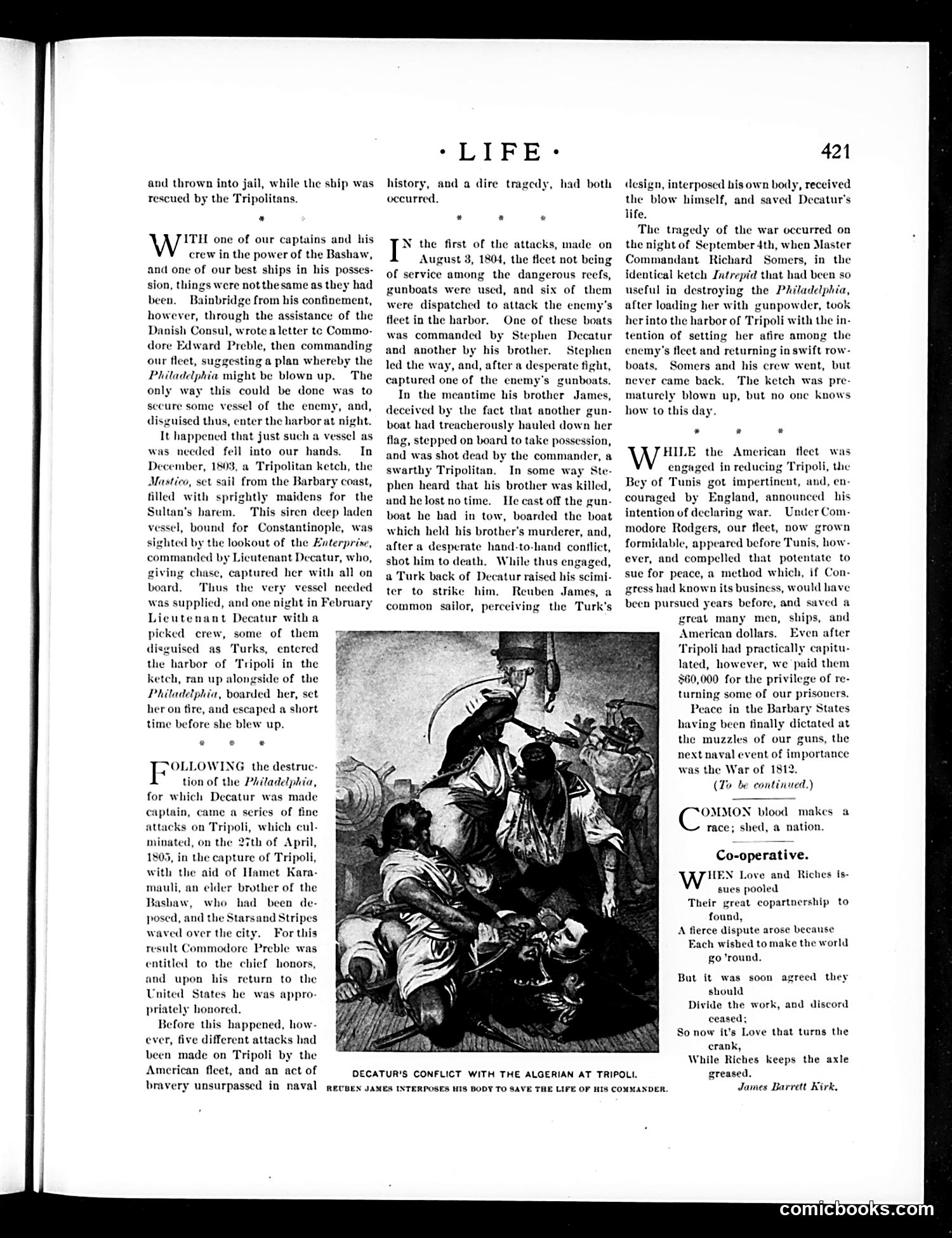
This page contains historical narrative about early 19th-century naval warfare, specifically describing attacks on Tripoli during the Barbary Wars (around 1804-1805). The central illustration depicts **Decatur's Conflict with the Algerian at Tripoli**, showing a dramatic hand-to-hand combat scene between American sailors and North African corsairs. The text describes Captain Decatur's military operations against Barbary pirates and discusses subsequent American naval conflicts, including references to the War of 1812. The article concludes with a lighthearted poem titled "Co-operative" by James Barrell Kirk about Love and Riches. This is not satire but rather historical journalism paired with patriotic narrative and unrelated verse—typical of Life's mixed-content format from this era.
📄 Transcribed text from this page (OCR, searchable)
Machine-transcribed from the original scan — historical spelling and the odd misread are preserved.
and thrown into jail, while the ship was rescued by the Tripolitans. * ITH one of our captains and his crew in the power of the Bashaw, and one of our best ships in his posses- sion, things were notthesame as they had been. ainbridge from his confinement, however, through the assistance of the Danish Consul, wrote a letter te Commo- dore Edward Preble, then commanding our fleet, suggesting a plan whereby the Philadelphia might be blown up. The only way this could be done was to secure some vessel of the enemy, and, disguised thus, enter the harbor at night. It happened that just such a vessel as was needed fell into our hands. In December, 1803, a Tripolitan ketch, the Mastico, set sail from the Barbary coast, filled with sprightly maidens for the Sultan's harem. This siren deep laden vessel, bound for Constantinople, was hted by the lookout of the Enterprise, commanded by Licutenant Decatur, who, giving chase, captured her with all on board, Thus the very vessel needed was supplied, and one night in February Lieutenant Decatur with a picked crew me of them disguised as Turks, entered the harbor of Tripoli in the ketch, ran up alongside of the Philadelphia, boarded her, set her on fire, and escaped a short time before she blew up. nr) * OLLOWING the destruc- tion of the Philadelphia, for which Decatur was made captain, came a series of fine s on Tripoli, which cul- minated, on the 27th of April, 1805, in the capture of Tripoli, with the aid of Hamet Kara- mauli, an elder brother of the Bashaw, who had been de- posed, and the Starsand Stripes waved over the city. For this result Commodore Preble was entitled to the chief honors, and upon his return to the United States he was appro- priately honored. Before this happened, how- ever, five different attacks had been made on Tripoli by the American fleet, and an act of Dravery unsurpassed in naval * LIFE: history, and a dire tragedy, had both occurred. * ® I N the first of the attacks, made on August 3, 1804, the fleet not being of service among the dangerous reefs, gunboats were used, and six of them were dispatched to attack the enemy's fleet in the harbor. One of these boats was commanded by Stephen Decatur and another by his brother. Stephen led the way, and, after a desperate fight, captured one of the enemy's gunboats. In the meantime his brother James, deceived by the fact that another gun- boat had treacherously hauled down her flag, stepped on board to take possession, and was shot dead by the commander, a swarthy Tripolitan. In some way Ste- phen heard that his brother was killed, und he lost no time. He cast off the gun- boat he had in tow, boarded the boat which held his brother's murderer, and, after a desperate hand-to-hand conflict, shot him to death, While thus engaged, a Turk back of Decatur raised his scimi- ter to strike him. Reuben James, a common sailor, perceiving the Turk’s DECATUR’S CONFLICT WITH THE ALGERIAN AT TRIPOLI. REUBEN JAMES INTERPOSES HIS BODY TO SAVE THE LIFE OF HIS COMMANDER. 421 design, interposed his own body, received the blow himself, and saved Decatur's life. The tragedy of the war occurred on the night of September 4th, when Master Commandant Richard Somers, in the identical ketch Jntrepid that had been so useful in destroying the Philadelphia, after loading her with gunpowder, took her into the harbor of Tripoli with the in- tention of setting her afire among the enemy's fleet and returning in swift row- boats, Somers and his crew went, but never came back. The ketch was pre- maturely blown up, but no one knows how to this day. * * * HILE the American fleet engaged in reducing Tripoli, the Bey of Tunis got impertinent, and, en- couraged by England, announced his intention of declaring war. Under Com- modore Rodgers, our fleet, now grown formidable, appeared before Tunis, how- ever, and compelled that potentate to sue for peace, a method which, if Con- gress had known its business, would have been pursued years before, and saved a great many men, ships, and American dollars. Even after ‘Tripoli had practically capitu- lated, however, we paid them $60,000 for the privilege of re- turning some of our prisoners. Peace in the Barbary States having been finally dictated at the muzzles of our guns, the next naval event of importance was the War of 2. (To be continued.) was OMMON blood makes a race; shed, a nation. Co-operative. HEN Love and Riches sues pooled Their great copartnership to found, A fierce dispute arose because Each wished tomake the world go ‘round. But it was soon agreed they should Divide the work, and discord ceased; So now it’s Love that turns the crank, While Riches keeps the axle greased. James Barrett Kir! comicbooks.com