
A complete issue · 20 pages · 1897
Life — January 28, 1897
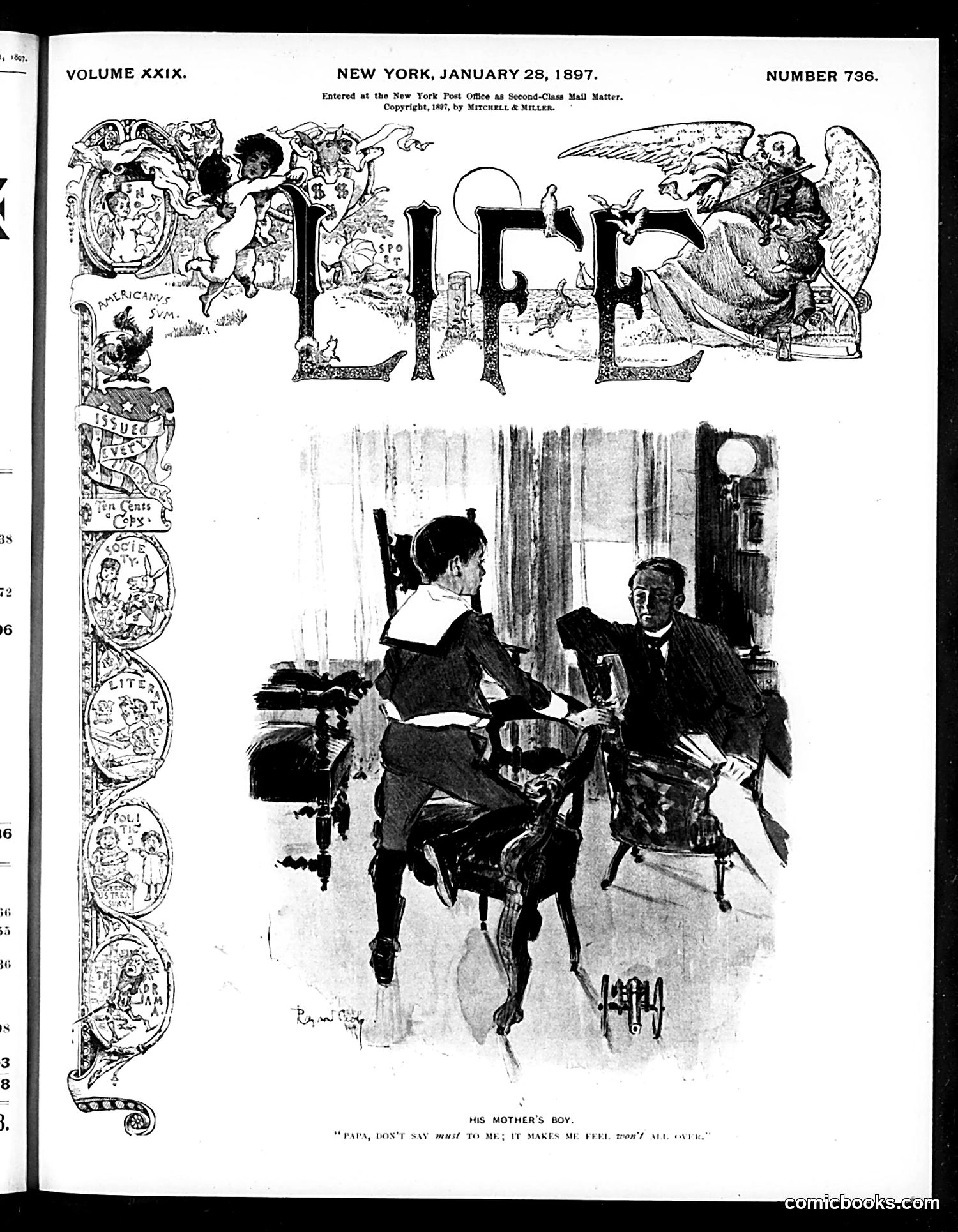
**Main Cartoon: "His Mother's Boy"** The illustration shows a young man in formal attire sitting with a woman (likely his mother), with the caption: "Papa don't say much to me; it makes me feel foul [sic]." This appears to be social satire about a privileged, sheltered young man—a "mama's boy"—who is emotionally fragile and avoids paternal discipline. The joke likely critiques late-Victorian upper-class parenting where overprotective mothers coddled sons, preventing them from developing masculine toughness or emotional resilience. The elaborate decorative border and ornamental header are typical of *Life* magazine's design aesthetic during this period, reflecting the publication's focus on satirizing American society, manners, and domestic life.
This page contains **no cartoon or satirical illustration**—it is entirely text-based editorial content. The piece discusses Mr. Charles Dudley Warner's literary project: a thirty-volume collection titled "World's Best Literature, Ancient and Modern." The article explains Warner's selection rationale and mentions his distinguished advisory board, including professors from Yale and Princeton. It emphasizes the collection's comprehensiveness, noting it includes translations of foreign works and biographical articles on major authors like Homer, Shakespeare, Kipling, and Darwin. The editorial presents this as a public service—making great literature accessible to ordinary readers who cannot otherwise afford or locate such works. It announces the first edition is selling through Harper's Weekly Club at a special price, with introductory sets soon available. This is promotional content, not satire.
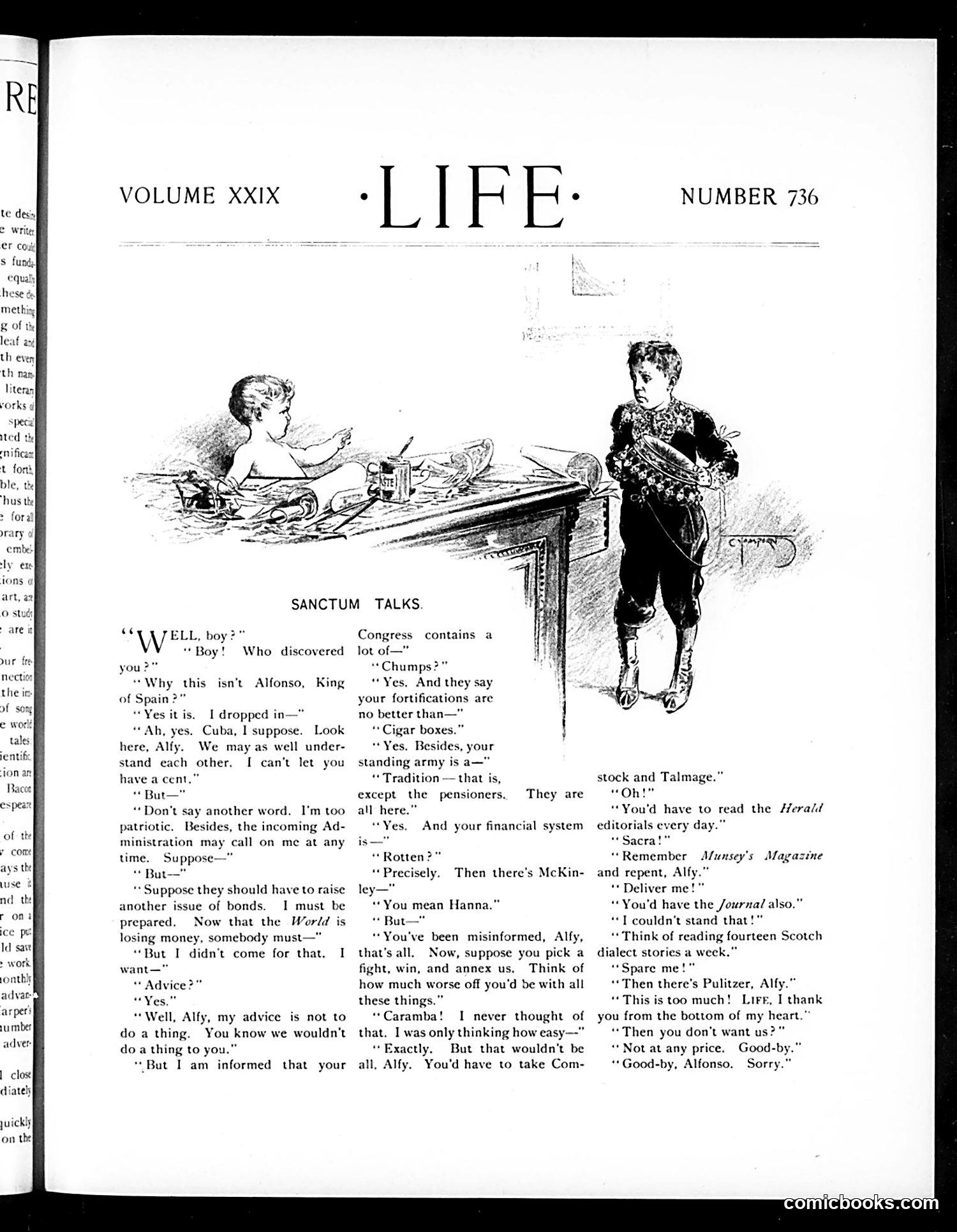
This is a dialogue between two figures—apparently a young boy (Alfy) and an adult (Alphonso)—discussing contemporary political and financial issues through comedic misunderstandings. The satire targets early 20th-century concerns: congressional spending ("champs"), Spanish colonial matters ("Why this isn't Alphonso, King of Spain?"), military preparedness and fortifications, bond issues, and financial instability ("the World is losing money"). Alfy represents naive youth seeking "advice," while Alphonso embodies weary worldliness. The humor lies in how serious governmental problems—budget deficits, bonds, military readiness—are reduced to absurd observations about "cigar boxes" and reading multiple newspapers. The title "Sanctum Talks" suggests this occurs in a newspaper office, making it meta-commentary on how the press reports on fiscal mismanagement.
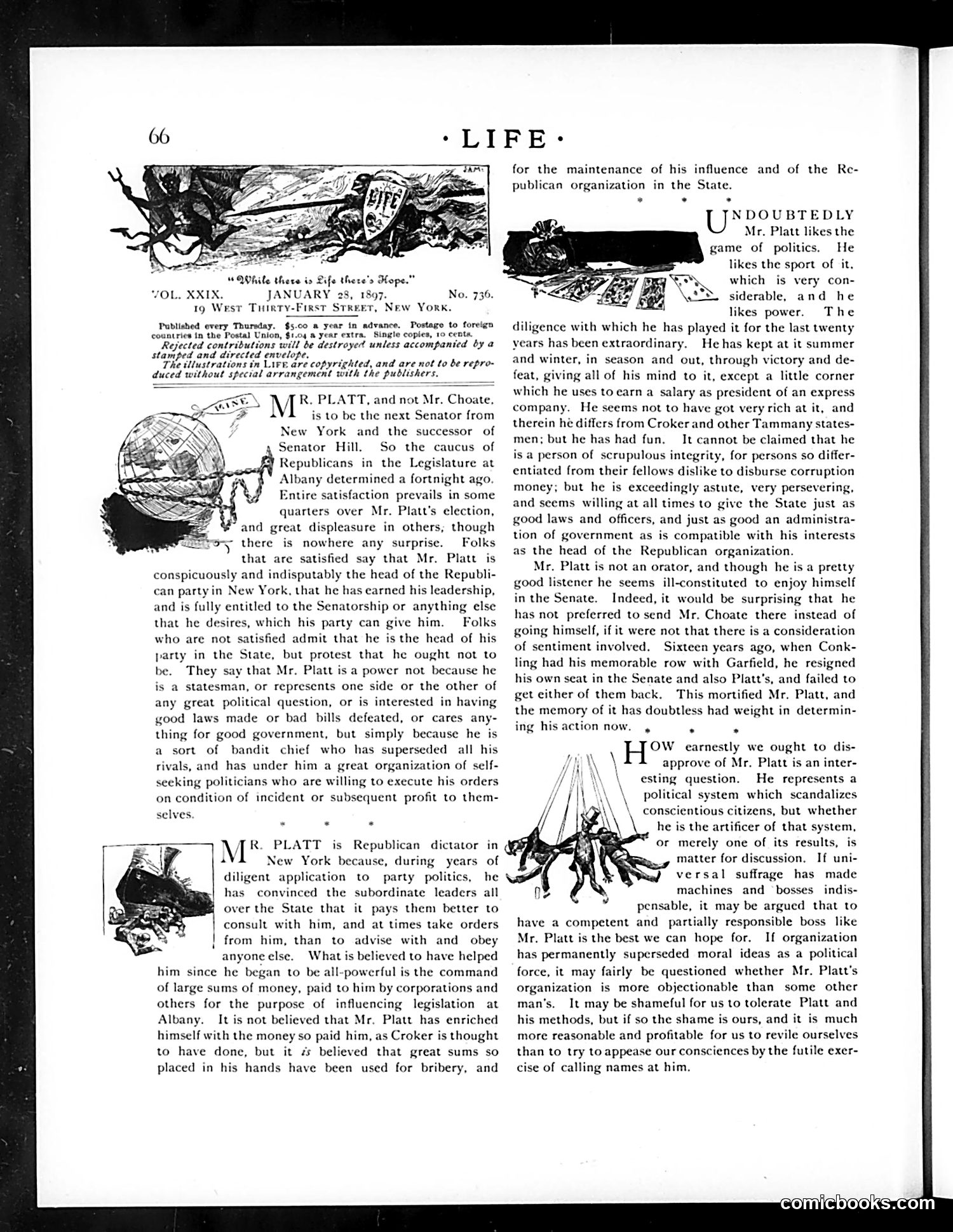
This page critiques **Mr. Platt**, a New York Republican political boss and Senator, through text and accompanying illustrations. The article describes Platt as a "dictator" who controls Republican politicians through organizational power rather than oratory skills. Key satirical points: - Platt maintains power through command of self-serving politicians willing to take orders - He allegedly received corporate money for legislative influence - The author questions whether Platt represents systemic corruption or is merely a symptom of a flawed political system The cartoons appear to mock Platt's puppet-master control over state politics. The text suggests readers judge whether Platt or the system itself deserves blame—a sophisticated critique acknowledging that individual villains may be less problematic than corrupt institutions they exploit.
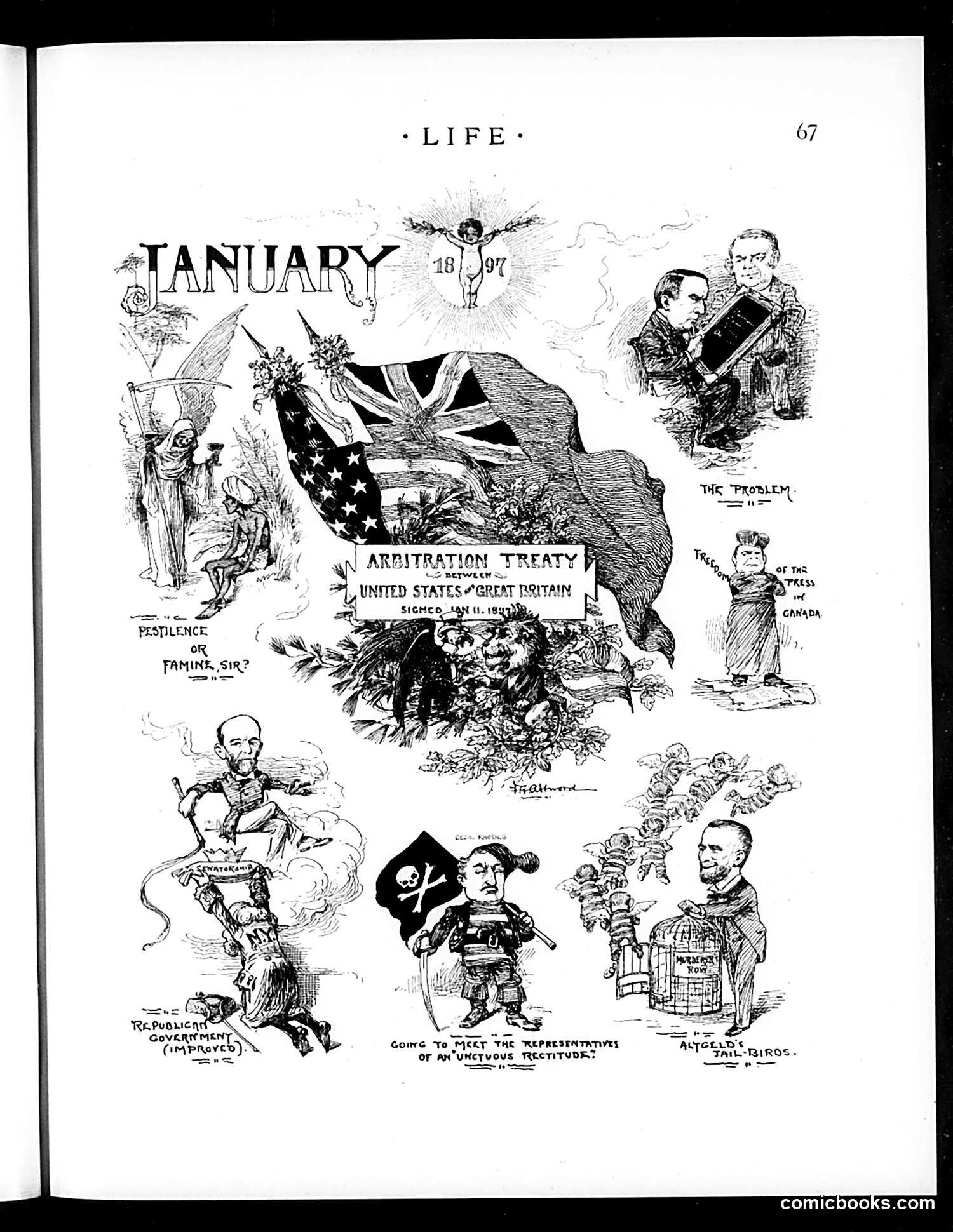
This page satirizes the **Arbitration Treaty between the United States and Great Britain**, signed January 11, 1897. The central image shows the treaty being attacked by various forces—likely representing political opposition. The smaller cartoons mock specific concerns: - **"Pestilence or Fame, Sir?"** critiques the treaty's uncertain consequences - **"The Problem"** shows two men (possibly senators) wrestling with the issue - **"Republican Government (Improved)"** appears to mock how the agreement might alter American governance - **"Going to Meet Representatives of an Unctuous Rectitude"** and **"Angelo's Tail-Birds"** use absurdist humor to ridicule treaty supporters The cartoons suggest American political anxiety about binding international agreements and British relations during this period of imperial tension.
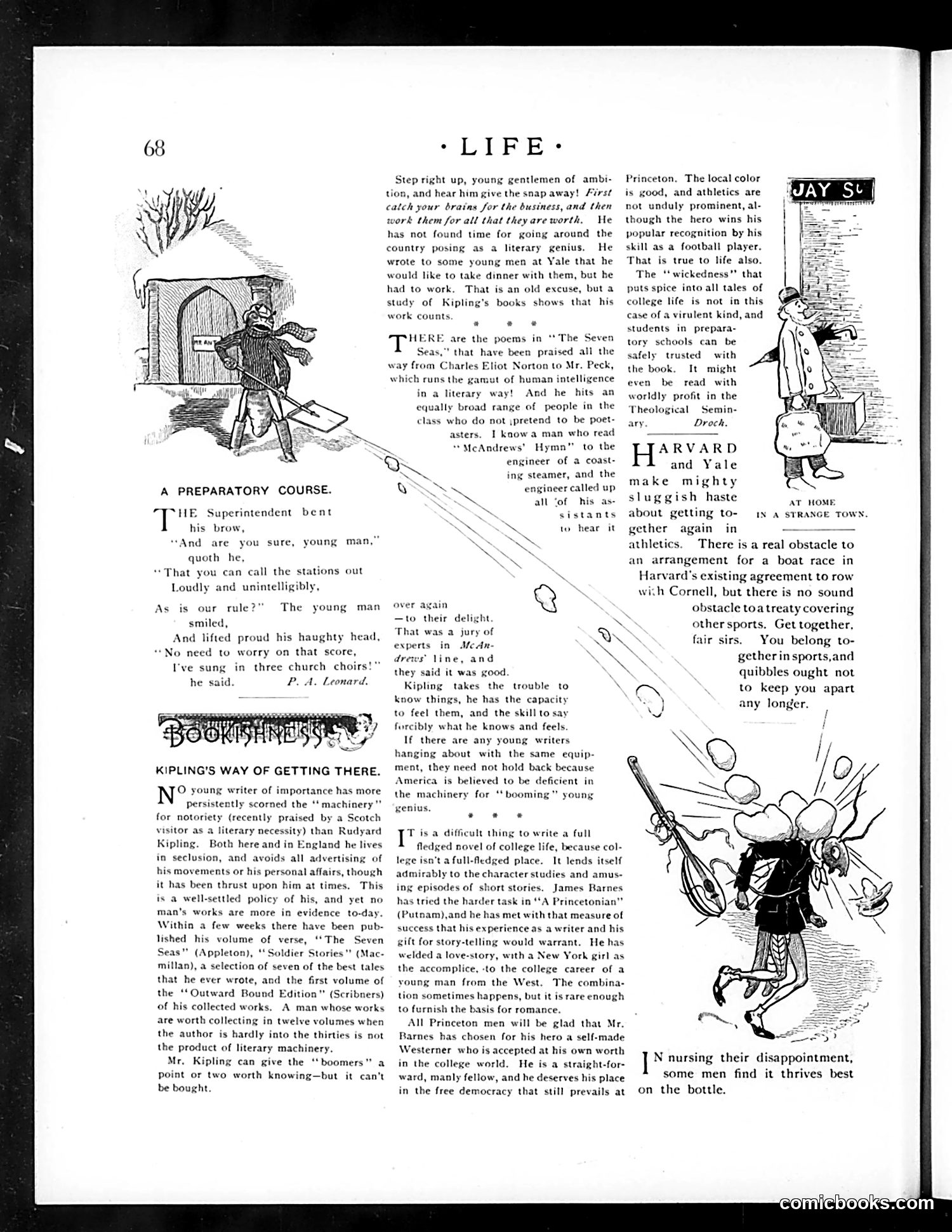
This page contains literary commentary rather than political satire. The main cartoon titled "A Preparatory Course" depicts a superintendent instructing a young man about calling out train stations—a mundane practical task contrasted with literary ambitions. The text discusses Rudyard Kipling's approach to writing and mentions his collection "The Seven Seas." It argues that Kipling's work, though praised by literary figures, demonstrates that practical experience and observing diverse people matters more than pretentious literary posturing. The second cartoon, "At Home in a Small Town," appears to show someone receiving news, likely illustrating the contrast between small-town life and broader ambitions discussed in the adjacent text about college life and writing. The overall message mocks young writers who avoid practical work while seeking literary success, celebrating Kipling as someone who combined both.
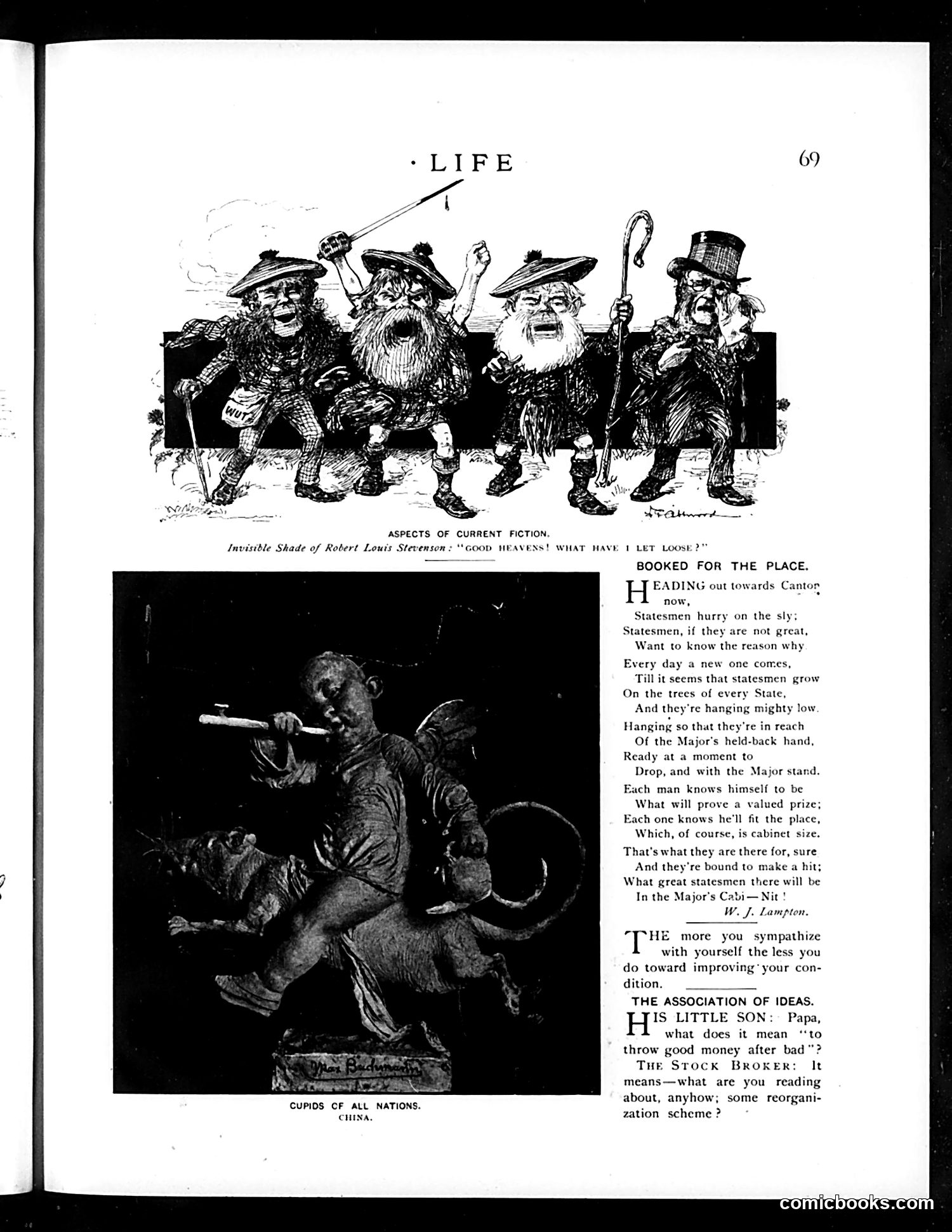
**Top Cartoon - "Aspects of Current Fiction":** This satirizes literary trends, specifically invoking Robert Louis Stevenson. Four caricatured old men represent stock characters appearing in contemporary fiction—depicted as grotesque, bearded figures. The caption quotes Stevenson asking "Good heavens! What have I let loose?"—suggesting that Stevenson's influence on literature has spawned countless poor imitations featuring similar melodramatic, exaggerated characters. **Bottom Image - "Cupids of All Nations (China)":** A cherub-like figure plays a flute while riding what appears to be a dragon or mythical creature. This likely satirizes Western romanticization of Chinese culture and "Oriental" aesthetics that were fashionable in late 19th/early 20th-century America. The right column contains unrelated satirical dialogue about politics and finance.
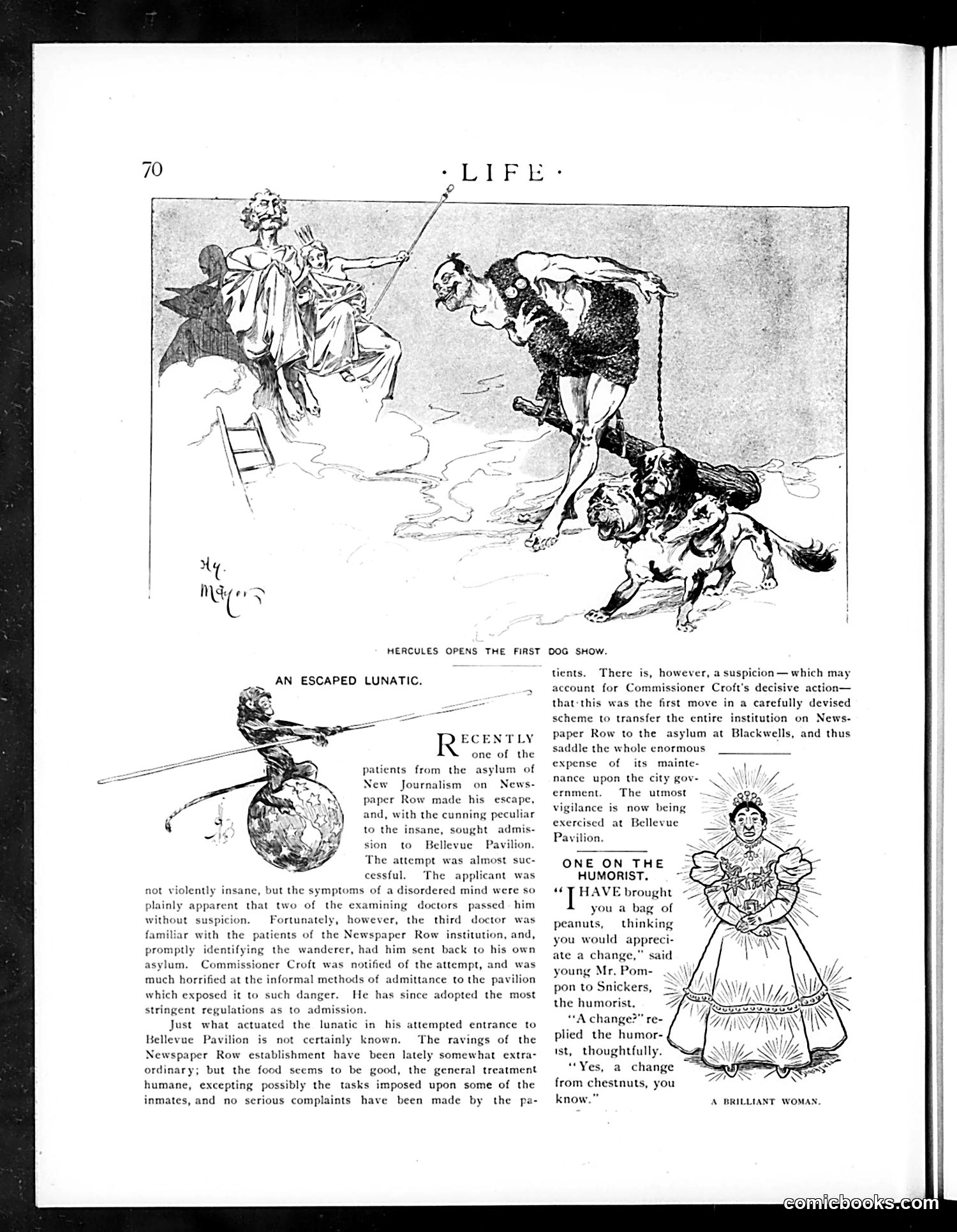
**Top cartoon: "Hercules Opens the First Dog Show"** A classical allegorical figure (labeled Hercules) gestures toward dogs being presented. This appears to satirize the debut of a dog show, using mythological grandeur to mock what the cartoonist treats as a trivial social event. **Middle section: "An Escaped Lunatic"** This cartoon depicts an asylum patient attempting to gain admission to Bellevue Pavilion by disguising himself. The text reveals the satirical point: the man is so obviously insane that even asylum doctors cannot miss it. The joke critiques both the patient's poor deception and possibly institutional incompetence. **Bottom: "One on the Humorist"** A brief humorous anecdote about someone offering peanuts as a "change," playing on the double meaning of the word.
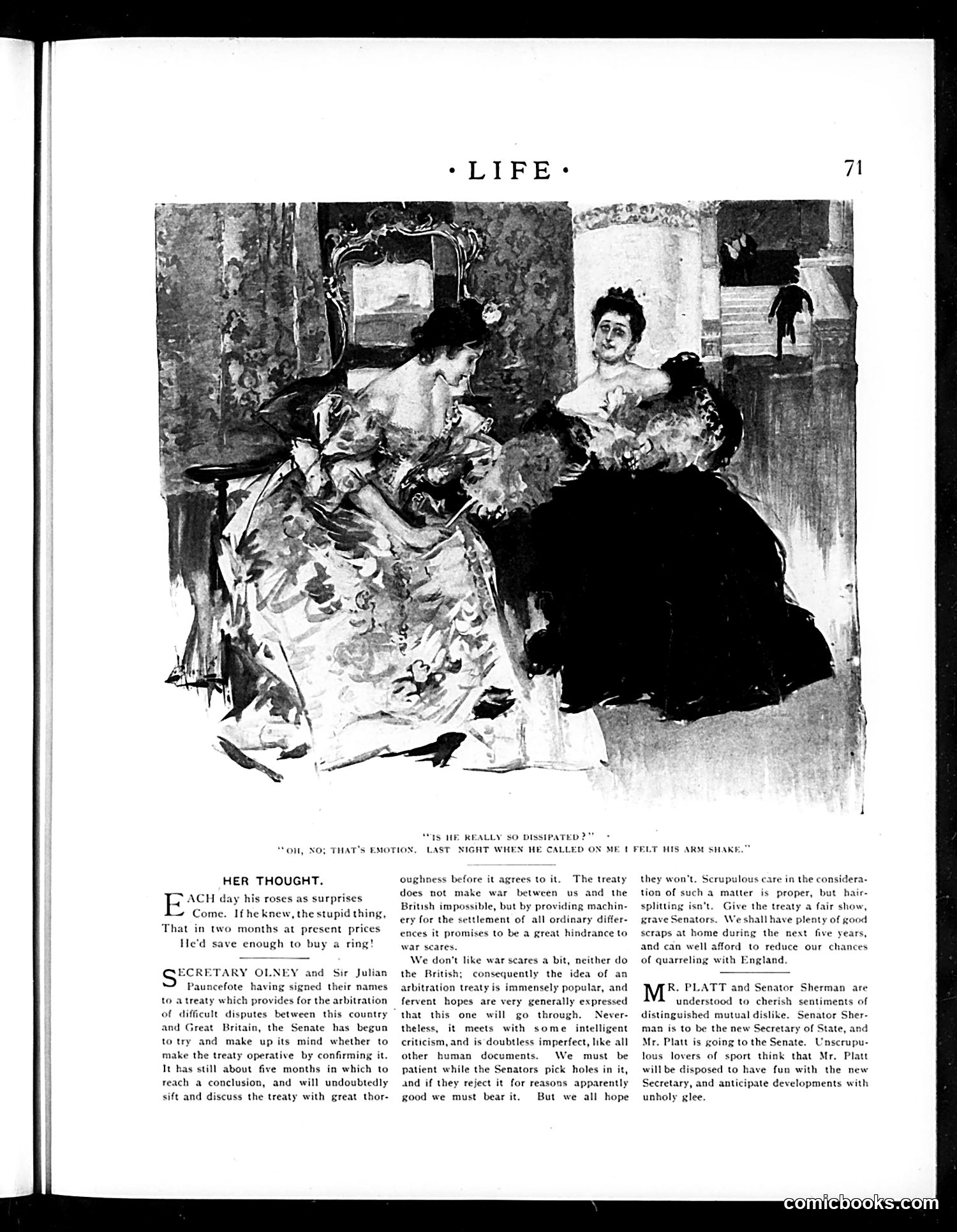
This page contains a satirical illustration titled "Her Thought" depicting what appears to be a social gathering. The accompanying text discusses Secretary Olney and Sir Julian Pauncefote signing names to a treaty addressing disputes between the United States and Great Britain. The satire concerns an arbitration treaty meant to prevent war. The text expresses cautious optimism that the treaty will pass Senate confirmation, though it acknowledges skepticism and anticipated criticism. References to Mr. Piatt and Senator Sherman suggest internal American political divisions over the agreement. The illustration likely satirizes upper-class social attitudes toward this serious diplomatic matter, contrasting frivolous socializing with weighty international negotiations—a typical Life magazine approach to exposing political hypocrisy or detachment among elites.
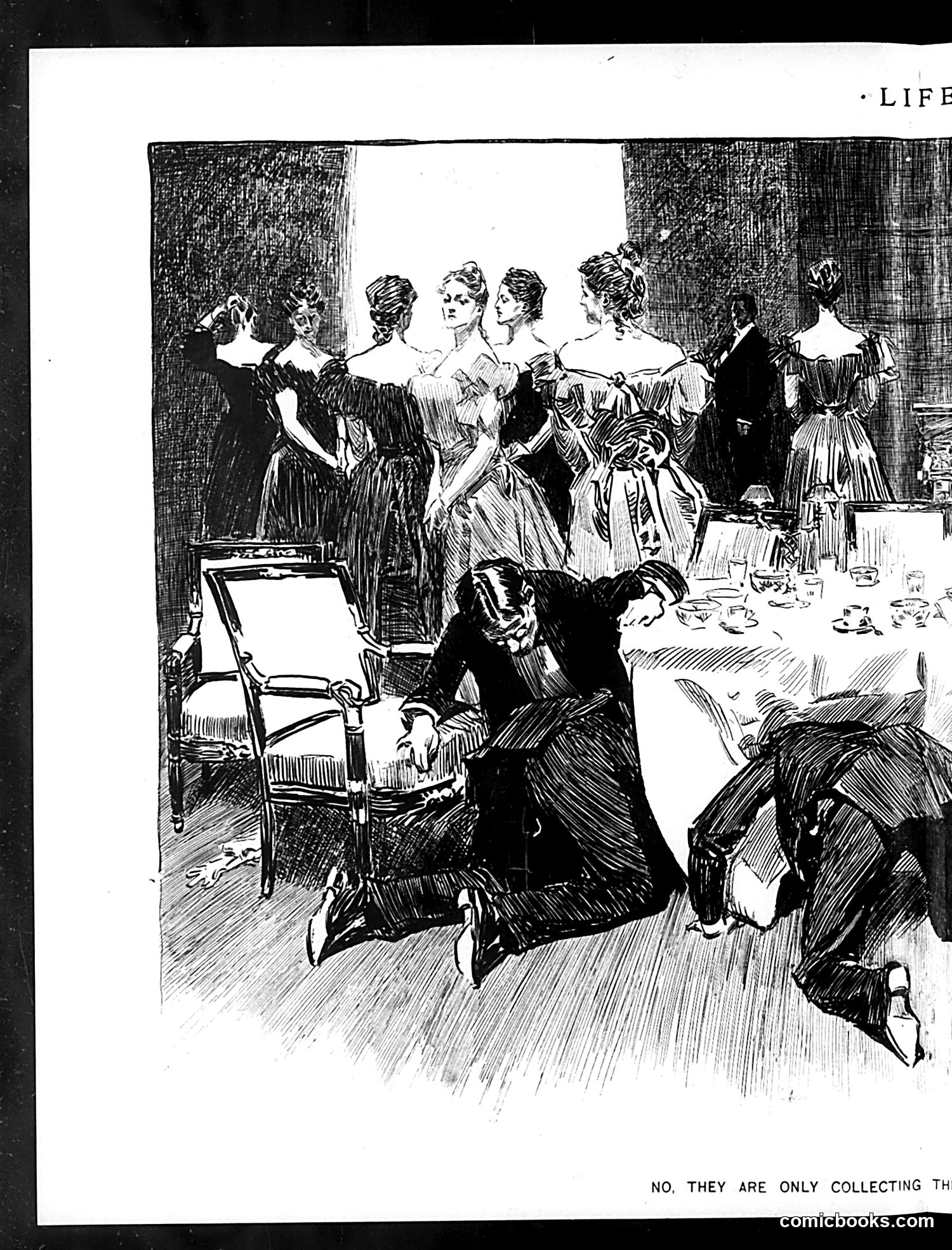
This satirical illustration from *Life* magazine depicts a formal dinner party with a clear social commentary. The caption reads "NO, THEY ARE ONLY COLLECTING TH[EIR]..." (text cut off). The cartoon shows well-dressed women at a formal dining table while two men in dark suits are positioned on the floor, appearing to collect or gather something beneath the table level. The visual joke suggests these men are engaged in some undignified activity while maintaining the pretense of a proper social gathering. The satire likely comments on either social hypocrisy—the contrast between outward propriety and actual behavior—or mocks a specific contemporary practice of wealthy society. Without the complete caption, the exact target remains somewhat unclear, but the juxtaposition of formal etiquette with degrading activity is the central comedic point.
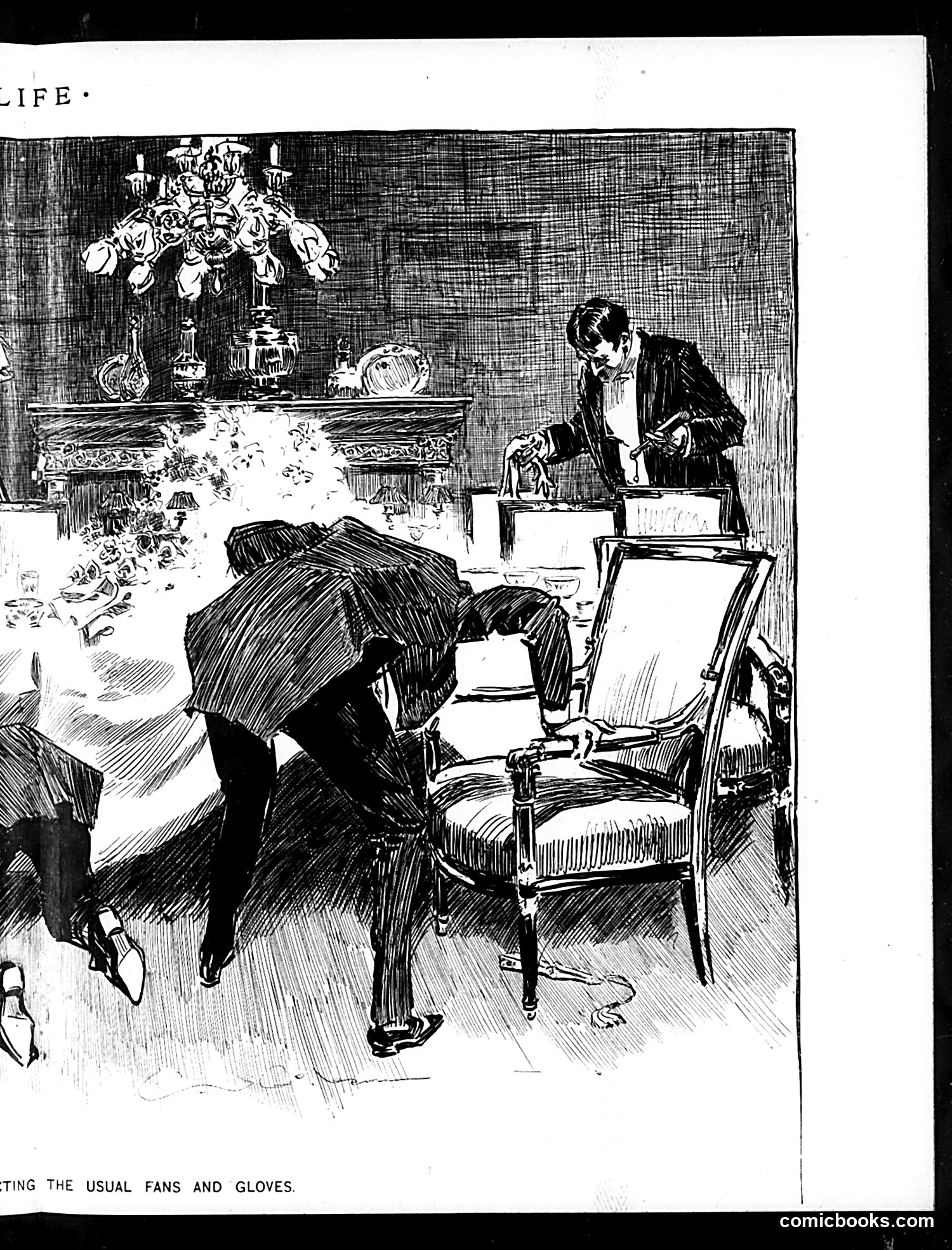
This appears to be a satirical illustration from *Life* magazine showing a social interaction scene. The visible caption reads "...ING THE USUAL FANS AND GLOVES," suggesting the image depicts someone (likely a woman based on the silhouette) adjusting or putting on fans and gloves—fashionable accessories of the era. The scene shows two figures in what appears to be an elegant interior with a fireplace and decorative items. One figure is bent over examining or adjusting items, while another stands nearby observing. The satire likely mocks either: 1. The fussiness of upper-class women obsessing over fashion details, or 2. The pretentiousness of adopting genteel accessories Without the complete caption and full context, the precise satirical target remains unclear, though it comments on Edwardian-era social conventions around dress and propriety.
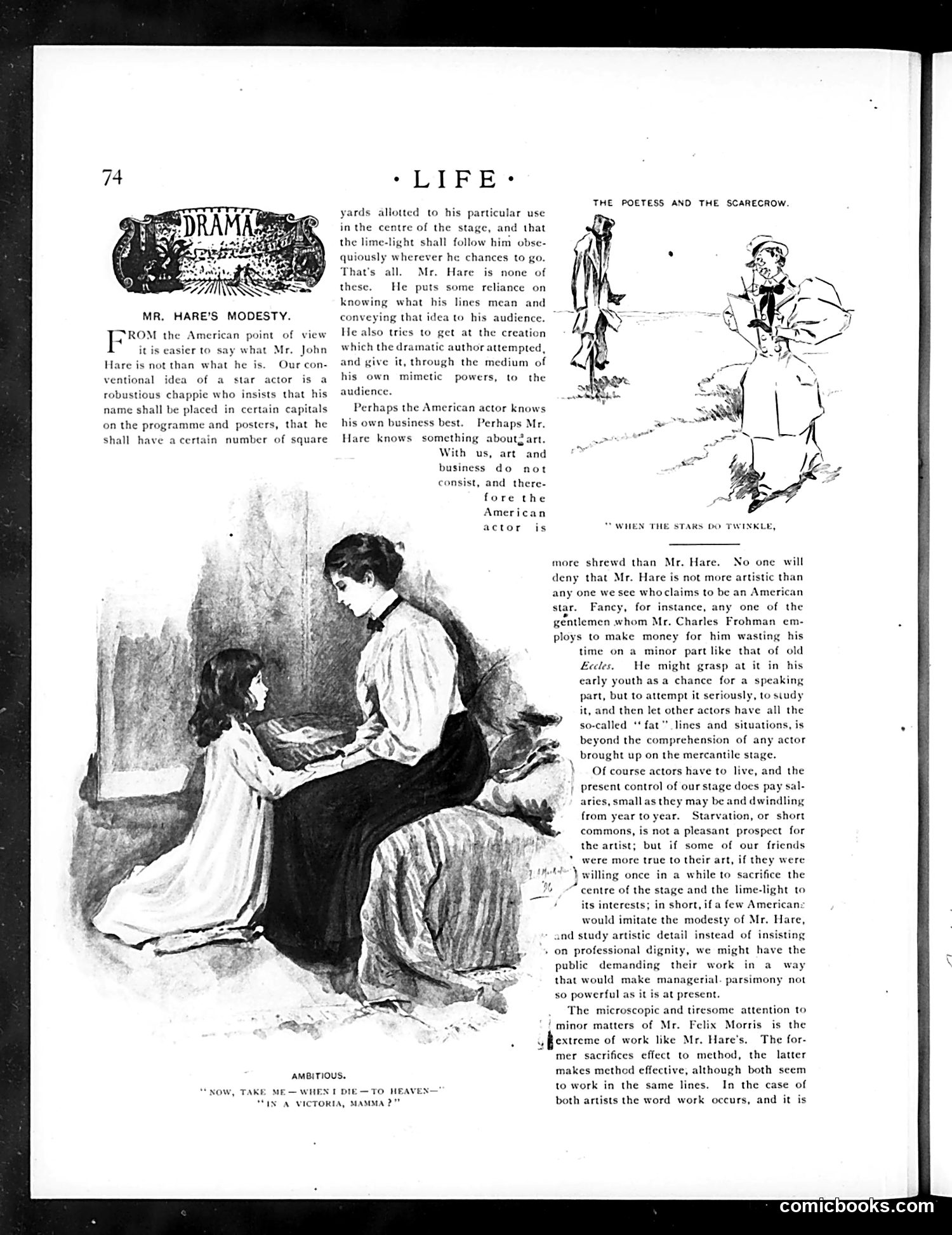
This page critiques American actor **Mr. Hare's** acting style and professional choices. The left section, titled "Mr. Hare's Modesty," argues that Hare prioritizes practical business concerns over artistic integrity. The text suggests American actors typically demand prominent billing and stage positioning, whereas Hare supposedly lacks such vanity. However, the right section ("When the Stars Do Twinkle") contradicts this, claiming Hare is actually quite calculating—willing to take minor roles under patrons like Charles Frohman only if it serves his career interests. The accompanying sketches appear to satirize theatrical pretension and the tension between artistic ambition and commercial pragmatism in American theater circa early 1900s. The overall tone mocks actors' claims to modesty while exposing underlying self-interest.
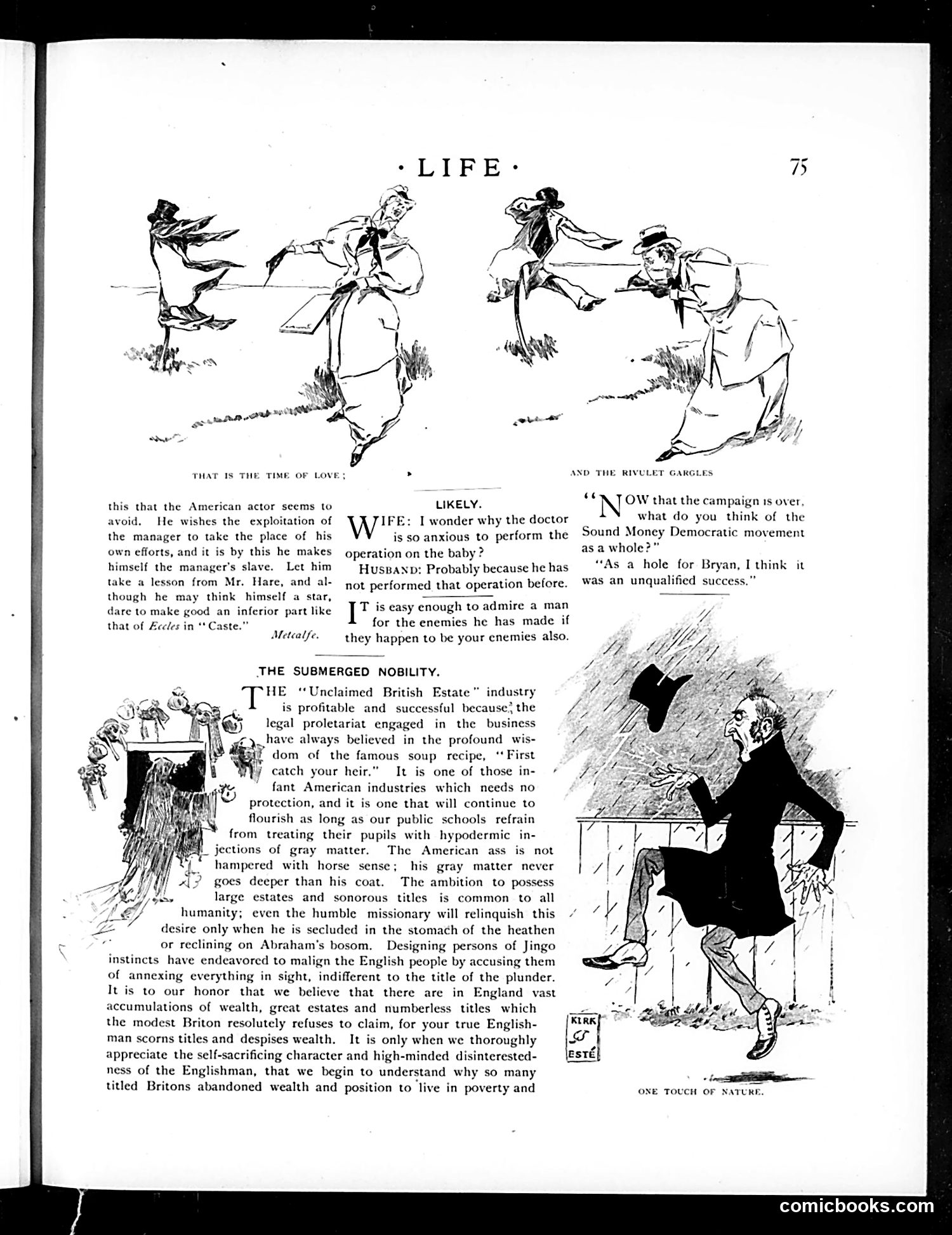
This page contains three satirical pieces from an American satirical magazine (likely early 1900s, given references to Bryan and the "Sound Money Democratic movement"). **Top cartoons**: Show men chasing women with nets, captioned "That is the Time of Love." The satire mocks romantic pursuit as predatory sport. **"Likely" dialogue**: A husband jokes that a doctor wants to operate on their baby because he hasn't performed the procedure before—satirizing unnecessary medical intervention and doctors' financial motivations. **"Sound Money" joke**: References William Jennings Bryan's 1896 presidential campaign and the monetary policy debate. A speaker calls Bryan "an unqualified success" as a "hole"—a pun suggesting he was worthless/hollow. **"The Submerged Nobility"**: The main article mocks American gullibility regarding fake "unclaimed British estates"—a real scam exploiting Americans' desire for titles and wealth. It also satirizes English aristocrats who claim moral superiority while possessing vast estates. **"One Touch of Nature"**: The silhouette cartoon (bottom right) appears to show someone discovering nature or truth, though the specific reference is unclear.
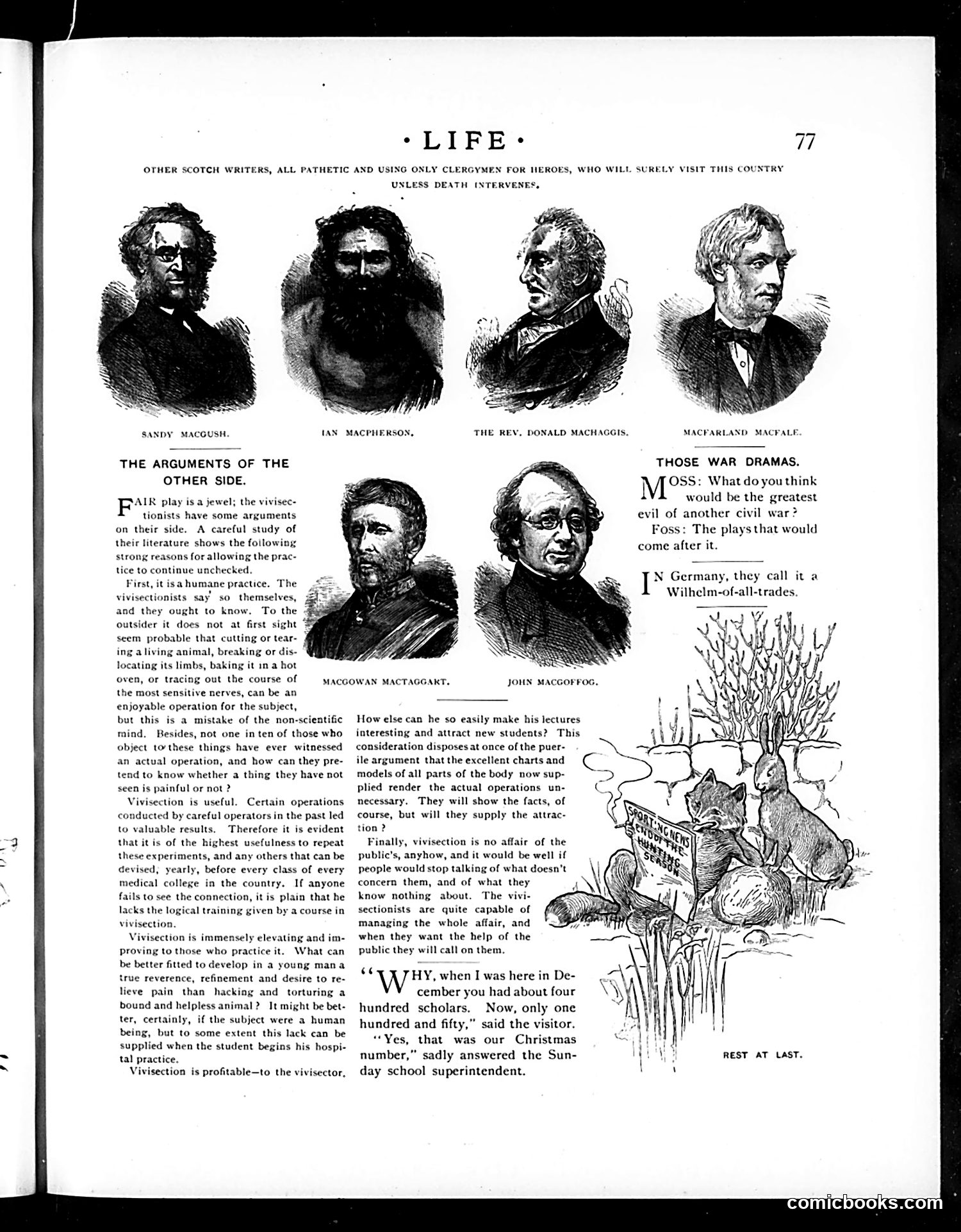
This page satirizes pro-vivisection arguments through ironic "reasoning." The four Scottish writer portraits at top are caricatured as pathetic figures whose works rely on clergymen as heroes—establishing them as targets of mockery. The main text presents the vivisectionists' arguments in deliberately absurd logic: calling animal torture "humane" because practitioners say so; claiming past successes justify endless repetition; arguing that torturing animals develops "reverence" in medical students; and insisting the public has no right to question the practice. The satire works by letting these arguments speak for themselves—their circular reasoning and cruelty become obvious to any rational reader. The implication is that vivisectionists use similarly flawed logic to justify their actual experiments on living animals. The small cartoon "Rest at Last" and the war-drama dialogue appear unrelated filler content typical of satirical magazines. **Context**: This reflects 1880s-1890s anti-vivisection activism in Britain, when the practice was increasingly controversial among the public and reformers, though defended by the medical establishment.
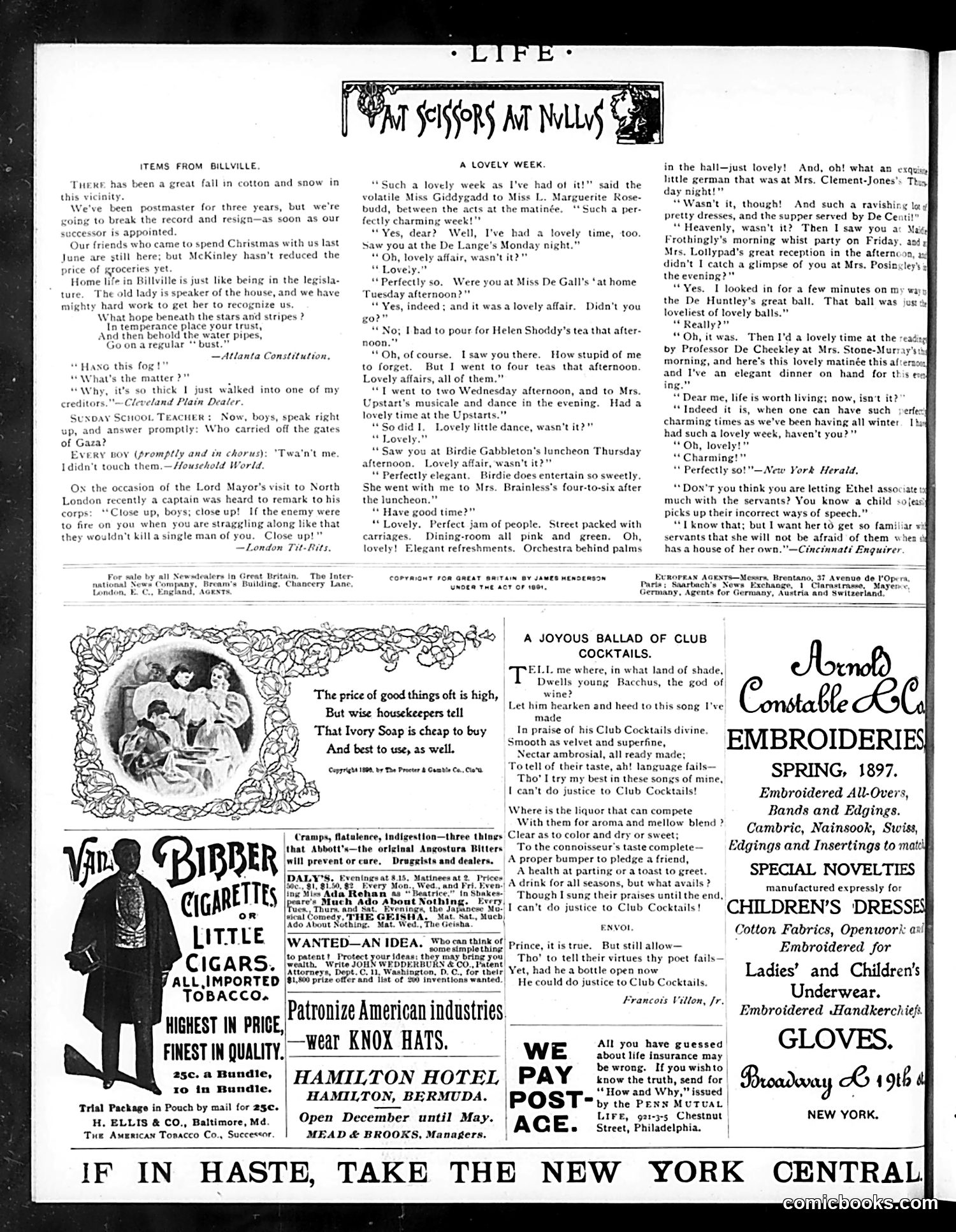
This page is primarily **advertising and humor columns**, not political cartoons. The main satirical content is "A Lovely Week," a dialogue mocking the superficial social calendar of wealthy women. Two society ladies discuss their week, each mentioning attending multiple teas, luncheons, musicales, dances, and receptions—all described as "lovely" and "elegant." The satire lies in the repetitive, empty praise and the exhausting frivolity of this lifestyle: one character mentions pouring tea instead of attending events, while another somehow attends multiple simultaneous functions. The joke highlights how meaningless these social obligations had become for affluent women of the 1890s—endless events with interchangeable descriptions and no substance. The page also contains unrelated short jokes from various newspapers (about fog, Sunday school, military discipline) and period advertisements for soap, cigarettes, hotels, and clothing—typical of Life's commercial content.
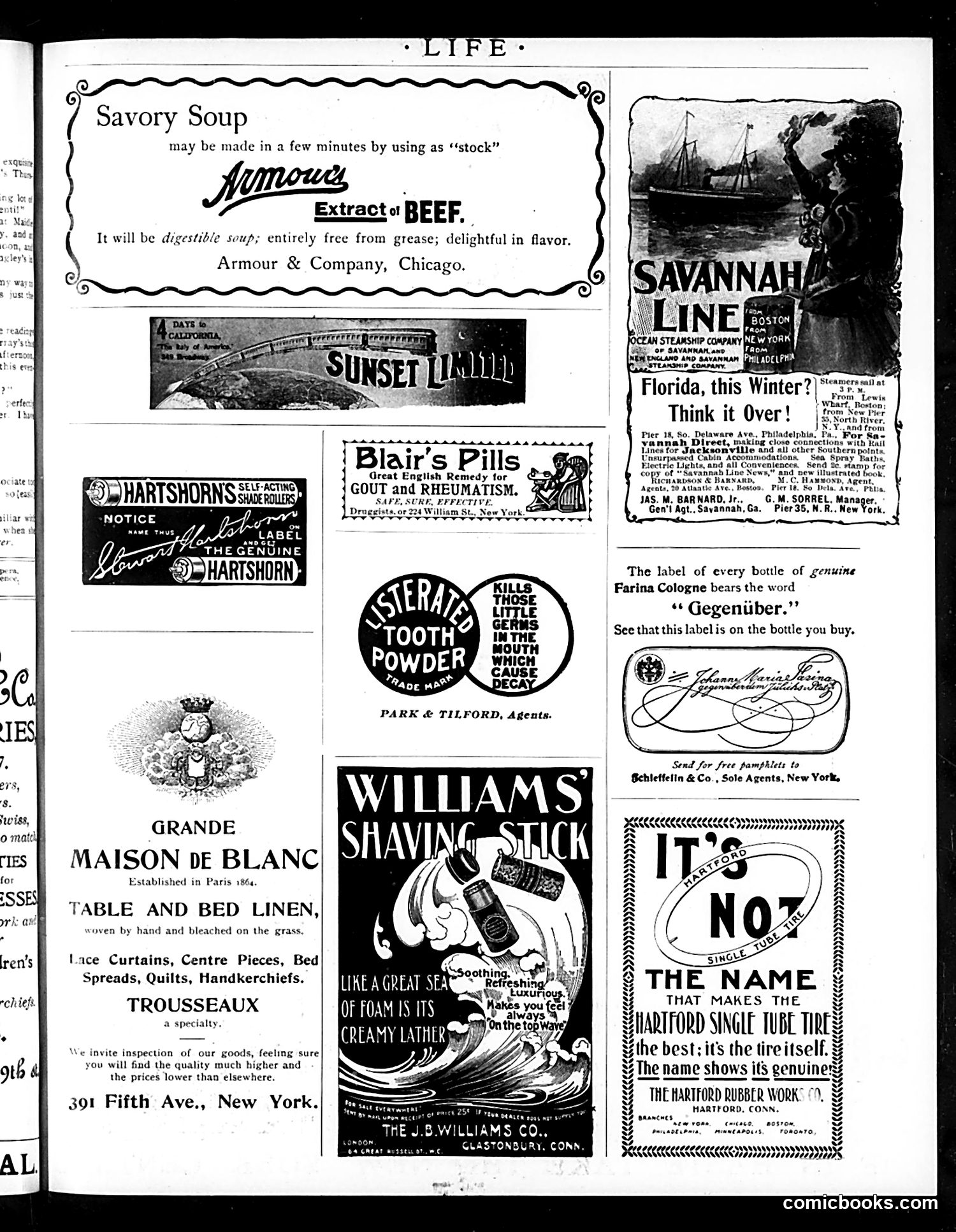
This page is **primarily advertisements**, not editorial content or satire. It represents typical early 20th-century magazine advertising with no political cartoon or satirical commentary. The ads promote consumer products: Armour's beef extract for soup, Savannah Line steamship travel to Florida, Blair's Pills for gout/rheumatism, Hartshorn smelling salts, Grande Maison de Blanc linens from Paris, Listerine tooth powder, Williams' shaving stick, Farina Cologne, and Hartford single-tube tires. The only quasi-humorous element is the tire advertisement's emphasis "IT'S NOT THE NAME"—a tongue-in-cheek claim that quality matters more than branding, ironically undermined by the ad's own heavy branding. This is a straightforward commercial page reflecting late 19th/early 20th-century print advertising conventions: product endorsements, claims of European prestige, and medical remedies (some now recognized as ineffective or harmful).
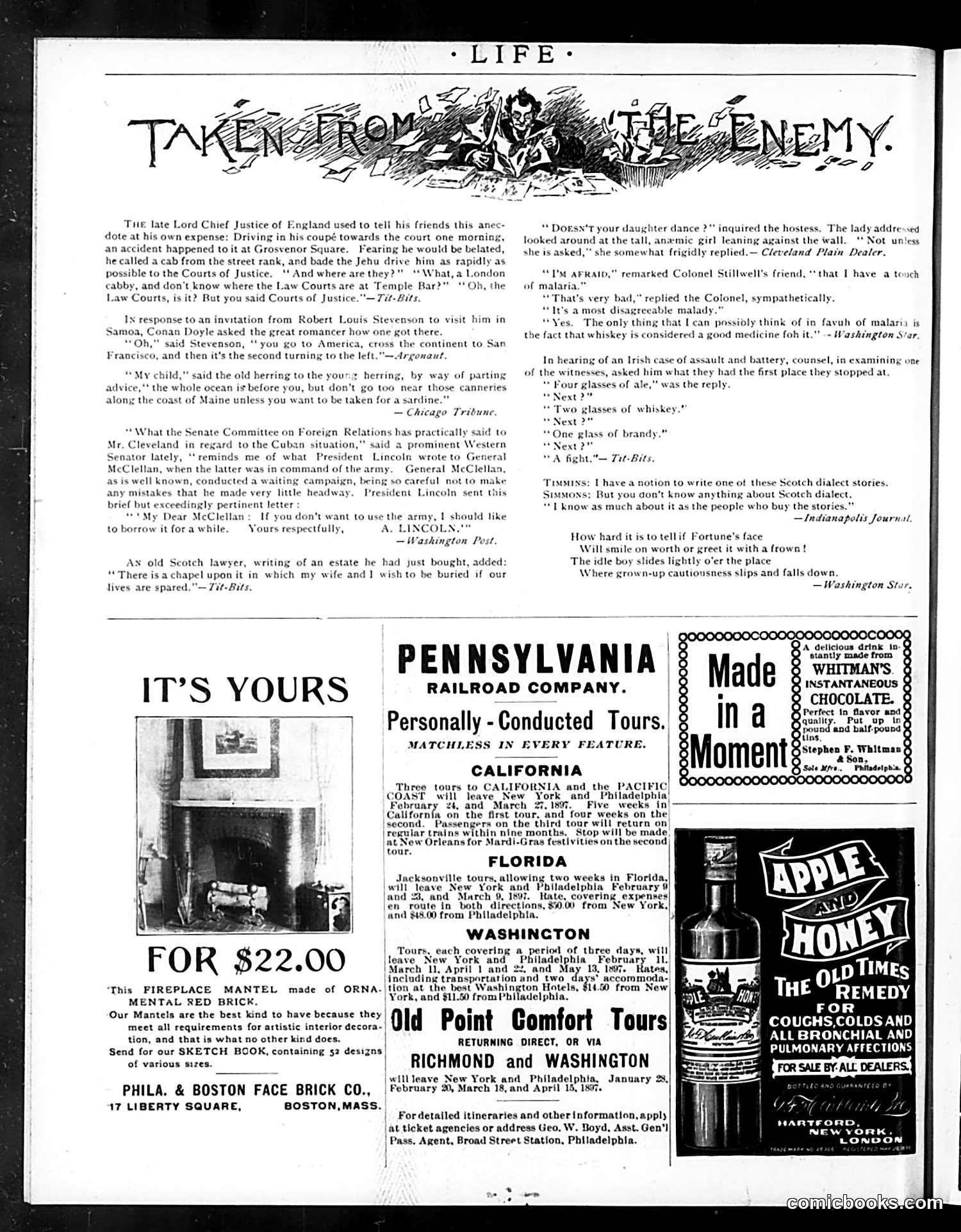
This page is primarily **advertisements and humorous anecdotes** rather than political cartoons. The top section contains several brief jokes reflecting turn-of-the-century humor: a Lord Chief Justice mistaken for ordering "Courts of Justice" instead of "Law Courts" by a London cabby; Conan Doyle asking Robert Louis Stevenson for directions to Samoa; and various quips about whiskey as medicine and courtroom testimony. These represent genteel magazine humor typical of the era. The main visual content is an advertisement for an ornamental fireplace mantel ($22.00) from a Boston brick company, featuring a photograph of the product. Below are travel advertisements for Pennsylvania Railroad tours to California, Florida, and Washington D.C., and product ads for Whitman's chocolate and Apple and Honey cough remedy. **No significant political satire or social commentary is evident on this page.** It represents typical content mixing light humor with commercial advertising from an early 1900s American magazine.
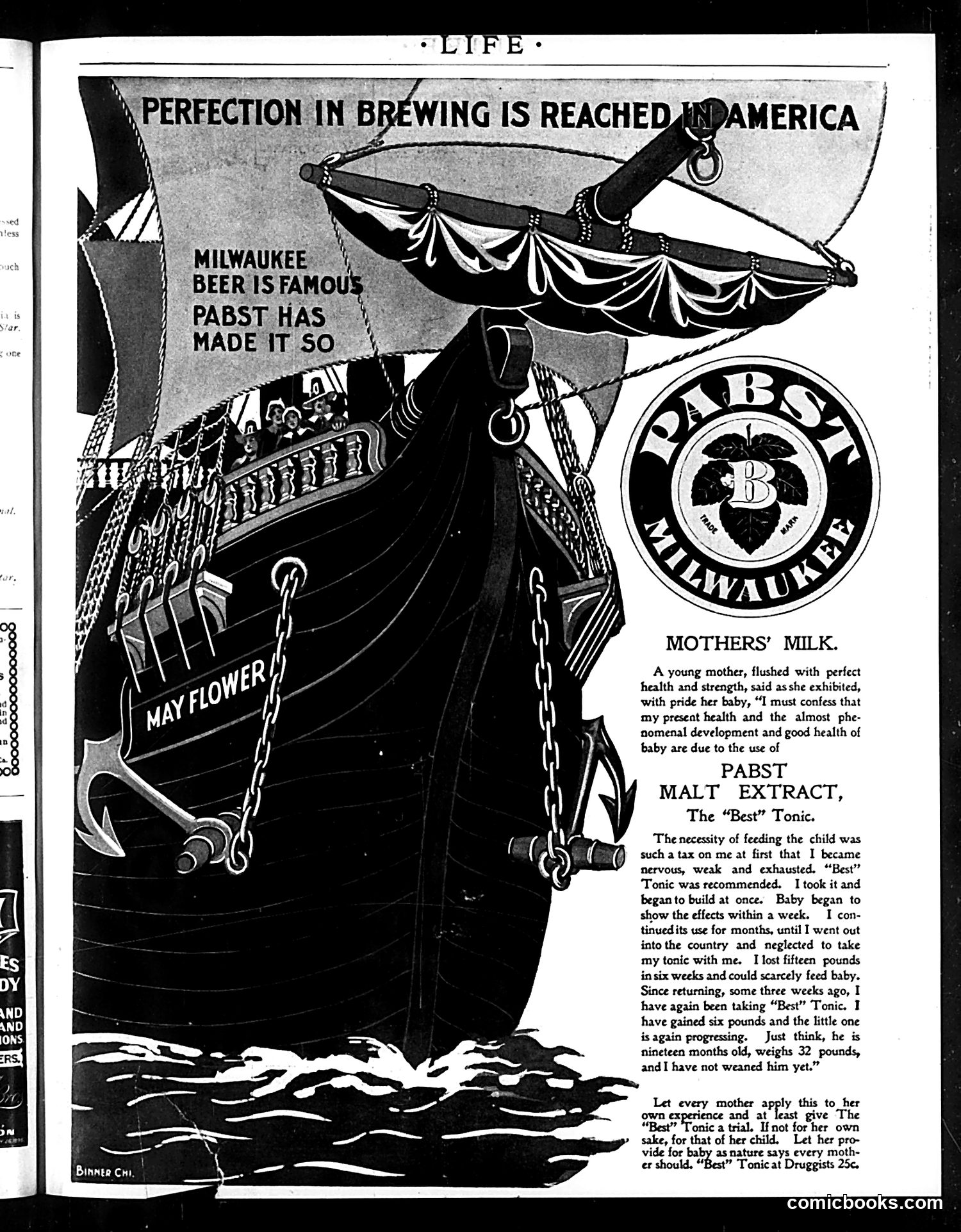
This is a **Pabst malt extract advertisement**, not satire—it's a genuine commercial from early 20th-century Life magazine. The page promotes Pabst's "Best" Tonic, a malt extract product marketed to nursing mothers. The elaborate ship imagery (the "May Flower") emphasizes Pabst's brewing heritage and quality. The testimonial claims a mother regained her health and strength by consuming the tonic, which supposedly also improved her baby's development and weight gain. **Context for modern readers:** This represents a bygone era when alcohol-based tonics were routinely marketed as medicinal cure-alls, especially to women and for infant health. The product likely contained malt (a fermented grain byproduct) and possibly alcohol. Today, giving such products to babies would constitute child abuse, and marketing them as nutritional supplements would violate FDA regulations. The ad reflects pre-regulation attitudes toward patent medicines and demonstrates how differently early 20th-century Americans viewed "tonics" and maternal/infant nutrition.
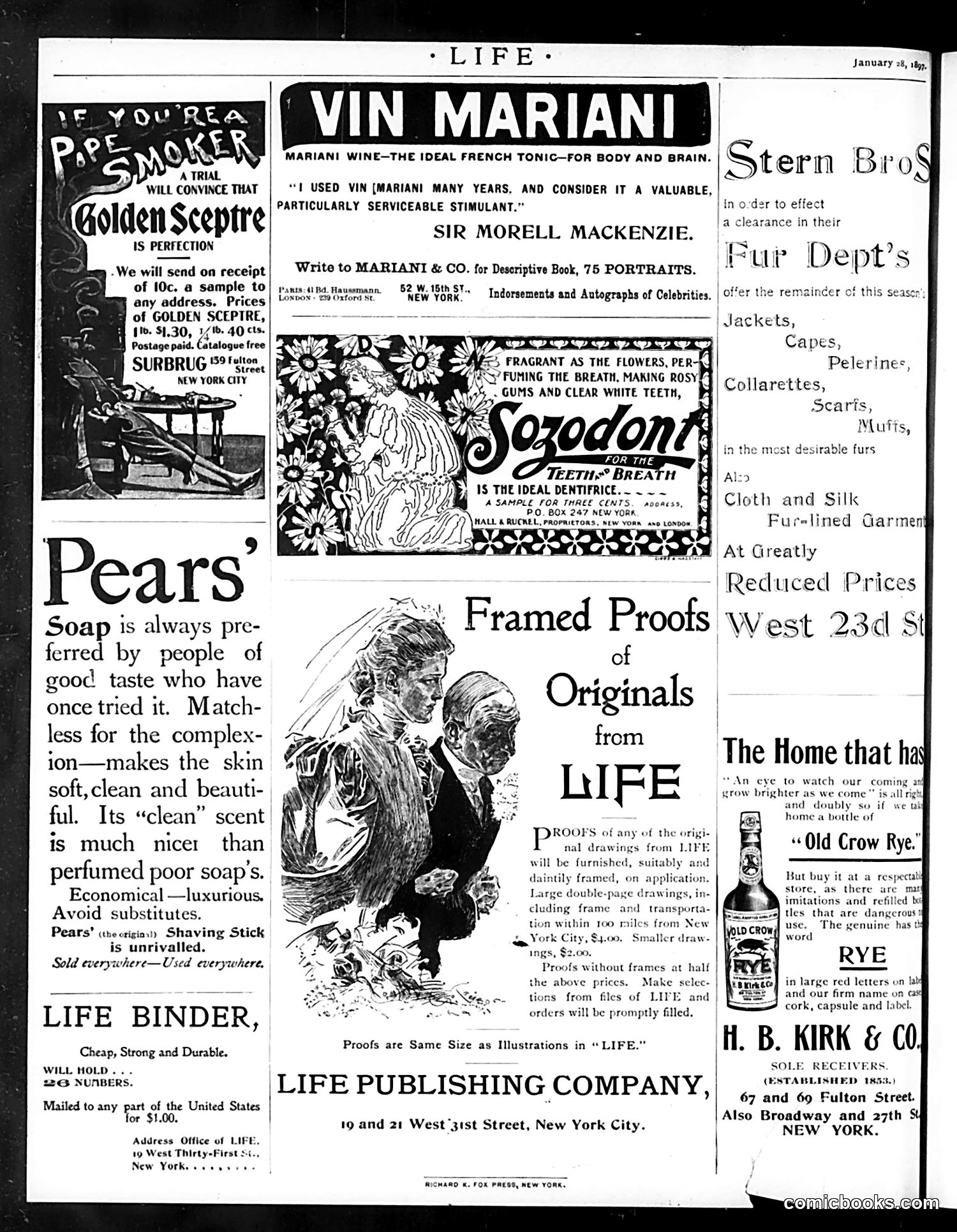
This is primarily a **classified advertising page** from Life magazine's early era. The content consists almost entirely of period product advertisements rather than editorial cartoons or satirical content. Notable ads include: - **Vin Mariani**: A French "tonic wine" endorsed by celebrity testimonial (Sir Morell Mackenzie), marketed as a stimulant for "body and brain"—a common patent medicine of the era, likely containing cocaine or similar substances - **Sozodont**: A toothpaste/dentifrice promising cosmetic dental benefits - **Pears' Soap**: Positioning itself as luxury soap for people of "good taste" - **Old Crow Rye**: Whiskey advertised with warnings against counterfeits The "Framed Proofs of Originals from LIFE" section shows Life Publishing Company sold reproductions of magazine illustrations. **For modern readers**: This reflects the unregulated patent medicine market of the 1890s, before FDA oversight. The advertising assumes readers will trust celebrity endorsements and vague health claims.