
Life, 1897-01-28 · page 2 of 20
Life — January 28, 1897 — page 2: what you’re looking at
What you’re looking at
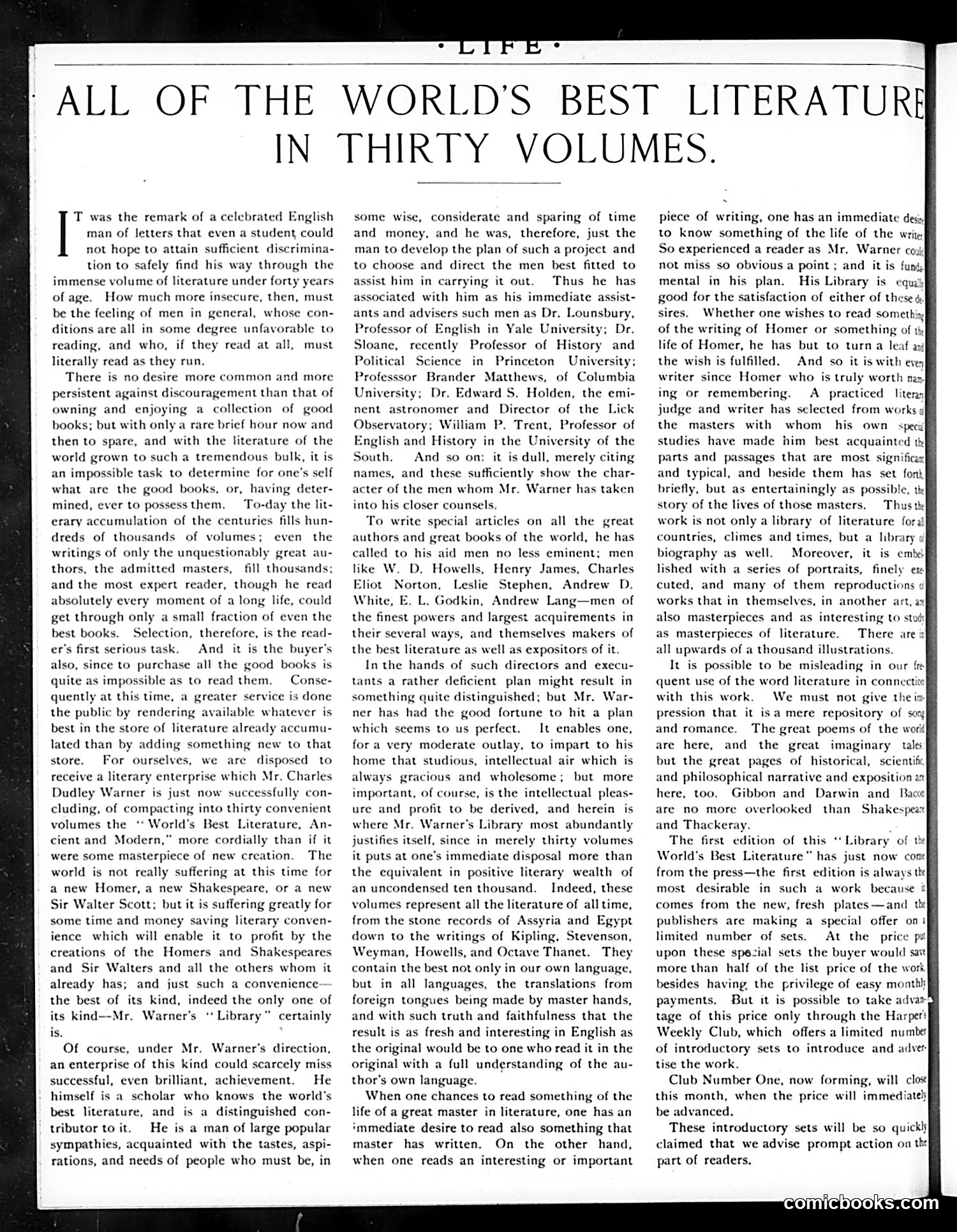
This page contains **no cartoon or satirical illustration**—it is entirely text-based editorial content. The piece discusses Mr. Charles Dudley Warner's literary project: a thirty-volume collection titled "World's Best Literature, Ancient and Modern." The article explains Warner's selection rationale and mentions his distinguished advisory board, including professors from Yale and Princeton. It emphasizes the collection's comprehensiveness, noting it includes translations of foreign works and biographical articles on major authors like Homer, Shakespeare, Kipling, and Darwin. The editorial presents this as a public service—making great literature accessible to ordinary readers who cannot otherwise afford or locate such works. It announces the first edition is selling through Harper's Weekly Club at a special price, with introductory sets soon available. This is promotional content, not satire.
📄 Transcribed text from this page (OCR, searchable)
Machine-transcribed from the original scan — historical spelling and the odd misread are preserved.
“ALL OF THE WORLD'S BEST. LITERATURE IN THIRTY VOLUMES. T was the remark of a celebrated English man of letters that even a student could not hope to attain sufficient discrimina- tion to safely find his way through the immense volume of literature under forty years of age. How much more insecure, then, must be the feeling of men in general, whose con- ditions are all in some degree unfavorable to reading, and who, if they read at all, must literally read as they run. There is no desire more common and more persistent against discouragement than that of owning and enjoying a collection of good books; but with only a rare brief hour now and then to spare, and with the literature of the world grown to such a tremendous bulk, it is an impossible task to determine for one’s self what are the good books, or, having deter- mined, ever to possess them, To-day the lit- erary accumulation of the centuric: dreds of thousands writings of only the unquestionably great au- thors, the admitted masters, fill thousands; and the most expert reader, though he read fills hun- of volumes; even the absolutely every moment of a long life, could get through only a small fraction of even the best books. Selection, therefore, is the read- er’s first serious task. And it is the buyer also, since to purch all the good books quite as impossible as to read them, — Conse- quently at this time, a greater service is done the public by rendering available whatever is best in the store of literature already accumu- lated than by adding something new to that store. For ourselves, we are disposed to receive a literary enterprise which Mr. Charles Dudley Warner is just now successfully con- cluding, of compacting into thirty convenient volumes the ‘* World’s Best Literature, An- cient and Modern,” more cordially than if it were some masterpiece of new creation. The world is not really suffering at this time for a new Homer, a new Shakespeare, or a new Sir Walter Scott; but it is suffering greatly for me time and money saving literary conven- ience which will enable it to profit by the creations of the Homers and Shakespeares and Sir Walters and all the others whom it already has; and just such a convenience the best of its kind, indeed the only one of its kind—-Mr. Warner's ‘‘ Library” certainly is. Of course, under Mr. Warner's direction, an enterprise of this kind could scarcely mis successful, even brilliant, achievement. He himself is a scholar who knows the world’s best literature, and is a distinguished con- tributor to it. He is a man of large popular sympathies, acquainted with the tastes, aspi- rations, and needs of people who must be, in some wise, considerate and sparing of time and money, and he was, therefore, just the man to develop the plan of such a project and to choose and direct the men best fitted to a him in carrying it out. Thus he has associated with him as his immediate assist- ants and advisers such men as Dr, Lounsbury, Professor of English in Yale University; Dr. Sloane, recently Professor of History and Political Science in Princeton Universit Professsor Brander Matthews, of Columbia University; Dr. Edward S$. Holden, the emi- nent astronomer and Director of the Lic Observatory; William P. Trent, Professor of English and History in the University of the South. And so on: it is dull, merely citing names, and these sufficiently show the char- acter of the men whom Mr. Warner has taken into his closer counsels, To write special articles on all the great authors and great books of the world, he has called to his aid men no less eminent; men like W. D. Howells, Henry James, Charles Eliot Norton, Leslie Stephen, Andrew D. Whit L. Godkin, Andrew Lang—men of the finest powers and largest acquirements in their several ways, and themselves makers of the best literature as well as expositors of it In the hands of such directors and execu- tants a rather deficient plan might result in something quite distinguished; but Mr. War- ner has had the good fortune to hit a plan which seems to us perfect. It enables one, fora very moderate outlay, to impart to hi home that studious, intellectual air which is always gracious and wholesome; but more important, of course, is the intellectual pleas- ure and profit to be derived, and herein is where Mr. Warner's Library most abundantly justifies itself, since in merely thirty volume it puts at one’s immediate disposal more than the equivalent in positive literary wealth of an uncondensed ten thousand. Indeed, these volumes represent all the literature of alltime, from the stone records of Assyria and Egypt down to the writings of Kipling, Stevenson, Weyman, Howells, and Octave Thanet. They contain the best not only in our own language, but in all languag the translations from foreign tongues being made by master hands, and with such truth and faithfulness that the result is as fresh and interesting in English as the original would be to one who read it in the original with a full understanding of the au- thor’s own language. When one chances to read something of the life of a great master in literature, one has an immediate desire to read also something that master has written, On the other hand, when one reads an interesting or important piece of writing, one has an immediate di to know something of the life of the write So experienced a reader as Mr. Warner coui not miss so obvious a point; and it is fund mental in his plan. His Library equal good for the satisfaction of either of these & sires. Whether one wishes to read somethix of the writing of Homer or something of t life of Homer, he has but to turn a leaf ax the wish is fulfilled. writer since Homer who is truly worth n ing or remembering. A_ practiced litera judge and writer has selected from works ¢ the masters with whom his own spec! studies have made him best acquainted part d passages that are most signifi and typical, and beside them has set font briefly, but as entertainingly as poss story of the lives of those masters. $ work is not only a library of literature fo: countries, climes and times, but a library biography as well. Moreover, it is embe lished with a series of portraits, finely exe} cuted, and many of them reproductions ¢ works that in themselves, in another art, a7 erpieces and as interesting to stud) as masterpieces of literature. There are 3! all upwards of a thousand illustrations. It is possible to be misleading in our quent use of the word literature in conn with this work. We must not give the io pression that it isa mere repository of soy and romance. The great poems of the wort are here, and the great imaginary tales but the great pages of historical, scientifx and philosophical narrative and exposition a here, too. Gibbon and Darwin and Bac are no more overlooked than Shakespez and Thacker; The first edition of this ‘Library of th World's Best Literature” has just now com from the press—the first edition is always tk most desirable in such a work because 4 comes from the new, fresh plates—and th publishers are making a special offer oni limited number of sets. At the price pz! upon these special sets the buyer would sat more than half of the list price of the work besides having the privilege of easy monthly payments. But it is possible to take advar tage of this price only through the Harpers Weekly Club, which offers a limited number of introductory sets to introduce and adver} tise the work, Club Number One, now forming, will clos} this month, when the price will immediatel be advanced. These introductory sets will be so quickly claimed that we advise prompt action on tt part of readers, And so it is with eves) also mas