
Life, 1897-01-28 · page 4 of 20
Life — January 28, 1897 — page 4: what you’re looking at
What you’re looking at
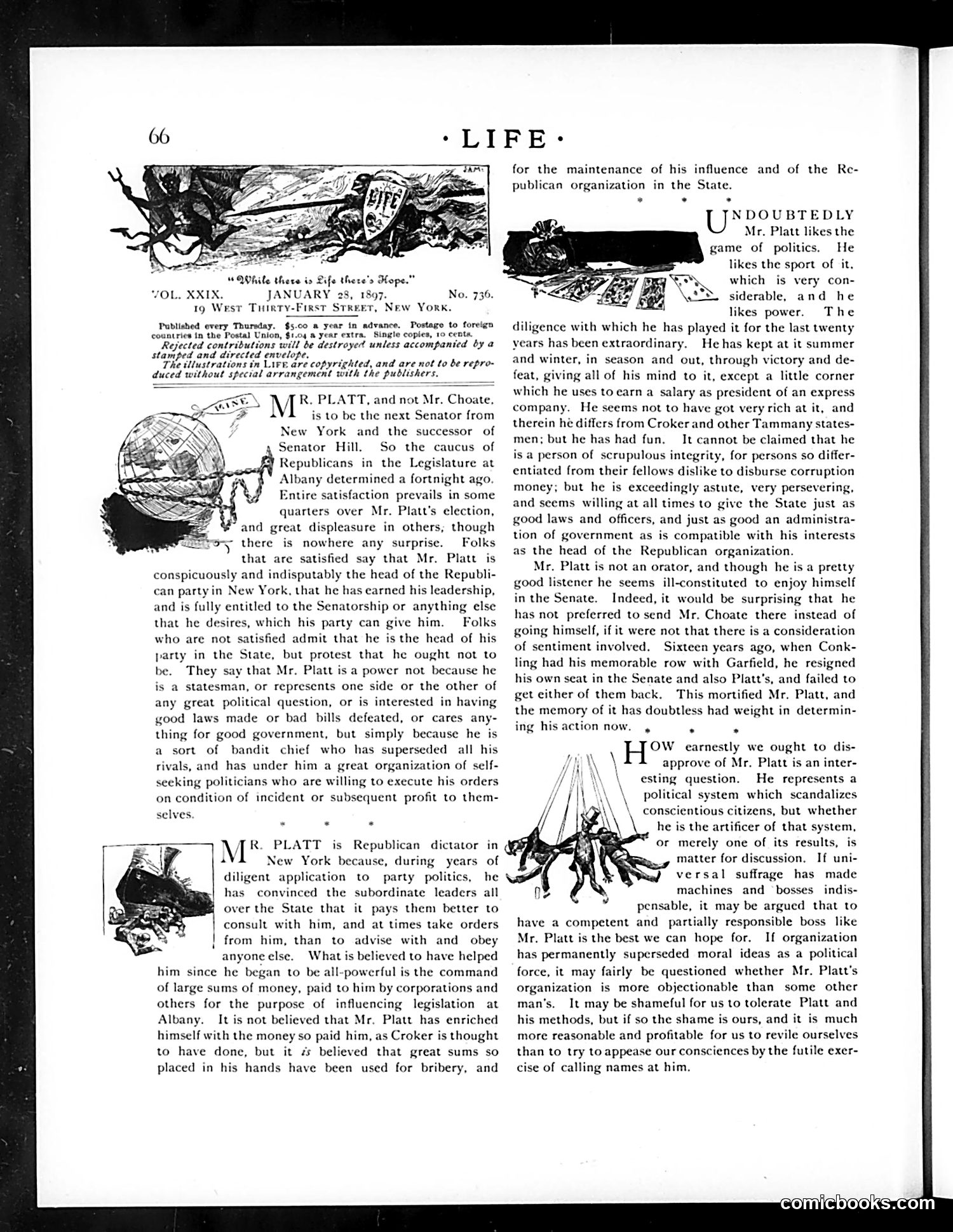
This page critiques **Mr. Platt**, a New York Republican political boss and Senator, through text and accompanying illustrations. The article describes Platt as a "dictator" who controls Republican politicians through organizational power rather than oratory skills. Key satirical points: - Platt maintains power through command of self-serving politicians willing to take orders - He allegedly received corporate money for legislative influence - The author questions whether Platt represents systemic corruption or is merely a symptom of a flawed political system The cartoons appear to mock Platt's puppet-master control over state politics. The text suggests readers judge whether Platt or the system itself deserves blame—a sophisticated critique acknowledging that individual villains may be less problematic than corrupt institutions they exploit.
📄 Transcribed text from this page (OCR, searchable)
Machine-transcribed from the original scan — historical spelling and the odd misread are preserved.
*LIFE: “QWhile there is Life there's Hope.” VOL. XXIX. JANUARY 28, No. 736. 19 West Tuirty-First STREET, New York. Published every Thursday. $5.00 a year in advance. Postage to foreign countrice in the Postal Union, $1-04 a year extra. Single copies, 10 centa Rejected contributions will be destroyed unless accompanied by a stamped and directed envelope, The illustrations in LiFe. are copyrighted, and are not to be repro- duced without special arrangement with the publishers. M R. PLATT, and not Mr. Choate, “ is to be the next Senator from New York and the successor of Senator Hill. So the caucus of fF) Republicans in the Legislature at 4° Albany determined a fortnight ago. a tire satisfaction prevails in some % quarters over Mr. Platt’s election, and great displeasure in others, though “a re~y there is nowhere any surprise. Folks that are satisfied say that Mr. Platt is conspicuously and indisputably the head of the Republi- can party in New York, that he has earned his leadership, and is fully entitled to the Senatorship or anything else that he desires, which his party can give him. Folks who are not satisfied admit that he is the head of his party in the State, but protest that he ought not to be. They say that Mr. Platt isa power not because he is a statesman, or represents one side or the other of any great political question, or is interested in having good laws made or bad bills defeated, or cares any- thing for good government, but simply because he a sort of bandit chief who has superseded all his rivals, and has under him a great organization of self- seeking politicians who are willing to execute his orders on condition of incident or subsequent profit to them- selves. . . . PLATT is Republican dictator in New York because, during years of party politics, he the subordinate leaders all diligent application to convinced over the State that it pays them better to | consult with him, and at times take orders has ! from him, than to advise with and obey anyone else. What is believed to have helped him since he began to be all-powerful is the command of large sums of money, paid to him by corporations and others for the purpose of influencing legislation at Albany. It is not believed that Mr. Platt has enriched himself with the money so paid him, as Croker is thought to have done, but it zs believed that great sums so placed in his hands have been used for bribery, and for the maintenance of his influence publican organization in the State. NDOUBTEDLY Mr. Platt likes the game of politics. He = ae likes the sport of it, ix which is very con- Bs ae LS 4) and of the Re- \“ = siderable, and he likes power. The diligence with which he has played it for the last twenty years has been extraordinary. He has kept at it summer and winter, in season and out, through victory and de- feat, giving all of his mind to it, except a little corner which he uses to carn a salary as president of an express company. He seems not to have got very rich at it, and therein hé differs from Croker and other Tammany states- men; but he has had fun. It cannot be claimed that he is a person of scrupulous integrity, for persons so differ- entiated from their fellows dislike to disburse corruption money; but he is exceedingly astute, very persevering, and seems willing at all times to give the State just as good laws and officers, and just as good an administra- tion of government as is compatible with his interests as the head of the Republican organization. Mr. Platt is not an orator, and though he is a pretty good listener he seems ill-constituted to enjoy himself in the Senate. Indeed, it would be surprising that he has not preferred to send Mr. Choate there instead of going himself, if it were not that there is a consideration of sentiment involved. Sixteen years ago, when Conk- ling had his memorable row with Garfield, he resigned his own seat in the Senate and also Platt’s, and failed to get cither of them back. This mortified Mr. Platt, and the memory of it has doubtless had weight in determin- ing his action now. , ‘ * He’ earnestly we ought to dis- approve of Mr, Platt is an inter- esting question. He represents a political system which scandalizes conscientious citizens, but whether he is the artificer of that system, or merely one of its results, is matter for discussion, If uni- versal suffrage has made machines and bo indis- pensable, it may be argued that to have a competent and partially responsible boss like Mr. Platt is the best we can hope for. If organization has permanently superseded moral ideas as a political force, it may fairly be questioned whether Mr. Platt’s organization is more objectionable than some other man’s. It may be shameful for us to tolerate Platt and his methods, but if so the shame is ours, and it is much more reasonable and profitable for us to revile ourselves than to try to appease our consciences by the futile exer- cise of calling names at him.