
Life, 1897-01-28 · page 6 of 20
Life — January 28, 1897 — page 6: what you’re looking at
What you’re looking at
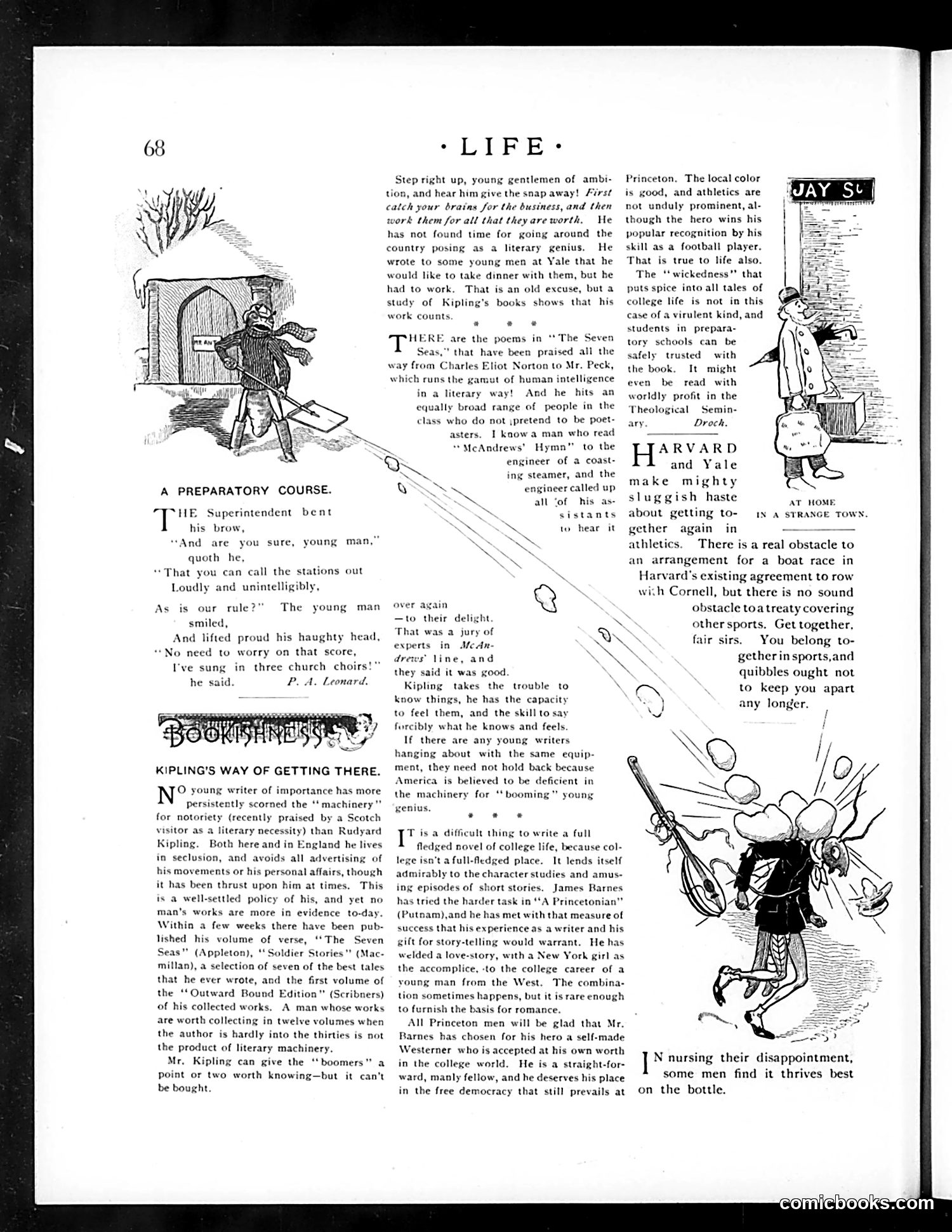
This page contains literary commentary rather than political satire. The main cartoon titled "A Preparatory Course" depicts a superintendent instructing a young man about calling out train stations—a mundane practical task contrasted with literary ambitions. The text discusses Rudyard Kipling's approach to writing and mentions his collection "The Seven Seas." It argues that Kipling's work, though praised by literary figures, demonstrates that practical experience and observing diverse people matters more than pretentious literary posturing. The second cartoon, "At Home in a Small Town," appears to show someone receiving news, likely illustrating the contrast between small-town life and broader ambitions discussed in the adjacent text about college life and writing. The overall message mocks young writers who avoid practical work while seeking literary success, celebrating Kipling as someone who combined both.
📄 Transcribed text from this page (OCR, searchable)
Machine-transcribed from the original scan — historical spelling and the odd misread are preserved.
A PREPARATORY COURSE. ye Superintendent his brow, “And are quoth he “That you can call the stations out Loudly and unintelligibly, The bent you sure, young man,” As is our rule?” young man smiled, And lifted proud his haughty head, “No need to worry on that score, I've sung in three church choirs he P. A. Leonard. KIPLING'S WAY OF GETTING THERE. NO 22228 writer of importance nas more persistently scorned the ‘ machinery" for notoriety (recently praised by a Scotch visitor as a literary necessity) than Rudyard Kipling. Both here and in England he lives in seclusion, and avoids all advertising of his movements or his personal affairs, though it has been thrust upon him at times. This is a well-settled policy of his, and yet no man's works are more in evidence to-day. Within a few weeks there have been pub- lished his volume of verse, ‘The Seven Seas" (Appleton), ‘Soldier Stories" (Mac- millan), a selection of seven of the best tales that he ever wrote, and the first volume of the ‘Outward Bound Edition" (Scribners) of his collected works. A man whose works are worth collecting in twelve volumes when the author is hardly into the thirties is not the product of literary machinery. Mr. Kipling can give the ‘* boomers” a point or two worth knowing—but it can't be bought. *> LIFE: Step right up, young gentlemen of ambi- tion, and hear him give the snap away! Férst catch your brains for the business, and then work them for all that they are worth. He has not found time for going around the country posing as a literary genius. He wrote to some young men at Yale that he would like to take dinner with them, but be had to work. That is an old excuse, but a study of Kipling’s books shows that his work counts. « e « HER way from C which runs the gam’ are the poems in “The Seven that have been praised all the jot Norton to Mr. Peck, of human intelligence And he hits an equally broad range of people in the class who do not \pretend to be poet- asters. I kaow a man who read McAndrews’ Hymn" to the engineer of a coast- ing steamer, and the engineer called up all ‘of his sistants rles in a literary way! as: to hear it over again —to their delight That was a jury of experts in Mcdn- drews’ line, and they said it was good. Kipling takes the trouble to know things, he has the capacity to feel them, and the skill to say forcibly what he knows and feels. If there are any young writers hanging about with the same equip- ment, they need not hold back because America is believed to be deficient in the machinery for ‘* booming” genius. young T is a difficult thing to write a full fledged novel of college life, because col- ge isn't a full-fledged place. It lends itself admirably to the character studies and amus- ing episodes of short stories. James Barnes has tried the harder task in A Princetonian” (Putnam),and he has met with that measure of success that his experience as a writer and his gift for story-telling would warrant. He has welded a love-story, with a New York girl as the accomplice, -to the college career of a young man from the West. The combina- tion sometimes happens, but it is rare enough to furnish the basis for romance. All Princeton men will be glad that Mr. Barnes has chosen for his hero a self-made Westerner who is accepted at his own worth in the college world. He is a straight-for- ward, manly fellow, and he deserves his place in the free democracy that still prevails at Princeton, The local color is good, and athletics are not unduly prominent, al- though the hero wins his popular recognition by his skill as a football player. That is true to life also. The ‘wickedness’ that puts spice into all tales of college life is not in this case of a virulent kind, and students in prepara- tory schools can be safely trusted with the book. It might be read with worldly profit in the Theological ary. even Semin- Droch. ARVARD and Yale make mighty sluggish haste about getting to- gether again athlet There is a real obstacle to an arrangement for a boat race in Harvard's existing agreement to row wich Cornell, but there is no sound obstacle toa treaty covering other sports. Get together, fair sirs. You belong to- gether insports,and quibbles ought not to keep you apart any longer. AT HOME in — ] N nursing their disappointment, some men find it thrives best on the bottle. IN A STRANGE TOWN.