
Life, 1897-01-28 · page 12 of 20
Life — January 28, 1897 — page 12: what you’re looking at
What you’re looking at
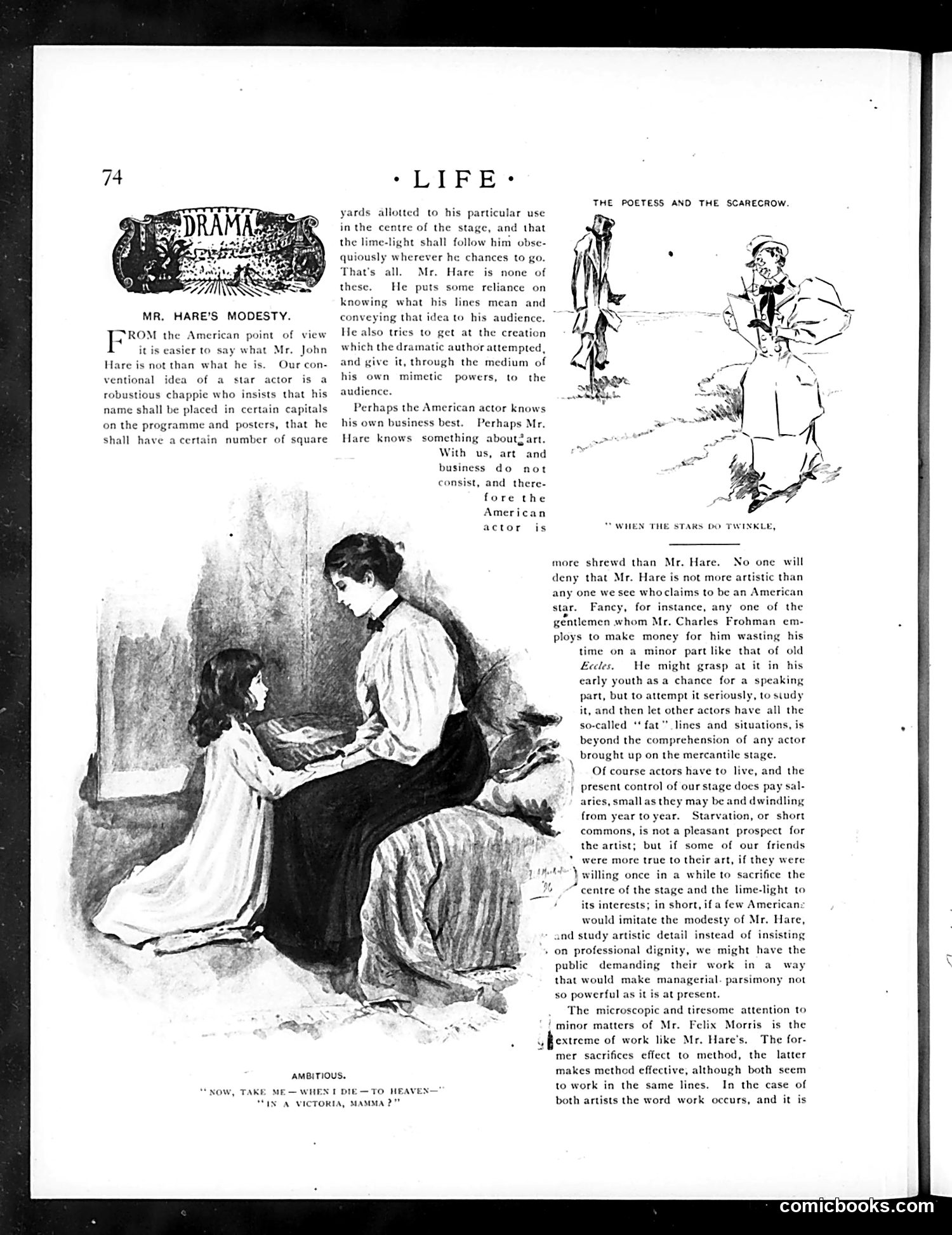
This page critiques American actor **Mr. Hare's** acting style and professional choices. The left section, titled "Mr. Hare's Modesty," argues that Hare prioritizes practical business concerns over artistic integrity. The text suggests American actors typically demand prominent billing and stage positioning, whereas Hare supposedly lacks such vanity. However, the right section ("When the Stars Do Twinkle") contradicts this, claiming Hare is actually quite calculating—willing to take minor roles under patrons like Charles Frohman only if it serves his career interests. The accompanying sketches appear to satirize theatrical pretension and the tension between artistic ambition and commercial pragmatism in American theater circa early 1900s. The overall tone mocks actors' claims to modesty while exposing underlying self-interest.
📄 Transcribed text from this page (OCR, searchable)
Machine-transcribed from the original scan — historical spelling and the odd misread are preserved.
MR, HARE’S MODESTY. Fre” the American point of view it is easier to say what Mr. John Hare is not than what he is. Our con- ventional idea of a star ‘or is a robustious chappie who insists that his name shall be placed in certain capitals on the programme and posters, that he shall have acertain number of square *LIFE: yards allotted to his particular use in the centre of the stage, and that the lime-light 1 follow him obse- quiously wherever he chances to go. That's all. Mr. Hare is none of these. He puts some reliance on knowing what his lines mean and conveying that idea to his audience. He also trices to get at the creation which the dramatic author attempted, and give it, through the medium of his own mimetic powers, to. the audience. Perhaps the American actor knows his own business best. Perhaps Mr. Hare knows something aboutZart. With us, art and business do not consist, and there- fore the American actor is Yt Maoke THE POETESS AND THE SCARECROW. “WHEN THE STARS DO TWINKLE more shrewd than Mr. Hare. No one will deny that Mr. Hare is not more artistic than any one we see who claims to be an American star. Fancy, for instance, any one of the gentlemen whom Mr. Charles Frohman em- ploys to make money for him wasting his time on a minor part like that of old Eccles. He might grasp at it in his early youth as a chance for a speaking part, but to attempt it seriously, to study it, and then let other actors have all the so-called “fat” lines and situation: beyond the comprehension of any actor brought up on the mercantile stage. Of course actors have to live, and the present control of our stage does pay aries, small as they may be and dwindling from year to year. Starvation, or short commons, is not a pleasant prospect for the artist; but if some of our friends were more true to their art, if they were Y willing once in a while to sacrifice the * centre of the stage and the lime-light to its interests; in short, if a few American would imitate the modesty of Mr. Hare, and study artistic detail instead of insisting . on professional dignity, we might have the public demanding their work in a way that would m: so powerful as it is at present. © managerial. parsimony not The microscopic and tiresome attention to ‘minor matters of Mr. Felix Morris is the AMBITIOUS. “NOW, TAKE ME— WHEN I DIE—TO HEAVEN— “IN A VICTORIA, MAMMA?" extreme of work like Mr. Hare's. The for- mer sacrifices effect to method, the latter makes method effective, although both seem to work in the same lines. In the case of both artists the word work occurs, and it is comicbooks.com os