
A complete issue · 20 pages · 1896
Life — April 30, 1896
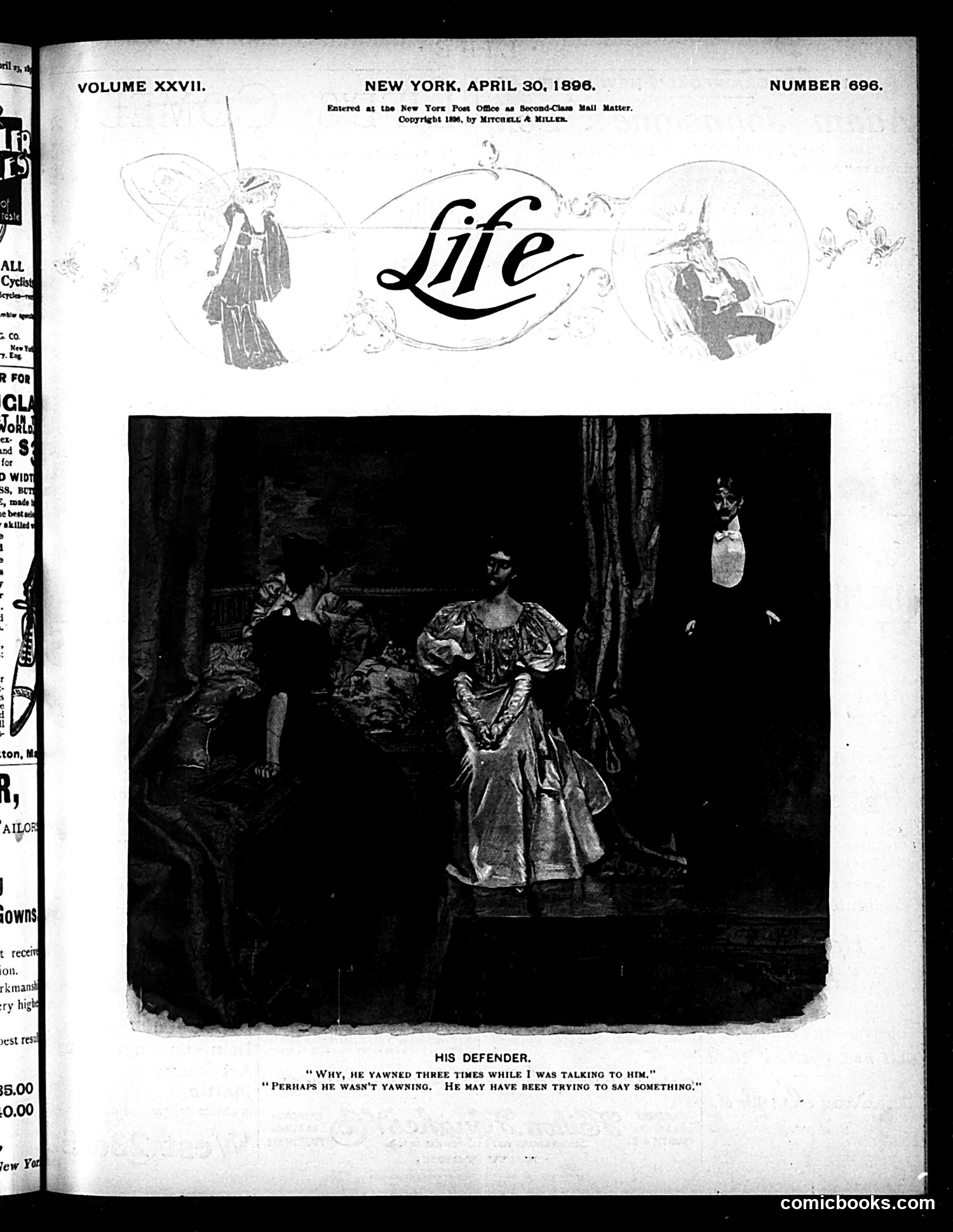
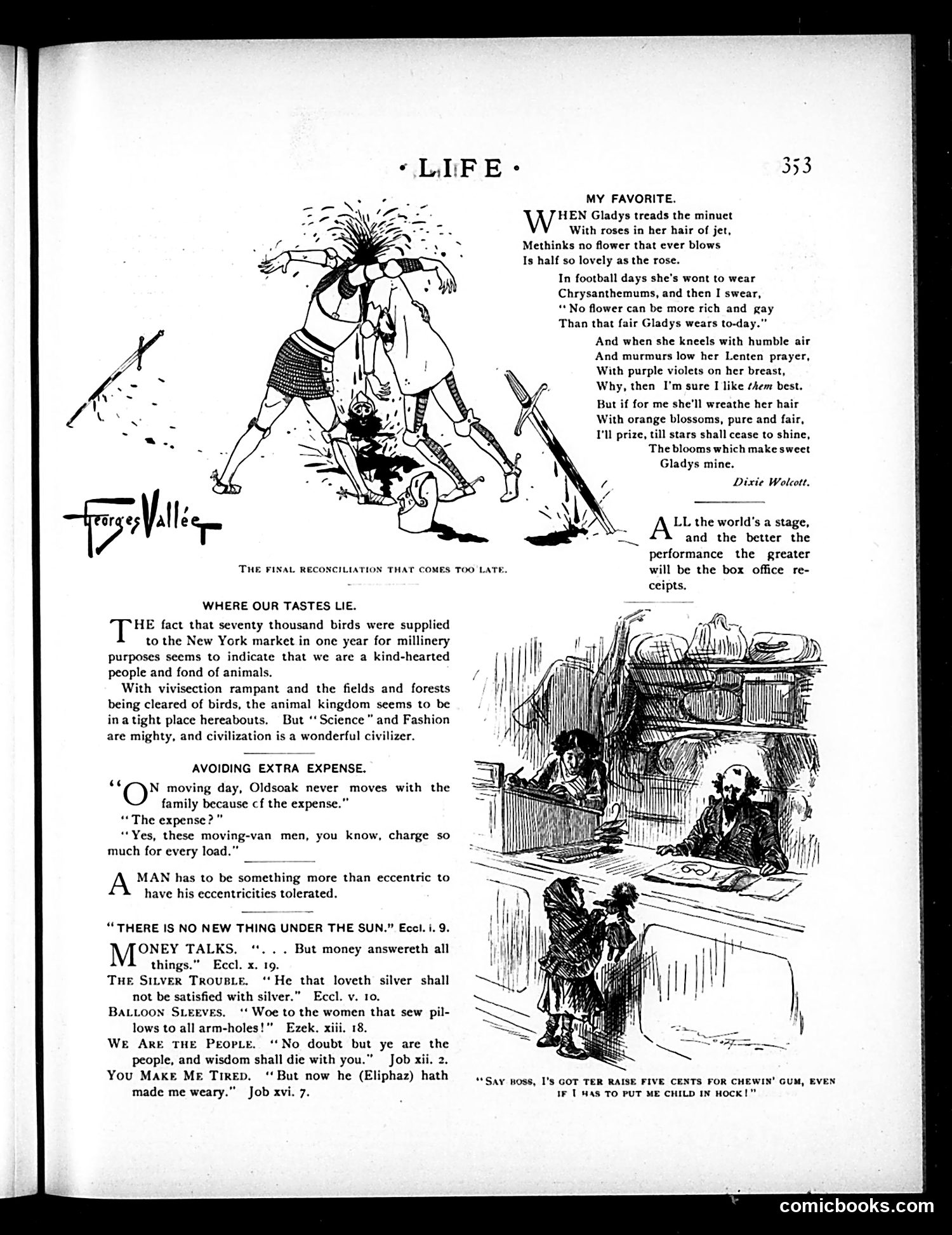
This illustration titled "His Defender" depicts a dramatic domestic scene with the caption: "Why, he yawned three times while I was talking to him. Perhaps he wasn't yawning. He may have been trying to say something." The satire mocks a woman defending her husband's inattentiveness during conversation. The joke plays on marital dynamics of the era—the wife rationalizes his yawning as potentially meaningful rather than acknowledging his obvious disinterest. This reflects period humor about marriage, where husbands were stereotyped as disengaged listeners while wives made excuses for their behavior. The dramatic staging suggests this was likely adapted from a theatrical work, common for Life's illustrated humor of this period.
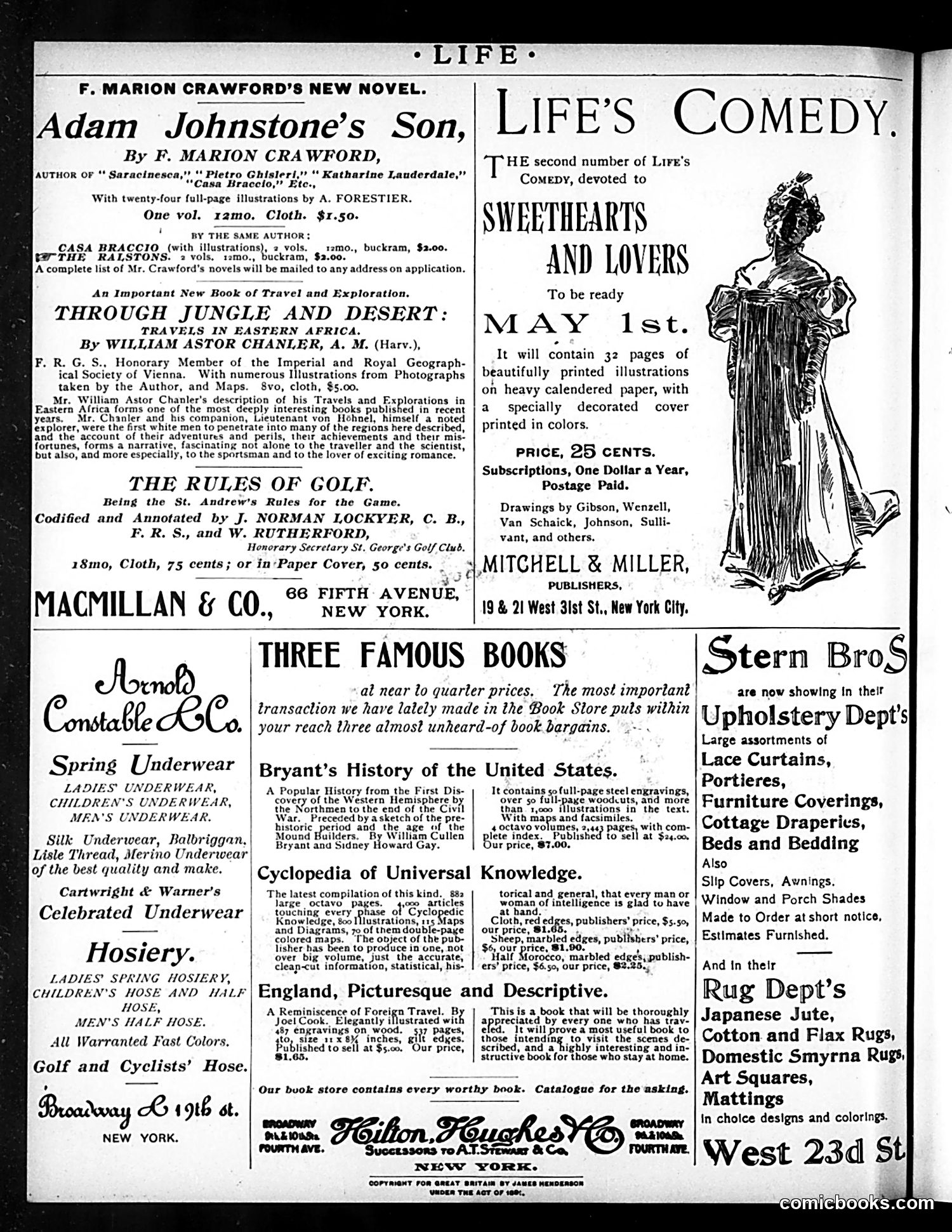
This page is **primarily advertising**, not political satire or editorial content. It showcases book advertisements and commercial promotions typical of Life magazine's revenue model. The main advertisements include: - **F. Marion Crawford's novel** "Adam Johnstone's Son" (top left) - **Travel/exploration books** including William Astor Chanler's jungle expedition account - **Three Famous Books** at bargain prices: Bryant's History of the United States, Encyclopedia of Universal Knowledge, and England, Picturesque and Descriptive - **Life's Comedy** magazine feature on "Sweethearts and Lovers" (right side, with decorative illustration) - **Department store ads** for Arnold Constable & Co. (underwear, hosiery) and Stern Bros. (furniture, rugs) No political cartoons or social satire appear on this page—it's a commercial product showcase aimed at late-19th/early-20th century readers.
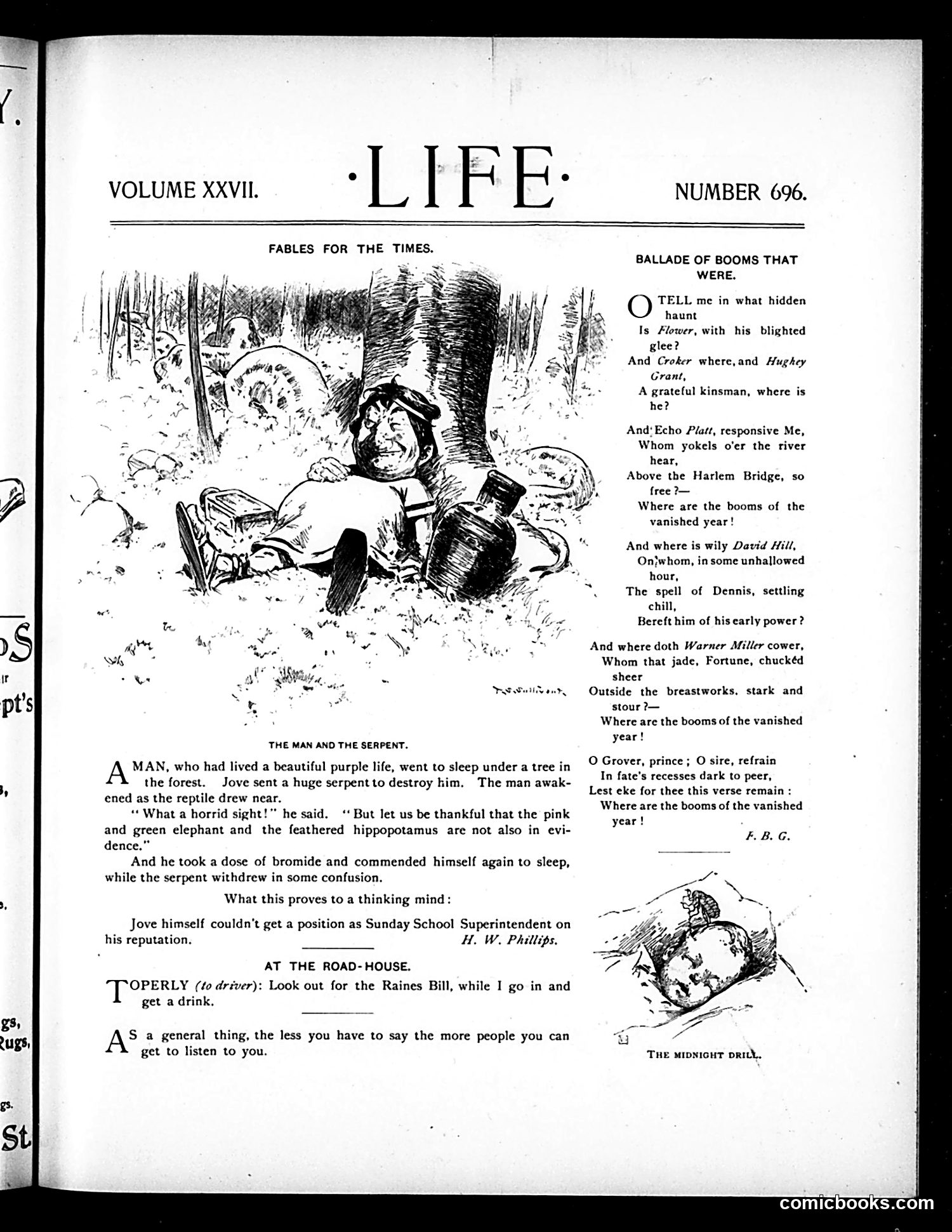
This page contains three satirical pieces: **"The Man and the Serpent"** (fable): A man sleeps under a tree and dreams of a serpent sent by "Jove." Upon waking, he's relieved the pink elephant and feathered hippopotamus weren't real—a joke about alcohol-induced hallucinations. The moral critiques that "Jove himself couldn't get a position as Sunday School Superintendent on his reputation," likely mocking the hypocrisy of religious institutions. **"Ballad of Booms That Were"**: A poem lamenting vanished figures like "Platt," "Grant," "David Hill," and "Warner Miller"—appears to reference prominent political/social figures whose influence has faded, asking "Where are the booms of the vanished year?" **"At the Road-House"**: A brief joke about a driver asking someone to watch for "Raines Bill" while he drinks, referencing Prohibition-era alcohol legislation.
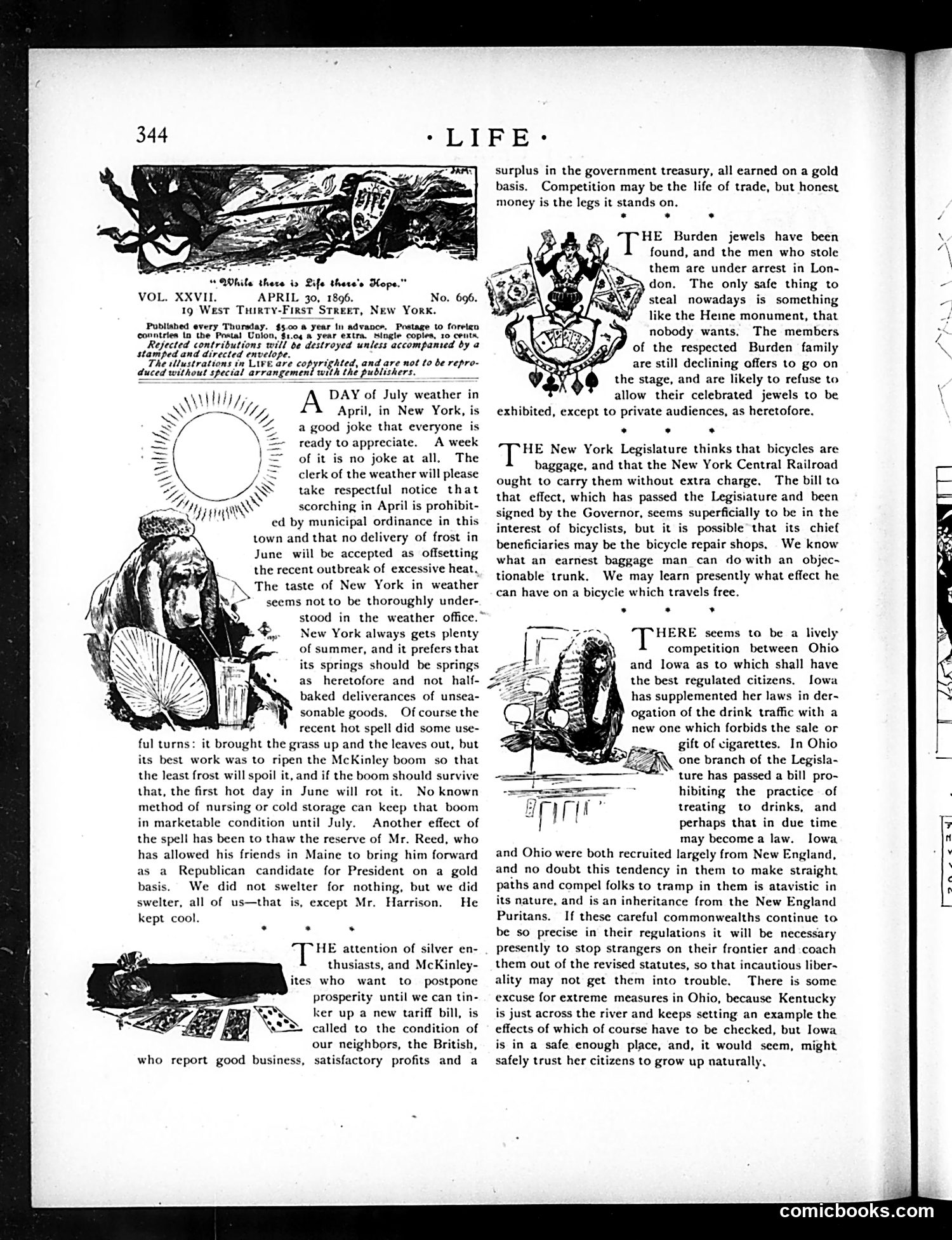
This page contains satirical commentary on several contemporary issues, circa 1904 (based on the volume number). The main topics addressed include: **Weather and New York City**: A lengthy discussion mocking the contradiction between April's cold weather ordinance (prohibiting frost delivery) and the reality of April snow, with a jab at the Weather Bureau's unreliability. **The Burden Jewels**: Brief mention of stolen jewels recovered in London, sardonically noting that only monuments—not the Burden family—will exhibit them publicly. **Bicycles and Railroad Baggage**: Commentary on New York Legislature's bill to allow bicycles as free baggage on trains, questioning its practicality. **Regulatory Competition**: Ohio and Iowa's competing drink-traffic regulations are discussed, with Iowa praised for natural citizen development versus Ohio's stricter legislation. The cartoons appear to be decorative rather than specifically satirical of individuals.
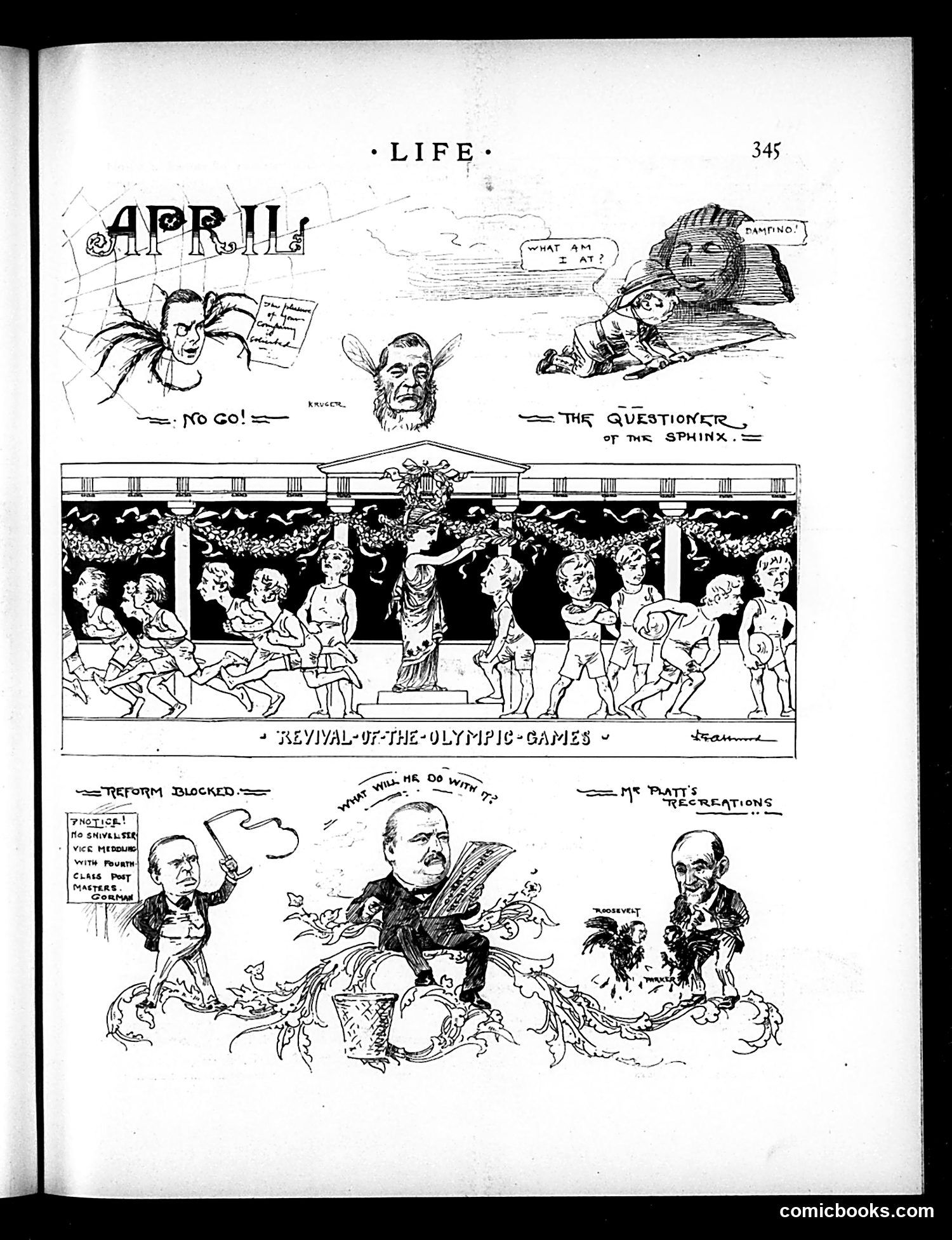
This page contains several political cartoons satirizing early 20th-century American politics and society: **"No Go!"** (top left) depicts April Fool's Day themes with a jester-like figure, playing on spring pranks. **"The Questioner of the Sphinx"** (top right) references classical Egypt, likely mocking someone's pretensions to wisdom or mystery-solving. **"Revival of the Olympic Games"** (center) shows cherubs/putti in classical athletic poses, satirizing the modern Olympics revival movement (1896 onward). **"Reform Blocked"** and **"Mr. Platt's Recreations"** (bottom) appear to reference American political reform efforts and a figure named Platt—likely New York political boss Thomas C. Platt—entangled in various obstacles and contradictions, mocking obstacles to progressive reform. The overall theme critiques American political hypocrisy and blocked progress.
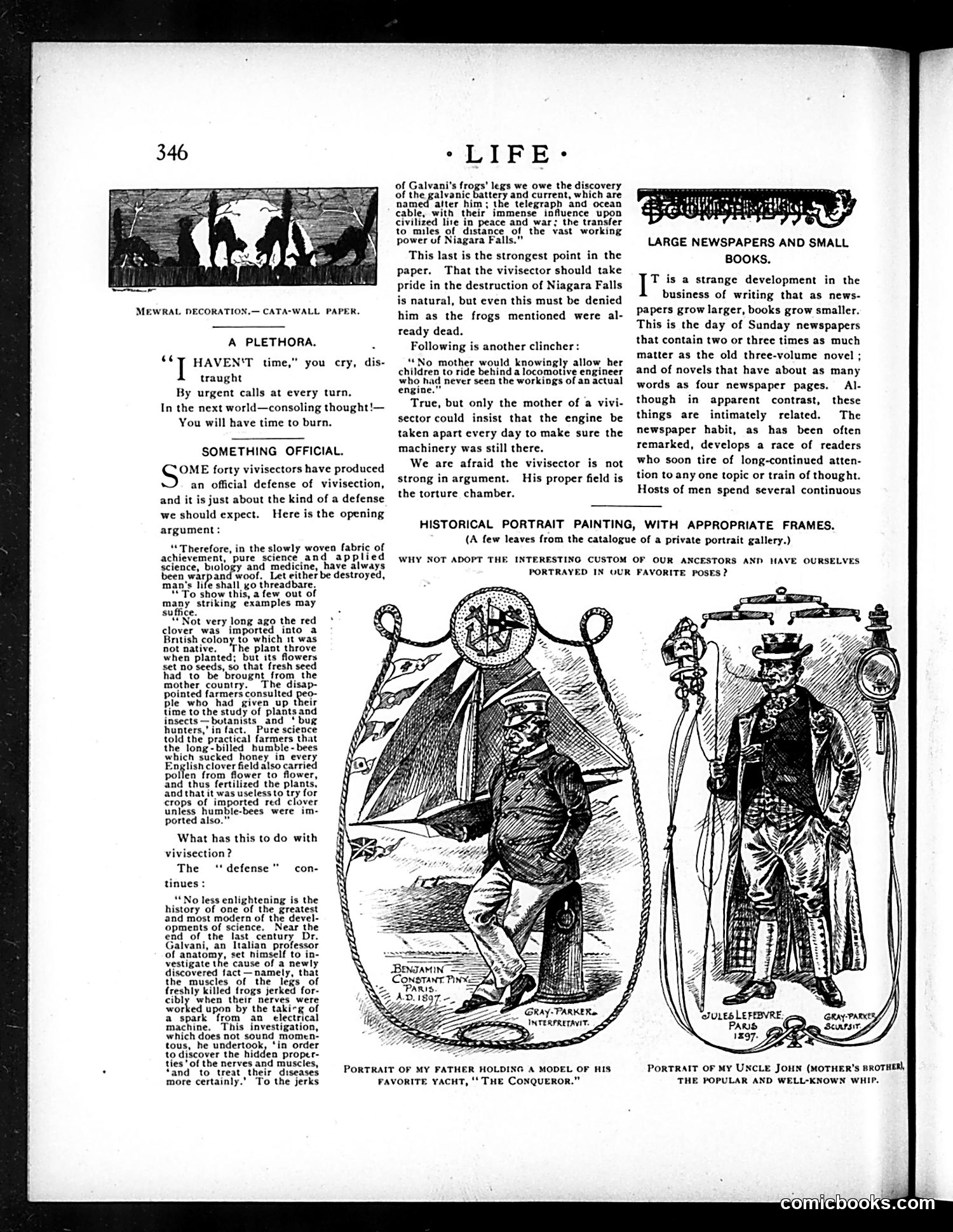
This page contains **satirical essays and historical portrait illustrations** rather than political cartoons. The main content critiques "vivisection" (animal experimentation). One essay defends vivisection's scientific value despite public outcry; another attacks it as unnecessary cruelty. The debate reflects late-19th/early-20th century tensions over animal welfare versus medical progress—a genuine controversy of the era. The two framed portraits show historical figures: one labeled "Benjamin Conqueror" (likely William the Conqueror, misidentified or a joke), and "Jules Lefebvre" (a known French academic painter). The heading proposes reviving ancestor portrait customs. The page also includes a section on newspapers versus books, noting modern papers now contain content rivaling full novels. The satire targets intellectual pretension and outdated customs rather than specific politicians.
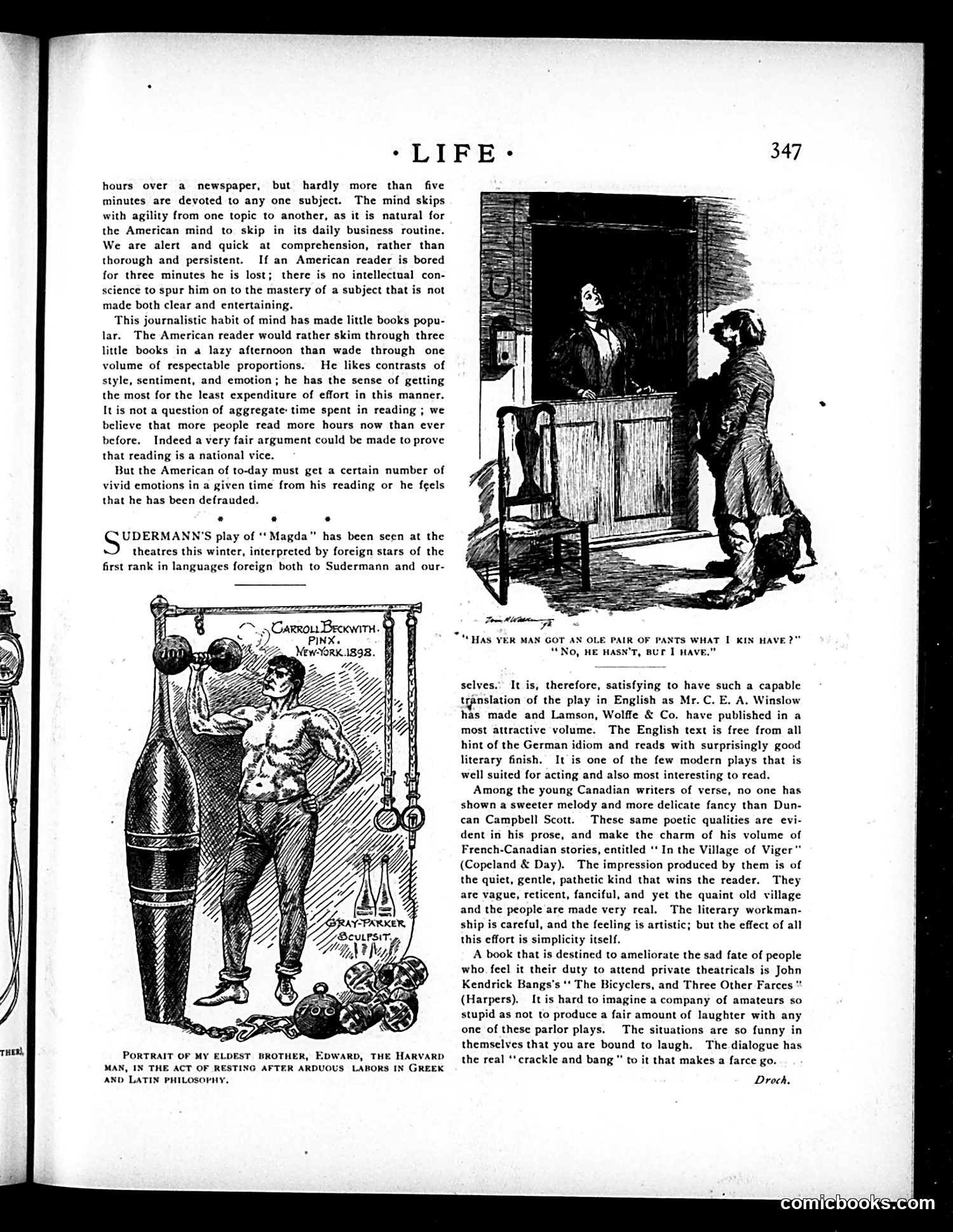
This page contains two illustrations and literary criticism rather than political cartoons. The upper illustration shows a domestic scene with the caption "Has yer new got an ole pair of pants what I kin have?" / "No, he hasn't, but I have." It appears to depict working-class people in a humorous exchange about clothing. The lower illustration, attributed to "Carroll Beckwith, N.Y. 1838," shows a figure labeled as "Portrait of my eldest brother, Edward, the Harvard man, in the act of resting after arduous labors in Greek and Latin philosophy." This is satirical—the man appears to be sleeping or lounging, mocking the intellectual pretensions of Harvard-educated individuals. The text discusses American reading habits, Sudermann's play "Magda," and Canadian literature, offering literary commentary rather than political satire.
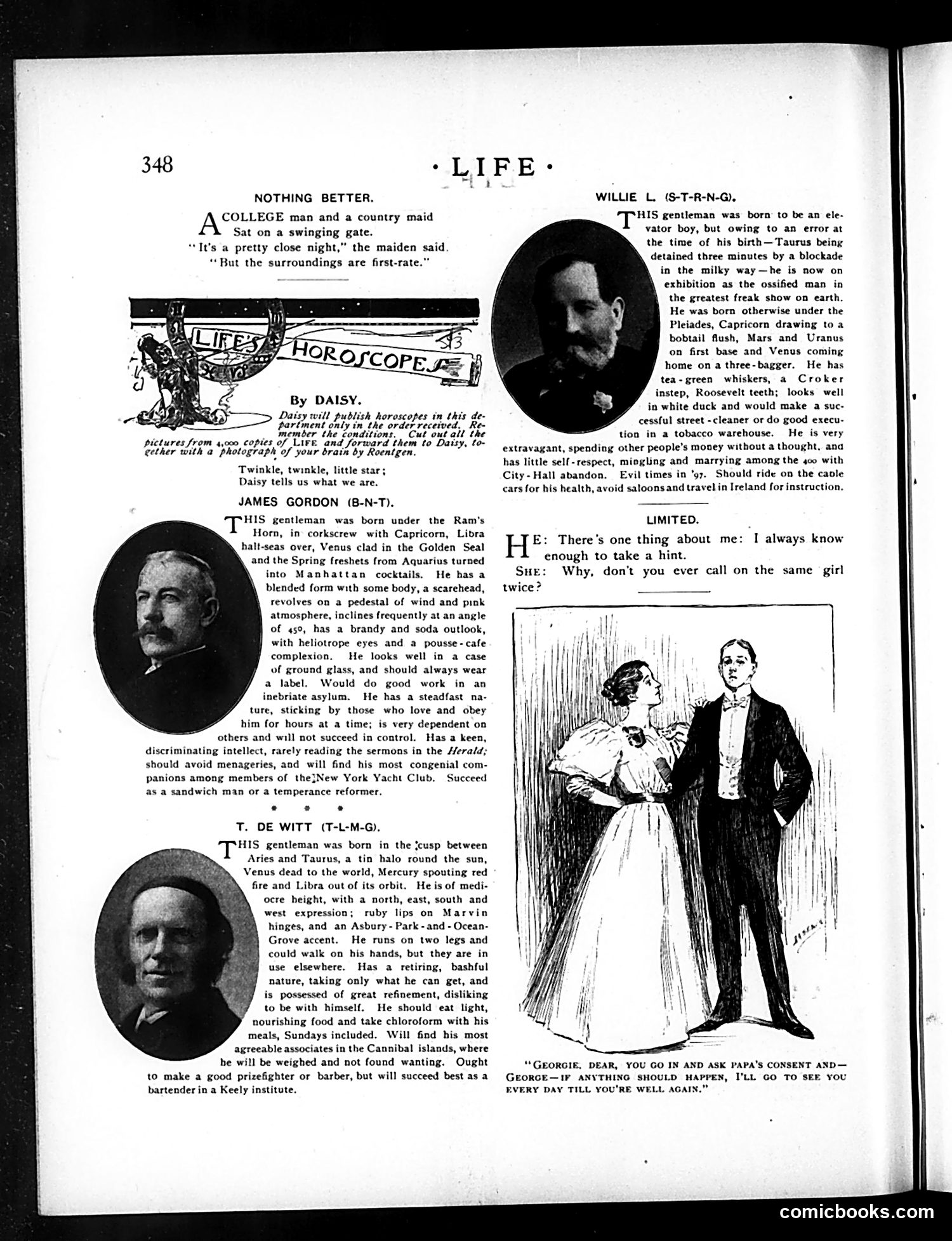
This page presents astrological character readings ("Nothing Better") by Daisy, a regular feature. Three men are profiled by their birth signs: **James Gordon (B-N-T)**, born under Ram/Capricorn, is described as a blended, somewhat contradictory personality—creative but dependent on others' approval, inclined toward social clubs and temperance reform. **T. De Witt (T-L-M-G)**, born in the Cusps between Aries/Taurus, is characterized as mediocre, retiring, and bashful, suited only for modest work like bartending. **Willie L.**, born under Taurus with a three-minute birth error, is satirized as an exhibition "ossified man"—a sideshow freak who is irresponsible, unscrupulous, and untrustworthy. The accompanying joke sketch involves a woman seeking paternal consent for courtship.
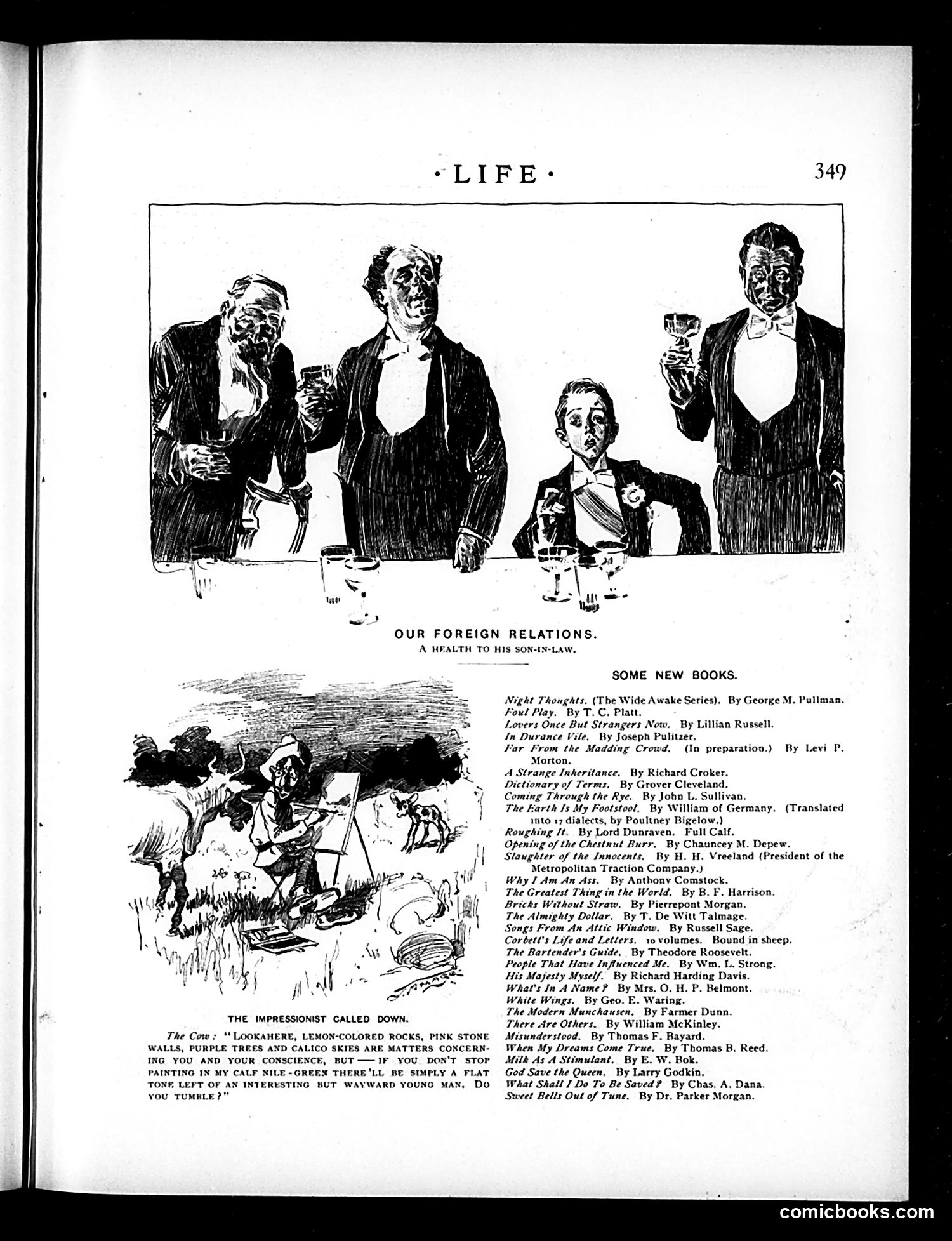
This cartoon satirizes American diplomatic relations through a formal dinner scene. Four well-dressed men in tuxedos raise glasses in a toast to a younger, smaller figure seated centrally—identified as the "son-in-law." The cartoon likely references a specific political figure or diplomatic relationship of the era, where familial connections influenced foreign policy. The caption "A Health to His Son-in-Law" suggests nepotism or personal favoritism driving international affairs rather than merit or policy. The bottom illustration, "The Impressionist Called Down," appears unrelated—a separate sketch satirizing impressionist art and a conversation about painting style. The page also lists contemporary book releases from the period.
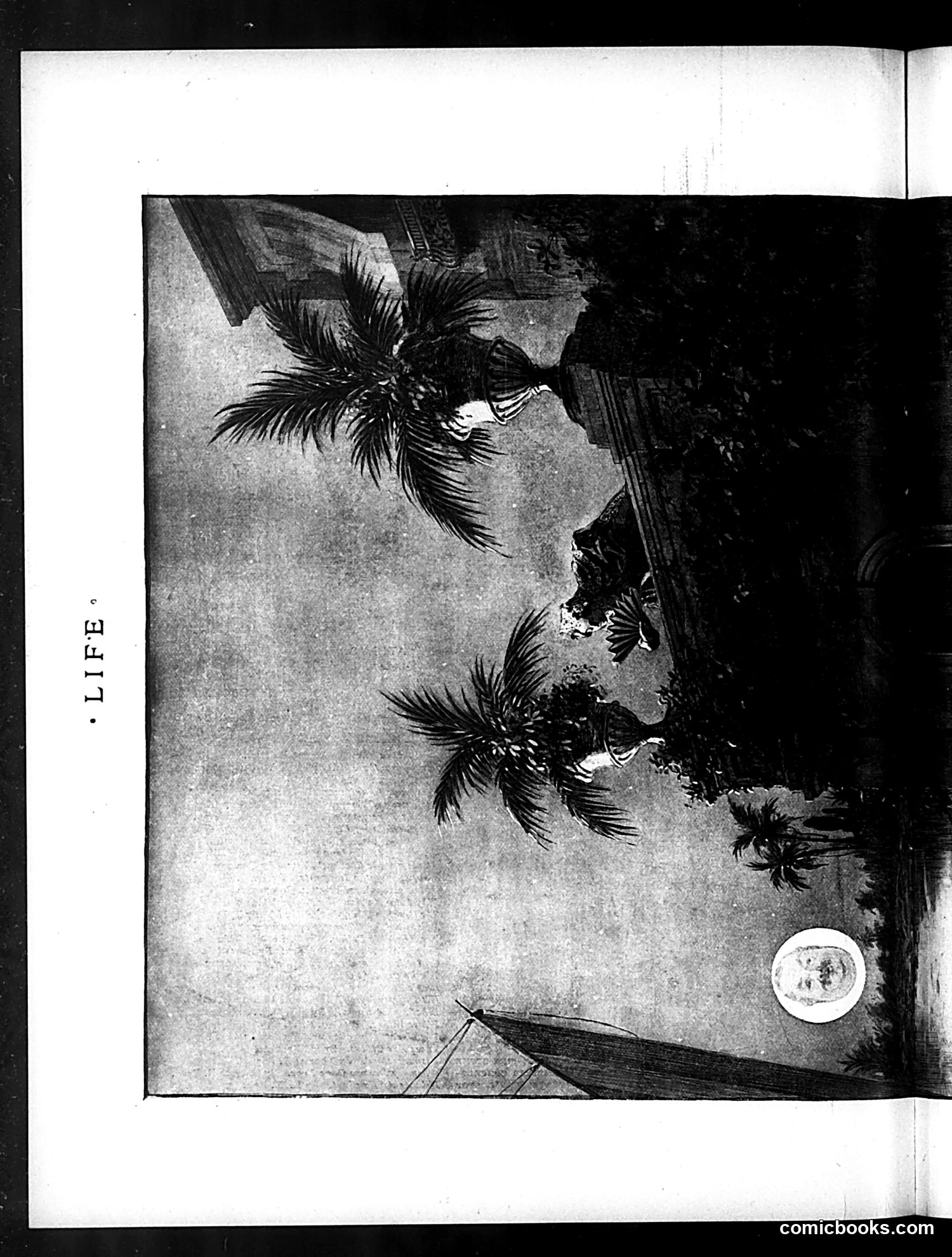
The image appears to show a black and white illustration featuring palm trees and tropical scenery, rotated 90 degrees on the page, making it difficult to interpret clearly. The text "LIFE" appears on the left margin, confirming this is from Life magazine. However, the OCR text provided is blank—no actual text content was captured from the page. Without readable text or a clear, properly-oriented view of the illustration, I cannot identify specific figures, explain the political or social references, or determine what the satire or joke intended. To provide an accurate historical analysis, I would need either legible OCR text or a properly-oriented image showing the cartoon's details and any captions or dialogue.
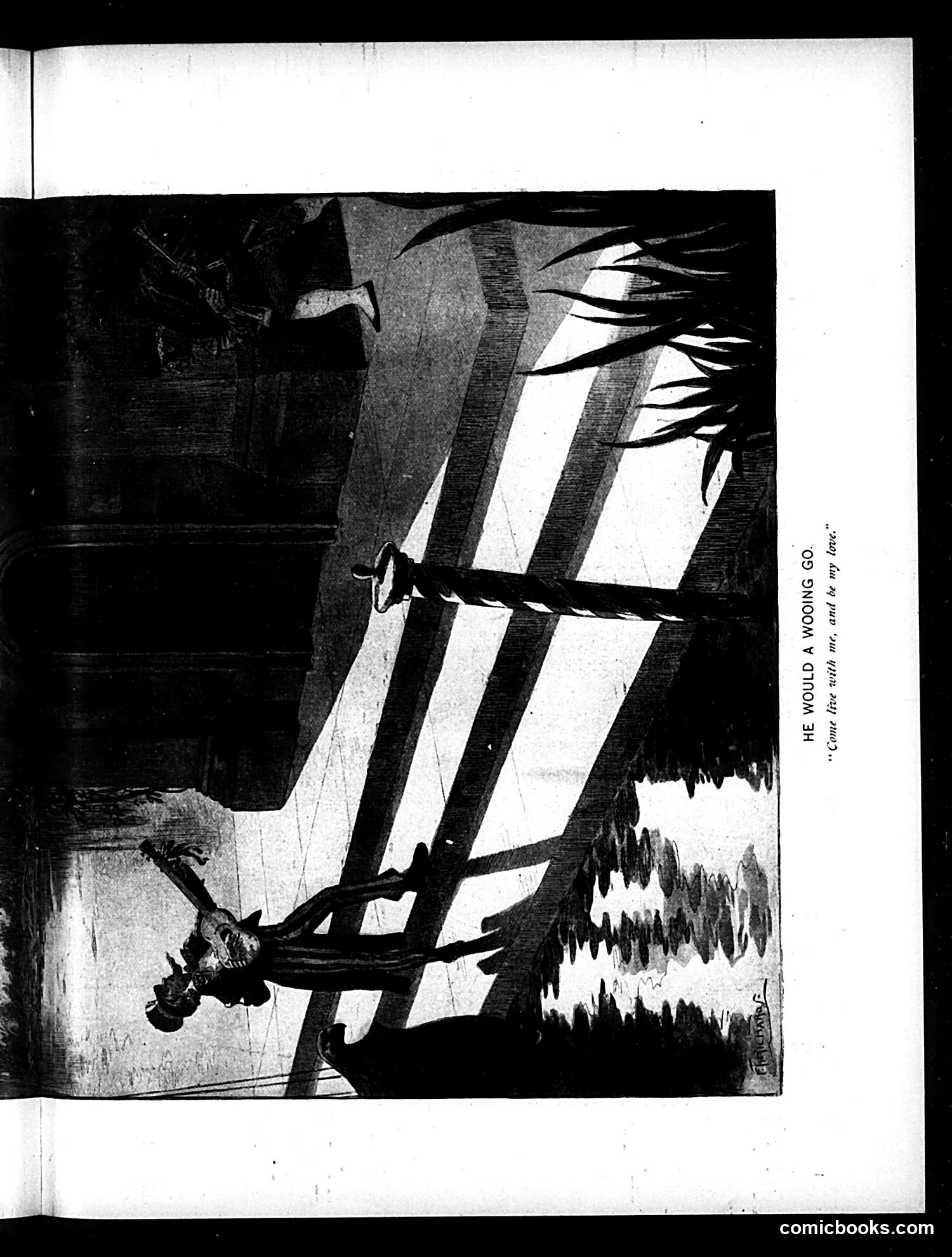
This political cartoon depicts a figure climbing a ladder or staircase structure, with the caption "He Would a Wooing Go" — a reference to the traditional nursery rhyme. The image appears to satirize someone pursuing romantic or political advancement through precarious means. The stark black-and-white composition emphasizes the dangerous, unstable nature of the climb, with dramatic shadows cast across striped structural elements. Without clearer identification of the specific historical figure or dating, the exact political target remains unclear. However, the cartoon likely comments on an ambitious public figure's risky pursuit of a goal—whether romantic, political, or social—suggesting the endeavor is foolish or destined to fail. The ladder's instability visually reinforces this critical message.
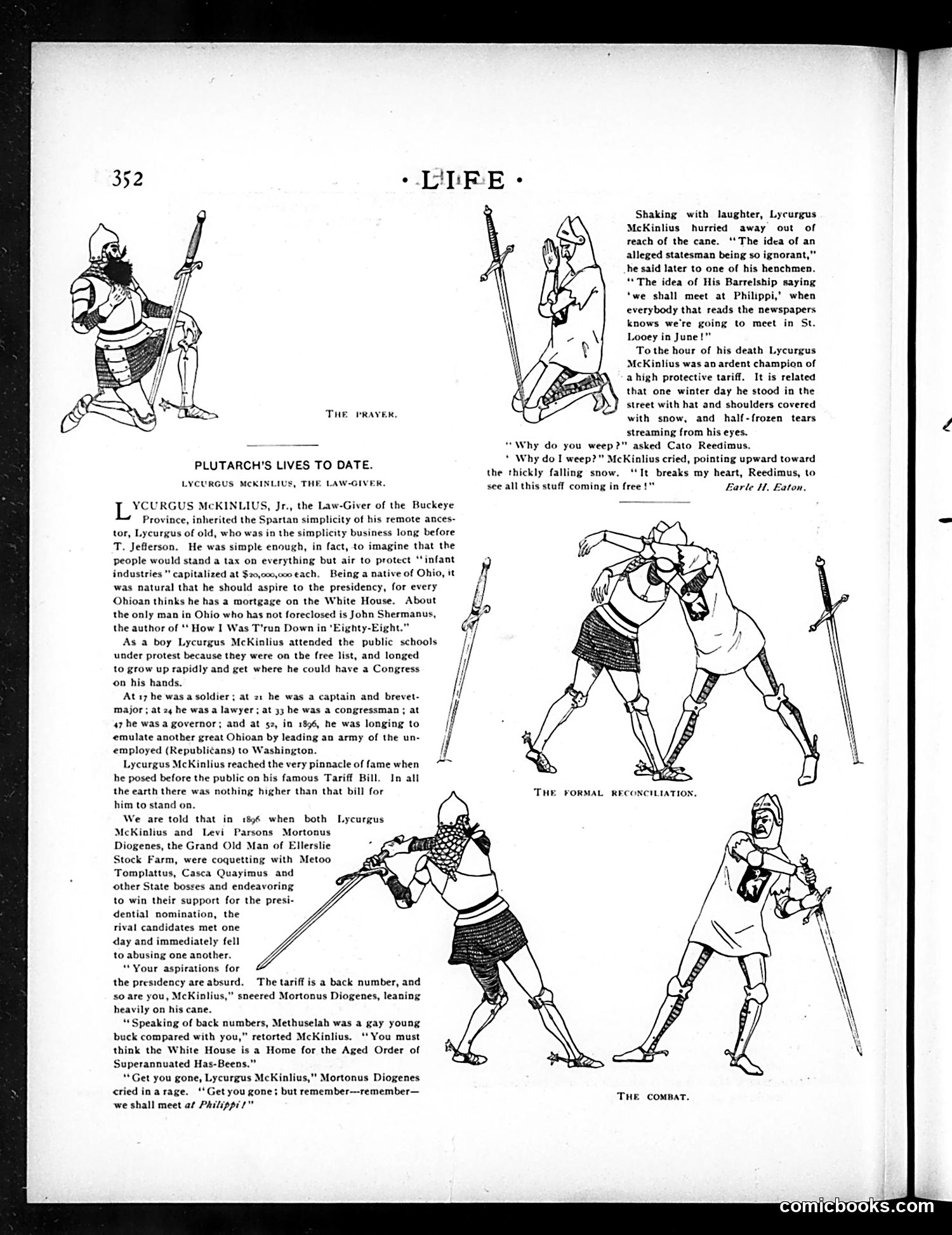
This Life magazine satire mocks **William McKinley** (thinly disguised as "Lycurgus McKinlius"), the Ohio Republican politician and tariff advocate who aspired to the presidency in 1896. **The satire's targets:** 1. **McKinley's protectionist tariff obsession**: The joke about weeping over free-falling snow illustrates his irrational fixation on protective tariffs—he objects to anything entering the country "free." 2. **Ohio politicians' presidential ambitions**: McKinley is mocked as one of many Ohioans who believe they have a "mortgage on the White House." 3. **The 1896 campaign rivalry**: The confrontation between McKinley and "Levi Parsons Mortonus Diogenes" (likely **Vice President Adlai Stevenson or another rival**) parodies real political feuding. The "Philippi" reference mocks grandiose campaign rhetoric. The classical allusions ("Plutarch's Lives," "Spartan simplicity") enhance the mockery of McKinley's pretensions to statesmanship, while the illustrations show absurd martial poses suggesting political combat.
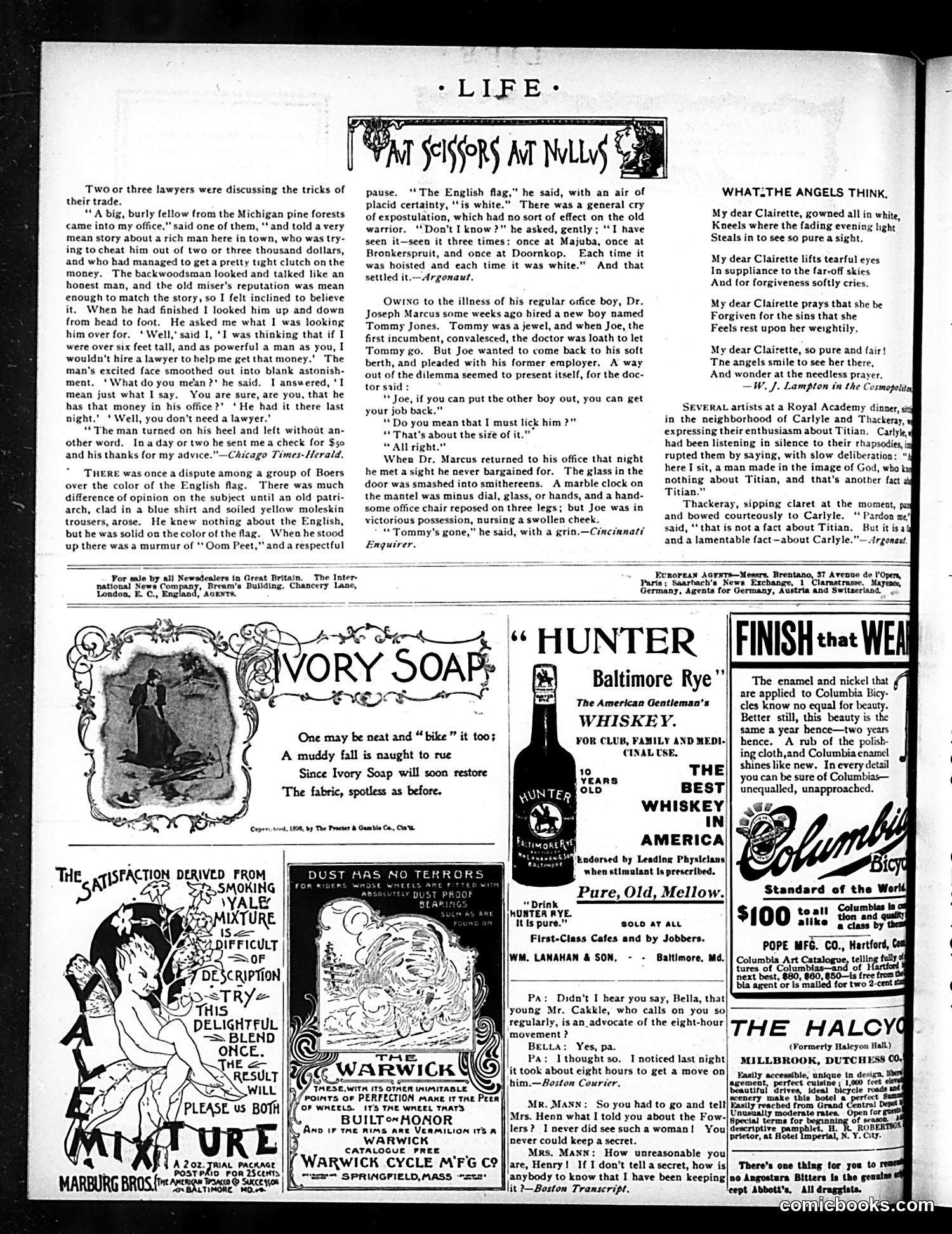
This page contains three distinct humorous pieces: 1. **"Scissors at Nulls" (top)**: A lawyer's anecdote mocking a backwoods client's misunderstanding of the English flag's color. The joke plays on the client's stubborn insistence the flag is "white" (likely confusing it with another nation's flag), and the lawyer's clever psychology in refusing legal help, which motivates the man to resolve the matter himself. 2. **"Tommy vs. Joe" (middle)**: A comedic story about two office boys competing for a doctor's position. The humor lies in literal physical combat resulting in destruction—the "winner" (Joe) returns victorious but battered, having literally fought for his job. 3. **"What the Angels Think" (right)**: A sentimental poem about a woman named Clairette seeking forgiveness, mocking excessive piety or self-flagellation. The ironic conclusion suggests her prayers are unnecessary. 4. **Carlyle anecdote (bottom)**: A witty exchange where Carlyle admits ignorance about the Renaissance painter Titian; Thackeray retorts that this isn't a fact about Titian but rather an unfortunate fact about Carlyle himself. The page is primarily **satirical commentary on human nature**—foolishness, stubbornness, and pretension.
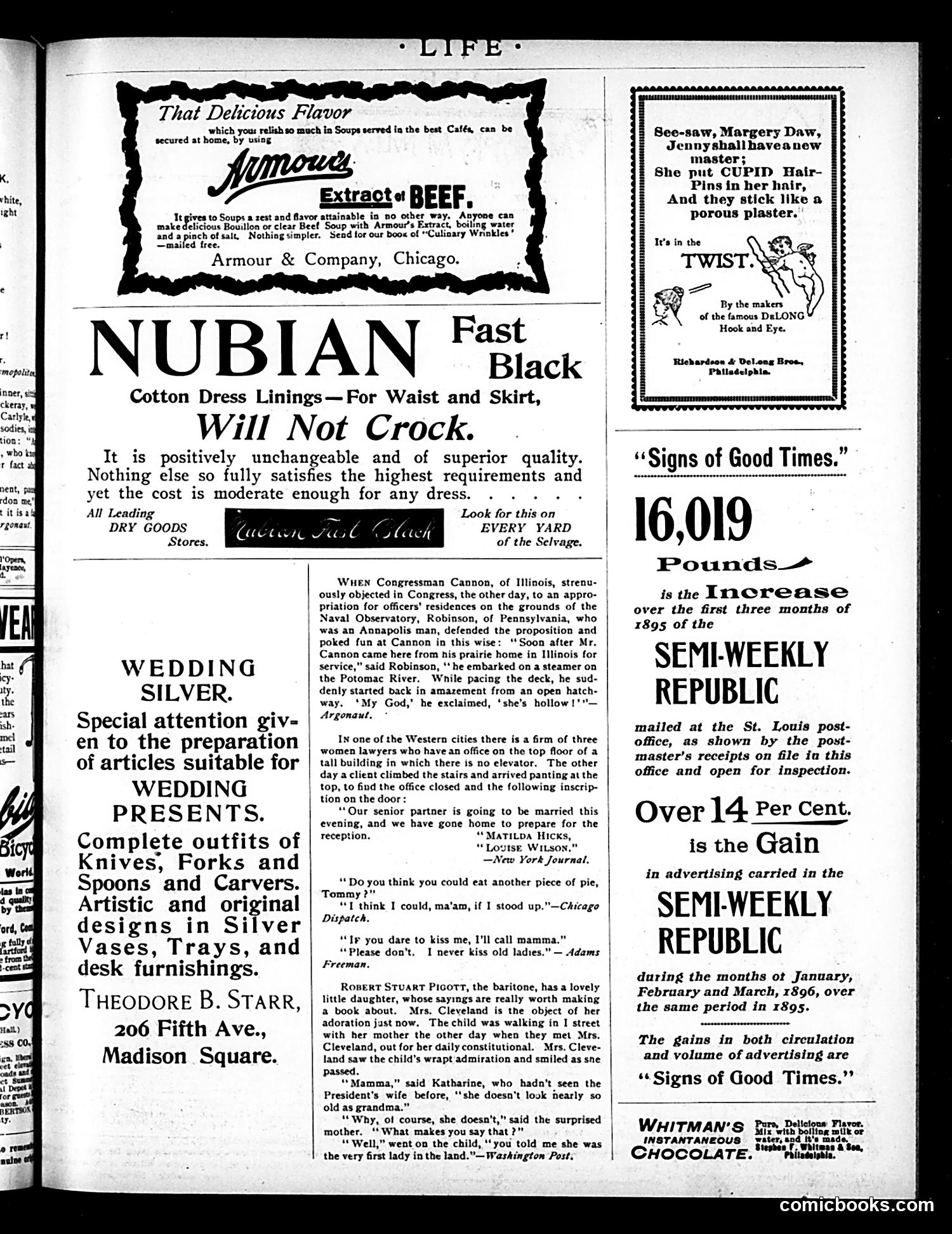
This page is primarily **advertising** for various consumer products and services (beef extract, fabric linings, wedding silver, hair pins, chocolate), interspersed with humorous anecdotes and jokes typical of Life magazine's satirical format. The only political-social content appears in a brief anecdote about **Congressman Joseph Cannon of Illinois**, presented as a butt of jokes. Robinson of Pennsylvania mocked Cannon as an unsophisticated prairie politician, joking that when Cannon first boarded a Potomac River steamer, he was amazed to discover the ship was hollow (implying he lacked basic knowledge). The anecdote ridicules Cannon as a rural rube unfit for Washington sophistication—a common form of early 1890s political mockery. The remaining humor consists of generic domestic jokes about children, courtship, and marital life, reflecting Victorian-era sensibilities about gender and family.
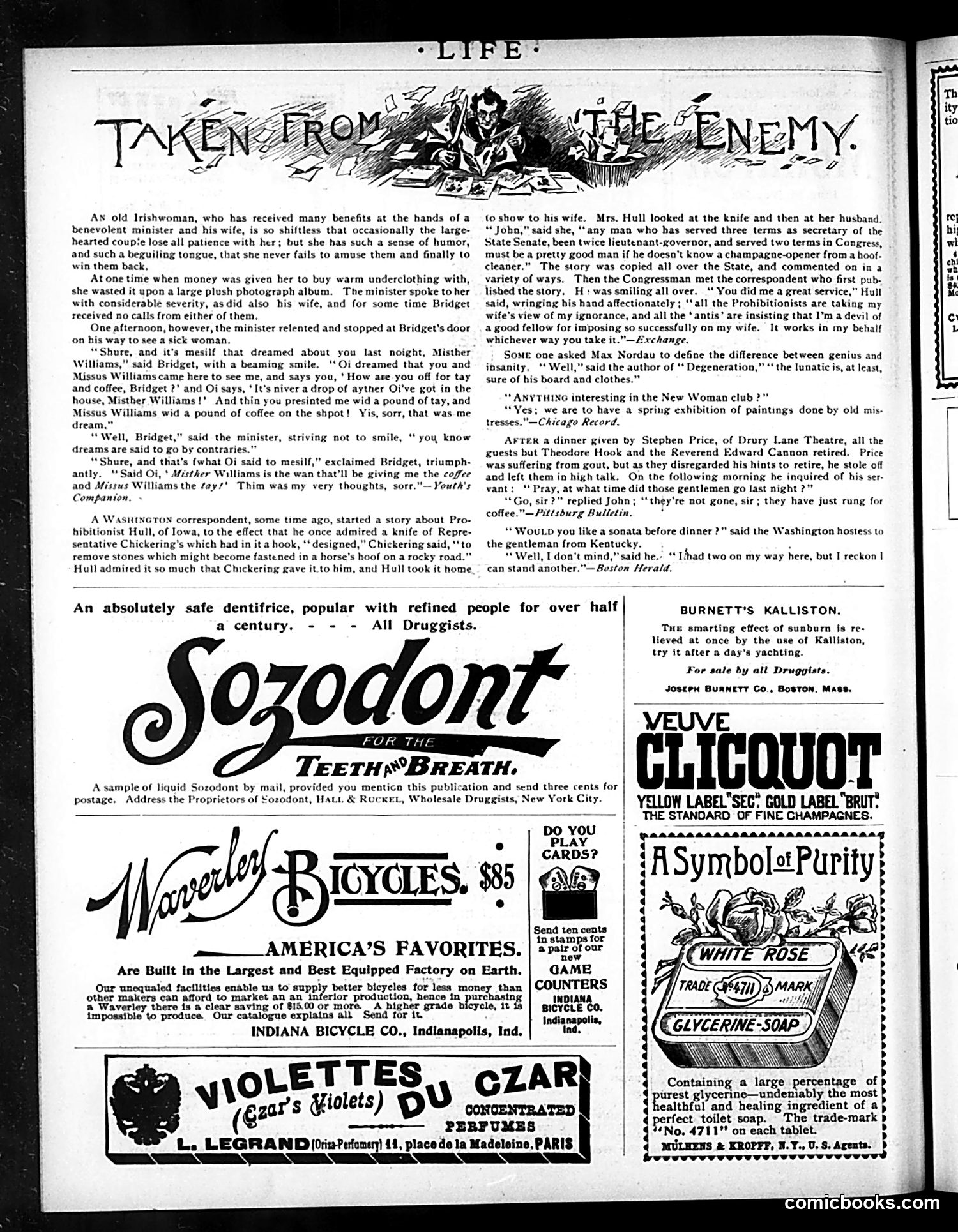
This page contains two distinct humorous stories rather than political cartoons: 1. **"Taken from the Enemy"** (main story): A satirical Irish anecdote about Bridget, a shiftless but charming woman who has squandered charitable aid on a photograph album. When the minister withholds visits as punishment, Bridget cleverly uses a dream narrative to invert expectations—claiming she dreamed the minister would give coffee while his wife gave tea, then "correcting" herself to say she meant the opposite. The joke relies on Irish dialect humor and the notion that the poor woman outsmarts her benefactors through wit. 2. **Hull anecdote**: A story mocking Prohibitionist politician Hull's inability to distinguish a champagne-opener from a hoof-cleaner. His wife's public embarrassment backfires—rather than damage his reputation, it endears him to both Prohibitionists (who see him as humble) and anti-Prohibitionists (who see him as a good fellow). The satire targets political hypocrisy and how identical facts serve opposing agendas. Both stories use humor to expose human folly and social contradictions.
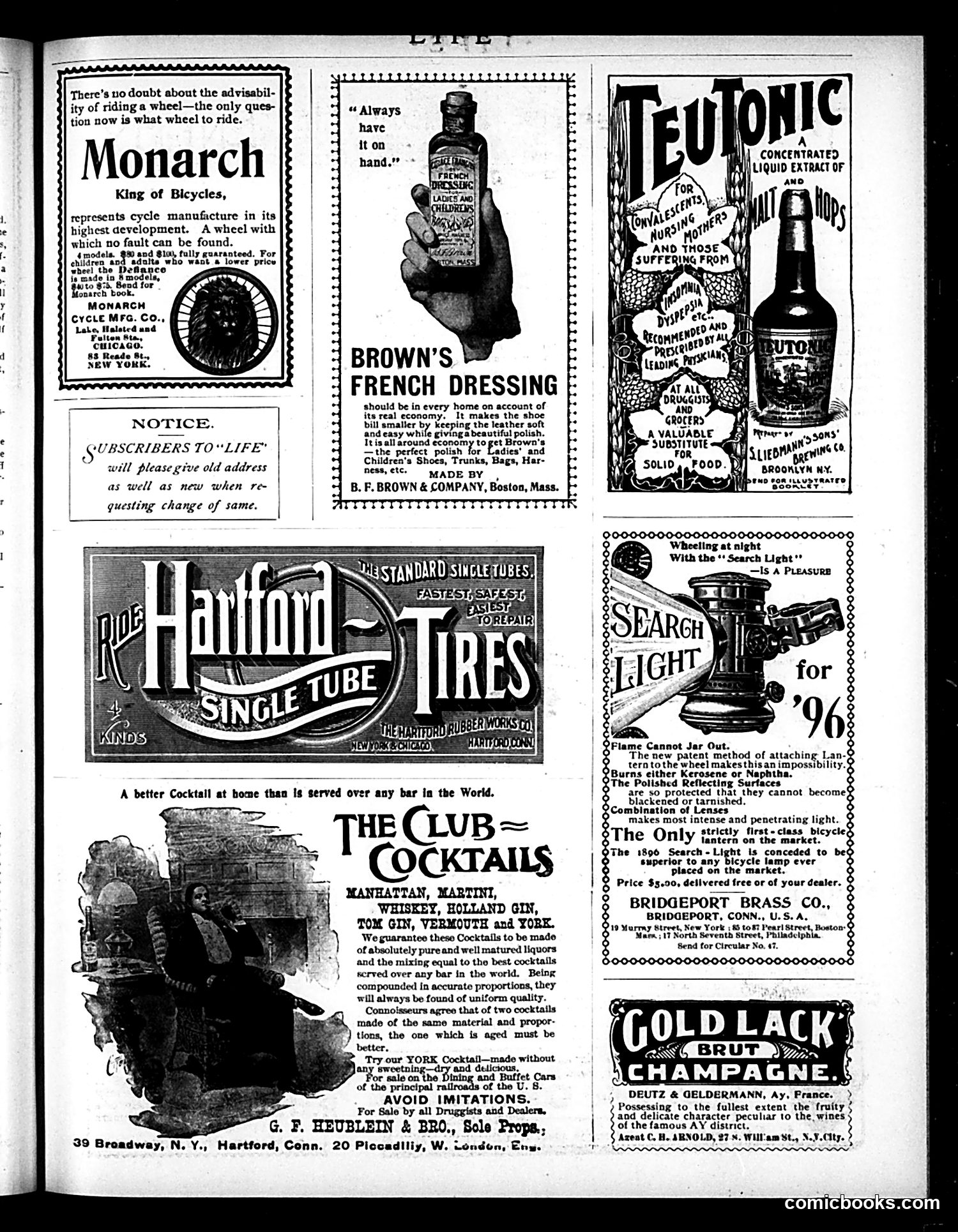
This is primarily a **turn-of-the-century (1896) advertisement page** with no political cartoon content. The page reflects late-Victorian consumer culture and product marketing. Key advertisements include: - **Monarch bicycles**: Positioning itself as the superior "King of Bicycles" during the 1890s bicycle boom - **Brown's French Dressing**: A shoe polish claiming economy by extending leather life - **Teutonic beer extract**: Marketed as medicinal relief for various ailments (reflecting era when alcohol was advertised for health) - **Hartford bicycle tires**: Emphasizing single-tube safety technology - **Search Light**: A new patent bicycle lamp with reflective surfaces - **Club Cocktails**: Pre-mixed spirits marketed as uniform quality - **Champagne and other spirits**: Premium imported beverages The page reveals middle-class consumer aspirations, emphasis on new technology (bicycles, lamps), and the normalization of alcohol as everyday products—even "medicinal" extracts. No satire or political commentary is evident; this is straightforward commercial advertising.
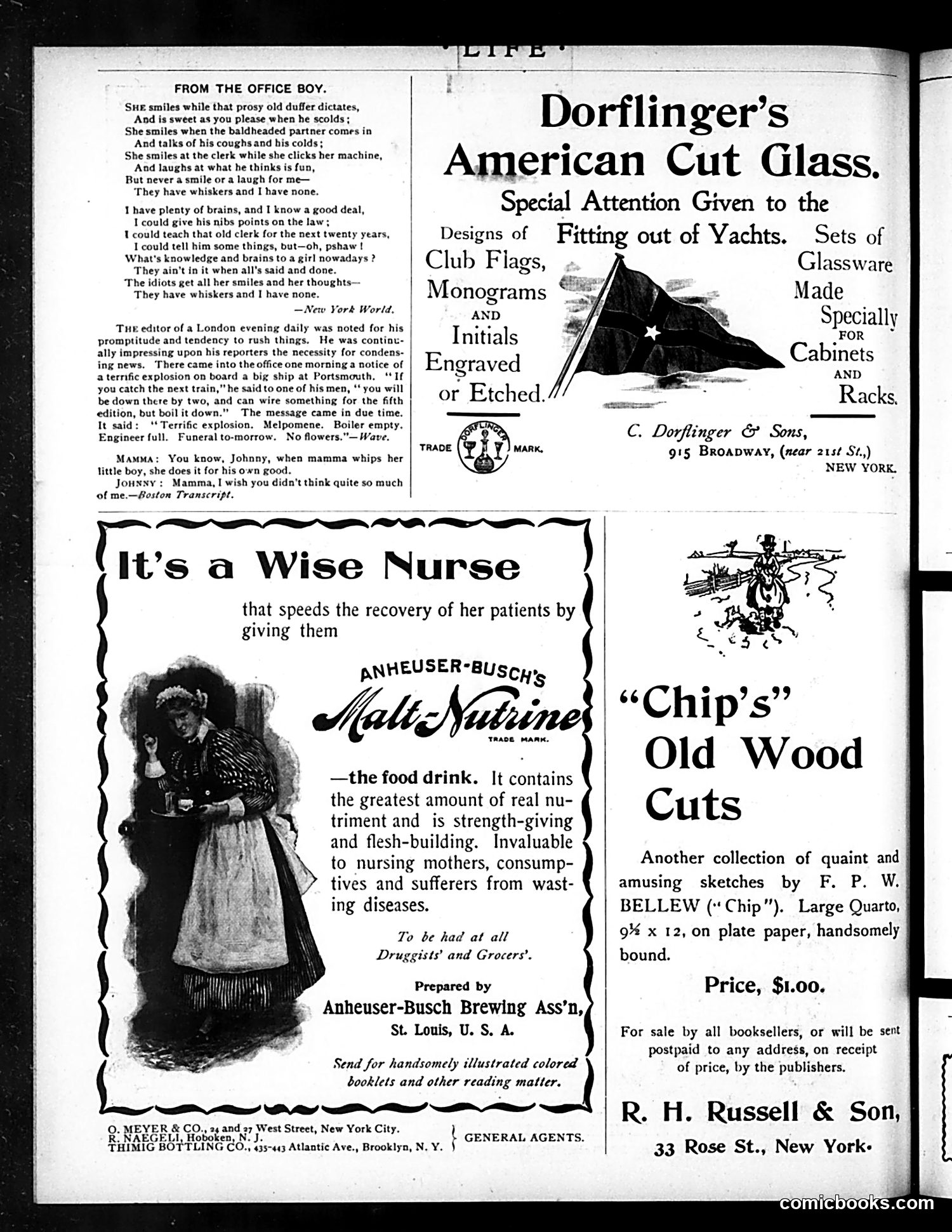
This page contains three humorous pieces typical of early 1900s American satire: **"From the Office Boy"** satirizes youth and attractiveness versus experience. A young office boy laments that female coworkers smile at older, bearded men (colleagues with "whiskers") but ignore him despite his intelligence and legal knowledge. The joke: women value conventional masculine status symbols over brains in young men. **The London Editor anecdote** mocks journalistic sensationalism and brevity. An editor demands condensed reporting; a reporter covers a ship explosion in absurdly terse language ("Boiler empty. Engineer full"), reducing a disaster to dark humor through extreme compression. **The Mother-Johnny dialogue** presents gentle irony: a mother claims she punishes her son "for his own good," but Johnny replies he wishes she didn't care about him so much—implying the punishment serves her interests, not his welfare. The page also contains period advertisements for cut glass, beverages, and illustrated books. These pieces reflect Era humor emphasizing social observation and mild cynicism about authority figures and conventional wisdom.
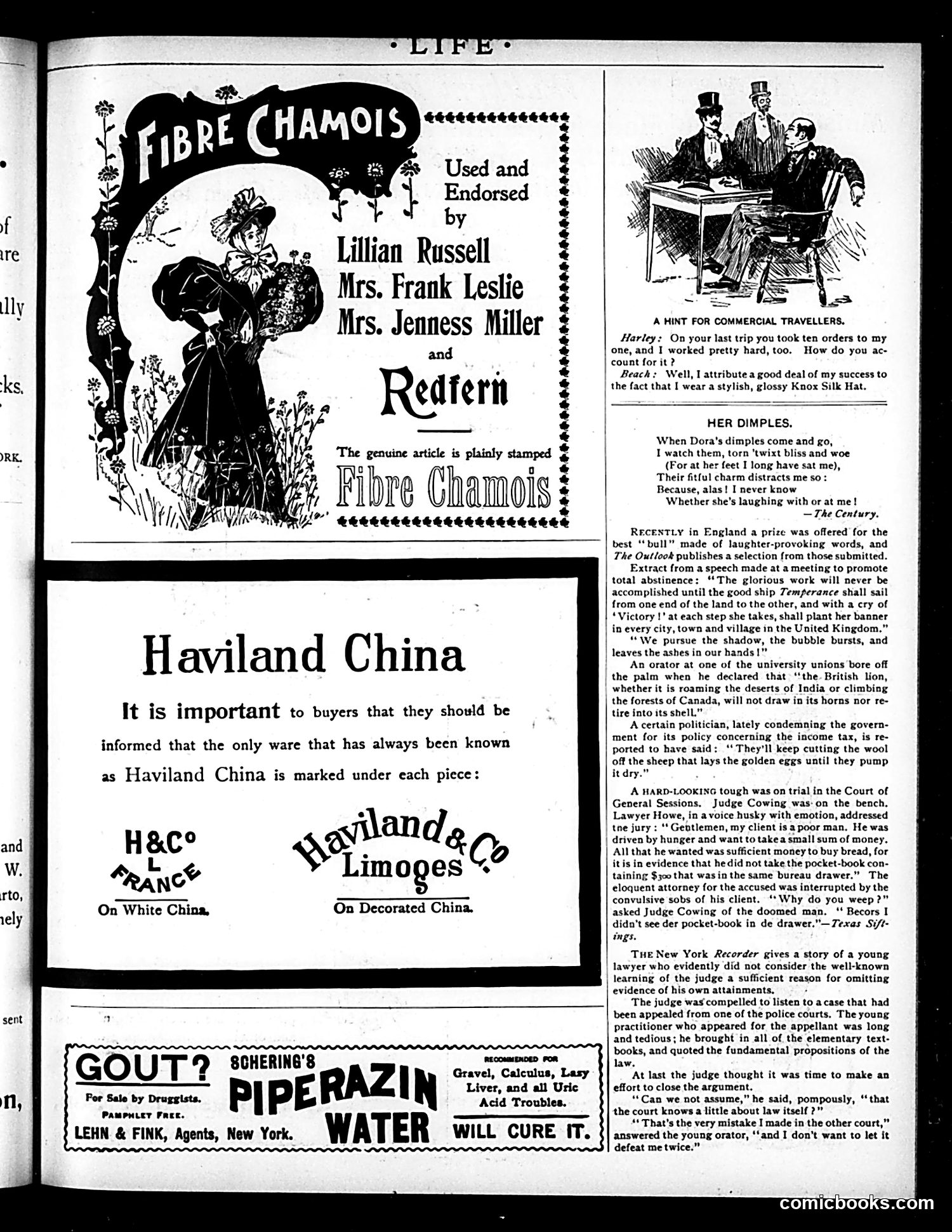
This is primarily an **advertising page** from Life magazine, featuring product endorsements and brief humorous anecdotes rather than political cartoons. **Main Advertisement**: Fibre Chamois fabric is endorsed by celebrities Lillian Russell, Mrs. Frank Leslie, and Mrs. Jenness Miller—prominent society figures of the era whose names lent credibility to consumer goods. **Humorous Content**: The page includes several short jokes and stories: - A commercial traveler credits his sales success to wearing a stylish hat - A poem about a woman's dimples - Absurd political speeches full of mixed metaphors ("the good ship Temperance") - Courtroom anecdotes mocking a defendant's greed and a young lawyer's pomposity **Other Ads**: Haviland China (establishing authenticity of marks) and Piperazin Water (claiming to cure gout and uric acid troubles—typical of dubious patent medicines of the era). The page's tone is lighthearted satire targeting vanity, pretension, and legal incompetence, typical of Life's satirical humor. No specific political references are evident.
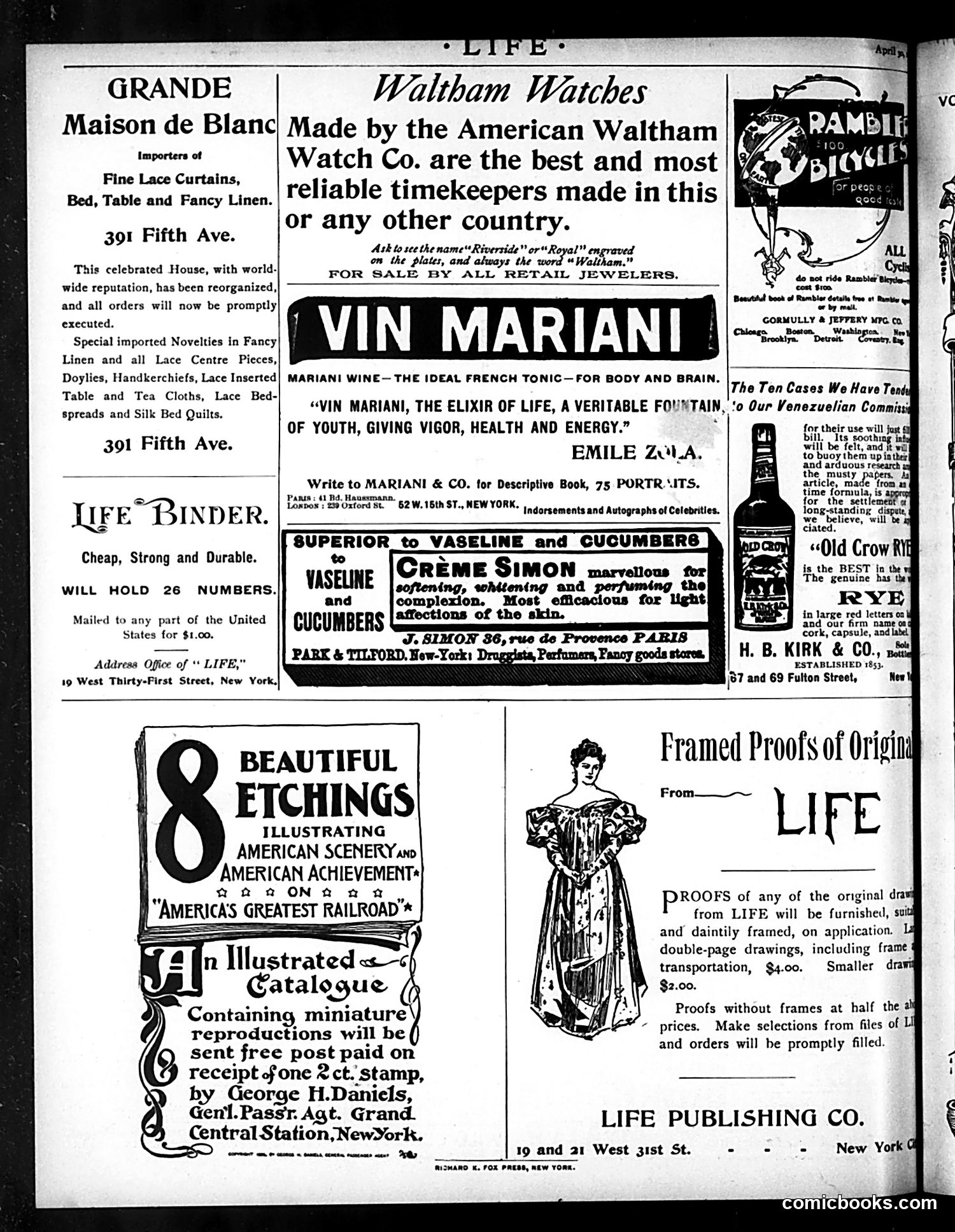
This page is primarily **advertising**, not satirical content. It showcases luxury and patent-medicine products marketed to affluent readers circa the late 1800s/early 1900s. Key advertisements include: - **Waltham Watches**: American timepieces promoted as superior quality - **Vin Mariani**: A French wine tonic claiming to provide "vigor, health and energy," endorsed by celebrity Émile Zola—a common patent-medicine marketing tactic of the era - **Vaseline and Crème Simon**: Cosmetic products for skin care - **Old Crow Rye**: Whiskey The page also advertises **Life Publishing's services**: framed reproductions of original artwork from the magazine, and an illustrated catalog of etchings featuring American scenery and achievement, plus promotional material for railroad imagery. No political cartoons or satirical commentary appear on this page—it's purely commercial content reflecting the magazine's business model of selling luxury goods to its educated, wealthy readership.