
Life, 1896-04-30 · page 7 of 20
Life — April 30, 1896 — page 7: what you’re looking at
What you’re looking at
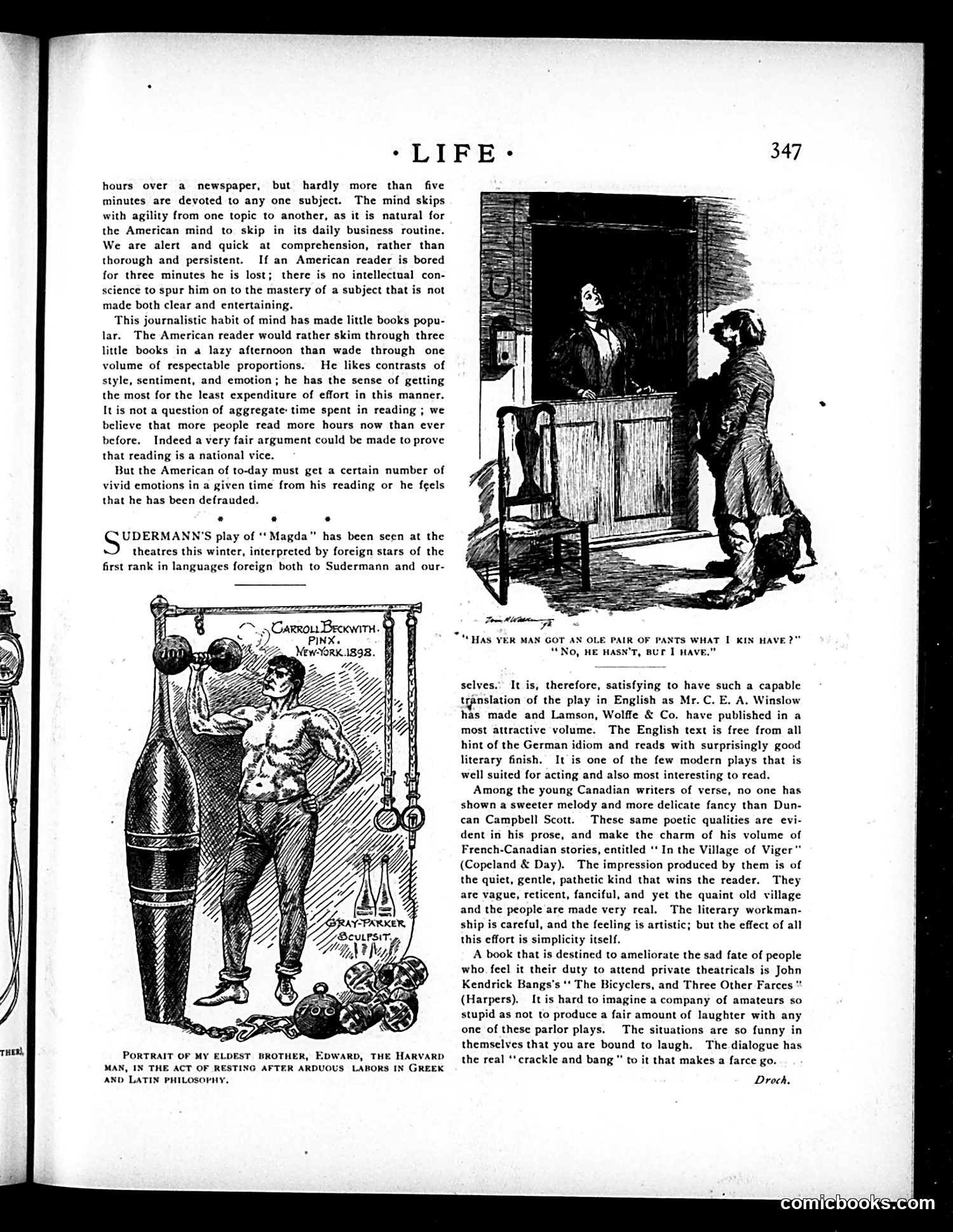
This page contains two illustrations and literary criticism rather than political cartoons. The upper illustration shows a domestic scene with the caption "Has yer new got an ole pair of pants what I kin have?" / "No, he hasn't, but I have." It appears to depict working-class people in a humorous exchange about clothing. The lower illustration, attributed to "Carroll Beckwith, N.Y. 1838," shows a figure labeled as "Portrait of my eldest brother, Edward, the Harvard man, in the act of resting after arduous labors in Greek and Latin philosophy." This is satirical—the man appears to be sleeping or lounging, mocking the intellectual pretensions of Harvard-educated individuals. The text discusses American reading habits, Sudermann's play "Magda," and Canadian literature, offering literary commentary rather than political satire.
📄 Transcribed text from this page (OCR, searchable)
Machine-transcribed from the original scan — historical spelling and the odd misread are preserved.
* LIFE: hours over a newspaper, but hardly more than five minutes are devoted to any one subject. The mind skips with agility from one topic to another, as it is natural for the American mind to skip in its daily business routine. We are alert and quick at comprehension, rather than thorough and persistent. If an American reader is bored for three minutes he is lost; there is no intellectual con- science to spur him on to the mastery of a subject that is not made both clear and entertaining. This journalistic habit of mind has made little books popu- lar. The American reader would rather skim through three little books in a lazy afternoon than wade through one volume of respectable proportions. He likes contrasts of style, sentiment, and emotion; he has the sense of getting the most for the least expenditure of effort in this manner. It is not a question of aggregate: time spent in reading ; we believe that more people read more hours now than ever before. Indeed a very fair argument could be made to prove that reading is a national vice. But the American of to-day must get a certain number of vivid emotions in a given time from his reading or he feels that he has been defrauded. . * . GDERMANNS play of ‘‘ Magda” has been scen at the theatres this winter, interpreted by foreign stars of the first rank in languages foreign both to Sudermann and our- == AY-PARKER, SCuLPSiT,, PORTRAIT OF MY ELDEST BROTHER, EDWARD, THE HARVARD MAN, IN THE ACT OF RESTING AFTER ARDUOUS LABORS IN GREEK AND LATIN PHILOSOPHY, “HAS YER MAN GOT AN OLE PAIR OF PANTS WHAT I KIN HAVE?” “No, HE HASN'T, BUT I HAVE.” selves.’ It is, therefore, satisfying to have such a capable translation of the play in English as Mr. C. E. A. Winslow has made and Lamson, Wolffe & Co. have published in a most attractive volume. The English text is free from all hint of the German idiom and reads with surprisingly good literary finish. It is one of the few modern plays that is well suited for acting and also most interesting to read. Among the young Canadian writers of verse, no one has shown a sweeter melody and more delicate fancy than Dun- can Campbell Scott. These same poetic qualities are evi- dent in his prose, and make the charm of his volume of French-Canadian stories, entitled ‘* In the Village of Viger” (Copeland & Day). The impression produced by them is of the quiet, gentle, pathetic kind that wins the reader. They are vague, reticent, fanciful, and yet the quaint old village and the people are made very real. The literary workman- ship is careful, and the feeling is artistic; but the effect of all this effort is simplicity itself. A book that is destined to ameliorate the sad fate of people who. feel it their duty to attend private theatricals is John Kendrick Bangs's ‘‘ The Bicyclers, and Three Other Farces * (Harpers). It is hard to imagine a company of amateurs so stupid as not to produce a fair amount of laughter with any one of these parlor plays. The situations are so funny in themselves that you are bound to laugh. The dialogue has the real ‘crackle and bang " to it that makes a farce go. Droch.