
Life, 1896-04-30 · page 6 of 20
Life — April 30, 1896 — page 6: what you’re looking at
What you’re looking at
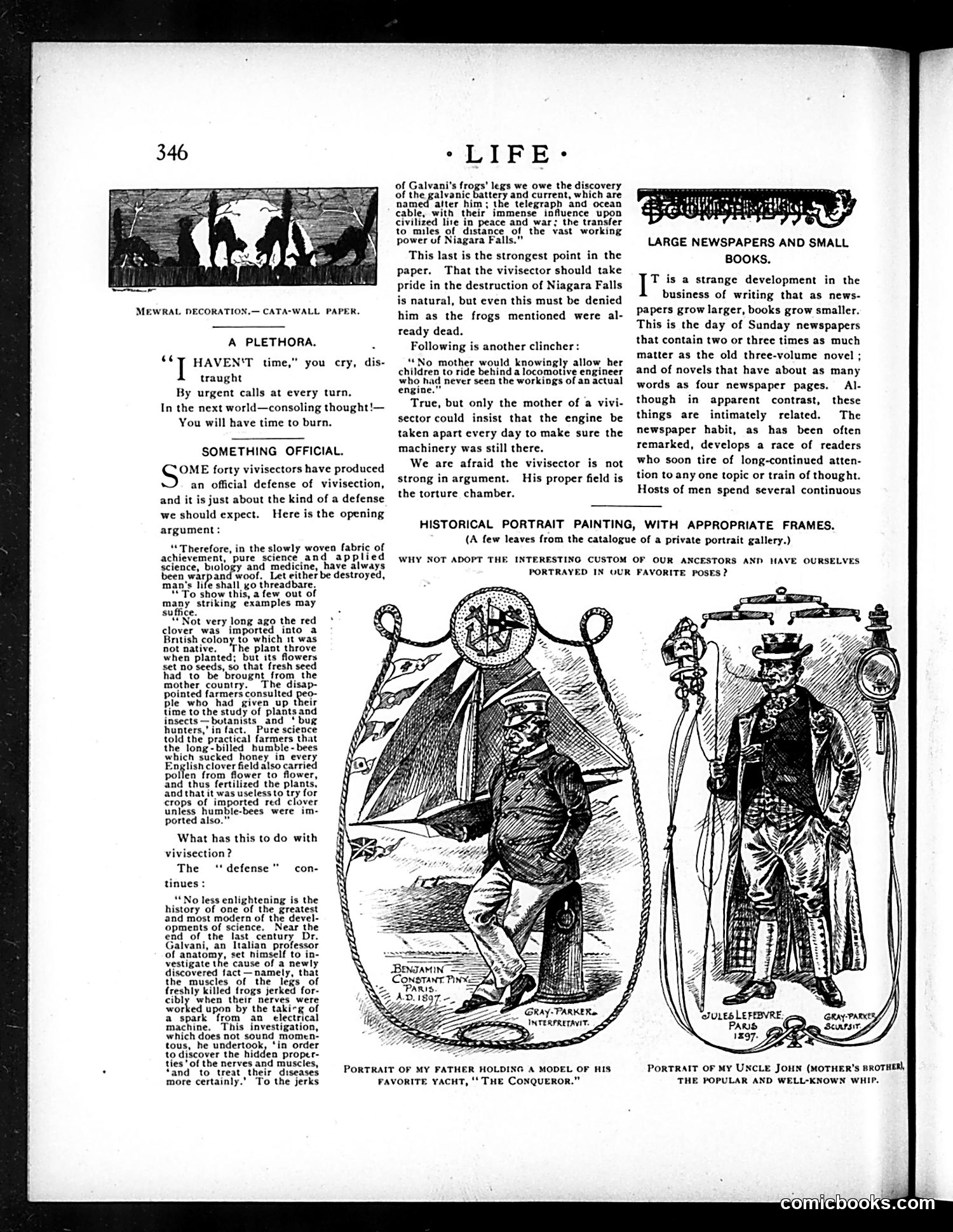
This page contains **satirical essays and historical portrait illustrations** rather than political cartoons. The main content critiques "vivisection" (animal experimentation). One essay defends vivisection's scientific value despite public outcry; another attacks it as unnecessary cruelty. The debate reflects late-19th/early-20th century tensions over animal welfare versus medical progress—a genuine controversy of the era. The two framed portraits show historical figures: one labeled "Benjamin Conqueror" (likely William the Conqueror, misidentified or a joke), and "Jules Lefebvre" (a known French academic painter). The heading proposes reviving ancestor portrait customs. The page also includes a section on newspapers versus books, noting modern papers now contain content rivaling full novels. The satire targets intellectual pretension and outdated customs rather than specific politicians.
📄 Transcribed text from this page (OCR, searchable)
Machine-transcribed from the original scan — historical spelling and the odd misread are preserved.
MEWRAL DECORATIC CATA-WALL PAPER. A PLETHORA. . ‘67 HAVEN'T time,” you cry, dis- traught By urgent calls at every turn. In the next world—consoling thought!— You will have time to burn. SOMETHING OFFICIAL. OME forty vivisectors have produced an official defense of vivisection, and it is just about the kind of a defense we should expect. Here is the opening argument: “Therefore, in the slowly woven fabric of achievement, ‘pure science and applied science, biology and medicine, have always been warpand woof. Let either be destroyed, man’s life shall xo threadbare. ** To show this, afew out of many striking examples may suffice. ‘Not very long ago the red clover was imported into a Bnitish colony to which it was not native. ‘The plant throve when planted; but its flowers set no seeds, so that fresh seed had to be ‘brougnt from the mother country. The disap- pointed farmers consulted peo- ple who had given up their time to the study of plants and insects — botanists and * bug hunters,’ in fact. Pure science told the practical farmers that the long-billed humble -bees which sucked honey in every English clover field also carried pollen from flower to flower, and thus fertilized the plants, and that it was useless to try for crops of imported red clover unless humble-bees were im- ported also." What hast vivisection? The ‘defense ” tinues : “No less enlightening is the history of one of the greatest and most modern of the devel- ‘opments of science. Near the end of the last century Dr. Galvani, an Italian professor of anatomy, set himself to in- Vestigate the cause of a newly discovered fact — namely, that the muscles of the legs of freshly killed frogs jerked for- cibly ‘when their nerves were worked upon by the taking of a spark from an electrical machine. This investigation, which does not sound momen tous, he undertook, ‘in order to discover the hidden proper- ties’ of the nerves and muscles, ‘and to treat their diseases more certainly.’ To the jerks todo with con- “LIFE: of Galvani's frogs’ legs we owe the discovery of the galvanic battery and current, which are named alter him; the telegraph and ocean cable, with their immense influence upon civilized lite in peace and war; the transfer to miles of distance of the vast working power of Niagara Falls." This last is the strongest point in the paper. That the vivisector should take pride in the destruction of Niagara Falls is natural, but even this must be denied him as the frogs mentioned were al- ready dead. Following is another clincher: “No mother would knowingly allow her children to ride behind a locomotive engineer who had never seen the workings of an actual engine. True, but only the mother of a vivi- sector could insist that the engine be taken apart every day to make sure the machinery was still there. We are afraid the vivisector is not strong in argument. His proper field is the torture chamber. LARGE NEWSPAPERS AND SMALL BOOKS. T is a strange development in the business of writing that as news- papers grow larger, books grow smaller. This is the day of Sunday newspapers that contain two or three times as much matter as the old three-volume novel ; and of novels that have about as many words as four newspaper pages. Al- though in apparent contrast, these things are intimately related. The newspaper habit, as has been often remarked, develops a race of readers who soon tire of long-continued atten- tion to any one topic or train of thought. Hosts of men spend several continuous HISTORICAL PORTRAIT PAINTING, WITH APPROPRIATE FRAMES. (A few leaves from the catalogue of a private portrait gallery.) WHY NOT ADOPT THE INTERESTING CUSTOM OF OUR ANCESTORS AND HAVE OURSELVES PORTRAYED IN OUR FAVORITE POSES? GRAY-PARKERe me INTERPRETAVIT. PORTRAIT OF MY FATHER HOLDING A MODEL OF HIS FAVORITE YACHT, ‘* THE CONQUEROR.” PORTRAIT OF MY UNCLE JOHN (MOTHER'S BROTHER) THE POPULAR AND WELL-KNOWN WHIP.