
A complete issue · 20 pages · 1896
Life — March 26, 1896
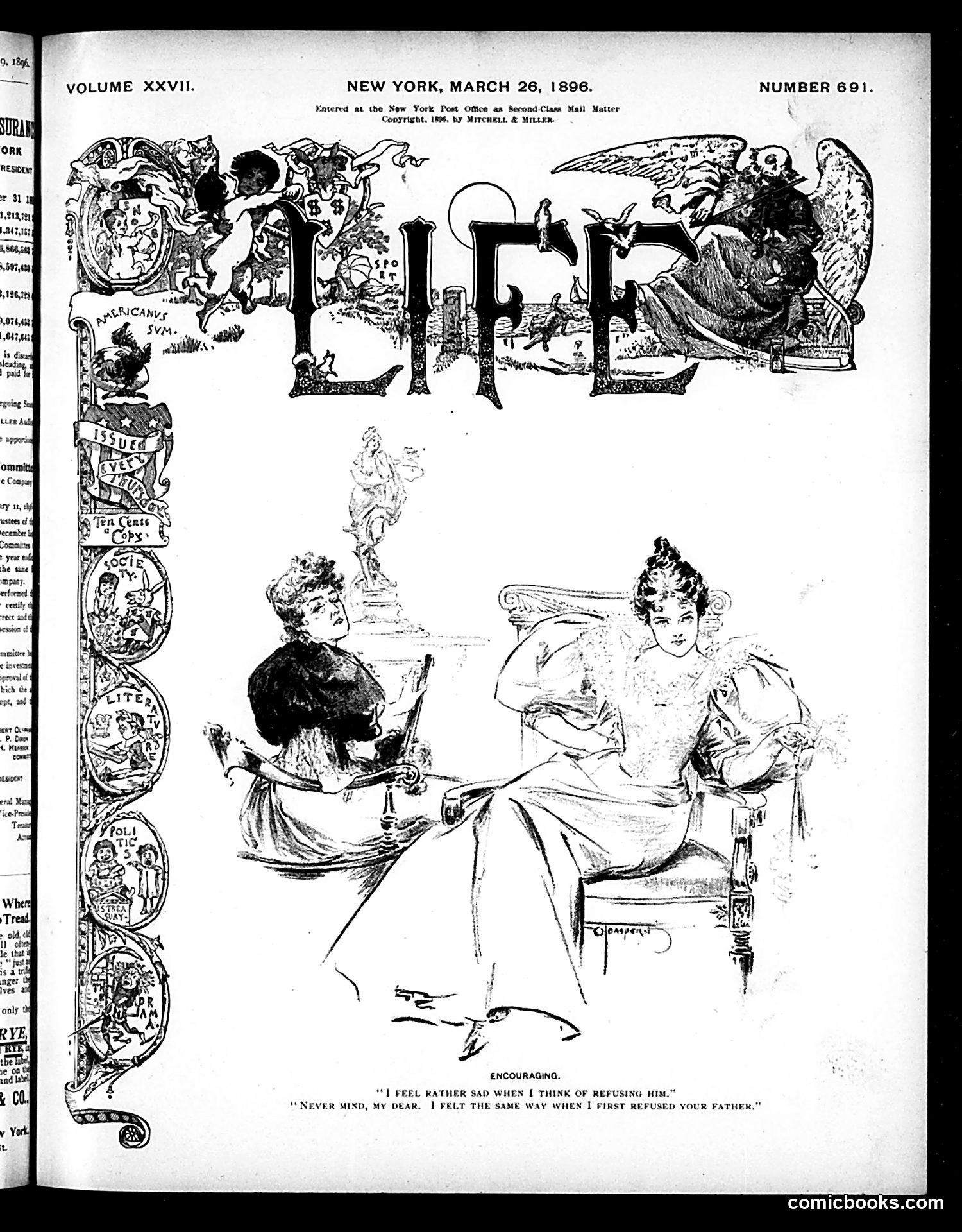
This cartoon satirizes a domestic conversation between a woman and man. The title "Encouraging" and dialogue quote—"Never mind, my dear. I felt the same way when I first refused your father"—suggest the woman has rejected a marriage proposal or romantic advance. The joke relies on the woman's mother (presumably speaking) reassuring her daughter that initial refusal of a suitor is normal; she herself initially refused the girl's father before eventually accepting him. The humor plays on Victorian courtship conventions, where women were expected to show initial coyness or reluctance before accepting marriage proposals. The elaborate decorative border typical of Life's design frames the satirical commentary on 1890s dating customs and gender expectations around marriage.
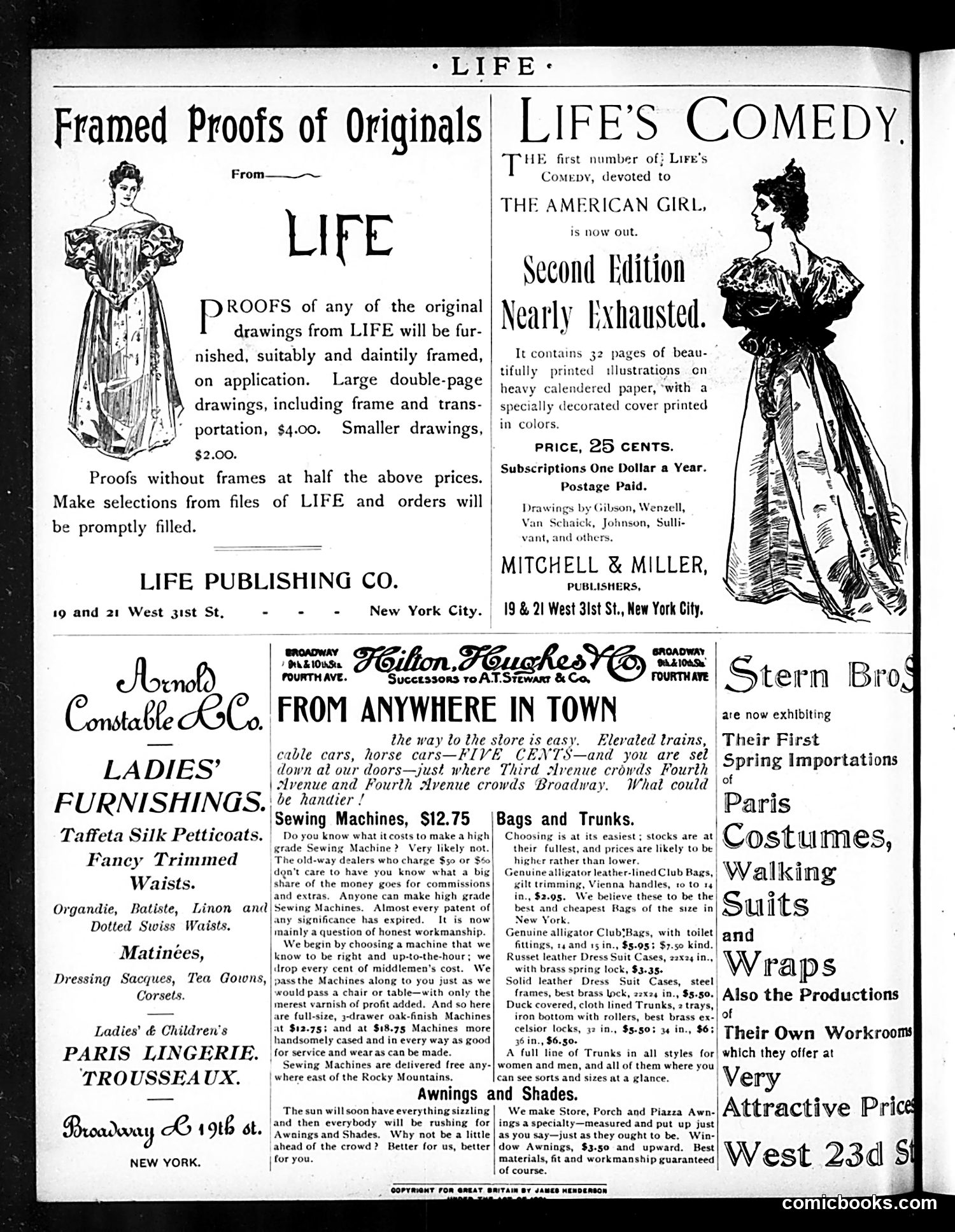
This page is primarily **advertising**, not satirical cartoons. It contains: **Left side:** Life Publishing Co. advertises framed proofs of original drawings available for purchase ($2-$4), with artists listed as "Gibson, Wentzell, Van Schaick, Johnson, Sullivan, and others." **Right side:** Mitchell & Miller publishers promote Life's Comedy issue devoted to "The American Girl" (second edition, nearly exhausted), priced at 25 cents. **Bottom half:** Department store advertisements for Arnold Constable & Co. (ladies' furnishings), Halton, Hughes & Co. (sewing machines and bags), and Stern Bros. (Paris costumes and wraps). The illustrated figures are fashionable women in period dress, serving as decorative elements for the ads rather than satirical commentary. This appears to be a turn-of-the-century advertising section.
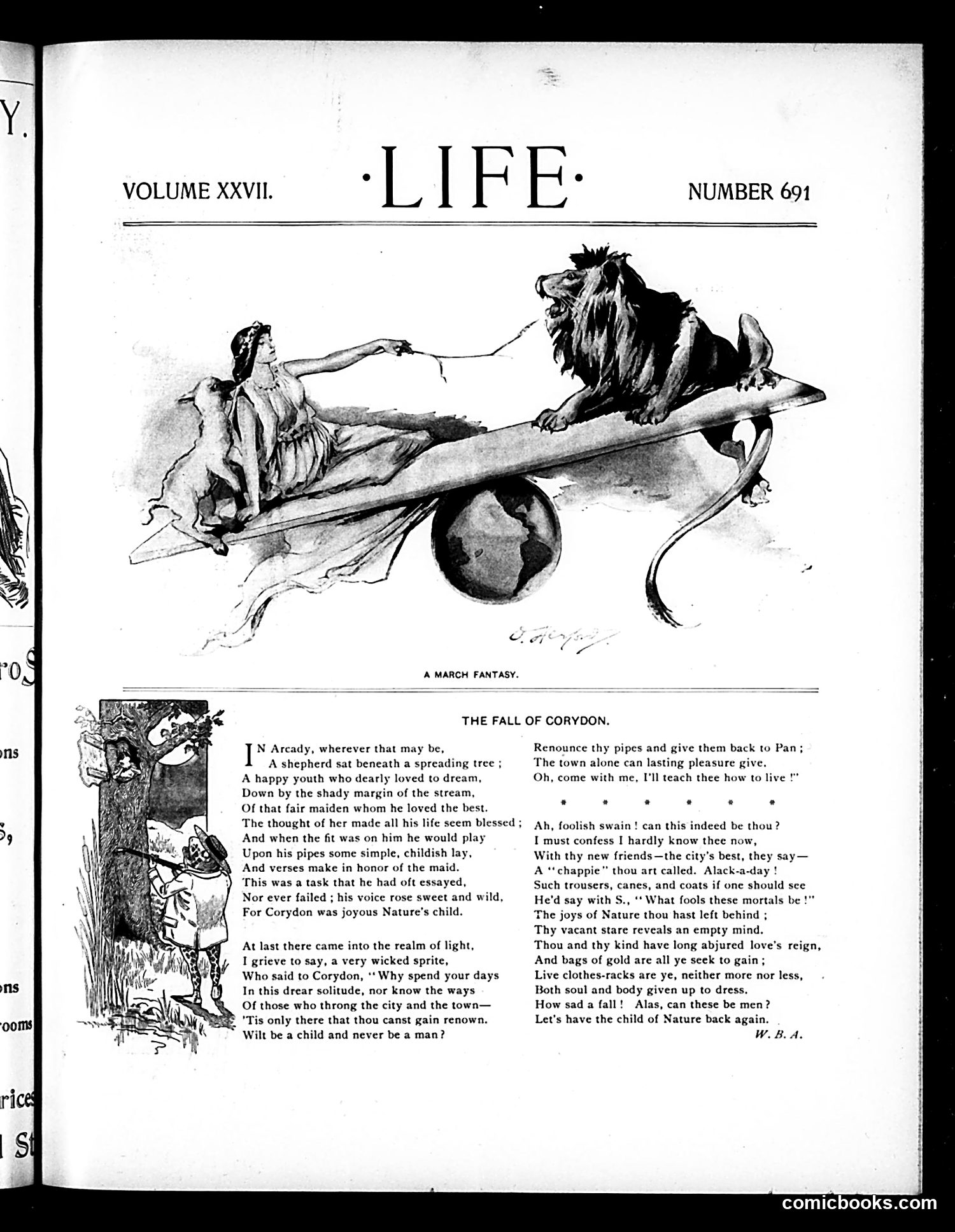
The top illustration depicts a woman and a lion on a seesaw balanced on a globe, titled "A March Fantasy." This appears to be whimsical rather than directly political satire. The accompanying poem, "The Fall of Cordon," concerns a shepherd character who abandons pastoral simplicity for city life and material wealth, ultimately losing his moral virtue. The poem's moral message—delivered by Pan himself—warns against urban corruption and greed, advocating a return to natural, childlike innocence. The left-side illustration shows classical/mythological figures reinforcing this pastoral theme. The satire targets late 19th/early 20th-century urbanization and materialism, using traditional moral fables to critique contemporary society's departure from simpler values.
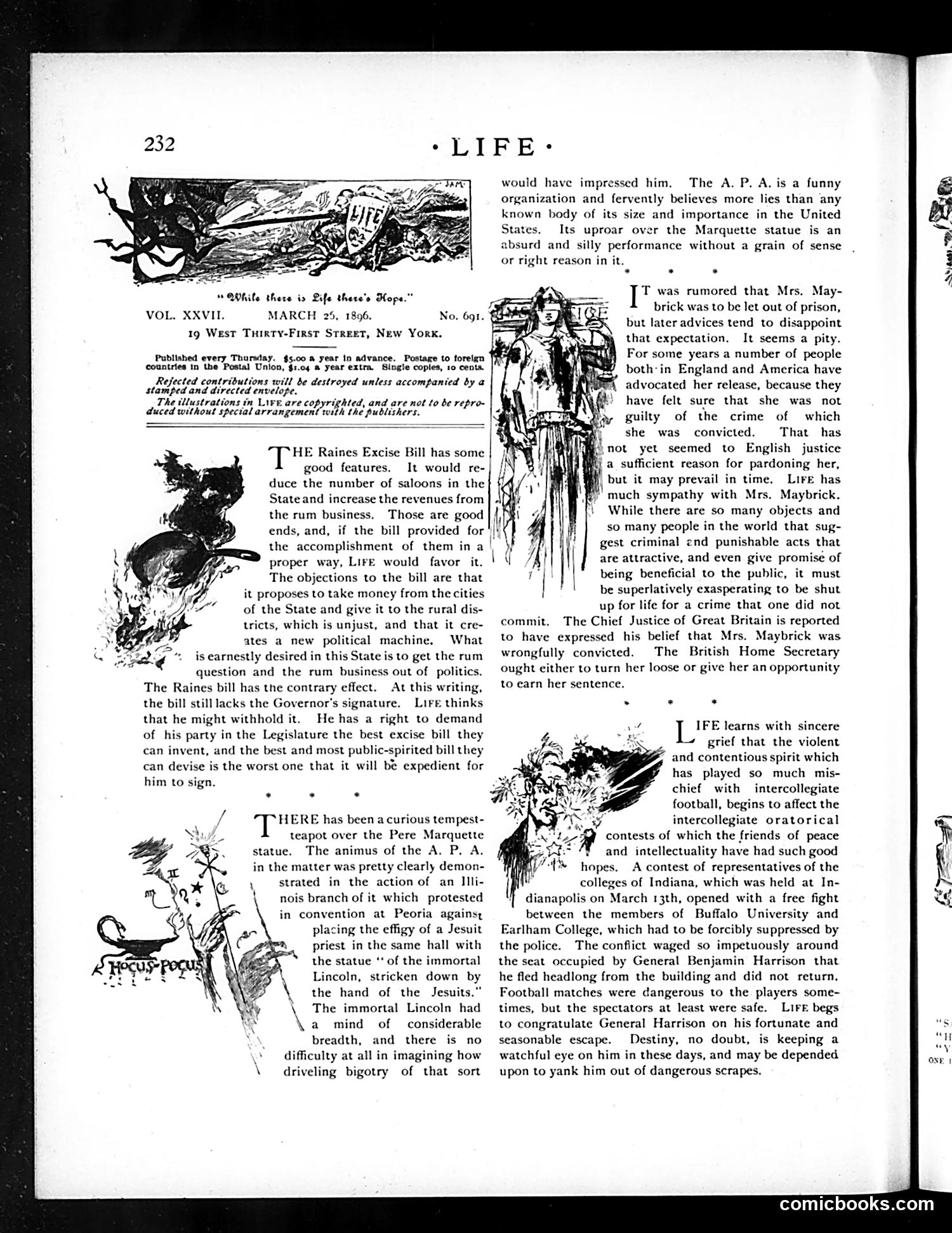
This page contains editorial commentary on three distinct topics: 1. **The Raines Excise Bill**: A satirical discussion of New York State legislation to regulate saloons and reduce rum sales. Life criticizes the bill's mechanism—taxing cities to fund rural districts—as unjust political maneuvering, and advocates the Governor's veto. 2. **The Marquette Statue Controversy**: Life mocks the A.P.A. (American Protective Association, a nativist anti-Catholic organization) for protesting a Jesuit priest statue in Illinois, calling their response absurd and demonstrating their general unreliability. 3. **Mrs. Maybrick's Case**: Life expresses sympathy for a woman imprisoned in Britain, hoping for her pardon despite controversy surrounding her conviction. The illustrations are decorative period cartoons accompanying these editorial positions.
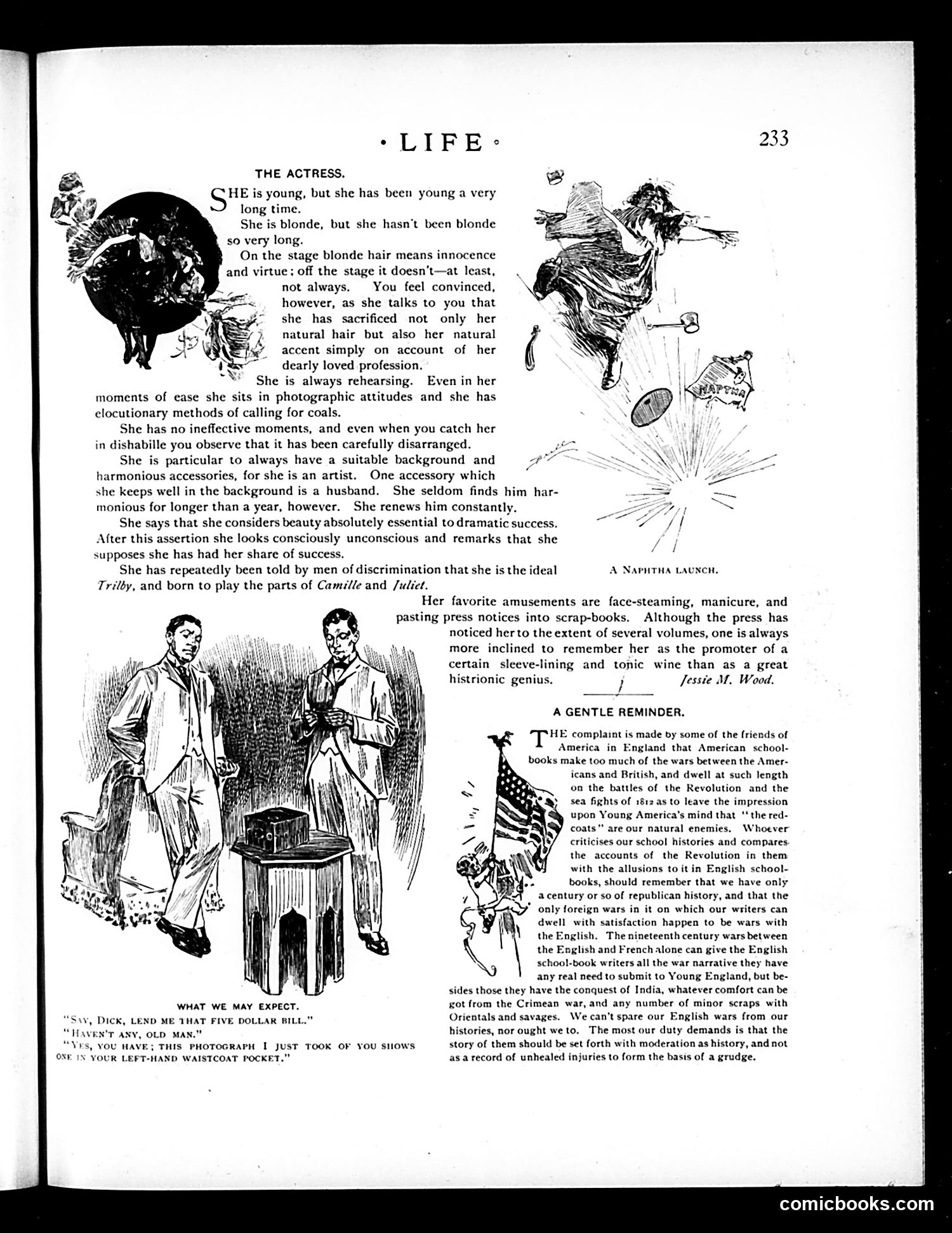
**"The Actress"** section contains a satirical portrait of an unnamed stage actress—likely a contemporary performer of the era. The text mocks theatrical conventions: her dyed blonde hair signifying false innocence, her constant self-presentation and "photographic attitudes," her reliance on a husband for background stability, and her frequent remarriages. The satire suggests actresses perform femininity offstage as much as on, existing in perpetual artifice. **"A Gentle Reminder"** addresses American school textbooks' treatment of Anglo-American conflict. The text objects to accounts emphasizing British-American wars (Revolution, 1812) and "red-coats" as enemies, arguing this creates bias against England. It advocates for balanced historical narrative over grievance-focused accounts. Both sections critique institutional dishonesty—theatrical and educational.
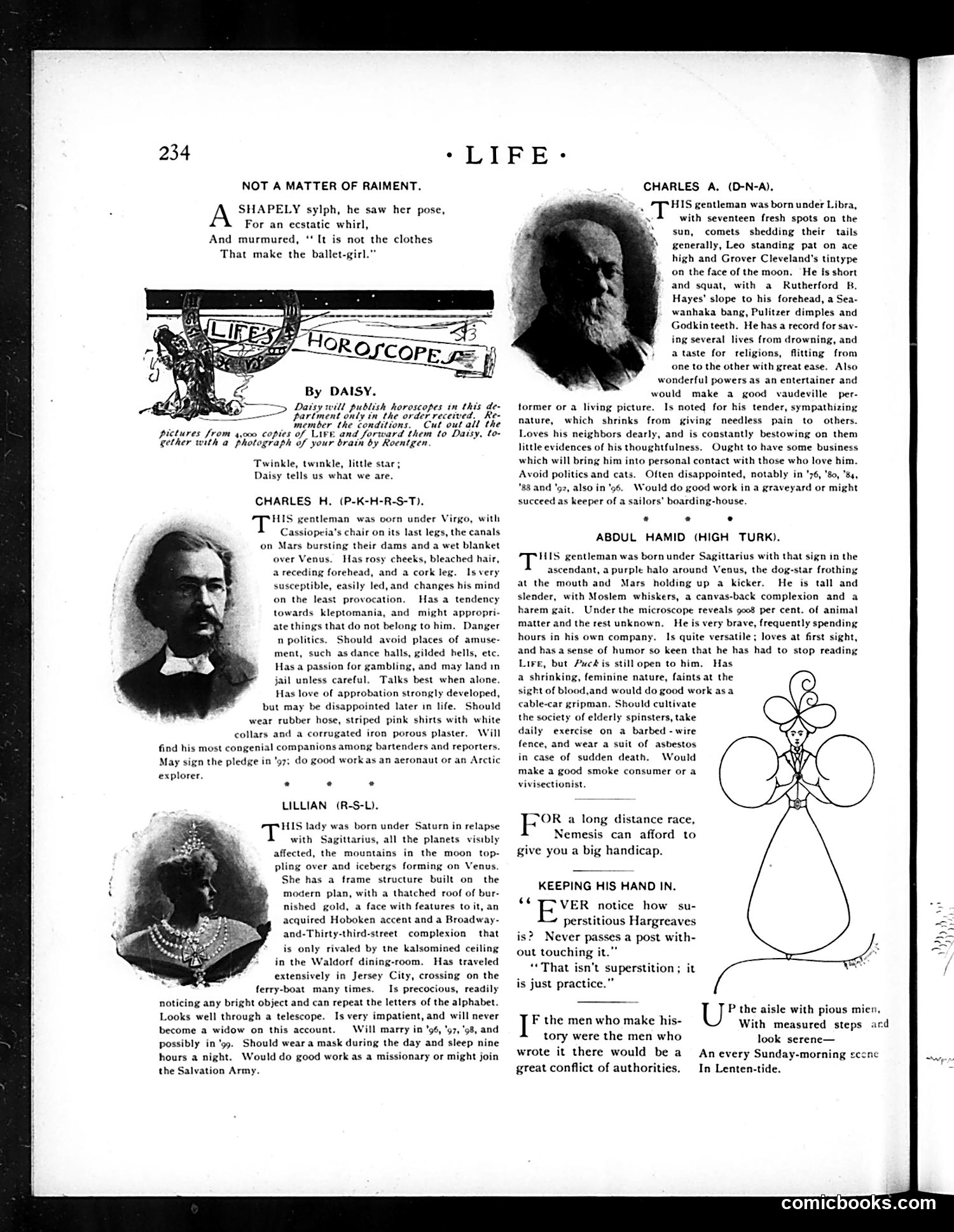
This page contains **astrological character sketches** rather than political satire. Each entry pairs a zodiac sign with a satirical personality description and portrait photograph. The sketches mock various character types: "Charles A." (Libra) is portrayed as an entertainment-minded man prone to disappointing others; "Charles H." (Virgo) describes a fussy, pedantic gentleman; "Lillian" (Saturn) depicts a wealthy, affected woman; and "Abdul Hamid" (Sagittarius) characterizes someone with conflicting traits. The humor derives from **stereotyping based on astrological signs**—a popular form of entertainment satire in early 20th-century magazines. The accompanying "Daisy's Horoscope" section reinforces this satirical approach to fortune-telling and personality prediction, which Life's readers would recognize as tongue-in-cheek social commentary rather than serious astrology.
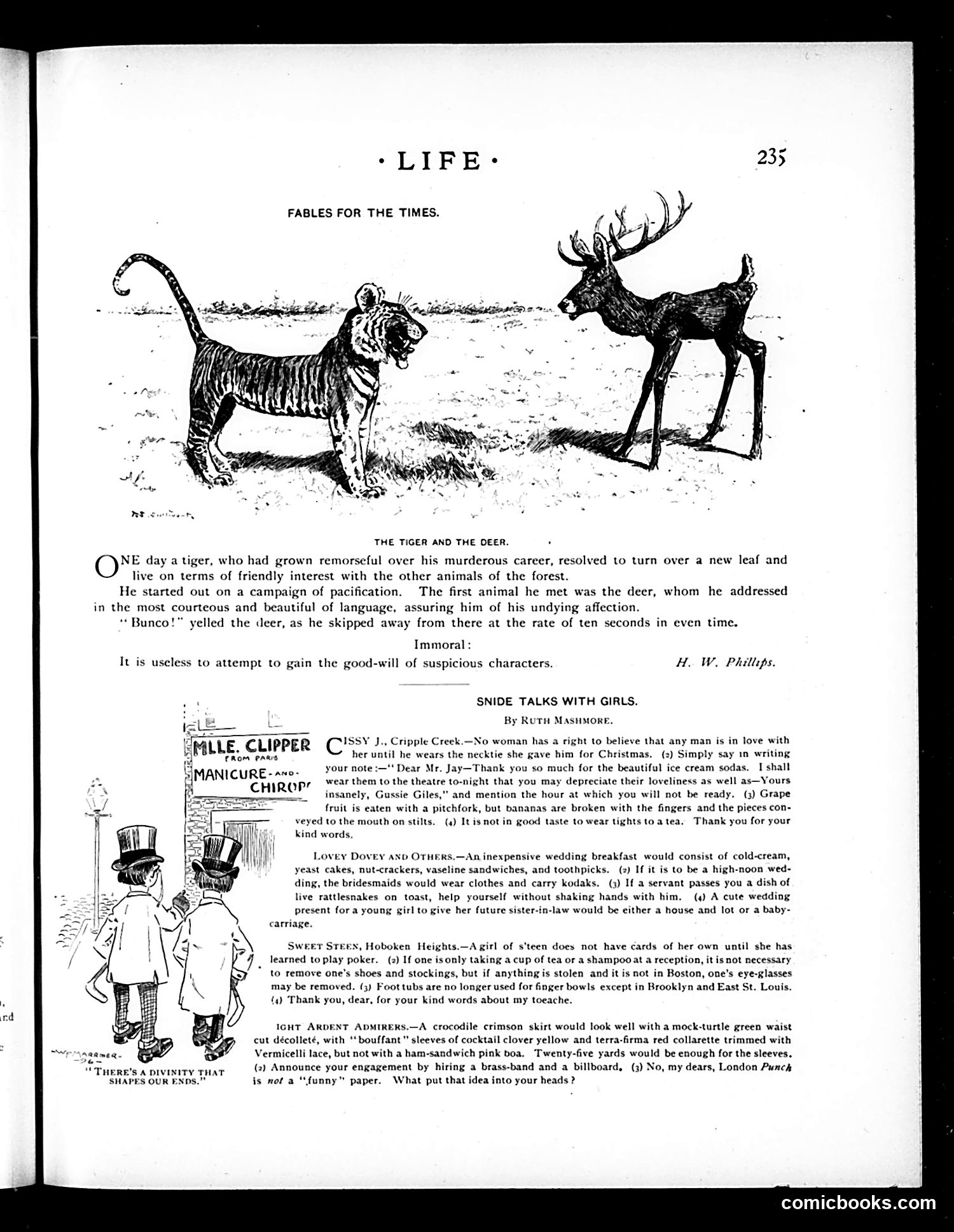
This page contains **two distinct sections**: **Upper section**: A fable titled "The Tiger and the Deer" illustrated with an engraving. A reformed tiger attempts to make peace with forest animals but is immediately rejected by a deer who flees in terror. The moral—"It is useless to attempt to gain the good-will of suspicious characters"—appears to be a general commentary on trust and reputation. **Lower section**: "Snide Talks with Girls" by Ruth Mashmore offers satirical advice to women on etiquette, fashion, and social conduct. Topics include proper gift-giving for Christmas, wedding etiquette, appropriate clothing choices, and engagement announcements. The tone is gently mocking of social conventions and expectations placed on women.
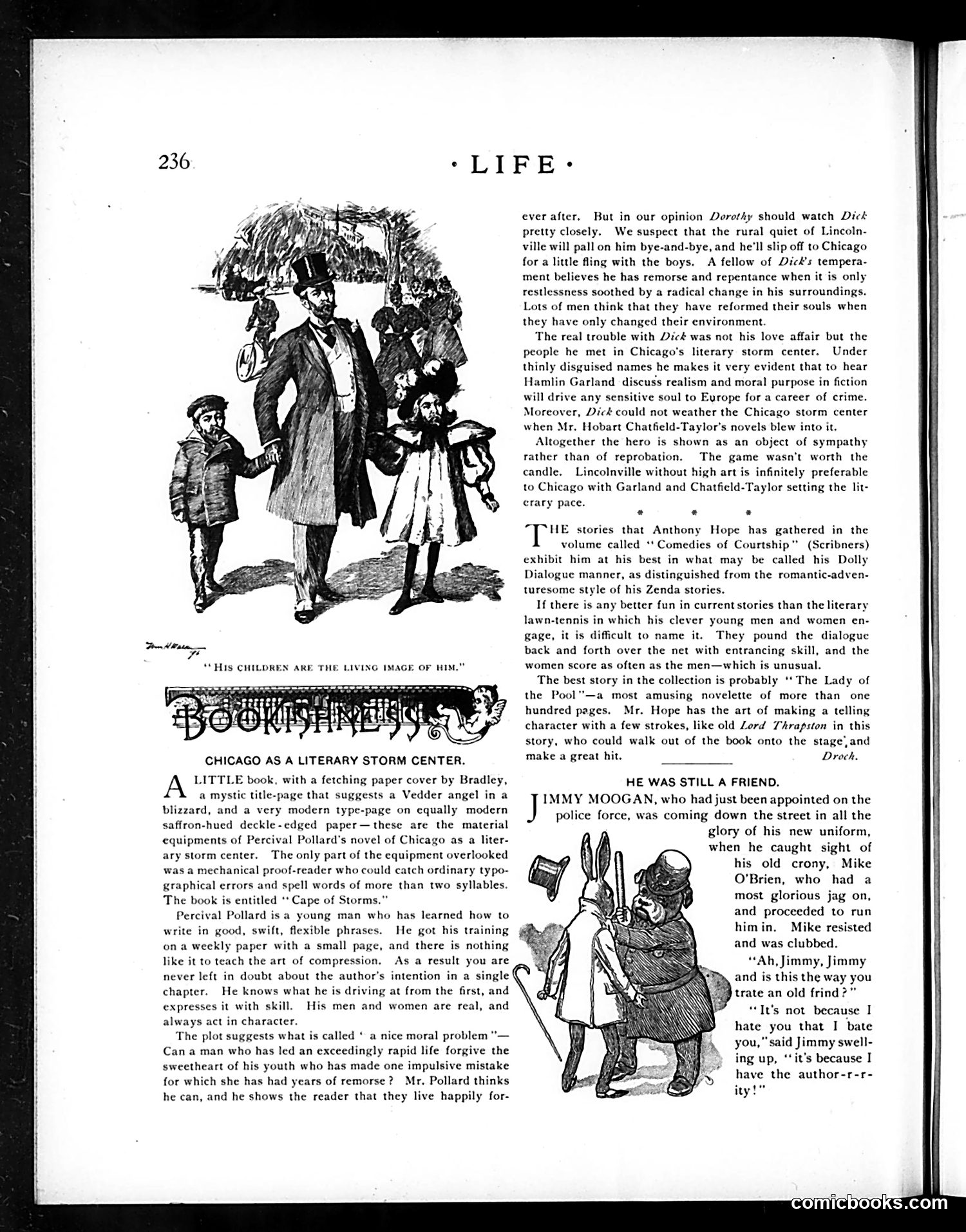
This page from *Life* magazine contains literary book reviews rather than political cartoons. The main illustration shows a Victorian-era street scene with well-dressed adults and children, captioned "His Children Are the Living Image of Him." The reviews discuss three works: 1. **"Cape of Storms"** by Percival Pollard—criticized for moral ambiguity about whether a man can forgive youthful indiscretions 2. **"Comedies of Courtship"** by Anthony Hope—praised for witty dialogue and amusing character interactions 3. An unnamed story featuring "Jimmy Moogan," a newly appointed police officer encountering an old crow named Mike O'Brien The page satirizes contemporary Chicago literary circles and debates about morality in fiction, but contains no identifiable political figures or caricatures—it's primarily book criticism with illustrative sketches.
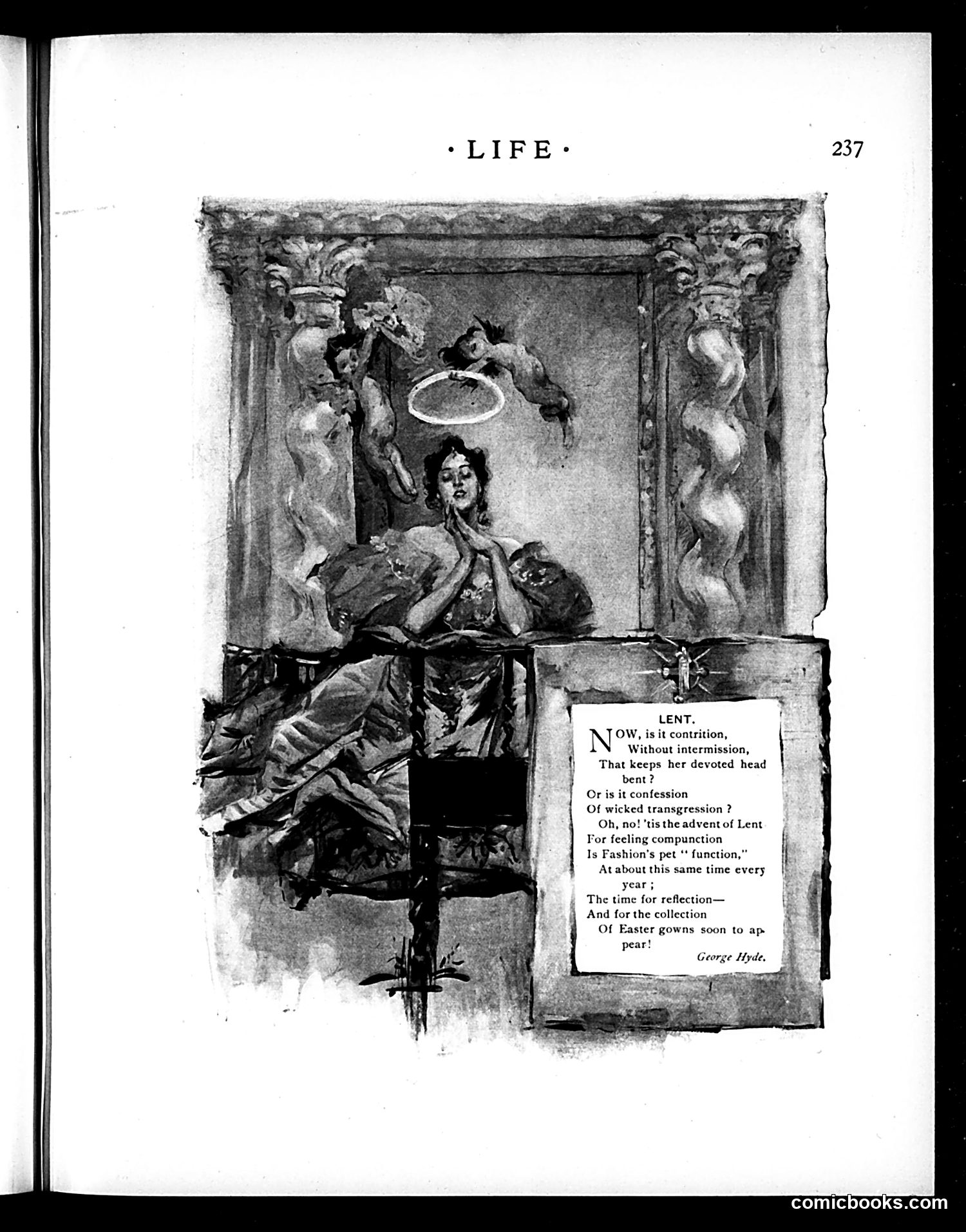
This page features a satirical poem titled "Lent" by George Hyde, accompanying an illustration of a fashionable woman in an ornate religious setting (indicated by the halo and cherub details). The satire mocks the superficiality of religious observance among the wealthy. Hyde questions whether the woman's devoted posture during Lent represents genuine spiritual reflection or merely fashionable social performance—noting that "feeling compunction / Is Fashion's pet 'function'" that occurs annually around Easter. The joke targets the seasonal, performative nature of Lenten piety among society women, who adopt religious devotion as a temporary fashion accessory coinciding with Easter gown purchases, rather than practicing sincere spiritual commitment. The ornate, theatrical framing reinforces this critique of superficial religiosity dressed up as genuine faith.
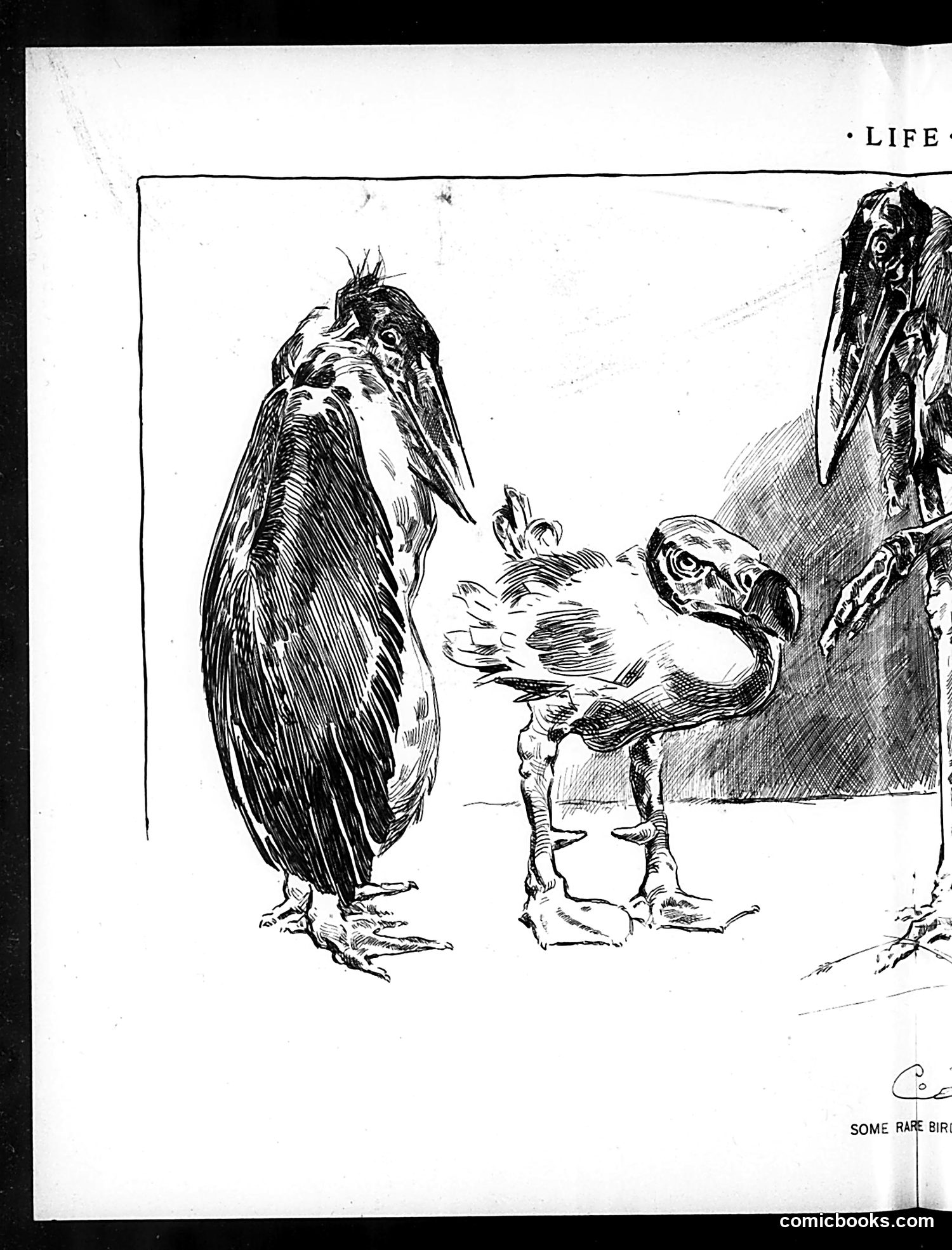
This page shows a sketch titled "SOME RARE BIRDS" depicting two birds in what appears to be a confrontational or interactive stance. The larger bird on the left has prominent dark plumage and an aggressive posture, while the smaller bird on the right appears more delicate or timid. Without additional visible text or captions identifying these specific birds or their symbolic meanings, I cannot definitively explain what political or social figures or events they represent. The drawing's style and the "rare birds" caption suggest satirical intent—likely commenting on some contemporary public figures or situations—but the specific reference remains unclear from this image alone. The composition emphasizes contrast between the two subjects, suggesting commentary on power dynamics or opposing personalities.
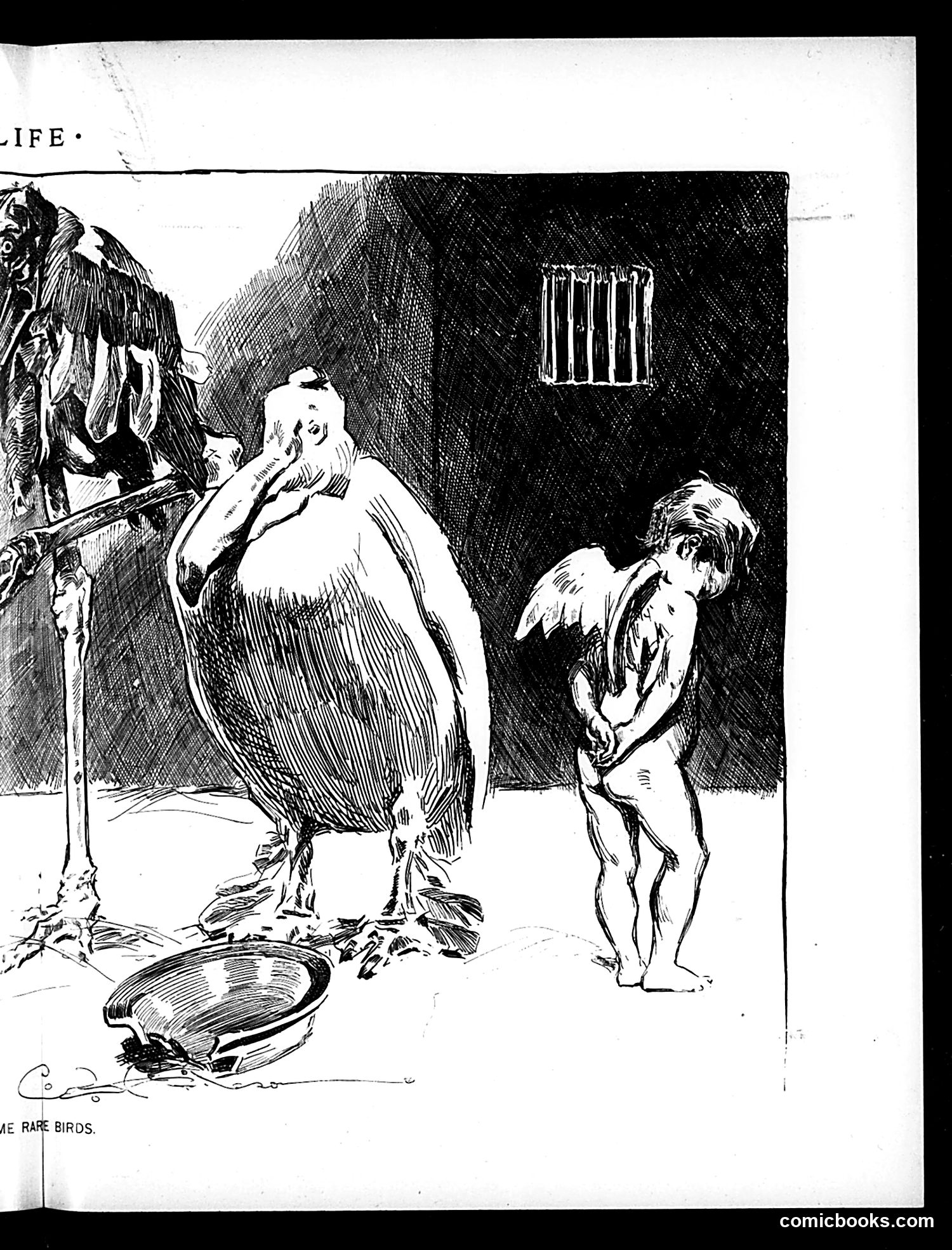
This appears to be a satirical cartoon from Life magazine depicting a scene in what looks like a prison cell (evidenced by the barred window). The cartoon shows two figures: a large, heavyset person in clothing and a small, nude child-like figure. There's a basin on the floor and hanging poultry on the left. The partial text visible reads "ME RARE BIRDS," though the full context is unclear from this page fragment alone. Without additional context about the publication date or clearer OCR text, I cannot definitively identify the specific political or social commentary intended. The crude caricature style and prison setting suggest satirical social or political critique, but determining the precise target or message would require more information than this single page provides.
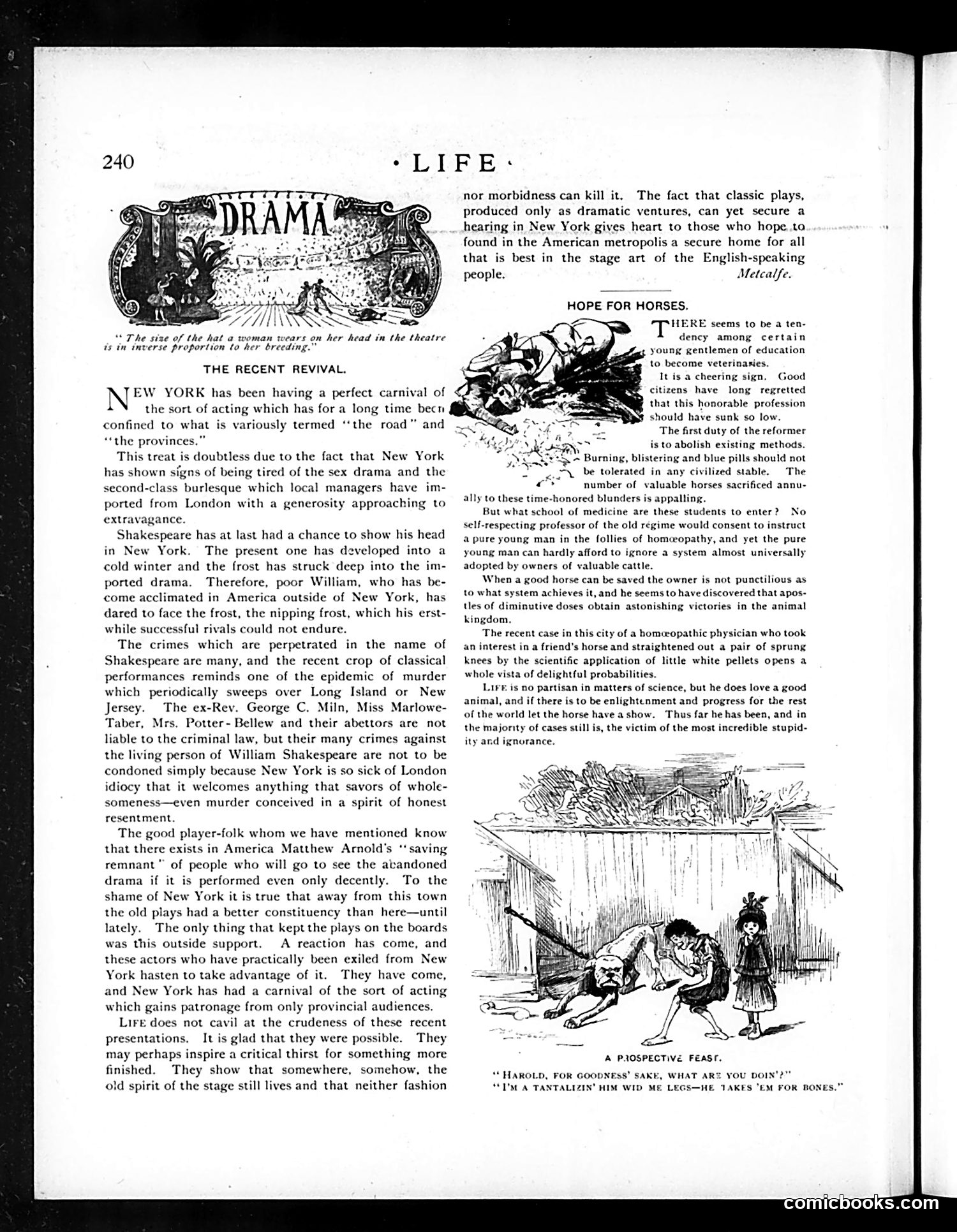
This page contains two distinct satirical pieces from Life magazine: **"The Recent Revival"** critiques New York theater's embrace of second-rate Shakespeare productions. The author argues that while New York had tired of London imports and sex farces, the city's recent "carnival" of classical theater—performed by actors like Marlowe-Bellew and Potter-Bellew—represents crude, poorly executed Shakespeare rather than quality drama. Life paradoxically welcomes even these flawed productions as potentially inspiring better theatrical standards, while mocking New York's provincial taste that had previously exiled these classical actors from the city. **"Hope for Horses"** celebrates young educated men entering veterinary medicine, viewing it as reform. The piece attacks existing brutal practices (burning, blistering, bloodletting) as murder of valuable animals, while humorously noting the irony that no respectable medical professor would teach the "homeopathy" methods universally used by horse owners—trapping students between outdated cruelty and unproven alternatives. The illustration shows a scene of prospective feasting on horses.
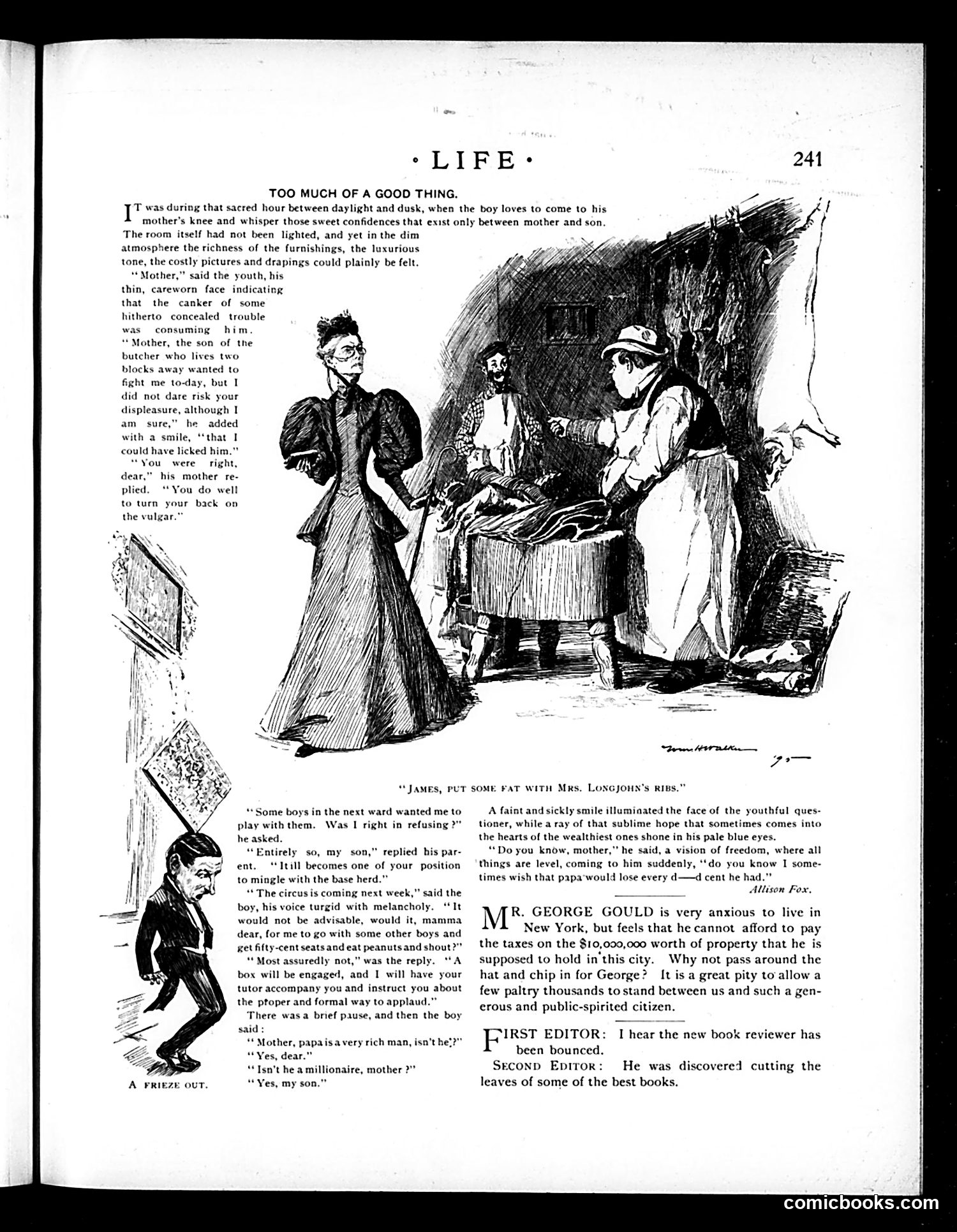
This page satirizes wealthy parents who over-protect their sons from normal childhood experiences. The main cartoon depicts a mother systematically forbidding her privileged boy from playing with working-class children, attending the circus casually, or any "vulgar" activity—enforcing rigid propriety instead. The joke's bitter punchline: the boy wishes his millionaire father would lose everything, so he could finally be *free* and equal to other children. The satire targets the hypocrisy of the ultra-wealthy: their obsessive class-consciousness and control actually impoverish their children's lives emotionally. A sidebar quip about "George Gould" (likely the real Gilded Age heir) adds irony—a multimillionaire claiming he can't *afford* to live in New York due to taxes, appealing for public charity. The satire attacks both parental snobbery and plutocratic entitlement simultaneously.
This page contains two humorous anecdotes rather than political cartoons. **First story**: Judge Gary presides over a case where an attorney complains about a stolen overcoat. The Judge dismisses it as trivial, quipping that "whole suits are lost here every day"—a satirical jab at the prevalence of theft in courtrooms, suggesting judicial corruption or incompetence was so common it was unremarkable. **Second story**: Frontier bystanders shoot at a beer bottle fifty times without hitting it. A Native American emerges from bushes, apparently injured by stray bullets meant for the bottle. The humor relies on period stereotypes: the settlers' poor marksmanship, casual violence, and the twist that their recklessness harmed an actual person—satirizing frontier lawlessness and indifference to human life. Both anecdotes mock institutional failure (legal system) and frontier brutality through ironic understatement typical of *Life* magazine's satirical style.
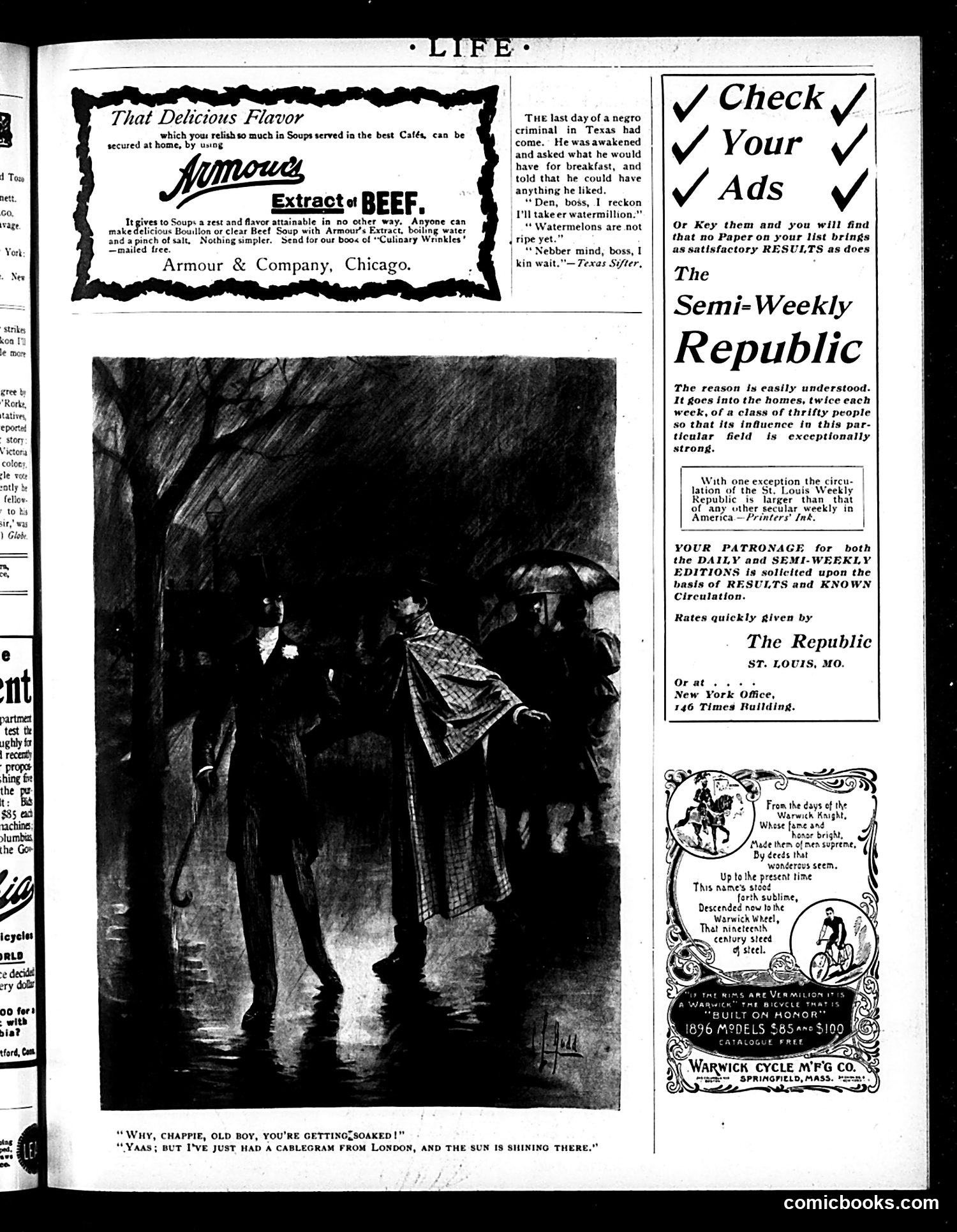
This page combines advertising with a racist "joke" typical of the era. The main cartoon depicts two men in rain with umbrellas—one appearing to be wealthy/upper-class, the other his servant. The caption plays on ironic contrast: the wealthy man complains about rain while the servant notes he just received a cable from London where "the sun is shining there," highlighting the absurdity of the servant's naive optimism despite their circumstances. The accompanying "Texas Sifter" anecdote is a deeply racist joke about a Black man awaiting execution, stereotyping him through dialect and the watermelon trope—a dehumanizing caricature common in this period. The page is primarily **advertising**—for Armour's beef extract, the St. Louis *Republic* newspaper, and Warwick bicycles—with these "humorous" items filling space between ads. The content reflects early 20th-century casual racism embedded in American commercial entertainment.
This page contains **anecdotal political humor** rather than visual cartoons. It presents three stories attributed to historical figures (Lincoln, Stevenson, and an unnamed judge) that satirize American political culture. The Lincoln story uses a buried-treasure parable to mock litigation—suggesting frivolous lawsuits distract from actual goals, much like a dwarf's interruption ruins treasure-hunting. The Stevenson story mocks **Joe Blackburn**, a Kentucky politician, by depicting him as so garrulous and self-promotional that even a condemned man about to be executed would surrender his final words to Blackburn's campaign speech. It's satire of politicians' inability to stop talking about themselves. The third (partial) story critiques jury duty avoidance in upstate New York courts. The page's **advertisements** (stockings, malt extract, patent medicines) are typical period filler. This represents Life magazine's format: mixing satirical text with advertising and commercial content—reflecting 19th-century magazine business models.
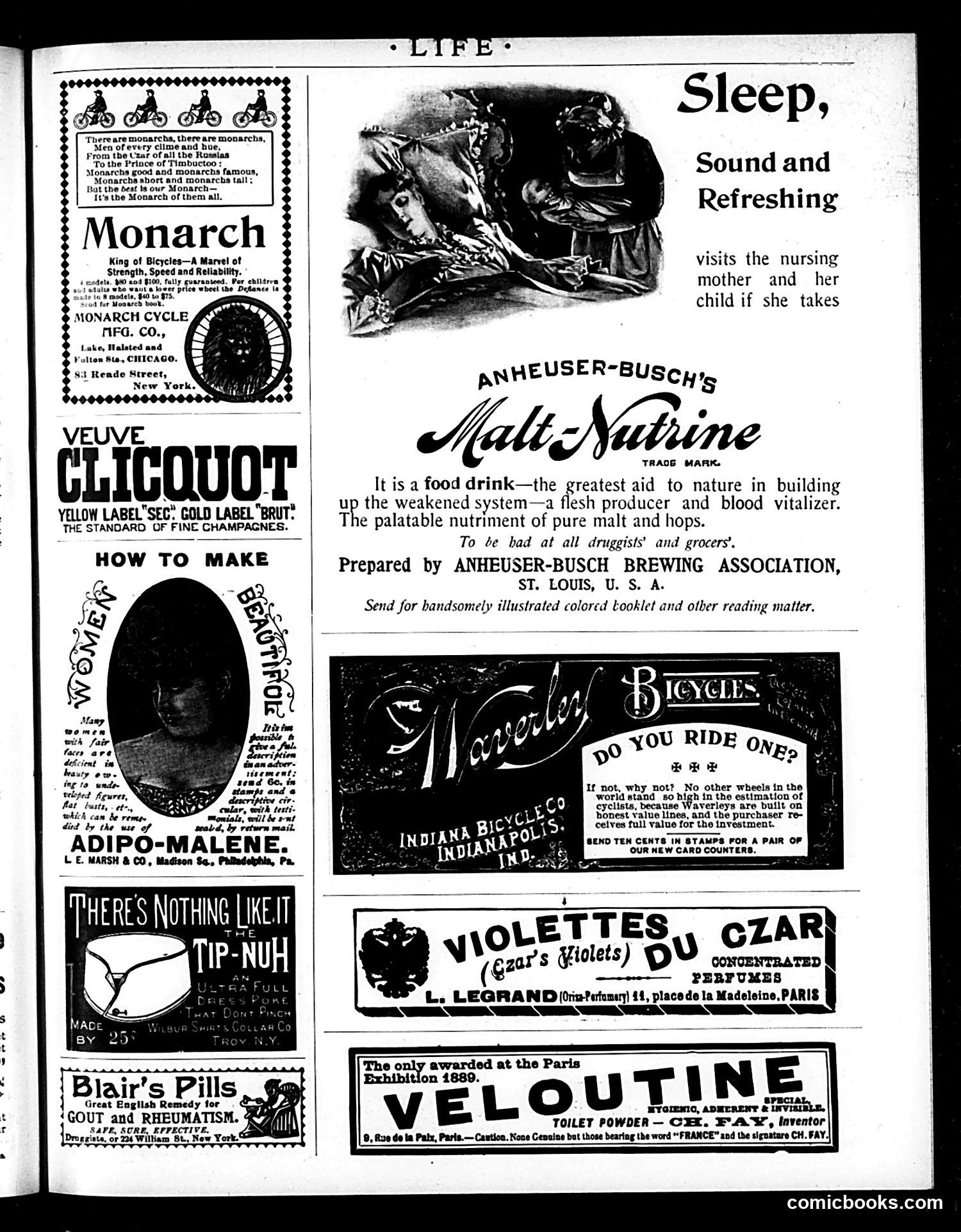
This is primarily an **advertising page**, not a satirical cartoon page. It contains multiple product advertisements typical of early 20th-century American magazines. The ads promote: - **Monarch bicycles** ("King of Bicycles") - **Anheuser-Busch's Malt-Nutrine** — marketed as a nutritional drink for nursing mothers and the sick, claiming to build up "weakened systems" - **Waverly bicycles** - **Various patent medicines and beauty products** (Adipo-Malene for weight loss, Veloute powder, Violettes du Czar perfume) - **Tip-Nuh** (appears to be a corset product) The modern reader should note: These ads reflect period attitudes where alcohol-based beverages and dubious patent medicines were openly marketed with unverified health claims. The ads targeting nursing mothers with malt beverages and weight-loss products to women are particularly striking from today's perspective. This is **not satire** — it's genuine commercial advertising reflecting early-1900s marketing practices and consumer culture.
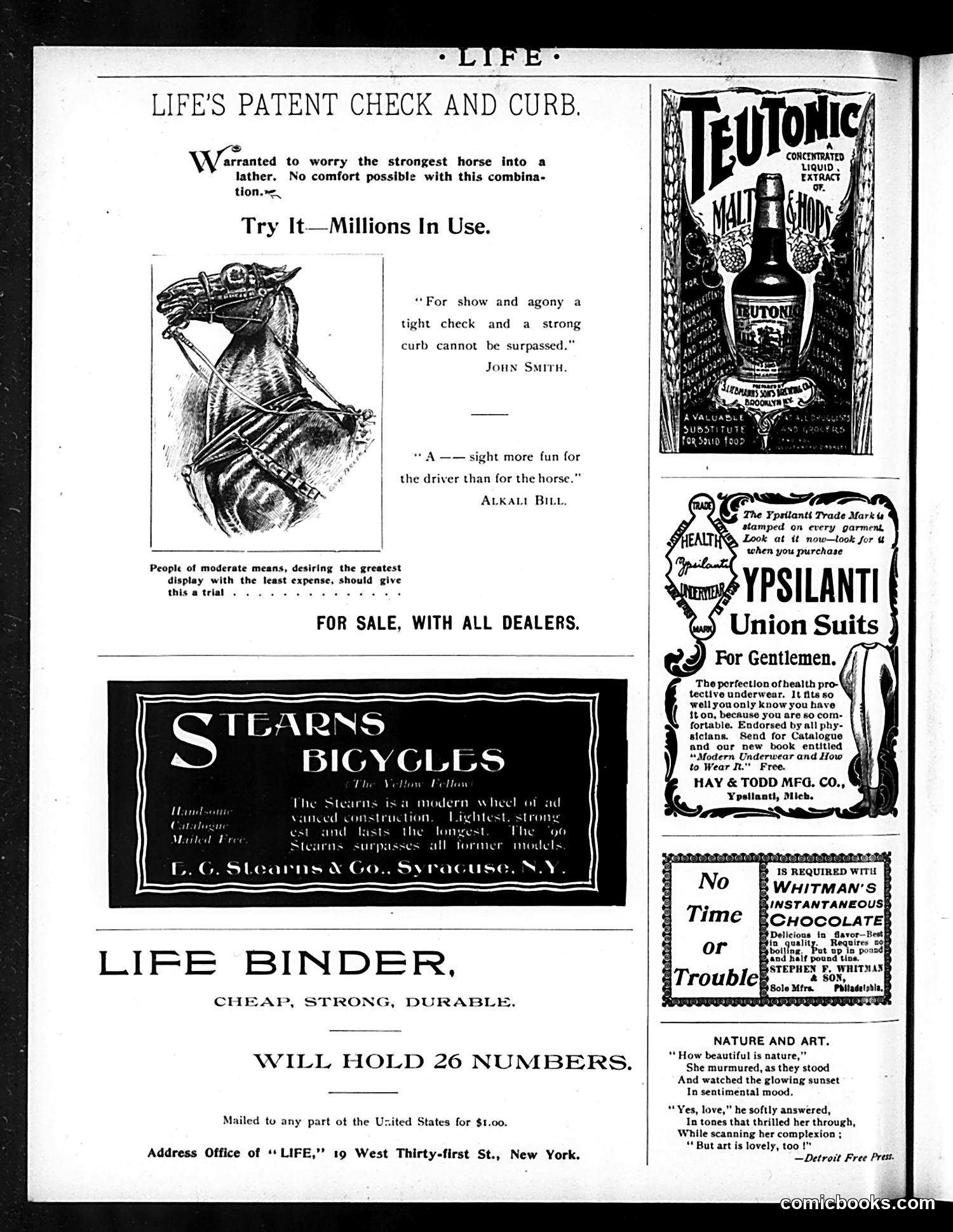
This page is primarily **advertising**, not political commentary. The main feature is "Life's Patent Check and Curb"—a horse-training device shown with a detailed anatomical drawing. The satire is gentle: Life magazine presents this as a solution for controlling strong horses, using mock testimonials ("Millions In Use") that openly acknowledge the device causes "agony" and "worry." The humor lies in the frank admission that this restraint causes suffering while being marketed as desirable. The page includes various period advertisements (bicycles, underwear, chocolate, magazine binders) typical of early 1900s Life magazine. At bottom, a brief poem titled "Nature and Art" offers light social satire: a romantic couple watches a sunset, but the man is actually scrutinizing his companion's complexion—suggesting male attention to female appearance masquerades as romantic sentiment. This reflects turn-of-the-century attitudes about courtship and vanity.
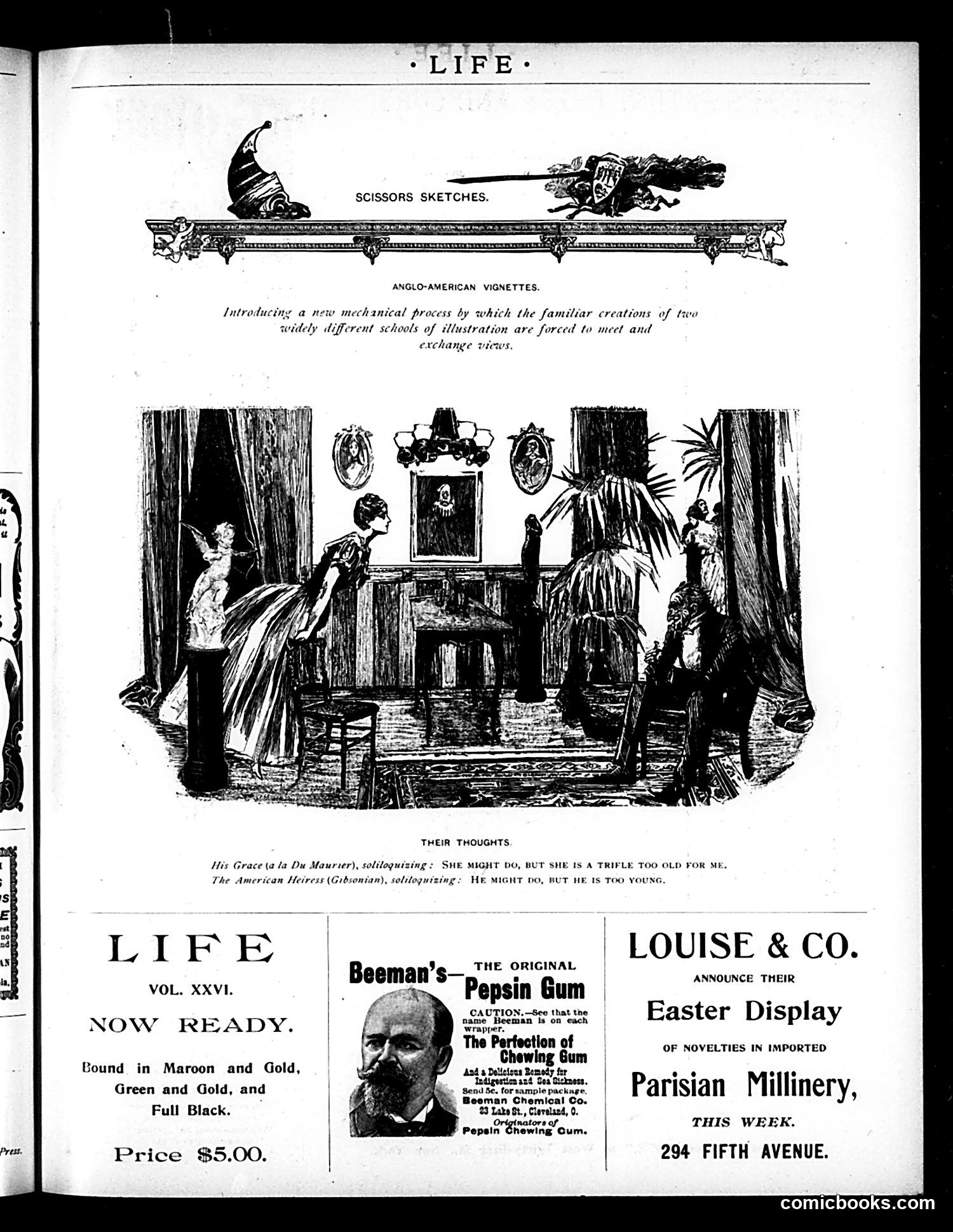
This page satirizes the cultural divide between British and American high society through a "mechanical process" juxtaposing two illustration styles: du Maurier's refined British aesthetic and the "Gibsonian" (Gibson Girl) American style. The cartoon depicts a drawing-room scene where a British aristocrat ("His Grace") and an American heiress eye each other with mutual interest yet mutual rejection—he finds her too old, she finds him too young. The satire targets transatlantic courtship aspirations: wealthy American heiresses famously sought titled British husbands for social elevation, while British nobility sometimes viewed American women as nouveau riche outsiders. The vignette mocks both sides' snobbish standards and the incompatibility of their expectations, despite their shared interest in marrying across the Atlantic. The remainder of the page consists of period advertisements (Beeman's Pepsin Gum, Louise & Co. millinery) unrelated to the satire.
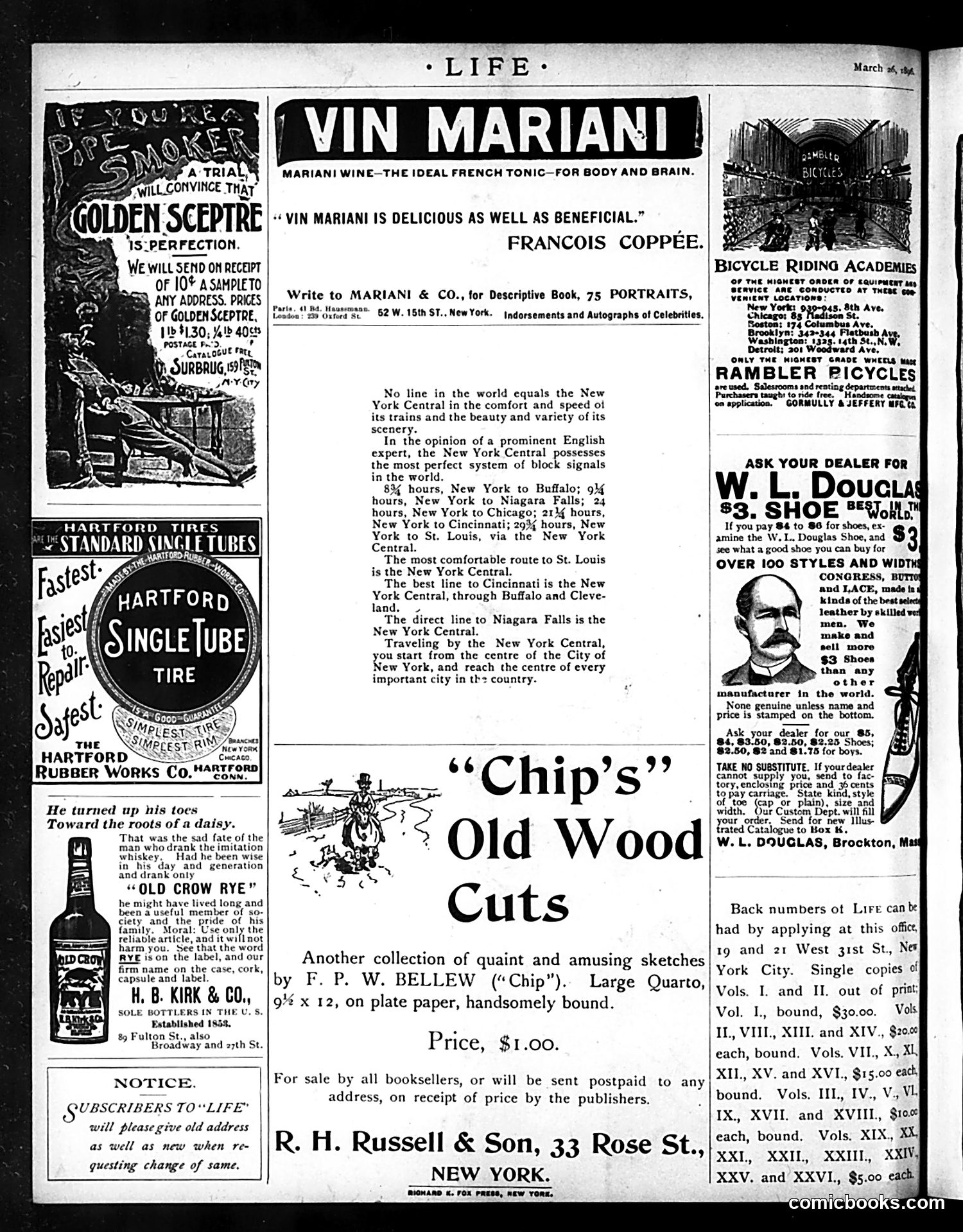
This page is primarily **advertisements** interspersed with minimal editorial content. The notable satirical element is the small cartoon accompanying the "Old Crow Rye" whiskey ad: a dead man lying prone, having "turned up his toes toward the roots of a daisy." The moral warns against drinking counterfeit whiskey—the implicit message being that imitation liquor kills, while the genuine "Old Crow" brand ensures survival and respectability. The other advertisements are earnest product pitches: Vin Mariani (a French wine tonic endorsed by celebrity testimonials), Hartford bicycle tires, Rambler bicycles, W.L. Douglas shoes, and the New York Central Railroad. These ads reflect 1890s consumer culture and emerging transportation/leisure industries. The page includes a notice about back issues of *Life* magazine itself available for purchase. There is minimal actual satire or political commentary—this is primarily a commercial advertising page with one minor cautionary joke about product authenticity.