
Life, 1896-03-26 · page 4 of 20
Life — March 26, 1896 — page 4: what you’re looking at
What you’re looking at
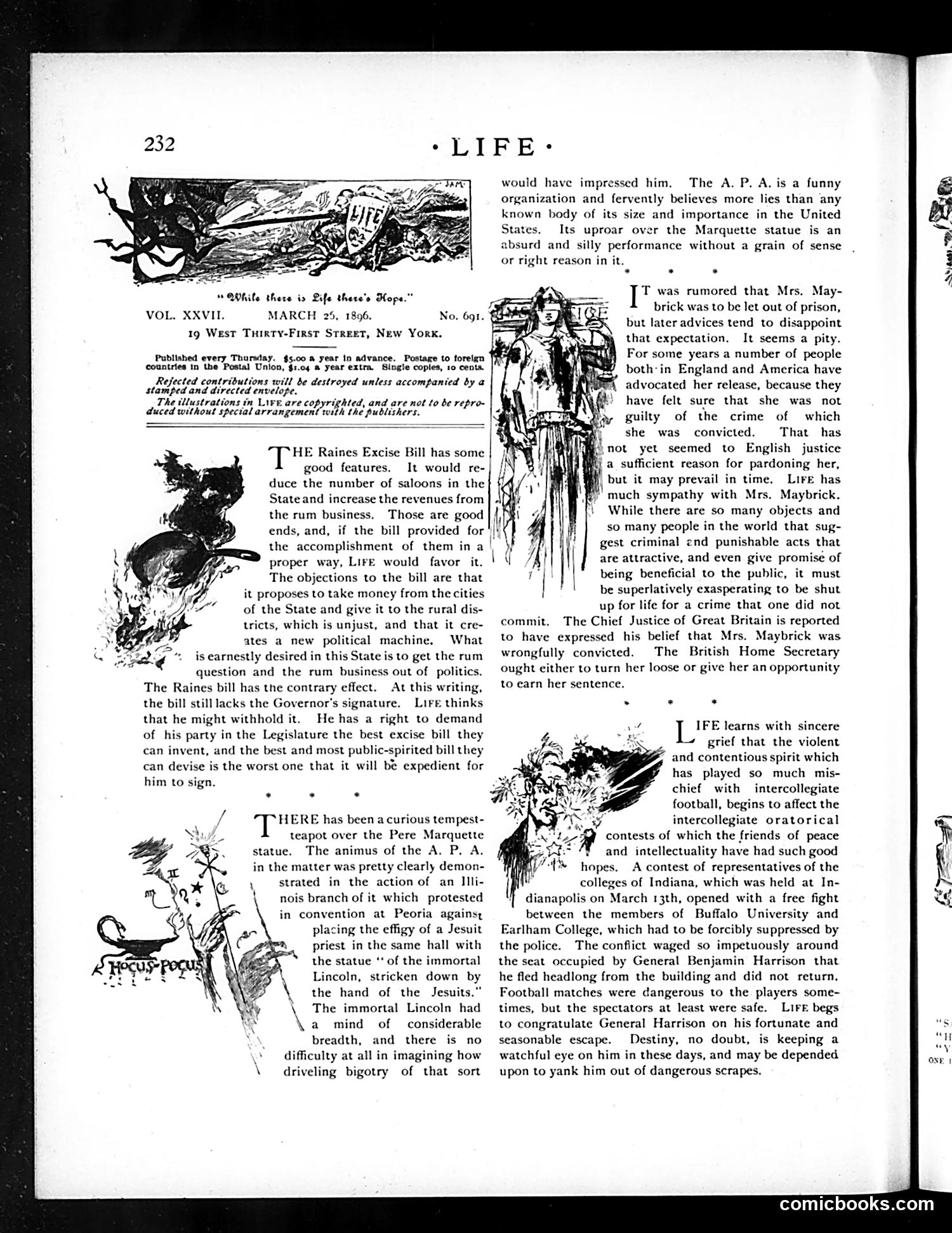
This page contains editorial commentary on three distinct topics: 1. **The Raines Excise Bill**: A satirical discussion of New York State legislation to regulate saloons and reduce rum sales. Life criticizes the bill's mechanism—taxing cities to fund rural districts—as unjust political maneuvering, and advocates the Governor's veto. 2. **The Marquette Statue Controversy**: Life mocks the A.P.A. (American Protective Association, a nativist anti-Catholic organization) for protesting a Jesuit priest statue in Illinois, calling their response absurd and demonstrating their general unreliability. 3. **Mrs. Maybrick's Case**: Life expresses sympathy for a woman imprisoned in Britain, hoping for her pardon despite controversy surrounding her conviction. The illustrations are decorative period cartoons accompanying these editorial positions.
📄 Transcribed text from this page (OCR, searchable)
Machine-transcribed from the original scan — historical spelling and the odd misread are preserved.
“LIFE: “OMhile there is Life there's Hope.” VOL. XXVII. MARCH 29, 1896. 19 West Tuirty-First Street, New York. Published every Thursd: $5.00 @ year In advance. Postage to foreign countries in the Postal U1 04 ® year extra, Single coples, 10 cents. Rejected contributions will be destroyed unless accompanied by a stamped and directed envelope. The illustrations in Live are copyrighted, and are not to be repro- duced without special arrangement with the publishers. HE Raines Excise Bill has some good features. It would re- duce the number of saloons in the State and increase the revenues from the rum business. Those are good ends, and, if the bill provided for the accomplishment of them in a proper way, Lire would favor it. The objections to the bill are that it proposes to take money from the cities of the State and give it to the rural d tricts, which is unjust, and that it cre- ates a new political machine, What is earnestly desired in this State is to get the ram question and the rum business out of p The Raines bill has the contrary effect. At this writing, the bill still lacks the Governor's signature. Lire thinks that he might withhold it. He has a right to demand of his party in the Legislature the best excise bill they can invent, and the best and most public-spirited bill they can devise is the worst one that it will be expedient for him to sign. . . . HERE has been a curious tempest- teapot over the Pere Marquette statue. The animus of the A. P. A. in the matter was pretty clearly demon- strated in the action of an Illi- nois branch of it which protested in convention at Peoria agains, placing the effigy of a Jesuit priest in the same hall with the statue ‘‘ of the immortal Lincoln, stricken down by the hand of the Jesuits.” The immortal Lincoln had \ a mind of considerable breadth, and there is no difficulty at all in imagining how driveling bigotry of that sort would have impressed him. The A. P. A. is a funny organization and fervently believes more lies than any known body of its size and importance in the United Its uproar over the Marquette statue is an ly performance without a grain of sense nin it. . . . T was rumored that Mrs. May- brick was to be let out of prison, but later advices tend to disappoint that expectation. It seems a pity. For some years a number of people both-in England and America have advocated her release, because they have felt sure that she was not guilty of the crime of which 4; she was convicted. That has A;not yet seemed to English justice a sufficient reason for pardoning her, | but it may prevail in time. Lire has much sympathy with Mrs. Maybrick. While there are so many objects and so many people in the world that sug- gest criminal 2nd punishable acts that are attractive, and even give promise of being beneficial to the public, it must be superlatively exasperating to be shut up for life for a crime that one did not commit. The Chief Justice of Great Britain is reported to have expressed his belief that Mrs. Maybrick was wrongfully convicted. The British Home Secretary ought either to turn her loose or give her an opportunity to carn her sentence. . IFE learns with sincere grief that the violent and contentious spirit which has played so much mis- chief with intercollegiate football, begins to affect the intercollegiate oratorical contests of which the friends of peace * and intellectuality have had such good hopes. A contest of representatives of the colleges of Indiana, which was held at In- dianapolis on March 13th, opened with a free fight between the members of Buffalo University and Earlham College, which had to be forcibly suppressed by the police. The confiict waged so impetuously around the seat occupied by General Benjamin Harrison that he fled headlong from the building and did not return, Football matches were dangerous to the players some- times, but the spectators at least were safe. LIFE begs to congratulate General Harrison on his fortunate and seasonable escape. Destiny, no doubt, is keeping a watchful eye on him in these days, and may be depended upon to yank him out of dangerous scrapes. nf SRig i “ny wy ONE | comicbooks.com