
Life, 1896-03-26 · page 8 of 20
Life — March 26, 1896 — page 8: what you’re looking at
What you’re looking at
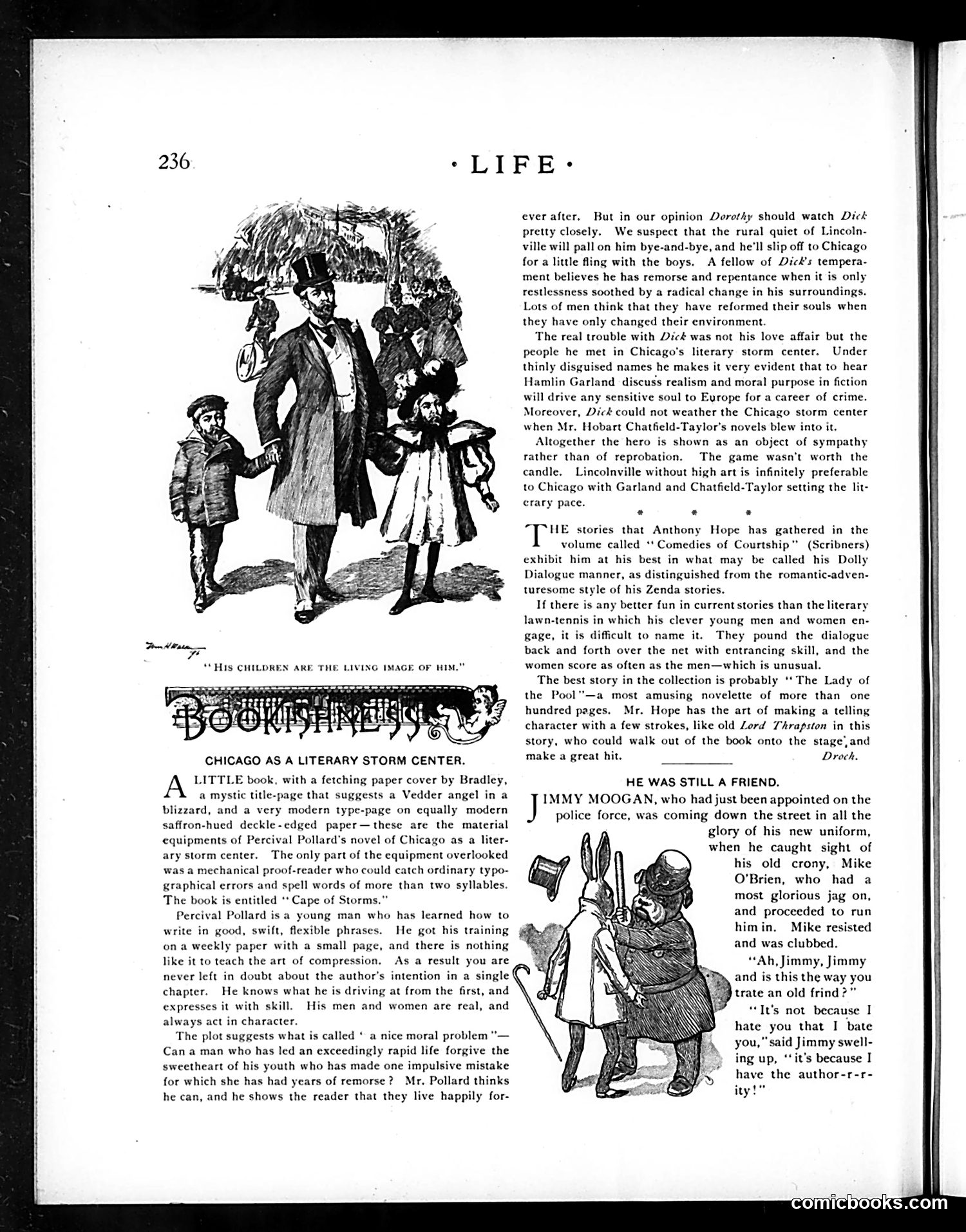
This page from *Life* magazine contains literary book reviews rather than political cartoons. The main illustration shows a Victorian-era street scene with well-dressed adults and children, captioned "His Children Are the Living Image of Him." The reviews discuss three works: 1. **"Cape of Storms"** by Percival Pollard—criticized for moral ambiguity about whether a man can forgive youthful indiscretions 2. **"Comedies of Courtship"** by Anthony Hope—praised for witty dialogue and amusing character interactions 3. An unnamed story featuring "Jimmy Moogan," a newly appointed police officer encountering an old crow named Mike O'Brien The page satirizes contemporary Chicago literary circles and debates about morality in fiction, but contains no identifiable political figures or caricatures—it's primarily book criticism with illustrative sketches.
📄 Transcribed text from this page (OCR, searchable)
Machine-transcribed from the original scan — historical spelling and the odd misread are preserved.
LIFE CHICAGO AS A LITERARY STORM CENTER. LITTLE book, with a fetching paper cover by Bradley, a mystic title-page that suggests a Vedder angel in a blizzard, and a very modern type-page on equally modern saffron-hued deckle-edged paper—these are the material equipments of Percival Pollard's novel of Chicago as a liter- ary storm center. The only part of the equipment overlooked as a mechanical proof-reader who could catch ordinary typo- graphical errors and spell words of more than two syllables. The book is entitled ** Cape of Storms.” Percival Pollard is a young man who has learned how to write in good, swift, flexible phrases. He got his training ona weekly paper with a small page, and there is nothing like it to h the art of compression, As a result you are never left in doubt about the author's intention in a single chapter. He knows what he is driving at from the first, and presses it with skill. His men and women are real, and s act in character. The plot suggests what is called * a nice moral problem "— Can a man who has led an exceedingly rapid life forgive the sweetheart of his youth who has made one impulsive mistake for which she has had years of remorse? Mr, Pollard thinks he can, and he shows the reader that they live happily for- ever after. But in our opinion Dorothy should watch Dick pretty closely. We suspect that the rural quiet of Lincoln- ville will pall on him bye-and-bye, and he'll slip off to Chicago for a little fling with the boys. A fellow of Dick's tempera- ment believes he has remorse and repentance when it is only restlessness soothed by a radical change in his surrounding Lots of men think that they have reformed their souls when they have only changed their environment. The real trouble with Dick was not his love affair but the people he met in Chicago's literary storm center. Under thinly disguised names he makes it very evident that to hear Hamlin Garland discuss realism and moral purpose in fiction will drive any sensitive soul to Eyrope for a career of crime. Moreover, Dick could not weather the Chicago storm center when Mr. Hobart Chatfield-Taylor’s novels blew into it. Altogether the hero is shown as an object of sympathy rather than of reprobation. The game wasn't worth the candle. Lincolnville without high art is infinitely preferable to Chicago with Garland and Chatfield-Taylor setting the lit- crary pace. * * . HE stories that Anthony Hope has gathered in the volume called ** Comedies of Courtship" (Scribners) exhibit him at his best in what may be called his Dolly Dialogue manner, as distinguished from the romantic-adven- turesome style of his Zenda stories. If there is any better fun in current stories than the literary lawn-tennis in which his clever young men and women en- gage, it is difficult to name it. They pound the dialogue back and forth over the net with entrancing skill, and the women score as often as the men—which is unusual. The best story in the collection is probably ‘The Lady of the Pool”—a most amusing novelette of more than one hundred pages. Mr. Hope has the art of making a telling character with a few strokes, like old Lord Thrapston in this story, who could walk out of the book onto the stageand make a great hit, Droch. HE WAS STILL A FRIEND. IMMY MOOGAN, who had just been appointed on the police force, was coming down the street in all the glory of his new uniform, when he caught sight of his old crony, Mike O'Brien, who had a most glorious jag on, and proceeded to run himin., Mike resisted and was clubbed. “Ah, Jimmy, Jimmy and is this the way you trate an old frind?" “It's not because I hate you that I bate you,” said Jimmy swell- ing up, ‘it’s because I have the author-r-r- ity!