
Life, 1896-03-26 · page 3 of 20
Life — March 26, 1896 — page 3: what you’re looking at
What you’re looking at
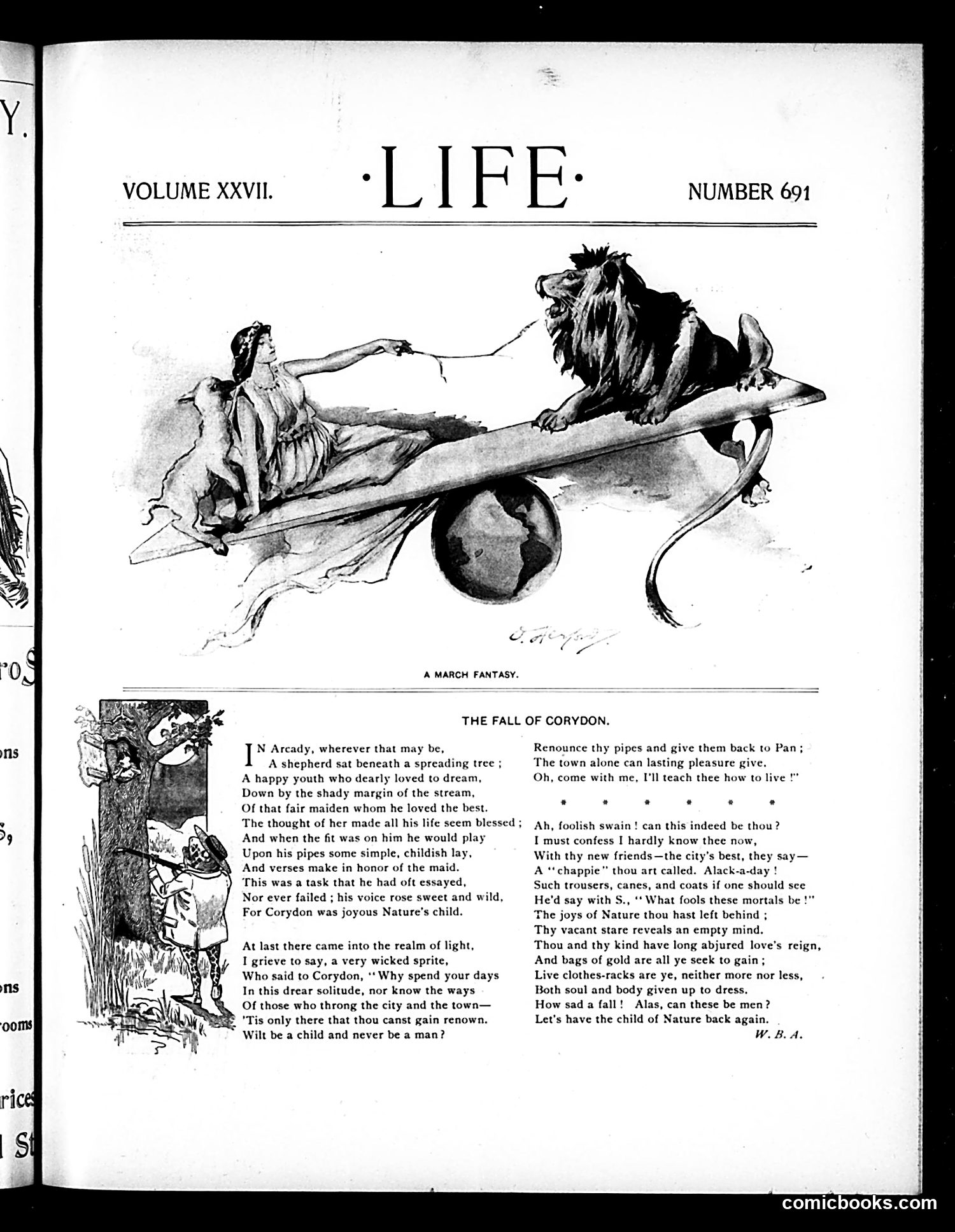
The top illustration depicts a woman and a lion on a seesaw balanced on a globe, titled "A March Fantasy." This appears to be whimsical rather than directly political satire. The accompanying poem, "The Fall of Cordon," concerns a shepherd character who abandons pastoral simplicity for city life and material wealth, ultimately losing his moral virtue. The poem's moral message—delivered by Pan himself—warns against urban corruption and greed, advocating a return to natural, childlike innocence. The left-side illustration shows classical/mythological figures reinforcing this pastoral theme. The satire targets late 19th/early 20th-century urbanization and materialism, using traditional moral fables to critique contemporary society's departure from simpler values.
📄 Transcribed text from this page (OCR, searchable)
Machine-transcribed from the original scan — historical spelling and the odd misread are preserved.
VOLUME XXVII. NUMBER 691 A MARCH FANTASY. THE FALL J N Arcady, wherever that may be, A shepherd sat beneath a spreading tree ; A happy youth who dearly loved to dream, Down by the shady margin of the stream, Of that fair maiden whom he loved the be: The thought of her made all his life seem blessed ; And when the fit was on him he would play Upon his pipes some simple, childish lay, And verses make in honor of the maid. This was a task that he had oft essayed, Nor ever failed ; his voice rose sweet and wild, For Corydon was joyous Nature's child. At last there came into the realm of light, I grieve to say, a very wicked sprite, Who said to Corydon, ‘* Why spend your days In this drear solitude, nor know the ways Of those who throng the city and the town— ‘Tis only there that thou canst gain renown. Wilt be a child and never be a man? OF CORYDON. Renounce thy pipes and give them back to Pan; ‘The town alone can lasting pleasure give. Oh, come with me, I'll teach thee how to live !” * * * * © ° Ah, foolish swain ! can this indeed be thou? I must confess I hardly know thee now, With thy new friends —the city’s best, they say— A ‘‘chappie” thou art called. Alack-a-day ! Such trousers, canes, and coats if one should see He'd say with S., ‘* What fools these mortals be !" The joys of Nature thou hast left behind ; Thy vacant stare reveals an empty mind. Thou and thy kind have long abjured love's reign, And bags of gold are all ye seek to gain; Live clothes-racks are ye, neither more nor less, Both soul and body given up to dress. How sad a fall! Alas, can these be men? Let’s have the child of Nature back again. W.B.A, comicbooks.com