
Life, 1896-03-26 · page 12 of 20
Life — March 26, 1896 — page 12: what you’re looking at
What you’re looking at
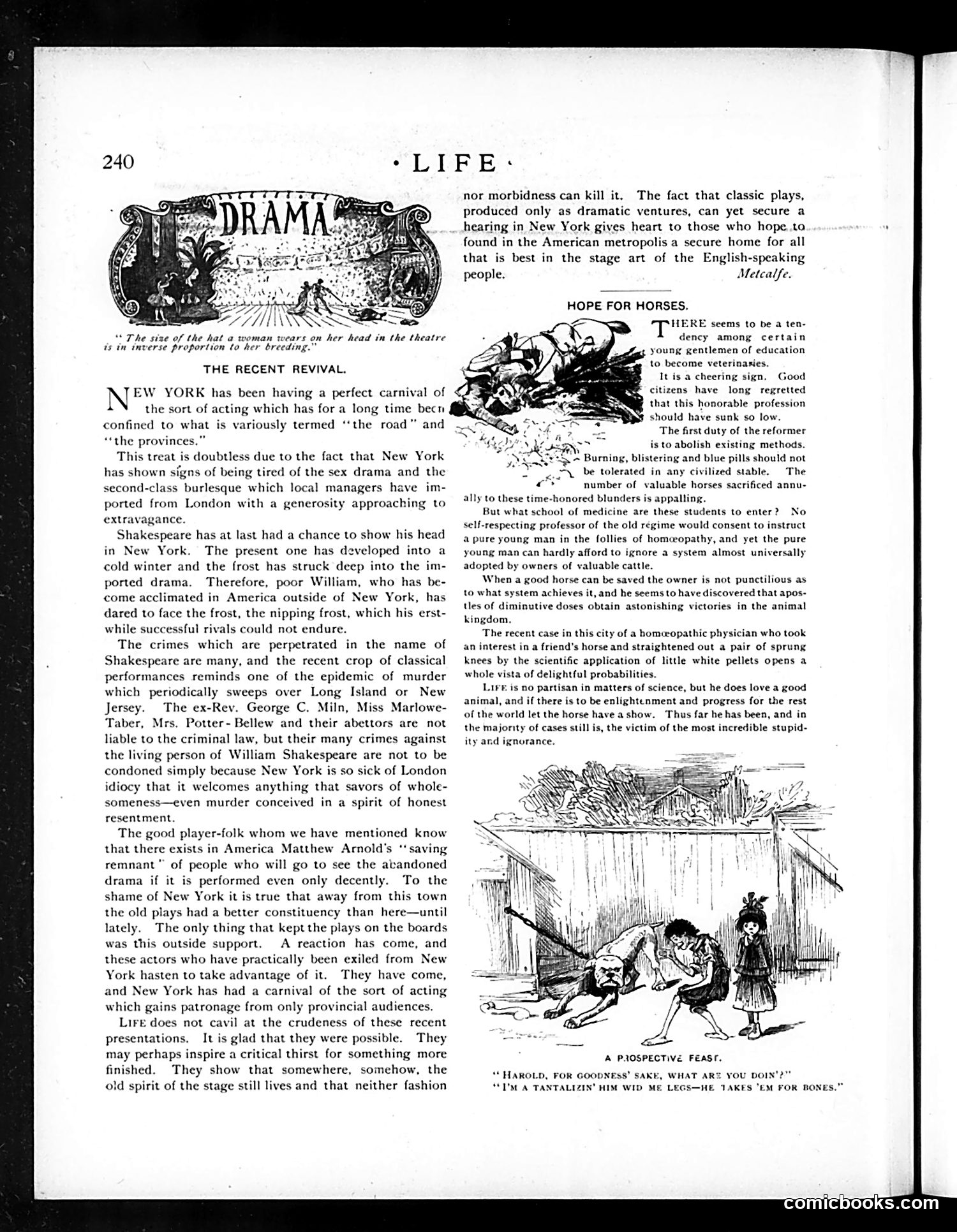
This page contains two distinct satirical pieces from Life magazine: **"The Recent Revival"** critiques New York theater's embrace of second-rate Shakespeare productions. The author argues that while New York had tired of London imports and sex farces, the city's recent "carnival" of classical theater—performed by actors like Marlowe-Bellew and Potter-Bellew—represents crude, poorly executed Shakespeare rather than quality drama. Life paradoxically welcomes even these flawed productions as potentially inspiring better theatrical standards, while mocking New York's provincial taste that had previously exiled these classical actors from the city. **"Hope for Horses"** celebrates young educated men entering veterinary medicine, viewing it as reform. The piece attacks existing brutal practices (burning, blistering, bloodletting) as murder of valuable animals, while humorously noting the irony that no respectable medical professor would teach the "homeopathy" methods universally used by horse owners—trapping students between outdated cruelty and unproven alternatives. The illustration shows a scene of prospective feasting on horses.
📄 Transcribed text from this page (OCR, searchable)
Machine-transcribed from the original scan — historical spelling and the odd misread are preserved.
* LIFE: “ The size of the hat a woman wears on her head in the theatre ts in inverse proportion to her breeding.” THE RECENT REVIVAL. N EW YORK has been having a perfect carnival of the sort of acting which has for a long time becn confined to what is variously termed ‘‘the road” and “the provinces.” This treat is doubtless due to the fact that New York has shown signs of being tired of the sex drama and the second-class burlesque which local managers have im- ported from London with a generosity approaching to extravagance. Shakespeare has at last had a chance to show his head in New York. The present one has developed into a cold winter and the frost has struck deep into the im- ported drama. Therefore, poor William, who s be- come acclimated in America outside of New York, has dared to face the frost, the nipping frost, which his erst- while successful rivals could not endure. The crimes which are perpetrated in the name of Shakespeare are many, and the recent crop of classical performances reminds one of the epidemic of murder which periodically sweeps over Long Island or New The ex-Rev. George C. Miln, Miss Marlowe- Mrs. Potter- Bellew and their abettors are not liable to the criminal law, but their many crimes against the living person of William Shakespeare are not to be condoned simply because New York is so sick of London idiocy that it welcomes anything that savors of whole- someness—even murder conceived in a spirit of honest resentment. The good player-folk whom we have mentioned know that there exists in America Matthew Arnold's ‘saving remnant” of people who will go to see the avandoned drama if it is performed even only decently. To the shame of New York it is true that away from this town the old plays had a better constituency than here—until lately. The only thing that kept the plays on the boards was this outside support. A reaction has come, and these actors who have practically been exiled from New York hasten to take advantage of it. They have come, and New York has had a carnival of the sort of acting which gains patronage from only provincial audiences. Lire does not cavil at the crudeness of these recent presentations. It is glad that they were possible. They may perhaps inspire a critical thirst for something more finished. They show that somewhere, somehow, the old spirit of the stage still lives and that neither fashion nor morbidness can kill it. The fact that classic plays, produced only as dramatic ventures, can yet secure a hearing in New York gives heart to those who hope.to found in the American metropolis a secure home for all that is best in the stage art of the English-speaking Metcalfe HOPE FOR HORSES. HERE seems to be a ten- dency among certain young gentlemen of education to become veterinasies. It is a cheering sign. Good citizens have long regretted that this honorable profession should have sunk so low. The first duty of the reformer is to abolish existing methods. +> Burning, blistering and blue pills should not \ be tolerated in any civilized stable. The «** "number of valuable horses sacrificed annu- ally to these time-honored blunders is appalling. But what school of medicine are these students to enter? No self-respecting professor of the old régime would consent to instruct a pure young man in the follies of homaopathy, and yet the pure young man can hardly afford to ignore a system almost universally adopted by owners of valuable cattle. When a good horse can be saved the owner is not punctilious as to what system achieves it, and he seems to have discovered that apos- Ues of diminutive doses obtain astonishing victories in the animal kingdom, The recent case in this city of a homaopathic physician who took an interest in a friend’s horse and straightened out a pair of sprung knees by the scientific application of little white pellets opens a whole vista of delightful probabilities. Lire. is no partisan in matters of science, but he does love a good animal, and if there is to be enlightenment and progress for the rest of the world let the horse have a show. ‘Thus far he has been, and in the majority of cases still is, the victim of the most incredible stupid- ity and ignorance. s~ A PROSPECTIVE FEAST. “HAROLD, FOR GOODNESS’ SAKE, WHAT ARE YOU DOI “LMA TANTALIZIN' HIM WID ME LE HE TAKES ‘EM FOR BONES.” Comicbooks.com