
Life, 1896-03-26 · page 5 of 20
Life — March 26, 1896 — page 5: what you’re looking at
What you’re looking at
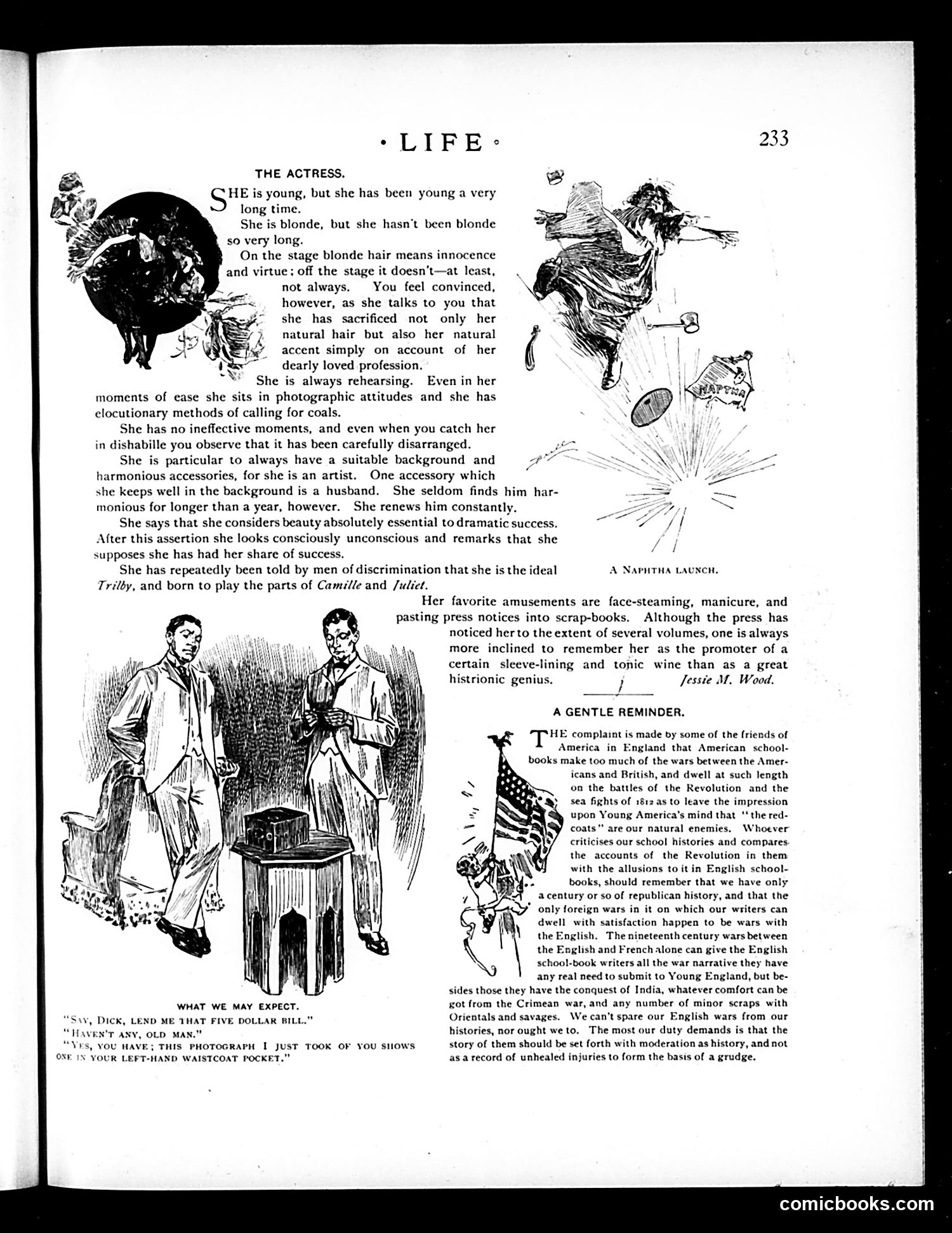
**"The Actress"** section contains a satirical portrait of an unnamed stage actress—likely a contemporary performer of the era. The text mocks theatrical conventions: her dyed blonde hair signifying false innocence, her constant self-presentation and "photographic attitudes," her reliance on a husband for background stability, and her frequent remarriages. The satire suggests actresses perform femininity offstage as much as on, existing in perpetual artifice. **"A Gentle Reminder"** addresses American school textbooks' treatment of Anglo-American conflict. The text objects to accounts emphasizing British-American wars (Revolution, 1812) and "red-coats" as enemies, arguing this creates bias against England. It advocates for balanced historical narrative over grievance-focused accounts. Both sections critique institutional dishonesty—theatrical and educational.
📄 Transcribed text from this page (OCR, searchable)
Machine-transcribed from the original scan — historical spelling and the odd misread are preserved.
*LIFE> THE ACTRESS, HE is young, but she has been young a very long time. She is blonde, but she hasn't been blonde so very long. On the stage blonde hair means innocence and virtue; off the stage it doesn’t—at least, not always. You feel convinced, however, as she talks to you that she has sacrificed not only her natural hair but also her natural accent simply on account of her dearly loved profession. She is always rehearsing. Even in her moments of ease she sits in photographic attitudes and she has elocutionary methods of calling for coals. She has no ineffective moments, and even when you catch her in dishabille you observe that it has been carefully disarranged. She is particular to always have a suitable background and harmonious accessories, for she is an artist. One accessory which she keeps well in the background is a husband. She seldom finds him har- monious for longer than a year, however. She renews him constantly. She says that she considers beauty absolutely essential to dramatic success. After this assertion she looks consciously unconscious and remarks that she supposes she has had her share of success. She has repeatedly been told by men of discrimination that she is the ideal A NAPHTHA LAUNCH. Triléy, and born to play the parts of Camille and /uliet. Her favorite amusements are face-steaming, manicure, and pasting press notices into scrap-books. Although the press has noticed her to the extent of several volumes, one is always Ay more inclined to remember her as the promoter of a ‘ certain sleeve-lining and tonic wine than as a great histrionic genius. } Jessie M, Wood. A GENTLE REMINDER. Tt complaint is made by some of the friends of America in England that American school- books make too much of the wars between the Amer- icans and British, and dwell at such length on the battles of the Revolution and the sea fights of 1812 as to leave the impression upon Young America’s mind that ‘‘ the red- coats" are our natural enemies, Whoever criticises our school histories and compares the accounts of the Revolution in them with the allusions to it in English school- books, should remember that we have only a century or so of republican history, and that the only foreign wars in it on which our writers can dwell with satisfaction happen to be wars with the English, The nineteenth century wars between the English and French alone can give the English school-book writers all the war narrative they have any real need to submit to Young England, but be- sides those they have the conquest of India, whatever comfort can be WHAT WE MAY EXPECT. got from the Crimean war, and any number of minor scraps with “Sity, Dick, LEND ARG HATUFIVE DOLUAR RELL” Orientals and savages. We can’t spare our English wars from our “WAVEN'T ANY, OLD MAN.” histories, nor ought we to. The most our duty demands is that the “Ves, YOU HAVE; THIS PHOTOGRAPH I JUST TOOK OF YoU slows story of them should be set forth with moderation as history, and not ONE IN YOUR LEFT-HAND WAISTCOAT POCKET.” as a record of unhealed injuries to form the basis of a grudge. comicbooks.com