
A complete issue · 20 pages · 1896
Life — January 30, 1896
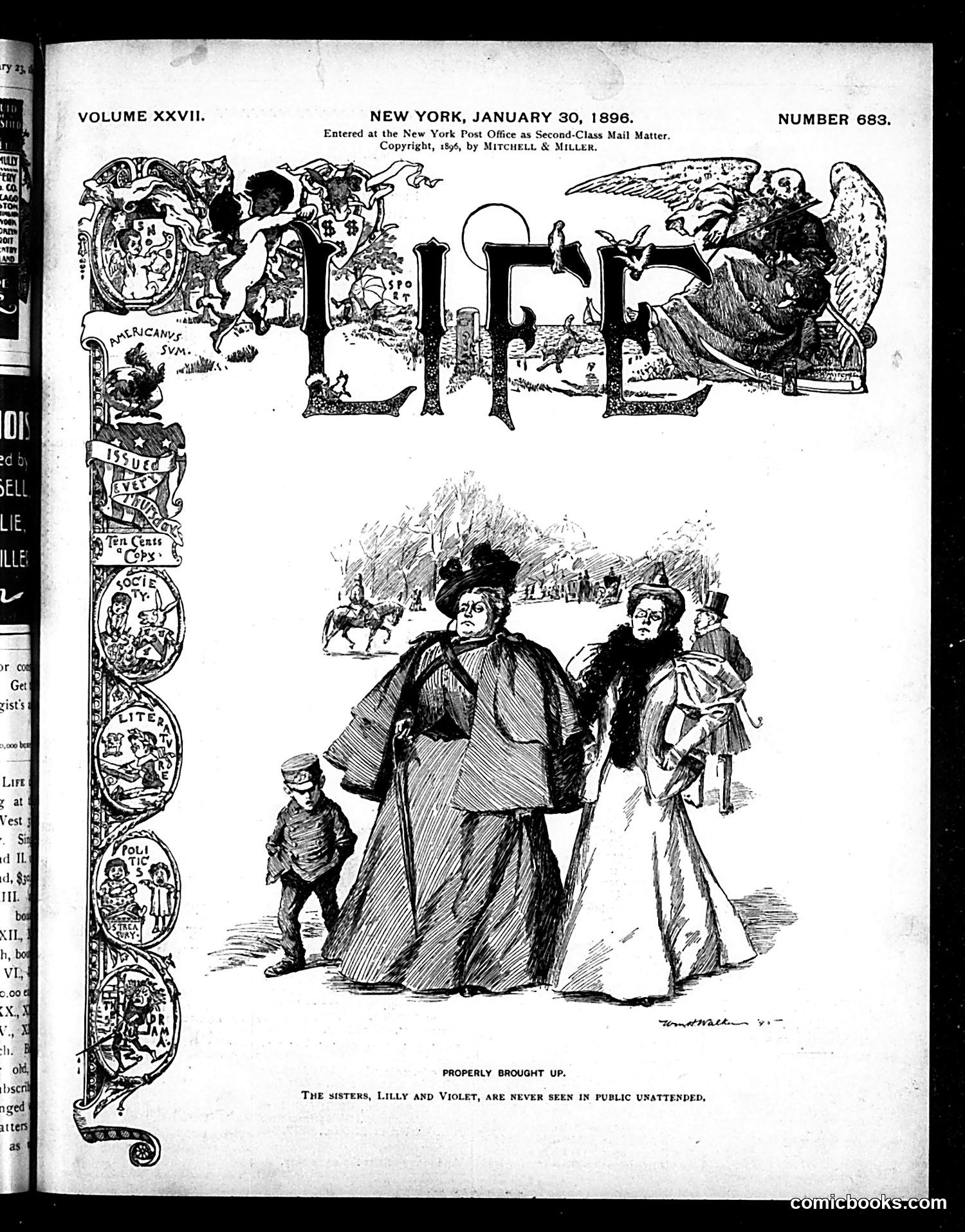
The main illustration, titled "Properly Brought Up," depicts two fashionably dressed women being escorted in public by a small boy and a uniformed officer. The caption states: "The sisters, Lilly and Violet, are never seen in public unattended." This is social satire mocking the Victorian era's strict rules governing women's public behavior and respectability. Unmarried women of the upper classes were required to have a chaperone when appearing in public—a practice considered essential to protecting their reputation. The humor lies in the absurdity of needing such constant supervision: even these adult women cannot venture out without male accompaniment and oversight. The ornate decorative border on the left appears typical of the magazine's design aesthetic.
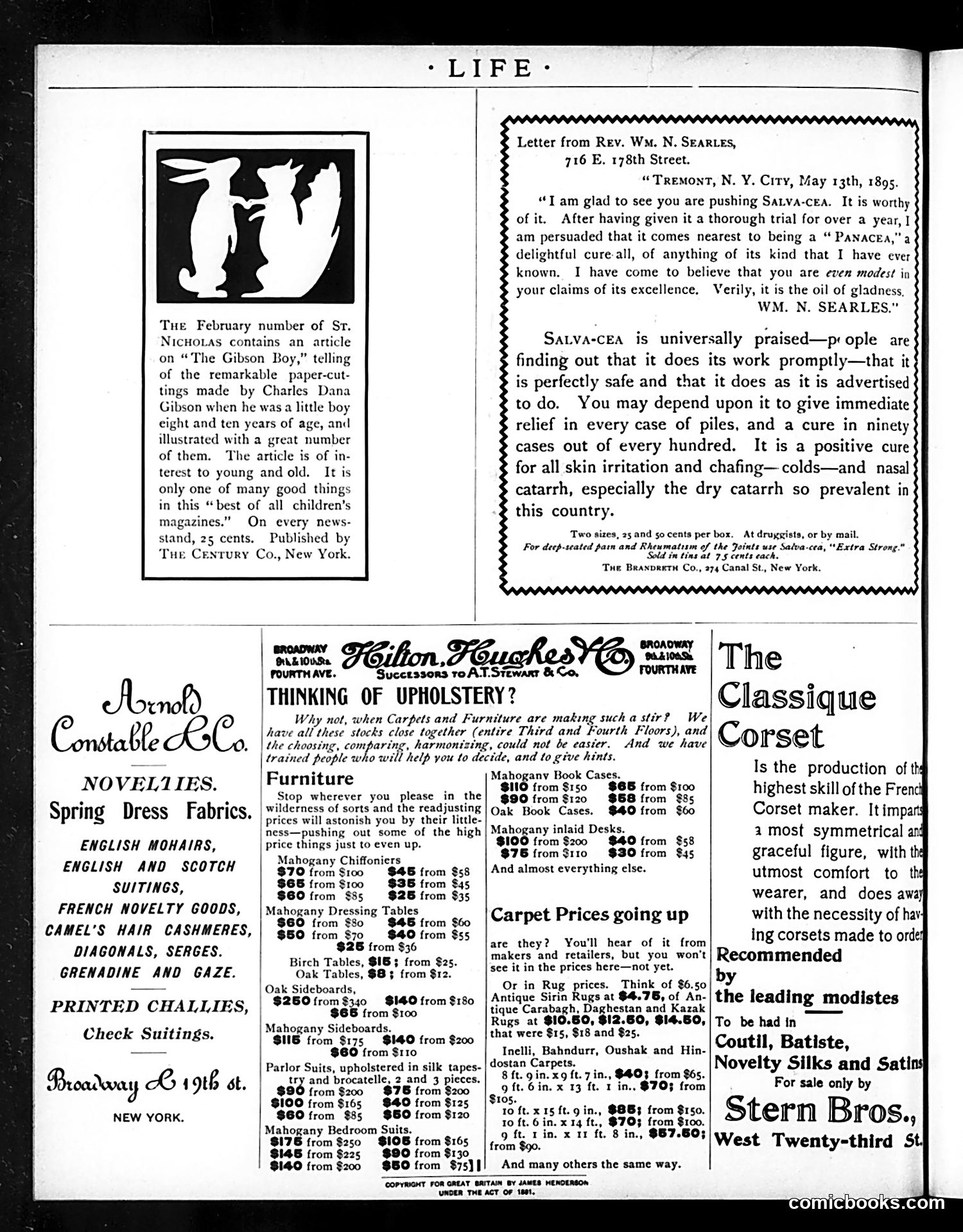
This page is primarily **advertising**, not satirical content. The left side features an ad for *St. Nicholas* magazine highlighting Charles Dana Gibson's paper-cutting artwork from his childhood. The right side promotes "Salva-cea," a patent medicine claimed to cure piles, skin irritation, catarrh, and nasal problems. Below are ads for Arnold Constable & Co. (fabrics and clothing), Holton, Houckes & Co. (furniture), The Classique Corset, and Stern Bros. (silks and satins). There is **no political cartoon** visible. The small silhouette illustration at top left merely decorates the *St. Nicholas* article—it's not satirical commentary. This is a commercial page typical of early 1895 *Life* magazine, mixing editorial content with period advertisements for goods and patent medicines.
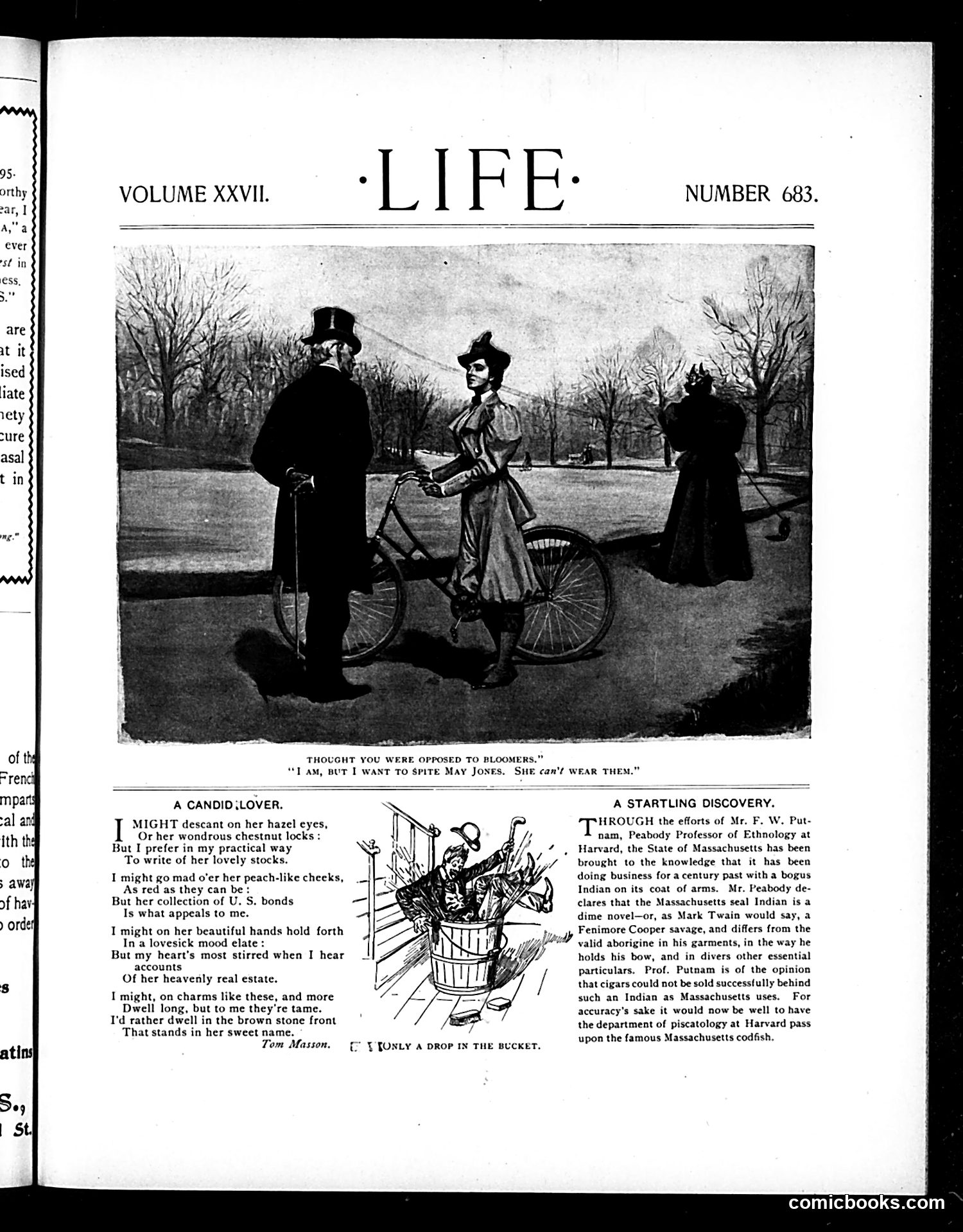
The main photograph shows three people with bicycles in a park, captioned "Thought you were opposed to bloomers. I am, but I want to spite May Jones. She can't wear them." This satirizes the "bloomer" controversy—a debate over women wearing practical split skirts (bloomers) for cycling instead of restrictive long skirts. The joke suggests a woman opposes bloomers on principle but would wear them out of spite against a rival (May Jones), revealing that fashion opinions are driven by social competition rather than genuine conviction. The accompanying poem "A Candid Lover" and illustration "Utterly a Drop in the Bucket" appear unrelated humorous content typical of Life's format—mixing social satire with whimsical verse and illustrations.
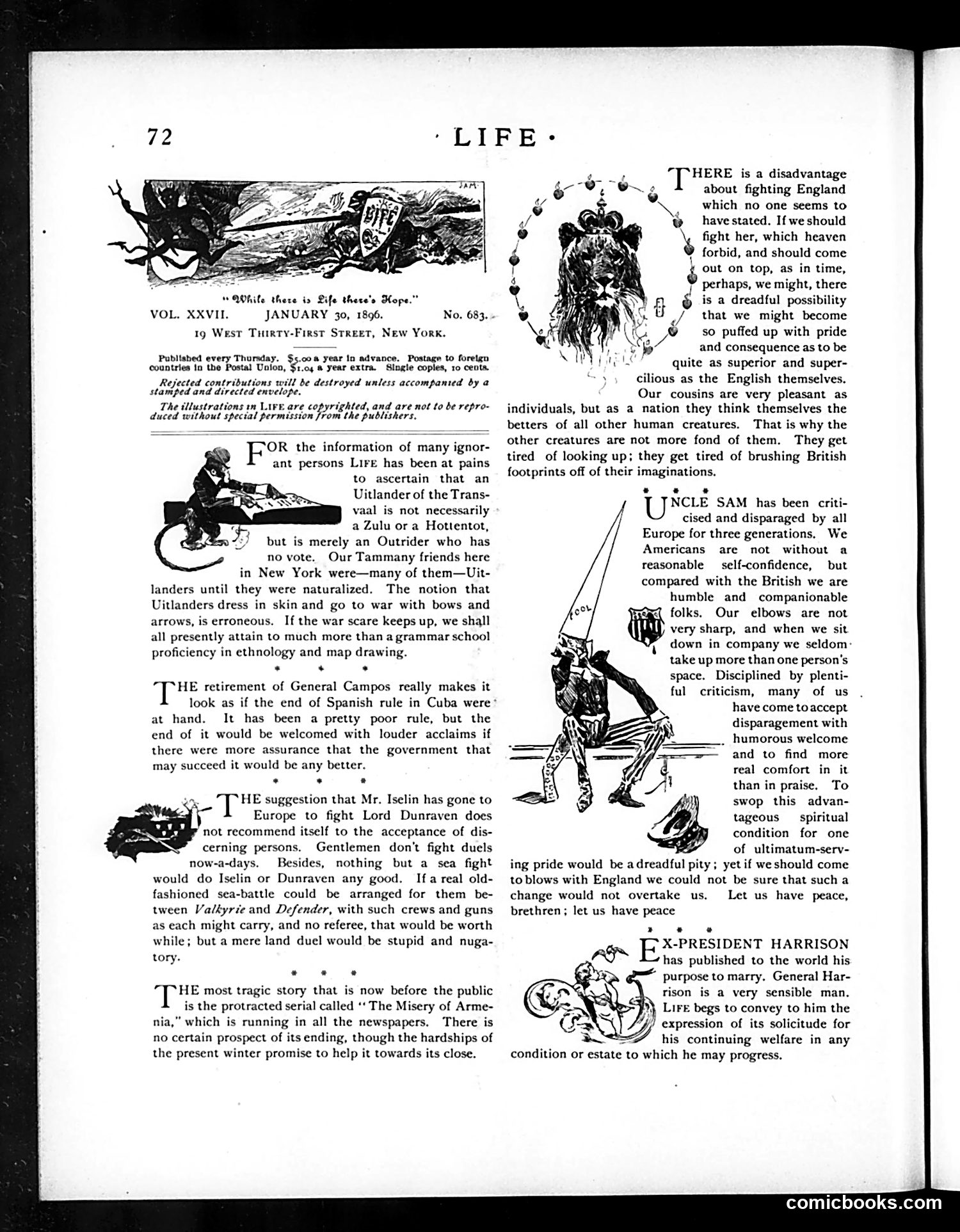
**Main Cartoons:** The page contains several political commentaries. One section discusses Uitlanders (foreign residents) in the Transvaal, South Africa, noting they lack voting rights—this likely references tensions preceding the Second Boer War. Another cartoon appears to criticize Mr. Iselin's suggestion of fighting Lord Dunraven, sarcastically dismissing dueling as outdated ("gentlemen don't fight duels now-a-days"). **Right Column Content:** The "Uncle Sam" section praises American humility compared to British superiority, suggesting Anglo-American tensions of the 1890s. **Bottom:** References "The Misery of Armenia," a serial about Armenian suffering—likely the 1894-1896 Ottoman massacres that shocked Western publics. The page is primarily editorial commentary on contemporary geopolitical crises rather than humorous satire.
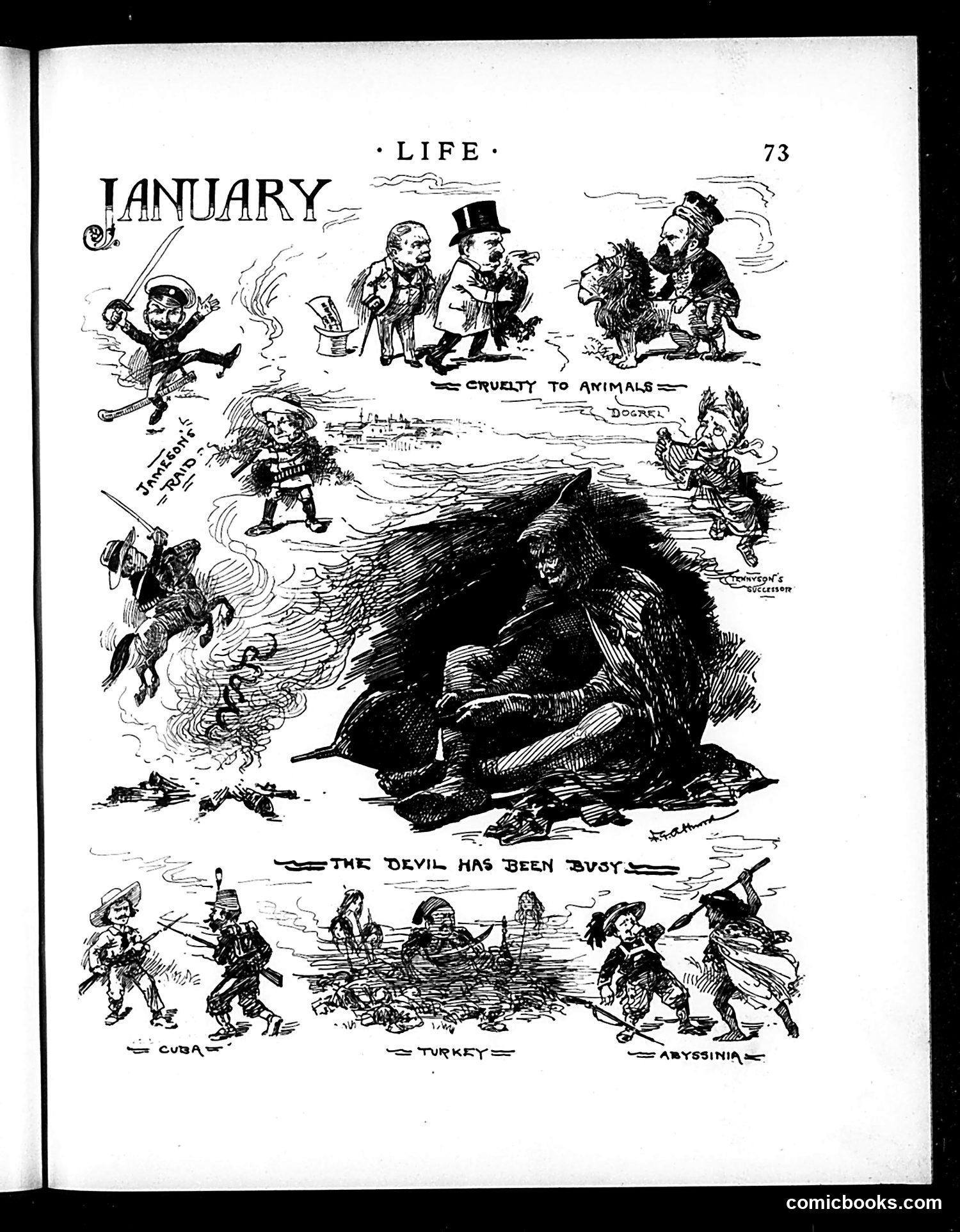
This satirical page from *Life* magazine uses the heading "JANUARY" to comment on early-year events and issues. The central image shows a large devil figure, labeled "THE DEVIL HAS BEEN BUSY," surrounded by smaller vignettes depicting global conflicts and cruelties. The labeled regions—"CUBA," "TURKEY," and "ABYSSINIA"—indicate these were hotspots of violence or instability during the time period. The upper section titled "CRUELTY TO ANIMALS" and "DOGGEREL" suggests commentary on animal mistreatment as a social concern. The surrounding caricatures of political figures (identities unclear from image alone) appear to represent world leaders or politicians blamed for these troubles. The overall message satirizes how widespread international conflict and cruelty characterized the opening month, with demonic forces seemingly orchestrating global unrest.
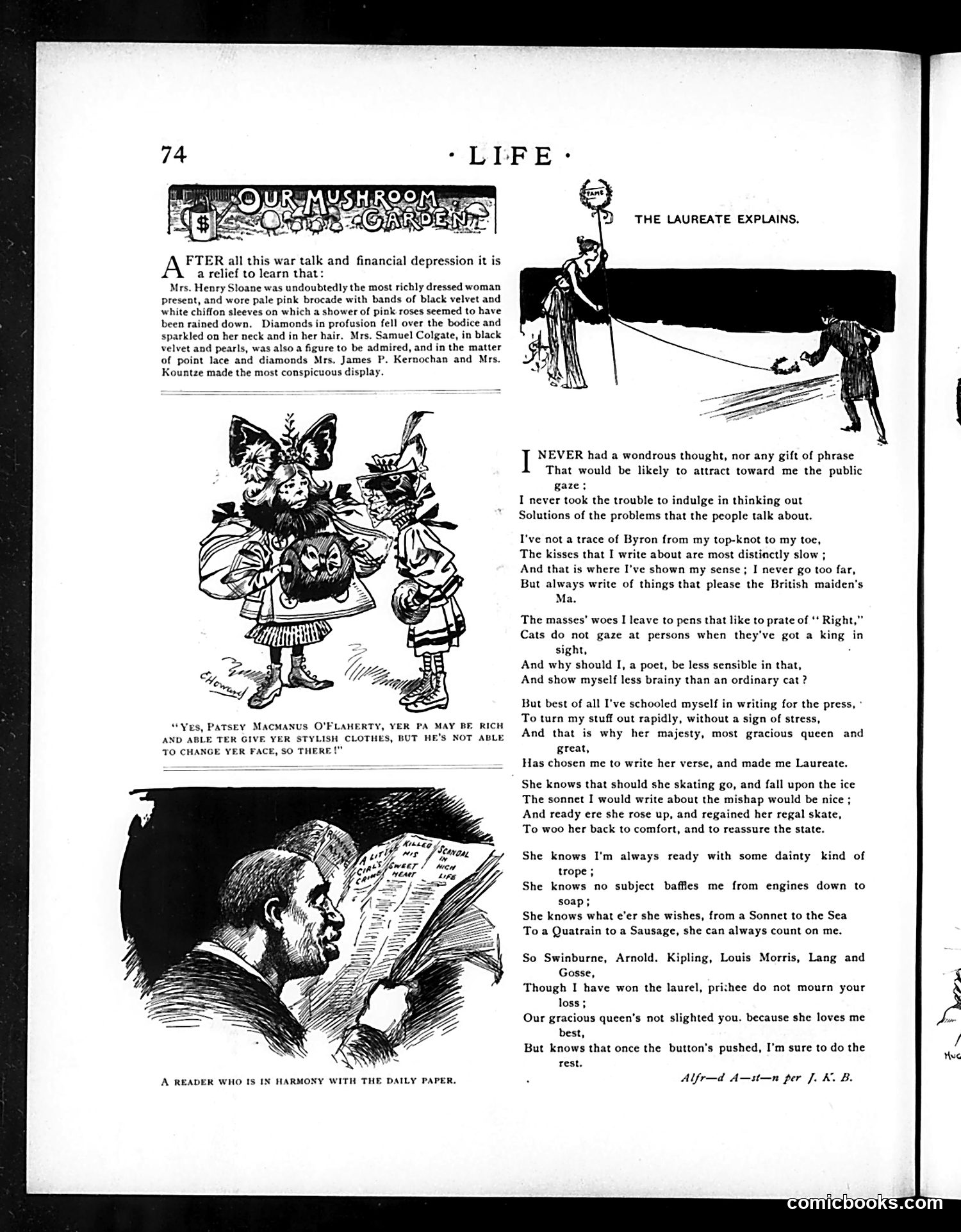
This page features a poem by a newly appointed Poet Laureate of Britain, explaining their approach to writing. The satire mocks the laureate's admission that they deliberately avoid serious subjects—wars, financial crises, social problems—preferring instead light, accessible verse about pleasant topics like ice-skating. The cartoon ridicules this evasion of weighty matters, particularly given the page opens with war and depression references. The poem names several famous male writers (Swinburne, Kipling, Morris, etc.), suggesting the laureate is proud despite writing less substantial work than their predecessors. The lower illustration shows a newspaper reader, contrasting the "harmonious" escapism of the laureate's verse with serious current events demanding attention—the central irony of the satire.
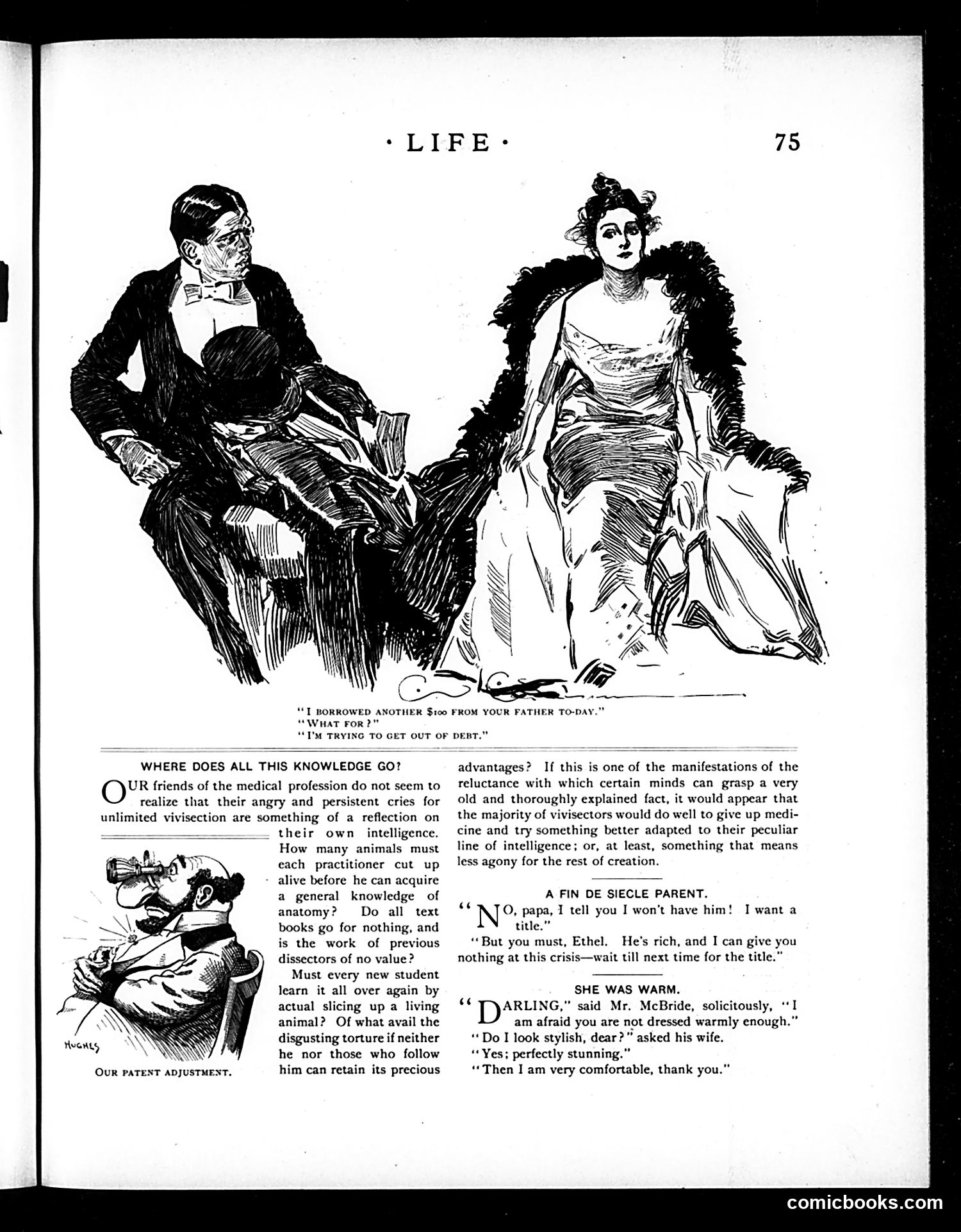
**Top Cartoon:** A man in formal dress tells a woman in an elegant gown, "I borrowed another $100 from your father today" / "What for?" / "I'm trying to get out of debt." The satire mocks financial irresponsibility—the man is borrowing money to pay debts, a circular logic that worsens his situation. This critiques either financial incompetence or the absurdity of living beyond one's means. **Article & Lower Cartoon:** The piece criticizes doctors' insistence on hands-on anatomical study of live animals, questioning whether such "vivisection" advances medical knowledge. The cartoon shows a surgeon operating on an anesthetized animal, titled "Our Patent Adjustment." The satire appears to challenge medical ethics and justify animal cruelty in the name of education. **Short Stories:** Domestic comedy sketches about titles, wealth, and marital comfort.
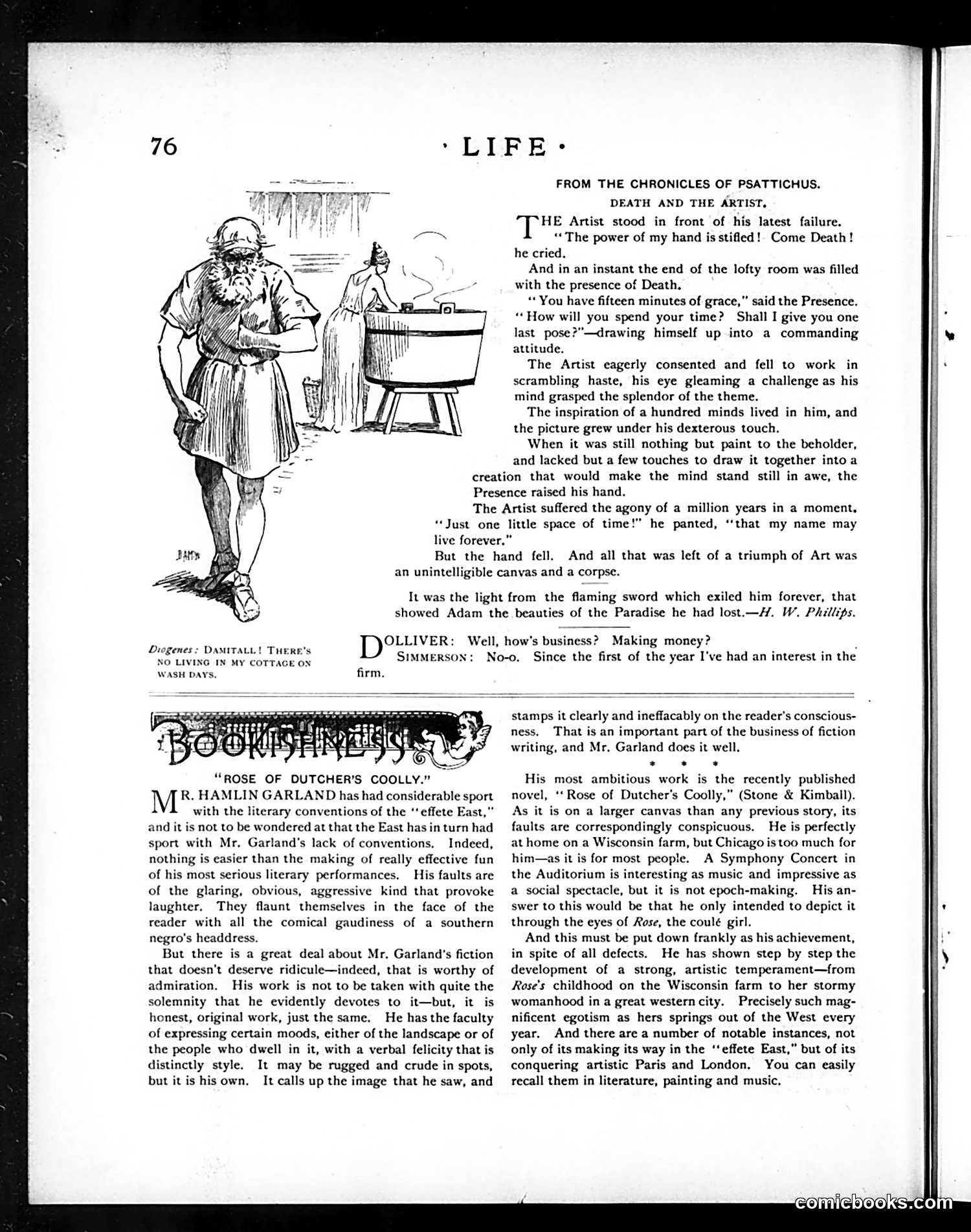
The top cartoon illustrates "Death and the Artist" from Psattichus's chronicles. It depicts a skeletal Death figure confronting a desperate artist at his easel. The narrative describes Death offering the artist fifteen minutes to complete his masterpiece—a dark, ironic commentary on artistic ambition versus mortality. The artist frantically works, creating a brilliant painting, only to collapse dead upon completion. The satire critiques the obsessive drive of artists who sacrifice everything for their work, achieving immortal fame only through death. Below this is a book review section titled "Rose of Dutcher's Coolly," discussing Hamlin Garland's novel. The reviewer praises Garland's unconventional literary style—crude but original—and his ability to capture Midwestern farm life and character development authentically, despite technical flaws.
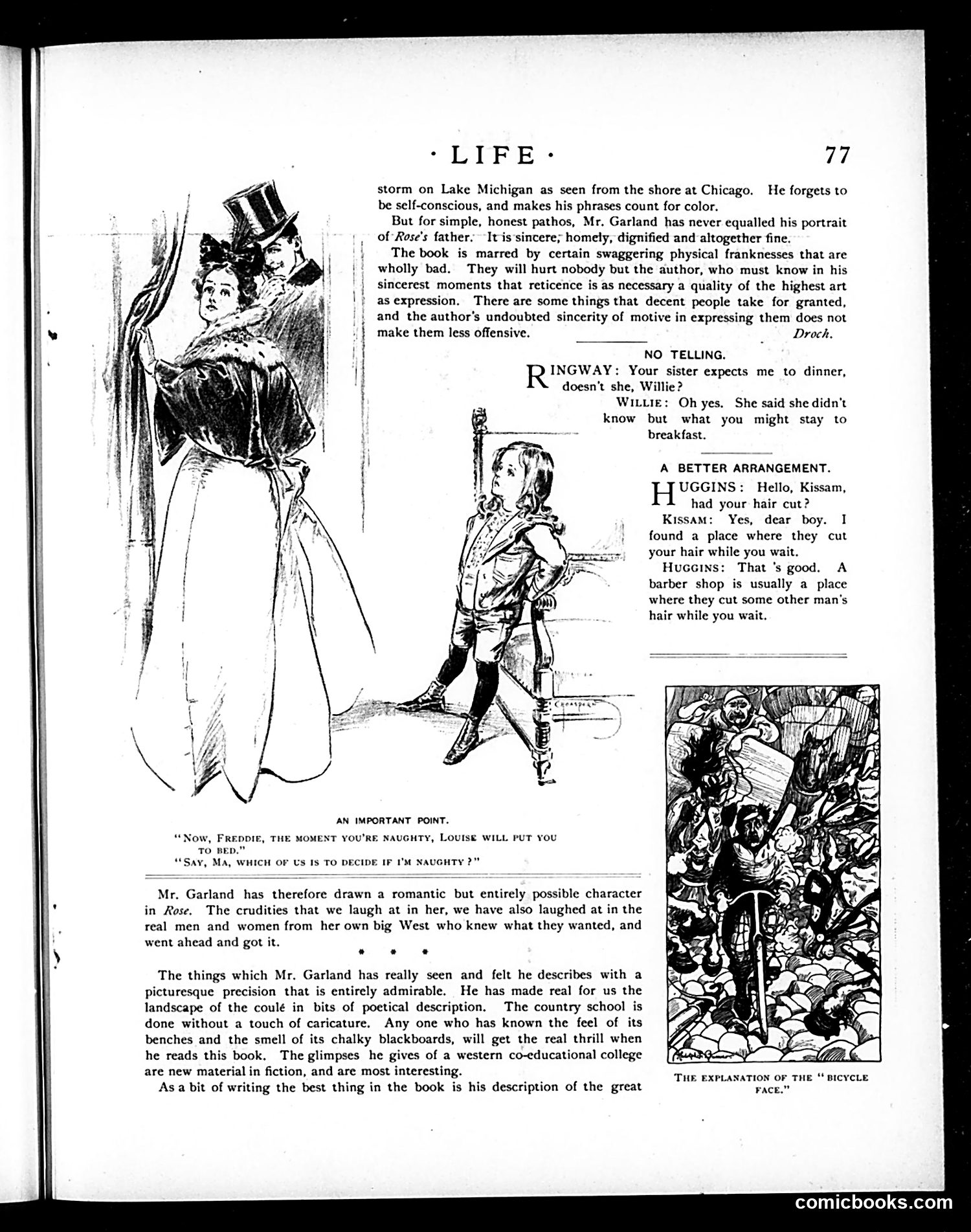
This page contains literary criticism and humorous dialogue sketches rather than political cartoons. The main content reviews a book (likely by Mr. Garland) about the American West, praising its realistic depiction of landscape and rural life, particularly country schools and colleges. Three illustrated jokes appear: 1. **"No Telling"** and **"A Better Arrangement"** are brief comedic dialogues playing on misunderstandings about dinner invitations and barbershop timing—common domestic humor of the era. 2. **"An Important Point"** features a romantic scenario with a mild sexual innuendo joke about deciding who is "naughty." 3. The right-side illustration labeled "The Explanation of the 'Bicycle Face'" appears to reference period concerns about women's cycling affecting their facial appearance—a genuine worry among Victorian commentators.
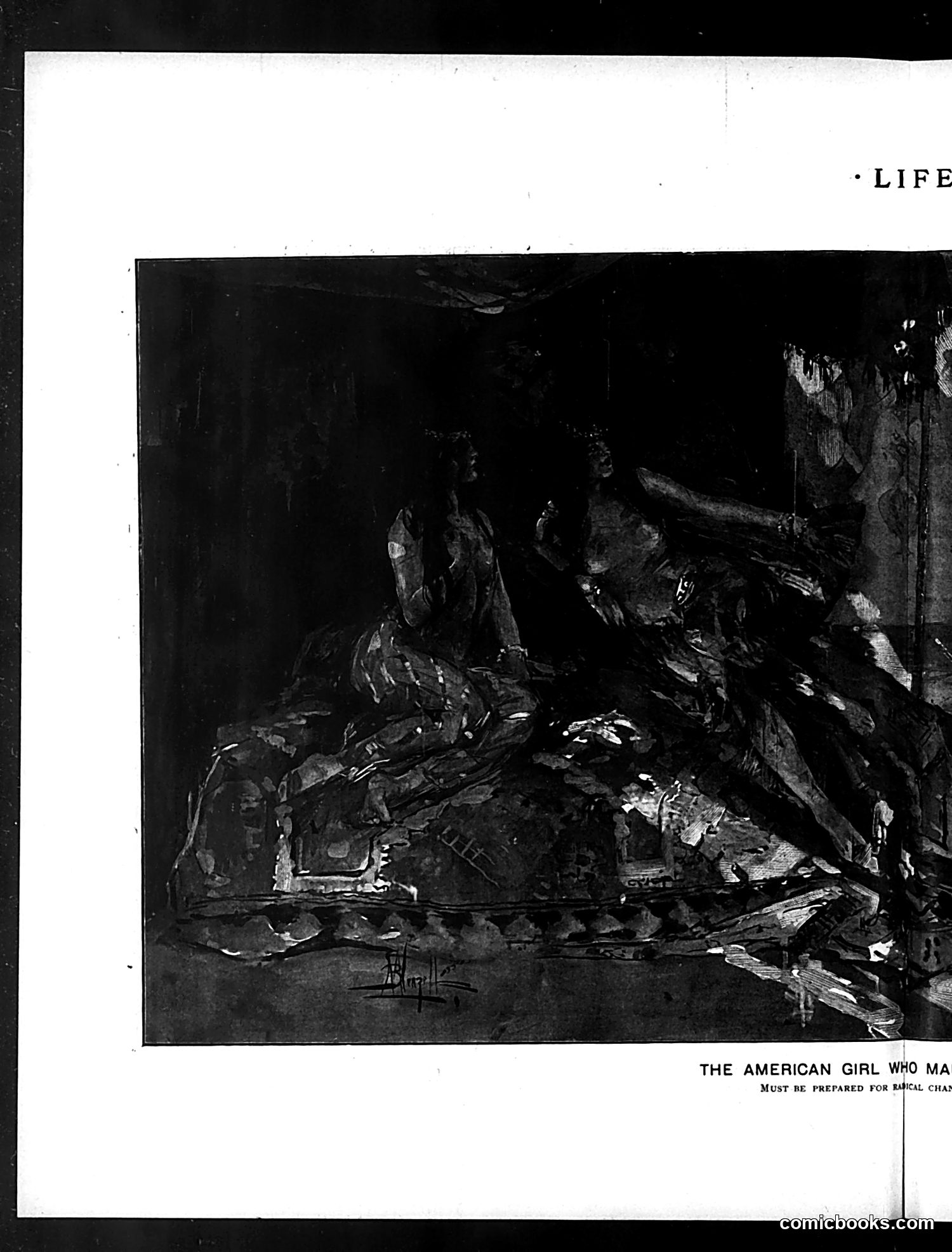
This appears to be a satirical illustration from *Life* magazine showing a dramatic interior scene with multiple figures in elaborate dress or costume. The caption reads "THE AMERICAN GIRL WHO MA[DE]... MUST BE PREPARED FOR RADICAL CHA[NGES]" (text is cut off). The image depicts what seems to be a social or theatrical scene rendered in dark, expressive brushwork. Without the complete caption text visible, the specific satirical target is unclear. However, the reference to "the American girl" needing preparation for "radical changes" suggests commentary on social transformation, possibly regarding women's roles, fashion, or social expectations during the early 20th century. The dramatic, somewhat chaotic composition emphasizes the turbulent nature of these "radical changes" being satirized.
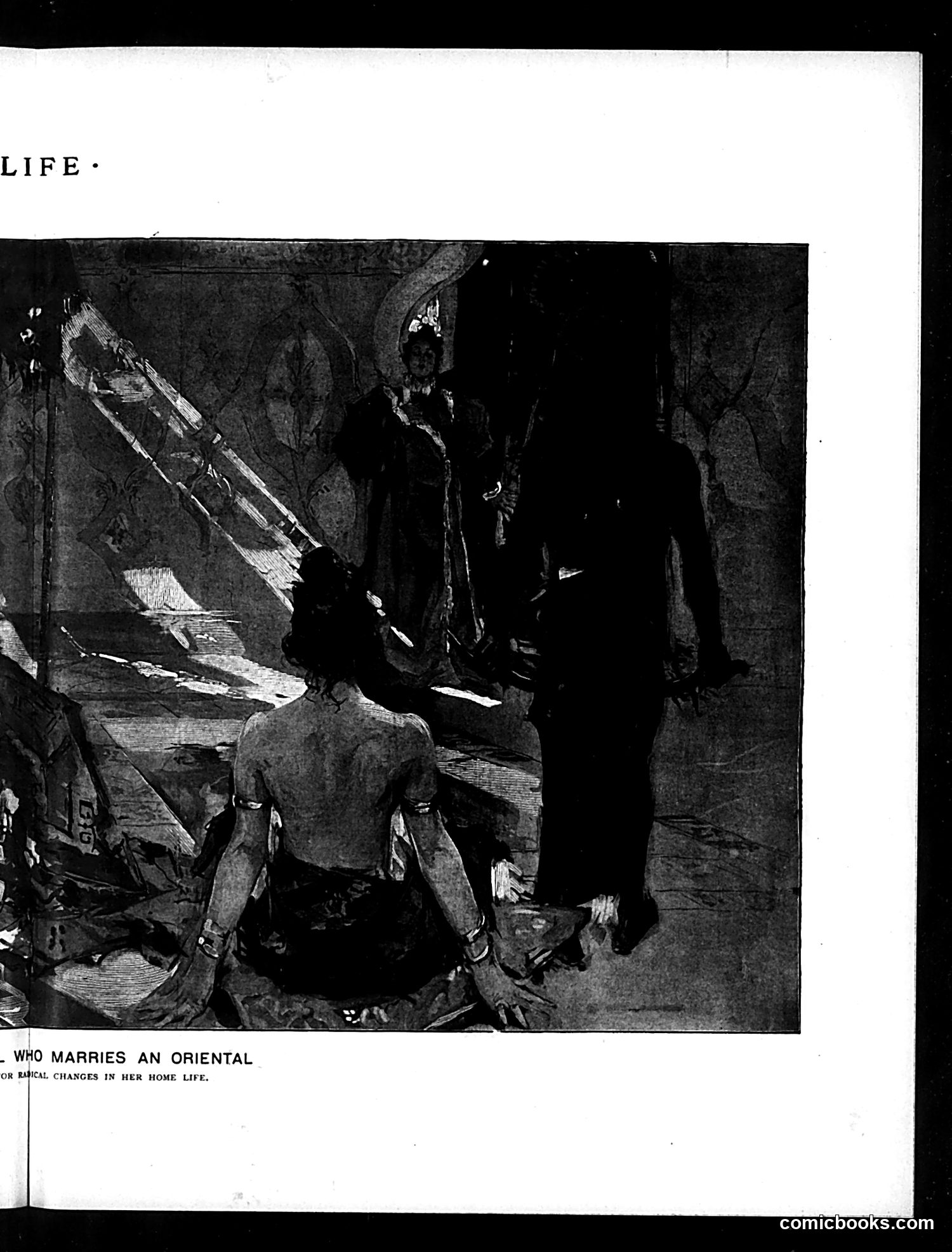
This appears to be a satirical illustration about marriage between a Western woman and an "Oriental" man, based on the visible caption: "WHO MARRIES AN ORIENTAL" with text mentioning "RADICAL CHANGES IN HER HOME LIFE." The image shows a dramatic domestic scene with a woman seated and figures in traditional Asian dress standing nearby, suggesting cultural clash or role reversal in the household. The satire likely mocks period anxieties about interracial marriage and the perceived "exotic" disruptions to Western domestic life. Without the full article text, I cannot identify specific individuals or the precise historical moment referenced. However, this reflects early-20th-century American xenophobic attitudes toward Asian immigration and intermarriage—common satirical subjects in Life magazine during this era. The tone appears to mock both the marriage itself and exaggerated fears about cultural difference.
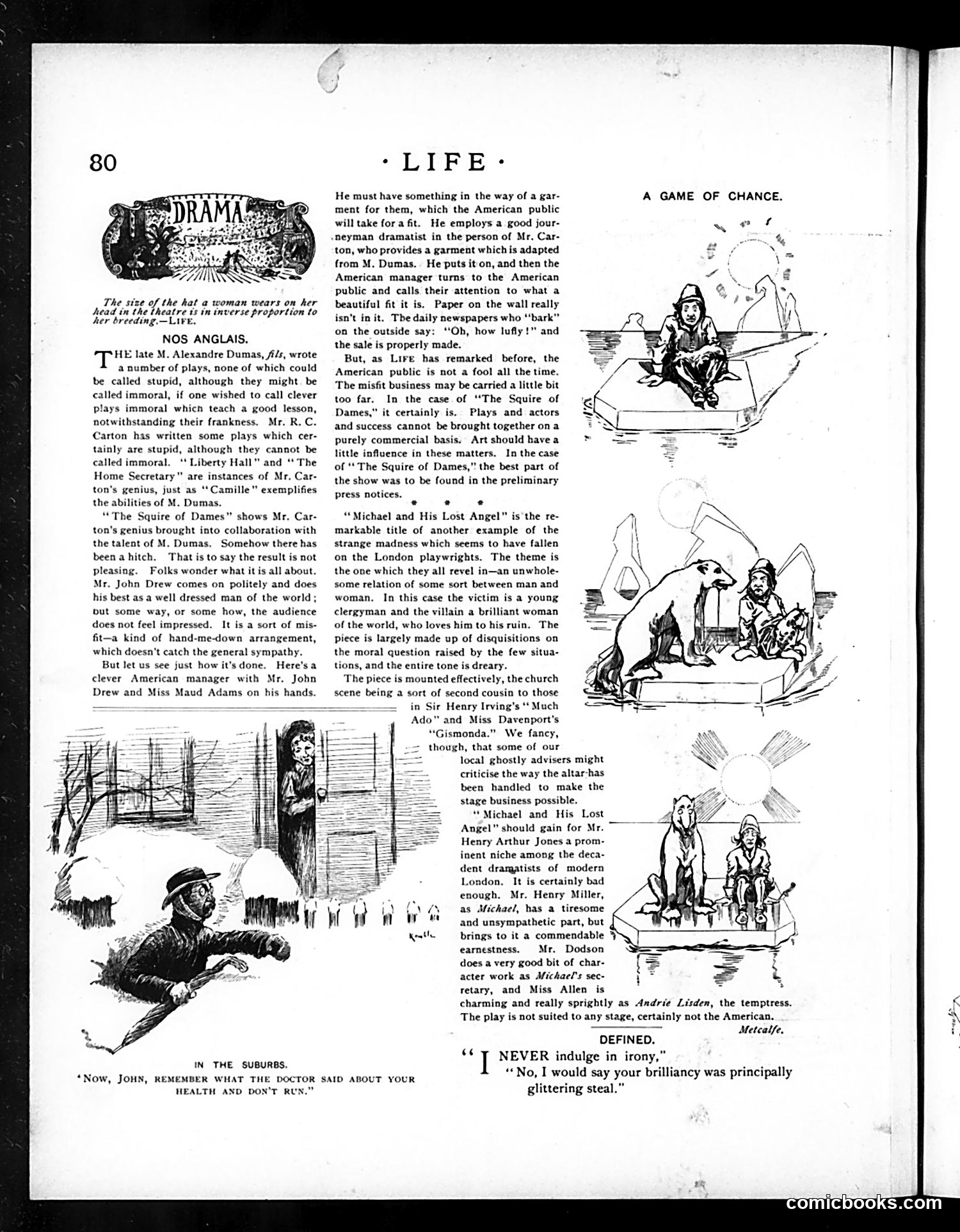
This page combines theater reviews with satirical illustrations. The main text critiques contemporary plays, particularly "The Squire of Dames" (adapted from Alexandre Dumas by R.C. Carton) and "Michael and His Lost Angel" by Henry Arthur Jones. The satire targets commercial theater practices: Life attacks the cynical formula of packaging mediocre American adaptations with star actors (John Drew, Maud Adams) and relying on preliminary press hype rather than artistic merit to fool audiences. The reviewer argues the American public isn't entirely foolish and resents being sold "misfits." The sidebar joke about women's hat sizes in theaters reflects contemporary complaints about obstructed sightlines caused by fashionable, oversized millinery. The right-side illustrations labeled "A Game of Chance" appear to be unrelated satirical drawings, likely commenting on luck or social situations.
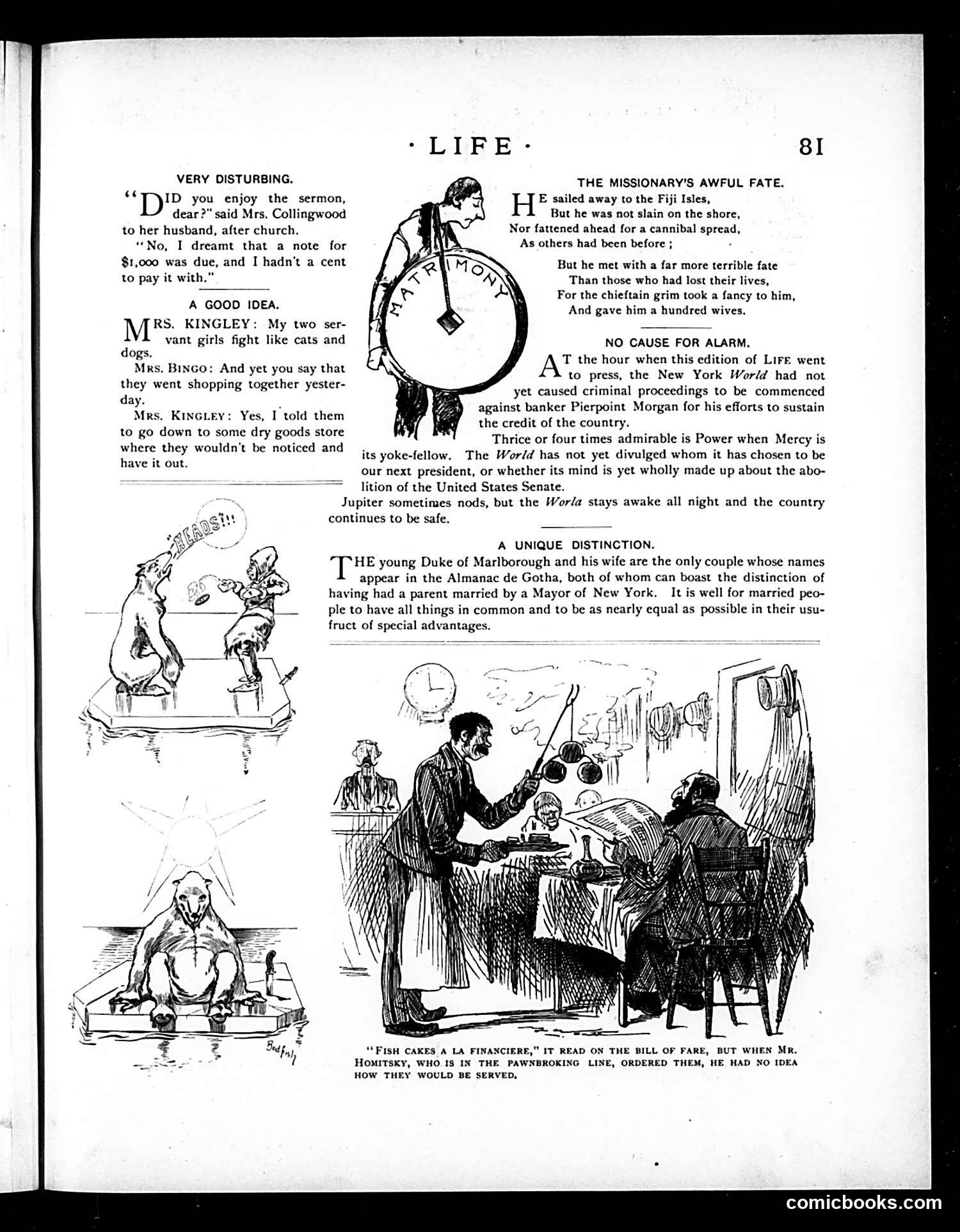
This page collects brief humorous anecdotes and cartoons mocking American society. **"Very Disturbing"** jokes about a woman's anxiety over finances rather than the sermon itself—satirizing materialism among the wealthy. **"A Good Idea"** mocks servant girls' logic: Mrs. Kingley suggests sending fighting servants shopping together so they'll behave properly in public, where they "wouldn't be noticed"—implying servants hide their true nature in society. **"The Missionary's Awful Fate"** uses dark humor: a missionary escapes cannibals in Fiji only to face a "worse" fate—being given a hundred wives. This plays on Victorian anxieties about marriage and masculine domesticity. **"No Cause for Alarm"** satirizes the New York *World* newspaper's editorializing about banker J.P. Morgan and political matters, suggesting the paper is self-important and makes sweeping proclamations while pretending to maintain national safety. **"A Unique Distinction"** notes the Duke of Marlborough and his wife both have parents married by a New York Mayor—a trivial "distinction" mocking aristocratic genealogical obsessions. The final cartoon (partially visible) appears to reference financial/pawn-shop humor, though details are unclear.
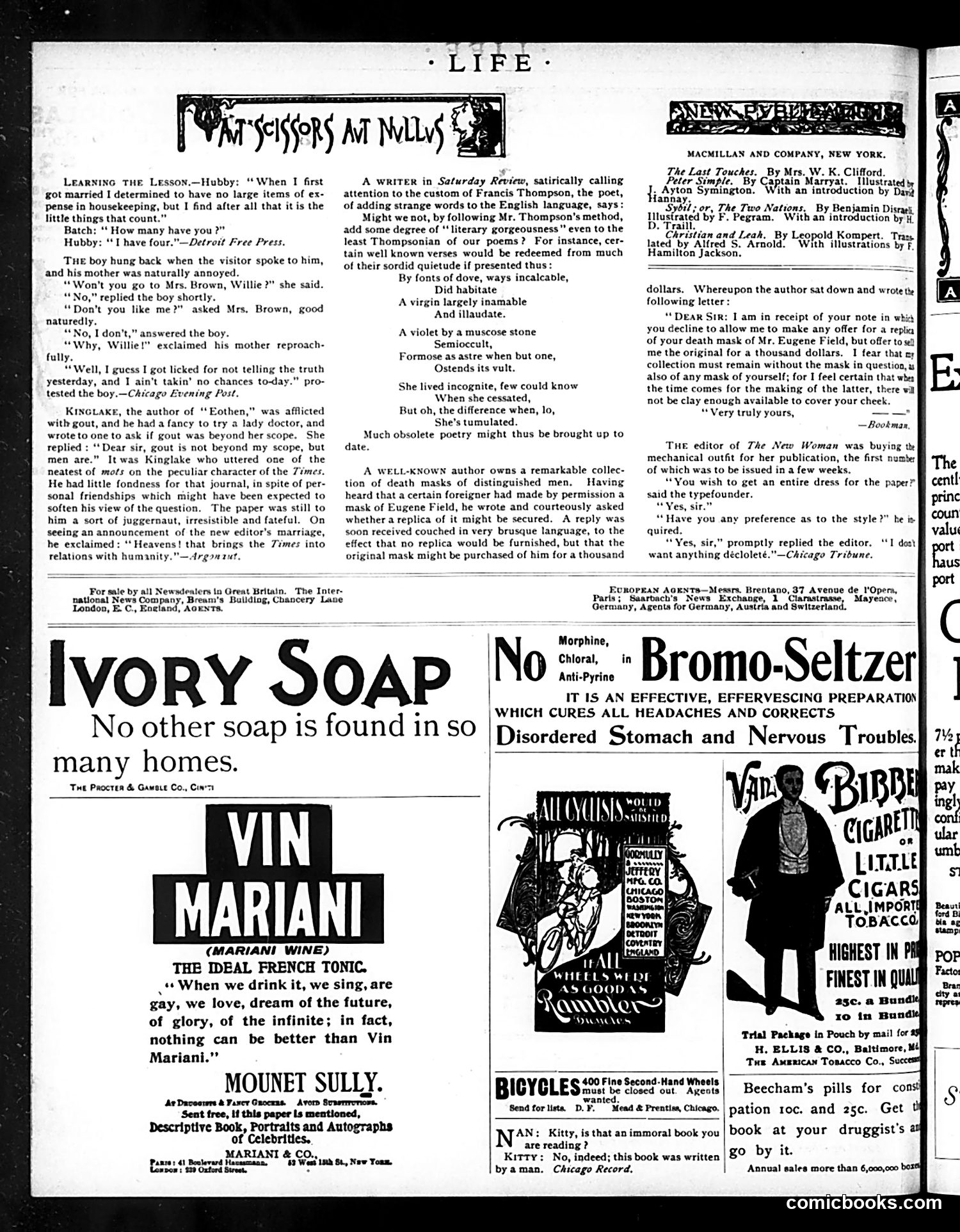
This page contains **humorous anecdotes** rather than political cartoons. The jokes reflect early 20th-century domestic and literary humor: 1. **"Learning the Lesson"** mocks a husband's discovery that marriage's expenses come from small purchases, not large items—a domestic economy joke. 2. **The boy refusing Mrs. Brown** satirizes childhood logic: the boy won't visit because he was punished for lying yesterday and fears punishment again. It's gentle humor about children's reasoning. 3. **Kinglake anecdotes** are literary gossip: one about a female doctor's clever retort ("men are" beyond her scope, unlike gout), another mocking the *Times* newspaper as an unstoppable force. 4. **The Francis Thompson parody** ridicules Thompson's practice of inventing obscure words by creating mock-archaic verses ("inamable," "tumulated") to show how overwrought his style is. 5. **The Eugene Field death mask story** humorously depicts a petty author refusing to share a mask replica but demanding payment for the original—satirizing artistic vanity and poor sportsmanship. The page is primarily **literary satire** targeting contemporary writers and social behavior.
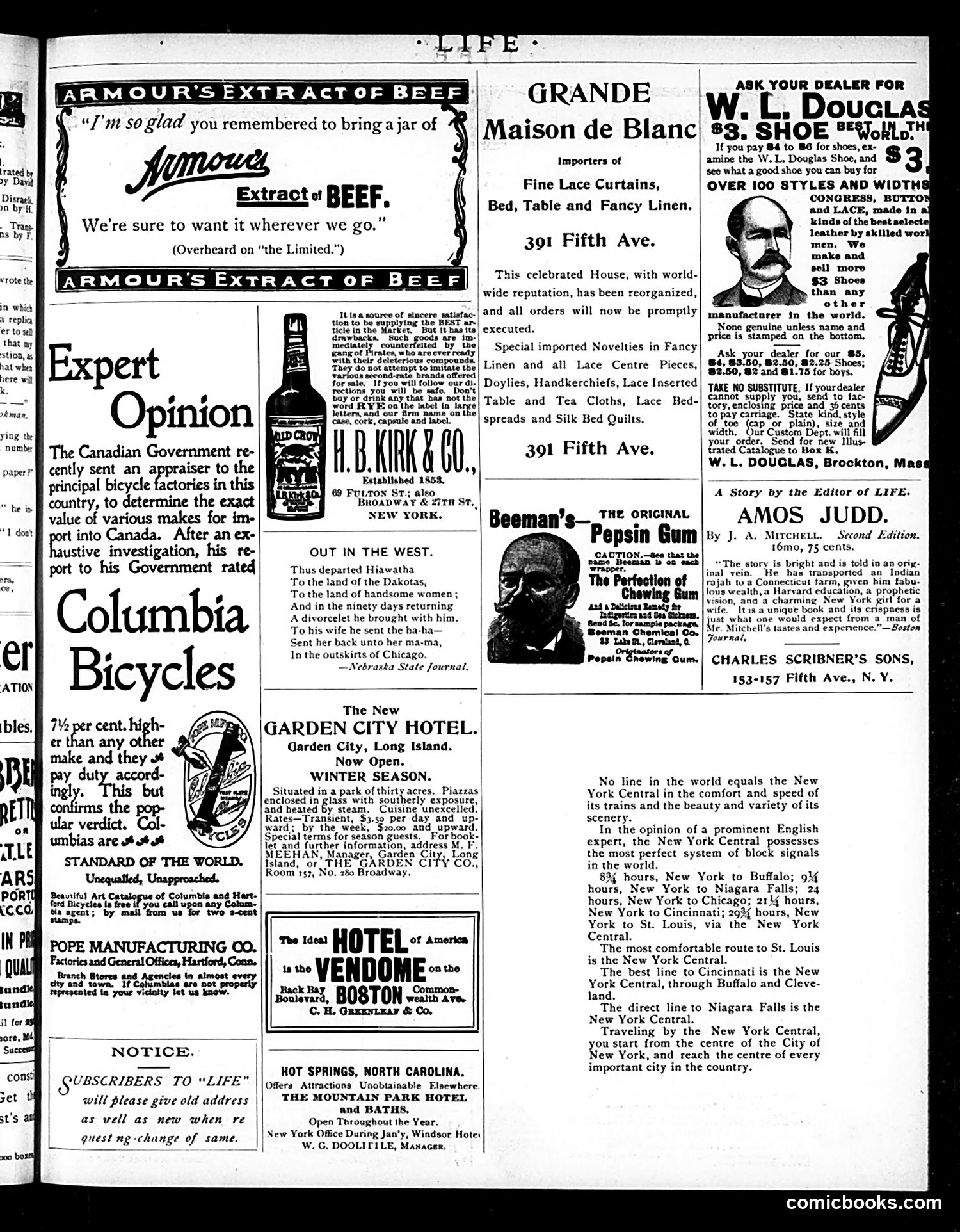
This page is primarily **advertisements** for consumer goods and services, typical of Life magazine's revenue model. However, it includes one brief satirical poem titled "OUT IN THE WEST." **The Satire:** The poem mocks **easy divorce** by referencing the Dakota territories (and Chicago), which had become known for lax divorce laws. It tells of "Hiawatha" departing to the Dakotas and returning with a "divorcelet" after ninety days—suggesting quickie divorces were available there. He sends his ex-wife "back unto her ma-ma," mocking both the legal ease and the dismissive attitude toward marital dissolution. The attribution to the *Nebraska State Journal* adds authenticity to the social critique. **The Advertisements:** The page showcases typical Gilded Age products: Armour's Extract of Beef (food), Columbia Bicycles (presented as superior by Canadian government appraisal), shoes by W.L. Douglas, fine linens, and luxury hotels—targeting affluent readers.
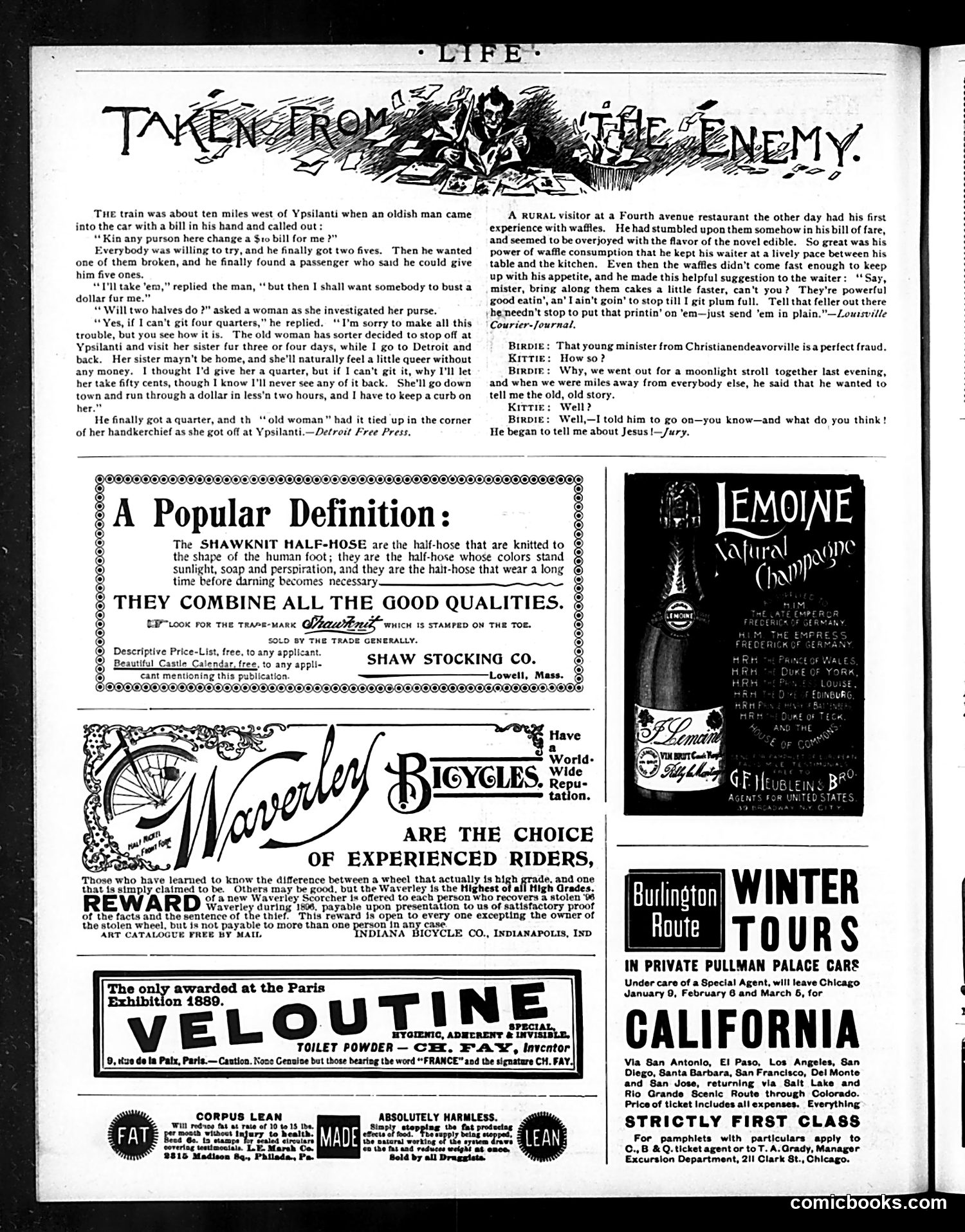
This page from *Life* magazine consists primarily of **humorous anecdotes and advertisements** rather than political cartoons. The main content includes three comedic stories: 1. **"Taken from the Enemy"** (top): A humorous tale about a frugal older man on a train near Ypsilanti, Michigan, who meticulously breaks down a $10 bill into smaller denominations to give his wife only a quarter, anticipating she'll spend money recklessly while he's away. The joke satirizes **misogynistic assumptions** about women's spending habits and marital control over finances. 2. **Rural Visitor & Waffles**: A rural man's excessive consumption of waffles at a restaurant, humorously suggesting the cook stop decorating them so prettily to speed up production—poking fun at **rural/urban cultural differences**. 3. **Minister & the "Old Story"**: A joke about a young Christian minister who, during a romantic moonlit walk, announces he wants to tell "the old, old story"—implying romance—but instead launches into preaching about Jesus, mocking **Christian earnestness and social awkwardness**. The remainder consists of period **product advertisements** (hosiery, bicycles, champagne, tours).
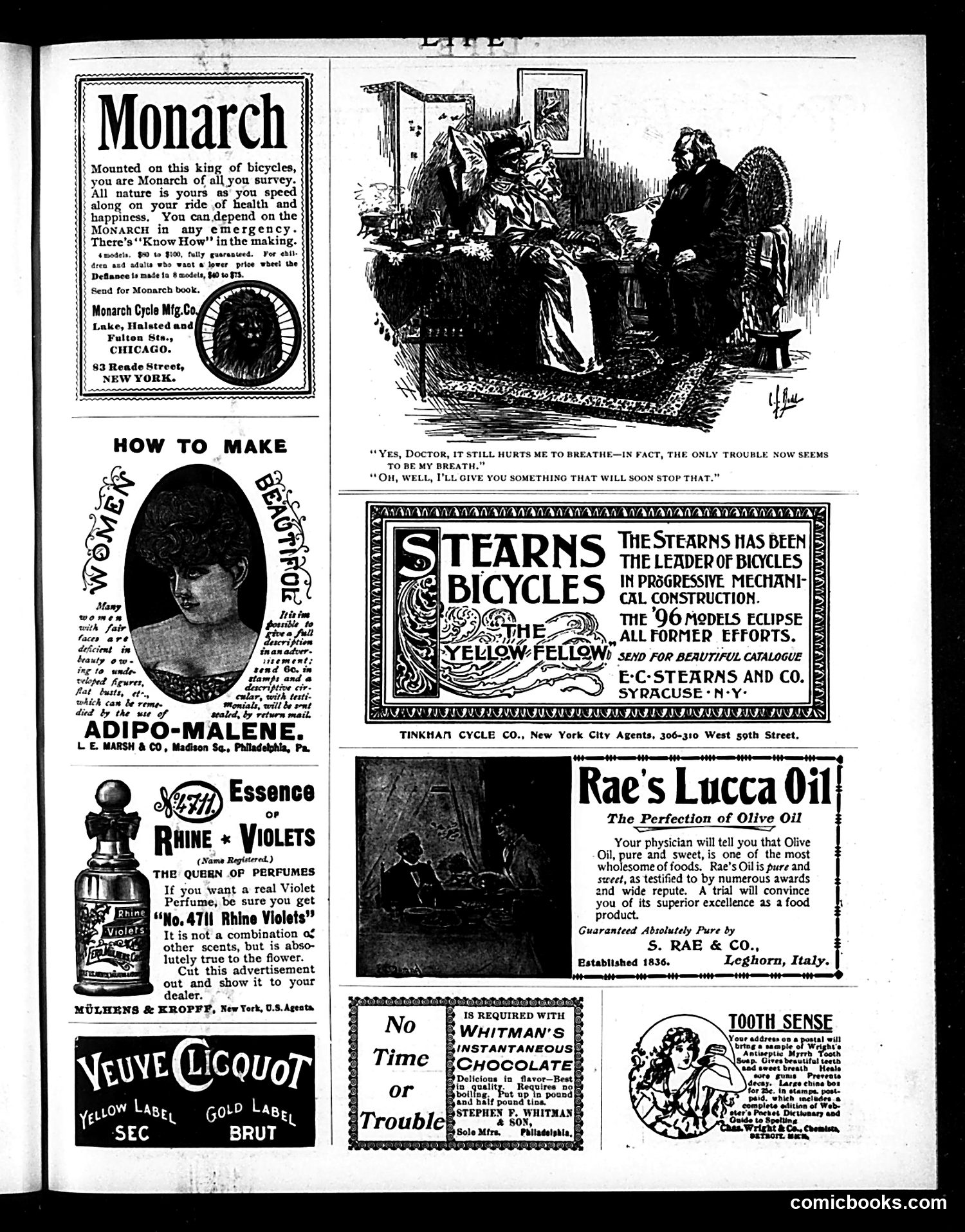
This page is primarily **advertisements** for various consumer products popular in the late 19th/early 20th century, with one central cartoon. **The Main Cartoon:** Shows a doctor speaking to a patient complaining of breathing difficulty. The doctor offers a remedy—a clear setup for a joke. The humor appears to rely on a dark medical gag: the doctor will give the patient "something that will soon stop that," implying the solution is death itself (stopping the patient's breathing permanently). This reflects era-typical "sick humor" about incompetent or callous medicine. **The Advertisements** include: - Monarch and Stearns bicycles - Adipo-Malene (a bust-enhancement product for "undeveloped figures") - Essence of Rhine Violets perfume - Rae's Lucca Oil (olive oil) - Whitman's chocolate - Tooth Sense (dental product) - Veuve Clicquot champagne The ads reflect consumer goods marketed to middle-class Americans, with particular focus on beauty products and luxury items. The page serves primarily as a revenue vehicle rather than satirical content.
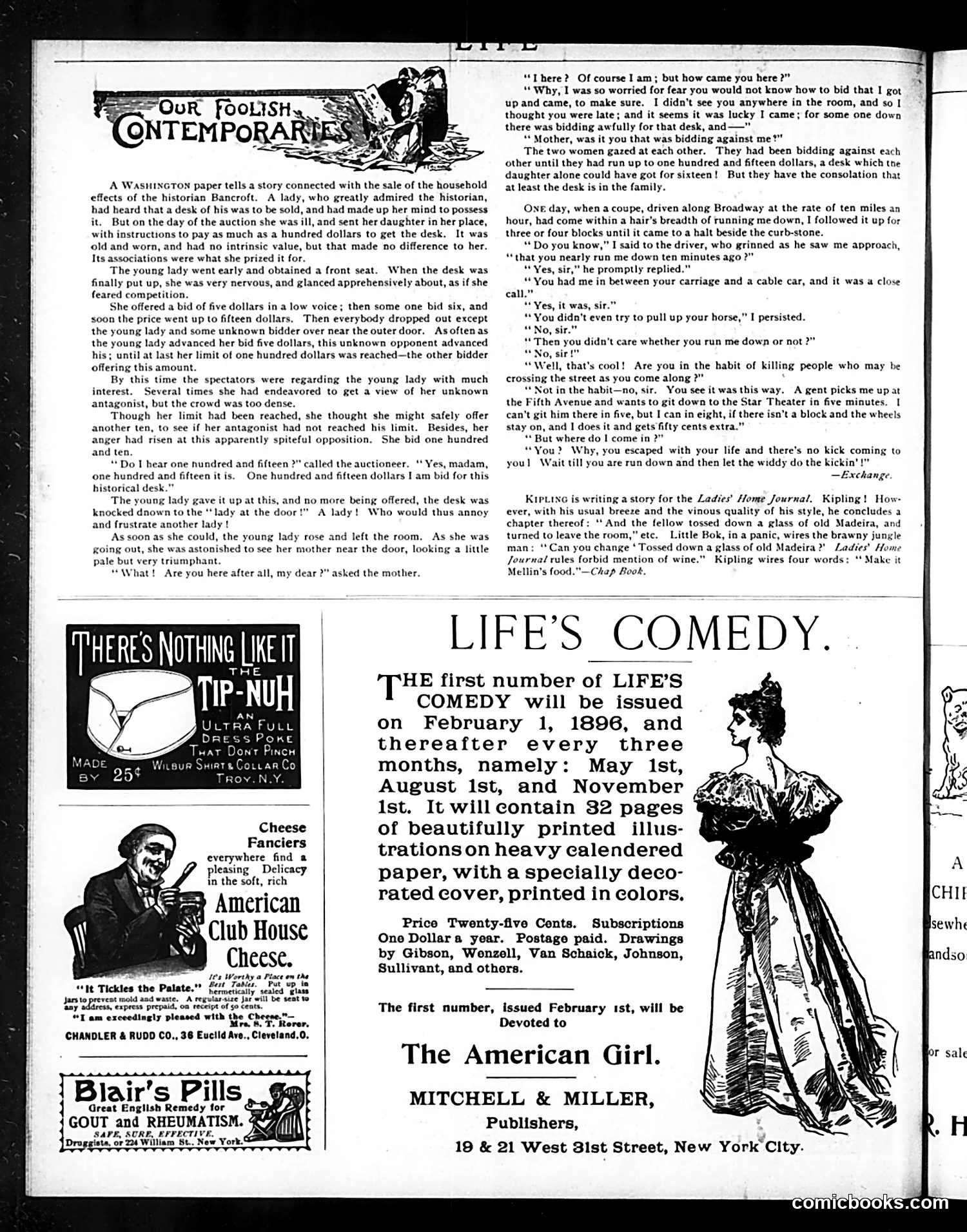
This page contains two satirical stories from *Life* magazine (a 19th-century American humor publication, not the modern photo magazine). **"Our Foolish Contemporaries" (top):** A humorous anecdote about a mother and daughter unknowingly bidding against each other at an auction for historian Bancroft's desk. The satire mocks sentimental attachment to objects ("associations were what she prized it for") and the absurdity of competitive bidding—they drive the price from $5 to $115 for a worthless item, only to discover they're family members. The joke: the desk stays "in the family" despite wasteful expenditure. **The Broadway incident (middle):** A pedestrian confronts a reckless carriage driver who nearly hit him. The driver's casual indifference and excuse-making satirize urban transportation dangers and the callousness of those prioritizing speed over safety—a contemporary concern as cities modernized. Both stories mock human foolishness and modern society's absurdities through everyday scenarios.
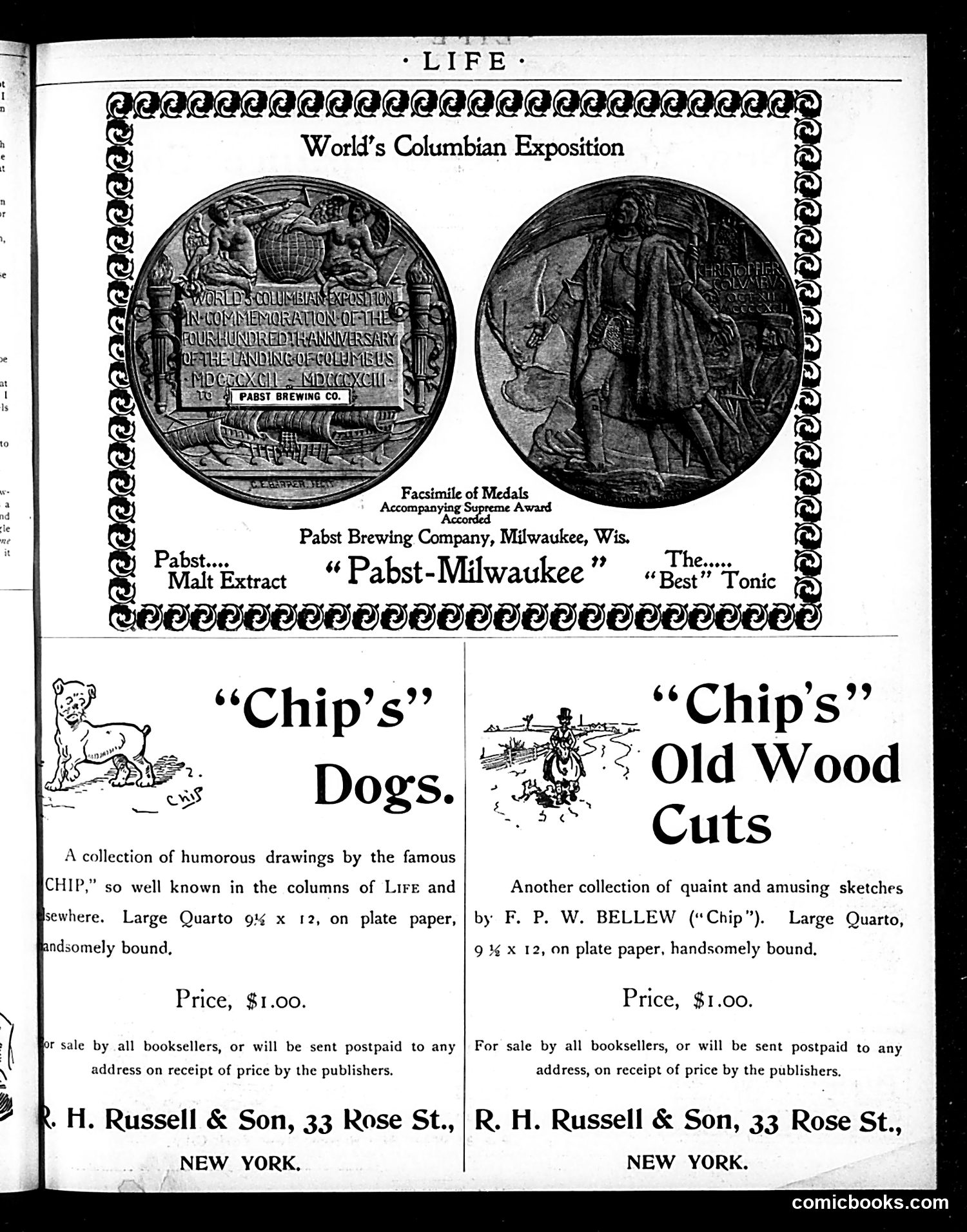
This page is primarily **advertising**, not political satire. It contains two sections: **Top:** An advertisement for Pabst-Milwaukee beer, featuring facsimile medals from the World's Columbian Exposition (the 1893 Chicago World's Fair). The medals commemorate Pabst's award and market the product as "The 'Best' Tonic." **Bottom:** Two book advertisements by the same publisher (R.H. Russell & Son) promoting collections of humorous drawings by **"Chip"** (the artist F.P.W. Bellew), who was apparently well-known in Life's columns. One collection features dog drawings; the other shows "Old Wood Cuts" — landscape and figure sketches. Both books cost $1.00. The page reflects late-19th-century publishing and advertising practices, using Life's platform to promote both commercial products (beer) and the magazine's own comic talent through book sales.
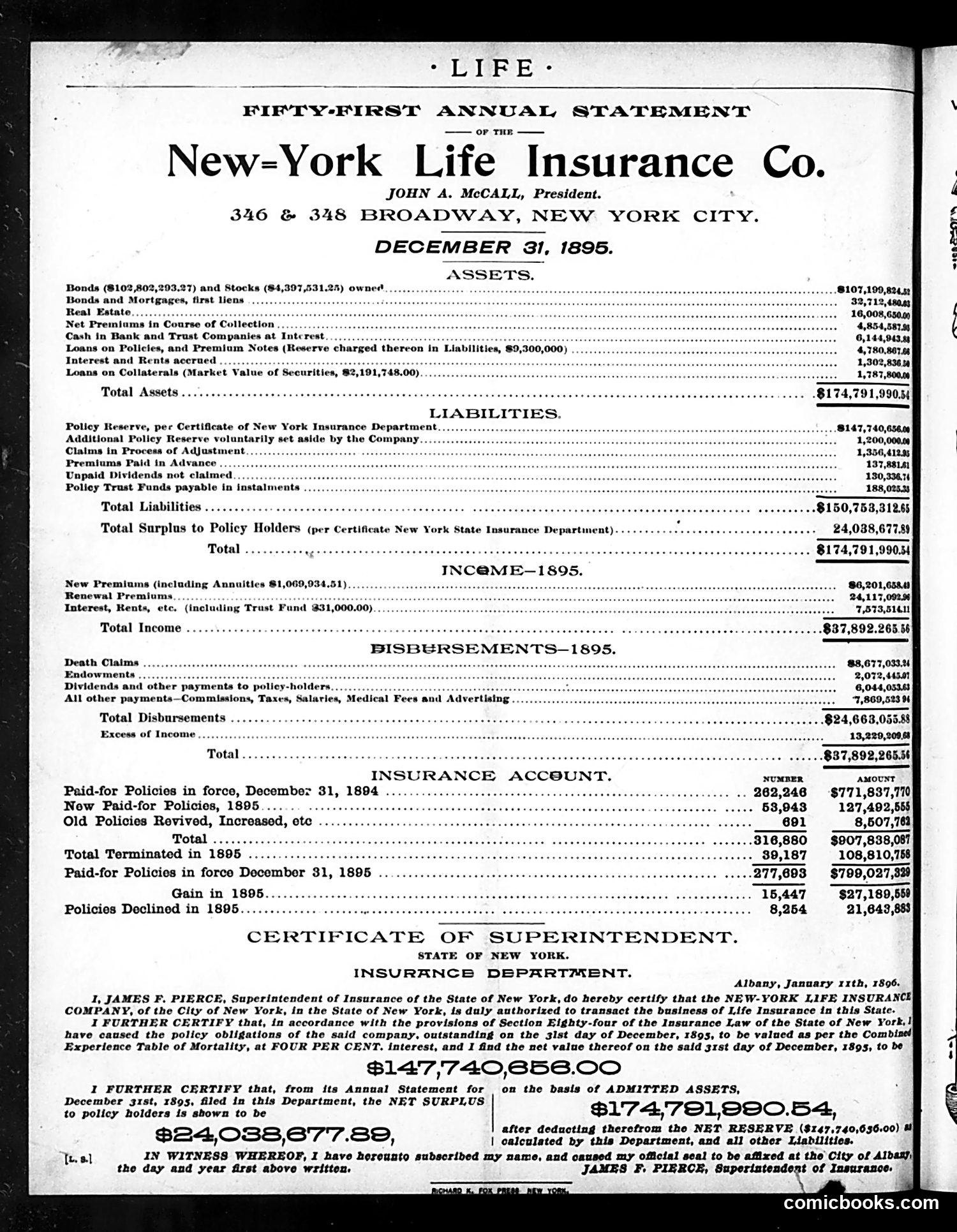
This is not a cartoon or satirical content—it's a **financial statement** from the New-York Life Insurance Company for 1895, printed in *Life* magazine as a public notice. The page documents the company's assets ($174.7 million), liabilities, income, and disbursements for the year. Notably, it includes a **Certificate of Superintendent** from New York's Insurance Department, certifying the company's legitimacy and solvency. The key figures are **John A. McCall** (president) and **James F. Pierce** (state superintendent), whose official seal validates the company's financial health. This appears to be a standard corporate disclosure—required reporting that *Life* published as a matter of public record, not as satire or commentary. Insurance company annual reports were common advertisements in magazines of this era.