
Life, 1896-01-30 · page 8 of 20
Life — January 30, 1896 — page 8: what you’re looking at
What you’re looking at
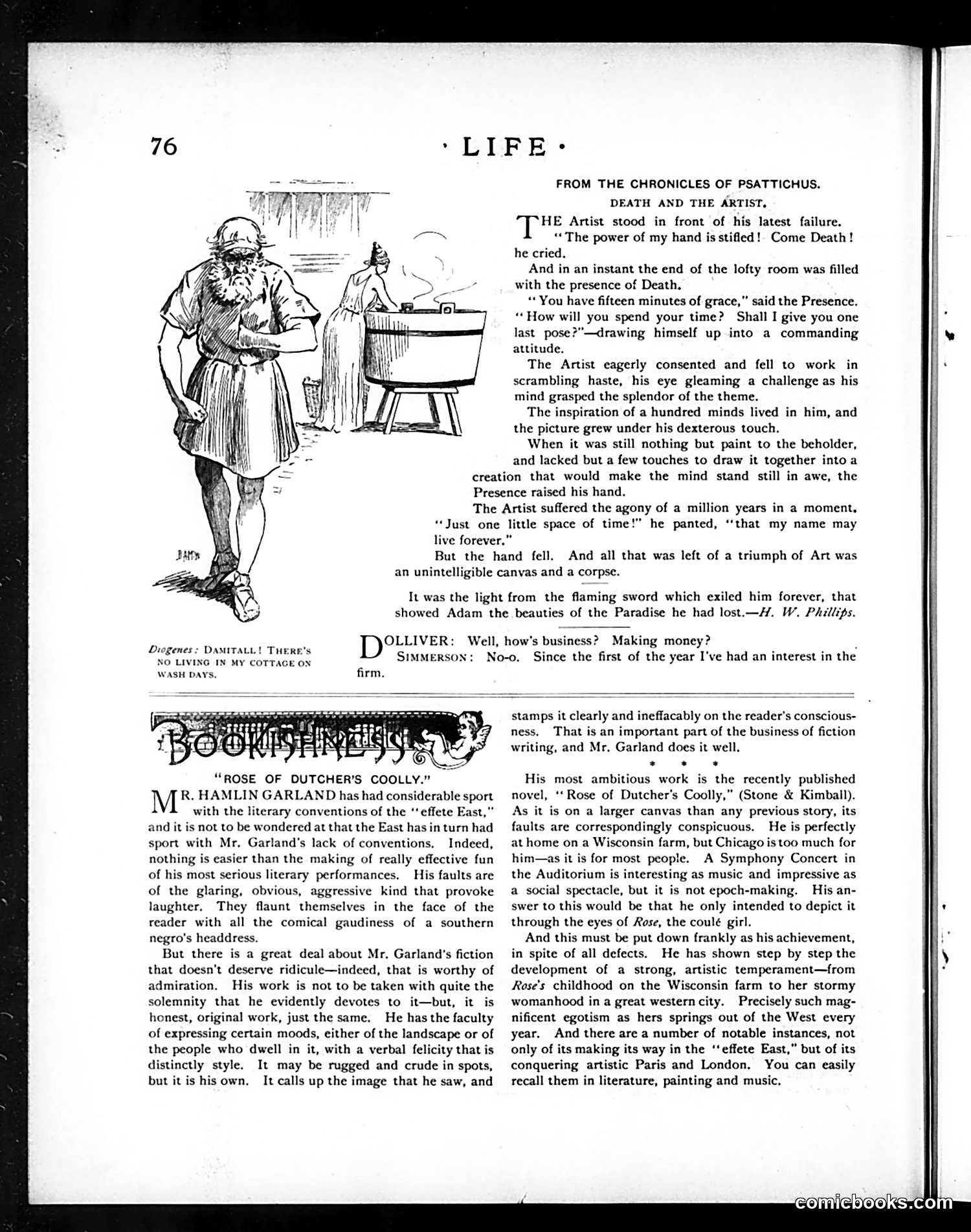
The top cartoon illustrates "Death and the Artist" from Psattichus's chronicles. It depicts a skeletal Death figure confronting a desperate artist at his easel. The narrative describes Death offering the artist fifteen minutes to complete his masterpiece—a dark, ironic commentary on artistic ambition versus mortality. The artist frantically works, creating a brilliant painting, only to collapse dead upon completion. The satire critiques the obsessive drive of artists who sacrifice everything for their work, achieving immortal fame only through death. Below this is a book review section titled "Rose of Dutcher's Coolly," discussing Hamlin Garland's novel. The reviewer praises Garland's unconventional literary style—crude but original—and his ability to capture Midwestern farm life and character development authentically, despite technical flaws.
📄 Transcribed text from this page (OCR, searchable)
Machine-transcribed from the original scan — historical spelling and the odd misread are preserved.
‘LIFE: FROM THE CHRONICLES OF PSATTICHUS. DEATH AND THE ARTIST, HE Artist stood in front of his latest failure. “The power of my hand is stifled! Come Death! he cried. And in an instant the end of the lofty room was filled with the presence of Death. “You have fifteen minutes of grace,” said the Presence. “How will you spend your time? Shall I give you one last pose?”—drawing himself up into a commanding attitude. The Artist eagerly consented and fell to work in scrambling haste, his eye gleaming a challenge as his mind grasped the splendor of the theme. The inspiration of a hundred minds lived in him, and the picture grew under his dexterous touch. When it was still nothing but paint to the beholder, and lacked but a few touches to draw it together into a creation that would make the mind stand still in awe, the Presence raised his hand. The Artist suffered the agony of a million years in a moment. “Just one little space of time!” he panted, ‘‘that my name may live forever.” But the hand fell. And all that was left of a triumph of Art was an unintelligible canvas and a corpse. It was the light from the flaming sword which exiled him forever, that showed Adam the beauties of the Paradise he had lost.—H. W. Phillips. OLLIVER: Well, how's business? Making money? SIMMERSON: No-o, Since the first of the year I've had an interest in the Freer a= 06, iifiarsh “ROSE OF DUTCHER’S COOLLY.” R. HAMLIN GARLAND has had considerable sport with the literary conventions of the ‘‘effete East,” and it is not to be wondered at that the East has in turn had sport with Mr, Garland’s lack of conventions. Indeed, nothing is easier than the making of really effective fun of his most serious literary performances. His faults are of the glaring, obvious, aggressive kind that provoke laughter. They flaunt themselves in the face of the reader with all the comical gaudiness of a southern negro’s headdress. But there is a great deal about Mr. Garland’s fiction that doesn’t deserve ridicule—indeed, that is worthy of admiration. His work is not to be taken with quite the solemnity that he evidently devotes to it—but, it is honest, original work, just the same. He has the faculty of expressing certain moods, either of the landscape or of the people who dwell in it, with a verbal felicity that is distinctly style. It may be rugged and crude in spots, but it is his own, It calls up the image that he saw, and stamps it clearly and ineffacably on the reader's conscious- ness, That is an important part of the business of fiction writing, and Mr. Garland does it well. * 8 6 His most ambitious work is the recently published novel, ‘‘Rose of Dutcher’s Coolly,” (Stone & Kimball). As it is on a larger canvas than any previous story, its faults are correspondingly conspicuous. He is perfectly at home on a Wisconsin farm, but Chicago is too much for him—as it is for most people. A Symphony Concert in the Auditorium is interesting as music and impressive as a social spectacle, but it is not epoch-making. His an- swer to this would be that he only intended to depict it through the eyes of Rose, the coulé girl. And this must be put down frankly as his achievement, in spite of all defects. He has shown step by step the development of a strong, artistic temperament—from Rose's childhood on the Wisconsin farm to her stormy womanhood in a great western city. Precisely such mag- nificent egotism as hers springs out of the West every year. And there are a number of notable instances, not only of its making its way in the ‘‘effete East,” but of its conquering artistic Paris and London. You can easily recall them in literature, painting and music,